Editorial for EJEL Volume 13 Issue 5
Coming soon
ISSN 1479-4403 429 ©ACPIL
Reference this paper as “Johnson P“ Editorial” The Electronic Journal of e-Learning Volume 13 Issue 6 2015, (pp429-474) available online at www.ejel.org
The Electronic Journal of e-Learning Volume 13 Issue 6 2015
Social Media for Learning and Teaching Undergraduate Sciences:
Good Practice Guidelines from Intervention
Jyothi Thalluri
1and Joy Penman
2 1School of Pharmacy and Medical Sciences, University of South Australia, Adelaide,
Australia
2
School of Nursing and Midwifery, University of South Australia, Whyalla Norrie, Australia
[email protected]
[email protected]
Abstract: In 2013, Facebook was used in learning and teaching clinical problem solving in a Pathology and a Clinical Sciences course delivered at a South Australian university. It involved first- and second-year Medical Radiation students and second-year Nursing students, Of the 152 students enrolled in the Pathology course, there were 148 students who participated in the Facebook group. Of the 148 students, 61 (41%) completed the invited post-intervention questionnaire. At the same time, all 17 nursing students enrolled in a science course at the regional campus of the same university participated in the Facebook initiative, however, only 10 (59%) completed the post-intervention questionnaire. A good practice and checklist were developed from the post-intervention evaluations, which consisted of 25 Likert- and open-type questions. Both student cohorts found the use of Facebook beneficial for them in terms of providing an innovative way of learning; fostering greater interaction amongst co-students and staff; and effectively engaging them with the content of courses. The importance of clear communication of goals and objectives to students was identified from student comments. Six good practice principles were identified relating to: goals and objectives, expectations, communication, engagement with the course content, active participation, and learning environment.
Keywords: Facebook, social media, medical radiation, nursing, guidelines for good practice, engagement
1
Introduction
In the age of internet, social interaction and engagement has evolved. Social media has become an integral avenue of social interaction. Given that engagement with peers is an important component to student success in higher education (Thalluri, O’Flaherty, & Shepherd, 2014), Contemporary teaching methods have been adapted to include social media, specifically the Facebook, a very popular networking website amongst all age groups. In order to maximise the potential of Facebook for collaboration and interactivity, various universities have attempted to incorporate it in their learning and teaching approaches. Medicine, pharmacy, medical radiation, veterinary students and library users have reported using Facebook (Thalluri & Penman 2014; Black et al. 2010; Hendrix et al. 2009; Cain 2008; Thompson et al. 2008). Undergraduate students are deeply immersed in this social network; for example, in the United States, over 90% of undergraduate students participate in Facebook (Ellison et al. 2007; Stutzman 2006).
The real and potential benefits of Facebook are documented. It presents a relaxed, accessible, friendly and comfortable environment that promotes promotes collaboration, social exchange of knowledge/ideas, and student engagement in learning outside the classroom. Whittaker, Howarth and Lymn (2013) posit that technologies used in learning promote a social constructivist educational approach which is student focused, highlighting open dialogue and collaborative construction of knowledge. There is also collegial support and enhanced networking opportunities (Wodzichi, Schwammlein & Moskaliuk 2012; Bosch 2009). ). Together this represents many of the skills and supports that are necessary for positive engagement and continued learning beyond the university degree into the professional career. In this way, social media may be key to modern professional engagement and continued learning.
On the other hand, the educational value of Facebook may be questioned. For instance, Hew (2011) in reviewing current published research studies on the use of Facebook by students and teachers concluded that there is very little educational value and that its application is limited to staying connected with others. Wise, Skues and Williams (2011) corroborate this view, stating that Facebook promotes social but not academic engagement. Further, this new digital paradigm is changing how we relate to society (Madden 2013). In the midst of proliferating social connected devices and websites, there are feelings of isolation and loneliness. It
ISSN 1479-4403 455 ©ACPIL
Reference this paper as Thalluri J and Penman J “Social Media for Learning and Teaching Undergraduate Sciences: Good Practice Guidelines from Intervention” The Electronic Journal of e-Learning Volume 13 Issue 6 2015, (pp455-465) available online at www.ejel.org
The Electronic Journal of e-Learning Volume 13 Issue 6 2015
looks like an “illusion of companionship without the demands of relationship” (Madden 2013, p. 13). This concern has merit, but may be mitigated by attention to maintaining Facebook and other social media as an adjunct to more meaningful social/academic interactions such as meeting in person for lectures, tutorials, practicals, and group study sessions. To this end, several authors have already argued.
The need to provide guidelines for its use (Ponce et al. 2013; Black et al. 2010; Gray, Annabell, & Kennedy 2010; Cain 2008; Thompson et al. 2008). University students are already using the platform as it is accessible, quick and convenient, and there is a real potential for its application on learning and teaching provided that it is carefully and appropriately structured.
This paper reports on an investigation into the success of Facebook as an educational tool for a Pathology course for Medical Radiation students and a Clinical Sciences course for Nursing students. The focus is on the development of good practice principles relating to learning and teaching utilising Facebook groups. This is important because learning and teaching in Facebook is not the same as classroom teaching; all the forces at work are different. In this intervention Facebook was used as a means of studying particular topics, contructing knowledge, signposting relevant resources, solving problems and/orreflecting on understanding and practice. The rationale behind the development of these post-intervention evaluations include: to inform and guide academics how to effectively use social media to enhance the learning and teaching of science concepts to undergraduate students, to provide them with key principles specifically related to Facebook learning and teaching, to assist in developing effective Facebook learning and teaching resources, and to ensure high quality learning and teaching of sciences using social media and high quality and satisfying academic experience for students.
2
Methodology
The service offered by Facebook Inc. was used as a platform for a Pathology class (identified as a common-interest user group), divided into groups in order to decipher case scenarios (Penman & Thalluri 2013; Thalluri & Penman 2013). Six pre-determined real-life case scenarios with problems and corollary questions were distributed to students who grouped themselves and divided the work to address the requirements of the scenarios. A case typically reported on a client presenting to the hospital with various medical complaints. The present illness, past medical history, family history, investigations, and treatments completed the case. Students used the approach to solve the general problems of: explaining disease processes of medical conditions, conducting and interpreting diagnostic procedures and rationalising the medical interventions undertaken. The lecturer/s posted the real-life case scenarios on Facebook for groups to access and discuss online. The culmination of the group process was a student-created product in the form of PowerPoint presentations and short videos clips which were to be presented to the lecturers, tutors and entire class, and made available on Facebook. The same procedure was undertaken for the Clinical Sciences course for nursing students, using case scenarios with similar content; the difference was emphasis on nursing interventions rather than clinical investigations and radiological medical interventions.
Prior to the Facebook activity, approval for the initiative was obtained from the university’s ethics committee. Information letters were sent informing students about the initiative and inviting them to participate in the study being undertaken, the aims of which were to understand the impact of the use of Facebook on the learning and teaching of science concepts in the undergraduate Medical Radiation and Nursing programs and to determine the perceptions about the use of this medium. Assurances of confidentiality of information and the voluntary nature of involvement were given. The lecturers/administrators organised the groups to enhance interaction and facilitate support for students, allowing for both synchronous and asynchronous electronic communications.
Evaluation of the learning that transpired using Facebook was conducted at the conclusion of the course using a post-intervention questionnaire administered via web-based TellUs2. A Likert- and open type questionnaire was used to cover various aspects such as: 1) the flexibility of Facebook; 2) opportunities to learn with peers; 3) opportunity to work with others; 4) opportunity to direct own learning of topics; 5) development of learn life-long learning skills; 6) engagement with content of the course; 7) learning opportunities; 8) increase interest on subject matter; 9) ability to synthesise past and present knowledge; 10) honing of research skills; 11) adequate introduction; 12) acceptable duration; 13) assisted in learning of the topic; 14) provided opportunities to interact with the lecturer; 15) opportunities to collaborate with peers; 16) pleasant learning
Jyothi Thalluri and Joy Penman
experience; 17) substitute for classroom; 18) effective way to learn; 19) innovative; 20) understanding of disease processes; 21) recommend to other students; 22) best things in the use of Facebook; 23) areas for improvement; 24) most important outcome; and 25) additional comments.
3
Results
Of the 152 students enrolled in the Pathology course in 2013, there were 148 students who participated in the Facebook activity. Of the 148 students, 62 opened the survey but only 61 completed the post-intervention questionnaire, representing a 41% response rate. The majority of the students rated the use of Facebook positively in the pre-defined categories. Of the 17 nursing students enrolled in the science course at the university’s regional campus, all participated in the Facebook group. Of those, 10 completed the post-intervention questionnaire representing 59% response rate. (Note that regional campus enrolments are smaller by comparison to the university’s main campus enrolments, explaining the significant difference in sample sizes.)
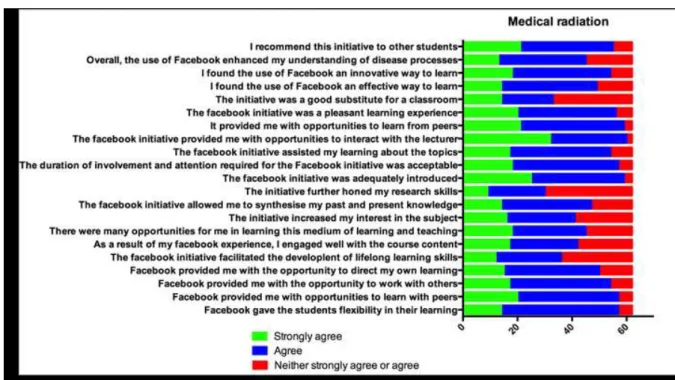
Post-intervention results reveal positive perceptions about the application of Facebook in the Pathology course. Students reported that Facebook gave them flexibility in their learning (they recommend this initiative to other students (92% and 100% of Medical Radiation and Nursing students respectively responded that they strongly agree or agree). Most agreed that Facebook provided them with opportunities to learn with peers (92%; 100%) and work with others (87%; 100%), as well as the opportunity to direct their own learning (81%; 80%). Many considered the Facebook initiative to facilitate the development of lifelong learning skills (58%; 80%). They engaged well with the course content (68%; 80%). Many attested that there were many opportunities in learning this medium of learning and teaching (66%; 100%). The initiative increased students’ interest in the subject (66%; 100%). Students had mixed opinions on whether the initiative allowed them to synthesise past and present knowledge (76%; 30%), or honed their research skills (48%; 60%). They did feel the initiative was adequately introduced (95%; 80%) and that the duration of attention required was acceptable (92%; 100%). Most asserted that the initiative their learning about the topics (87%; 90%). Students agreed that they were provided with opportunities to interact with the lecturer (97%; 100%) and learn from peers (95%; 90%). They considered it a pleasant learning experience (90%; 80%) but were of mixed opinions on whether it made a good substitute for classroom learning (53%; 40%). Regardless they found it an effective (79%; 80%) and innovative (87%; 80%) way to learn. Most found that the initiative enhanced their understanding of disease processes (73%; 80%), and would recommend it to other students (89%; 100%). See Figures 1 and 2summarising the perceptions of students about the Facebook activity.
Figure 1: Likert survey of medical radiation students’ perceptions about Facebook after completing the course. n = 62.
The Electronic Journal of e-Learning Volume 13 Issue 6 2015
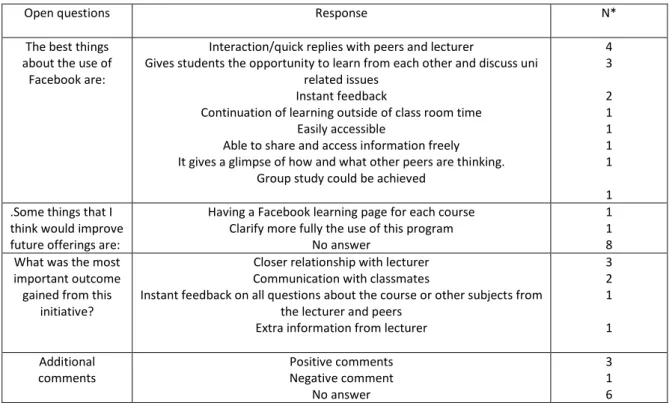
The following tables, Table 1 and 2, summarise the responses to the open questions. Students’ diverse responses were grouped into categories, counted and tabulated.
Figure 2: Likert survey of nursing students’ percaptions about Facebook after completing the course. n = 10. Table 1: Post-intervention responses for open questions (Perceptions about Facebook after Pathology course)
n=62
Open questions Response N*
The best things about the use of Facebook are:
Ease of access, quick and easy to use, convenient Extra resources
Interaction with lecturers and students Familiarity
Response to questions No anwer
24 20 15 10 8 18 Some things that I
think would improve future
offerings are:
Post more questions Provide explanation to answers Posting more additional readings and resources
No answer
11 4 3 42 What was the most
important outcome gained from this
initiative?
Knowledge and understanding Friendly learning environment Collaborative learning with peers
Engagement Easy access
Interaction/communication to lecturers and peers No answer
11 9 7 7 7 2 30 Additional
comments
Positive comments Negative comments
No answer
7 4 50 *Number of times the item was identified
Jyothi Thalluri and Joy Penman
Table 2: Post-intervention responses for open questions (Perceptions about Facebook after Clinical Science course) n=10
Open questions Response N*
The best things about the use of
Facebook are:
Interaction/quick replies with peers and lecturer
Gives students the opportunity to learn from each other and discuss uni related issues
Instant feedback
Continuation of learning outside of class room time Easily accessible
Able to share and access information freely It gives a glimpse of how and what other peers are thinking.
Group study could be achieved
4 3 2 1 1 1 1 1 .Some things that I
think would improve future offerings are:
Having a Facebook learning page for each course Clarify more fully the use of this program
No answer
1 1 8 What was the most
important outcome gained from this
initiative?
Closer relationship with lecturer Communication with classmates
Instant feedback on all questions about the course or other subjects from the lecturer and peers
Extra information from lecturer
3 2 1 1 Additional comments Positive comments Negative comment No answer 3 1 6 *Number of times the item was identified
4
Discussion
The use of Facebook as a platform for a group learning activity for the majority of students in this initiative. Facebook assisted students’ learning about the topics (87%; 90%), helped them direct their own learning (81%; 80%), and enhanced their understanding of disease processes (73%; 80%). Most students maintained that Facebook was an innovative (87%; 80%) and effective way to learn (79%; 80%). The Facebook activity provided students with a pleasant learning experience (90%; 80%) and flexibility in their learning (92%; 100%). In this way, Facebook appears to be an education tool that is well suited to the modern students’ dynamic learning style(s).
Student engagement is a strong contributor to student success in higher education but is difficult to facilitate and promote. Student engagement includes that with course content, with lecturer(s), and with peers. The current trend for mass higher education has resulted in very large cohort sizes and the opportunity to interact directly with lecturers has become minimal despite open door policies. Also, large groups are correlated with a decrease in interpersonal interaction, such that forming a group of peers for friendship and learning becomes more difficult. More direct opportunities for interaction with peers would be beneficial. In this study, students reported that Facebook facilitated their engagement with the course content (68% and 80% for the Medical Radiation and Nursing students, respectively).
Moreover, it increased students’ interest in the subject (66%; 100%), provided opportunities for greater interaction with the lecturer (97%; 100%), facilitated learning with peers (92%; 100%), learning from peers (95%; 90%), and working with others (87%; 100%). Furthermore, while the graded group activity was concluded the Facebook group and Facebook ‘friends’ remained. These peers had the opportunity to further their friendships and professional learning collaborations in the future. From this it appears that Facebook could become an integral part of a rounded, engaging, and lasting experience in higher education.
Approximately half of the Medical Radiation students and a minority of the Nursing students were of the opinion that Facebook could be a good substitute for classroom learning (53%; 40%). In actuality, Facebook cannot substitute for face-to-face learning and teaching; it was applied here as an additional tool to enhance the core modes learning and teaching that are lectures, tutorials and practicals.
The Electronic Journal of e-Learning Volume 13 Issue 6 2015
Nursing students expressed a poor positive response (30%) for the statement querying the effect of Facebook on synthesising past and present knowledge, while the Medical Radiation students’ response qas positive. . The Nursing students did not do research or synthesise past and present knowledge while on Facebook in real time, but if they engaged actively in the initiative in the way it was designed, they would have undertaken research and connected with their past and present knowledge. It is interesting to note that while the majority of students reported increased engagement (68% and 80%) and interest (66% and 100%) in the subject, this did not necessarily translate to increased initiative for research and learning. A possible explanation can be discerned from the Medical Radiation students’ report that the initiative did not contribute considerably to honing their research skills (48%). When combined with the finding that students were appreciative of an adequate introduction to how Facebook would be used (95%; 80%), it appears that attention should be given to introducing tools and methods for research and learning that students can use both independently and as a part of group learning in their own time away from classes. Again, the trend for mass education has brought an increasingly diverse cohort to higher education, so such skills should no longer be assumed. Proficiency in research and learning skills would increase the likelihood of effective and active engagement in Facebook activities and many other areas of higher education.
This study indicated overwhelmingly that using Facebook offered many benefits and advantages for students. In providing an interesting, interactive, gratifying and productive way of learning and teaching via Facebook, students could be assisted to be successful learners (Irwin et al. 2012; Ferdig 2007). Good practice guidelines may be drawn from this study when one considers the features of the Facebook initiative that appealed and worked well for both cohorts of students. Six good practice principles for academics, namely 1) defines goals and objectives, 2) clarifies expectations, 3) facilitates communication with co-learners and staff, 4) engages students with the course content, 5) encourages active participation, and 6) provides a conducive and safe learning environment. Earlier pieces of work by Chickering and Ehrmann (1996) and Chickering and Gamson (1987) on good practices on teaching utilising technological advances have relevance on this Facebook good practice guidelines.
4.1
Good practice defines goals and objectives
Objectives to be achieved in utilising Facebookinclude: to enhance learning and teaching experience of students, increase communication and interaction, promote student-student/student-teacher engagement, get to know other students and the lecturer on a more personal level, stay connected, reduce student disengagement, guide students and new staff, and ensure quality delivery of course. These goals were evident to the administrators of the initiative and the survey assessment, but appeared unclear to participating students, as seen by a nursing student’s suggestion to:
Clarify more fully the use of this program [Facebook] to enhance the communications between students to ensure their understanding and progress.
The students’ statements emphasise the need to communicate the goals and objectives at the very outset for optimal use of Facebook in higher education.
4.2
Good practice clarifies expectations
The majority of students were appreciative of the meticulous organisation of the Facebook activities which they considered to include adequate introduction (95%; 80%). The extent and duration of involvement as well as the expectations from each student participant were made clear. Students needed to know exactly what is their involvement, what is expected of them, what is required in terms of time and participation, and the knowledge and skills to be gained and used to optimise the use of Facebook as a learning and teaching tool. The lecturer/s expectations and what might be expected of them are important as well as these would indicate to students how they might succeed in this aspect of the course. It was important also to recognise that students may be unfamiliar in the use of Facebook as a learning and teaching environment. Some students may struggle with inadequate hardware/software, slow internet connections, and/or lack the technology know-how (Keengwe & Kidd 2010). This was not a major concern since the majority of students were internal so wireless internet, computers and a data allowance were readily available to them on campus. Care was taken to introduce the procedural aspects so students felt comfortable with the new learning format.
Jyothi Thalluri and Joy Penman
The need to elucidate the expectations is illustrated in this sentiment from a student:
Facebook is distracting. … I don't like Facebook as a medium for learning.” (This student explained how it led to visiting her Facebook account and being distracted from the task at hand.)
On the hand, a Nursing student remarked:
I am not an avid user of Facebook. However, this experience has been a positive experience and has encouraged me to use Facebook as a learning tool, and a tool to further my involvement with groups associated with nursing.
Possible distraction is a valid concern for some participants and cannot be separated from using Facebook as a learning platform. However, the efficacy of Facebook learning in facilitating student engagement is an important outcome that is increasingly difficult to promote elsewhere (tutorials etcetera), and as such the benefits of Facebook as a learning platform outweigh any potential diversion.
4.3
Good practice facilitates communication with co-learners and staff
Greater communication with peers and staff was one of the desirable outcomes students reported in participating in the Facebook initiative. The activity facilitated this communication by allowing students to work and collaborate, contribute to the discussion, and affirm or challenge each other’s understanding. The “presence” of the staff member/s was equally important (Penman & Ellis 2012). The best online academics are those who are actively present at the course site multiple times a week or even daily (Boettcher 2012). Interactions with students and staff do not happen only in the university but extend beyond the university. The Medical Radiation and Nursing students attested:
It really allowed students to engage with each other in a friendly online environment and the immediate response from the lecturers was good.
Collaborative learning with peers, sharing information between teaching staff and students are important outcomes.
There was better and faster interaction between the students and the lecturers. There was open communication and connection too.
Using Facebook for me was excellent as I live away and travel to campus, so this was a quicker way to keep in contact and gain info from other peers and the lecturer.
4.4
Good practice engages students with the course content
The interactions centred mostly on the case scenarios and these allowed the formation of a learning community where participants were connected and fully engaged with the topics. At the same, there were meaningful and enriching activities (e.g. the quizzes, multiple choice questions You Tube clips, online resources, other extra information and updates) supplied by the lecturer/s and peers from time to time. These value-adding materials contributed in increasing interest, better understanding, and closer engagement with the course content. Knowledge was conveniently and easily accessed.
Following are comments from the students:
The questions and extra resources helped tie things together and gain more understanding. It kept me thinking about pathology.
Improved my learning and made me engage in this subject.
… helped to keep me engaged in my learning rather than just putting it aside after the lecture or workshop.
Enhancing learning and enthusiasm for Pathology
… sharing resources with peers and communicating with them. Being immediately notified of updates e.g. by mobile.
After the students’ case presentations, students who presented posted photographs of the presentation and also tips on what worked and what did not work for them on their experiences of preparing the case
The Electronic Journal of e-Learning Volume 13 Issue 6 2015
presentations on the Facebook. These assisted other groups while they prepare their presentations. This not only assisted peer to peer learning, but also allowed learning from other students’ mistakes and promoted reflection and consolidation of the new learning process.
4.5
Good practice encourages active participation
The Facebook initiative required the participants to be active in their learning and take responsibility of the same. The focus was on what students will do to meet the requirements of the case scenario assignment. Active participation meant working closely with the group members for a purpose, brain storming ideas, searching literature to find the answers, debating, problem-solving, finding alternatives, critical thinking, and reflecting on decisions made. Threaded discussion is an excellent strategy to promote critical thinking (Ehrmann n.d.), and so with other meta-cognitive tasks as goal setting, self-monitoring and evaluation (Online Teaching in Learnonline 2010). After the groups delivered their presentations, other students were expected to peruse their work and more discussions would be undertaken. The entire class would be actively involved in deciphering the cases which maximised learning. The dynamic written format allows both real time and delayed responses, which is beneficial for shy, reticent or ESL students who find it hard to contribute in real time face to face activities such as tutorials. In this way, Facebook group activities promote active participation from a wider range of students than traditional group activities in higher education. In using Facebook to learn about a clinical case, Pathology and Nursing students revealed:
Accessing course information so easily and being able to ask questions as well as read answers to questions other students have asked was awesome.
I have Facebook on my phone so it was super easy to access all the time.
On Facebook it's easier to use than the uni website, quick and easy to get extra information. We could know what was happening with the course any time as students may frequent Facebook more often than the Moodle site. Additionally, students were able to ask questions any time and get immediate response from peers or lecturers.
The multiple choice questions posted every week and also the lecturer provides feedback on the right and wrong answers. You can also interact with the teacher.
Good medium to discuss past exam questions.
Active participation was also illustrated in comments such as “Group study could be achieved [in Facebook].” and “Most useful for the group presentation.” as students endeavoured to contribute their bit in solving the problems required in the case scenarios. The student comments reveal that group engagement had burgeoned beyond the set group activity to include more general achievement and opportunity to prepare for the final examination for the course. This is an ideal outcome beyond the expectations of the initiative.
4.6
Good practice provides a conducive and safe learning environment
The Online Teaching in Learnonline (2010), Learning and Teaching Unit Academic Development of the university provides additional information and examples of good practice in online learning and teaching which are applicable to the creation of Facebook learning groups. Facebook staff members do not simply set a group, provide the case scenarios, and retreat waiting for students to take control. They support the learning activity actively; they help the students understand what is required and assist students to work toward the course learning objectives. Staff need to develop their communication skills to keep students interested and engaged. Their role demands that they attend to pedagogical, managerial, social facilitative and technical support aspects of the online initiative. Under pedagogical roles, Facebook staff members facilitate educational processes for students’ understanding of critical science concepts and principles, while managerial roles would include the organisational, procedural, and administrative tasks associated with Facebook as a learning environment. The technical roles refer to making the students comfortable with the system, referring students to technical support resources, and addressing technical concerns.
Equally important is the psychosocial component of Facebook teaching, promoting a friendly, pleasant and safe environment and eliciting feelings of support for the cognitive learning processes of participants. “Such social functions include developing harmony, group cohesiveness, and collective identity. Online social roles require instructors to develop nurturing skills by encouraging participation, giving ample feedback and reward,
Jyothi Thalluri and Joy Penman
attending to individual concerns, and using a friendly, personal tone.” (Online Teaching in Learnonline 2010). Students stressed the importance of psychosocial factors such as:
A friendly online environment
… ability to ask questions in a non-confrontational manner Getting to know medical radiation students and lecturers Closer relationship with lecturer
… collaboration and cooperation between students
These emotions, feelings, attitudes and values have a place in effective learning (Penman & Ellis 2012; Kolb & Kolb 2005). Koballa (2011) refers to this as creating a “hospitable place for learning”. In order to achieve this ideal environment for learning, some rules of engagement or rules of conduct, also known as Facebook etiquette, is in order. Specifically, behaviours such as “putting down” a peer, using inappropriate language or visual, or posting irrelevant and inappropriate message, are not acceptable.
5
Checklist for the use of Facebook
The six principles outlined above are translated into a 16-item checklist that might inform and guide academics how to effectively use social media to enhance the learning and teaching of science concepts to undergraduate students, to assist in developing effective Facebook learning and teaching resources, and to ensure high quality learning and teaching of sciences using social media.
CHECKLIST FOR THE USE FACEBOOK FOR LEARNING AND TEACHING
Bear in mind that Facebook is used as an additional learning and teaching tool. Involvement in the Facebook group is not compulsory, it is optional. Students may choose to use the university discussion board and/or Facebook group.
Organise the Facebook methodically by creating a ‘Closed group’ before the start of the study period. Invite teaching and other relevant staff members to the closed group. (A closed Facebook group means only group members can see who are in it and can read the postings contributed by the members).
1) Set clear goals and objectives to be achieved in utilising Facebook, emphasising engagement with course content, peers and staff.
.Privacy of users must be respected. Instruct students to set their privacy settings as appropriate from their end. Students have a choice of creating a new Facebook account or they can use an existing account with the appropriate privacy settings.
Clarify expectations with students, level and duration of involvement. Encourage high level of participation.
Provide adequate introduction. Explain how and why Facebook is being used as an educational tool. Discuss the benefits from the literature as well as from previous years’ evaluation data.
Consider the educational, technical and administrative aspects as well as the psychosocial aspect when using Facebook.
Allow adequate students opportunities to interact, communicate and collaborate.
Resource sharing such as You Tube, online links, articles etc. is encouraged. However, if the material is not relevant to the course, it will be deleted by the administrators.
Promote student-teacher interaction by providing prompt feedback, engaging discussions, and enriching and meaningful activities.
Encourage active learning and provide opportunities for students to show evidence of their learning. Note the teacher’s Facebook ‘presence’ is important.
The Electronic Journal of e-Learning Volume 13 Issue 6 2015
Make sure to provide a pleasant experience. Observe Facebook etiquette. Note that inappropriate postings will be deleted by the administrators.
Use a variety of teaching approaches to suit varying learning backgrounds and learning styles.
Provide opportunities for students’ to clarify their issues and concerns regarding assessments, final exam, class standing and other academic issues.
Evaluate the Facebook activity and determine how to continue improving its application in higher education.
6
Conclusion
This study asserts that there is merit in the use of Facebook as an adjunct in the learning and teaching of science concepts and principles. In fact, a Nursing student suggested to “[Have] a Facebook learning page for each course” of the program, while three Medical Radiation students offered: “Definitely keep this initiative going!”; “A valuable initiative, please do keep it in place for future students to benefit.”; and “It's a good program and best to continue.” In order to ensure that goals and objectives are met and that high-quality course is delivered, good practice guidelines and a checklist for good practice were formulated. These were informed from the post-intervention evaluations administered to students which considered the features of the Facebook that were satisfactory and less satisfactory for the students.
The outcome of a well-maintained and structured Facebook group is the formation of a learning community, where participants are connected and fully engaged with content, co-students and staff, and where knowledge is conveniently and easily accessed. This represents a relatively easily incorporated way to facilitate and encourage student engagement in contemporary higher education. The good practice guidelines and checklist presented in this paper will guide academics how to effectively use social media to enhance the learning and teaching of science concepts to undergraduate students, and help provide high quality and satisfying academic experience for students thereby contributing to academic success and ongoing professional development. .
References
Black, E. W., Thompson, L. A., Duff, W. P., Dawson, K., Saliba, H. and Black, N. M. (2010) “Revisiting social network utilization by physicians-in-training”, Journal of Graduate Medical Education, Vol. 2, No. 2, pp. 289-293.
Boettcher, J. (2011) “Ten best practices for teaching – online Quick guide for new online faculty, Designing for Learning”, [online], www.designingfor learning.info/services/writing/ecoach/tenbest.html
Bosch, T. E. (2009). “”sing online social networking for teaching and learning: Facebook use at the University of Cape Town”, Communication: South African Journal for Communication Theory and Research, Vol. 35, No. 2, pp. 185-200. Cain, J. (2008) “Online social networking issues within academia and pharmacy education”, American Journal of
Pharmaceutical Education, Vol. 72, No. 1, p. 10.
Chickering, A.W. and Ehrmann, S.C. (1996) “Implementing the Seven Principles, Technology as Lever”, [online], AAHE Bulletin, www.tltgroup.org/programs/seven.html.
Chickering, A.W. and Gamson, Z.F. (1987) “Applying the Seven Principles for Good Practice in Undergraduate Education”, [online], teaching.uncc.edu/articles-books/best-practice-articles/instructional-methods/7-principles.
Ehrmann, S. n.d. “Seven Principles Collection of TLT ideas”, [online], The TLT Group,
www.tltgroup.org/seven/3_Active.htm#_Toc33357278.
Ellison, N., Steinfield, C. and Lampe, C. (2007) “The benefits of Facebook ‘friends’: Social capital and college students’ use of online social network sites”, Journal of Computed-Mediated Communication, Vol. 12, No. 4, pp. 1143-1168.
Ferdig, R. E. (2007) “Editorial: Examining social software in teacher education”, Journal of Technology and Teacher Education, Vol. 15, No. 1, pp. 5-10.
Gray, K., Annabell, L. and Kennedy, G. (2010) “Medical students’ use of Facebook to support learning: Insights from four case studies”, Medical Technology, Vol. 32, No. 12, pp. 971-976.
Hendrix, D., Chiarella, D., Hasman, L., Murphy, S. and Zafron, M. (2009) “Use of Facebook in academic health sciences libraries”, Journal of the Medical Library Association, Vol. 97, No. 1, pp. 44-47.
Hew, K. H. (2011) “Students’ and teachers’ use of Facebook”, Computers in Human Behaviour, Vol. 27, No. 2, pp. 662-676. Irwin, C., Ball, L., Desbrow, B. and Leveritt, M. (2012) “Students’ perceptions of using Facebook as an interactive learning
resource at university”, Australian Journal of Educational Technology, Vol. 28, No. 7, pp. 1221-1232.
Keengwe, J. and Kidd, T. (2010) “Towards Best Practices in Online Learning and Teaching in Higher Education”, Journal of Online Learning and Teaching, Vol. 6, No.2, [online], jolt.merlot.org/vol6no2/keengwe_0610.htm.
Koballa, T. ( 2011) “Framework for the affective domain in science education”, [online], serc.carleton.edu/NAGTWorkshops/affective/framework.html.
Jyothi Thalluri and Joy Penman
Kolb, A. Y. and Kolb, D. A. (2005) “Learning styles and learning spaces: Enhancing experiential learning in higher education”, Academy of Management Learning & Education, Vol. 4, No. 2, pp. 193–212.
Madden, J. (2013) “Digital disconnect”, Record, Vol. 118, No. 11, p. 13.
Online Teaching in Learnonline, Learning & Teaching Unit Academic Development (2010) , Online teaching in learnonline, [online], UniSA , resource.unisa.edu.au/mod/respurce/view.php?id=48362.
Penman, J. and Ellis, B. (2012) Psychosocial factors in the success of electronic learning groups, Virtual paper presented in the 6th International Multi-conference on Society, Cybernetics and Informatics: IMSCI 2012, Orlando Florida, USA, 17-20 July.
Penman, J. and Thalluri, J. (2013) “Optimising the use of online technology for learning and teaching science”, The Electronic Journal of e-Learning; Proceedings of the 8th International Conference on e-learning ISSUU, Vol 2 ACPI, ISSN: 1479-4403, pp. 344-352.
Ponce, B. A., Fetermann, J. R., Boohaker, H. A., Sheppard, E., McGwin, G. Jr and Theiss, S. (2013) “Social networking profiles and professionalism issues in residency applicants: an original study-cohort study”, Journal of Surgical Education, Vol. 70, No. 4, pp. 502-507.
Stutzman, F. (2006) “Case study: Facebook feeds and networked political action. PhD research report”, [online],
www.ibiblio.org/fred/academic.html.
Thalluri, J. O'Flaherty J. and Shepherd P. (2014) Classmate peer-coaching: "A Study Buddy Support Scheme" Journal of Peer Learning, 7, pages 92-104 Available at: http://ro.uow.edu.au/ajpl/vol7/iss1/8/
Thalluri, J. and Penman, J. (2014) “Staying connected and engaged with the use of Facebook: Experiences of studying Pathology”, Poster presented during OCW Consortium Global Conference, no. 74, Slovenia, 23-25 April. (J Thalluri presented.) In the Proceedings of OpenCourseWare Consortium Global 2014: Open Education for a Multicultural World, [online], conference.ocwconsortium.org/2014/wp-content/uploads/2014/04/Paper_74-Facebook.pdf. Thalluri J. and Penman J. (2013) “Case scenario oral presentations as a learning and assessment tool”, The Journal of the
World Universities Forum, Vol. 5, No. 3, pp. 51-62.
Thompson, L. A. , Dawson, K., Ferdig, R., Black, E. W., Boyer, J., Coutts, J. and Black, N. P. (2008) “The intersection of online social networking with medical professionalism”, Journal of General Internal Medicine, Vol. 23, No. 7, pp. 954-957. Whittaker, A. L., Howarth, G. S. and Lymn, K. (2013) “Evaluation of Facebook to create an online learning community in an
undergraduate animal science class”, Bricks to Bytes, HERGA Conference, 25-27 September, p. 99.
Wise, L. Z., Skues, J. and Williams, B. (2011) “Facebook in higher education promotes social but not academic engagement. In Changing demands, changing directions”, Proceedings Ascilite, [online]. www.ascilite.org.
au/conferences/hobart11/downloads/papers/Wise-full.pdf.
Wodzichi, K., Schwammlein, E. and Moskaliuk, J. (2012) “Actually, I wanted to learn”: Study-related knowledge exchange on social networking sites”, Internet & Higher Education, Vol. 15, No. 1, pp. 9-14.
Synthesizing Technology Adoption and Learners’ Approaches
Towards Active Learning in Higher Education
Kevin Chan
1, George Cheung
1, Kelvin Wan
1, Ian Brown
2and Green Luk
2 1Department of Applied Social Sciences, Hong Kong Polytechnic University, Hunghom,
Kowloon, Hong Kong
2
Educational Development Centre, Hong Kong Polytechnic University, Hunghom, Kowloon,
Hong Kong
[email protected]
[email protected]
[email protected]
[email protected]
[email protected]
Abstract: In understanding how active and blended learning approaches with learning technologies engagement in undergraduate education, current research models tend to undermine the effect of learners’ variations, particularly regarding their styles and approaches to learning, on intention and use of learning technologies. This study contributes to further examine a working model for learning outcomes in higher education with the Unified Theory of Acceptance and Use of Technology (UTAUT) on SRS adoption attitude, and the Study Process Questionnaire (SPQ) on students’ approach to learning. Adopting a cross-section observational design, the current study featured an online survey incorporating items UTAUT and SPQ. The survey was administered to 1627 undergraduate students at a large comprehensive university in Hong Kong. Relationships between SRS adoption attitude, learning approaches, and learning outcomes in higher-order thinking & learning and collaborative learning were analyzed with a structural equation model (SEM). A total of 3 latent factors, including four factors from UTAUT in Performance Expectancy, Effort Expectancy, and Deep Learning Approach from the SPQ, were identified in the structural model on students’ intention to adopt SRS in classes. Current results suggested that a model of active learning outcomes comprising both UTAUT constructs and deep learning approach. Model presented in the present study supported the UTAUT in predicting both behavioral intention and in adopting SRS in large classes of undergraduate education. Specifically, positive attitudes towards SRS use measured with the UTAUT, via a learning approach towards deep learning, accounted for variation on high-impact learning including higher-order thinking and collaborative learning. Results demonstrated that the process of technology adoption should be conceptualized in conjunction with learners’ diversity for explaining variation in adoption of technologies in the higher education context.
Keywords: Technology adoption; Learning Approaches; Students Response System (SRS); Higher Education
1
Background
Prevailing ideologies in higher education are advocating student-oriented, constructivist, and collaborative learning among students and their faculties (Al-Huneidi and Schreurs, 2013, Slavich and Zimbardo, 2012), in which learners must assume an active role in constructing knowledge in a collaborative and interactive learning environment. Active and blended learning approaches with learning technologies have been identified as instrumental in engaging large classes at the undergraduate level in higher education (Kerr, 2011, Exeter et al., 2010). Current research has proposed various models for outlining the process in which learners adopted such learning technologies (Venkatesh and Bala, 2008, King and He, 2006, Davis et al., 1989) and enhance their learning experience and performance.
While giving feedback individually to students in large classes remains a daunting task with limited time in face-to-face lecture, the use of SRS allows mass, yet personalized feedback to students in the face-to-face learning process with aid from adopting the blended learning approach. The use of students’ response system (SRS) with mobile devices has been demonstrated as an effective tool for engaging students in active learning under the large-class context in higher education (Velasco and Çavdar, 2013, Chan et al., 2013, Cobb et al., 2010, Shapiro, 2009, Caldwell, 2007, Schell et al., 2013).
Use of SRS for blended learning is influenced by the learner’s propensity to adopt and use the technology in their learning practices. One of the more recent and prevailing models for understanding use of learning technology is the Unified Theory of Acceptance and Use of Technology (UTAUT), a comprehensive (Venkatesh
ISSN 1479-4403 431 ©ACPIL
Reference this paper as Chan K, Cheung G, Wan K, Brown I and Luk G “Synthesizing Technology Adoption and Learners’ Approaches Towards Active Learning in Higher Education” The Electronic Journal of e-Learning Volume 13 Issue 6 2015, (pp431-440) available online at www.ejel.org
The Electronic Journal of e-Learning Volume 13 Issue 6 2015
et al., 2003) and cross-cultural (Lidia et al., 2007) model for understanding factors to behavioral intentions and actual use of technology. Core components in the UTAUT include expectancies towards performance from adopting the technology, effort required in adopting the technology, social influence to adopt the technology, facilitating conditions for adopting the technology. These core components are hypothesized to influence satisfaction and behavioral intention to continue use of the targeted technology.
However, these current models, when applied in an educational context, tend to undermine the effect of learners’ variations, particularly regarding their styles and approaches to learning, on intention and use of learning technologies. To accommodate the moderating effect of learners’ approaches, a multi-dimensional model is proposed for delineating the relationships between attitude towards learning technologies, learners’ approaches to learning, and behavioral intention towards continuous use of learning technology as one of the strategies for practicing active learning.
Recent research suggested that behavioral changes with SRS in classes influenced students’ approaches or styles to learning (Tlhoaele et al., 2015, Wang et al., 2012) towards deep approach to understanding of subject matters. Whether such deep learning stimulated by SRS in higher education would translate into learning outcomes calls for a theoretical integration and an empirical investigation.
In this context, this study contributes to further examine a working model for students’ learning engagement with behavioral intention towards SRS usage with the Unified Theory of Acceptance and Use of Technology (UTAUT) (Dwivedi et al., 2011, Lidia et al., 2007, Venkatesh et al., 2003), and the Revised Two-Factor Study Process Questionnaire (SPQ) (Justicia et al., 2008, Biggs et al., 2001) on students’ approach to learning.
The present study is set to address the research question of whether students with high readiness towards use of Clickers towards active learning (UTAUT) would be more likely to adopt deep learning approach (R-SPQ-2F) and subsequent learners’ engagement in higher order thinking and collaborative learning (NSSE).
2
Methods
This study features a cross-section observational study at a large comprehensive university in Hong Kong. An online survey incorporating items UTAUT and SPQ was administered to 1623 undergraduate students.
Participants in this study were enrolled in undergraduate courses using students response system (SRS, a.k.a. Clickers) for active learning activities in classes. Details on Clickers administration in the participating courses were reported in a previous paper by the research team (Chan et al., 2013).
Implementation of SRS in the current study was evaluated with an online quantitative instrument on various aspects of SRS implementation with 5-point Likert-type and non-Likert type questions.
• Instruments
• Unified Theory of Use and Acceptance of Technology (UTAUT)
The Unified Theory of Acceptance and Use of Technology (UTAUT) augments the original technology acceptance model (Davis et al., 1989) with addition of social influence and facilitating conditions in the technology deployment environment towards measurement of technology adoption. By integrating other technology adoption models, the UTAUT proposed a unified model with four determinants influencing both behavioral intention (BI) and actual use of a technology; these determinants are:
• Performance expectancy (PE): perceived gains on task performance by adopting the targeted technology
• Effort expectancy (EE): ease of use in adopting the targeted technology
• Social influence (SI): degree to which significant others influence the user's intention or actual use of the targeted technology
• Facilitating conditions (FC): perceived level of organizational and technical infrastructure support to facilitate use of the targeted technology
Attitude towards usage of SRS as a learning tool in classroom was assessed with the Unified Theory of Use and Acceptance of Technology (UTAUT) (Venkatesh et al., 2003), a 5-domain 20-item instruments on a 5-point
Kevin Chan, George Cheung, Kelvin Wan et al
likert scale measuring performance expectancy (PE), effort expectancy (EE), social influence (SI), facilitating conditions (FC), and satisfaction and behavioral intention to continue use of the technology adopted (S/BI).
• Revised Two-Factor Study Process Questionnaire (R-SPQ-2F)
Learners’ learning approaches were assessed with the 20-item Revised Two-Factor Study Process Questionnaire (R-SPQ-2F) (Biggs et al., 2001), with learners classified as adopting surface or deep learning approaches for outlining their motives and strategies towards their learning.
• Higher-Order Learning and Collaborative Learning – National Survey of Students’ Engagement (NSSE-HO / NSSE-CL)
Students’ generic learning outcomes were captured with two subscales, higher-order learning (NSSE-HO) and collaborative learning (NSSE_CL) from the National Survey of Student Engagement 2013 (Indiana University Center for Postsecondary Research, 2013). Higher order learning refers to challenging learning tasks including applying information learned in solving practical problems, synthesizing information from multiple sources, and forming new ideas from information sourced. Collaborative learning refers to the degree that students master skills and concepts through discussion and team learning with other students toward formative and summative assessments.
3
Data Analysis
Quantitative data derived from this study was analyzed with a structural equation model (SEM). Data were analyzed using confirmatory factor analysis (CFA) and structural equation modeling (SEM) (Bollen, 1989). Descriptive and correlations were generated with the IBM SPSS Statistics 22 software. All SEM models were estimated with the IBM SPSS Amos 22 software. Standard maximum likelihood estimations were applied in the SEM with no observed missing data. The research model on students' learning outcomes was based on two latent variables, namely satisfaction and behavioral intention to use of SRS in class in the Unified Theory of Use and Acceptance of Technology (UTAUT), and students' deep approach to learning with the Revised Study Process Questionnaire - 2 Factor Structure (R-SPQ-2F). The research model is illustrated in Figure 1 and the research hypotheses are listed in Table 1.
Figure 1: Research model
Table 1: Research hypotheses
The Electronic Journal of e-Learning Volume 13 Issue 6 2015
H1 Performance expectancy (PE) will have a positive and significant influence on satisfaction and behavioral intention to use SRS (S/BI)
H2 Effort expectancy (EE) will have a positive and significant influence on satisfaction and behavioral intention to use SRS (S/BI)
H3 Social influence (SI) will have a positive and significant influence on satisfaction and behavioral intention to use SRS (S/BI)
H4 Facilitating conditions (FC) will have a positive and significant influence on satisfaction and behavioral intention to use SRS (S/BI)
H5 Satisfaction and behavioral intention to use SRS (S/BI) will have a positive and significant influence on deep learning approach (Deep)
H6 Deep learning approach (Deep) will have a positive and significant influence on NSSE Higher-Order Thinking / Learning (NSSE-HO)
H7 Deep learning approach (Deep) will have a positive and significant influence on NSSE Collaborative Learning (NSSE-CL)
The proposed model fit was evaluated using conventional fit indices (Hu and Bentler, 1999) including Chi-Square Statistics ( 2), global fit index (GFI), Tucker-Lewis index (TLI), comparative fit index (CFI), incremental fit index (IFI), root mean square error of approximation (RMSEA), and the standardized root mean square residuals (SRMRs).
4
Results
4.1
Participants and demographics
A total of 1623 undergraduate students from 39 courses at a 4-year university participated in this study. The mean age of participating students is 18.93 year old, with 30.44% of the study sample being freshmen (year-1 students) at age 17 or below, 67.1% being sophomores between age 18-23 or below, and 2.46% being mature students age 24 or above. Figure 2 illustrated the distribution of participants’ age.
Figure 2: Age of participating students
Kevin Chan, George Cheung, Kelvin Wan et al
Students in this sample represented a balanced mix of academic disciplines, with business and health / social sciences students accounting for 60% of the study population while science / technology / engineering (STE) students (19%), tourism & hospitality students (16%), and humanities / design students (5%) rounded up the remaining 40% of the study sample. Figure 3 depicted distribution of students’ disciplines.
Figure 3: Disciplines of participating students
Structural model and path coefficients of learning technology use, deep learning, and learning outcomes
Figure 4: Structural Equation Model of UTAUT constructs, behavioral intention and satisfaction towards learning technology and R-SPQ-2F deep learning approach on NSSE higher-order learning and collaborative learning
The Electronic Journal of e-Learning Volume 13 Issue 6 2015
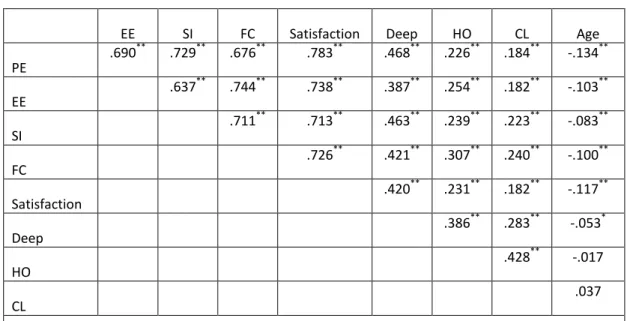
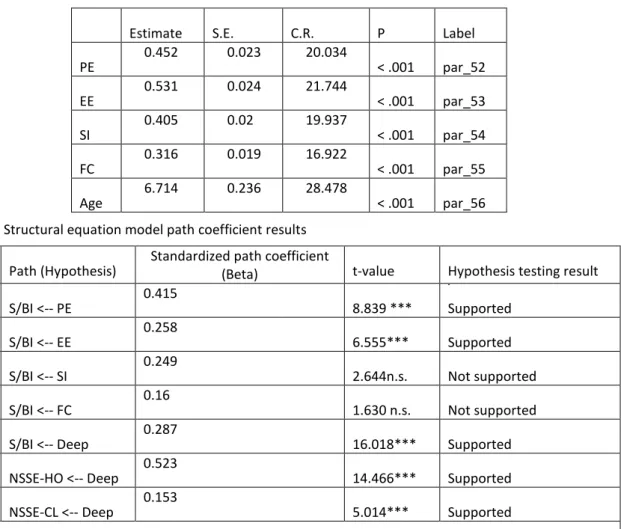
The proposed structural model is illustrated in Figure 4, where Table 2 presents correlation among model variables and Table 3 highlights the critical ratios of exogenous (predictor) variables included in the research model. Table 4 presents the path coefficients and corresponding statistical significance for each of the hypotheses.
U
GFI TLI CFI IFI RMSEA SRMR O erall, five out of seven hypotheses were supported by the data.
Two out of four hypotheses (H1 and H2) representing the relationship among the main UTAUT constructs (PE, EE) to S/BI were supported in this study. As shown in Table 4, performance expectancy (PE) positively predicted satisfaction and behavioral intention (0.415, p < 0.001); therefore, H1 was supported. Similarly, effort expectancy (EE) significantly predicted satisfaction and behavioral intention (0.258, p < 0.001); therefore, H2 was supported.
The hypotheses that were not supported was H3: SI to S/BI and H4: FC to S/BI. Social Influence (SI) (2.644, ) and Facilitating Condition (FC) (1.630, ) did not significantly predict satisfaction and behavioral intention to continual use of SRS; therefore, H3 and H4 were not supported.
Satisfaction and behavioral intention to continue use of SRS (S/BI) significantly predict deep learning approach (Deep) (0.287, p < 0.001); therefore, H5 was supported.
Regarding learning outcomes, deep learning approach (Deep) positively predicted usage higher-order thinking and learning (NSSE-HO) (0.523, p < 0.001) and collaborative learning (CL) (0.153, p < 0.001); thus H6 and H7 were supported.
Table 2: Correlation coefficient of model variables
EE SI FC Satisfaction Deep HO CL Age PE
.690** .729** .676** .783** .468** .226** .184** -.134**
EE
.637** .744** .738** .387** .254** .182** -.103**
SI
.711** .713** .463** .239** .223** -.083**
FC
.726** .421** .307** .240** -.100**
Satisfaction
.420** .231** .182** -.117**
Deep
.386** .283** -.053*
HO
.428** -.017
CL
.037
PE: Perceived ease of use; EE: Effort Expectance; SI: Social influence; FC: Facilitating Conditions; Deep: Deep approach; HO: Higher Order Thinking; CL: Collaborative Learning; **p < 0.01; *p <0.05
Kevin Chan, George Cheung, Kelvin Wan et al
Table 3: Standard error and critical ratios for each of the parameters
Estimate S.E. C.R. P Label PE
0.452 0.023 20.034
< .001 par_52 EE
0.531 0.024 21.744
< .001 par_53 SI
0.405 0.02 19.937
< .001 par_54 FC
0.316 0.019 16.922
< .001 par_55 Age
6.714 0.236 28.478
< .001 par_56
Table 4: Structural equation model path coefficient results Path (Hypothesis)
Standardized path coefficient
(Beta) t-value Hypothesis testing result H1 S/BI <-- PE
0.415
8.839 *** Supported H2 S/BI <-- EE
0.258
6.555*** Supported H3 S/BI <-- SI
0.249
2.644n.s. Not supported H4 S/BI <-- FC
0.16
1.630 n.s. Not supported H5 S/BI <-- Deep
0.287
16.018*** Supported H6 NSSE-HO <-- Deep
0.523
14.466*** Supported H7 NSSE-CL <-- Deep
0.153
5.014*** Supported
M GFI TLI CFI IFI RMSEA SRMR p < 0.001; n.s. Not significant.
5
Discussion and implications
A model of 3 latent factors, including two factors from UTAUT in Performance Expectancy and Effort Expectancy along with Deep Learning Approach from the SPQ, were identified in the structural model on students’ learning outcomes upon adopting SRS in classes.
Hypotheses H1 & H2 were statistically significant, indicating evidence for substantial influence on behavioral intention to adopt education technology based on perceived performance and effort expectancies. Particularly, the observed effect size of performance expectancy with standardized coefficient of 0.415 in the research model was substantially larger than average coefficient estimated in a recent meta-analysis on UTAUT of 0.343 (Dwivedi et al., 2011).
Performance expectancy may play a significant role in adoption of education technology towards learning goals in the Asian culture. It has been suggested that Asian, particularly Chinese students, tend to value the avoidance of poor performance and extrinsic motivation (D’Lima et al., 2014) high in formulating their learning goal orientation. If adoption of certain educational technology could significantly improve on their performance and avoid failure, it is likely that students would value performance expectancy in making decision to adopt technology for learning over other factors.
Hypotheses H3 & H4 did not reach statistical significance in the current research model. While Social Influence (SI) and Facilitating Conditions (FC) did not predict satisfaction and behavioral intention, the overall model nonetheless suggested linkage between readiness towards SRS and tendency to engage in deep learning, which in turn positively predict higher-order thinking and learning and collaborative learning with peers.
The Electronic Journal of e-Learning Volume 13 Issue 6 2015
Though regarded as one of the more significant constructs in UTAUT, the contribution of SI is subjected to further investigations since it is sometimes omitted in systematic review and meta-analysis because of its context and cultural specificity (Lidia et al., 2007). Indeed, non-significant path between SI and other model variables parallels findings about the inconsistent relationship of this construct with the overall model in the technology adoption literature (Lee et al., 2003) in general. Exclusion of SI in the UTAUT-based research model has also been resonated in a similar non-significant finding from a study population of Asian origin (Koh et al., 2010). Further investigation of cross-cultural variation of this dimension is required to delineate the role of social influence in education technology adoption in the Asian context, particularly when level of individualism and avoidance of uncertainty that vary significantly across cultures (Nistor et al., 2014).
In the higher education context, findings on the role of facilitating conditions (FC) in UTAUT have been mixed – from key correlates to effort expectancy (Terzis and Economides, 2011)] to non-significant factor excluded from the research model (Al-Hujran et al., 2014). A possible explanation to the non-significant path observed in the current study is that the participating classes using SRS were part of an ongoing e-learning project that provides centralized support and training on developing and delivering SRS questions in classes. Further analyses are required to examine whether uniformity in technical and user support explains the lack of variation in terms of facilitating conditions towards technology adoption.
Hypotheses 5-7 were supported in the research model presented. Findings from the current study confirms the effect of SRS on encouraging complex cognitive effort (Brady et al., 2013a) and collaborative learning (Jones et al., 2012, Blasco-Arcas et al., 2013), while bridging these learning outcomes via activation of deep learning approach being facilitated by satisfaction and intention to use SRS. Soliciting students’ responses in learning environment has been suggested to facilitate retrieval-based learning (Karpicke and Grimaldi, 2012, Campbell and Mayer, 2009) Through retrieval of recently acquired information, students consolidate their acquired information in the higher education setting with active learning effort and timely feedback (Lantz and Stawiski, 2014). The student-initiated effort in SRS also resonates with the generation effect (Hirshman and Bjork, 1988, Lantz, 2010), a theory in cognitive and learning psychology hypothesizing better memorization and retention in learning when individuals are required to generate learning artifacts rather than simply receiving and encoding information. These cognitive processes in a learning context possibly account for the demonstrated association between deep learning approach and readiness to SRS demonstrated in this study. The presented research model highlights the long-term impact of using SRS in classes beyond immediate gains such as students’ attention and class engagement (Velasco and Çavdar, 2013, Vaterlaus et al., 2012, Kay and LeSage, 2009, Morling et al., 2008). Appropriate and effective use of SRS should be regarded as an integral mean to achieve deep learning strategies towards enriched, applied, and collaborative learning, which are considered high-impact practices in higher education in the 21st century (Kilgo et al., 2014).
During SRS session, the level of students monitoring their cognitive effort could vary substantially, leading to corresponding variation in learning outcome through SRS. Recent studies suggested that SRS questions and subsequent students’ responses effect moderately on heightening students’ metacognitive effort by verifying their knowledge mastery with the responses presented and discussed in classes (Brady et al., 2013b, Brady et al., 2013a);Schell, 2013 #1066]. The current model could possibly address students’ varying level of metacognitive activities during SRS sessions with deep learning approach, an orientation calling for metacognition and mastery of knowledge acquisition, partially contributing to students’ motivation and effort to think through the questions presented towards a reasoned response.
5.1
Limitations of the current study
Learning approach and attitude towards acceptance and use of technology are limited and subjected to recall and social desirability biases by self-reported items from survey. In delineating the moderating effect of learning approach between intention and behavior, further inquiries through qualitative data in a mixed method design would provide more accurate explanations on the findings currently presented in this paper.
Implication for learning with technology in higher education:
Findings from the present study suggested that using SRS, when students are properly motivated with its utility on learning performance, could influence deep learning approach that in turn predicts higher-order