Sharif University of Technology
Scientia IranicaTransactions D: Computer Science & Engineering and Electrical Engineering www.scientiairanica.com
A survey on formal, object-oriented program
development approaches
M. Naja, H. Haghighi
and T. Zohdi Nasab
Faculty of Electrical and Computer Engineering, Shahid Beheshti University G.C., Tehran, Iran. Received 6 September 2014; received in revised form 19 March 2015; accepted 15 June 2015
KEYWORDS Formal program development; Object-orientation; Formal specication; Object-Z;
VDM; VDM++; B; Event-B; UML-B.
Abstract. Due to the popularity of object-oriented programming approaches, there is a growing interest in utilizing object-oriented concepts, such as encapsulation and reuse, when applying formal methods. The main contribution of this paper is to review and compare existing formal methods to develop object-oriented programs from formal specications. The secondary contribution is providing a comparison between widely used object-oriented formal specication languages. The results of this paper can be utilized by researchers wishing to know what open problems are outstanding in the areas of formal, object-oriented specication and program development. Our ndings are also useful for those who are looking for proper specication languages and program development methods to specify and develop object-oriented programs formally. In addition, the provided criteria are suitable for evaluating numerous object-oriented formal specication languages that are under development, either by extending existing formal approaches or formalizing informal OO-methods. As one consequence of this work, it can be mentioned that among formal specication languages, OZ and VDM++ support OO concepts more strongly in comparison to VDM++ and UML-B. Program development methods based on OZ have less tool support. Finally, most proposed methods for formal, object-oriented program development have been evaluated using only case studies, rather than employing formal approaches.
c
2015 Sharif University of Technology. All rights reserved.
1. Introduction
In the late 1960s, formal methods based on math-ematics were proposed as an option for providing software reliability [1]. Formal methods are used to uncover ambiguity, incompleteness and inconsistency in a system. These methods can be used at any stage of software development, from the initial statement of a customer's requirements to system implementation and verication. Usually, these methods are introduced to
*. Corresponding author. Tel.: +98 21 29904190; Fax: +98 21 29904181
E-mail addresses: [email protected] (M. Naja); h [email protected] (H. Haghighi); [email protected] (T. Zohdi Nasab).
the software life-cycle by adding the formal specica-tion stage to the stages of software projects. At this stage, we describe WHAT has to be done in the nal software, instead of HOW it has to be done.
Formal program development is a process pro-ducing software program code in relatively high level programming languages, such as C and Java, from a given formal specication of the software. A formal program development process has two stages. First, programs are specied using formal specication lan-guages, and are then developed from formal specica-tions applying one of the formal program development methods. Formal program development methods are categorized as animation, renement, or constructive approaches.
pro-posed for animating a formal specication: direct execution and rapid prototyping. Direct execution means that the formal specication statements are ex-ecuted directly and normally by interpretation. Rapid prototyping refers to any method that directly converts specications to programs in a high-level language by using ad hoc rules [2,3]. By a renement technique, one applies a set of well-dened renement rules to alter a software specication into a more concrete mathematical model, i.e. its renement, while main-taining the abstract properties involved in the initial specication [4]. Constructive approaches based on constructive mathematics [5] derive programs from correctness proofs of specications.
Many researchers are interested in studying the OO paradigm at specication and program develop-ment levels because object orientation is well adapted to specifying interesting high level properties of de-pendable systems. Precisely, by formal, object-oriented program development approaches, we refer to those approaches presented to rene formal specications into object-oriented code, or animate formal specica-tions with object-oriented code. While sharing almost the same objective, the existing related publications adopt dierent approaches for formal, object-oriented program development. They also use dierent formal specication languages at the beginning stage of the development process.
Naja and Haghighi [6] presented a brief overview on some of the existing formal approaches to develop object-oriented programs from Object-Z, VDM (Vi-enna Development Method), VDM++, Event-B, and UML-B specications. Furthermore, they provided a comparison between Object-Z, VDM++, and UML-B.
This paper presents a more complete review, which relies on the following advantages in comparison to our previous study [6]:
1. In this study, a larger set of criteria has been used in order to compare Object-Z, VDM++, and UML-B, as well-known object-oriented, formal specication languages. For instance, \polymorphism", \typing", \multiple inheritances" and \multiple sub-typing" are new criteria considered in the present study.
2. A brief description of existing formal methods to develop object-oriented programs from Object-Z, VDM, VDM++, B, Event-B, and UML-B speci-cations has been provided.
3. Formal methods to develop object-oriented pro-grams from Object-Z, VDM, VDM++, B, Event-B, and UML-B specications have been compared according to a larger set of criteria. For in-stance, we have considered \interactivity",
\simi-larity degree", \validation approach", and \rene-ment style" as new criteria.
4. We have summarized the strengths and weaknesses of formal methods to develop object-oriented pro-grams based on the given criteria.
Our methodology to perform this survey is as follows:
1. The following eligibility criteria were rst deter-mined to include papers, theses, and books pub-lished in English:
Performing a survey of formal specications or formal program development;
Proposing a method or tool under formal spec-ications, formal program development or code generation, regarding OO approaches and view-points.
2. To search potentially eligible research and nd appropriate papers to satisfy the specied cri-teria, databases such as ACM digital library, arXiv, CiteSeer, Scientic Literature Digital Li-brary, IEEE/IET Electronic LiLi-brary, and Google scholar were used.
3. In a duplicate and independent manner, title and abstract screening, and full text screening were un-dertaken. Irrespective of discrepancies, all studies selected at a title and abstract level were included for the full text screening. Then, the full text of studies was investigated and relevant studies were selected, according to the mentioned eligibility criteria, and others were disregarded.
4. Selected research was categorized into two over-lapped categories:
Research related to formal specication;
Research related to formal program development or code generation.
5. Languages, methods, and tools mentioned in each category were investigated and compared, based on the criteria introduced in the next subsections.
6. The strengths and weaknesses of formal methods to develop object-oriented programs were summa-rized, based on the performed investigation and comparison.
Section 2 introduces and compares well-known object-oriented formal specication languages. Sec-tion 3 reviews existing formal methods to de-velop object-oriented programs from Object-Z, VDM, VDM++, B, Event-B, and UML-B specications. Sec-tion 4 compares these methods according to a set of criteria. Finally, the last section is devoted to conclusions and some directions for future studies.
2. Object-oriented formal specication languages
Many object-oriented specication languages, i.e. lan-guages which cover known object-oriented concepts, have been so far developed, but we only focus on well-known languages that are based on the rst-order predicate logic and set-theory. They are Object-Z, UML-B, and VDM++. Object-Z [7,8] was developed by researchers at Queensland University as an object-oriented extension of Z. Object-Z models systems as collections of independent classes and objects [9]. The structure of class schema, as a main new construct of Object-Z, is described in [7].
VDM++ [10,11] is an extension of VDM, which was developed since 1992, but the current notation of VDM++ is a part of the Afrodite project [11]. Using this language, one can model OO systems that have parallel and real-time behavior [12]. The major new construct in VDM++, in comparison to VDM, is a class whose structure is explained in the CSK Corporation [12]. Also, there is a further construct in VDM++ specications that introduces the notion of inheritance and multiple inheritance [12].
Based on UML [13], Snook et al. introduced UML-B [14-16] as a graphical formal specication language. The old version of UML-B [14,15] relies on the B Method, but its current version [16] relies on Event-B. Also, UML-B was implemented by the Eclipse Modeling Framework (EMF) as a plug-in for RODIN toolkits. UML-B provides four kinds of diagram: pack-age, class, context, and statemachine diagrams [16].
The package diagram indicates the relationships between machines and contexts. In a machine, one can dene classes, variables, events, statemachines and invariants. Static data are modeled in the context part [17]. More precisely, the context diagram is drawn as a class diagram but has constant data represented by Class Type, attributes, constants and association. The dynamic part is modeled in a Class diagram and used to describe a machine [17]. Classes may contain a set of attributes, events, statemachines and invariants. A statemachine is used to model the behaviors of a system [17]. It can be dened in two ways: within a corresponding class and as a statemachine [17]; a statemachine is dened within a class in order to explain the changes in the class states. In contrast, if an object has to be represented by a statemachine, a machine statemachine is utilized.
2.1. Comparison of object-oriented formal specication languages
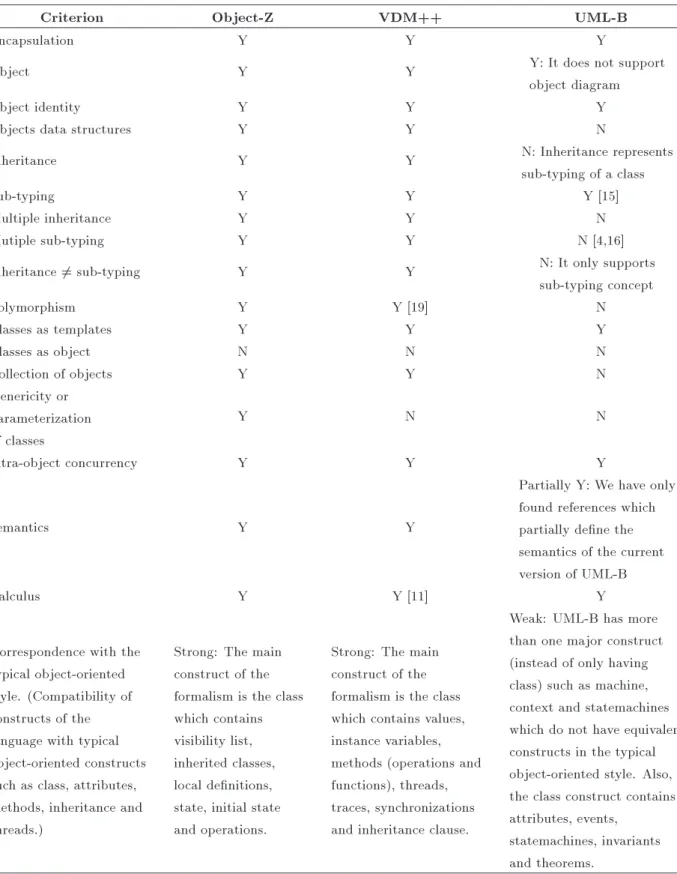
In addition to \polymorphism" and \correspondence with the typical object-oriented style", which we pro-posed as two special criteria, a set of criteria presented in [18] are used in Table 1 to demonstrate a comparison
between UML-B, Object-Z and VDM++ (for more description of these criteria, see [18]). It is worth men-tioning that we added column \UML-B" to Table 1, and the rest come from [18]. In Table 1, \Y" means that the related language bears that feature and \N" stands for lack of that feature.
According to Table 1, we conclude that:
Unlike UML-B, Object-Z and VDM++ have spec-ication styles which correspond to constructs of typical object-oriented programming languages;
Object-Z and VDM++ support important concepts of object-orientation, such as \object" and \multiple inheritance" which have been supported weakly in UML-B.
3. Formal development of object-oriented programs
Formal methods are described to develop object-oriented programs by categorizing them into animation and renement techniques. It must be stated that no constructive approach with the aim of developing object-oriented programs from formal specications has to date been proposed.
3.1. Animation
As mentioned in Section 1, we consider both cat-egories of approaches that have been proposed for animating a formal specication: direct execution and rapid prototyping. Direct execution means that the formal specication statements are executed directly, normally by interpretation. Rapid prototyping refers to any method which directly converts specications to programs in a high-level language by using ad hoc rules.
To investigate animation techniques, we classify them based on their formal specication languages in the following subsections. However, prior to investi-gating these techniques, we should mention that no animation technique for mapping Event-B and UML-B specications into object-oriented code has been proposed to date.
3.1.1. Object-Z
Rafsanjani and Colwill [20] introduced rules to trans-late constants, state variables, inheritance, multiple inheritance, and operations into C++ constructs. Also, they considered a null constructor, a copy constructor, a destructor, and an assignment operator for each class of C++. Johnston and Rose [21] proposed guidelines for manual conversion of class schema, visibility list, inheritance, type denition, state schema, initial state schema and operations to C++ constructs. Fukagawa et al. [22] augmented the work of Rafsanjani and Colwill [20] by considering constructor for types of constants and template classes for generic parameters.
Table 1. Comparing object-oriented specication languages.
Criterion Object-Z VDM++ UML-B
Encapsulation Y Y Y
Object Y Y Y: It does not support
object diagram
Object identity Y Y Y
Objects data structures Y Y N
Inheritance Y Y N: Inheritance represents
sub-typing of a class
Sub-typing Y Y Y [15]
Multiple inheritance Y Y N
Mutiple sub-typing Y Y N [4,16]
Inheritance 6= sub-typing Y Y N: It only supports
sub-typing concept
Polymorphism Y Y [19] N
Classes as templates Y Y Y
Classes as object N N N
Collection of objects Y Y N
Genericity or parameterization of classes
Y N N
Intra-object concurrency Y Y Y
Semantics Y Y
Partially Y: We have only found references which partially dene the semantics of the current version of UML-B
Calculus Y Y [11] Y
Correspondence with the typical object-oriented style. (Compatibility of constructs of the language with typical object-oriented constructs such as class, attributes, methods, inheritance and threads.)
Strong: The main construct of the formalism is the class which contains visibility list, inherited classes, local denitions, state, initial state and operations.
Strong: The main construct of the formalism is the class which contains values, instance variables, methods (operations and functions), threads, traces, synchronizations and inheritance clause.
Weak: UML-B has more than one major construct (instead of only having class) such as machine, context and statemachines which do not have equivalent constructs in the typical object-oriented style. Also, the class construct contains attributes, events,
statemachines, invariants and theorems.
Griths [23] proposed a method which maps Object-Z specications to Eiel code. Ramkarthik and Zhang [9] developed a tool for animation of Object-Z specications to Java code. This tool consists of a main control system, a graphical user interface, XML
manager, and Java skeletal code generator. XML man-ager rst generates a XML document for an Object-Z specication, and then a Java skeletal code generator generates Java code from developed XML documents. In this work, general mapping rules are described for
class schema, class constants, class variables, class invariants, initialization schema, operation schema and visibility lists.
Ni and Zhang [24] developed a tool for conversion of Object-Z specications to Spec# code. Their tool provides a GUI which accepts and facilitates formal specication in Object-Z, converts the Object-Z class schemas to XML representations, and generates a Spec# skeletal code through processing of the XML representation. Spec# skeletal code generated through this tool includes state variables with their types, class constants and initial schema, in addition to class invariants, and all inputs, preconditions and postconditions for operations. Wang et al. [25] pro-posed transformation mechanisms for conversion from Object-Z specications to Java code, which support the mapping of class, inheritance, polymorphism, and object.
Naja and Haghighi [26] described some mapping rules from Object-Z specications to C++ code. Their method supports the mapping of formal generic param-eters, visibility list, local denitions, class union, object aggregation, type denitions, object, state schema, initial state schema, operations, inheritance, multiple inheritance, object containment, and promotion. In another publication, Naja and Haghighi [27] pre-sented general ideas (not specic rules and related code) for mapping some new constructs and cases of Object-Z specications into C++ that have not been considered in [26]. Naja and Haghighi [28] presented another much more comprehensive version of their method, which has advantages, such as covering more Object-Z constructs and proposing mapping rules in a much more detailed way in comparison to the previous work. In addition, they provided templates for constructors and destructors that have not been considered in any previous work. Finally, Naja and Haghighi [29] presented new work that describes mapping rules formally and proves their correctness formally, too.
3.1.2. VDM and VDM++
Jackson [30] presented a method for systematic devel-opment of sequential Ada programs using VDM. His approach is based upon using the facilities of Ada for supporting parameterized abstract data types to implement the primitives of the VDM specication language. Chedgey et al. [31] described the use of VDM in the context of development of software to be targeted at the Ada programing language. Moulding and Newton [32] investigated the formal renement of a VDM specication to an Ada implementation. Also, O'Neill et al. [33] proposed a semiautomatic translation from VDM specication language to Ada, including the translation of composite types, domain equations, and expressions.
Lou [34] described a methodology for deriving C++ implementations from VDM specications. To derive an object-oriented design from a given VDM specication, the methodology tries to link classes, their attributes and member functions in the design, with data types, variables, and operations in the specication, respectively. This process is independent from target object-oriented language. There are four stages in the mentioned transformation: identifying the classes in the design, identifying the attributes within each class, deriving member functions for each class and deriving relationships between the classes. Lou [34] then proposed rules for deriving C++ code from the obtained object-oriented designs.
In addition, code generators exist that convert VDM specications to Smalltalk and Ada95 code [35]. Albalooshi and Long [36] proposed a software devel-opment environment that supports transformation be-tween VDM and Ada. This automatic transformation supports the mapping of VDM types, value denitions, state variables, and methods.
Chartan and Kans [37] proposed a method that maps VDM specications to Java code. It supports the mapping of state, value clauses, state clauses, initialization clauses, invariants, operations, sets, se-quences, composite objects, maps and operators. The CSK group [38] developed a C++ code generator for VDM specications. Their code generator supports approximately 95% of all VDM++ constructs, such as classes, types, functions, operations, instance variables, values, expressions, and statements.
Besides work that maps VDM specications into object-oriented code, there is also work that trans-lates VDM++ specications to object-oriented code. Bousquet [39] describes translation rules which map VDM++ specications to Ada95 code. In addition, the CSK group has developed VDMTools [40,41] for mapping VDM++ specications to Java and C++ code. They support the mapping of class, type denitions, inheritance, function and operation deni-tions, instance variables, value denideni-tions, expressions, statements and class members.
3.2. Renement
We categorize renement techniques into approaches that rene specications to designs, and methods that rene designs to code. The former is also known as refactoring, which is a process of extending a specication to contain design elements [42]. Of course, refactoring is a technique which has long been used by programmers to improve the design of their code once it became unreadable. In this way, refactoring is the term given to the process of remodeling object-oriented software to improve an existing design whilst preserving its behavior [43]. At the formal specication level, however, refactoring means the use of more
general rules, similar to refactoring rules presented by Fowler [43] to introduce designs from specications rather than improve existing designs.
3.2.1. Renement from specication to design
We categorize this group of renement techniques based on their formal specication languages as follows. We only review those renements from specication to design whose corresponding renements from design to object-oriented code have been also proposed. Hence, we do not review existing renements from Z or VDM specications to design, because their renements from design to object-oriented code have not yet been proposed.
3.2.1.1 Object-Z
Derrick and Boiten [44,45] proposed a rule, called downward simulation, to rene one class to another class without considering object references. They also proposed renement of one class to another class in the case of decomposing a class to multiple interacting classes (i.e., by considering object references). More precisely, in comparison to their former work, their later work uses instantiated objects in retrieve rela-tions. However, the needed proof obligations in the two approaches are the same. Smith [46] described a process for renement of the value semantics of classes (a class is denoted as a set of values representing its objects) to the reference semantics of classes (a class is denoted as a set of pointers to values representing its objects).
McComb [47] proposed \annealing" and \coales-cence" rules as refactoring rules for Object-Z speci-cations. The former enables us to decompose one class into two, and the latter allows two classes, A and B, to be replaced with one class, C. Although he proves that these two rules are behavior preserving, they are not powerful enough to derive MVC (Model-View-Controller), as the observer pattern cannot be implemented. The reason for this is that the two rules provide structure modication by reorganizing state information, operations, and classes, but oer no means for adding redundancy to a system or expanding a system at a structural level. Therefore, McComb and Smith [48] have introduced a new behavior preserving rule, called \reection", which adds redundancy to a system or expands a system at a structural level. Also, they [49] proposed a compositional class renement, which is introduced in order to overcome the limitation where coupling constraints between classes make class renement non-compositional. Moreover, Ruhroth [50] described an approach to transfer refactoring tech-niques in programming languages to formal methods through introducing an \Extract method" rule. He proposed a schema for the correctness proof of refac-toring rules.
In another publication, McComb and Smith [42] proposed the following four refactoring rules:
1. Introducing generic parameter: replaces instanti-ated types with new formal parameters;
2. Introducing polymorphism: creates a union of classes through dividing the behavior of a class into separate classes;
3. Introducing inheritance: assists in building an inheritance hierarchy from existing classes;
4. Introducing instances: performs a similar function to the annealing rule; however, it overcomes the restriction of the annealing rule which is limited to introducing only one instance of a new class into the specication. Thus, having this rule, object construction and disposal no longer introduce chal-lenges.
McComb and Smith [51] present a minimal set of refactoring rules, namely \introduce generic param-eters", \introduce inheritance" and \introduce poly-morphism", and show that these rules, along with compositional class renement and annealing, make de-signing in Object-Z completely possible. Furthermore, regarding references to objects of a class that is being rened, McComb and Smith [52] have shown how an arbitrary number of object instances can be introduced into a specication.
Liu and Zhu [53] present a set of refactoring rules which are more ne-grained than the refactoring rules presented by McComb and Smith. These rules are renaming, moving, removing entities (e.g., classes, variables, operations and parameters), adding new entities, replacing expressions with equivalent expres-sions, refactoring (with generic entities, generalization and specialization), separating qualiers, simplifying expressions, explaining literal and simplifying schemas. 3.2.1.2 VDM++
Lano and Goldsack [54] proposed renement, sub-typing and subclassing in VDM++. Also, Goldsack et al. [55] described how verication, as understood in VDM, can be applied to VDM++. In another publication, Goldsack and Lano [56,57] built upon [58], which introduced data decomposition in VDM speci-cations, to formalise annealing for decomposing classes in VDM++. Since they concentrated on invariant distribution in the decomposition process, they did not propose a complete method for object-oriented design based on formal specications. In this work, annealing is proposed in two forms. In both forms, a main class is divided into classes one of which is the client and the rest of which are servers. However, in one form, the client maintains references of instances of servers, while in the other, servers will be held in one class through multiple inheritance.
3.2.1.3 B
In B, renement of an abstract machine is described using a REFINEMENT part. The structure of RE-FINEMENT is similar to the abstract machine struc-ture with two dierences: It does not have parameters and only contains SEES relations. Suppose that we have an abstract machine, M, and its renement, N. The following properties must be satised in order to say that N is a renement of M [59]:
There is a composition of abstract and real states which satises the renement relationship (the cor-respondence between abstract and real states) and invariants of the abstract machine;
Real initial state is a renement of abstract initial state under the conditions dened in both abstract and renement machines;
If we suppose that operation op in abstract and renement machines is dened as follows, then, each execution of Defop,N (when Preop,M is
sat-ised) has a corresponding execution of Defop, M.
y op (x) = y op (x) = PRE Preop, M PRE Preop, N
THEN Defop, M THEN Defop, N
END END
3.2.1.4 Event-B
Metayer et al. [60], and Abrial and Hallerstede [61] proposed the following renements in Event-B:
1. Extending the list of state variables;
2. Adding new carrier sets and new constants to existing sets and constants;
3. Rening abstract events into corresponding con-crete events;
4. Adding new events.
Abrial et al. [62] showed that the proposed method for rening events is not always possible in the development of large systems and, thus, applied some non-deterministic actions to preserve the in-variant instead of rening events. Also, Metayer et al. [60] introduced the concept of generic instantiation. More precisely, a development \M" (i.e., a set of machines and their contexts) is said to be generic if it is parameterized by the carrier sets \s" and the constants \c" that have been accumulated in its contexts. Now, it is possible to instantiate development \M" by instantiating sets \s" and constants \c". In addition, to provide reusability through instantiation, the generic instantiation is also introduced to construct large models more easily.
Abrial [63] has described an Event-B development process and developed a tool on the Rodin Platform which supports Event-B renement. Butler et al. [64]
categorized Event-B renement into feature augmen-tation (the renements of existing model features are maintained, and additional features are added) and structural renement (detailed design is added to the implementation).
Butler [65,66] modelled atomicity decomposition (i.e., event decomposition) by which more ne-grained atomicities could be obtained through the renement of a coarse-grained atomicity by means of an event renement diagram. Also, Butler proposed the notion of basic parallel composition (i.e., k) and parallel composition with shared event operators. Finally, he described machine decomposition using the compo-sition operator in reverse. Abrial [67] proposed an event model decomposition in which for decomposing an event model, M, rstly, M is split into several sub-models, say N, ..., P. Next, the events and then the variables of M are partitioned over sub-models. Then, sub-models are rened several times independently yielding, eventually, NR,..., PR.
The decomposition of machines is where an Event-B machine is separated into a number of smaller components that are easier to manage [4]. Machine decomposition in Event-B is in the style of either shared variable decomposition or shared event decomposition. The former style of machine decomposition is also proposed by Abrial [67], Metayer et al. [60], Abrial and Hallerstede [61] and also Jones [68] in which a machine is decomposed into two or more machines, based on an arbitrary shared variable. Shared variables are those accessed by the events of dierent sub-machines.
Shared event decomposition is also proposed by Butler [65]. In this style of machine decomposition, a machine is decomposed into an arbitrary number of sub-machines, based on a shared event in that machine. Also, Pascal and Silva [69] developed a tool for both styles of machine decomposition as a decomposition plug-in of the Rodin platform. Silva et al. [70] described a complete specication of the mentioned decomposition plug-in. Also, they developed context decomposition as a plug-in of the Rodin platform. Furthermore, Hoang and Abrial [71] proposed an ap-proach to develop parallel programs using renement and decomposition.
Poppleton [72] proposed Event-B model compo-sition based on shared variables. More precisely, he introduced Event-B model composition by introducing the notion of event fusion and model fusion. In order to perform model fusion, he divided the variables of two models, which are considered to be composed into two lists; \actioned variables" and \skipping variables". Thus, the composed model has variables existing in the intersection of actioned and skipping variables of two models. Also, its events are obtained through applying an event fusion operator on the events of two models. Finally, contexts and invariants of the composed model
are a conjunction of the contexts and invariants of the two models.
Silva and Butler [73] proposed a shared event decomposition which is necessary to recompose de-composed machines. They have described this form of composition through adding the composed machine notation to Event-B, and also using the notion of a parallel composition operator for events. Moreover, they developed a tool to support composition in Event-B as a plug-in of the Rodin platform. In another related work, Silva and Butler [74] proposed a way to instantiate generic models, previously dened by Meteyer et al. [60]. More precisely, they introduced the notion of an instantiated machine that allows one to replace elements in the context(s) of generic development and to rename variables and events in the generic development.
Hallerstede et al. [75] provided a detailed de-scription of renement in Event-B. This dede-scription was then used to assist simultaneous animation of multiple levels of renement. Finally, besides work rening Event-B specications directly, there is work which renes Event-B specications through B method renements using Atelier-B [76]. In other words, Atelier-B supports the renement of Event-B speci-cations through mapping of Event-B specispeci-cations into B method specications, and then renement of B method specications.
3.2.1.5 UML-B
Said et al. [77] proposed rules for rening classes and state machines. Renement of classes can be done by either removing or adding attributes. To rene a state machine, its structure should be elaborated either by replacing each transition by one or more transitions or by elaborating an abstract state by a nested state machine. In addition, a technique for moving class events is proposed in [77].
Also, Said [4] proposed a more complete approach for renement of UML-B specications. Rules given in [4] support the renement of machines, classes, state machines and context diagrams. Rules for rening machines include \decomposition with a shared event approach", \composition" and also \machine rene-ment via rening its class diagram". Rules for rening class diagrams include machine variables, events and invariant renements (similar to Event-B rules for rening these constructs), class and state machine renements, adding new classes and dropping abstract classes. The followings are rules for class renement:
1. Introducing new associations and attributes;
2. Dropping abstract associations and attributes;
3. Renement of class events and invariants (similar to Event-B rules for rening these constructs). Besides the two ways proposed in [77] for the renement
of state machines, Said [4] introduces a attening state machine (renement of a machine with nested state machines to a state machine without any nested state machines) and state grouping (adding a new structure or state to a state machine and nesting some of its states in the new structure). Rules for rening context diagrams include introducing new associations and at-tributes to the extended classtype and also introducing new classtypes to the renement. Other rules support a moving event or transition in the renement class or new class.
3.2.2. Renement from specication to code
This group of renement techniques is categorized based on their formal specication languages, as fol-lows.
3.2.2.1 Object-Z
Besides Derrick and Boiten [44,45] who rene one class schema to another class schema, there are other researchers who rene Object-Z into code using Perfect Developer [78,79] and Spec# [80]. Stevens [78] and Kimber [79] demonstrated how an Object-Z specica-tion can be expressed in Perfect and rened towards an implementation. Qin and He [80] described a linking process between Object-Z and Spec#.
In another publication, Naja and Haghighi [81] described a set of mapping functions that map Object-Z constructs to Morgan's Renement Calculus (MRC) [82] constructs. Using the provided mappings, the specier can develop nal programs by applying MRC rules to resulting MRC specication constructs. 3.2.2.2 VDM++
Based on our investigations, there is no work in VDM++ in this area.
3.2.2.3 B
B provides a notation for implementation which is a basis for translating abstract machine/renement into code. The form of IMPLEMENTATION is as follows:
IMPLEMENTATION Name
REFINES component (machine or renement) SEES seen machines
IMPORTS imported machines
PROMOTES operations of imported machines (without any changes)
SETS local sets
CONSTANTS scalar local constants VALUES local values
INVARIANT relationship between rened and imported states
OPERATIONS implementation of rened operations
END
The IMPLEMENTATION clause introduces the name of implementation;
The REFINES clause contains the name of the rened component (also called abstraction) for the renement;
The SEES clause consists of a list of instances of seen machines;
The IMPORTS clause contains the declaration of the list of imported machine instances and creates concrete instances of the modules in a project. The implementation creates the imported abstract machine instance to use its data and operations to implement its own data and operations;
The PROMOTES clause introduces a list of pro-moted operations of instances of included machines;
The SETS clause introduces the sets which are used in the implementation;
The CONSTANTS clause introduces the constants which are used in the implementation;
The VALUES clause is used to assign values to the deferred sets and to the concrete constants;
The INVARIANT clause indicates the relationship between rened and imported states. It consists of predicates separated by a conjunction operator;
The OPERATIONS clauses are made up of concrete expressions or substitutions.
Some proof obligations have been dened to show that an implementation implements a rene-ment/abstract machine appropriately. In addition, Atelier-B [76] has been developed that supports code generation from B specications to Ada and C++ code. 3.2.2.4 Event-B
Although ProB is an animator for Event-B, it does not support Event-B code generation; hence, we would like to mention some works approaching Event-B code generation.
Based on [83-85], one can link Event-B specica-tions with concurrent object-oriented programs using Object-oriented Concurrent-B (OC-B). In this way, specication of concurrency issues and reasoning about them in an abstract manner become possible. For this purpose, Edmunds and Butler interpreted details of concurrent features, such as processes and monitors, in Event-B. Then, they introduced an approach to rene Event-B specications to their OC-B counter-parts. Finally, they described the mapping of OC-B specications to object-oriented code (for example, in Java). Also, they have developed a tool which is based on Eclipse, and maps Event-B specications to object-oriented code.
As another related work, Edmunds and But-ler [86] showed how one could develop the Ada source
code from Event-B specications. For this purpose, they introduced an extension of Event-B, called Task-ing Event-B, which includes taskTask-ing and shared ma-chines. Using this approach, one can convert Event-B models to Tasking Event-B models, and then convert Tasking Event-B models to Ada code using translation rules and decomposition rules dened for Event-B, and also extension rules dened for Tasking Event-B. Moreover, Edmunds, Rezazadeh, and Butler [87] describe a streamline process, where the abstract mod-elling artefacts are mapped to Ada language constructs using renement, decomposition, and implementation annotations.
In addition, Mery and Singh [88] developed a set of software tools, i.e. EB2C, EB2C++, EB2J and EB2C#, that generate programming code in C, C++, Java, and C# from Event-B specications, respectively. These tools perform code generation from Event-B models using Event-B grammar and through syntax-directed translation, code scheduling architecture and verication of an automatic code generation. EB2C, EB2C++, EB2J and EB2C# have been developed as a set of Rodin plug-ins under the Eclipse development framework. In comparison to [83,84], these tools support set theory based notations.
3.2.2.5 UML-B
The current code generation technique for UML-B specications is based on using the Event-B code generation tool [83-85]. UML-B specications are rst converted to Event-B specications using the U2B tool [89]. Then, an object-oriented code is generated using the Event-B code generation tool. Some conver-sion rules of the U2B tool are described in Table 2.
Table 2. Mapping rules from UML-B constructs to Event-B constructs.
UML-B construct Event-B construct Machine Implicit context and machine
Class Machine variable
Class attribute
Machine variable with an invariant which demonstrates attribute membership in a relationship between its class and its type Class event Machine event Class invariant Machine invariant Class theorems Machine theorems
Context Context
ClassType Context sets ClassType association Context constant State machine transition Machine event
4. Comparison
In this section, we rst dene a set of criteria used to compare overviewed formal, object-oriented program development techniques. Then, these techniques will be compared in terms of the given criteria.
4.1. Criteria denition
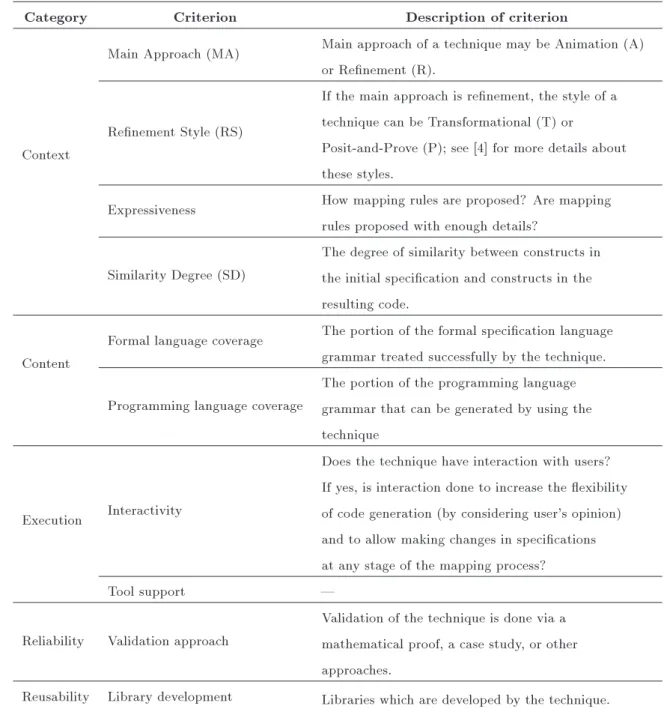
Table 3 shows the criteria that will be used for com-paring formal, object-oriented program development techniques:
Remarks:
> Two main styles are considered for the \Renement
Style": \Posit-and-Prove" is where a renement of specication is proposed and then justied against its abstract specication via the verication of a set of proof obligations, and \Transformational" renement is where algorithms or rules are applied to a specication to generate a more concrete specication [4].
> For \Expressiveness" criterion, we determine whether \Mapping rules are proposed with enough details (and thus are informative enough to show various aspects and cases of the mapping) or not" based on our intuition.
> A high \Similarity Degree" makes it easier for the
Table 3. Criteria for comparing formal, object-oriented program development techniques.
Category Criterion Description of criterion
Context
Main Approach (MA) Main approach of a technique may be Animation (A) or Renement (R).
Renement Style (RS)
If the main approach is renement, the style of a technique can be Transformational (T) or
Posit-and-Prove (P); see [4] for more details about these styles.
Expressiveness How mapping rules are proposed? Are mapping rules proposed with enough details?
Similarity Degree (SD)
The degree of similarity between constructs in the initial specication and constructs in the resulting code.
Content
Formal language coverage The portion of the formal specication language grammar treated successfully by the technique.
Programming language coverage
The portion of the programming language grammar that can be generated by using the technique
Execution Interactivity
Does the technique have interaction with users? If yes, is interaction done to increase the exibility of code generation (by considering user's opinion) and to allow making changes in specications at any stage of the mapping process?
Tool support |
Reliability Validation approach
Validation of the technique is done via a mathematical proof, a case study, or other approaches.
developer to understand how some constructs in the nal programming language correspond to some specication constructs and vice versa.
> We regard \Programming language coverage" as a criterion because using some special constructs of the programming language (such as macro and the notion of operator overloading in C++) may provide more ecient programs and also reveal the distinguishing features of programming languages between them.
4.2. Comparison between techniques 4.2.1. Context
As Tables A.1 to A.3 of [90] show, 30% of the existing formal methods for object-oriented program develop-ment are animation, and 70% of them are renedevelop-ment. Most of the existing animation techniques:
1. Propose their mapping rules using natural lan-guage, while formal presentation of mapping rules increases precision and provides the possibility of proving the correctness of the method (the correct-ness of the mapping rules) formally.
2. Do not consider special cases of constructs in the specication language when presenting their map-ping rules; however, they describe these rules with enough level of detail. For example, in animation of Object-Z specications, the mapping of a local abbreviation denition when its left hand side is a variable name, and its right-hand side is the class union, has never been covered in many related publications, such as [20-22].
3. Benet from a degree of high similarity.
In contrast, most of the existing renement techniques propose their renement rules using both natural language and rst order predicate logic. Also, they propose their rules with enough level of de-tail.
4.2.2. Content
As Tables B.1 to B.3 of [90] show, none of the existing animation techniques cover all constructs of the formal specication language. Instead, most of the existing animation and renement techniques propose rules for mapping common constructs of the formal specication language. Moreover, they use a small set of programming language constructs in their map-pings.
4.2.3. Execution
Object-Z: Most of the techniques available for ani-mating Object-Z specications interact with users and are not fully automatic. Also, few existing renement techniques for the mentioned language have tool support.
VDM and VDM++: Most of the existing animation and renement techniques for these languages, in papers to which we had access, have tool support. In addition, all of them, except [34,36], have interaction with users.
B, Event-B and UML-B: Considering Table C.3 of [90], most of the renement techniques for B, Event-B and UML-B specications have tool sup-port and interact with users.
In addition, all the existing techniques (either anima-tion or renement), except [27,28,34,36,88], regard in-teractivity only for the purpose of getting specications and lling those parts of the code whose techniques cannot present any mapping and cannot conrm the correctness of the performed mapping with users. In this case, we put \Y: Weak", in Tables C.1 to C.3 of [90], because interaction with users can also be done for other reasons, such as:
Increasing exibility of techniques by considering user opinion when obtaining code from specica-tions;
Requesting and making changes in specications at any stage when executing the mapping process. 4.2.4. Reliability
As Tables D.1 to D.3 of [90] show, most existing works, except [29] try to validate their methods based on case studies, while using mathematical proof is a more powerful validation approach.
4.2.5. Reusability
As Tables E.1 to E.3 of [90] show, most existing techniques did not develop libraries for their mapping rules.
5. Conclusion and future work
Using object-orientation in formal program develop-ment has led to methods which have the advantages of both formal methods and object oriented approaches. In this paper, we rst compared Object-Z, VDM++ and UML-B specication languages. Then, we re-viewed existing formal, object-oriented program devel-opment from Object-Z, VDM, VDM++, B, Event-B and UML-B specications. Finally, we compared these methods according to a set of criteria classied into categories of context, content, reliability, reusability, and execution.
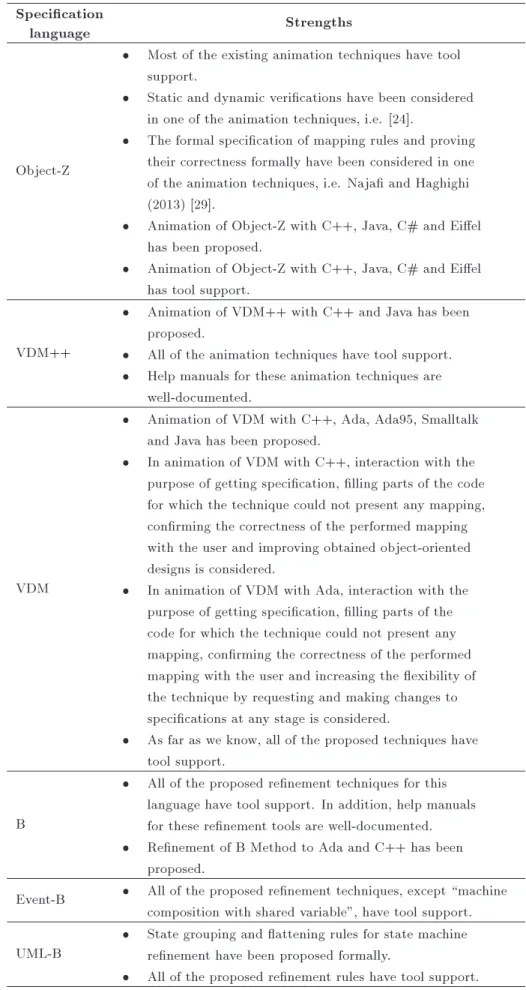
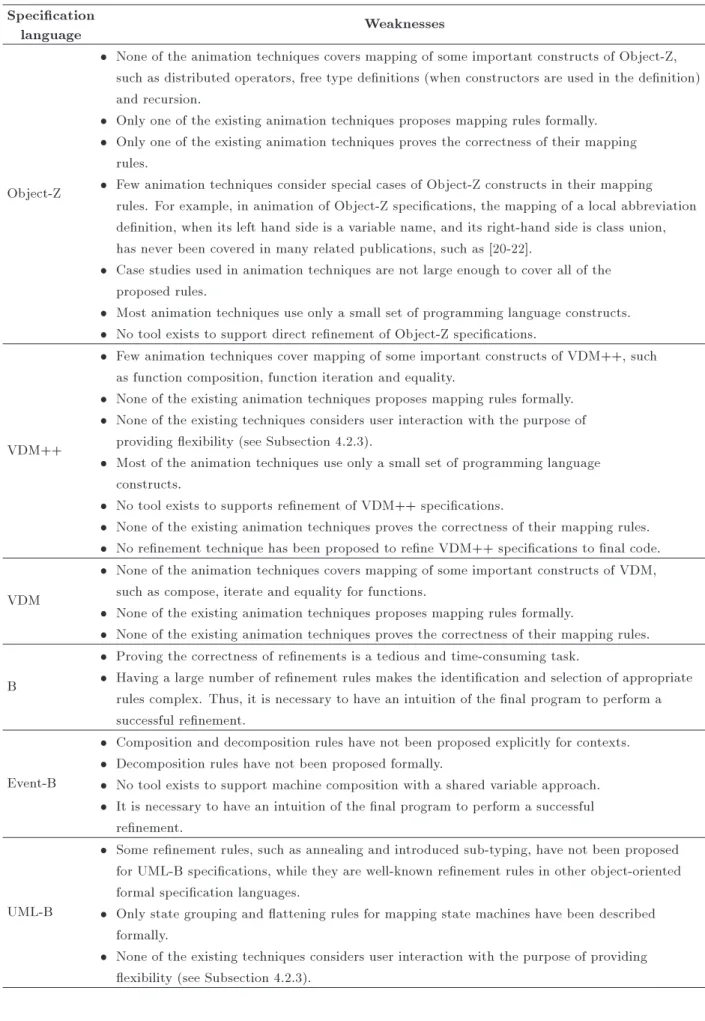
Tables 4 and 5 show a summary of our investiga-tion. Some interesting topics for future work can be extracted from these two tables, along with detailed information extracted from the tables shown in [90] in order to reduce the weaknesses of existing methods while preserving their strengths through presenting new formal methods for object-oriented program de-velopment.
Table 4. Strengths of existing formal methods for object-oriented program development. Specication
language Strengths
Object-Z
Most of the existing animation techniques have tool support.
Static and dynamic verications have been considered in one of the animation techniques, i.e. [24].
The formal specication of mapping rules and proving their correctness formally have been considered in one of the animation techniques, i.e. Naja and Haghighi (2013) [29].
Animation of Object-Z with C++, Java, C# and Eiel has been proposed.
Animation of Object-Z with C++, Java, C# and Eiel has tool support.
VDM++
Animation of VDM++ with C++ and Java has been proposed.
All of the animation techniques have tool support. Help manuals for these animation techniques are
well-documented.
VDM
Animation of VDM with C++, Ada, Ada95, Smalltalk and Java has been proposed.
In animation of VDM with C++, interaction with the purpose of getting specication, lling parts of the code for which the technique could not present any mapping, conrming the correctness of the performed mapping with the user and improving obtained object-oriented designs is considered.
In animation of VDM with Ada, interaction with the purpose of getting specication, lling parts of the code for which the technique could not present any mapping, conrming the correctness of the performed mapping with the user and increasing the exibility of the technique by requesting and making changes to specications at any stage is considered.
As far as we know, all of the proposed techniques have tool support.
B
All of the proposed renement techniques for this language have tool support. In addition, help manuals for these renement tools are well-documented. Renement of B Method to Ada and C++ has been
proposed.
Event-B All of the proposed renement techniques, except \machine composition with shared variable", have tool support. UML-B
State grouping and attening rules for state machine renement have been proposed formally.
Table 5. Weaknesses of existing formal methods for object-oriented program development. Specication
language Weaknesses
Object-Z
None of the animation techniques covers mapping of some important constructs of Object-Z, such as distributed operators, free type denitions (when constructors are used in the denition) and recursion.
Only one of the existing animation techniques proposes mapping rules formally. Only one of the existing animation techniques proves the correctness of their mapping
rules.
Few animation techniques consider special cases of Object-Z constructs in their mapping rules. For example, in animation of Object-Z specications, the mapping of a local abbreviation denition, when its left hand side is a variable name, and its right-hand side is class union, has never been covered in many related publications, such as [20-22].
Case studies used in animation techniques are not large enough to cover all of the proposed rules.
Most animation techniques use only a small set of programming language constructs. No tool exists to support direct renement of Object-Z specications.
VDM++
Few animation techniques cover mapping of some important constructs of VDM++, such as function composition, function iteration and equality.
None of the existing animation techniques proposes mapping rules formally. None of the existing techniques considers user interaction with the purpose of
providing exibility (see Subsection 4.2.3).
Most of the animation techniques use only a small set of programming language constructs.
No tool exists to supports renement of VDM++ specications.
None of the existing animation techniques proves the correctness of their mapping rules. No renement technique has been proposed to rene VDM++ specications to nal code.
VDM
None of the animation techniques covers mapping of some important constructs of VDM, such as compose, iterate and equality for functions.
None of the existing animation techniques proposes mapping rules formally.
None of the existing animation techniques proves the correctness of their mapping rules.
B
Proving the correctness of renements is a tedious and time-consuming task.
Having a large number of renement rules makes the identication and selection of appropriate rules complex. Thus, it is necessary to have an intuition of the nal program to perform a successful renement.
Event-B
Composition and decomposition rules have not been proposed explicitly for contexts. Decomposition rules have not been proposed formally.
No tool exists to support machine composition with a shared variable approach. It is necessary to have an intuition of the nal program to perform a successful
renement.
UML-B
Some renement rules, such as annealing and introduced sub-typing, have not been proposed for UML-B specications, while they are well-known renement rules in other object-oriented formal specication languages.
Only state grouping and attening rules for mapping state machines have been described formally.
None of the existing techniques considers user interaction with the purpose of providing exibility (see Subsection 4.2.3).
References
1. Naur, P. and Randell, B., Eds. \Software engineering", Report on a Conference Sponsored by the NATO Sci-ence Committee, Scientic Aairs Division (1969).
2. Mirian-Hosseinabadi, S.H. \Constructive Z", Ph.D. Thesis, University of Essex, Essex, UK (1997).
3. Kemmerer, R.A. \Testing formal specications to detect design errors", Software Engineering, IEEE Transactions (1985).
4. Said, M.Y. \Methodology of renement and decom-position in UML-B", Ph.D. Thesis, University of Southampton, Southampton, UK (2010).
5. Beeson, M.J., Foundations of Constructive Mathemat-ics: Mathematical Studies, Springer-Verlag (1985).
6. Naja, M. and Haghighi, H. \Formal methods to develop object-oriented programs: A survey", Second World Conference on Information Technology, An-talya, Turkey (2011).
7. Smith, G., The Object-Z Specication Language, Kluwer Academic Publishers, USA (2000).
8. Duke, R. and Rose, G., Formal Object-Oriented Spec-ication Using Object-Z, Macmillan, UK (2000).
9. Ramkarthik, S. and Zhang, C. \Generating java skele-tal code with design contracts from specications in a subset of object-Z", In Fifth IEEE/ACIS Int. Conf. on Computer and Information Science, Honolulu, HI, pp. 405-411 (2006). [doi: 10.1109/ICIS-COMSAR.2006.41]
10. Durr, E. and Katwijk, J.V. \VDM++: A formal specication language for object-oriented designs", Computer Engineering and Software Systems (Com-pEuro'92), pp. 214-219 (1992). [doi: 10.1109/CM-PEUR.1992.218511]
11. Fitzgerald, P., Larsen, P.G., Mukerji, P., Plat, N. and Verhoef, M., Validated Designs For Object-Oriented Systems, Springer-Verlag, USA (2004).
12. CSK Corporation, The VDM++ Language Manual 1.0, Available at: http://www.vdmtools.jp/en/ mod-ules/tinyd2/index.php?id=2/langmanpp a4E.pdf (2010).
13. Booch, G., Jacobson, I. and Rumbaugh, J., The Unied Modeling Language - A Reference Manual, Addison Wesley (1998).
14. Snook, C., Butler, M. and Oliver, I. \The UML-B prole for formal systems modeling in UML", ACM Transactions on Software Engineering and Methodol-ogy (TOSEM), 15(1), pp. 92-122 (2004).
15. Snook, C. and Butler, M. \UML-B: Formal modeling and design aided by UML", ACM Transactions on Software Engineering and Methodology, 15(1), pp. 92-122 (2006).
16. Snook, C. and Butler, M. \UML-B and event-B: An integration of languages and tools", In The IASTED Int. Conf. on Software Engineering, pp. 1-6 (2008). [doi: 10.1016/j.infsof.2007.10.010]
17. Joochim, T. \Bringing requirements engineering to formal methods: timing diagrams for event-B and KAOS", Ph.D. Thesis, University of Southampton, Southampton, UK (2010).
18. Guel, N., Biberstein, O., Buchs, D., Canver, E., Gaude, M.C., Henke, F.V. and Schwier, D. \Com-parison of object-oriented formal methods", Technical Report of the Esprit Long Term Research Project 20072 \Design for Validation", University of New-castle Upon Tyne, Department of Computing Science (1997).
19. Chrietensen, T.J.H. \Extending the VDM++ formal specication language with type inference and generic classes", M.S. Thesis, University of Aarhus, Aarhus, Denmark (2007).
20. Rafsanjani, G. and Colwill, S.J. \From object-Z to C++: A structural mapping", In Z User Meeting (ZUM'92), pp. 166-179 (1992).
21. Johnston, W. and Rose, G. \Guidelines for the manual conversion of object-Z to C++", SVRC Technical Report No. 93-14, University of Queensland, Canada (1993).
22. Fukagawa, M., Hikita, T. and Yamazaki, H. \A mapping system from object-Z to C++", In First Asia-Pacic Software Engineering Con-ference (APSEC94), pp. 220-228 (1994). [doi: 10.1109/APSEC.1994.465258]
23. Griths, A. \From object-Z to Eiel: A rigorous development method", Technology of Object-Oriented Languages and Systems: TOOLS 18, Prentice-Hall (1995).
24. Ni, X. and Zhang, C. \Converting specications in a subset of object-Z to skeletal spec# code for both static and dynamic analysis", Journal of Object Technology, 7(8), pp. 165-185 (2008). [doi: 10.5381/jot.2008.7.8.a6]
25. Wang, Z., Xia, M. and Zhao, Y. \Transform mech-anisms of object-Z based formal specication to java", In Computational Intelligence and Software Engineering (CISE), Wuhan, pp. 1-4 (2009). [doi: 10.1109/CISE.2009.5365403]
26. Naja, M. and Haghighi, H. \An animation approach to develop C++ code from object-Z specications", CSI International Symposium on Computer Science and Soft-ware Engineering (CSSE 2011), Tehran, Iran, pp. 9-16 (2011). [doi: 10.1109/CSICSSE.2011.5963990]
27. Naja, M. and Haghighi, H. \An approach to develop C++ code from object-Z specications", In Second World Conference on Information Technology, An-talya, Turkey (2011).
28. Naja, M. and Haghighi, H. \An approach to animate object-Z specications using C++", Sci-entia Iranica, 19(6), pp. 1699-1721 (2012). [doi: 10.1016/j.scient.2012.06.021]
29. Naja, M. and Haghighi, H. \A formal mapping from object-Z specication to C++ code", Scientia Iranica, 20(6), pp. 1953-1977 (2013).
30. Jackson, M.I. \Developing Ada programs using the Vienna development method (VDM)", Software: Prac-tice and Experience, 15(3), pp. 305-318 (1985).
31. Chedgey, C., Kerney, S. and Kugler, H. \Using VDM in an object-oriented development method for Ada software", VDM-Europe Symposium 1987 on VDM'87: VDM - A Formal Method at Work, LNCS 252, pp. 63-76 (1987). [doi: 10.1007/3-540-163-7654-3 5]
32. Moulding, M.R. and Newton, A.R. \Rapid prototyping from VDM specications using Ada", IEEE Colloqium on Automating Formal Methods for Computer Assisted Prototyping, London, UK, pp. 11-22 (2002).
33. O'Neill, D., Bloomeld, R., Marshall, L. and Jones, R. \VDM development with Ada as the target language", VDM'88-The Way Ahead, LNCS 328, pp. 116-123 (1988). [doi: 10.1007/3-540-50214-9 11]
34. Lou, Y. \VDM/C++: A design and implementation framework", M.S. Thesis, Concordia University, Mon-treal, Canada (1994).
35. Katwijk, J.V., Durr, E. and Goldsack, S. \Hy-brid object-oriented real-time software development", In First IEEE Int. Conf. on Formal Engineering Methods, Hiroshima, Japan, pp. 17-26 (1997). [doi: 10.1109/ICFEM.1997.630393]
36. Albalooshi, F. and Long, F. \Multiple view environ-ment supporting VDM and Ada", IEEE Proceedings Software, 146(4), pp. 203-219 (2002). [doi: 10.1049/ip-sen:19990487]
37. Chartan, Q. and Kans, A., Formal Software Develop-ment: from VDM to Java, Palgrave Macmillan, China (2004).
38. CSK Corporation, The VDM-SL to C++ Code Generator Manual 1.0, Available at: http://www. vdmtools.jp/en/modules/tinyd2/index.php?id=2/ cg-mansl a4E.pdf (2010).
39. Bousquet, F. \VDM++ to Ada95 translation rules", Technical Report VICE-MBDF-17, MatraBAe Dy-namics, Rue Grange Dame Rose 20/22, 78141 Velizy-Villacoublay, France (2000).
40. CSK Corporation, The VDM++ to C++ Code Generator Manual 1.0, Available at: http://www. vdmtools.jp/en/modules/tinyd2/index.php?id=2/ cg-manpp a4E.pdf (2010).
41. CSK Corporation, The VDM++ to Java Code Gen-erator Manual 1.1, Available at: http://www. vdm-tools.jp/en/modules/tinyd2/index.php?id=2/ javacg-manpp a4E.pdf (2010).
42. McComb, T. and Smith, G. \Refactoring object-oriented specications: A process for deriving de-signs", Technical Report SSE-2006-01, University of Queensland, Aus-tralia (2006).
43. Fowler, M., Refactoring: Improving the Design of Existing Code, Addison Wesly (1999).
44. Derrick, J. and Boiten, E.A. \Renement of objects and operations in object-Z", Int. Conf. on Formal
Methods for Open Object-Based Distributed Systems IV, IFIP Advances in Information and Communica-tion Technology, Stanford, California, USA, pp. 257-277 (2000). [doi: 10.1007/978-0-387-35520-7 13]
45. Derrick, J. and Boiten, E.A. \Renement in Z and object-Z: Foundations and advanced applications", 1st Ed., Formal Approaches to Computing and Informa-tion Technology, Springer-Verlag (2001).
46. Smith, G. \Introducing reference semantics via rene-ment", In Fourth Int. Conf. on Formal Engineering Methods: Formal Methods and Software Engineering, pp. 588-599 (2002).
47. McComb, T. \Refactoring object-Z specications", Fundamental Approaches to Software Engineering, Barcelona, Spain, LNCS 2984, pp. 69-83 (2004). [doi: 10.1007/978-3-540-24721-0 5]
48. McComb, T. and Smith, G. \Architectural de-sign in object-Z", Australian Software Engineer-ing Conference (ASWEC), pp. 77-86 (2004). [doi: 10.1109/ASWEC.2004.1290460]
49. McComb, T. and Smith, G. \Compositional class renement in object-Z", In FM2006: Formal Methods Conference, Hamilton, Canada, LNCS 4085, pp. 205-220 (2006). [doi: 10.1007/11813040 15]
50. Ruhroth, T., Refactoring Object-Z Specications, Available at: http://citeseerx.ist.psu.edu/viewdoc/ download?doi= 10.1.1.106.2651.pdf (2006).
51. McComb, T. and Smith, G. \A minimal set of refactoring rules for object-Z", Formal Methods for Open Object-Based Distributed Systems, Oslo, Norway, LNCS 5051, pp. 170-184 (2008). [doi: 10.1007/978-3-540-68863-1 11]
52. McComb, T. and Smith, G. \Introducing objects through renement", In FM2008: Formal Methods Conference, Turku, Finland, LNCS 5014, pp. 358-373 (2008). [doi: 10.1007/978-3-540-68237-0 25]
53. Liu, H. and Zhu, B. \Refactoring formal specications in object-Z", In International Conference on Computer Science and Software Engineering, Wuhan, Hubei, pp. 342-345 (2008). [doi: 10.1109/CSSE.2008.260]
54. Lano, K. and Goldsack, S.J. \Renement, subtyping and subclassing in VDM++. computing", Workshop on Theory and Formal Methods, pp. 341-363 (1994).
55. Goldsack, S.J., Durr, E.H. and Plat, N. \Object rei-cation in VDM++", ICSE 17: Workshop on Formal Methods Application in Software Engineering Practice, pp. 194-201 (1995).
56. Goldsack, S.J. and Lano, K. \Annealing and data decomposition in VDM++", ACM SIGPLAN, 13(4), pp. 32-38 (1996).
57. Lano, K. and Goldsack, S. \Renement of distributed object systems", Workshop on Formal Methods for Open Object-based Distributed Systems, Chapman and Hall (1996).
tractable development of programs", ACM SIGPLAN Notices, 30(9), pp. 41-50 (1995).
59. Lano, K. \Specication in B: An introduction using the B toolkit", World Scientic Publishing Company, Imperial College Press (1996).
60. Metayer, C., Abrial, J.R. and Voisin, L. \Event-B language", Technical Report, Deliverable 3.2, EU Project IST-511599-RODIN (2005).
61. Abrial, J.R. and Hallerstede, S. \Renement, decom-position, and instantiation of discrete models: Appli-cation to event-B", Fundamenta Informaticae, 77(1-2), pp. 1-28 (2007). [doi: 10.1145/362575.362577]
62. Abrial, J.R., Cansell, D. and Mery, D. \Renement and reachability in event-B", In Fourth International Conference of B and Z Users, Guildford, UK, LNCS 3455, pp. 222-241 (2005). [doi:10.1007/11415787 14]
63. Abrial, J.R. \A system development process with event-B and the rodin platform", In Ninth Inter-national Conference on Formal Methods and Soft-ware Engineering, LNCS 4789, pp. 1-3 (2007). [doi: 10.1007/978-3-540-76650-6 1]
64. Butler, M., Abrial, J.R., Damchoom, K. and Edmunds, A. \Applying event-B and Rodin to the le store", Abstract State Machines, B and Z, London, UK, ASRNET (2008).
65. Butler, M. \Synchronization-based decomposition for event-B", RODIN Deliverable D19 Intermediate Re-port on Methodology (2006).
66. Butler, M. \Incremental design of distributed systems with event-B", Engineering Methods and Tools for Software Safety and Security, Marktoberdorf Summer School 2008, IOS Press, pp. 131-160 (2008). [doi: 10.3233/978-1-58603-976-9-131]
67. Abrial, J.R. \Event model decomposition", Technical Report, 626, ETH Zurich (2009)
68. Jones, C.B. \RODIN deliverable D19", Intermediate Report on Methodology, Available at: http://rodin.cs.ncl.ac.uk/deliverables/D19.pdf, Technical report, University of Newcastle-upon-Tyne, UK (2006).
69. Pascal, C. and Silva, R. \Event-B model decomposi-tion", DEPLOY Plenary Technical Workshop (2009).
70. Silva, R., Pascal, C., Hoang, T.S. and Butler, M. \Decomposition tool for event-B", Workshop on Tool Building in Formal Methods- ABZ Conference (2010).
71. Hoang, T.S. and Abrial, J.R. \Event-B decomposition for parallel programs", In Second Int. Conf. on Ab-stract State Machines, Alloy, B and Z, pp. 319-333 (2010). [doi: 10.1007/978-3-642-11811-1 24]
72. Poppleton, M. \The composition of event-B models", In First Int. Conf. on Abstract State Machines, B and Z, London, UK, pp. 209-222 (2008). [doi: 10.1007/978-3-540-87603-8 17]
73. Silva, R. and Butler, M. \Supporting reuse mech-anisms for developments in event-B: Composition",
Technical Report ECS, University of Southampton, Southampton, UK (2009).
74. Silva, R. and Butler, M. \Supporting reuse of event-B developments through generic instantiation", In Eleventh Int. Conf. on Formal Engineering Methods: Formal Methods and Software Engineering (ICFEM), pp. 466-484 (2010). [doi: 10.1007/978-3-642-10373-5 24]
75. Hallerstede, S., Leuschel, M. and Plagge, D. \Renement-animation for event-B-towards a method for validation", In Second International Conference on Abstract State Machines, Alloy, B and Z, LNCS 5977, pp. 287-301 (2010). [doi: 10.1007/978-3-642-11811-1 22]
76. Atelier-B, Available at: http://www.atelierb.eu/en/ atelier-b-tools/atelier-b-4-0/ (2011).
77. Said, M.Y., Butler, M. and Snook, C. \Language and tool support for class and state machine renement in UML-B", FM 2009: Formal Methods, pp. 579-595 (2009). [doi: 10.1007/978-3-642-05089-3 37]
78. Stevens, B. \Implementing object-Z with perfect devel-oper", Journal of Object Technology, 6(2), pp. 189-202 (2006). [doi: 10.5381/jot.2006.5.2.a5]
79. Kimber, T.G. \Object-Z to perfect developer", M.S. Thesis, Imperial College Lon-don, London, UK (2007).
80. Qin, S. and He, G. \Linking object-Z with spec#", In Twelfth IEEE Int. Conf. on Engineering Complex Computer Systems, Auckland, New Zealand, pp. 185-196 (2007). [doi: 10.1109/ICECCS.2007.27]
81. Naja, M. and Haghighi, H. \Renement of object-Z specications using Morgan's renement calculus", In Int. Conf. on Software Engineering and Technology (ICSET2011), Venice, Italy, pp. 1735-1744 (2011).
82. Morgan, C., Programming from Specications, Prentice-Hall (1990).
83. Edmunds, A. and Butler, M. \Linking event-B and concurrent object-oriented programs", Thir-teenth BAC-FACS Renement Workshop (REFINE 2008), ENTSC 214, pp. 159-182 (2008). [doi: 10.1016/j.entcs.2008.06.008]
84. Edmunds, A. and Butler, M. \Tool support for Event-B code generation", Workshop on Tool Event-Building in Formal Methods, Quebec, Canada (2010).
85. Edmunds, A. \Providing concurrent implementations for event-B developments", Ph.D. Thesis, University of Southampton, Southampton, UK (2010).
86. Edmunds, A. and Butler, M. \Tasking event-B: An extension to event-B for generating concurrent code", Programming Language Approaches to Concurrency and Communication-Centric Software, Saarbrucken, Germany (2011).
modelling for Ada implementations: Tasking event-B", In Ada-Europe, LNCS, 7308, pp. 119-132 (2012).
88. Mery, D. and Singh, N.K. \Automatic code generation from event-B models", In Second Symposium on Infor-mation and Communication Technology, ACM Press, pp. 179-188 (2011). [doi: 10.1145/2069216.2069252]
89. Snook, C. and Butler, M., U2B- A Tool for Translat-ing UML-B into B, UML-B Specication for Proven Embedded Systems Design, Chapter 5, Springer-Verlag (2004).
90. Appendix, Available at: http://ticksoft.sbu.ac.ir/? page id=5116 (2015).
Biographies
Mehrnaz Naja received both her MS and BS
de-grees in Computer Engineering-Software from Shahid Beheshti University, Iran, in 2012 and 2010, respec-tively. Her research interests are formal program development and formal verication.
Hassan Haghighi received his PhD degree in Com-puter Engineering-Software from Sharif University of Technology, Iran, in 2009, and is currently Assistant Professor in the Faculty of Electrical and Computer En-gineering at Shahid Beheshti University, Tehran, Iran. His main research interests include formal methods in the software development life cycle.
Tahereh Zohdi Nasab received her BS degree in Computer Engineering Software from the University of Tehran, Iran, in 2009. Her research interest is formal program development.