Sharif University of Technology
Scientia IranicaTransactions D: Computer Science & Engineering and Electrical Engineering www.scientiairanica.com
A formal mapping from Object-Z specication to C++
code
M. Naja and H. Haghighi
Faculty of Electrical and Computer Engineering, Shahid Beheshti University G.C., Tehran, P.O. Box 1983963113, Iran. Received 13 May 2012; received in revised form 12 December 2012; accepted 25 June 2013
KEYWORDS Formal program development; Object-oriented programming; Animation; Object-Z; C++.
Abstract. Object-Z is an extension of Z which provides specic constructs to facilitate specication in an object-oriented style. A number of contributions have been made so far to animate Object-Z with various object-oriented programming languages. However, none of the existing animation methods present their mapping rules formally. Also, none of these animation methods prove the correctness of their mapping rules. In our previous work, we informally presented an animation method to map Object-Z specications into C++ code. In this paper, we propose a formal mapping from Object-Z specications to C++ code. We also prove the correctness of the given mapping rules.
c
2013 Sharif University of Technology. All rights reserved.
1. Introduction
Object-orientation is a popular approach which is applied to formal methods in order to express encap-sulation and reuse concepts in formal specications [1]. Object-Z [2,3] is an extension of Z [4] providing facility to dene large and complex software as a collection of independent classes [5]. There are a number of approaches in the literature for developing object-oriented programs from Object-Z specications.
Rafsanjani and Colwill [6] presented a method which maps Object-Z specications to C++ code structurally; however, this method does not consider mapping of some constructs of Object-Z, such as precondition, postcondition, class invariants, visibility list, operation operators, object containment and some types of denitions such as class variables and generic parameters. In [7], Fukagawa et al. built upon the work of [6] to propose an approach for mapping Object-Z specications to C++ code; indeed, they added two new rules to the work of [6] that consider constructor
*. Corresponding author. Tel.: +982129904190;
E-mail addresses: [email protected] (M. Naja), h [email protected] (H. Haghighi)
for types of constants and template class for generic parameters.
Johnston and Rose [8] presented another method which animates Object-Z specications using C++. Although this method covers mapping of precondition, postcondition, class invariants, visibility list, some types of denitions like free types and class variables, it does not consider mapping of axiomatic denitions and multiple inheritance. In addition, the proposed mapping rules for some constructs are rather general; examples are visibility list and state schema.
Although some other works exist in the literature which animate Object-Z specications by other object-oriented programming languages, such as Java [5,9], Eiel [10] and Spec# [11], there are limitations in all of these works: none of them propose their mapping rules formally and prove the correctness of their mapping rules.
In our previous work [12-14], we presented an animation approach to develop C++ code from Object-Z specications that covers the mapping of some Object-Z structures whose mappings are never been considered in the mentioned work. For example, we introduced animation rules for most of the global paragraph constructs, all types of denitions like class
union, object aggregation, object containment, all of the local denitions and operation operators. Also, animation rules were given with much more details facilitating automation capability.
In this paper, we present a new version of our animation approach to develop C++ code from Object-Z specications which have the following advances in comparison to our previous work [12-14]:
1. We present our previous mapping rules [12-14] formally. In this way, the precision of presented rules is increased. In addition, the number of various cases, when mapping some constructs, is decreased.
2. We prove the correctness of our mapping rules; a contribution which has not been aimed with any of the existing animation methods.
3. We present translation of some constructs, such as local abbreviation denition (when its left-hand side is a variable name, and its right-hand side is in the form of class union or in the form of a set of sets of numbers) which have not been covered in our previous work [12-14].
The paper is organized in the following way: Section 2 presents formal mapping from Object-Z to C++. In Section 3, we prove the correctness of our method. In Section 4, we give a case study. In Section 5, we compare our method with other related methods based on a set of dened criteria. Finally, Section 6 concludes the paper.
It is worth mentioning that due to the space limitation, we only present the mapping of global paragraphs and class paragraphs except the visibility list. The formal mapping of other constructs, such as visibility list, denitions and promotion can be obtained easily. Also, we do not review related work in this paper; interested readers can refer to [14] for a complete description of related work. As the preliminaries of this paper, the readers should be familiar with Object-Z [2], C++ [15] and also our previous work [14].
2. Formal mapping of Object-Z to C++
Based on our previous work [12-14], we interact with the user in order to obtain the mapping of predicates, check whether operators have the same semantics, and increase the exibility of our method by enabling the user to select one of the alternative mappings according to his or her preference; see the mapping of scope enrichment as an example. It is worth mentioning that some other work, such as [16,17], considers in-teraction with the user to increase the exibility of the mapping method regarding user's opinion in code generation process. For modeling the user interaction,
we introduce a new basic type UserDesc and a new free type UserInteraction Description as follows:
[UserDesc]
UserInteraction Description ::= NULL j Input <<Seq UserDesc>>
Value \NULL" allows us to show that no interaction with the user is performed. The constructor \Input" allows us to get an input from the user via its expression (i.e., Seq UserDesc).
Now we dene a translation function K which translates each part of the Object-Z abstract syntax (see Appendix A for complete account of the abstract syntax of Object-Z) into its counterpart in C++ (using user interaction, if needed).
Denition 1. Translation Function K:
K: Object-Z UserInteraction Description ! C++ is a function from Object-Z UserInterac-tion DescripUserInterac-tion to C++ which will be explained in detail in Subsections 2.1, 2.2, 2.3 and 2.4. Before beginning these subsections, it should be noted that:
1. When applying translation function K, we assume that UserInteraction Description has default value \NULL".
2. We consider each construct in Object-Z abstract syntax as a type throughout the paper. Also, we assume that each Object-Z construct, such as PredicateList and Declaration, is a set of elements; hence, we use set notations, such as membership throughout the paper.
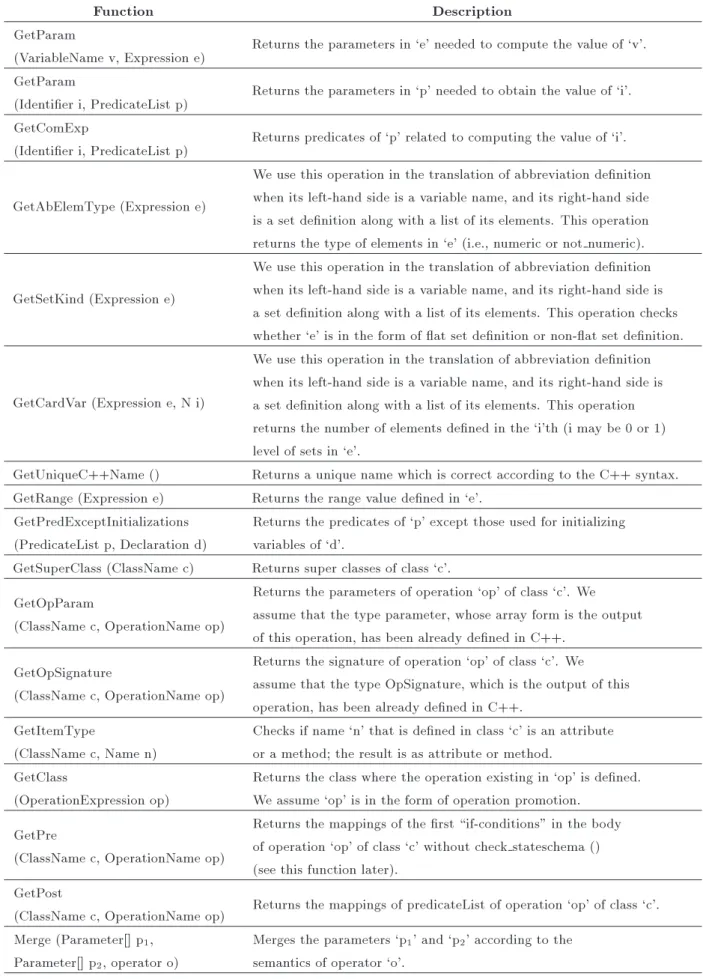
3. We consider a set of functions (as utilities) to present translation function K. These functions are illustrated in Table 1.
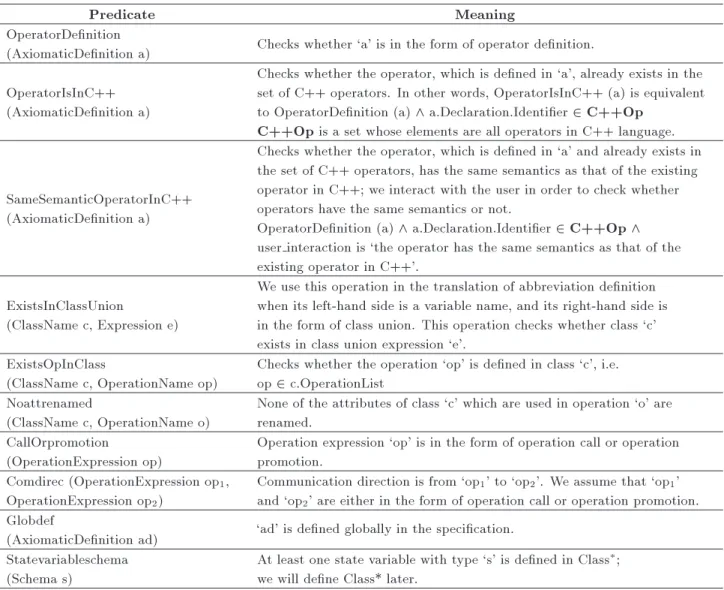
4. We dene a set of predicates in order to present translation function K. These predicates are illus-trated in Table 2.
2.1. Mapping of specication
We did not present any mapping for specication in our previous work [12-14]. The translation of a specication is equivalent to translation of each of its paragraphs to their counterparts in C++ (user interaction may be needed to obtain the mapping of paragraphs in specication); hence, the translation of specication is as follows:
K (Specication, user interaction) = K (Para-graphList, user interaction) = 8 p: ParagraphList K (p, user interaction)
2.2. Mapping of global paragraphs
Now we present the translation of each global para-graph construct as follows. Note that the scope of
Table 1. Utility functions used for formal mapping.
Function Description
GetParam
(VariableName v, Expression e) Returns the parameters in `e' needed to compute the value of `v'. GetParam
(Identier i, PredicateList p) Returns the parameters in `p' needed to obtain the value of `i'. GetComExp
(Identier i, PredicateList p) Returns predicates of `p' related to computing the value of `i'.
GetAbElemType (Expression e)
We use this operation in the translation of abbreviation denition when its left-hand side is a variable name, and its right-hand side is a set denition along with a list of its elements. This operation returns the type of elements in `e' (i.e., numeric or not numeric).
GetSetKind (Expression e)
We use this operation in the translation of abbreviation denition when its left-hand side is a variable name, and its right-hand side is a set denition along with a list of its elements. This operation checks whether `e' is in the form of at set denition or non-at set denition.
GetCardVar (Expression e, N i)
We use this operation in the translation of abbreviation denition when its left-hand side is a variable name, and its right-hand side is a set denition along with a list of its elements. This operation returns the number of elements dened in the `i'th (i may be 0 or 1) level of sets in `e'.
GetUniqueC++Name () Returns a unique name which is correct according to the C++ syntax. GetRange (Expression e) Returns the range value dened in `e'.
GetPredExceptInitializations (PredicateList p, Declaration d)
Returns the predicates of `p' except those used for initializing variables of `d'.
GetSuperClass (ClassName c) Returns super classes of class `c'. GetOpParam
(ClassName c, OperationName op)
Returns the parameters of operation `op' of class `c'. We assume that the type parameter, whose array form is the output of this operation, has been already dened in C++.
GetOpSignature
(ClassName c, OperationName op)
Returns the signature of operation `op' of class `c'. We assume that the type OpSignature, which is the output of this operation, has been already dened in C++.
GetItemType
(ClassName c, Name n)
Checks if name `n' that is dened in class `c' is an attribute or a method; the result is as attribute or method.
GetClass
(OperationExpression op)
Returns the class where the operation existing in `op' is dened. We assume `op' is in the form of operation promotion.
GetPre
(ClassName c, OperationName op)
Returns the mappings of the rst \if-conditions" in the body of operation `op' of class `c' without check stateschema () (see this function later).
GetPost
(ClassName c, OperationName op) Returns the mappings of predicateList of operation `op' of class `c'. Merge (Parameter[] p1,
Parameter[] p2, operator o)
Merges the parameters `p1' and `p2' according to the
Table 2. Predicates used for formal mapping.
Predicate Meaning
OperatorDenition
(AxiomaticDenition a) Checks whether `a' is in the form of operator denition. OperatorIsInC++
(AxiomaticDenition a)
Checks whether the operator, which is dened in `a', already exists in the set of C++ operators. In other words, OperatorIsInC++ (a) is equivalent to OperatorDenition (a) ^ a.Declaration.Identier 2 C++Op
C++Op is a set whose elements are all operators in C++ language.
SameSemanticOperatorInC++ (AxiomaticDenition a)
Checks whether the operator, which is dened in `a' and already exists in the set of C++ operators, has the same semantics as that of the existing operator in C++; we interact with the user in order to check whether operators have the same semantics or not.
OperatorDenition (a) ^ a.Declaration.Identier 2 C++Op ^ user interaction is `the operator has the same semantics as that of the existing operator in C++'.
ExistsInClassUnion
(ClassName c, Expression e)
We use this operation in the translation of abbreviation denition when its left-hand side is a variable name, and its right-hand side is in the form of class union. This operation checks whether class `c' exists in class union expression `e'.
ExistsOpInClass
(ClassName c, OperationName op)
Checks whether the operation `op' is dened in class `c', i.e. op 2 c.OperationList
Noattrenamed
(ClassName c, OperationName o)
None of the attributes of class `c' which are used in operation `o' are renamed.
CallOrpromotion
(OperationExpression op)
Operation expression `op' is in the form of operation call or operation promotion.
Comdirec (OperationExpression op1,
OperationExpression op2)
Communication direction is from `op1' to `op2'. We assume that `op1'
and `op2' are either in the form of operation call or operation promotion.
Globdef
(AxiomaticDenition ad) `ad' is dened globally in the specication. Statevariableschema
(Schema s)
At least one state variable with type `s' is dened in Class;
we will dene Class* later.
mappings of global paragraph constructs (except the mapping of axiomatic denition in the form of operator denition and generic denition in the form of operator denition) are the whole C++ code obtained from the mapping of the specication (i.e., global); see [14] for more details.
Basic type denition
According to our previous work [13,14], we map each basic type to a struct as follows:
K (BasicTypeDenition) = K ([IdentierList]) = 8 i: Identier ji 2 IdentierList (K(i) = struct i fg;) Axiomatic denition
Based on the form of an axiomatic denition (constant denition, operator denition, symbol (not operator) denition and function denition), we considered four cases for its mapping in [12,14]. We use concept \class union" in order to model these four cases. More
precisely, for each form of the axiomatic denition, we introduce a new class whose instances are axiomatic denitions in the form of case description. For instance, we consider a new class whose name is \ADConstant-Denition" to model the axiomatic denition in the form of constant denition; in this way, four cases of axiomatic denition are modeled formally as follows: AxiomaticDenition = = ADConstantDenition [ ADOperatorDenition [ ADSymbolDenition [ AD-FunctionDenition
Also, we assume that the Declaration part of the axiomatic denition is in the form of \Identier: Ex-pression". Now we present the formal translation of AD: AxiomaticDenition using the mapping rules given in our previous work [12,14]; of course, there is an exeption: when the operator already exists in C++, and its semantics is not the same as what exists in C++, we map \AD" to a global method
whose return type is Boolean; this method checks satisfaction of the semantics of the dened operator. In the following, \NM" means that \no mapping is needed". \PredicateListMapping" indicates the map-ping of PredicateList part of \AD" obtained via user interaction. Also, \OZIdentier" means that word \OZ" is concatenated with \Identier" to build a new name. Similarly, \opIdentier" denotes that word \op" is concatenated with \Identier".
((AD 2 ADConstantDenition) ) (K (AD, PredicateListMapping) =
K ([Identier: ExpressionjPredicateList],
PredicateListMapping) = (const K (Identier: Expression)
Boolean check Identier ()f
if(!K (PredicateList, PredicateListMapping)) return false;
return true;g))) _
(((AD 2 ADOperatorDenition) ^ OperatorIs-InC++ (AD) ^ SameSemanticOperatorOperatorIs-InC++ (AD)) ) (K (AD) = NM))
_
(((AD 2 ADOperatorDenition) ^ OperatorIs-InC++ (AD) ^ !SameSemanticOperatorOperatorIs-InC++ (AD)) ) (K (AD) =
Boolean OZIdentier (K (Expression))f
if (K (PredicateList, PredicateListMapping)) return true;
return false;g)) _
(((AD 2 ADOperatorDenition) ^ !OperatorIs-InC++ (AD)) )
((K (AD, the left-most operand of the operator function is an object of the class of that operator _PredicateListMapping) =
K ([Identier: ExpressionjPredicateList], the
left-most operand of the operator function is an object of the class of that operator _
PredicateListMapping) =
(virtual Boolean opIdentier (ClassName c, K (Expression))f
if (K (PredicateList, PredicateListMapping)) return true;
return false;g)) _
(K (AD, the left-most operand of the operator function is an object of a class dierent from the class of that operator _PredicateListMapping) =
K ([Identier: ExpressionjPredicateList],
the left-most operand of the operator function is an object of a class dierent from the class of that
operator _ PredicateListMapping) =
(typedef char [50] ClassName;
Boolean opIdentier (ClassName c, K (Expression))f if (K (PredicateList, PredicateListMapping)) return true;
return false;g)))) _
((AD 2 ADSymbolDenition) ) (K (AD, Predi-cateMapping) =
K ([Identier: ExpressionjPredicate],
PredicateMapping) =
(#dene Identier (GetParam (Identier, Expression)) K (Predicate, PredicateMapping)))) _
((AD 2 ADFunctionDenition) ) (K (AD, Predi-cateListMapping)=
K ([Identier: ExpressionjPredicateList],
PredicateListMapping) =
(void Identier (K (Expression))fK (PredicateList, PredicateListMapping);g)))
In the translation of axiomatic denition in the form of symbol (not operator) denition, we used Predicate instead of PredicateList because we assume this case of axiomatic denition has only one predicate.
Generic denition
In our previous work [14], we considered two cases for the mapping of generic denition based on whether it is in the form of operator denition or not. Similar to what we did for modeling the four cases of axiomatic denition, we model the mentioned two cases of generic denition formally using the concept of \class union" as follows:
GenericDenition= = GDOperatorDenition [ GDNOperatorDenition
Now we present the formal translation of GD: Gener-icDenition using the mapping rules given in our previ-ous work [14]. We map a generic denition that is in the form of operator denition and does not have formal parameters similar to the mapping of axiomatic deni-tion which is in the form of operator denideni-tion; abbre-viation \GPADOD" in the following implies that we use a translation similar to what presented for \global paragraph axiomatic denition in the form of operator denition". Note that we interact with the user in order to obtain the mapping of predicates, such as PredicateList part of GD (i.e., PredicateListMapping) and also preconditions (i.e., PredicateListPrecondition) and postconditions (i.e., PredicateListPostcondition) included in the PredicateList part of GD:
((GD 2 GDOperatorDenition) ^ (GD = [Declaration
) K (GD) = GPADOD _
((GD 2 GDNOperatorDenition) ) (K ([DeclarationFormalParameters jPredicateList], PredicateListMapping _
DeclarationMapping _ PredicateListPrecondition _ PredicateListPostcondition) =
K ([Declaration[IdentierList]
jPredicateList], PredicateListMapping _
DeclarationMapping _ PredicateListPrecondition _ PredicateListPostcondition) =
(template h 8 i: IdentierList class i, i Boolean GetUniqueC++Name () (K (Declaration, DeclarationMapping))f
if (K (PredicateList, PredicateListMapping _ PredicateListPrecondition))f
K (PredicateList, PredicateListMapping _ PredicateListPostcondition)
return true;g return false;g))) Abbreviation denition
In our previous work [12,14], we considered four cases for the mapping of abbreviation denition. Always, the left-hand side of the abbreviation denition is a variable name, but its right-hand side is in the form of a (an): computational expression, set denition along with a list of its elements, class union and range denition. The formal model of these cases of abbreviation denition is as follows:
AbbreviationDenition = = AD1[ AD2[ AD3[ AD4
where AD1, AD2, AD3 and AD4 contain those
in-stances of abbreviations whose right-hand side is in the form of computational expression, set denition along with a list of their elements, class union and range denition, respectively. In all four cases, the left-hand side is a variable name. In order to present the translation of abbreviations, we dene new free types whose name are SetKind and AbElemType (\non-at" refers to a set of . . . of numbers):
AbElemType ::= numeric j not numeric SetKind ::= at j non-at
Now we map AbD: AbbreviationDenition. To trans-late an abbreviation denition whose right hand side is a set along with the list of its members, we consider two cases in terms of whether the right hand set is a at set (of non-number or number members) or a non-at set. For non-at sets, each member may be either a number or a set; if a member is set, it can be itself at or non-at similar to the above distinction. This story can be continued recursively. In our previous work [14],
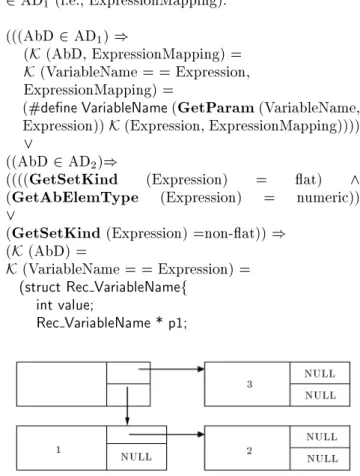
we only considered the mapping of at sets. Now, we map a non-at set to a linked list of records each of which corresponds to a set member. These records are dened by a struct, called Rec VariableName; see the following obtained code in C++. The rst attribute of this record contains a number if the corresponding member is a number; otherwise, it has no value. For a member that is a set itself, p2 points to a linked list obtained from the mapping of that set recursively. In addition, we have another pointer, called p1, to point to the next member of the set being mapped. For example, Figure 1 shows the mapping of ff1; 2g; 3g to this struct.
Also, we consider two methods \Variable-Name Initialization", which recursively maps an Ex-pression in Abbreviation Denition when it is in the form of a non-fat set, and \initializa-tion VariableName", which initialize VariableName (VariableName is the left hand side of AbD; see below). For simplicity, only the pseudo code of the mapping is given here (for this, many implementation details and required denitions are not given here; for example, we use type \Expression" in the signature of \VariableName Initialization" without dening it in advance). Note that we interact with the user to initialize the elements of VariableName for obtaining the mapping of the Expression part of AbD when AbD 2 AD1 (i.e., ExpressionMapping).
(((AbD 2 AD1) )
(K (AbD, ExpressionMapping) = K (VariableName = = Expression, ExpressionMapping) =
(#dene VariableName (GetParam (VariableName, Expression)) K (Expression, ExpressionMapping)))) _
((AbD 2 AD2))
((((GetSetKind (Expression) = at) ^ (GetAbElemType (Expression) = numeric)) _
(GetSetKind (Expression) =non-at)) ) (K (AbD) =
K (VariableName = = Expression) = (struct Rec VariableNamef
int value;
Rec VariableName * p1;
Figure 1. Mapping of ff1; 2g; 3g to linked list of Rec VariableName elements.
Rec VariableName * p2;gVariableName;
Rec Variable* VariableName Initialization (Expression s)f
Rec VariableName * p; Rec VaribaleName * pp; p=NULL;
for each x in sf
pp=new Rec VariableName (); if (x is number)f
pp->value=x; pp->p2=NULL;g elsef
pp->p2=VariableName Initialization (x);g pp->p1=p;
p=pp;gg
void initialization VariableName ()
fVariableName = VariableName Initialization (Expression);g
)))_
((GetSetKind (Expression) = at) ^
(GetAbElemType (Expression) = not numeric) ) (K (AbD, ExpressionMapping) =
K (VariableName = = Expression, ExpressionMapping) =
(enum VariableName fK
(Expression, ExpressionMapping)g)))) _
((AbD 2 AD3) ) (K (AbD) =
K (VariableName = = Expression) = (struct VariableName f 8 c: Class j
ExistsInClassUnion (c, Expression) c * GetUniqueC++Name (); g)))
_
((AbD 2 AD4 ) ) (K (AbD) =
K (VariableName = = Expression) = (int [GetRange (Expression)] VariableName;)))
Free type denition
We only present the mapping of free type denition when no constructor is used in its denition as follows (this case is a limitation of our work):
K (FreeTypeDenition) = K (Identier ::= BranchList) = enum Identier f 8 b: Branch j b 2 BranchList
Notation \j" used in the above mapping is the separator which is dened in enumerator syntax. Schema
If SchemaHeader is in the form of SchemaName, then the translation of schema is as follows (\Pred-icateListMapping" indicates the mapping of Predi-cateList part of Schema obtained via user interaction):
K (Schema, PredicateListMapping) =
K (SchemaName= [Declaration^
jPredicateList], PredicateListMapping) =
struct SchemaName f K (Declaration) g; Boolean check SchemaName (SchemaName s)f
if (K (PredicateList, PredicateListMapping)) return true;
return false;g Class
The translation of class is as follows. Notice that we present the translation of class paragraphs in Subsec-tion 2.3. Also, since we may need user interacSubsec-tion in the translation of class paragraphs, we consider user interaction in translation function here:
K (Class, user interaction) = K (ClassName
FormalParameters, user interaction)=
[VisibilityList InheritedClassList LocalDenitionList State
InitialState OperationList]
K (FormalParameters);
class ClassName: K (InheritedClassListClassName) fK (LocalDenitionList, user interaction);
K (State, user interaction);
K (InitialState, user interaction);
K (OperationList, user interaction)
K (InheritedClassListRenameList)g;
where K (InheritedClassListClassName) denotes the mapping of ClassName part of the InheritedClassList (see InheritedClassList abstract syntax in Appendix A). In addition, K (InheritedClassListRenameList) indicates the mapping of the remained parts of Inherit-edClassList.
In our previous work [12-14], we proposed tem-plates for constructors and destructors; hence, they must be considered in class denition. Also, it is worth mentioning that the mapping of the VisibilityList is considered implicitly when mapping other constructs; see [14] for details.
2.3. Mapping of class paragraphs
We present the translation of each class construct step by step as follows. For each class in Object-Z specication, we consider a corresponding class in C++ which is denoted by Class* throughout the paper. Formal parameters
In our previous work [12,14], we considered a template class for each formal parameter. Thus, the translation of formal parameters is as follows (the mapping of each formal parameter has global scope):
K (FormalParameters) = K ([IdentierList])= template h 8 i: IdentierList class i, i
Local denitions
Basic type denition: Its translation is the same as of the global paragraph basic type denition. However, the result of translation must be considered within Class* denition.
K (BasicTypeDenition) = K ([IdentierList]) = 8 i: IdentierList (K (i) = struct i fg;)
Axiomatic denition: Similar to what we did for the mapping of global paragraph axiomatic denition, we consider four cases. However, mappings of all cases except axiomatic denition in the form of operator denition must be considered within Class* denition; see [14] for more details. Now we map AD: Axiomat-icDenition (see Subsection 2.2 Axiomatic Denition). If the axiomatic denition is in the form of a (an):
Constant denition: In addition to map the Predi-cateList part of AD in the constructor of Class* [14], the following translation must be considered: (AD 2 ADConstantDenition) )
(K (AD, PredicateListMapping) =
K ([Identier: Expressionj PredicateList],
Pred-icateListMapping) = (const K (Declaration)
virtual Boolean check Identier ()f
if(!K (PredicateList, PredicateListMapping)) return false;
return true;g))
Operator denition: The translation of local ax-iomatic denition in the form of operator denition is the same as that of global paragraph axiomatic denition. In the following, GPADOD abbreviates for \Global Paragraph Axiomatic Denition in the form of Operator Denition".
(AD 2 ADOperatorDenition)) ) (K (AD) = GPADOD)
Symbol (not operator) denition: Its translation is the same as that of global paragraph axiomatic def-inition (when it is in the form of symbol denition); GPADSD abbreviates that translation:
(AD 2 ADSymbolDenition) ) (K (AD, Predi-cateMapping) = GPADSD)
Function denition: The translation of this case of axiomatic denition is as follows:
(AD 2 ADFunctionDenition) ) (K (AD, PredicateListMapping)=
K ([Identier: Expression [jPredicateList]], Predi-cateListMapping) =
(void Identier (K (Expression))fK (PredicateList, PredicateListMapping);g))
Abbreviation Denition: Similar to what we did for the mapping of global paragraph abbreviation denition, we consider four cases here. However, mappings of all cases must be considered within Class* denition. Now we map AbD: AbbreviationDenition (see Subsection 2.2 Abbreviation Denition). Suppose that the left-hand side of the abbreviation denition is a variable name. In the following, we provide the mapping of the denition based on the various forms of its right-hand side:
Computational expression: Its translation is the same as that of global paragraph abbreviation de-nition when its left-hand side is a variable name, and its right-hand side is in the form of computational expression; GPAbDCE denotes the translation of this case of global paragraph abbreviation denition: (AbD 2 AD1) ) (K (AbD, ExpressionMapping) =
GPAbDCE)
Set denition along with a list of its elements: ((AbD 2 AD2))
((((GetSetKind (Expression) = at) ^
(GetAbElemType (Expression) = numeric)) _ (GetSetKind (Expression) =non-at)) )
(K (AbD) = K (VariableName = = Expression) = (struct Rec VariableNamef
int value;
Rec VariableName * p1;
Rec VariableName * p2;gVariableName; virtual Rec Variable* VariableName Initialization (Ex-pression s)f
Rec VariableName * p; Rec VaribaleName * pp; p=NULL;
for each x in sf
pp=new Rec VariableName (); if (x is number)f
pp->value=x; pp->p2=NULL;g elsef
pp->p2=VariableName Initialization (x);g pp->p1=p;
p=pp;gg
virtual void initialization VariableName ()
fVariableName = VariableName Initialization (Expres-sion);g )))_
(((GetSetKind (Expression) = at) ^
(GetAbElemType (Expression) = not numeric)) )
(K (AbD, ExpressionMapping) = K (VariableName = = Expression, ExpressionMapping) =
ExpressionMapping)g))))
Class union: We did not present any mapping for this case of abbreviation denition in our previous work [12-14]. Nevertheless, the translation of this case of abbreviation denition is the same as that of global paragraph abbreviation denition when its left-hand side is a variable name, and its right-hand side is in the form of class union; GPAbDCU abbreviates that translation:
(AbD 2 AD3) ) (K (AbD) = GPAbDCU)
Range denition: Its translation is the same as that of global paragraph abbreviation denition when its left-hand side is a variable name, and its right-hand side is in the form of range denition; GPAbDRD abbreviates that translation:
(AbD 2 AD4) ) (K (AbD) = GPAbDRD)
Free type denition: Its translation is the same as that of global paragraph free type denition; GPFD abbreviates the translation of global paragraph free type denition when it involves no constructor. Notice that the translation of local free type denition must be considered within Class* denition.
K (FreeTypeDenition) = GPFD State
We consider the Declaration given before Delta nota-tion in State abstract syntax as \Declaranota-tion1" (i.e., the part including primary variables) and the Dec-laration given after Delta notation as \DecDec-laration2" (i.e., the part including secondary variables). Also, we separate two categories of secondary variables: those secondary variables that are not obtained via primary variables and other constants in PredicateList (i.e., D2NP), and those secondary variables that are
obtained via primary variables or other constants in PredicateList (i.e. D2P). To model these two categories
formally, we use a \class union" as follows: Declaration2: D2P [ D2NP
Now, we present the translation of State which may need user interaction as follows. We interact with the user in order to obtain the mapping of PredicateList part of State (i.e., PredicateListMapping), global predi-cates (i.e., PredicateMapping) and the Declaration part of those generic denitions which are not in the form of operator denition (i.e., DeclarationMapping).
Note that CEL and FAS, which are used to obtain the mapping of secondary variables according to our previous work [14], abbreviate for \Computational Expression Length" (the expression in PredicateList used to compute the value of these variables) and \Frequency of Appearance in the Specication" (the
frequency of appearance of these variables in the specication), respectively. Also, K (Dec) indicates the mappings of denitions; see [14] for details. Notice that the mapping of all parts of State must be considered within Class* denition:
K ([Declaration1 [ Declaration2] [jPredicateList]],
CEL _ FAS _ PredicateListMapping _ PredicateMapping _ DeclarationMapping) = (8Dec: Declaration j Dec 2 Declaration1 K (Dec)
(8Dec: Declaration j Dec 2 Declaration2
((Dec 2 D2np) ) K (Dec))
_ ((Dec 2 D2p) )
(K ([Decj PredicateList], CEL _ FAS _
PredicateListMapping) =
K ([Identier: ExpressionjPredicateList], CEL
_ FAS _ PredicateList Mapping) = (((CEL=NotLong) ^ (FAS= High)) )
(#dene Identier (GetParam (Identier, PredicateList))
K (GetCompExp (Identier, PredicateList), PredicateListMapping)))
_ ((FAS= Low) ) (K (Dec);
virtual inline void set Identier ()f K(GetCompExp (Dec, PredicateList), PredicateListMapping);g))
_
(((CEL=Long) ^ (FAS=High)) ) (K (Dec); virtual void set Identier ()f
K(GetCompExp (Dec, PredicateList), PredicateListMapping);g)))
virtual Boolean check stateschema ()f if ((8 P: Predicate K (P, PredicateMapping)) && (8 AD: AxiomaticDenition j Globdef (AD) check axiomaticdenition name ()) && K (GetPredExceptInitializations (PredicateList, Declaration2),
PredicateListMapping) && GetSuperClass (Class*)::check stateschema ()
&&(8 S:Schema jStatevariableschema (S) check SchemaName (S.SchemaName s)) && (8 GD: GenericDenition j GD 2
GDNOperatorDenition
genericdenition name (K (GD.Declaration, DeclarationMapping)))(
return true; return false;g) Initial state
in [14] is as follows. We interact with the user in order to obtain the mapping of the PredicateList part of INIT (i.e., PredicateListMapping). We also apply PredicateList in constructor of Class*. In addition, method INIT must be considered within Class* de-nition:
K (INIT=[PredicateList], PredicateListMapping) =^ virtual Boolean INIT()f
return (check stateschema () && K (PredicateList, Predicate
ListMapping) && GetSuperClass (Class*)::INIT ()) g
Operation schema
According to our previous work [12-14], we map op-eration schema to a virtual method whose name is the operation schema name itself as follows. Notice that we interact with the user in order to obtain the mapping of PredicateList part of operation schema (i.e., PredicateListMapping). The mapping of the operation schema must be considered within Class* denition:
((! ExistsOpInClass (Class*, OperationName)) ) (K (OperationName = [DeltaList^ Declaration j
PredicateList], PredicateListMapping) =
(virtual Boolean OperationName (K (Declaration), GetOpParam (GetSuperClass (Class*), Opera-tionName))f
if (check stateschema () &&
K (9State* [DeltaListDeclaration j PredicateList]n Declaration,
PredicateListMapping) &&
GetOpSignature (GetSuperClass (Class*), OperationName))f
K (PredicateList, PredicateListMapping); return check stateschema();g
return false;g)))) _
((ExistsOpInClass (Class*, OperationName)) ) (K(OperationName = [DeltaList^ Declaration j
PredicateList], PredicateListMapping) =
(virtual Boolean OperationName (K (Declaration))f if (check stateschema() &&
K (9 State* [DeltaListDeclaration j PredicateList]n Declaration,
PredicateListMapping))f
K (PredicateList, PredicateListMapping); return check stateschema();g
return false;g)))
where Declaration and State* denote the outputs of
the operation schema and State of Class*, respectively.
Inheritance
In order to present the translation of rename list when mapping inheritance, we dene a new free type as follows:
ItemType ::= attribute j method
Now, we translate inheritance as follows. Notice that in the case of method renaming, when at least one of the method attributes is renamed, we need to interact with the user to know how to map the renamed attribute (i.e., attribute renaming). In other words, we get the mapping of the renamed attribute(s) based on the user interaction. Also, the mapping of both method renaming and attribute renaming must be considered within Class* denition:
K (InheritedClass) = K (ClassName
ActualParameters RenameList)=
K (ClassName [ExpressionList]
[RenameItemList])=
(: public virtual ClassName < 8 e: Expression j e
2 ExpressionList K (e),>
8 item: RenameItem j (item 2 RenameItemList) ^ (item=newName/oldName) ^ (GetItemType Name, oldName)=method) ^ Noattrenamed (Class-Name, oldName) K (item) =
(virtual Boolean newName (GetOpParam (ClassName, oldName))f
if (check stateschema () && ClassName ::oldName (GetOpParam (ClassName, oldName))
return check stateschema(); return false;g)
8 item: RenameItem j (item 2 RenameItemList) ^ (item=newName/oldName) ^ (GetItemType Name, oldName)=method) ^ : Noattrenamed (Class-Name, oldName) K (item, attribute renaming)
8 item: RenameItem j (item 2 RenameItem-List) ^ (item=newName/oldName) ^ (GetItemType (ClassName, oldName)=attribute) K (item, at-tribute renaming)
Note that we cannot present the result of K (item, attribute renaming) because it depends on how to map attribute renaming which is determined by the user. 2.4. Mapping of operation expressions
Suppose that we want to translate op = op^ 1 O op2,
where O is the operator and op1 and op2 are the
operands. First, we dene new free type \operator" which is used in function \Merge":
operator ::= ^ j [] j0
9j jj j j :
We map conjunction and parallel composition opera-tors in main method to boost threads [18]. In addition, we merge inputs and outputs of op1 and op2 and map
the resulting parameters to attributes of ClassName because threads cannot have any input and output parameters. We also dene new methods op1conj and
op2conj whose bodies are promotions of op1 and op2;
parameters of op1conj and op2conj are newly dened
attributes for ClassName, provided that they have not been dened before. The mappings of other operators are the same as what we presented in our previous work [12-14]:
op = op^ 1 ^ op2.
(CallOrpromotion (op1) ^ CallOrpromotion (op2))
)
K (op= op^ 1 ^ op2) =
virtual Boolean op ()f
void op1conj () fop1 (related attributes ClassName)g;
void op2conj () fop2 (related attributes ClassName)g;
if (check stateschema() && GetPre (GetClass (op1), op1) && GetPre (GetClass (op2), op2))f
boost::thread conj op1 op2 (&op1conj);
boost::thread conj op2 op1 (&op2conj);
conj op1 op2.join ();
conj op2 op1.join ();g
else return false;g op = op^ 1 [] op2.
(CallOrpromotion (op1) ^ CallOrpromotion
(op2))
) K (op= op^ 1 [] op2) =
virtual Boolean op (Merge (GetOpParam (GetClass (op1), op1), GetOpParam
(GetClass (op2), op2), []))f
int r =rand() % 2; if (r = = 0)f
if (check stateschema ())f
if (!GetPre (GetClass (op1), op1)) return
op2 (GetOpParam (GetClass (op2),
op2));
else return op1 (GetOpParam (GetClass
(op1), op1));g
return false;g else f
if (check stateschema ())f
if (!GetPre (GetClass (op2), op2)) return op1
(GetOpParam (GetClass (op1), op1));
else return op2 (GetOpParam (GetClass
(op2), op2);g
return false;gg op = op^ 1 09 op2.
(CallOrpromotion (op1) ^ CallOrpromotion (op2))
) K (op= op^ 1 09op2) =
virtual Boolean op (Merge (GetOpParam
(GetClass (op1), op1), GetOpParam (GetClass
(op2), op2),09))f
Local Params Def
if (check stateschema () && GetClass (op1)::
op1 (GetOpParam (GetClass (op1), op1))
&& GetClass (op2):: op2 (GetOpParam
(GetClass (op2), op2))
return true; return false;g
where Local Params Def denotes those parameters which are included in both parameters lists of op1and
op2; they are also outputs in op1 and inputs in op2.
op = op^ 1 jj op2.
(CallOrpromotion (op1) ^ CallOrpromotion (op2) ^
Comdirec (op1, op2)) )
K (op= op^ 1 jj op2) = K (op= op^ 1^ op2)
op = op^ 1 op2.
(CallOrpromotion (op1) ^ CallOrpromotion (op2))
)
K (op= op^ 1 op2, user opinion) =
((user opinion = 1) ) K (op= op^ 1 ^ op2)
^
(user opinion = 2) )
virtual Boolean op (Merge (GetOpParam (GetClass (op1), op1), GetOpParam
(GetClass (op2), op2), ))f
if (check stateschema () && GetPre (GetClass (op1), op1) && GetPre
(GetClass (op2), op2))f
GetPost (GetClass (op1), op1);
GetPost (GetClass (op2), op2);
return check stateschema();g return false;g)
Note that in our previous work [13,14], we considered the user's opinion to obtain the nal mapping of scope enrichment when at least one of its operands is in the form of operation promotion; we specied this kind of user interaction using \user opinion" in the above mapping. The value of \user opinion" could be \1" or \2" indicating the rst option or the other one; to see options, refer to [13,14]
op = : op.^
(CallOrpromotion (op)) )
K (op= : op, PredicateListMapping) =^
virtual Boolean op (GetOpParam (GetClass (op), op))f
(: op)nDeclaration, PredicateListMapping))f
K (: (op. PredicateList), PredicateListMapping); return check stateschema();g return false;g
where \PredicateListMapping" indicates the mapping of negation of PredicateList part of op in the above translation.
3. Proof sketch
Theorem 1 demonstrates the soundness of our mapping method by showing it renes Object-Z specications into corresponding C++ code.
Theorem 1 (Soundness). For a given Object-Z specication ozs and a given C++ code cppc, if cppc = K (ozs), then we have ozs v2cppc (The notation `v'
is used as the renement notation.)
In the next subsection, we present our proof methodology.
3.1. Proof methodology
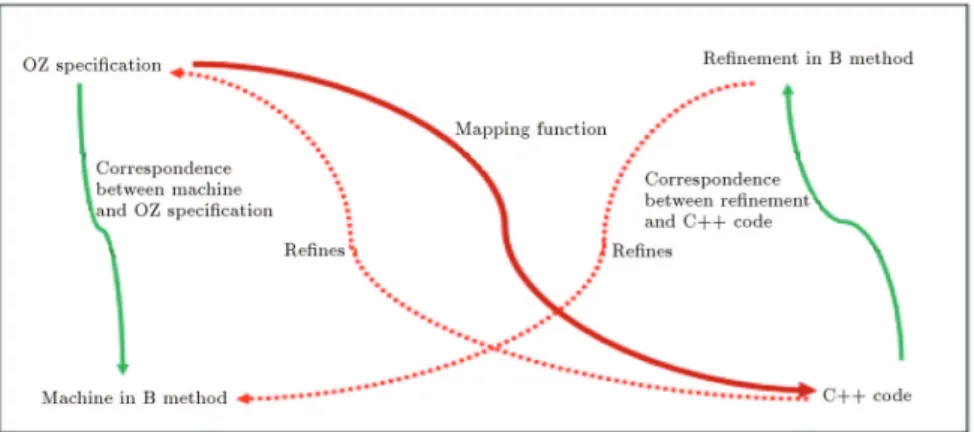
We use some proof obligations similar to what are proposed in B method [19] to prove that a renement N renes a machine M in order to prove Theorem 1. The steps of our proof methodology are as follows:
1. We consider a correspondence between OZ speci-cations and machine notion in B. In other words, when determining each construct of B machine, we notice which parts of an OZ specication (and in which way) could participate, based on the semantics of OZ and machines in B.
2. We consider a correspondence between C++ code and renement notion in B. In other words, when determining each construct of B renement, we notice which parts of C++ code (and in which way) could participate, based on the semantics of C++ and renements in B.
3. We introduce the machine and renement obtained after doing steps 1 and 2 into Atelier-B [20].
4. Atelier-B makes three proof obligations [19] to show the introduced renement renes the introduced machine. Finally, Atelier-B proves the obtained proof obligations.
The next two subsections describe the details of our proof method by explaining proof approach in B and details of correspondences mentioned in steps 1 and 2 above. Figure 2 summarizes our proof methodology. 3.2. Proof in B method
Consider the following specication of machine M and
renement N: MACHINE M(p)
CONSTRAINTS Constraints CONSTANTS CM
PROPERTIES PropertiesM
VARIABLES VM
INVARIANT InvM
INITIALIZATION InitM
OPERATIONS y op(x) = PRE Preop, M
THEN Defop, M
END END
REFINEMENT N REFINES M CONSTANTS CN
PROPERTIES PropertiesN
VARIABLES VN
INVARIANT InvN
INITIALIZATION InitN
OPERATIONS y op(x)= PRE Preop, N
THEN Defop, N
END END
Now, the proof obligations in B to prove that Rene-ment N renes Machine M are as follows (if S is a statement, and P is a predicate, then the notation [S]P denotes a predicate which is true of a given state precisely when executing S in that state is guaranteed to reach a nal state in which P is true [19]):
1. Constraints ^ PropertiesM ^ PropertiesN!
9(VM,VN) (InvM^ InvN)
2. Constraints ^ PropertiesM^ PropertiesN! [InitN]
: [InitM] : InvN
3. Constraints ^ PropertiesM ^ PropertiesN^ InvM
^ InvN^ Preop, M! Preop,N^ [Def0op,N]
: [Defop,M] : (InvN)
It is worth noting that the third proof obligation should be repeated for each specied operation.
3.3. Details of correspondences
Now, we dene correspondences mentioned in steps 1 and 2 of our proof methodology in order to enable Atelier-B to customize the three proof obligations given in Subsection 3.2. At rst, we should consider the following cases in order to customize the third proof obligation:
Figure 2. Our proof methodology.
Case 1 (proof obligation 3.1): operation op is dened in the form of operation schema whose container class is a child class, and none of its parent classes has an operation with the same name as this operation. The proof of the two other cases which we considered in order to propose the mapping of operation schema in [14] (when the container class is not a child class, or operation op has delta-list and declaration part in its denition) can be done similarly by removing the predicates related to the parent class.
Case 2 (proof obligation 3.2): operation op is dened in the form of operation schema and has the same name as inherited operation schemas.
Case 3 (proof obligation 3.3): operation op is dened in the form of op= op^ 109op2; also, op1and op2are
in the form of operation schema.
Case 4 (proof obligation 3.4): operation op is dened in the form of op = op^ 1 O op2; also, op1 and op2
are in the form of operation schema, and O is the conjunction or parallel composition operator.
Case 5: operation op is dened in the form of op
^
= op1 [] op2; also, op1 and op2 are in the form of
operation schema.
Case 6 (proof obligation 3.6): operation op is dened in the form of op= : op^ 1in which op1is in the form
of operation schema.
1. Correspondence between Object-Z specications and machines in B. Before presenting the corre-spondence, we should mention the following used conventions:
1.1 \Class" denotes the class in Object-Z
speci-cation for which the given proof obligations are being proved. To simplify the proof, we assume that \Class" has only one parent class.
1.2 \Declaration" denotes the outputs of the
op-eration whose denition is put before `n'.
1.3 \Operation" indicates the denition of op-eration op. Similarly, \Operation1" and
\Operation2" denote the denition of
opera-tion schemas op1and op2, respectively.
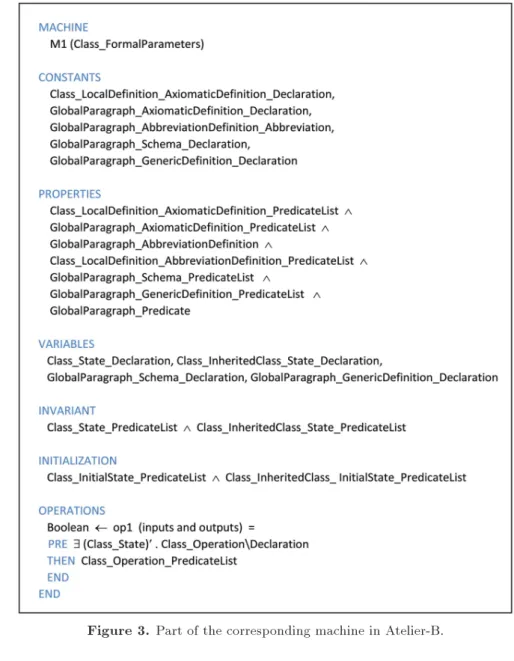
Now, the correspondence is as follows. Cases 1 to 6 in parts Preop,Mand Defop,Mare related to Cases 1
to 6 considered at the beginning of this subsection (Figure 3 shows part of the corresponding machine in Atelier-B):
Constraints = true
X PropertiesM= Class.LocalDenition.
AxiomaticDenition.PredicateList ^ GlobalParagraph.AxiomaticDenition. PredicateList ^ GlobalParagraph. AbbreviationDenition ^ Class.
LocalDenition.AbbreviationDenition. PredicateList ^ GlobalParagraph.Schema. PredicateList ^ GlobalParagraph.
GenericDenition.PredicateList ^ GlobalParagraph.Predicate
X InvM= Class.State.PredicateList ^
Class.InheritedClass.State.PredicateList
X Preop, M =
(1): 9 (Class.State)0 Class.Operation n
Declaration
(2): (9 (Class.State)0 Class. Operation
n Declaration) ^(9 (Class.
InheritedClass.State)0 Class.
InheritedClass.OperationnDeclaration)
(3): (9 (Class.State)0 Class.Operation 1
nDeclaration) ^ (9 (Class.State)0
Class.Operation
2 nDeclaration)
(4): (9 (Class.State)0
Class.Operation
1 n Declaration) ^ (9
(Class.State)0 Class.Operation 2 n
Figure 3. Part of the corresponding machine in Atelier-B.
(5): (9 (Class.State)0 Class.Operation 1
n Declaration) _(9 (Class.State)0
Class.Operation
2 n Declaration)
(6): 9 (Class.State)0 Class. : Operation
n Declaration
X InitM = Class.InitialState.PredicateList ^
Class.InheritedClass.InitialState.PredicateList
X Defop,M=
(1): Class.Operation.PredicateList
(2): Class.Operation.PredicateList ^
Class.InheritedClass.Operation.
PredicateList
(3): Class.Operation
1.PredicateList ^
Class.Operation
2.PredicateList
(4): Class.Operation
1.PredicateList jj
Class.Operation
2.PredicateList
(5): Class.Operation
1.PredicateList []
Class.Operation
2.PredicateList
(6): Class.:(Operation.PredicateList)
X CM = Class.LocalDenition.
AxiomaticDenition.Declaration, GlobalParagraph.AxiomaticDenition. Declaration,GlobalParagraph.
AbbreviationDenition.Abbreviation, GlobalParagraph.Schema.Declaration,
GlobalParagraph.GenericDenition.Declaration
X p = Class.FormalParameters
X VM= Class.State.Declaration, Class.
InheritedClass.State.Declaration,
GlobalParagraph.Schema.Declaration, Global-Paragraph.GenericDenition.Declaration
2. Correspondence between C++ code and rene-ments in B. Before presenting the correspondence, we should mention the following used conventions:
Figure 4. Part of the corresponding renement in Atelier-B. denition of operation schemas op1 and op2,
respectively.
2.2 \Class.attributes" denotes the attributes of
C++ class obtained from the mapping of Class except the constant attributes.
2.3 We substitute check Identier () in the map-ping of axiomatic denition, when it is in the form of constant denition, with const method.
2.4 We also substitute the method resulted from the mapping of generic denition, when it is not in the form of operator denition, with gen method.
2.5 IO denotes the inputs and outputs of op. Also, IO1 and IO2 denote the inputs and
outputs of op1 and inputs and outputs of op2,
respectively.
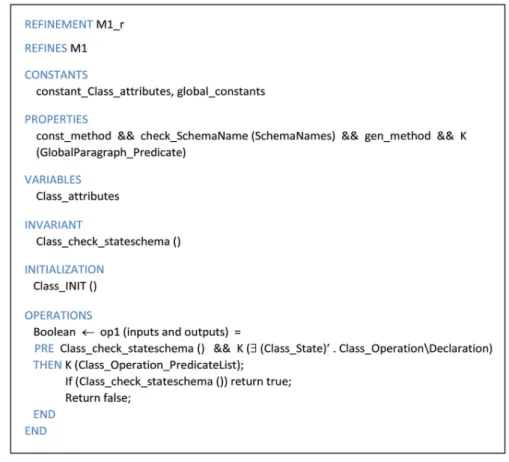
Now, the correspondence is as follows. Cases 1 to 6 in parts Preop,Mand Defop,Mare related to Cases 1
to 6 considered at the beginning of this subsection (Figure 4 shows part of the corresponding rene-ment in Atelier-B):
X PropertiesN= const method &&
check SchemaName (SchemaName s) && gen method && K
(GlobalParagraph.Predicate)
X InvN= Class.check stateschema ()
X Preop,N=
(1): Class.check stateschema () && K (9
(Class.State)0
Class.OperationnDeclaration)
(2): Class.check stateschema () &&
K (9 (Class.State)0
Class.OperationnDeclaration) &&
Class.InheritedClass.op (IO)
(3): Class.check stateschema () && op 1
(IO1) && op2 (IO2)
(4): Class.check stateschema () && K (9
(Class.State)0
Class.Operation
1 nDeclaration) &&
K (9 (Class.State)0
Class.Operation
2 n Declaration)
(5): Class.check stateschema () && (K (9
(Class.State)0
Class.Operation1 n Declaration) jj K
(9 (Class.State)0
Class.Operation2 n Declaration))
(6): Class.check stateschema () && K (9
(Class.State)0
Class.:OperationnDeclaration)
X InitN= Class.INIT ()
X Defop,N=
(1): K (Class.Operation.PredicateList);
true; return false;
(2): K (Class.Operation.PredicateList);
if (Class.check stateschema ()) return
true; return false;
(3): if (Class.check stateschema ()) return
true; return false;
(4): op1 (IO1) jj op2 (IO2)
(5): Any v v:=0 [] v:=1
if (v==0) then return op1 (IO1);
else return op2 (IO2);
(6): K (Class.:(Operation.PredicateList));
if (Class.check stateschema ()) return
true; return false;
X CN=constant Class attributes, global
con-stants
X VN=Class.attributes
3.4. Proof in Atelier-B
Using the correspondences mentioned in the previous subsection, we introduced the resulting machine and renement into Atelier-B. Then, Atelier-B made three proof obligations and proved the obtained proof obli-gations. To simplify the proof, in all proof obligations, we assumed that a correct method is used for mapping predicates from Object-Z to C++. We also assumed that an operation call with a Boolean return value is equivalent to a predicate with the same value.
4. Case study
In this section, we rst present a specication of credit-card bank accounts system [14] in Object-Z. Then, we use our translation method in order to obtain C++ code from this specication.
4.1. Specication of credit-card bank accounts system
The aim of the credit-card bank accounts specication is to capture the basic functionality of credit-card account objects and their interactions. At rst, the following global abbreviation and types are needed in the specication: Free type \Status" has two constants, namely \valid" and \invalid", and is used as a type to model validity of credit cards. Basic type \CUSTOMER" will be used later as a type to model holder(s) of credit card(s); \limitvalue" ab-breviates for a set containing possible values which the account(s) cannot be overdrawn beyond them.
CreditCard
(limit, expiry-value, balance, INIT,
withdraw, deposit, withdraw Avail, newday, reissue, status, holder)
limit: N
limit 2 limitvalue expiry-value: N balance: Z
holder: CUSTOMER expiry: Z
status: Status balance + limit >= 0
status = invalid , expiry = 0 INIT
balance = 0 ^ expiry = expiry-value reissue
(expiry) status = invalid expiry0 = expiry-value
status0 =valid
withdraw (balance) amount?: N
amount? <= balance + limit status = valid
balance0 = balance - amount?
deposit (balance) amount?: N status = valid
balance0 =balance + amount?
withdrawAvail (balance) amount!: N status = valid
amount!= balance + limit balance0 = - limit
newday (expiry) expiry0 =expiry-1
limitvalue = = f1000, 2000, 5000g Status ::= invalid j valid
Next, the class of a credit-card account object in isolation is specied: this class encapsulates the details of the state of a credit card and the operations it can undergo. Also, this specication introduces axiomatic denitions in the form of constant denition (i.e., the declaration of limit and its associated predicate list and also the denition of expiry-value). This class records four numbers, one an integer denoting the current balance of the account (this balance is of course often negative, indicating that the account is overdrawn) and the others are a natural number (a non-negative integer) denoting a xed limit: the account cannot be overdrawn beyond this credit limit and the natural number denoting the xed number of days before credit card expiration (i.e. expiry-value) and the integer number denoting how many days remained until credit card expiration (i.e. expiry), respectively. It is worth mentioning that expiry will be initialized with expiry-value in \INIT". Also, this class contains one more primary variable holder, which denotes the holder of credit card and secondary variable status, which denotes whether credit card is valid or not. If credit card is expired, then the status will become \invalid"; otherwise, it will be \valid". Finally, this class has the following operations:
1. \reissue": reissuing the credit card.
2. \withdraw": using the credit card to obtain funds for some purpose, e.g. to purchase goods.
3. \deposit": depositing money supplied by the envi-ronment (as variable amount?) into the account.
4. \withdrawAvail": withdrawing the total amount currently available (i.e., balance + limit).
5. \newday": decrementing the value of expiry. The following specication (CreditCardConrm class schema) uses inheritance to extend CreditCard class schema with additional features. This specica-tion also introduces the sequential composispecica-tion op-erator. This class schema denes two operations \fundsAvail" and \withdrawConrm" that are not inherited from class CreditCard. The former re-sults in the available funds, i.e., balance + limit. The overall consequence of the latter is to withdraw some amount from the account and output the value of the available funds that remain in the account.
CreditCardConrm
(limit, balance, INIT, withdraw, deposit, withdrawAvail, witdrawConrm)
CreditCard fundsAvail funds!: N
funds!= balance + limit withdrawConrm= withdraw^ 0
9fundsAvail
The following specication (CreditCardCount class schema) uses the notion of operation renaming and redenition when inheriting CreditCard class schema. Also, the class CreditCardCount introduces the con-junction operator. This class schema denes one state variable, i.e. withdrawals, which keeps the number of times the operation \withdraw" has been applied. CreditCardCount also denes two operation \incre-mentCount" and \withdraw". The overall consequence of the latter is to withdraw some amount from the account and increment the value of withdrawals.
CreditCardCount
(limit, balance, INIT, withdraw, deposit, withdrawAvail)
CreditCard [oldWithdraw/withdraw] withdrawals: N
INIT
withdrawals = 0 incrementCount
(withdrawals) status = valid
withdrawals 0 = withdrawals +1
withdraw= oldWithdraw ^ incrementCount^
The following specication (CreditCards class schema) species a banking system consisting of an aggregate of credit-card account objects (of class CreditCard), each with the same limit on the magnitude of the overdraft permitted. Also, this specication introduces scope enrichment and parallel composition operators and uses operation promotion. This class schema has one state variable, i.e. cards whose value is a set of identities of objects of CreditCard. It also has a number of operations: \add" which species the addition of a new credit-card account object to cards, \delete" which species the deletion of an object from cards, \transferAvail" whose role is simply to specify the selection from cards of two distinct credit-card account objects between which funds transfer is to occur; the other operations is applied to particular credit-card account objects similar to the operations of CreditCard.
4.2. Obtaining C++ code
Now, we use our translation method in order to map the specication presented in Subsection 4.1 into a C++ code. We map each class schema to a C++ class with the same name as its associated class schema name. In this section, we only pro-pose the C++ code for global data types and Cred-itCard class schema; see Appendix B for mapping of other classes. Also, as we said in our previous
CreditCards
(commonlimit, INIT, add, delete, withdraw, deposit, withdrawAvail, transferAvail, newday, reissue)
commonlimit: N
commonlimit 2 limitvalue cards: P CreditCardc
8 c:cards c.limit = commonlimit INIT
cards = add (cards)
card?: CreditCard customer?: CUSTOMER card? =2 cards
card?.limit = commonlimit card?.INIT
card?.holder = customer? cards0 = cards [ fcard?g
delete (cards)
card?: CreditCard card? 2 cards
card?.status = invalid cards0 = cardsn fcard?g
withdraw= [card?: cards] card?.withdraw^ deposit= [card?: cards] card?.deposit^ withdrawAvail= [card?:cards] card?.^ withdrawAvail
transferAvail = [from?, to?: cards j from? 6= to?] ^ from?.withdrawAvail jj to?.deposit
newday= [card?: cards] card?.newday^ reissue = [card?: cards] card?.reissue^
work [14], we consider forward declaration of classes as follows:
class CreditCard;
class objectaggregation CreditCard; class CreditCards;
class CreditCardConrm; class CreditCardCount;
Moreover, we consider an enum \Boolean" to model return type of methods of classes globally (recall that return types of all mappings of operation schemas are \Boolean"). In addition, we consider an enum \Status" as mapping of the global free type \Status". We map
basic type \CUSTOMER" to a struct whose name is \CUSTOMER". Furthermore, we map abbreviation limitvalue to an array and also we consider two global methods whose names are \check limitvalue" and \ini-tialization limitvalue" according to the mapping of abbreviation denition in the form of set denition when all of its elements are numeric; see Subsection 2.2. enum Boolean ffalse, trueg;
enum Status finvalid, validg; struct CUSTOMER fg; int [3] limitvalue;
Boolean check limitvalue (int var)
f if (limitvalue[0] = = var jj limitvalue[1] = = var jj limitvalue[2] = = var) return true;
return false;g
void initialization limitvalue () f limitvalue [0] = 1000;
Limitvalue [1] = 2000; Limitvalue [2] = 5000;g
In order to map CreditCard class schema, we consider a new class whose name is CreditCard. Methods and attributes of this class are as follows:
Methods: We map each operation schema such as \withdraw", \deposit", \withdrawAvail" to a method whose name is the same as its associated operation schema name. It is worth mentioning that we consider method \INIT" for mapping Initialization schema. Also, we consider constructor and destructor according to their templates. It is worth mentioning that we call \check limitvalue" in constructor according to the mapping of global abbreviations. Note that we will explain later why we must consider operator over-loading `=' and \==" (we marked them with \user interaction" because the user must herself ll these operator overloading).
Attributes: We map limit and its associated predi-cate list and also expiry-value according to the mapping of axiomatic denition in the form of constant de-nition to const attributes limit and expiry-value; the associated predicate list of limit is mapped into the constructor. Also, we should consider input parameters for initializing limit and expiry-value (we name them l and m). Moreover, we map holder to an attribute whose name is \holder". Furthermore, we map balance and expiry which are primary variables to attributes whose names are \balance" and \expiry", respectively. We map status to a macro since it is a secondary variables obtained via the primary variable expiry. Finally, we should consider attribute p CreditCards
according to the mapping of object containment in class \CreditCards" (i.e., cards: P CreditCardc).
class CreditCardf public:
/*[user interaction]*/
#dene status expiry=0?invalid:valid
const unsigned int limit; int balance; CUSTOMER holder;
const unsigned int expiry-value; virtual Boolean INIT ();
virtual Boolean withdraw (unsigned int amount); virtual Boolean deposit (unsigned int amount); virtual Boolean withdrawAvail (unsigned int & amount);
virtual Boolean newday (); virtual Boolean reissue(); CreditCard (unsigned int 1); CreditCard();
/*[user interaction]*/
void operator=(CreditCard a); Boolean operator==(CreditCard a); protected:
virtual Boolean check stateschema(); CreditCards * p CreditCards;
int expiry;g; /*[user interaction]*/
void CreditCard::operator=(CreditCard a) fthis!balance=a.balance;g
/*[user interaction]*/
Boolean CreditCard::operator==(CreditCard a)
fif(this!limit==a.limit && this!balance==a.balance) return true;
return false;g
Boolean CreditCard::INIT ()
fif (check stateschema() && balance==0 && expiry==expiry-value && status==valid) return true;
return false;g
Boolean CreditCard::withdraw (unsigned int amount) fif (check stateschema() && amount==balance+limit && status==valid)
fbalance=balance-amount;
if (check stateschema()) return true;g return false;g
Boolean CreditCard::deposit (unsigned int amount) fif (check stateschema() && status==valid)
fbalance=balance+amount;
if (check stateschema()) return true;g return false;g
Boolean CreditCard::withdrawAvail (unsigned int & amount)
fif (check stateschema() && status==valid) famount=balance+limit;
balance=-limit;
if (check stateschema()) return true;g return false;g
Boolean CreditCard::reissue ()
fif (check stateschema() && status==invalid) fexpiry=expiry-value;
if (check stateschema()) return true;g return false;g
Boolean CreditCard::newday() fif (check stateschema())
fexpiry=expiry-1;
if (check stateschema()) return true;g return false;g
Boolean CreditCard::check stateschema() fif (balance+limit>=0)
return true; return false;g
CreditCard::CreditCard()fg
CreditCard::CreditCard (unsigned int 1, unsigned int m):limit(1), expiry-value(m)
fif (!check limitvalue (limit)) CreditCard::CreditCard(); else f
balance=0;
expiry=expiry-value; status=valid;gg 5. Discussion
In our previous work [14], we compared our mapping method with some prominent works [6-8] considering some criteria including Formal language coverage [21], Correctness [21], Interactivity [22], Transparency [22], Expressiveness [14], Tool support [14] and Program-ming language coverage [14]. Now, we update that part of this comparison aected by the new version of our mapping method.
5.1. Correctness
Unlike our method, none of the previous work [6-8] paid attention to prove the correctness of the mapping method.
5.2. Expressiveness
The previous work [6-8] represented their mapping rules only by the use of natural language while we presented our mapping method formally in addition to proposing templates for mappings in C++ language.
5.3. Tool support
Two of previous work, i.e. [6,7], have developed tools for supporting mapping methods. Authors in [8] did not propose any mapping rules for operation operators, but they used them in their case studies. To compare our method with that of [8], we can assert that we pro-posed all of our mapping rules explicitly and formally. Also, comparing our method with those of [6,7], we proposed our mapping rules formally. Having explicit and formal rules helps us to develop a supporting tool easily; the next section describes our tool status. 6. Conclusion and future work
In this paper, we presented a formal mapping from Object-Z specications to C++ code based on the mappings given in our previous work [12-14]. Hav-ing the formal mappHav-ing in place, correctness of the mapping can be proved in an easier way, and the possibility to develop supporting tools for the approach is increased. It is worth mentioning that we are now in nal stages of developing a tool which supports our mapping method using C++ (in Visual Studio) and MS SQL server; more precisely, we have so far developed parts regarding the mapping of global basic type denition, axiomatic denition, generic denition, abbreviation denition, schema, free type denition and some parts of class schema.
In continuing the paper, we have proposed the mapping of local abbreviation denition when its left-hand side is a variable name, and its right-left-hand side is class union; this case has never been covered in neither related work [6-8] nor our previous work [12-14]. Finally, we proved the correctness of our mapping method.
As our future work, we are going to:
1. Present appropriate rules to animate the remaining constructs of Object-Z, such as distributed opera-tors and free types when construcopera-tors are used in the denition.
2. Finalize the development of the tool supporting our mapping method together with doing complexity analysis and benchmarks for the resulting tool. References
1. McComb, T. and Smith, G. \Animation of object-Z specications using a Z animator", First International Conference on Software Engineering and Formal Meth-ods, pp. 191-201, IEEE Computer Society Press (2003).
2. Smith, G., The Object-Z Specication Language, Kluwer Academic Publishers, USA (2000).
3. Duke, R. and Rose, G., Formal Object-Oriented Spec-ication Using Object-Z, Macmillan, UK (2000).
4. Woodcock, J. and Davies, J., Using Z: Specication, Renement, and Proof, Prentice Hall (1996).
5. Ramkarthik, S. and Zhang, C. \Generating Java skele-tal code with design contracts from specications in a subset of Object-Z", 5th IEEE/ACIS International Conference on Computer and Information Science, pp. 405-411, IEEE Computer Society Press (2006).
6. Rafsanjani, G. and Colwill, S.J. \From Object-Z to C++: a structural mapping", Z User Meeting (ZUM'92), pp. 166-179, Springer-Verlag (1992).
7. Fukagawa, M., Hikita, T. and Yamazaki, H. \A mapping system from Object-Z to C++", First Asia-Pacic Software Engineering Conference (APSEC94), IEEE Computer Society Press, pp. 220-228 (1994).
8. Johnston, W. and Rose, G. \Guidelines for the manual conversion of Object-Z to C++", SVRC Technical Report 93-14, The University of Queensland (1993).
9. Wang, Z. Xia, M. and Zhao, Y. \Transform mecha-nisms of Object-Z based formal speci-cation to Java", Computational Intelligence and Software Engineering (CiSE), pp. 1-4, IEEE Computer Society Press (2009).
10. Griths, A. \From Object-Z to Eiel: a rigorous development method", Technology of Object-Oriented Languages and Systems: TOOLS 18, Prentice-Hall (1995).
11. Ni, X. and Zhang, C. \Converting specications in a subset of Object-Z to skeletal Spec# code for both static and dynamic analysis", Journal of Object Technology, 7(8), pp. 165-185 (2008).
12. Naja, M. and Haghighi, H. \An animation approach to develop C++ code from Object-Z specications", International Symposium on Computer Science and Software Engineering, pp. 9-16, IEEE Computer So-ciety Press (2011).
13. Naja, M. and Haghighi, H. \An approach to develop C++ code from Object-Z specications", Accepted in 2nd World Conference on Information Technology (2011).
14. Naja, M. and Haghighi, H. \An approach to animate Object-Z specications using C++", Scientia Iranica, 19(6), pp. 1699-1721 (2012).
15. Deitel, H.M. and Deitel, P.J., C++: How to Program, 5th Edn., Prentice Hall (2005).
16. Mery, D. and Singh, N.K. \Automatic code generation from event-B models", Second Symposium on Informa-tion and CommunicaInforma-tion Technology, ACM Press, pp. 179-188 (2011).
17. Albalooshi, F. and Long, F. \Multiple view environ-ment supporting VDM and Ada", IEEE Proceedings Software, 146(6), pp. 203-219 (2002).
18. http://boost.org
19. Schneider, S., The B-Method: An Introduction, Macmillan (2001).
20. Atelier-B tool, Available at: http://www.atelierb.eu/ en/atelier-b-tools/atelier-b-4-0/.