A Convergent Genetic Algorithm
for Pipe Network Optimization
M.H. Afshar
and M.A. Mari~no1
A highly convergent Genetic Algorithm (GA) for pipe network optimization is presented in this paper. An articial genotype passing mechanism, an alternative penalty cost calculation method, an iterative setting of the penalty parameters prior to the GA search and, more importantly, a new selection operator, are introduced in the proposed GA. The genotype passing mechanism leads to a monotonically decreasing convergence curve of the GA search and, therefore, paves the way for introducing a logical convergence criterion for genetic algorithms. The use of an alternative penalty cost calculation leads to a better distribution of the tness function in the search space, compared to conventional methods and, therefore, helps the GA to locate useful genes. Penalty parameters used for the calculation of the penalty cost are determined prior to a GA search, via use of a mathematical programming method, eliminating the possibility of choosing too low or high parameter values. Finally, a new selection operator is designed in an attempt to simulate the process of natural mating more closely, leading to an improvement in the optimality and convergence characteristics of the method. The eciency of the proposed GA is shown by applying the method to the optimal design of three well-known benchmark networks, namely two-loop, Hanoi and New York networks. The method produces results comparable to the best results presented in the literature with much less computational eort.
INTRODUCTION
The problem of network optimization requires the determination of pipe sizes from a set of commer-cially available diameters ensuring a feasible least-cost solution. Various methods, with dierent degrees of success, have been devised by dierent researchers to solve this problem. These methods can be grouped into three classes: Enumeration, mathematical pro-gramming and random search methods. Enumeration methods, capable of nding a global optimum solution to a pipe network design problem, are very costly and cannot be used for the optimization of real-world networks 1,2]. On the other hand, mathematical programming methods are very ecient from a compu-tational point of view, but, are often trapped in saddle points in their search for the global optimum of the pipe
*. Corresponding Author, Department of Civil Engineering, Iran University of Science and Technology, P.O. Box 16844, Tehran, I.R. Iran.
1. Department of Land, Air and Water Resources and Department of Civil and Environmental Engineering, University of California, Davis, CA, P.O. Box 95616, USA.
network design problem. The computational eciency of mathematical programming methods is, of course, limited to continuous solutions, which are not favored from an engineering point of view 3-9]. Random search methods have shown to logically balance between com-putational eciency and the capability of approaching a global optimum. Among the random search methods, the GA has gained more popularity for pipe network optimization in recent years. The early research was primarily concentrated on developing a methodology for applying GA to pipe network optimization problems using simple genetic algorithms 10-14]. More recent investigations on the application of GA to pipe network optimization have focused on the development of new genetic algorithms to yield less costly solutions than already existing algorithms. These improvements are mostly achieved via modications of the simple genetic algorithm or by introducing new operators and features to the basic algorithms 15-20]. This paper presents a new genetic algorithm with improved convergence characteristics compared to simple and even recently improved genetic algorithms. The improvements are achieved via four modications made to the simple and basic genetic algorithm, as follows: (1) Introduction
of an articial genotype passing mechanism (2) Pre-determination of the penalty parameters (3) Use of an alternative method of penalty cost calculation and, more importantly, (4) Introduction of a new selecting operator. The proposed algorithm is shown to out-perform the existing algorithm from a convergence characteristics point of view, while producing results comparable to the cheapest solutions available in the literature.
PROBLEM FORMULATION
The optimal design of a pipe network with a pre-specied layout in its standard form can be described as:
minC=Xm
l=1LlCl (1)
subject to:
1. Hydraulic constraints:
X
l2k
ql=Qk k= 12n X
l2p
Jl= 0 p= 12P
ql=Kchldl(Jl=Ll) (2)
with= 2:63= 0:54 and K= 0:06393160 forq
in cm/hr anddin inches. 2. Head and ow constraints:
Hk Hmin k= 12n
qlqmin l= 12m: (3)
3. Pipe size availability constraints:
dl2did] l= 12m id= 12nd
(4) where:
Ll length of the lth pipe,
Cl per unit cost of the lth pipe,
dl diameter of thelth pipe,
did] set of commercially available diameters,
ql ow in the lth pipe,
Jl head loss in thelth pipe,
Hk nodal head at thekth node,
Hmin minimum allowable hydraulic head,
qmin minimum allowable pipe ow,
dmin minimum allowable pipe diameter,
dmax maximum allowable pipe diameter,
npm total number of nodes, loops and links in the network, respectively.
The rst set of constraints describes the ow continuity at nodes, head loss balance in loops and the Hazen-Williams equation. The second set refers to the mini-mum nodal head and pipe ow requirements while the last constraint requires that the optimal pipe diameters should be chosen from a set of commercially available diameters. Equation 1 describes the total cost of the pipes in the network.
Here, as in all GA searches, the second set of constraints is included in the objective function via the use of an exterior penalty method, resulting in the following penalized problem:
minCp=Xm
l=1ClLl+ m
X
l=1l(ql
;qmin)2
+Xn
k=1k(Hk
;Hmin)2 (5)
where l and k are the pipe ow and nodal head
penalty parameters, respectively, with large values when corresponding constraints are violated and zero values otherwise.
A SIMPLE GA FORMULATION
The following steps are taken in a simple GA search for the optimal design of the pipe networks:
1. Encoding the design variables. The genetic algo-rithm requires that any trial solution of the design problem be represented by a coded string of nite length, similar to the structure of a chromosome of a genetic code. This is usually achieved by dening a selected mapping between the possible values of the design variables and a set of coded sub-strings with a required number of binary bits. For example, a four-bit sub-string can be coded to represent any of the 16 commercially available pipe diameters. Here, a binary coding is used to represent the possible values of the pipe diameters
2. Generation of an initial population. The GA randomly generates an initial population, of sizeN, of coded strings representing some trial solutions to the pipe network design problem
3. Computation of network cost. Each of the N
members of the population is considered in turn and decoded to the corresponding pipe networks. The cost of each trial solution of the current population is then calculated
4. Hydraulic analysis of the network. A steady-state analysis is carried out for each network of the current population to nd the pressure and velocity constraint violations. In this work, the hydraulic
constraints are satised via the use of an element-by-element simulation program, which explicitly solves the set of hydraulic constraints for nodal heads 21]
5. Computation of the total penalized cost. The penalty cost of the networks in the population is computed if the trial design does not satisfy the pressure and velocity constraints. The total penalized cost is considered as the sum of the network and penalty cost
6. Computation of the tnesses. The tness of a trial design is taken as some function of the total network cost. Investigators use dierent forms of the tness functions 15,22]. Here, the decit of the total cost from a big number and the sum of the maximum and minimum total network cost of the current generation, is used as the tness of each network 7. Generation of a new population. The GA generates
the members of the new generation by a roulette wheel selection scheme. In this scheme, the prob-ability of a stringipi, to be selected for the next
generation, is given by:
pi= Nfi
P
i=1fi
: (6)
8. The crossover operation. Two o-springs are formed via partial exchange of bits between two selected parents by using a crossover operator. Crossover occurs with some specied probability of crossover,pc, for each pair of parents selected in the
previous step
9. Mutation. A bit-wise mutation, with some specied probability of mutation,pm, is carried out for each
of the strings that have undergone crossover. The bit-wise mutation changes the value of the selected bit to the opposite value (i.e., 0 to 1 or 1 to 0) 10. Production of successive generations. The three
operators described above produce a new genera-tion of pipe network trial designs. This procedure is repeated to create successive generations. Typ-ically, a GA will evaluate between 100 and 1000 generations, depending on the problem size.
A HIGHLY CONVERGENT GENETIC
ALGORITHM
The highly convergent GA formulation is achieved by introducing the following features into the simple and basic GA: (1) Alternative penalty cost calculation (2) Pre-determination of penalty parameters (3) Best genotype passing mechanism and (4) New selection operator.
Penalty Cost Calculation
It is a common practice to use the maximum constraint violation for calculating the penalty cost 15,17,19,23]. In this method, the GA could not distinguish between two dierent designs with the same maximum straint violation but with a dierent number of con-straint violations. Here, the penalty cost is calculated according to Equation 5, in which all the constraint violations are used for the penalty cost calculation. This method ensures that non-proper networks would have more penalty costs and, therefore, leads to a better distribution of the tness function in the search space, compared to the conventional method, helping the GA to locate useful genes.
Pre-Determination of the Penalty Parameters
The values of the penalty parameters used in the GA formulation of the pipe network optimizations are usually specied by the user 15,19,23]. This method of specifying the penalty parameters requires a trial-and-error procedure to get the proper range for the parameter values before the nal runs. The proper setting of the penalty parameters is very important in the GA solution to the pipe network optimization problems, as a low value of the penalty parameters could lead to a constraint-violating solution, while a high value of the parameters would result in rejecting some of the constraint-violating solutions with useful genes from the evolution process 22]. Here, the proper setting of the penalty parameters is achieved before starting the genetic search by use of a math-ematical programming method to solve the problem for it's continuous solution. For this, an iterative setting of the penalty parameter is chosen, whereby the minimization of the penalized cost function in Equation 5 is substituted with a series of minimization problems with dierent values of penalty parameter values. The procedure starts with a value of unity for penalty parameters and the design problem is solved. The solution is then checked for constraints violation, upon which the next design problem is dened by an increased value in the penalty parameters, by an order of magnitude, if corresponding constraints are not satised. This procedure is continued until all the constraints are satised, i.e., all the penalized terms are equal to zero. The computational eort required for the setting of the penalty parameters is negligible compared to the one required by the genetic search.
Best Genotype Passing Mechanism
One of the recognized problems of the GA is the uncertainty about the termination of the search, since
Table1. GA parameter values.
GA Parameter
Test No.
1
2
3
Population size,N 100,200 250,500 250,500
Probability of crossover 1 1 1
Probability of mutation 0.5 0.5 0.5
Crossover operator One point One point One point Mutation operator One bit One bit One bit Pressure penalty parameter (automatically 108 108 1010
determined prior to GA search)
the best solution of the generation could oscillate during the evolution process. A too loose convergence criterion could, therefore, lead to an early termina-tion, while a too stringent termination criterion would increase the computational cost. Here, the ttest string of the current generation is directly copied into a randomly chosen position of the next generation. This mechanism has two advantages. First, useful information in the ttest string is directly passed to the next generation as a member, in addition to the information carried by its o-springs. This ensures that this information is never lost during the evolutionary process. Second, the oscillatory nature of the best so-lution of the generations is eliminated, paving the way for the denition of a logical convergence criterion. In this work, the GA search is assumed to have converged, if the best solution of the generations remains constant for a specied number of generations.
Selection Operator
The genetic algorithm owes its credit to the claim of simulating the real-world evolutionary process engi-neered by nature. Three basic GA operators, such as selection (mating), crossover and mutation operators used in the reproduction stage of any genetic search, are designed to mimic nature as closely as possible. If this is the case, then, the proportionate selection scheme used in the simple GA is not simulating nature. This method often leads to the dominance of a few good solutions and, hence, premature convergence, which is not seen in nature. What really happens in the natural mating process is twofold. First, the genotypes will have a tendency to look for a tter mate or mates. This means that genotypes of very low and very high tnesses are unlikely to mate. Second, the search for the mate is often limited to a small community rather than the whole population. The size of this community is, of course, larger for a big size population and vice-versa. In an eort to closely simulate this mating procedure, a new selection operator is devised and
used in this work. A small community of random size between 2 andN0:5 is randomly generated out of the
current population and, then, the two ttest members are chosen to mate. This operator is believed to be the most responsible for the eciency of the proposed GA.
Here, only the results of the improved GA, considering all the modications, will be presented and the eect of individual modications will not be discussed. The parameters used for the improved GA are shown in Table 1. In all the examples, the GA search is terminated if the cost of the best generations remains constant for 50 subsequent gener-ations.
TEST PROBLEMS
The rst problem to be considered is a two-loop network with 8 pipes, 7 nodes and one reservoir shown in Figure 1 23]. All the pipes are 1000 m long and the Hazen-Williams coecient is assumed to be 130 for all the pipes. The minimum nodal head requirement for all demand nodes is 30 m. There are 14 commercially available pipe diameters, as listed in Table 2. Figure 2 shows the best generation cost against the number of network analyses required for two dierent numbers of population in each generation. The solution of 420,000 units is obtained at the expense of 3,400
Table 2. Cost data for the two-loop network.
Diameter (inch)
1 2 3 4 6 8 10 12 14 16 18 20 22Cost (units/m)
2 5 8 11 16 23 32 50 60 90 130 170 300Table 3. Optimal pipe diameters along with some of the available discrete results for two-loop network.
Pipe
Present Work
Solomatine 23]
Abebe and
Wu et al.
25
]Walters
Savic and
17
]P100 P200
FMGA
GA2
GA1
1 18 18 18 18 20 18
2 14 10 14 10 10 10
3 14 16 14 16 16 16
4 1 4 1 4 1 4
5 14 16 14 16 14 16
6 6 10 1 10 10 10
7 14 10 14 10 10 10
8 10 1 12 1 1 1
Cost (units) 420000 419000 424000 419000 420000 419000
* These solutions are obtained using dierent numerical conversion constant for the head loss equations.
Figure2. Best of generation cost for two-loop network.
evaluations, while the best ever solution of 419,000 units is reached after 4,600 evaluations. This compares favorably with 250000 evaluations required by the
method of Savic and Walters 17],53000 evaluations
required by the method of Cuncha and Sousa 24], 9,201 evaluations required by the fast messy genetic algorithm of Boulos et al. 19] and 7,467 evaluations required by the fast messy genetic algorithm of Wu et al. 25] to get the least cost solution of 419,000 units. Table 3 compares the results produced by the presented method to some of the random search results available in the literature 17,19,23,24]. These solutions are obtained in less than 1 minute on a 366 HZ PC.
The second test problem is that of the Hanoi network shown in Figure 3, with 34 pipes, 31 de-mand nodes and one reservoir 23]. The minimum
nodal head requirement at all demand nodes is 30 m. Table 4 shows the diameters of commercially available pipes and their cost calculated, based on the analytical cost function 1.1 D1:5 9]. This is a
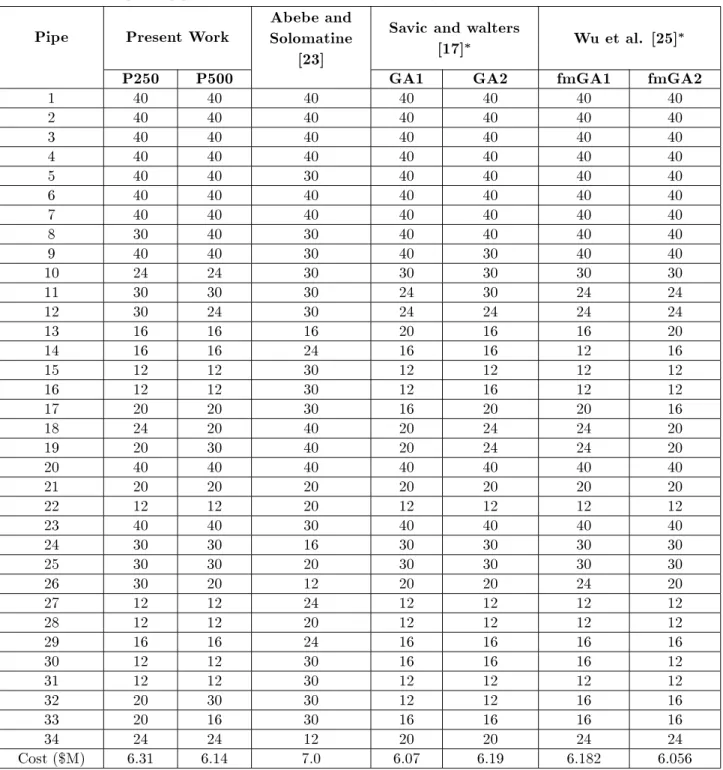
dicult problem amongst the three benchmark ex-amples in the literature and has been considered by only a few of the GA researchers 17,23,25]. Figure 4 shows the best generation cost against the number of network analyses required for two dierent numbers of population in each generation. The solution of $6.31 million is obtained at the expense of 13,000 evaluations, while the cheaper solution of $6.14 million is reached after 23,000 evaluations. This compares favorably with about 1,000,000 evaluations required by the method of Savic and Walters 17] to obtain the corresponding solutions of $6.19 million and $6.07 million and 113600 evaluations by the fast messy genetic algorithm of Wu et. al 25] to produce solutions of $6.182 million and $6.056 million. Ta-ble 5 compares the results produced by the proposed method with some of the available GA search solu-tions 17,23]. It should be noted that these solusolu-tions are obtained with 8 and 15 minutes of CPU time on a 366Hz PC.
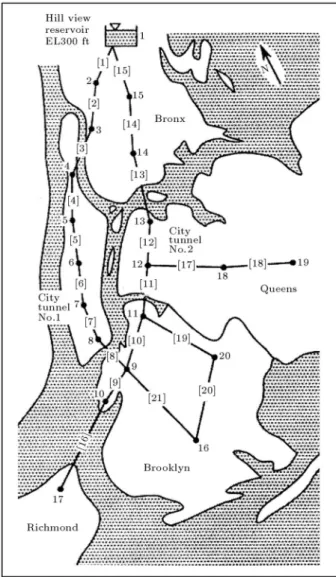
The third test problem concerns the rehabilitation of the New York City water supply network with 21 pipes, 20 demand nodes and one reservoir, as shown in Figure 5 15]. The commercially available pipe diameters and their respective costs are listed in Table 6, while the pipe and nodal data of the existing network are shown in Table 7. Figure 6 shows the best generation cost against the number of network analyses
Table4. Cost data for the Hanoi network.
Diameter (inch)
12 16 20 24 30 40Cost (units/m)
45.73 70.40 98.39 129.33 180.75 278.28Table5. Optimal pipe diameters and nodal heads obtained by dierent methods for Hanoi network.
Pipe
Present Work
Abebe and
Solomatine
23]
Savic and walters
17]
Wu et al. 25]
P250
P500
GA1
GA2
fmGA1
fmGA2
1 40 40 40 40 40 40 40
2 40 40 40 40 40 40 40
3 40 40 40 40 40 40 40
4 40 40 40 40 40 40 40
5 40 40 30 40 40 40 40
6 40 40 40 40 40 40 40
7 40 40 40 40 40 40 40
8 30 40 30 40 40 40 40
9 40 40 30 40 30 40 40
10 24 24 30 30 30 30 30
11 30 30 30 24 30 24 24
12 30 24 30 24 24 24 24
13 16 16 16 20 16 16 20
14 16 16 24 16 16 12 16
15 12 12 30 12 12 12 12
16 12 12 30 12 16 12 12
17 20 20 30 16 20 20 16
18 24 20 40 20 24 24 20
19 20 30 40 20 24 24 20
20 40 40 40 40 40 40 40
21 20 20 20 20 20 20 20
22 12 12 20 12 12 12 12
23 40 40 30 40 40 40 40
24 30 30 16 30 30 30 30
25 30 30 20 30 30 30 30
26 30 20 12 20 20 24 20
27 12 12 24 12 12 12 12
28 12 12 20 12 12 12 12
29 16 16 24 16 16 16 16
30 12 12 30 16 16 16 12
31 12 12 30 12 12 12 12
32 20 30 30 12 12 16 16
33 20 16 30 16 16 16 16
34 24 24 12 20 20 24 24
Cost ($M) 6.31 6.14 7.0 6.07 6.19 6.182 6.056
* These solutions are obtained using dierent numerical conversion constant for the head loss equations. Table 6. Pipe cost data for New-York network.
Diameter (inch)
0 36 48 60 72 84 96 108Cost ($/ft)
0 93.5 134.0 176.0 221.0 267.0 316.0 365.0Diameter (inch)
120 132 144 156 168 180 192 204Figure 3. Hanoi network.
Table 7. Pipe and nodal data for New York tunnel network.
Pipe Data
Nodal Data
Pipe Start
Node
Node
End
Length
(ft)
Existing Diameter
(inch)
Node Demand
(Cft/s)
Min Total Head
(ft)
1 1 2 11600 180 1 Reservoir 300
2 2 3 19800 180 2 92.4 255
3 3 4 7300 180 3 92.4 255
4 4 5 8300 180 4 88.2 255
5 5 6 8600 180 5 88.2 255
6 6 7 19100 180 6 88.2 255
7 7 8 9600 132 7 88.2 255
8 8 9 12500 132 8 88.2 255
9 9 10 9600 180 9 170 255
10 11 9 11200 204 10 1 255
11 12 11 14500 204 11 170 255
12 13 12 12200 204 12 117.1 255
13 14 13 24100 204 13 117.1 255
14 15 14 21100 204 14 92.4 255
15 1 15 15500 204 15 92.4 255
16 10 17 26400 72 16 170 260
17 12 18 31200 72 17 57.5 272.8
18 18 19 24000 60 18 117.1 255
19 11 20 14400 60 19 117.1 255
20 20 16 38400 60 20 170 255
Table 8. Optimal pipe diameters and nodal heads obtained by dierent methods for New York network.
Pipe Present Work
Dandy
et al.
15]
Boulos
et al.
19]
Murphy
et al.
13]
Savic and Walters
17]
Wu et al. 25]
P250 P500
GA1 GA2
GA1
GA2
fmGA1 fmGA2
1 96 0 0 0 0 0 0 0 0 0
2 0 0 0 0 0 0 0 0 0 0
3 0 0 0 0 0 0 0 0 0 0
4 0 0 0 0 0 0 0 0 0 0
5 0 0 0 0 0 0 0 0 0 0
6 0 0 0 0 0 0 0 0 0 0
7 84 0 0 124 108 0 108 0 124 108
8 0 0 0 0 0 0 0 0 0 0
9 0 0 0 0 0 0 0 0 0 0
10 0 0 0 0 0 0 0 0 0 0
11 0 0 0 0 0 0 0 0 0 0
12 0 0 0 0 0 0 0 0 0 0
13 0 0 0 0 0 0 0 0 0 0
14 0 0 0 0 0 0 0 0 0 0
15 0 108 120 0 0 120 0 144 0 0
16 96 96 84 96 96 84 96 84 96 96
17 120 96 96 96 96 96 96 96 96 96
18 72 84 84 84 84 84 84 84 84 84
19 72 72 72 72 72 72 72 72 72 72
20 0 0 0 0 0 0 0 0 0 0
21 72 72 72 72 72 72 72 72 72 72
Cost ($M) 41.9 39.28 38.80 37.83 37.13 38.80 37.13 40.42 37.83 37.13
* These solutions are obtained using dierent numerical conversion constant for the head loss equations.
required for two dierent numbers of population in each generation. The solution of $41.9 million is obtained at the expense of 10,500 evaluations, while the less costly solution of $39.28 million is reached after 20,500 evaluations. This compares favorably with 200000 evaluations required by the method
of Murphy et al. 13] to get the solution of $38.80,
46000 evaluations required by Lippai et al. 26] to
get their solution of $37.83, 1000000 evaluations
required by the method of Savic and Walters 17] to get the solutions of $40.42 and $37.13 and, nally, 37,186 evaluations required by the fast messy genetic algorithm of Boulos et al. 19] and Wu et al. 25] to get the solutions of $37.83 million and $37.13 million. The solution to this problem is shown in Table 8, along with
some of the available GA solutions. These solutions are obtained with 154 and 300 seconds of CPU time on the same machine used previously.
It should be noted that a criterion of `no solution change for 50 consecutive generations' is used as a convergence criterion for all the examples presented.
CONCLUDING REMARKS
A highly convergent Genetic Algorithm (GA) for pipe network optimization was presented in this paper. An articial genotype passing mechanism, an alternative penalty cost calculation method, an iterative setting of the penalty parameters prior to the GA search and, more importantly, a new selecting operator were
Figure4. Best of generation cost for Hanoi network.
Figure5. New York tunnel network.
introduced in the proposed GA. The genotype pass-ing mechanism leads to a monotonically decreaspass-ing convergence curve and, therefore, paves the way for introducing a logical convergence criterion for genetic algorithms. The use of an alternative penalty cost leads
Figure6. Best of generation cost for New-York network.
to a better distribution of the tness function compared to the conventional method and, therefore, helps the GA to locate useful genes. Penalty parameters used for the calculation of the penalty cost were determined prior to the GA search, via use of a mathematical programming method, eliminating the possibility of choosing too low or high values of the parameters. Finally, a new selecting operator was designed in an attempt to better simulate the process of natural mating, leading to an improvement in the accuracy and convergence characteristics of the method. The eciency of the proposed GA was shown by applying the method to the optimal design of three well-known benchmark networks, namely two-loop, Hanoi and New York networks. The method produced results comparable to the results presented in the literature with much less computational eort.
REFERENCES
1. Yates, D.F., Templeman, A.B., and Boey, T.B. \The computational complexity of the problem of determining least capital cost designs for water supply networks", Engrg. Optimization, 7(2), pp 142-155 (1984).
2. Gessler, J. \Pipe network optimization by enumera-tion",Wat. Resour. Res.,23(7), pp 977-982 (1985). 3. Alperovits, E. and Shamir, U. \Design of optimal water
distribution systems",Water Res.,13(6), pp 885-900 (1977).
4. Quindry, G.E., Brill, E.D. and Liebman, J.C. \Opti-mization of looped water distribution systems",J. of Env. Engg. ASCE,107(4), pp 665-679 (1981). 5. Mahjoub, Z. \Contribution a etude de
optimiza-tion des reaseaux mailles", Doctoral Thesis (Docteur Etat), Inst. Nat. Poly-Tech. de Toulouse, pp 51-142, Toulouse, France (1983).
6. Saphir, Y.N. \Optimization of water distribution sys-tem (in Hebrew)", M.S. Thesis, Technion-Israel Insti-tute of Technology, 150 pages, Haifa, Israel (1983). 7. Fujiwara, O., Aimahakoon, J. and Edirisinghe, N.C.P.
optimal design of looped water distribution networks", Wat. Resour. Res.,23(6), pp 997-982 (1987).
8. Kessler, A. and Shamir, U. \Analysis of the linear programming gradient method for optimal design of water supply networks",Wat. Resour. Res.,25(7), pp 1469-1480 (1989).
9. Fujiwara, O. and Khang, D.B. \A two-phase decom-position method for optimal design of looped water distribution networks", Wat. Resour. Res., 26(4), pp 539-549 (1990).
10. Murphy, L.J. and Simpson, A.R. \Pipe optimization using genetic algorithms", Research Report 93, Dept. of Civil Eng., Univ. of Adelaide, 95 pages, Adelaide, Australia (1992).
11. Dandy, G.C., Simpson, A.R. and Murphy, L.J. \A review of pipe network optimization techniques", Pro-ceedings of Watercomp, 93, pp 373-383, Melboune, Australia (1993).
12. Simpson, A.R., Murphy, L.J. and Dandy, G.C. \Pipe network optimization using genetic algorithms", Pro-ceedings of Wat. Resour. Plng. and Mgmt. Specialty Conference, ASCE, Seattle, WA, USA (1993). 13. Murphy, L.J., Simpson, A.R. and Dandy, G.C. \Design
of a network using genetic algorithms",Water,20, pp 40-42 (1993).
14. Simpson, A.R., Dandy, G.C. and Murphy, L.J. \Ge-netic algorithms compared to other techniques for pipe optimization",J. Wat. Resour. Plng. and Mgmt., ASCE,120(4), pp 423-443 (1994).
15. Dandy, G.C., Simpson, A.R. and Murphy, L.J. \An improved genetic algorithm for pipe network optimiza-tion",Wat. Resour. Res.,32(2), pp 449-458 (1996). 16. Halhal, D., Walters, G.A., Quazar, D. and Savic, D.A.
\Water network rehabilitation with structured messy genetic algorithm", J. Wat. Resour. Plng. and Mgmt ASCE,123(3), pp 137-146 (1997).
17. Savic, D.A. and Walters, G.A. \Genetic algorithms for least-cost design of water distribution networks", J.
Wat. Resour. Plng. and Mgmt. ASCE,123(2), pp 67-77 (1997).
18. Walters, G.A., Halhal, D., Savic, D. and Quazar, D. \Improved design of any town distribution network using structured messy genetic algorithms", Urban Water,1(1), pp 23-38 (1999).
19. Boulos, P.F., Wu, Z.Y., Orr, C.H. and Ro, J.J. \Least-cost design and rehabilitation of water distribution systems using genetic algorithms", Proceedings of the AWWA IMTech Conference, April 16-19, Seattle, WA, USA (2000).
20. Wu, Z.Y. and Simpson, A.R. \A self-adaptive bound-ary search genetic algorithm and its application to water distribution systems", J. of Wat. Res., 40(2), pp 191-203 (2002).
21. Afshar, M.H. \An element-by-element algorithm for the analysis of pipe networks",Int. J. for Eng. Science, 3(12), pp 87-100 (2001).
22. Gen, M. and Cheng, R. Genetic Algorithms and Engineering Design, John Wiley & Sons, NY, USA (1997).
23. Abebe, A.J. and Solomatine, D.P. \Application of global optimization to the design of pipe networks", 3rd Int. Conf. on Hydroinformatics, Copenhagen, pp 989-996, Balkema, The Netherlands (1999).
24. Cunha, M. and Sousa, J. \Water distribution network design optimization: simulated annealing approach", J. Wat. Resour. Plng. and Mgmt. ASCE, 125(4), pp 215-221 (1999)
25. Wu, Z.Y. et al. \Using genetic algorithms to rehabil-itate distribution systems", Journal American Water Works Association,93(11), pp 74-85 (Nov. 2001). 26. Lippai, I., Heaney, P. and Laguna, M. \Robust water
system design with commercial intelligent search opti-mizers",J. of Computing in Civil Engrg. ASCE,13(3), pp 133-135 (1999).