Eect of Quantum Interference
on the Absorption Spectrum of a
Four-Level Atom in Photonic Crystals
S. Roshan Entezar 1
and H. Tajalli
In this paper, the probe absorption spectrum of a four-level atom in photonic crystals has been investigated. A model is used, which assumes the transitions from the two upper levels to one of the lower levels coupled to the modes of the modied reservoir (photonic band gap) and transitions from the two upper levels to the other lower level coupled to the free vacuum modes. The eect of quantum interference in spontaneous emissions from the two upper levels to the lower levels on the absorption spectrum of an atom is investigated in detail. Most interestingly, it is shown that the atom becomes transparent to a probe laser eld coupled to the free space transition only in situations where complete quantum interference takes place in both the free space transitions and the modied reservoir transitions.
INTRODUCTION
The control of spontaneous emission and probe absorp-tion of an atom will lead to a number of potential appli-cations in high-precision measurements, quantum com-putation, teleportation, quantum information theory and lasing without population inversion. Therefore, the study of spontaneous emission and probe absorption has attracted much attention in recent years. It is well known that the spontaneous emission and probe ab-sorption of an atom depend, not only on the properties of the excited atomic system, but also on the nature of the surrounding environment [1]. The quantum interference of spontaneous emission and probe absorp-tion is widely studied. A classic example is the V-type three-level system, consisting of two close excited levels and one ground state in the same environment reservoirs [2]. A quantum interference phenomena will occur if the dipole moments of the two arms of a transition are not orthogonal. The interference in such a system arises from indistinguishable sponta-neous emission pathways. The interference, vacuum-induced or additionally driven by external coherent laser elds, is widely studied and leads to many
remark-1. Research Institute for Applied Physics and Astronomy, Tabriz University, Tabriz, I.R. Iran.
*. Corresponding Author, Research Institute for Applied Physics and Astronomy, Tabriz University, Tabriz, I.R. Iran.
able phenomena, including very narrow absorption and uorescence spectra [3], population trapping in a degenerate system [4], uorescence quenching in the free space [5], phase-dependent line shapes [6,7], lasing without inversion [8] and etc. [9]. From the viewpoint of the surrounding environment of atoms, Photonic Band Gap (PBG) structures have dierent Densities Of State (DOS) compared with a free-space vacuum eld [1,10,11]. The study of quantum and nonlinear optical phenomena for types of atoms embedded in such PBG materials leads to the prediction of many inter-esting eects: For example, localization of light [12,13], photon-atom bound states [1,12], suppression and even complete cancellation of spontaneous emission [14,15], enhancement of spontaneous emission [16,17], electro-magnetically induced transparency and other phenom-ena [18].
Many papers have reported on the population involution and distribution in upper levels [1,12] and the spectral components in the spontaneous emission elds [16,17] of an atom embedded in a photonic crystal. Of particular interest, Knight and his co-workers [18] investigated the transparency phenomena of an atom in the -type model, where one transition interacts with free vacuum modes and another interacts with modes near the edges of the photonic band gap. Focusing on the quantum interference of an atom without external driving coherent laser elds, Zhu [3] independently reported the quantum interfer-ence of a spontaneous emission spectrum and the probe
absorption spectrum of an atom coupled to vacuum space reservoirs. The quantum interference in the spontaneous emission spectrum of an atom embedded in a double-band photonic crystal was reported by Zhang and his co-workers [19-21].
In this paper, the model of a four-level atom in a double-band photonic crystal is adopted. The situations, where transitions from two upper levels to one of the lower levels coupled to the free vacuum modes, and the transitions from two upper levels to the other lower level coupled to the modes, which are isotropic PBG and anisotropic PBG, respectively, are studied. The probe absorption spectrum with the transitions coupled to free vacuum modes is also investigated and the eect of quantum interference on the absorption spectrum is studied in detail. Then, the equations for describing the probe absorption spectrum of the four-level atom in a photonic crystal are deduced. After that, the general calculated results and analysis are presented. And nally, major conclusions are summarized.
EQUATIONS FOR THEPROBE
ABSORPTION SPECTRUM
Consider a single four-level atom placed inside a PBG. The two excited states are labeledj3iandj2iand the
two lower states of the atomj1iandj0i, are as shown
in Figure 1. The transitionsj3i!j1iandj2i!j1iare
taken to be near resonant with a modied reservoir (the non-Markovian reservoir), while the transitionsj3i! j0iand j2i!j0i are assumed to be occurring in free
space (the Markovian reservoir). The probe absorption spectrum of these latter transitions is of central interest in this section. In the conguration shown in Figure 1, the upper levels,j3iandj2i, are of the same symmetry.
The four-level atom is initially prepared in the
Figure1. The schematic diagram of a four-level atomic system.
lower level, j0i. At time t = 0, this atom starts
to interact with a probe eld of frequency ! p. The
dynamics of the system can be described using the Schrodinger equation. Then, the wave function of the system at timetcan be expressed in terms of the state
vectors, as follows:
j (t)i=a 0(
t)j0;f0gi+a 2(
t)e i2t
j2;f0gi
+a 3(
t)e i3t
j3;f0gi+ X
k e a
k e(
t)j0;fkegi
+X
qe a
qe(
t)j1;fqegi; (1)
where k and q denote the momentum vectors of the
emitted photons ande denotes the polarization of the
emitted photons, 2 =
! p
! 20 and
3 =
! p
! 30.
The function, a j(
t) (j = 0;2;3), gives the probability
amplitude to nd the atom in the excited state,jji, and
the photon reservoir in the vacuum state. On the other hand,a
k e(
t) anda qe(
t) give the probability amplitude
to nd the atom in the lower state, j0i andj1i, and a
single photon of wavevectorkandqand polarizatione
in the photon reservoir, respectively.
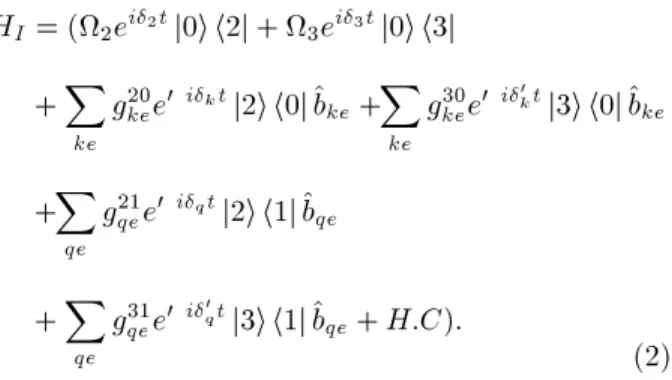
The Hamiltonian, describing the dynamics of this system in the interaction picture and the rotating wave approximation, can be written as follows:
H I = (2
e i2t
j0ih2j+ 3
e i3t
j0ih3j
+X
k e g
20 k e e
ikt j2ih0j^b
k e+ X
k e g
30 k e e
i 0 k
t j3ih0j^b
k e
+X qe
g 21 qe e
iqt j2ih1j^b
qe
+X
qe g
31 qe e
i 0 q t
j3ih1j^b qe+
H:C):
(2) Here, rst and second terms describe the coupling of the probe eld to the atom in transitionsj0i!j2iand j0i!j3i, respectively, and the next two terms express
the interaction of the atom with the free vacuum reser-voir in transitionsj2i!j0iandj3i!j0i, respectively.
Finally, the last two terms explain the interaction of the atom with the free vacuum reservoir in transitions
j2i ! j1i and j3i ! j1i, respectively.
2 and 3
are the Rabi frequencies, which are considered real for convenience in this problem;
k = !
k !
20 (
0 k = !
k !
30) represents the detuning of the radiation mode
frequency, !
k, from the atomic transition frequency, !
20( !
30), and
q= !
q !
21(
0 q =
! q
!
31) represents
the detuning of the radiation mode frequency, ! q,
from the atomic transition frequency, ! 21(
! 31).
g ij e
the atomic transition, jii! jji, and the mode, feg,
of the radiation eld. More precisely:
g ij e= ! ij d ij ~ ( ~ 2" 0 ! V )1=2! e e : ! d ij : (3) Here,! d
ij is the atomic dipole moment unit vector for
the transition, jii! jji, !
e
e is the polarization unit
vector of the radiation elds, V is the sample volume
and"
0is the Coulomb constant.
This Hamiltonian is substituted into the Schrodinger equation and the following set of equations is obtained:
ia_ 0(
t) = 2
a 2(
t) + 3
a 3(
t); (4)
i d dt
(a 2(
t)e
i2t) = 2 e i2t a 0( t) +X k e g 20 k e e ikt a
k e( t) +
X qe g 21 qe e iqt a qe(
t); (5) i
d dt
(a 2(
t)e
i3t) = 3 e i3t a 0( t) +X k e g 30 k e e i 0 k t a
k e( t) +
X qe g 31 qe e i 0 q t a qe(
t); (6) ia_
k e( t) =g
02 k e i(k 2)t a 2(
t) +g 03 k e i( 0 k 3)t a 3( t); (7) ia_
qe( t) =g
12 q e i(q 2)t a 2(
t) +g 13 q e i( 0 q 3)t a 3(
t): (8)
By formal time integration of Equations 7 and 8 and by eliminatinga
qe(
t) and a k e(
t) from Equations 5 and 6,
one obtains the following: _
a 2(
t) =i 2
a 2(
t) i 2 a 0( t) 20 2 a 2( t) 2 p 20 30 a 3( t) Z t 0 a 2( t 0) e i2(t t 0 ) K 22( t t 0) dt 0 Z t 0 a 3( t 0) e i3(t t 0 ) K 23( t t 0) dt 0 ; (9) _ a 3(
t) =i 3
a 3(
t) i 3 a 0( t) 2 p 20 30 a 2( t) 30 2 a 3( t) Z t 0 a 2( t 0) e i2(t t 0 ) K 32( t t 0) dt 0 Z t 0 a 3( t 0) e i 3 (t t 0 ) K 33( t t 0) dt 0 : (10) Here; K ij( t t 0) =
X qe g i1 qe g 1j qe e i(! q ! j1 )(t t 0 ) ; (11)
is the delayed Green function, where (i;j = 2;3)
i0 is the eective decay rate for the transition from
the upper level, jii(i = 2;3), to the lower level, j0i. = (3=8)
R (cos 20cos 30+cos 20cos 30)
d, where f i0 ; i0 ; i0
g(i= 2;3) are the directional angles of the
dipole moment unit vector,! d
i0, in a coordinate system
dened by the unit victors f ! e k 1 ; ! e k 2 ; !
kg and d is
the solid angle. So,= 1:0, when ! d 20 : ! d 30= 1 and = 0, when
! d 20 : ! d
30 = 0; otherwise, 0
< < 1:0.
In obtaining Equations 9 and 10, the following is used (see [1]): X k e g i0 k e g j0 k e e i(! k ! j0 )(t t 0 )= ij 2 p i0 j0 (t t
0) ; (12) where, ij= ij+ (1 ij)(
i;j= 2;3).
The delayed Green function, K ij(
t t
0), can be
expressed in the following forms [22]:
K ij(
t t 0) =
p ij 2 q 3=2 i1 3=2 j1 ( e i[ j g 2 (t t 0 ) =4] p
(t t 0) +e i[ j g 1 (t t 0 )+=4] p
(t t 0) ) ; (13) K ij( t t 0) =
p ij 2 p i1 j1 ( e i[ j g 2 (t t 0 )+=4] p
4(t t 0)3
+e i[ j g 1 (t t 0 ) =4] p
4(t t 0)3
)
; (14)
for isotropic PBG and anisotropic PBG reservoirs, respectively, with j gi = ! j1 ! gi (
i = 1;2 and j = 2;3). Here, p
ij =
ij +
p(1 ij) (
i;j = 2;3)
and p = (3=8) R
(cos 21cos
31+ cos 21cos 31) d, wheref i1 ; i1 ; i1
g(i= 2;3) are the directional angles
of the dipole moment unit vector,! d
i1, in a coordinate
system dened by the unit victorsf ! e k 1 ; ! e k 2 ; !
kg. So, p = 1:0, when
! d 21 : ! d 31 =
1 and p = 0, when ! d 21 : ! d
31 = 0; otherwise, 0
<p<1:0. The denitions
of the parameters are, as follows:
3=2 i1 = 12
" 0 ! 2 i1 d 2 i1 ! 3=2 gi 3~c 3 ; (15) i1= 1
2" 0 ! 2 i1 d 2 i1 ! 1=2 gi 3~c 3 : (16)
The aim here is to investigate the absorption and dispersion properties of the system for a weak probe laser eld. The equation of motion for the electric eld amplitude,E(z;t), is given by [23],
@ @z + 1 v g @ @t
E(z;t) = i !
2c
where () is the steady state linear susceptibility of
the medium andv g=
c=[1 + (!=2)(@Re()=@!)] is the
group velocity of the laser pulse with the derivative of the real part of the susceptibility being evaluated at the carrier frequency. Here, the denition of is
=
3+ 0 :5!
32 =
2 0 :5!
32 = !
p 0 :5(!
20+ !
30).
Since the transitions j0i ! j2i and j0i ! j3i are
treated as occurring in free space, the steady state linear susceptibility is given by [24]:
() = 4N jd 02 j 2 2 a 0(
t!1)a 2(
t!1)
+jd 03 j 2 3 a 0(
t!1)a 3(
t!1) !
; (18)
with N being the atomic density. The solutions
of Equations 9 and 10 are obtained by means of a perturbation theory [24-26]. It is assumed that the interaction between the probe laser and the atom is very weak (2
; 3
<< ;), so that a 0(
t) 1 for
all times. With the use of the Laplace transform, one obtains, from Equations 9 and 10,
s a
2( s) = i
2
D(s) 3
B(s)) A(s)D(s) B(s)C(s)
; (19)
s a
3( s) = i
2
C(s) + 3
A(s)) A(s)D(s) B(s)C(s)
; (20)
where:
A(s) =s i 2+
K
22(
s i
2) +
20
=2; (21) B(s) =
K
23(
s i
3) + p 20 30
=2; (22)
C(s) = K
32(
s i
2) + p 20 30
=2; (23)
D(s) =s i 3+
K
33(
s i
3) +
30
=2; (24)
here, a i(
s) =L[a i(
t)], K
ij(
s) = L[K ij(
t)] (i;j = 2;3), sis the Laplace variable and:
K
ij( s) =
p ij 2 q 3=2 i1 3=2 j1 0 @ i q is+ j g1
+q 1 is+ j g2 1 A ; (25) K ij( s) =
p ij 2 p i1 j1 i q is+ j g1+ q is+ j g2 ; (26) for double-band isotropic PBG and double-band anisotropic PBG reservoirs, respectively.
Therefore, one can easily obtain, using the nal value theorem, the long time behavior of the probabil-ity amplitude,
a 2(
t!1) = i
2
D(0) 3
B(0)) A(0)D(0) B(0)C(0)
; (27)
a 3(
t!1) = i
2
C(0) + 3
A(0)) A(0)D(0) B(0)C(0)
: (28)
Equations 18, 27 and 28, obtained above are used and the absorption spectrum for several parameters of the system are calculated.
RESULTS ANDDISCUSSION
In the model shown in Figure 1, the transitions from the two upper levels to the two lower levels,j1iandj0i, are
coupled, respectively, by the free vacuum modes and PBG modes, leading to two possible types of quantum interference. The rst is ascribed to atomic transitions coupled to the PBG modes and the second arises from atomic transitions coupled to the free vacuum modes. As far as it is known, there are no reports on the eects of the two types of quantum interference on the probe absorption spectrum. The following denitions are used:
g1=
2 g1+ 0
:5! 32=
3 g1 0
:5! 32
= 0:5(! 21+ ! 31) ! g1 ; (29) g2= 2 g2+ 0
:5! 32=
3 g2 0
:5! 32
= 0:5(! 21+ ! 31) ! g2 : (30)
The spectrum of Im[()], which is usually considered
to be the absorption spectrum, is shown in Figure 2 as a function of the detuning of the probe eld for the
cases of the transitionsj3i!j1iandj2i!j1icoupled
to the isotropic PBG reservoir and the anisotropic PBG reservoir, respectively. The plots at the positionsN =
1;2;3;4 correspond to (p= 1; = 1), (p = 1; = 0),
(p= 0; = 1) and (p= 0; = 0), respectively. Here,
symmetric values of parameters (i.e., same detunings
g1 =
g2 = 0
:5 and same coupling constants 21 =
31= 1
:0 and 21=
31= 1
:0) are employed.
Figure 2 shows that, altogether, three zeros ap-pear at position N = 1 and two zeros appear at
positions N = 2;3;4 in the case of the isotropic PBG
reservoir (Figure 2a). But there exists only one zero at position N = 1 and it is not seen at other positions
(N = 2;3;4) in the cases of the anisotropic PBG
reservoir (Figure 2b). In Figure 2, the zeros at the center of = 0 at position N = 1, in both cases
of the isotropic PBG reservoir and the anisotropic PBG reservoir, are due to the quantum interference
Figure2. The absorption Im() spectrum (in arbitrary units) as a function of detuningof probe eld, for dierent reservoirs; a) Double-band isotropic PBG reservoir and
21=
31= 1
:0 and b) double-band anisotropic PBG reservoir and
21=
31= 1 :0. The parameters used areg1= g2= 0:5,a0(0) = 1:0 and !
32= 0
:5. All parameters in this paper are in units of 20.
of the transitions between (j3i ! j0i, j2i !j0i) and
(j3i!j1i,j2i!j1i). The two dark lines at symmetric
sides of = 0 in Figure 2a originate from the two
singularities in the Laplace transform of the delayed Green's function, as shown in Equation 25, which is equivalent to the DOS of the isotropic PBG modes.
In order to investigate the eect of ! 32 (the
frequency distance between the two upper levels) on the absorption spectrum, the absorption spectrum was plotted as a function of detuning , in the case of p = 1; = 1, as shown in Figure 3. Here, the
parameters used are g1=
g2= 1
:0 anda
0(0) = 1 :0.
The plots at the positionsN = 1;2;3;4 correspond to !
32 = 0 :25, !
32 = 0 :5, !
32 = 0
:75 and ! 32 = 1
:0,
respectively. It is seen that, by increasing ! 32, the
transparency window around= 0 becomes wider.
Figure3. Same as Figure 2 forg1= g2= 1:0 and (p= 1;= 1).
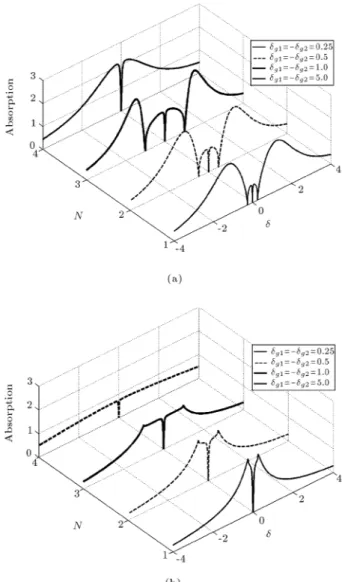
In Figure 4, the absorption spectrum was plotted as a function of detuning , for dierent widths of
PBG, in the case of p = 1 and = 1. Here, the
parameters used are! 32 = 0
:5 and a
0(0) = 1
:0. The
plots at the positions N = 1;2;3;4 correspond to
g1=
g2= 0 :25,
g1=
g2= 0 :5,
g1=
g2= 1 :0
and g1 =
g2 = 5
:0, respectively. It is easily seen
that, by increasing the width of the PBG, the probe absorption spectrum becomes similar to the absorption spectrum of a three-level atom placed in the free space reservoir. The reason for this behavior is that the spontaneous emissions of the transitions j3i ! j1i, j2i ! j1i are suppressed by PBG. This behavior is
shown in Figure 4 at positionN = 4.
CONCLUSION
The absorption spectrum of a four-level atom em-bedded in a double-band photonic crystal has been investigated. The transitions from the two upper levels to one of the lower levels was assumed to interact with
Figure4. Same as Figure 2 for!32= 0:5 and (p= 1;= 1).
free vacuum modes, and the transitions from the two upper levels to the other lower level were assumed to interact with anisotropic PBG modes. The absorption spectrum for the transitions coupled to the free vacuum modes is studied. Most interestingly, it is shown that there are zero absorptions in the absorption spectrum, only in the case of complete quantum interferences of the transitions between (j3i ! j0i, j2i ! j0i) and
(j3i ! j1i, j2i ! j1i). It is shown that the number
of zeros is dierent for a double-band isotropic PBG reservoir and a double-band anisotropic PBG reservoir. This dierence is due to the singularities in the Laplace transform of the delayed Green's function, in the case of a double-band isotropic PBG reservoir.
REFERENCES
1. Lambropoulos, P. et al. \Fundamental quantum optics in structured reservoirs", Rep. Prog. Phys.,63(4), pp 455-503 (2000).
2. Zhou, P. and Swain, S. \Quantum interference in probe absorption: Narrow resonances, transparency, and gain without population inversion", Phys. Rev. Lett.,78, pp 832-835 (1997).
3. Zhu, S.Y. et al. \Spontaneous emission from a three-level atom",Phys. Rev. A.,52, pp 710-716 (1995). 4. Radmore, P.M. and Knight, P.L. \Population trapping
and dispersion in a three-level system", J. Phys. B., 15, pp 561-573 (1982).
5. Lee, H. et al. \Quenching of spontaneous emission via quantum interference", Phys. Rev. A., 55, pp 4454-4465 (1997).
6. Paspalakis, E. and Knight. P.L. \Phase control of spontaneous emission", Phys. Rev. Lett., 81, pp 293-296 (1998).
7. Paspalakis, E. et al. \Transparency induced via decay interference", Phys. Rev. Lett., 82, pp 2079-2082 (1999).
8. Scully, M.O. et al. \Degenerate quantum-beat laser: Lasing without inversion and inversion without lasing",
Phys. Rev. Lett.,62, pp 2813-2816 (1989).
9. Agarwal, G.S. and Menon, S. \Quantum interferences and the question of thermodynamic equilibrium",
Phys. Rev. A.,63, pp 023818 (2001).
10. Yablonovitch, E. \Inhibited spontaneous emission in solid-state physics and electronics", Phys. Rev. Lett., 58, pp 2059-2062 (1987).
11. John, S. \Strong localization of photons in certain disordered dielectric superlattices", Phys. Rev. Lett., 58, pp 2486-2489 (1987).
12. John, S. and Quang, T. \Spontaneous emission near the edge of a photonic band gap",Phys. Rev. A.,50, pp 1764-1769 (1995).
13. John, S. and Wang, J. \Quantum optics of localized light in a photonic band gap", Phys. Rev. B., 43, pp 12772-12789 (1991).
14. Kofman, A.G. et al. \Spontaneous and induced atomic decay in photonic band structures", J. Mod. Optic., 41(2), pp 353-384 (1994).
15. Bay, S. et al. \Atom-atom interaction in strongly modied reservoirs",Phys. Rev. A.,55, pp 1485-1496 (1997).
16. Zhu, S.Y. et al. \Quantum interference eects in spontaneous emission from an atom embedded in a photonic band gap structure", Phys. Rev. Lett., 79, pp 205-208 (1997).
17. Zhu, S.Y. et al. \Spontaneous radiation and lamb shift in three-dimensional photonic crystals", Phys. Rev. Lett.,84, pp 2136-2139 (2000).
18. Paspalakis, E. et al. \Transparency near a photonic band edge",Phys. Rev. A.,60, pp R33-R36 (1999). 19. Zhang, H.Z. et al. \Quantum interference in
sponta-neous emission of an atom embedded in a double-band photonic crystal",Phys. Rev. A.,65, 063802 (2002).
20. Zhang, H.Z. et al. \Spontaneous emission spectrum from a V-type three-level atom in a double-band photonic crystal", J. Opt. B: Quantum Semiclass. Opt.,4, pp 300-307 (2002).
21. Zhang, H.Z. et al. \Spontaneous emission from a dou-ble V-type four-level atom in a doudou-ble-band photonic crystal",J. Mod. Opt.,50, pp 1649-1662 (2003). 22. Woldeyohannes, M. and John, S. \Coherent control
of spontaneous emission near a photonic band edge",
J. Opt. B: Quantum Semiclass. Opt., 5, pp R43-R82 (2003).
23. Harris, S.E. et al. \Dispersive properties of
electromag-netically induced transparency",Phys. Rev. A.,46, pp R29-R32 (1992).
24. Scully, M.O. and Zubairy, M.S. \Quantum optics", inQuantum Coherence and Interference Eects, Cam-bridge University Press, CamCam-bridge (1997).
25. Harris, S.E. et al. \Nonlinear optical processes using electromagnetically induced transparency",Phys. Rev. Lett.,64, pp 1107-1110 (1990).
26. Imamoglu, A. \Interference of radiatively broadened resonances",Phys. Rev. A.,40, pp 2835-2838 (1989).