A Human Cognitive Processing Perspective in Designing
E-Commerce Checkout Processes
Marios Belk1, Panagiotis Germanakos1,2, Argyris Constantinides3, George Samaras1 1Department of Computer Science, University of Cyprus, CY-1678 Nicosia, Cyprus
{belk,cssamara}@cs.ucy.ac.cy
2Suite Engineering UX, Products and Innovation SAP SE, Dietmar-Hopp-Allee 16, 69190 Walldorf, Germany
3Department of Computer Science, University College London, London, UK
Abstract. Designing a usable checkout process is of paramount importance for both E-Commerce and M-Commerce success. Aiming to understand human-computer interactions during checkout and improve the usability and user expe-rience of checkout tasks, this research work investigates the relation among us-ers’ cognitive styles, and alternative checkout designs in terms of user prefer-ence and task performance. A controlled user study with 38 participants was conducted which entailed a psychometric-based survey for highlighting the us-ers’ cognitive styles, combined with a real usage scenario with two variations of checkout designs that were deployed on standard desktop computers and mobile touch-based devices. Results suggest that human cognitive differences could play an important role in designing E-Commerce and M-Commerce checkout processes, and particularly users’ cognitive styles may affect the way users per-ceive and perform during such tasks.
Keywords: Human Cognitive Factors, E-Commerce, Usability, User Study.
1
Introduction
The checkout process has become widely known over the years in online commercial environments, and making purchases on the World Wide Web has become a fairly standard process, with clear steps and expected outcomes [1]. Nevertheless, recent research has shown that a high number of E-Commerce and M-Commerce environ-ments entail usability issues, from the user's conceptual understanding of commercial Web-sites, to how users interact with form fields [2-5]. In addition, studies revealed that usability issues of M-Commerce Web-sites as well as the small screen displays discourage users from accessing M-Commerce Web-sites [6].
In this realm, research has shown that both E-Commerce and M-Commerce Web-sites should satisfy the needs and preferences of users via the visual and interaction design of the system aiming to improve the shopping experience of users [7]. Thus, it is necessary to understand human-computer interactions in such realms and follow
user-centered design approaches when designing checkout processes, by incorporat-ing the unique needs, characteristics and preferences of users. Taken into considera-tion that users do not necessarily share common cognitive backgrounds in which online purchase decisions are required to be taken, we suggest that individual differ-ences in cognitive processing should be investigated and integrated in the user inter-face design process of checkout environments.
Accordingly, the work presented in this paper aims to understand and investigate whether individual differences in cognitive processing styles (Wholist/Analyst) affect user preference and task performance in different checkout designs that are deployed on alternative interaction device types (standard desktop vs. touch-based devices). The work is primarily motivated by existing research and theory that relates the Wholist/Analyst cognitive style to the way individuals navigate within hypermedia environments and the way hypermedia content is structured [8, 9, 10].
The rest of the paper is structured as follows: we present the underlying theory of this work in the next two sections. Thereafter we describe the context of a controlled user study and methods. Finally, we analyze and discuss the findings of the study and outline the implications of the reported research.
2
Individual Differences in Cognitive Styles
Research on individual differences in cognitive styles aims to understand how indi-viduals differ in mental representation and processing of information. Among various theories on cognitive styles [8, 11, 12], we have utilized the Wholist/Analyst cogni-tive style [8] since it is considered a widely accepted and accredited cognicogni-tive style dimension. The Wholist/Analyst cognitive style distinguishes individuals as Wholists that prefer and tend to structure incoming information as a whole to get the big pic-ture, and experience surroundings of the environment in a relative passive and global manner, or as Analysts that prefer and tend to structure the incoming information in detail, and experience surroundings in an active manner and with an internal perspec-tive.
A high number of studies which investigated the effect of cognitive styles on users’ task usability and interaction patterns within Web environments, revealed implica-tions of cognitive styles on users’ performance and preferred ways of using different navigation tools and display options [13, 14, 15]. On the contrary, various studies concluded that cognitive styles do not have a main effect on users’ task performance and preference within hypermedia environments [16].
3
Checkout Designs
We investigated the checkout designs of the most popular commercial Web-sites [4, 5], and concluded that the majority of them utilized two broad checkout designs that could be categorized as follows: i) a single one-page checkout process that contains all the necessary information for performing the purchase in a single page; and ii) a
guided step-by-step checkout process in which users have to fill out their information in multiple steps, usually across multiple pages.
Based on theory of cognitive styles, the single one-page checkout design could be related to the analytical approach that Analysts follow since it enables users to freely access all sections of the checkout process in a single page. On the other hand, the guided step by step design could be related to the Wholist dimension of cognitive styles since it presents content through a constrained and guided environment. In this respect, this work investigates the following research questions:
- Do users with different cognitive processing styles prefer a particular visual and interaction design of checkout processes?
- Do users with different cognitive processing styles perform differently in terms of task completion efficiency in different visual and interaction designs of check-out processes?
- Is there an observable interaction effect between cognitive processing styles of users and device type towards user preference and task performance of different checkout designs?
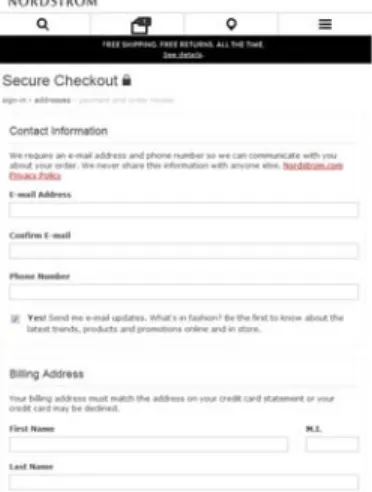
For the purpose of this study, we utilized different checkout designs of two existing commercial Web-sites: nordstrom.com (Nordstrom) and amazon.com (Amazon). Nordstrom checkout design follows a simple top-down navigation style in which us-ers can freely enter the required information for performing the checkout process (Figure 1). All required information (shipping information, payment information, etc.) is visible in one single Web-page.
Fig. 1. Nordstrom checkout process design.
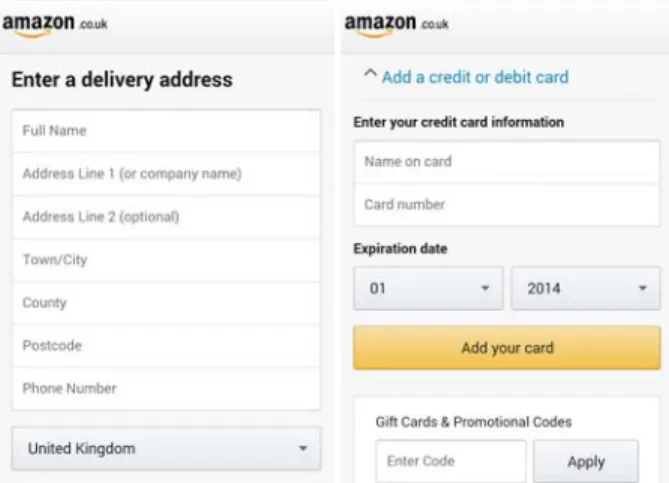
Amazon illustrates content in a guided horizontal step-by-step navigation style in which users can only enter information of a particular section, and then proceed to the next section (Figure 2). In the desktop version, a horizontal menu is utilized illustrat-ing the active section of the checkout process.
Fig. 2. Amazon checkout process design.
4
Method of Study
4.1 Sampling and Procedure
A total of 38 undergraduate Computer Science students (18 female and 20 male, age 20-25) participated voluntarily in a controlled user study held at the laboratory of the researchers. Controlled laboratory sessions were conducted with a maximum of two participants in each session and were held at times convenient to the students. Partici-pants initially interacted with a psychometric instrument aiming to classify each user to the Wholist or Analyst cognitive style class. Depending on the cognitive style clas-sification of each participant, a mixed design (within-subjects and between-subjects) was followed in which all participants navigated in two different commercial Web-sites; Nordstrom and Amazon, and were assigned to complete an online purchase in each checkout setting (within-subjects). Half of the participants interacted with stand-ard input/output (IO) devices (keybostand-ard and mouse) on desktop computers (IBM Thinkcenter M73, 21’’ monitor), and the other half interacted with mobile touch-based devices (Apple iPad 3) (between-subjects). The allocation of checkout designs’ sequence as well as the device types used for interaction was balanced across users depending on their cognitive styles’ classification.
The instructions provided to the participants for both navigation scenarios were as follows: i) select a product of their choice and add it to the shopping basket of the system; and ii) start the checkout process until buying the product with a virtual credit card that was provided to them at the beginning of the study. A client-side logging tool measured the total time spent for completing the checkout process, aiming to compare the usability of each checkout process in terms of task efficiency. At the end of the study, focus group sessions were conducted and questionnaires were provided in order to elicit the users’ subjective preference and perception of each design.
4.2 Cognitive Style Elicitation
Users’ cognitive styles where elicited by exploiting Riding’s Wholist/Analyst Cogni-tive Style Analysis test (CSA) [17]. As reported in Peterson et al. [18], the reliability of the test is r=0.81, p<0.01. The psychometric test highlights individual differences in Wholist/Analyst cognitive style by requiring from users to respond to 40 questions as true or false. In particular, 20 of the questions ask whether a pair of geometric shapes is identical or not (“Is shape X the same as shape Y?”), and the remaining 20 questions ask whether a single geometric shape is part of another complex geometric figure (“Is shape X contained in shape Y?”). It is assumed that Wholists respond faster in the task that involves the comparison of two figures than Analysts, whereas Analysts respond faster in the task that requires dis-embedding the simple geometric shape from the complex one than Wholists. Depending on the response time and pro-vided answer to each of the stimuli type, users are classified as Wholists or Analysts.
5
Analysis of Results
Users were grouped as follows based on their responses to the psychometric test: Wholists (N=21, f=55%), Analysts (N=17, f=45%).
5.1 Task Efficiency
A Repeated Measures Analysis of Variance (ANOVA) test was conducted using cog-nitive styles (Wholist or Analyst), device type (standard desktop or touch-based), and environment (Nordstrom or Amazon) as independent variables and the time spent to complete the checkout process as the dependent variable. Table 1 illustrates the mean of time to complete the process per checkout design and cognitive style group.
Table 1. Means of task performances (in seconds).
Wholists Analysts
Desktop Touch Desktop Touch Nordstrom 140.00 (36.15) 159.66 (57.39) 100.75 (24.28) 151.00 (18.74)
Amazon 118.16 (50.81) 135.73 (32.99) 127.33 (31.30) 164.60 (14.53) The analysis revealed that, the effect of checkout design on time needed to com-plete the checkout process is not significant (F(1,34)=0.032, p=0.860). In contrast, there was a statistically significant interaction between cognitive styles and checkout design on the time to complete the checkout process (F(1,34)=7.525, p=0.01, partial eta2=0.181). Furthermore, there was no interaction effect between cognitive styles and device type on the time to complete the checkout process (F(1,34)=0.232, p=0.633, partial eta2=0.007). Pairwise comparisons between checkout designs for each cogni-tive styles group and device type revealed that Analysts were significantly more effi-cient in completing the single page checkout design (Nordstrom) when this was de-ployed on desktop computers (MD=-26.583, SE=12.583; F(1,34)=4.463, p=0.042).
Furthermore, when the interaction was performed on touch-based devices, again, Analysts were faster in completing the single page checkout process but with no sta-tistical significant differences (MD=-13.600, SE=19.494; F(1,34)=0.487, p=0.490). On the other hand, Wholists were significantly more efficient in completing the guid-ed step-by-step checkout process (Amazon) when this was deployguid-ed on touch-basguid-ed devices (MD=23.933, SE=11.255; F(1,34)=4.522, p=0.042), whereas no significant differences where observed when the interaction took place on desktop computers (MD=21.833, SE=17.795; F(1,34)=1.505, p=0.288). Furthermore, a comparison be-tween the two cognitive style groups revealed that Analysts were significantly faster than Wholists when interacting in Nordstrom (F(1,38)=7.056, p=0.012). On the other hand, no significant differences were observed between Wholists and Analysts in Amazon (F(1,38)=0.422, p=.520).
5.2 User Preference
Focus-group sessions were concentrated around the participants’ subjective prefer-ence and perception of the different checkout designs. The focus groups followed a semi-structured process based on predetermined questions that lasted approximately 15 minutes. The participants were asked to rank the checkout designs based on their preference. In particular, participants ranked the checkout designs with 1 and 2 to represent their first and second choice. Table 2 lists the number of participants who chose a specific design as their first choice.
A Chi square test revealed that there is statistical significant association between cognitive styles and checkout design preference in desktop computers (Chi square value=6.343, df=1, p=0.012). For interactions that took place on desktop computers, Analyst users significantly preferred the single one page design, whereas Wholists preferred the guided step-by-step approach. On the contrary, in cases where users interacted with touch-based devices, no significant association between cognitive styles and checkout design has been revealed (Chi square value=1.534, df=1, p=0.216) since the majority of participants preferred the single page checkout design (Nordstrom). Based on comments, this might be based on the fact that users preferred to have all information in a single page due to size and interaction limitations. In the case of Wholists, although the task efficiency analysis revealed that they were signifi-cantly faster when interacting in a guided step-by-step checkout design (Amazon), they preferred the other type of checkout given the limitations of the touch-based device.
Table 2. User preference of checkout design. Wholists Analysts Desktop Touch Desktop Touch
Nordstrom 2 7 8 6
6
Conclusions
Designing a usable checkout process is of paramount importance for both E-Commerce and M-E-Commerce success. Thus, supporting users that are engaged in such tasks with more efficient decision-making and information processing is of criti-cal importance. Aiming to understand how individual differences in cognitive pro-cessing styles affect users’ interactions in different checkout designs, a controlled user study was conducted that explored the impact of the Wholist-Analyst cognitive style on user preference and task performance of different checkout designs within E-Commerce and M-E-Commerce settings. We primarily intended to focus on the Wholist/Analyst dimension since it highlights differences in the way individuals view the structure presented by their visual field as well as react and behave in various situations triggered by their contextual surroundings (e.g., desktop vs. touch-based interactions). Analysis of results suggests that cognitive styles affect users’ task com-pletion across device types (desktop computers and mobile touch-based devices). In particular, Wholist users have performed more efficiently in checkout processes that followed a guided approach, whereas Analyst users were more efficient and preferred a single page checkout design which did not follow a guided approach and provided more flexibility while entering information.
Results of the study suggest that personalizing the checkout process based on in-trinsic cognitive characteristics could support the users in terms of usability and im-prove the users’ buying experience, and eventually benefit the providers since person-alized tasks improve user acceptance of their services, and thus gain a competitive advantage. Nonetheless, the practical feasibility of such an approach entails a number of issues and challenges that need closer attention. An important challenge relates to the prior knowledge required by the system, about the users’ cognitive characteristics in order to provide personalized checkout designs without engaging users in a psy-chometric test. Given the complexity of cognitive styles’ research, implicit elicitation methods of cognitive styles without engaging users in a psychometric test is still at its infancy. In this context, existing noteworthy works could be used for implicitly elicit-ing the users’ cognitive styles based on the users’ navigation behavior [9, 10]. Anoth-er point relates to practitionAnoth-ers adopting the cognitive style elicitation process since the current paradigm of interactive systems might limit the proposed approach of applying cognitive style as a user profile and personalization factor. In view of our long-term goal of personalizing checkout tasks based on cognitive differences, this work aims to point out the importance of personalizing such tasks. In this respect, findings of this research build on the promise that human cognitive factors could offer an alternative perspective to the current one-size-fits-all paradigm of checkout pro-cesses.
Limitations of the study relate to the rather small sample size and non-varying user profiles (e.g., age, experience). Furthermore, the study did not control possible influ-encing factors such as content, images, etc., since different commercial Web-sites were used. On the other hand, we aimed to initially investigate the accumulated expe-rience of users in real life settings aiming to increase the ecological validity of the study. Future work entails investigating different combinations of content
presenta-tion and navigapresenta-tion within such tasks, and recruiting participants with varying profiles in order to increase our understanding about the effects of cognitive styles on users’ checkout process behavior and thus increase the external validity of this research. Acknowledgements. The work is co-funded by the Cyprus Research Promotion Foundation project PersonaWeb (ΤΠΕ/ΠΛΗΡΟ/0311(ΒΙΕ)/10) and EU project Miraculous-Life (#611421).
7
References
1. Nielsen, J.: Ecommerce Usability. NNGroup, 2014.
2. Kukar-Kinney, M., Close, A.G.: The Determinants of Consumers’ Online Shopping Cart Abandonment. Academy of Marketing Science 38, 2 (2010), 240-250.
3. Close, G.A., Kukar-Kinney, M.: Beyond Buying: Motivations Behind Consumers’ Online Shopping Cart Use. Business Research 63, (2010), 986-992.
4. Appleseed, J., Holst, C.: E-Commerce Checkout Usability: Exploring the Customer’s Checkout Experience. Baymard Institute, Denmark, 2013.
5. Appleseed, J., Holst, C.: M-Commerce Usability: Exploring the Mobile Shopping Experi-ence. Baymard Institute, Denmark, 2013.
6. Shim, J.P., Bekkering, E., Hall, L.: Empirical Findings on Perceived Value of Mobile Commerce as a Distributed Channel. In Proc. Information Systems (2002), 1835-1837.
7. Bellman, S., Lohse, G.L., Johnson, E.J.: Predictors of Online Buying Behavior. Communi-cations ACM 42, 12 (1999), 32-38.
8. Riding, R., Cheema, I.: Cognitive Styles – An Overview and Integration. Educational Psy-chology 11, 3-4 (1991), 193-215.
9. Chen, S., Liu, X.: An Integrated Approach for Modeling Learning Patterns of Students in Web-Based Instruction: A Cognitive Style Perspective. ACM Transactions on Computer-Human Interaction 15, 1 (2008), 1-28.
10. Belk, M., Papatheocharous, E., Germanakos, P., Samaras, G.: Modeling Users on the World Wide Web based on Cognitive Factors, Navigation Behavior and Clustering Tech-niques. Systems and Software 86, 12 (2013), 2995-3012.
11. Kozhevnikov, M.: Cognitive Styles in the Context of Modern Psychology: Toward an In-tegrated Framework of Cognitive Style. Psychological Bulletin, 133, 3 (2007), 464-481 12. Peterson, E., Rayner, S., Armstrong, S.: Researching the Psychology of Cognitive Style
and Learning Style: Is there Really a Future? Learning and Individual Differences, 19, 4 (2009), 518-523
13. Chan, C., Hsieh, C., Chen, S.: Cognitive Styles and the use of Electronic Journals in a Mo-bile Context. Documentation 70, 6, 997-1014 (2014)
14. Lo Storto, C.: Subjective Judgment, Cognitive Style and Ecommerce Website Evaluation: A Non-parametric Approach. Advanced Science Letters, 20, 10-12 (2014), 2073-2077
15. Belk, M., Germanakos, P., Asimakopoulos, S., Andreou, P., Mourlas, C., Spanoudis, G., Samaras, G.: An Individual Differences Approach in Adaptive Waving of User Checkout Process in Retail Ecommerce. In Proc. HCI International (2014), 451-460.
16. Brown, E., Brailsford, T., Fisher, T., Moore, A., Ashman, H.: Reappraising Cognitive Styles in Adaptive Web Applications. In Proc. World Wide Web (2006), 327-335.
17. Riding, R. (1991). Cognitive Styles Analysis - Research Administration. Learning and Training Technology, Birmingham, U.K.
18. Peterson, E.R., Deary, I.J., Austin, E.J.: The Reliability of Riding’s Cognitive Style Analy-sis Test. Personality and Individual Differences 34, 5 (2003), 881-891.