Preparing U.S. Companies for the
Transition to IFRS: A Guide for
JD Edwards Customers
An Oracle White Paper
Updated June 2010
Preparing U.S. Companies for the Transition to IFRS:
A Guide for JD Edwards Customers
EXECUTIVE OVERVIEW
In the fall of 2008, the SEC published a discussion road map for the adoption of IFRS by U.S. public companies in which early IFRS adopters could file as soon as 2011, and regular filing under IFRS would begin in 2014. In March 2010, the SEC announced that in 2011 they would consider accepting IFRS into the U.S.
Financial Reporting system if certain readiness conditions were met and IFRS and U.S. GAAP had reached convergence by mid 2011. This would mean that 2015 might be the earliest possible date for IFRS reporting.
The SEC’s March announcement brought focus on “convergence” that would now need to happen before the SEC finalized their decision to adopt IFRS. This means that U.S. filers would adopt the revised standard under U.S. GAAP in advance of IFRS adoption. Simultaneously, IFRS filers would adopt the same standard under IFRS.
For several years, FASB and IASB (the Boards) have been working on the convergence project with the objective of completing the urgent convergence projects by mid 2011. As both Boards have to negotiate general acceptance for the standards, it is difficult to forecast the actual completion date.
The convergence project includes many sub projects. The following lists the four most important projects from a system viewpoint:
• Financial Statements • Revenue Recognition • Lease Accounting • Financial Instruments
In May 2010, the Boards published “Comprehensive Income,” a proposed modification to both the U.S. GAAP Codification topic 220 and to IAS 1. This was the first major proposal from the Convergence project.
In the area of financial reporting, the Boards published a series of proposals that require more disclosure, in particular distinguishing operating and investment assets and requiring the use of direct cash flow reporting. The proposal is partially
1 IFRS: The right step for U.S. business, PriceWaterhouseCoopers, 2007.
“
“Although some thorny issues need attention, moving to IFRS is all but inevitable and will be entirely worthwhile.”1– PriceWaterhouseCoopers
1
definitive – a draft standard was published May 26, 2010 - and the Boards have not yet agreed on a final proposal for public review.
Regarding revenue recognition, there are proposals to replace U.S. GAAP revenue recognition (e.g., VSOE) and IFRS revenue recognition (IAS 18) with a
performance obligation model. The proposal is not yet definitive, and the Boards have not yet agreed on a final proposal for public review.
In the area of Lease Accounting, the proposals clarify the difference between long-term financing of assets and short-long-term rental of assets. While neither Board is keen on the current standards, the existing standards in U.S. GAAP and IFRS are quite similar. It is anticipated that a proposal will be published in the summer of 2010.
Regarding financial instruments, the Boards are deep in consultation with the financial industry, regulators, and authorities around the world to determine the best way to value and report on complex financial instruments and transactions. Both Boards have published standards and proposals covering elements of this topic, but the overall position is not definitive, and the community is not in agreement on what is generally acceptable.
Background
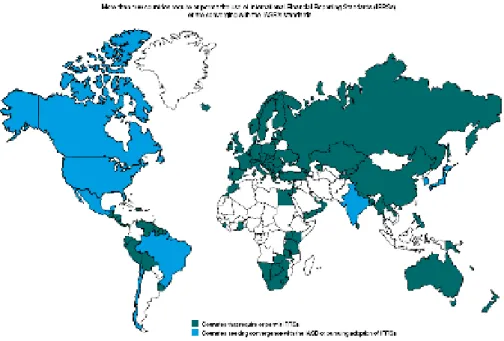
Over 12,000 companies within one hundred countries have successfully adopted IFRS, and by 2011-2012, every major capital market will use IFRS except the U.S. Figure 1 illustrates the momentum towards global IFRS adoption. Investors are interested in a single set of accounting standards in order to accelerate cross-border capital flows and the comparison of financial statements across territories, and are beginning to ask the question; “why maintain two different financial reporting languages in the U.S. when IFRS is proving to be a high-quality accounting standard in the rest of the world?”
As the U.S. enters this period of historic debate over global accounting and financial reporting standards, companies should be preparing for change. Whether your organization is currently adopting IFRS or plan to do so in the next few years, this white paper will help you understand how Oracle’s Financial Management Solutions address the challenges of global accounting and financial reporting.
Figure 1. The Momentum Towards Global IFRS Adoption (Source: The Journal of the IASB and the IASC Foundation, Insight Newsletter, Q3, 2007)
THE CHALLENGES OF TRANSITIONING TO IFRS
Although there will be significant challenges along the way, the transition to IFRS will bring considerable benefits to worldwide businesses. A single global
accounting and financial reporting standards will not only increase comparability for investment purposes and reduce accounting complexity, but it will increase the competitiveness of U.S. companies and capital markets. As with any significant change, challenges and obstacles will need to be planned for and addressed. The following section takes into consideration the top challenges U.S. companies will face.
Accessing the Right Information
Companies transitioning to IFRS will inevitably find themselves having to capture data and gather additional information in new ways. They may need to use new accounting definitions and valuations for specific balance sheet and income statement lines, obtain more comprehensive reporting from overseas operations, provide more detailed segment reporting, or comply with wider disclosure obligations. The challenge will be to honor a fundamental tenet of IFRS, which is consistency in definition and in depth of detail. Each reporting entity must report a financial item, such as revenue, as recognized in the same way and according to the same definition. If your organization has standardized data definitions for
customers, employees, suppliers, products, and management organizations, then you have a head start. The next step is to define corporate accounting policies centrally and implement controls to ensure that the rules are applied consistently
2 PwC China Accounting Standards Convergence Commentary, February 16, 2006,
Beijing, China.
““Based on our experience in other countries that have converged, the amount of effort involved for a company to embed IFRS into its financial reporting process should not be under-estimated. Our experience working with clients who adopted IFRS for the first time in 2005 was that many did not fully contemplate the amount of financial information, most of which had not been collected in the past, that is needed to comply with the standards.” 2
Addison Everett, Accounting Consulting Services Leader, PricewaterhouseCoopers
across the enterprise. Implementing preventative and detection controls will ensure that your information is recorded correctly. You’ll want to know who has access to do what and ensure that someone isn’t given inappropriate privileges.
Companies should be mindful of the risks involved in using spreadsheets to support the collection, consolidation, and reporting of information under IFRS. Spreadsheet-based reporting processes lack control, are prone to errors, and don’t provide adequate audit trails. Instead, today’s consolidation solutions support multiple accounting standards (U.S. GAAP, IFRS, and so on), provide validations and controls over the process, and can handle the collection of both financial and non-financial metrics.
Managing Multiple Frameworks
Not only does management need to respond to the specific IFRS accounting policies and procedures, but it must simultaneously maintain firm control of all of the other statutory requirements relevant to the group. It is this “multi-GAAP” view of the world that makes IFRS so challenging. If the U.S. moves forward with IFRS, then public companies would need to support both U.S. GAAP and IFRS during a transition period. So how does management move from reporting one GAAP to another or local reporting requirements to IFRS without losing control? How can management be certain that results reported using one method are consistent and reconcilable to the numbers reported using another method? Do management’s systems allow complete mastery of performance, or is management to be continuously exposed to unexpected volatility of results?
Until there’s a single set of global accounting and financial reporting standards, many companies face a constant balancing act between group and subsidiary-level reporting. On the one hand, they must implement controls to ensure international financial reporting standards are followed consistently worldwide. On the other hand, they need to continue preparing statutory financial statements and calculating taxes based on local regulations. U.S. companies must file locally according to national statutory regulations, and perhaps according to both U.S. GAAP and IFRS at the corporate level. In some cases, they may even need to keep multiple sets of books to manage dual accounting entries and reports. While having the flexibility to accommodate different account structures and reporting
requirements is critical, financial systems must achieve this in the context of robust controls.
Understanding the Accounting Impact
Based on the experience of companies outside the U.S., the introduction of IFRS requires constant working and reworking of management and statutory accounts in order to quantify the potential impact of those standards. This effort involves considerable reconciliation work aimed at quantifying and testing out the reasons for the differences so that their impact on reported results can be explained. A change in accounting standards may not sound like a strategic change, but it does
“Fortunately, the largest commercial ERP systems, such as Oracle and SAP, are able to handle running two sets of generally accepted accounting principles – a likely requirement for the foreseeable future. However companies with older versions of
the software may have to upgrade or reconfigure their current systems.” Sarah Johnson, CFO Magazine
impact the way that the business is run, the way that success is measured, and how information and records are maintained.
To meet investor expectations and ensure they have confidence in the IFRS reported results, organizations will be expected to produce consistent and reconcilable results. Business and accounting processes must be clearly
documented, and material deviations from them must be scrutinized and explained by the auditors. Management must be keenly aware of the impact of IFRS on external reporting and stakeholder relationships because of the deep implications IFRS could have for pensions, credit ratings, and share option schemes, to name a few. They will need technology and/or systems in place to analyze IFRS
accounting policies and their impact on reported results.
Reporting tools and dashboards need the versatility to allow management to monitor, understand and report performance in whatever GAAP or language is desired. In a compliance-rich culture, where good governance equates to superior management capability, nothing short of complete oversight of performance and risk is required.
ADDRESSING IFRS CHALLENGES WITH ORACLE’S FINANCIAL MANAGEMENT SOLUTIONS
Oracle solutions including JD Edwards help solve the fundamental information integrity issues, such as how to consistently collect, calculate, analyze, and store data from multiple systems that are associated with the transition to a new accounting framework. By synchronizing data centrally from all systems, Oracle and JD Edwards:
• Improve transparency into business, financial, and compliance
performance across the enterprise
• Strengthen your controls to enforce compliance with regulatory standards
• Increase operational efficiency.
Having accurate, consolidated information simplifies the task of producing high quality, transparent and comparable IFRS-compliant reports, and help free up scarce resources to grow your business.
Oracle solutions provide a complete offering for all of your financial control and reporting needs. JD Edwards records business transactions according to the accounting rules you define, whether they’re based on U.S. GAAP, IFRS, or another standard. If you operate a single consolidated general ledger or ERP instance, then the consolidation and reporting capabilities in JD Edwards can easily support IFRS reporting. If your company has complex entity relationships and consolidation structures across heterogeneous environments, then Oracle’s market-leading consolidation and reporting module, Hyperion Financial Management (HFM), is the right solution for you. Hyperion Financial
Management complements existing ERP and transaction systems by integrating data from multiple sources, providing a common view across the enterprise, and
enabling an integrated financial management process that helps businesses comply with stringent reporting regulations.
Ensure Information Consistency and Reliability
Information consistency and reliability start with having enterprise standards— standard data definitions, a standard chart of accounts, standard policies, and standard processes. Designed specifically to support global standards, the centralized business functions in JD Edwards makes it easier to enforce a consistent use of IFRS across reporting entities. Oracle’s Hyperion Financial Management and Oracle’s Hyperion Financial Data Quality Management offer standardized data management and financial consolidation and reporting processes for all of your source systems.
Centralized Business Functions
The process of standardizing accounting policies usually involves documenting the policy, communicating it to those who must apply it, and ensuring the standard policy is enforced. JD Edwards enables you to standardize your accounting policies, document them in the form of user-defined accounting rules, and distribute them across the entire enterprise, ensuring that everyone adheres to the same set of rules. The rules that you define centrally determine the appropriate accounting for all transactions, and users without access to the rules cannot modify or override them.
At the same time, JD Edwards offers the flexibility needed to meet virtually any accounting requirement. You can configure accounting rules based on attributes of a transaction so that you decide how accounts should be derived and the type of information to be captured in journal entries for management and financial reporting purposes.
In addition, using JD Edwards’ Automatic Accounting Instructions reduces reconciliation issues caused by the recording of accounting entries to the wrong account. For example, reversing a supplier liability or customer receivable when cash is dispersed or received can easily introduce problems if the liability or receivable account that is reversed doesn’t match the one used to record the original invoice. Automatic Accounting Instructions prevents problems related to this string of events or transaction flows by ‘remembering’ the original account that was used in the initial event (i.e. invoicing) and ensuring that the same account is reversed during the subsequent event (i.e. payment). It also lets you define, test, and validate accounting rules so that you have little risk of error when generating journal entries.
Standardized Financial Reporting Processes
The segment reporting requirements in IFRS require a multifaceted view of business, which is enabled by the ability to “slice and dice” information. However, data capture remains a fractured process that relies heavily on manual intervention to ensure that information is correctly mapped and processed from operational systems into group reporting systems. This poses a problem because manual
controls cannot provide the consistency offered by automatic controls, which once established can provide the basis of repeatable and dependable processes.
JD Edwards’ Flex Accounting and Data Relationships eliminate the data integrity risks associated with collecting, mapping, and verifying critical financial data within a single system. Flex Accounting allows accountants to define a standardized set of rules which determine the type of financial attributes captured at the transaction level. Data Relationships provide the ability to define data rules within master data which reduces setup errors and enforces consistency in reporting.
Oracle’s Hyperion Financial Data Quality Management, together with Oracle’s Hyperion Financial Management, eliminates the data integrity risks associated with collecting, mapping, verifying, and moving critical financial data from multiple source systems. It allows business analysts to develop standardized financial data management processes and validate data from any source system—all while reducing costs and complexity.
Oracle’s Hyperion Financial Management also helps companies align the processes for collecting financial results, operating results, and sustainability information in response to investor demands for increased disclosures of both financial and non-financial metrics. Hyperion Financial Management streamlines the collection, consolidation, and reporting of financial and non-financial information. The result is more control and consistency over financial and non-financial reporting,
improved data integrity and audit trails, as well as savings in time, effort, and costs. Hyperion Financial Management supports standardized consolidation and
reporting processes in compliance with U.S. GAAP, IFRS, and local statutory requirements. It provides intercompany eliminations, multicurrency translations, and minority interest calculations, delivering them quickly and cost-effectively out-of-the-box. Hyperion Financial Management is comprised of entity structures which define the group structure, i.e., the management or statutory hierarchies of reporting units and a chart of accounts hierarchy, which maintains the relationship or roll-up of account lines used in management and statutory reporting.
Achieve Corporate and Local Compliance
Until there’s a single set of global accounting standards, most companies will be required to maintain multiple sets of books to manage dual accounting entries and reporting requirements.
Simplified Dual Accounting
Oracle applications provide an adaptable infrastructure to support diverse legal and business requirements worldwide. The JD Edwards architecture ensures strict control over all accounting transactions. It uses configurable automatic accounting instructions to define accounting rules centrally and ledgers to capture accounting transactions. The single, tightly integrated, G/L architecture allows all systems that create accounting lines to use a central business function for creating G/L
transactions in real-time. Companies can achieve consistency across all financial systems while satisfying numerous reporting requirements.
JD Edwards enables compliance with multiple accounting requirements
concurrently in a single instance. Different accounting regulations are satisfied by maintaining and applying appropriate accounting rules to the right transactions. Ledgers, Companies, and User Defined Category Codes are used to capture and segregate accounting transactions based on one set of rules from another. For example, asset depreciation schedules may differ between IFRS, U.S. GAAP, tax books and local requirements. The depreciation journal process simultaneously generates depreciation transactions for each set of books in a separate ledger. Another example of using the JD Edwards architecture to support dual accounting would be the use of account category codes to stripe an account as applying to a specific accounting standard such as IFRS or GAAP. An account striped as IFRS would be ignored for GAAP reporting.
Simplified Multi-Dimensional Consolidation
A vital requirement of an IFRS-compliant consolidation model is the ability to roam between results in different GAAPs and report them side-by-side together with the reconciling differences between them. These reports can be readily generated on-demand in Hyperion Financial Management by utilizing its customizable multi-dimensionality. In other words, the system holds a single instance of the full management and statutory chart of accounts and a completely separate and customizable hierarchy for any of the relevant GAAPs. In practical terms, this means that any of the chart of account lines can, if required, be analyzed to any of the applicable GAAPs. The whole consolidation model
becomes a completely self-contained model that is amenable to change. Data entry and production reporting can expand dynamically in response to any changes to the chart of accounts, IFRS requirements, or group structure. Multi-dimensionality comes into its own around the complexities of segment reporting required by IAS 14. In theory, segment reporting is supposed to reflect internal reporting for the purposes of identifying appropriate business or geographical segments. The reality is that the level of detail required for the ‘primary’ segment is stretching and there is also a need to report ‘secondary’ segments. This gives rise to a very serious concern around how best to capture segmented, multi-dimensional, multi-GAAP data from reporting entities without encumbering end users with unmanageable web-based data entry forms that seem to scroll forever.
Hyperion Financial Management has smart capability in data capture. Web-based schedules for data entry permit multiple-GAAP data to be captured in a columnar format through a ‘point of view’ on the underlying database that is relevant to the end user. Scrolling across the page is kept to a minimum and segment reporting schedules, where required, can be populated via sub forms in a separate window. The ability to provide on line guidance via written instructions on a form or to capture commentary at a cell level which explains an IFRS adjustment provides useful support to end users and helps safeguard the reliability of the information and confidence in the integrity of the system.
Improve Confidence and Deliver Predictable Results
The movement towards one global accounting and reporting standard is good news for investors, making it easier to compare companies and assess investment opportunities worldwide. However, these changes can make life more complex for finance executives, who need to be aware of the coming changes, understand the impact on their financial results with appropriate audit trails, and maintain the confidence of investors so that the company can continue to raise capital.
Predictive Modeling and Analysis
Hyperion Strategic Finance can help finance organizations minimize investor surprise by assessing the impact of different accounting policies on reported results. It allows management to develop a model of the business and plan for different scenarios, perform business sensitivity analysis, and adjust inputs and assumptions with goal-seeking techniques. For example, many companies required to perform asset impairment tests under IAS 36 will calculate the recoverable amount of an asset by discounting future cash flows in a separate spreadsheet. While this generates an arithmetically correct result, it ignores other aspects of business performance. By doing impairment tests within a completely integrated economic model of the business, management can see the combined impact of IFRS accounting policies and different planning scenarios on balance sheet ratios. Unlike spreadsheets, Hyperion Strategic Finance provides an audit trail of the rules and assumptions used in various scenarios. It also includes financial intelligence to ensure that balance sheets, profit and loss accounts, and cash flows are
synchronized and automatically updated for any changes in the model. This integrated model enables management to analyze everyday business decisions in the context of new accounting standards that might otherwise introduce
unwelcome volatility
.
Auditable Accounting and Reporting
The confidence of management and investors depends on transparent and auditable information and processes.
Transparent Accounting – JD Edwards
A good record of how and why journal entries are created is especially important during the transition to a new accounting standard. With JD Edwards the automatic accounting instructions used to generate accounting entries are stored centrally and can be queried and reviewed at any time. JD Edwards’ single, integrated General Ledger architecture means that journal entries are created real time by the source transactions using a centralized business function allowing a direct link to the underlying transaction. The supporting transaction detail together with the accounting rules provide a complete audit trail of how the accounting was created for all transactions, along with assurance that it was done correctly.
In conjunction with Oracle BI Publisher, customized reports can be created from JD Edwards’ data. Oracle BI Publisher allows finance to create and maintain
report formats with familiar desktop tools. You can mix and match accounting transaction details with XML data extracts, including information captured in user defined category code fields to tailor financial reports for your specific needs. BI Publisher merges the custom report template with the data extract to generate the output in the desired format (e.g., PDF, HTML, RTF, and Excel).
Versatile Reporting – Oracle’s Hyperion Financial Management
The presentation of reports can differ significantly under U.S. GAAP, IFRS, and national standards. Oracle’s Hyperion Financial Management is versatile enough to satisfy these multiple reporting requirements while ensuring adequate controls in the financial reporting process. All report formats are dynamically updated with changes to an accounting standard or the chart of accounts, and draw from the same database to ensure consistency among them. It provides a complete audit trail from original data capture to final results with drill-down on reconciling or adjusting entries. Hyperion Financial Management also allows management to compare and contrast key performance indicators based on different accounting standards. Because Hyperion Financial Management synchronizes data from all sources and provides an easily accessible audit trail, management can be confident in the accuracy of information even if financial results vary significantly between accounting standards.
SUCCESSFULLY ADDRESS THE CHALLENGES OF MOVING TO IFRS
The shift to a global accounting and reporting standard for publicly listed companies in the U.S. is underway. IFRS will have implications not just for external reporting but also for internal reporting and performance measurements processes. Public companies should consider becoming early adopters to increase the likelihood of a smooth transition. This includes making sure your financial systems are capable of accounting for and reporting in both IFRS and existing standards, modeling the impact IFRS may have on your financial results, and taking actions to minimize any negative impacts.
Progressive companies in the U.S. are embracing the idea of a global standard by embedding IFRS into their processes and systems. IFRS as we know it today continues the tradition of investor protection and transparent financial reporting that have traditionally been characteristics of U.S. standards. We encourage all U.S. stakeholders to think globally, plan for the transition, and embrace the benefits that IFRS will bring.
Oracle solutions are uniquely equipped to help you improve information quality,
manage multiple frameworks and enforce global standards and controls while complying with local regulations and improve business processes.
Preparing U.S. Companies for the Transition to IFRS with Oracle and JD Edwards Solutions June 2010 Oracle Corporation World Headquarters 500 Oracle Parkway Redwood Shores, CA 94065 U.S.A. Worldwide Inquiries: Phone: +1.650.506.7000 Fax: +1.650.506.7200 oracle.com
Copyright © 2010, Oracle Corporation and/or its affiliates. All rights reserved. This document is provided for information purposes only and the contents hereof are subject to change without notice.
This document is not warranted to be error-free, nor subject to any other warranties or conditions, whether expressed orally or implied in law, including implied warranties and conditions of merchantability or fitness for a particular purpose. We specifically disclaim any liability with respect to this document and no contractual obligations are formed either directly or indirectly by this document. This document may not be reproduced or transmitted in any form or by any means, electronic or mechanical, for any purpose, without our prior written permission. Oracle is a registered trademark of Oracle Corporation and/or its affiliates. Other names may be trademarks of their respective owners.