Consultative Document
Standards and Processes for Global Securities Financing
Data Collection and Aggregation
Table of Contents
Page
1. Introduction ... 1
2. Data elements and granularity ... 3
2.1. Data elements for financial stability ... 3
2.2. Definitions of data elements ... 4
2.2.1 Repurchase agreement and sell/buy back operations ... 4
2.2.2 Securities lending and borrowing ... 13
2.2.3 Margin lending ... 17
3. Data architecture ... 22
3.1. First tier: Data collection at the national/regional level ... 24
3.1.1 Sources of data ... 24
3.1.2 Reporting population and non-reporting entities ... 26
3.1.3 Granularity of the data ... 27
3.1.4 Aggregation and classification of the data ... 27
3.2. Second tier: data aggregation at the global level ... 28
3.2.1 Legal and operational issues ... 28
3.2.2 Data confidentiality ... 29
3.2.3 Access to data on securities financing transactions ... 29
3.2.4 Governance ... 31
3.3. Double-counting ... 31
3.3.1 Over-netting ... 34
4. Recommendations for national/regional data collections ... 36
5. Use of data ... 38 5.1. Flow data ... 38 5.2. Loan data ... 39 5.3. Collateral data ... 40 6. Next steps ... 42 i
Annex 1: Recommendations for improving market transparency in the August 2013
Report ... 44
Annex 2: An example of the use of TRs as the main source of data (European Commission legislative proposal) ... 45
Annex 3: Data on repos for financial stability purposes(*) ... 46
Annex 4: Data on securities lending for financial stability purposes(*) ... 48
Annex 5: Data on margin lending for financial stability purposes(*) ... 50
1.
Introduction
On 29 August 2013, the FSB published the report Policy Framework for Addressing Shadow Banking Risks in Securities Lending and Repos (hereafter August 2013 Report) that set out final recommendations to address financial stability risks in relation to securities lending and repos.1 These included recommendations for national/regional authorities to improve data collection on securities lending and repo markets to detect financial stability risks and develop policy responses, and for the FSB to aggregate the total national/regional data for these markets in order to assess global trends in financial stability (Annex 1).
Based on these recommendations, a FSB Data Experts Group (hereafter DEG) was established to develop standards and processes for global data collection and aggregation on securities financing transactions that are relevant for financial stability monitoring and policy responses. Such standards and processes would allow the FSB to collect periodically (at least monthly) from national/regional authorities aggregated data on securities lending and repos, based on granular information collected at the national/regional level. The recommendations for data collection procedures used by national/regional authorities should help to minimise potential problems in global aggregates, including double-counting.2 The aggregated national/regional data submitted to the FSB should exclude central bank repo transactions.
This document sets out the proposed standards and processes for global securities financing data collection and aggregation. It includes proposals on data elements for repos, securities lending and margin lending that national/regional authorities will be asked to report as aggregates to the FSB for financial stability purposes in Section 2. The document then describes the data architecture issues related to the data collection and transmission from the reporting entity to the national/regional authority (first tier) and then from the national/regional to the global level (second tier), to ensure the quality of global aggregates and the efficiency of the reporting framework in Section 3. Six recommendations to national/regional authorities are set out in Section 4 to ensure consistency among national/regional data collections and to derive meaningful global aggregates. Section 5 discusses the potential uses of the aggregated data (in particular those data elements not covered in the August 2013 Report). The next steps for the completion of the initiative are outlined in Section 6, including plans to follow up on the proposals set out in this document with an evaluation of potentially expanding the data collection to include economically equivalent operations and additional data for financial stability purposes. These additional data elements could also include those that are needed to measure collateral velocity - leveraging on the FSB work on the possible harmonisation of regulatory approaches to
re-1 http://www.financialstabilityboard.org/wp-content/uploads/r_130829b.pdf
2 Double-counting occurs when both parties involved in a contract may provide the data. In the case of securities financing
transactions, this means that the same transaction may be reported twice, by both the lender and the borrower, leading to an overestimation of the size of the overall securities financing market. Therefore it is necessary to make adjustments to remove double-counting, in order to derive appropriate measures (see Section 3.3 for details).
1
hypothecation of client assets - and to monitor the implementation of the new regulatory framework for haircuts on non-centrally cleared securities financing transactions.3
The proposals in this document have been developed by the DEG and were discussed in meetings with market participants. The FSB wishes to thank those who have taken the time and effort to share their views.
The DEG has also leveraged other initiatives such as the FSB definition of a common data template for global systemically important banks (G-SIBs).4 The collection of data on securities financing transactions is also a component of the implementation of the G20 Data Gaps Initiative Recommendation 4 on the development of measures of system-wide macro-prudential risk such as the aggregate leverage and maturity mismatches in the financial system.5 Where possible, duplications among similar international data collections have been avoided.
The FSB welcomes comments on the proposals set out in this document. Comments and responses to questions should be submitted by 12 February 2015 by email to [email protected] or by post (Secretariat of the Financial Stability Board, c/o Bank for International Settlements, CH-4002, Basel, Switzerland). All comments will be published on the FSB website unless a commenter specifically requests confidential treatment.
3 http://www.financialstabilityboard.org/wp-content/uploads/r_141013a.pdf
4 This initiative is developing a common data template to collect from G-SIBs data relevant for financial stability analyses.
Partial data on securities financing transactions are currently collected to assess major bilateral linkages between large international financial institutions as well as their common exposures and funding dependencies to countries, sectors and financial instruments. Given the high confidentiality of such bilateral information, a framework for pooling and sharing relevant data among supervisors and central banks with macro-prudential mandates has been established (see
http://www.financialstabilityboard.org/wp-content/uploads/r_120328l1.pdf and the latest progress report at
http://www.financialstabilityboard.org/wp-content/uploads/r_140506.pdf).
5 See the FSB – IMF report on “The Financial Crisis and Information Gaps” (October 2009;
http://www.financialstabilityboard.org/wp-content/uploads/r_091029.pdf). Annual progress reports on the implementation of the 20 recommendations have been issued since 2010 ( http://www.financialstabilityboard.org/wp-content/uploads/r_140923.pdf for 2014).
2
2.
Data elements and granularity
2.1. Data elements for financial stability
The first step in creating standards and processes for global data collection and aggregation of securities financing transactions is the identification of data elements and the definition of a minimum granularity necessary to create the meaningful global aggregates to inform authorities in their financial stability monitoring and policy responses. With regard to repos and securities lending operations, the August 2013 Report identified an initial list of key data elements. The DEG started with this list of data elements (see Table 1 below) and identified additional elements that are also relevant for financial stability purposes (see Sections 2.2.1 and 2.2.2 for the full list of data elements for repos and securities lending and Section 2.2.3 for additional tables for margin lending).
Table 1 – Data on securities financing transactions identified in the August 2013 Report to be useful for financial stability monitoring and policy responses
Repo Securities Lending
Value date Value date
Maturity date Maturity date
Collateral type Collateral type
Collateral quality Collateral quality
Haircut Haircut
Principal Amount Amount of security lent
Counterparty type Counterparty (Borrower) type
(Repo) Market segment (bilateral, tri-party
or CCP-cleared) Beneficial owner (Security lender) type
Repo Rate Type of security lent
Cash currency Cash collateral reinvestment – Asset type
Collateral currency Cash collateral reinvestment – Maturity
The final list of data elements will be based on and complemented by a comprehensive dictionary of data definitions (metadata) and reporting guidelines to ensure effective and consistent global aggregation. In addition to (i) the set of data elements for global aggregation purposes, the DEG also agreed on recommendations for (ii) reference periods or dates (see “2.1 Reporting period” in Table 2 and “3.1 Reference date” in Table 3 below) as well as (iii) reporting frequency and timeliness (see recommendation (ii) in Section 4).
The tables below describe the common definitions and minimum granularity of data elements that authorities are requested to use in their data collections in order to ensure a consistent aggregation of the data on securities financing reported to the FSB. As stated in the August 2013 Report, national/regional authorities should collect the needed data, based on a
consideration of their market structure, and building upon existing data collection processes and market infrastructure where appropriate. Thus, the proposed data elements are not intended to restrain national/regional authorities from collecting additional data elements or adopting higher frequency or higher level of detail, provided that the data collected are consistent with the proposed FSB definitions (see Section 2), processes (see Section 3) and recommendations (see Section 4) so that it is possible to create meaningful global aggregates for financial stability purposes (see Section 5).
2.2. Definitions of data elements
The creation of comparable global aggregates requires that data be collected using consistent taxonomies and common definitions.
Common definitions of securities financing transactions such as repo, securities lending and margin lending are needed to ensure that the vast majority of these transactions are captured, irrespective of the local trading practices (for example, where repos are executed as buy/sell backs), and without introducing errors due to inconsistencies in the way data are reported by different jurisdictions. Such common definitions should also reduce the risk of incentivising market participants to carry out securities financing transactions under a different legal or contractual form to avoid or circumvent the reporting obligation.
The global data collection could be based on the aggregation of reporting from either one or both parties to a trade (e.g. repos and reverse repos or securities lent and borrowed). Assuming that at least FSB member jurisdictions will provide the data, a two-side reporting scheme, where both counterparties report the trade, would maximise the data collection coverage.6 For example, a one-sided reporting scheme for repos would not capture a reverse repo between a reporting entity and a non-reporting counterparty. With two-side reporting, only transactions where both counterparties are non-reporters would not be included in the global aggregates. However, collecting data from both parties of securities financing contracts introduces double-counting as data from the same transaction could be reported twice (See Section 3.3).
Transactions executed with central banks are excluded from the data reporting scope as well as internal deals within the same legal entity. Intra-group transactions between different legal entities (banks or other subsidiaries) should be included.
2.2.1 Repurchase agreement and sell/buy back operations
A repurchase agreement (repo) is an arrangement involving the provision of securities or other financial assets (“collateral”) in exchange for cash (spot leg) with a commitment to repurchase the same or similar collateral at a fixed price (forward leg) either on a specified
6 The two-sided approach is suggested for stock data on repos and securities lending. Reverse repos’ flow data are based on
a one-sided reporting scheme since they are meant to look at the turnover of credit exposures so that only the cash leg is required. Also, data for margin lending would be based on one-side reporting because of the characteristics of these transactions and the nature of the intermediary-client relationship.
4
future date or on demand (“open” or extendable repos).7 A repo is viewed from the perspective of the provider of the collateral - i.e. the cash taker. The transaction is called a reverse repo when viewed from the perspective of the buyer of collateral and cash provider. Repos include not only classic repos, but also sell/buy back transactions. In the case of classic repos, the spot and forward legs are always governed by a single contract which allows for the payment of variation margins and the right of substitution of the collateral during the term of the repo. Sell/buy backs are economically similar transactions but governed by two legally independent contracts for the spot and the forward legs, which makes it difficult to legally enforce margin calls and exercise the right of substitution of the collateral.8 However, as with classic repos, sell/buy backs can also be governed by a single agreement (“documented sell/buy backs”) that allow for variation margins and right of substitution.9
Table 2 lists the recommended data elements that should be reported for reverse repos and buy/sell back transactions (hereafter collectively referred as “reverse repos”). Tables 3 and 4 list, in addition to those for reverse repos, the recommended data elements for repos and sell/buy back transactions (hereafter “repos”).
Repos include but are not limited to contracts conducted under the following master agreements: Master Repurchase Agreement (MRA), Global Master Repurchase Agreement (GMRA), Deutscher Rahmenvertrag für Wertpapierpensionsgeschäfte, China Bond Repurchase Master Agreement, Korea Financial Investment Association (KOFIA) Standard Repurchase Agreement, Investment Industry Regulatory Organization of Canada (IIROC) Repurchase/Reverse Repurchase Transaction Agreement, Convention-Cadre Relative aux Operations de Pensions Livrees, Saiken Tou no Gensaki Torihiki ni Kansuru Kihon Keiyaku Sho, Contrato Marco de compraventa y Reporto de valores, Clearing House Rules (for example, Fixed Income Clearing Corporation - FICC), bespoke repo agreements.
Based on the August 2013 Report, the FSB recommends that national/regional authority report two sets of data for global aggregation:
(i) Flow data (as transactions settled over a certain period of time) would be collected and reported to the FSB, but limited to (i) the number, (ii) principal amount, (iii) currency and (iv) maturity of trades whose spot leg has been settled during the reporting period.10 By
7 “Open” maturity is where both parties agree daily either to renew or terminate the agreement. Such an arrangement
avoids settlement costs if both parties wish to roll-over the repo on a continuing basis.
8 While the different legal nature of the contracts also implies operational differences in the way classic repos and sell/buy
back operations are conducted (e.g. on the payment of repo interest and the coupon or dividend on the collateral), there is no significant economic difference between these transaction types.
9 Specifically, the parties agree on an “early close-out” clause, which allows them to terminate the original sell/buy back
and initiate a new one for the remaining term to maturity and with the adjusted amount of cash or collateral.
10 Specific guidance will be provided on how modified or novated contracts should be included in flow data. One approach
is that modified or novated trades should be reported as only one transaction to avoid an increase in centrally cleared transactions resulting in an increase in the reported global flow data. Also, flow data should include rolled-over OTC repos, when counterparties decide to skip the settlement of the forward leg of the first repo and of the cash leg of the second repo.
5
design, it is not possible to link flow data with variations in position/stock data. For flow data, the collection and aggregation of only the reverse repo cash leg is recommended; (ii)Position/stock data (outstanding balance of all transactions measured at a given point in
time), represented by the total gross amount of loans (cash leg) received for repo or provided for reverse repo, aggregated according to the required classification (e.g. underlying collateral types, counterparties). The collection and aggregation of position/stock data includes separate reporting of both legs of the securities financing transactions.
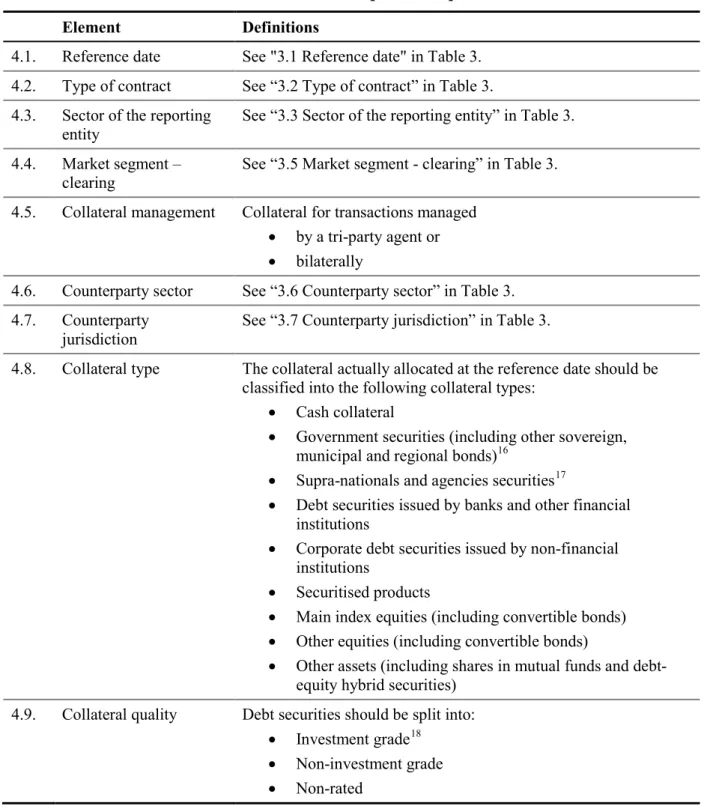
The Tables 2 to 4 below define the proposed data elements and describe the reporting of aggregated data to the FSB. The stock/position data is separated into data elements related to the loan in Table 3 and related to the collateral in Table 4. The loan and collateral data are linked by the classification of the contract (type and market segment) and the counterparty (sector and jurisdiction). Separating the collateral related data elements from the loan related data elements will facilitate the reporting of collateral pools for repos managed at portfolio level.
At the national/regional level – where confidentiality issues are addressed by prudential or other regulations – the data collection could be more detailed, with additional information useful to conduct more comprehensive analysis on individual counterparties, markets or instruments.
Specific guidance will be provided for particular cases such as callable bonds, tri-party substitutions and other forms of collateral turnover.
Table 2: Data elements related to reverse repos – loans flow data Element Definitions
2.1. Reporting period The month of the settled transactions. 2.2. Number of trades settled
(spot leg) during the reporting period
The number of trades with spot leg settled in the reporting period. The spot leg is the first part of the reverse repo and buy/sell back, where the buyer provides cash to the seller of securities.
2.3. Original maturity Maturity buckets of trades with spot leg settled in the period (in calendar days), according to:
• Open or continuing terms contracts for which no maturity date is specified
• Overnight, including 1-day term trades or longer that mature the next day
• from 2 days to 1 month
• more than 1 month up to 3 months
• more than 3 months and up to 1 year
• more than 1 year
2.4. Currency Proposed list of major currencies:11
• BRL – Brazilian Real
• CAD – Canadian Dollar
• CHF – Swiss Franc
• CNY - Renminbi
• DKK – Danish Krona
• EUR – Euro
• GBP – UK Pound
• JPY – Japanese Yen
• SAR – Saudi Arabian Riyal
• USD – US Dollar
• Other currencies
Specific guidance will be provided for cross-currency trades. 2.5. Principal amount The actual amount of cash provided for trades with spot leg settled
in the reporting period, in millions of USD.12
11 An alternative is to include a full list of currencies and require the principal amount be in units of the currency of
denomination so that the global aggregator is able to convert in USD.
12 At the national/regional level, the principal amount may be reported in the currency of denomination, in which case the
conversion in USD could be done by the authority in charge of the collection.
7
Table 3: Data elements related to reverse repos and repos – loans stock data Element Definitions
3.1. Reference date End-of-month date at which the snapshot of outstanding transactions is reported to the FSB.
3.2. Type of contract • Repo and sell/buy back operations
• Reverse repo and buy/sell back operations
whose spot leg date is equal or earlier than the reference date and whose off-leg date is later than the reference date.
3.3. Sector of the reporting
entity The reporting entity is the cash taker for repo or sell/buy back operations and the cash provider for reverse repo or buy/sell back operations.
The sector classification should be based on the System of National Accounts definitions and consistent with other FSB initiatives (e.g. the GSIBs common data template). The following classification is proposed:
• Banks (SNA: deposit-taking corporations)
• Broker-dealers and investment firms
• MMFs
• ETFs
• REITs
• Other investment funds
• Other financial corporations13 excluding CCPs
• CCPs
• Insurance/re-insurance corporations14
• Pension Funds
• General government (transactions with central banks are excluded)
• Non-financial corporations (including public non-financial corporations, large corporate and small-medium
enterprises) and other sectors 3.4. Market segment –
trading Transactions traded: • on a pure principal-to-principal basis or
• with the intermediation of an agent
13 Including financial corporations engaged in the securitisation of assets, security and derivative dealers operating on their
own account, financial corporations engaged in lending (e.g. financial leasing, personal or commercial finance), specialised financial corporations that provide short-term financing for corporate mergers and takeovers, export/import finance, factoring services, venture capital and development capital firms.
14 The classification of insurance companies may be revised in the implementation of the FSB framework of numerical
haircut floors.
8
Element Definitions 3.5. Market segment –
clearing Transactions: • cleared or
• not cleared
3.6. Counterparty sector See “3.3 Sector of the reporting entity” for the classification For transactions cleared via a CCP, the sector “CCPs” should be selected.
Counterparties could also be split into reporting and non-reporting (See Section 3.1.2 and 3.3).
3.7. Counterparty
jurisdiction All counterparty jurisdictions should be reported (materiality thresholds could apply). In case of CCP cleared repos, the jurisdiction of the CCP should be reported.
3.8. Residual maturity See “2.3 Original maturity” in Table 2.
For “evergreen” contracts, the residual maturity is based on the minimum notice period.
For repos with a put, maturity is based on the first day the put can be exercised.
3.9. Repo rate The repo rate is explicitly set and separately paid in a classic repo while, in jurisdictions where repo is carried out as sell-buy back, the rate is implicit in the difference between the forward price
(including repo interest) and the spot price.
To be reported according to buckets to be decided. As a starting point, 0.5% increments could be considered, with the final calibration of buckets according to the results of a pilot exercise. Specific guidance will also be provided for rates of operations cleared via a CCP.
3.10. Cash currency See “2.4 Currency” in Table 2.
3.11. Principal amount The amount of cash provided (reverse repo) or received (repo) in millions of USD, on a gross basis.
Table 4: Data elements related to reverse repos and repos – collateral stock data15 Element Definitions
4.1. Reference date See "3.1 Reference date" in Table 3. 4.2. Type of contract See “3.2 Type of contract” in Table 3. 4.3. Sector of the reporting
entity See “3.3 Sector of the reporting entity” in Table 3.
4.4. Market segment –
clearing See “3.5 Market segment - clearing” in Table 3.
4.5. Collateral management Collateral for transactions managed
• by a tri-party agent or
• bilaterally
4.6. Counterparty sector See “3.6 Counterparty sector” in Table 3. 4.7. Counterparty
jurisdiction See “3.7 Counterparty jurisdiction” in Table 3.
4.8. Collateral type The collateral actually allocated at the reference date should be classified into the following collateral types:
• Cash collateral
• Government securities (including other sovereign, municipal and regional bonds)16
• Supra-nationals and agencies securities17
• Debt securities issued by banks and other financial institutions
• Corporate debt securities issued by non-financial institutions
• Securitised products
• Main index equities (including convertible bonds)
• Other equities (including convertible bonds)
• Other assets (including shares in mutual funds and debt-equity hybrid securities)
4.9. Collateral quality Debt securities should be split into:
• Investment grade18
• Non-investment grade
• Non-rated
15 CCPs’ initial and variation margining requirements should not be included.
16 This includes government-sponsored securitisation where they benefit from an explicit government guarantee. 17 This includes agency-sponsored securitisation where they benefit from an explicit agency guarantee.
18 According to external ratings, i.e. securities rated Baa or higher by Moody’s and BBB or higher by Standard and Poor’s.
10
Element Definitions
4.10. Collateral currency Currency of denomination of collateral assets. See “2.4 Currency” in Table 2.
4.11. Collateral residual
maturity Non-cash collateral other than equities should be classified into the following maturity buckets:
• below 1 month
• more than 1 month and up to 3 months
• more than 3 months and up to 1 year
• more than 1 year and up to 5 years
• more than 5 and up to 10 years
• more than 10 year 4.12. Jurisdiction of the issuer
of the underlying security
See “3.7 Counterparty jurisdiction” in Table 3.
In case of securities issued by a foreign subsidiary, the jurisdiction of the ultimate parent company is preferred, but the jurisdiction of the subsidiary could be reported in case of difficulties to identify the ultimate parent.
4.13. Haircut Report actual haircut (cash investor margin levels) on non-centrally
cleared transactions, according to the following buckets (in percentage): 19
Corporate and other issuers,
including government securities Securitised products, equities and other assets
0 0 > 0 and <= 0.5 > 0 and <= 1 > 0.5 and <= 1.5 > 1.5 and <= 3 > 1 and <= 4 > 3 and <= 4 > 4 and <= 6 > 4 and <= 6 > 6 and <= 10 > 6 and <= 7 > 7 and <= 10 > 10 and <= 15 > 10 and <= 15 > 15 and <= 25 > 15 and <= 25 > 25 > 25
19 The buckets are consistent with Table 1 in the FSB Regulatory framework for haircuts on non-centrally cleared securities
financing transactions (http://www.financialstabilityboard.org/wp-content/uploads/r_141013a.pdf).
11
Element Definitions
4.14. Re-use Total market value of collateral pledged by the lender to the
borrower that has been re-used.
4.15. Collateral market value Gross market value of the collateral in millions of USD.
Consultative questions (please provide any available evidence to support your response, including data, studies or other documentation as necessary)
Q2-1. Does the proposed definition of repos provide a practical basis for the collection of
comparable data across jurisdictions as well as the production of comprehensive and meaningful global aggregates?
Q2-2. In a later stage, a list of transactions that are economically equivalent to repos may
be added to the reporting framework (see also Section 6 for details). Which economically equivalent transactions would you suggest for future inclusion? Please provide a definition of such transactions and explain the rationale for inclusion.
Q2-3. Are the proposed definitions and level of granularity of the data elements described
in Tables 2 to 4 appropriate for a consistent collection of data on repo markets at the national/regional level and for aggregation at the global level? In particular, are the detailed breakdown of major currencies (in Table 2), sector of the reporting entity and counterparty as well as bucketing for repo rate (in Table 3), collateral residual maturity, haircut and collateral type (in Table 4) appropriate? If not, please specify which definitions or classifications of data element(s) require modification, why the modification is necessary, and the alternative definitions/classifications.
Q2-4. Do you see any practical difficulties in reporting the total market value of collateral
that has been re-used? Do you have any suggestion for addressing such difficulties?
Q2-5. Do the classifications provided for “market segment – trading” (in Table 3) and
“market segment – clearing” (in Table 3 and 4) appropriately reflect relevant structural features of the repo markets? Are there additional structural features of repo markets that should be considered?
Q2-6. Are there additional repo data elements that should be included in the FSB global
securities financing data collection and aggregation for financial stability purposes? Please describe such additional data elements, providing definitions and the rationale for their inclusion.
2.2.2 Securities lending and borrowing
Securities lending refers to a transaction where an entity (lender) lends specific securities to a counterparty (borrower), with an agreement to terminate the loan at a fixed date or on demand of the lender or the borrower, returning the same or equivalent securities. In exchange for the securities, the borrower provides collateral, usually in the form of cash or non-cash collateral. The collateral may be of equal value to the securities lent, or, more frequently, of greater value, depending on the applied margin or haircut. In addition, there is usually a fee paid by the borrower to the lender. Frequently, custodian banks operate securities lending programs on behalf of their customers (“beneficial owners”), although non-custodian banks are often active securities lending agents as well.
Securities lending transactions include but are not limited to contracts conducted under the following master agreements: Master Securities Loan Agreement (MSLA), Global Master Securities Lending Agreement (GMSLA), Overseas Securities Lending Agreement (OSLA), Master Equity and Fixed Interest Stock Lending Agreement (MEFISLA), Gilt Edged Stock Lending Agreement (GESLA), Korean Securities Lending Agreement (KOSLA), Deutscher Rahmenvertrag für Wertpapierdarlehen, Australian Masters Securities Lending Agreement (AMSLA), Japanese Stock Lending Agreement, Clearing House Rules, Bespoke securities lending agreements.20 Repo-like transactions traded under the GMSLA should be reported as securities lending transactions.
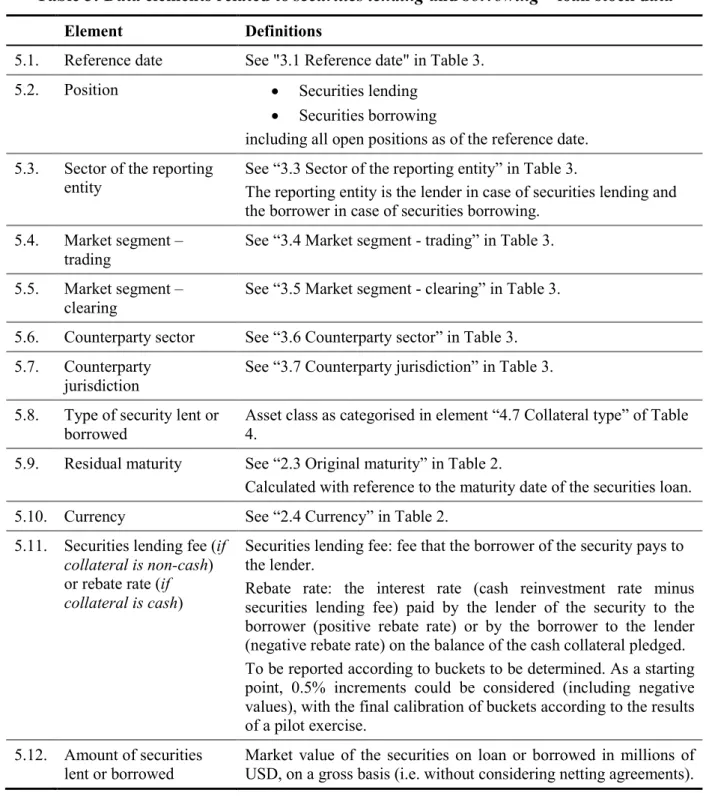
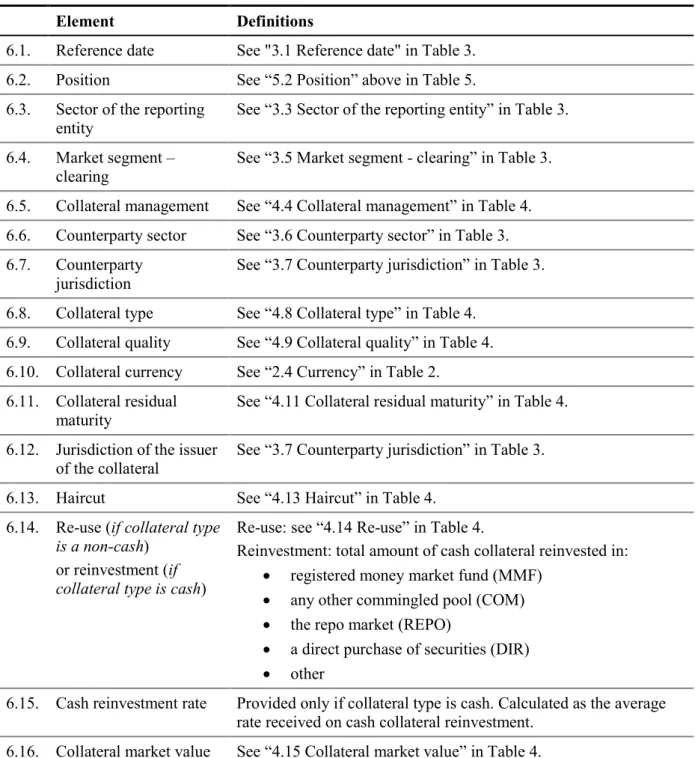
Table 5 and 6 define the proposed securities lending data elements, with separate tables for the loans and for the collateral. The two tables are linked by the classification of the contract (type and market segment) and the counterparty (sector and jurisdiction). Separating the collateral related data elements from the loan related data elements will facilitate the reporting of collateral pools that are linked to a portfolio of securities loans.
20 Securities lending provided by a Central Securities Depository (CSD) as a principal for settlement enhancing services to
prevent or resolve failures should also be included.
13
Table 5: Data elements related to securities lending and borrowing – loan stock data Element Definitions
5.1. Reference date See "3.1 Reference date" in Table 3.
5.2. Position • Securities lending
• Securities borrowing
including all open positions as of the reference date. 5.3. Sector of the reporting
entity See “3.3 Sector of the reporting entity” in Table 3. The reporting entity is the lender in case of securities lending and the borrower in case of securities borrowing.
5.4. Market segment –
trading See “3.4 Market segment - trading” in Table 3.
5.5. Market segment –
clearing See “3.5 Market segment - clearing” in Table 3.
5.6. Counterparty sector See “3.6 Counterparty sector” in Table 3. 5.7. Counterparty
jurisdiction See “3.7 Counterparty jurisdiction” in Table 3.
5.8. Type of security lent or
borrowed Asset class as categorised in element “4.7 Collateral type” of Table 4. 5.9. Residual maturity See “2.3 Original maturity” in Table 2.
Calculated with reference to the maturity date of the securities loan.
5.10. Currency See “2.4 Currency” in Table 2.
5.11. Securities lending fee (if collateral is non-cash) or rebate rate (if collateral is cash)
Securities lending fee: fee that the borrower of the security pays to the lender.
Rebate rate: the interest rate (cash reinvestment rate minus securities lending fee) paid by the lender of the security to the borrower (positive rebate rate) or by the borrower to the lender (negative rebate rate) on the balance of the cash collateral pledged. To be reported according to buckets to be determined. As a starting point, 0.5% increments could be considered (including negative values), with the final calibration of buckets according to the results of a pilot exercise.
5.12. Amount of securities
lent or borrowed Market value of the securities on loan or borrowed in millions of USD, on a gross basis (i.e. without considering netting agreements).
Table 6: Data elements related to securities lending and borrowing – collateral stock data Element Definitions
6.1. Reference date See "3.1 Reference date" in Table 3.
6.2. Position See “5.2 Position” above in Table 5.
6.3. Sector of the reporting
entity See “3.3 Sector of the reporting entity” in Table 3.
6.4. Market segment –
clearing See “3.5 Market segment - clearing” in Table 3.
6.5. Collateral management See “4.4 Collateral management” in Table 4. 6.6. Counterparty sector See “3.6 Counterparty sector” in Table 3. 6.7. Counterparty
jurisdiction See “3.7 Counterparty jurisdiction” in Table 3.
6.8. Collateral type See “4.8 Collateral type” in Table 4. 6.9. Collateral quality See “4.9 Collateral quality” in Table 4. 6.10. Collateral currency See “2.4 Currency” in Table 2.
6.11. Collateral residual
maturity See “4.11 Collateral residual maturity” in Table 4.
6.12. Jurisdiction of the issuer
of the collateral See “3.7 Counterparty jurisdiction” in Table 3.
6.13. Haircut See “4.13 Haircut” in Table 4.
6.14. Re-use (if collateral type is a non-cash)
or reinvestment (if collateral type is cash)
Re-use: see “4.14 Re-use” in Table 4.
Reinvestment: total amount of cash collateral reinvested in:
• registered money market fund (MMF)
• any other commingled pool (COM)
• the repo market (REPO)
• a direct purchase of securities (DIR)
• other
6.15. Cash reinvestment rate Provided only if collateral type is cash. Calculated as the average rate received on cash collateral reinvestment.
6.16. Collateral market value See “4.15 Collateral market value” in Table 4.
Q2-7. Does the proposed definition of securities lending provide practical basis for the collection of comparable data across jurisdictions as well as the production of comprehensive and meaningful global aggregates?
Q2-8. In a later stage, a list of transactions that are economically equivalent to securities
lending may be added to the reporting framework (see also Section 6 for details). Which economically equivalent transactions would you suggest for future inclusion? Please provide a definition of such transactions and explain the rationale for inclusion.
Q2-9. For securities lending, do you think that an additional table with flow data would
add insights into the operations of securities financing markets and assist regulators in their financial stability monitoring?
Q2-10. Are the proposed definitions and level of granularity of data elements as described
in Tables 5 to 6 appropriate for consistent collection of data on securities lending markets at the national/regional level and for aggregation at the global level? In particular, are the detailed breakdown of major currencies (in Table 2), sector of the reporting entity and counterparty as well as bucketing for securities lending fees or rebate rates (in Table 5), residual maturity (in Table 5), collateral residual maturity and collateral type (in Table 6) appropriate? If not, please specify which definitions or classifications of data element(s) require modification, why the modification is necessary, and the alternative definitions/classifications.
Q2-11. Do you foresee any practical difficulties in reporting the total market value of
collateral that has been re-used or cash collateral reinvested? Do you have any suggestion for addressing such difficulties?
Q2-12. Do the classifications provided for “market segment – trading” (in Table 5) and
“market segment – clearing” (in Table 5 and 6) appropriately reflect relevant structural features of the securities lending markets? Are there additional structural features of securities lending markets that should be considered?
Q2-13. Are there additional securities lending data elements that should be included in the
FSB global securities financing data collection and aggregation for financial stability purposes? Please describe such additional data elements, providing definitions and the rationale for their inclusion.
2.2.3 Margin lending
Margin lending entails the provision of collateralised loans by a financial institution (usually a bank or a broker) to clients who are seeking leverage of their trading positions by borrowing money from their broker. The securities serving as collateral are held in margin accounts and are often re-hypothecated by brokers to fund the loans provided and eventually to reduce the cost of funding to the clients. In most jurisdictions, margin lending is included in the “prime brokerage” services provided to the client based on a margin agreement between the financial institution and the client.
For the purpose of the collection and aggregation of securities financing data at the global level, the FSB would only focus on margin lending provided to non-retail clients as these transactions may pose risks to financial stability similar to those of repos and securities lending. The relationship between broker and client typically includes various types of trading activities not limited to securities financing transactions but also including short sales of securities and trading of OTC and listed derivatives. The process for determining the collateral for each client will apply across the range of those transactions and will often include consideration of the credit risk of the client as well as the risk associated with the client's full portfolio of positions.
While margin lending is similar to repo and securities lending transactions, it also exhibits several important differences. The main similarities include:
• each type of transactions involves the temporary exchange of assets, namely the provision of cash secured against collateral;
• margin lending allows banks or brokers to create “collateralised” short-term liabilities;
• each type of transactions creates leverage and facilitate maturity and liquidity transformation.21
The major differences are:
• unlike most repo transactions, margin lending is conducted on a portfolio basis and subject to portfolio margining;
• most repo and securities lending activities are governed by industry-standard master agreements, while margin lending is governed by margin agreements that could differ across brokers and jurisdictions;
• repo and securities lending usually involve temporary transfer of title or all incidents of ownership of the collateral, while margin lending only provides the broker with the right to hypothecate the collateral, although the ability of the broker to re-hypothecate the collateral may be restricted by contract or regulation. However, once
21 In some jurisdictions, the amount of transformation and leverage allowed for margin lending is limited by laws and
regulations (e.g. in the US, the Federal Reserve Board Regulation T and FINRA’s Portfolio Margin Rule).
17
the collateral has been re-hypothecated by the broker, then it has the same obligation as under a repo or securities lending transaction to return “equivalent securities” to the client.
The FSB believes that including margin lending transactions in the scope of the global data collection and aggregation is essential, since margin lending have economic similarities to repo and securities lending, and may pose similar risks to financial stability. Moreover, its inclusion in the data collection is consistent with the scope of the FSB framework on numerical haircut floors.22
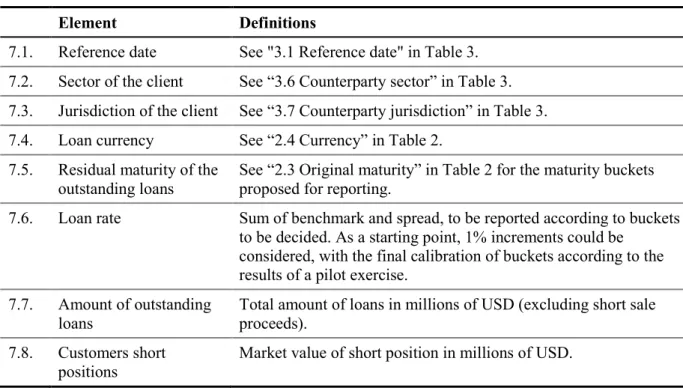
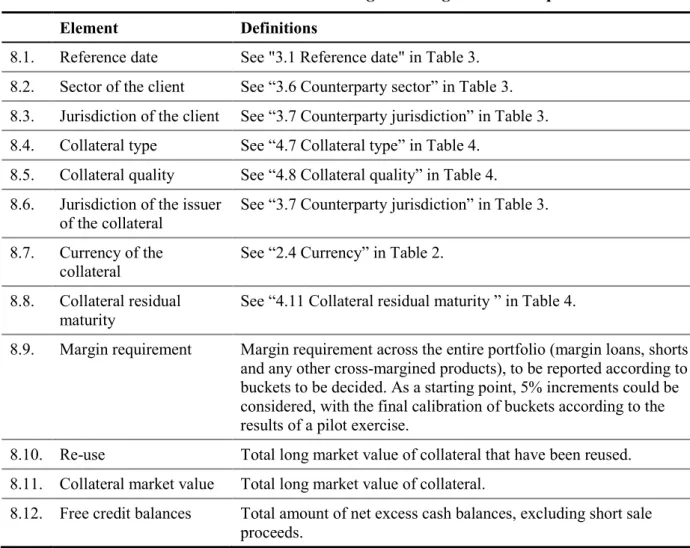
The collection of data for margin lending requires the compilation of specific tables for this transaction type (see Table 7 – 9 below). Most proposed data elements for margin lending are similar to what required for repo and securities lending, in which case the definitions in previous Tables are referenced.
Table 7: Data elements related to margin lending – loans stock data Element Definitions
7.1. Reference date See "3.1 Reference date" in Table 3. 7.2. Sector of the client See “3.6 Counterparty sector” in Table 3. 7.3. Jurisdiction of the client See “3.7 Counterparty jurisdiction” in Table 3.
7.4. Loan currency See “2.4 Currency” in Table 2.
7.5. Residual maturity of the
outstanding loans See “2.3 Original maturity” in Table 2 for the maturity buckets proposed for reporting.
7.6. Loan rate Sum of benchmark and spread, to be reported according to buckets
to be decided. As a starting point, 1% increments could be considered, with the final calibration of buckets according to the results of a pilot exercise.
7.7. Amount of outstanding
loans Total amount of loans in millions of USD (excluding short sale proceeds). 7.8. Customers short
positions Market value of short position in millions of USD.
22 See http://www.financialstabilityboard.org/wp-content/uploads/r_141013a.pdf.
18
Table 8: Data elements related to margin lending – collateral portfolios Element Definitions
8.1. Reference date See "3.1 Reference date" in Table 3. 8.2. Sector of the client See “3.6 Counterparty sector” in Table 3. 8.3. Jurisdiction of the client See “3.7 Counterparty jurisdiction” in Table 3. 8.4. Collateral type See “4.7 Collateral type” in Table 4.
8.5. Collateral quality See “4.8 Collateral quality” in Table 4. 8.6. Jurisdiction of the issuer
of the collateral See “3.7 Counterparty jurisdiction” in Table 3. 8.7. Currency of the
collateral See “2.4 Currency” in Table 2.
8.8. Collateral residual
maturity See “4.11 Collateral residual maturity ” in Table 4.
8.9. Margin requirement Margin requirement across the entire portfolio (margin loans, shorts and any other cross-margined products), to be reported according to buckets to be decided. As a starting point, 5% increments could be considered, with the final calibration of buckets according to the results of a pilot exercise.
8.10. Re-use Total long market value of collateral that have been reused.
8.11. Collateral market value Total long market value of collateral.
8.12. Free credit balances Total amount of net excess cash balances, excluding short sale proceeds.
Table 9: Data elements related to margin lending – funding sources Element Definitions
9.1. Reference date See "3.1 Reference date" in Table 3.
9.2. Funding sources The following funding sources for financing client margin lending should be considered:
• Repo (including sell/buy back)
• Cash collateral from securities lending
• Free credits23
• Proceeds from customer short sales
• Proceeds from broker short sales
• Unsecured borrowing
• Other
9.3. Market value of funding
sources Market value of funding source balances in millions of USD. If it is not possible to specifically assign funding sources to the subset of margin lending activity, a pro-rata amount of total funding activities could be an accepted estimate.
Q2-14. Does the proposed definition of margin lending provide practical basis for the
collection of comparable data across jurisdictions as well as the production of comprehensive and meaningful global aggregates?
Q2-15. In a later stage, a list of transactions that are economically equivalent to margin
lending may be added to the reporting framework (see also Section 6 for details). Which economically equivalent transactions would you suggest for future inclusion? Please provide a definition of such transactions and explain the rationale for inclusion.
Q2-16. Are the proposed definitions of data elements as described in Tables 7 to 9
appropriate for consistent collection of data on margin lending at the national/regional level and for aggregation at the global level? In particular, does the collection of the data elements in table 9, which represents a specific requirement for margin lending, provide relevant information for financial stability purposes? Do you foresee any particular difficulties to reporting the required data elements at the national/regional level?
Q2-17. Are the detailed breakdown of major currencies (in Table 2), sector of the client
and bucketing for loan rates (in Table 7), collateral type and bucketing for margin requirements (in Table 8) and funding sources (in Table 9) appropriate? If not, please specify which definitions or classifications of data element(s) require modification, why the modification is necessary, and the alternative definitions/classifications.
23 Liabilities of a broker-dealer to customers subject to immediate cash payment on demand, i.e. the amount of cash that can
be withdrawn from a margin account, calculated as the excess value of margin securities.
20
Q2-18. Is the collection of the data on the customers’ short position, in addition to the value of outstanding loans, a necessary metric for assessing the overall clients’ exposures and for financial stability purposes? Do you foresee any practical difficulties to report this data element at the national/regional level?
Q2-19. Are there additional data elements in relation to margin lending that should be
included in the FSB global securities financing data collection and aggregation for financial stability purposes? Please describe such additional data elements, providing definitions and the rationale for their inclusion.
3.
Data architecture
This section describes the recommended standards and processes to ensure: (i) the maximum consistency in the data collection by national/regional authorities; (ii) minimisation of double-counting at the national/regional and global level; (iii) the adequate distribution of the information collected; and (iv) proper confidentiality throughout the process.
Recommendations 2 and 3 of the August 2013 Report describe the global data collection and aggregation as a two-tiered process:
• First, national/regional authorities would collect data frequently and with a high level of detail. This recommendation also highlights that authorities should decide the most appropriate way to collect such data, depending on their market structure and building on existing data collection processes and market infrastructure where appropriate.
• Then, national/regional authorities would provide aggregated data (excluding individual counterparty positions) to the FSB, which would play the role of a global aggregator.
These two tiers can further be divided into five phases, as illustrated in Exhibit 1.
Exhibit 1 - Reporting and compilation of global aggregates
The first tier will take place in each jurisdiction and would encompass:
(1) the flow of data from reporting entities to national/regional authorities; and
(2) the processing of data at the national/regional level, which includes the removal of double-counting and compilation of aggregates that meet the recommendations described in Section 2.2 of this document.
The second tier refers to the global data aggregation process, and encompasses:
(3) the transmission of aggregated data from national/regional authorities to the FSB as global aggregator;
(4) the processing of data at the global level, which includes the removal of remaining (cross-border) double-counting and the production of meaningful global aggregates; and
(5) the distribution of information from the FSB to the relevant authorities and, potentially, to the general public.
Recommendation 2 of the August 2013 Report allows national/regional authorities to determine the most appropriate way to organise the data collection in the first tier. However, it also recommends that the national/regional authorities design their data collection in such a way as to facilitate aggregation at the global level.24 The second tier should follow a single harmonised approach to limit issues in the compilation of global aggregates and enhance the comparability between national/regional aggregates.
This section on data architecture is divided in two parts. The first part contains a discussion of a number of issues related to the first tier of the data collection and aggregation process that could compromise the quality of the information collected or its comparability across jurisdictions (Section 3.1). Issues that could prevent the elimination of double-counting are also described. National/regional authorities are expected to consider these issues as appropriate when developing the data collection process at the national/regional level.
The second subsection contains a discussion of legal and operational issues related to the global data collection and aggregation process (Section 3.2). The primary concern relates to data confidentiality, and the rules by which various authorities and institutions will have access to all or part of the data according to their mandate. The potential rules by which non-confidential aggregates could be distributed to the general public are also considered.
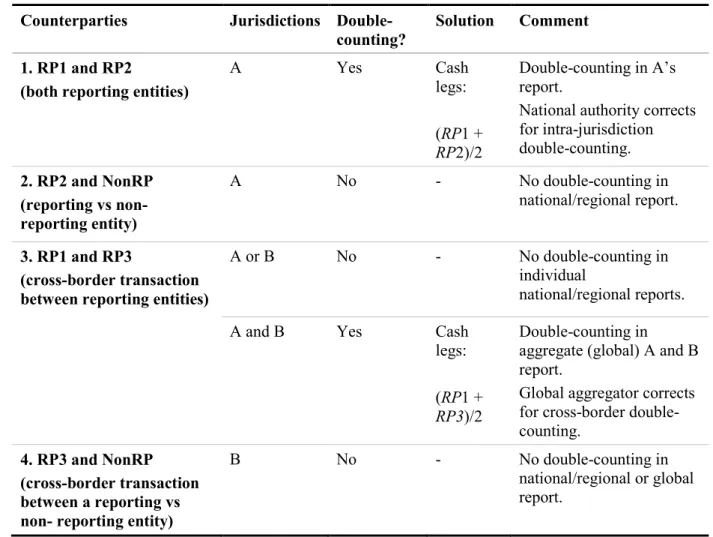
Finally, issues related to double-counting, with possible solution and an evaluation of the possibility of over-netting, are described in Section 3.3.
24 In addition, the harmonisation of national/regional approaches is desirable to reduce the reporting burden for reporting
institutions active in multiple jurisdictions.
23
3.1. First tier: Data collection at the national/regional level
Recommendation 2 of the August 2013 Report states that the data collection processes at the national/regional level could be organised in different ways. This would allow the data collection process to reflect the diversity of national/regional markets in practices, procedures and systems for clearing and settling securities financing transactions. However, a wide divergence in the national/regional data collection processes may pose practical challenges in the aggregation of data at the global level and compromise the quality of the global aggregates. To overcome such problems, there should be consistent data elements definitions as well as minimum granularity and collection frequency, in order to produce meaningful global aggregates. In addition, the data collection and aggregation procedures should address the double-counting issues that appear whenever two sides of the same transaction are reported.
The following sections discuss alternative approaches that national/regional authorities might choose while retaining the ability to provide data to the FSB which will be combined into global aggregates, focusing on the following issues:
(i) the sources of data;
(ii) the reporting population and the identification of trades with non-reporting entities; (iii) the level of granularity of the information collected; and
(iv) the aggregation and classification of information at the national/regional level.
3.1.1 Sources of data
National/regional authorities may have access to at least three main sources for the data elements described in Section 2:
(i) Bilateral counterparties in a trade (reporting entity, as defined in “3.3 Sector of the reporting entity” in Table 3);
(ii) Trading venues, securities settlement systems, CCPs and tri-party agents; and
(iii) Trade repositories (TRs), which would provide the authorities with access to transaction level data provided by counterparties.25
The three approaches are not mutually exclusive and which source or sources are preferred may depend on the market structure and the contract type.
The first approach that a national/regional authority may adopt would be to collect data directly from the counterparties to a trade. This may be the only source available if there are no financial market infrastructures offering services to the trading and post-trading of securities financing transactions (e.g. trading venues, CCPs). If the counterparties often use agents to conduct the transactions (e.g. agent lenders in securities lending transactions), the
25 This solution is envisaged in the EU (see Annex 2).
24
national/regional authorities may decide that the information should be collected directly from such agents rather than from the counterparties.
When the counterparties are the preferred source of data, authorities may wish to verify that they have all the data requested for the national/regional data collection and for the calculation of global aggregates. For example, for transactions secured by baskets of collateral, timely and detailed information on the composition of those baskets can only be provided by tri-party systems or electronic trading platforms, unless such information are disclosed by those service providers to counterparties with a proper lag and granularity.
The second approach would be for the national/regional authority to collect the data from third-parties such as CCPs and tri-party agents, which would send information directly on behalf of the counterparties for centrally-cleared transactions or transactions managed by tri-party agents. This would reduce the number of sources from which national/regional authorities would need to collect data.26 However, this approach would not cover a potentially significant part of the market such as non-centrally cleared bilateral transactions. Moreover, care should be taken to prevent duplicate reporting of trades from multiple intermediaries, for example by both a CCP and a tri-party agent.
In principle, the first two approaches could be combined, with the resulting dataset providing full market coverage. However, a mixed approach would require the ability to clearly identify every transaction to avoid the possibility of double counting (the possibility that a single transaction is counted more than twice is possible in a mixed reporting population where both counterparties and CCPs provide the data).
The third approach would be to require counterparties to report transaction level data to one or several TRs (as envisaged in the EU27) and then the responsible authorities could access the data stored in TRs. If several TRs exist in the same jurisdiction or region, an appropriate process to remove duplicate transactions before creating the national/regional aggregates would be necessary. If counterparties are allowed to report to several TRs in different jurisdictions, it also needs to be ensured that adequate mechanisms exist to create national/regional aggregates, i.e. that transactions can be regionally assigned.
Any of these approaches discussed above are capable of providing the necessary data for creating global aggregates. The aggregation process and the management of double-counting issues arising in the national/regional market among resident market participants will be addressed by the national/regional authorities responsible for compiling the data (see Section 3.3). For cross-border transactions, it is essential that the national/regional authorities identify whether the foreign counterparty is included in the global reporting population and hence is reporting the same trades/positions that may also be reported by another jurisdiction (see also Section 3.1.2).
26 Potential sources for detailed data could also be other market infrastructures like trading platforms and settlement
systems.
27 See Annex 2 for details.
25
3.1.2 Reporting population and non-reporting entities
Depending on the reporting framework adopted by national/regional authorities, data collected could cover either the activities of all counterparties (whole population) or a subset of counterparties that is broadly representative of the market. The latter will divide market participants into those providing data (reporting entities) and those not providing data (non-reporting entities). The two possible approaches for (non-reporting are:
• Full population – All counterparties and all securities financing transactions covered by the definitions (independently of their size) will be reported. All local market participants are considered reporting entities and non-resident market participants are classified as non-reporting entities;
• Market-representative subset – The national/regional authorities could collect and/or report at the global level only transactions above a certain amount (threshold on transactions size) or omit transactions conducted by insignificant counterparties (i.e. entities with annual activity or size of total assets smaller than a certain amount), or both. To ensure international comparability and consistent aggregation at the global level, national/regional authorities will need to confirm that the reporting population is comprehensive and highly representative of the respective securities financing markets. Market participants resident in other countries will still be classified as non-reporting entities.
If a national/regional authority chooses to use a threshold on transactions size or to exclude non-relevant transactions, the methodology for choosing which transaction to include should be transparent and communicated to the FSB and all other jurisdictions. If a threshold is applied to exclude insignificant counterparties (or in a mixed approach combining individual transaction and overall activity size), market participants should be separated into reporting and non-reporting entities (see “3.3 Sector of the reporting entity” in Table 3), based on a list of reporting entities maintained by the competent national/regional authority.28
When determining the reporting population, it is important for national/regional authorities to ensure all transactions of reporting entities operating in the jurisdiction are covered so as to derive meaningful global aggregates.29 If national/regional authorities adopt a broader reporting scope (e.g. world-wide consolidation of groups with head offices located in the jurisdiction), transactions reported by foreign subsidiaries or foreign branches of national/regional reporting entities should be excluded before sending the data to the FSB.
28 National/regional authorities should work in close cooperation with the FSB to develop reference lists of reporting
institutions based on global codes (e.g. LEI) and avoid inconsistencies.
29 Such reporting institutions should include both branches of foreign institutions registered in the jurisdiction and
subsidiaries of foreign institution established in the jurisdiction.
26
3.1.3 Granularity of the data
National/regional authorities may collect data with various degrees of granularity. Granular reporting refers to counterparty-by-counterparty and security-by-security reporting, while aggregate reporting refers to any other reporting which groups more than a single counterparty or a single security in some an aggregate (i.e. position level data or portfolio level data). In both cases, a consistent classification of market participants and collateral will be needed to support the compilation of national/regional and global aggregates, as well as to remove double-counting.
3.1.4 Aggregation and classification of the data
According to the two-tiered global data collection and aggregation process, national/regional authorities will be asked to aggregate and classify data based on the taxonomies and definitions described in Section 2 of this document, and then send the aggregates to the FSB. This classification of the data requires the extraction of certain unique identifiers such as LEI or ISIN and characteristics30 that could be performed centrally by the national/regional authority collecting the data (centralised approach), or distributed across reporting entities which would classify their own transactions (distributed approach).
In the case of the centralised approach, national/regional authorities will have to create reference databases to be able to associate the codes reported by market participants31 with the required classifications (e.g. sector and jurisdiction of the counterparty, or asset type and quality of the collateral).
The primary drawback of the centralised approach is the cost of establishing and maintaining the reference databases that will have to be in place to support the production of aggregate statistics. National/regional authorities could rely on information already available from data providers or collected in cooperation with market participants.
In the case of the distributed approach, each reporting entity will assign the classifications before sending the data to the national/regional authorities. Reporting entities may also be required to aggregate the transactions by their characteristics, according to the categories requested by the FSB, and report those aggregated data to the national/regional authorities. The primary drawback of this approach is not only the burden it creates for reporting entities, but also the additional burden for national/regional authorities, who might need to verify that the same classification scheme is applied consistently by all reporting entities.
Regardless of the approach adopted, national/regional authorities will need to work in close cooperation with the FSB to develop reference databases and avoid inconsistencies.
30 For example, residence of LEI and its business sector, or issue date and rating of a security.
31 For example, LEI for the identification of market participants or ISIN for the securities and collateral.
27
3.2. Second tier: data aggregation at the global level
Recommendation 3 of the August 2013 Report specifies that the aggregates calculated at the national/regional level should be transmitted to the FSB, which will play the role of global aggregator.
The most sensitive data would be collected and processed in the first tier of the collection process where granular data are transmitted from reporting institutions to the national/regional authorities. Once processed by the national/regional authorities, the data transmitted to the FSB will be limited to aggregates without individual counterparty information. Data confidentiality in the first tier of the process is not covered by this document, as it will be addressed by national/regional authorities according to local rules and procedures.
Details on the aggregated data to be provided to the FSB by national/regional authorities are discussed in Section 2. This section considers some of the practical issues that should be addressed in relation to global data aggregation such as the interaction between the national/regional authorities and the FSB and the appropriate level of access for a wide range of authorities to the data stored by the FSB in its role as the global aggregator.
3.2.1 Legal and operational issues
The national/regional authorities must have the legal mandate to obtain the relevant data with an adequate level of granularity. Even with such mandate, the national/regional authorities may face legal obstacles in sharing the information obtained in a particular capacity (for example, due to the supervisory capacity of the relevant authority) with the FSB and/or in allowing the FSB to share that information with other interested parties. Since data transmitted by national/regional authorities to the FSB will be aggregated and with no identification of individual counterparties or positions, some potential legal constraints may be minimised. However, there may remain some legal obstacles. Given that some authorities are currently in the process of defining their national/regional reporting framework, these authorities may wish to identify at the earliest stage any potential legal barrier to sharing aggregated data with the FSB in order to begin the process of adapting the legal framework if necessary.
The national/regional authority collecting the data may be subject to laws and regulations that prohibit or limit the data collected in fulfilling a specific mandate (e.g. banking supervision) from being used for other purposes or shared with other authorities. In addition, the legal framework may specify a confidentiality regime even for the aggregated data shared with the FSB or other interested institutions. This requirement may expose the national/regional authority to legal liability in case of breach of these confidentiality rules (see Section 3.2.2 on confidentiality issues).
Should legal obstacles exist and changes in the legal framework are unfeasible, national/regional authorities may wish to explore other alternatives. For example, they may be able to implement a voluntary framework through a multilateral memorandum of understanding (MMoU) between the authority and the reporting firms, to obtain the necessary approval to share the aggregates with the FSB and potentially with other interested authorities.