The Allegro™ A1101-A1104 and A1106 Hall-effect switches
are next generation replacements for the popular Allegro 312x and 314x lines of unipolar switches. The A110x family, produced with BiCMOS technology, consists of devices that feature fast power-on time and low-noise operation. Device programming is performed after packaging, to ensure increased switchpoint accuracy by eliminating offsets that can be induced by package stress. Unique Hall element geometries and low-offset amplifiers help to minimize noise and to reduce the residual offset voltage normally caused by device overmolding, temperature excursions, and thermal stress.
The A1101-A1104 and A1106 Hall-effect switches include the following on a single silicon chip: voltage regulator, Hall-voltage generator, small-signal amplifier, Schmitt trigger, and NMOS output transistor. The integrated voltage regulator permits operation from 3.8 to 24 V. The extensive on-board protection circuitry makes possible a ±30 V absolute maximum voltage rating for superior protection in automotive and industrial motor commutation applications, without adding external components. All devices in the family are identical except for magnetic switchpoint levels.
The small geometries of the BiCMOS process allow these devices to be provided in ultrasmall packages. The package styles available provide magnetically optimized solutions for most applications. Package LH is an SOT23W, a miniature low-profile surface-mount package, while package UA is a three-lead ultramini SIP for through-hole mounting. Each package is lead (Pb) free, with 100% matte-tin-plated leadframes.
• AEC-Q100 automotive qualified • Continuous-time operation
□ Fast power-on time □ Low noise
• Stable operation over full operating temperature range • Reverse battery protection
• Solid-state reliability
• Factory-programmed at end-of-line for optimum performance
• Robust EMC performance • High ESD rating
• Regulator stability without a bypass capacitor
Packages:
Functional Block Diagram
Not to scale Amp Regulator GND VCC VOUT Offset Gain Trim Control To all subcircuits LH: A1101, A1102, A1103, A1104, and
A1106
UA: A1101, A1102, A1103,
and A1104
UA: A1106
FEATURES AND BENEFITS
DESCRIPTION
3-pin SIP (suffix UA) 3-pin SOT23W (suffix LH)
Part Number Packing* Mounting Ambient, TA BRP (Min) BOP (Max)
A1101ELHLT-T 7-in. reel, 3000 pieces/reel 3-pin SOT23W surface mount
–40ºC to 85ºC
10 175
A1101ELHLX-T 13-in. reel, 10000 pieces/reel 3-pin SOT23W surface mount
A1101EUA-T Bulk, 500 pieces/bag 3-pin SIP through hole
A1101LLHLT-T 7-in. reel, 3000 pieces/reel 3-pin SOT23W surface mount
–40ºC to 150ºC A1101LLHLX-T 13-in. reel, 10000 pieces/reel 3-pin SOT23W surface mount
A1101LUA-T Bulk, 500 pieces/bag 3-pin SIP through hole
A1102ELHLT-T 7-in. reel, 3000 pieces/reel 3-pin SOT23W surface mount
–40ºC to 85ºC
60 245
A1102ELHLX-T 13-in. reel, 10000 pieces/reel 3-pin SOT23W surface mount
A1102EUA-T Bulk, 500 pieces/bag 3-pin SIP through hole
A1102LLHLT-T 7-in. reel, 3000 pieces/reel 3-pin SOT23W surface mount
–40ºC to 150ºC A1102LLHLX-T 13-in. reel, 10000 pieces/reel 3-pin SOT23W surface mount
A1102LUA-T Bulk, 500 pieces/bag 3-pin SIP through hole
A1103ELHLT-T 7-in. reel, 3000 pieces/reel 3-pin SOT23W surface mount
–40ºC to 85ºC
150 355
A1103ELHLX-T 13-in. reel, 10000 pieces/reel 3-pin SOT23W surface mount A1103LLHLT-T 7-in. reel, 3000 pieces/reel 3-pin SOT23W surface mount
–40ºC to 150ºC A1103LLHLX-T 13-in. reel, 10000 pieces/reel 3-pin SOT23W surface mount
A1103LUA-T Bulk, 500 pieces/bag 3-pin SIP through hole
A1104EUA-T Bulk, 500 pieces/bag 3-pin SIP through hole –40ºC to 85ºC
25 450
A1104LLHLT-T 7-in. reel, 3000 pieces/reel 3-pin SOT23W surface mount
–40ºC to 150ºC A1104LLHLX-T 13-in. reel, 10000 pieces/reel 3-pin SOT23W surface mount
A1104LUA-T Bulk, 500 pieces/bag 3-pin SIP through hole
A1106EUA-T Bulk, 500 pieces/bag 3-pin SIP through hole –40ºC to 85ºC
160 430
A1106LLHLT-T 7-in. reel, 3000 pieces/reel 3-pin SOT23W surface mount
–40ºC to 150ºC A1106LLHLX-T 13-in. reel, 10000 pieces/reel 3-pin SOT23W surface mount
A1106LUA-T Bulk, 500 pieces/bag 3-pin SIP through hole
*Contact Allegro for additional packing options. Selection Guide
Absolute Maximum Ratings
Characteristic Symbol Notes Rating Units
Supply Voltage VCC 30 V
Reverse Supply Voltage VRCC –30 V
Output Off Voltage VOUT 30 V
Reverse Output Voltage VROUT –0.5 V
Output Current IOUTSINK 25 mA
Magnetic Flux Density B Unlimited G
Operating Ambient Temperature TA Range E –40 to 85 ºC
Range L –40 to 150 ºC
Maximum Junction Temperature TJ(max) 165 ºC
Storage Temperature Tstg –65 to 170 ºC
Characteristic Symbol Test Conditions Min. Typ. Max. Units
Supply Voltage1 VCC Operating, TJ < 165°C 3.8 – 24 V
Output Leakage Current IOUTOFF VOUT = 24 V, B < BRP – – 10 µA
Output On Voltage VOUT(SAT) IOUT = 20 mA, B > BOP – 215 400 mV
Power-On Time2 tPO Slew rate (dV– 5 G CC/dt) < 2.5 V/μs, B > BOP + 5 G or B < BRP – – 4 µs
Output Rise Time3 tr VCC = 12 V, RLOAD = 820 Ω, CS = 12 pF – – 400 ns
Output Fall Time3 tf VCC = 12 V, RLOAD = 820 Ω, CS = 12 pF – – 400 ns
Supply Current ICCON B > BOP – 4.1 7.5 mA
ICCOFF B < BRP – 3.8 7.5 mA
Reverse Battery Current IRCC VRCC = –30 V – – –10 mA
Supply Zener Clamp Voltage VZ ICC = 10.5 mA; TA = 25°C 32 – – V
Supply Zener Current4 IZ VZ = 32 V; TA = 25°C – – 10.5 mA
1 Maximum voltage must be adjusted for power dissipation and junction temperature, see Power Derating section. 2 For VCC slew rates greater than 250 V/μs, and TA = 150°C, the Power-On Time can reach its maximum value. 3 CS =oscilloscope probe capacitance.
4 Maximum current limit is equal to the maximum ICC(max) + 3 mA.
DEVICE QUALIFICATION PROGRAM
Contact Allegro for information.EMC (ELECTROMAGNETIC COMPATABILITY) REQUIREMENTS
Contact Allegro for information.1 2 3
GND
VOUT
VCC
Package UA, 3-pin SIP Package LH 1 2 3 GND VOUT VCC Terminal List
Number Name Description
Package LH Package UA
1 1 VCC Connects power supply to chip
2 3 VOUT Output from circuit
3 2 GND Ground
ELECTRICAL OPERATING CHARACTERISTICS over full operating voltage and ambient temperature ranges, unless otherwise noted
Characteristic Symbol Test Conditions Min. Typ. Max. Units
Operate Point BOP
A1101 TA = 25°C 50 100 160 G
Operating Temperature Range 30 100 175 G
A1102 TA = 25°C 130 180 230 G
Operating Temperature Range 115 180 245 G
A1103 TA = 25°C 220 280 340 G
Operating Temperature Range 205 280 355 G
A1104 TA = 25°C 70 – 350 G
Operating Temperature Range 35 – 450 G
A1106 TA = 25°C 280 340 400 G
Operating Temperature Range 260 340 430 G
Release Point BRP
A1101 TA = 25°C 10 45 130 G
Operating Temperature Range 10 45 145 G
A1102 TA = 25°C 75 125 175 G
Operating Temperature Range 60 125 190 G
A1103 TA = 25°C 165 225 285 G
Operating Temperature Range 150 225 300 G
A1104 TA = 25°C 50 – 330 G
Operating Temperature Range 25 – 430 G
A1106 TA = 25°C 180 240 300 G
Operating Temperature Range 160 240 330 G
Hysteresis BHYS
A1101 TA = 25°C 20 55 80 G
Operating Temperature Range 20 55 80 G
A1102 TA = 25°C 30 55 80 G
Operating Temperature Range 30 55 80 G
A1103 TA = 25°C 30 55 80 G
Operating Temperature Range 30 55 80 G
A1104 TA = 25°C 20 55 – G
Operating Temperature Range 20 55 – G
A1106 TA = 25°C 70 105 140 G
Operating Temperature Range 70 105 140 G
1 Magnetic flux density, B, is indicated as a negative value for north-polarity magnetic fields, and as a positive value for south-polarity magnetic fields. This so-called alge-braic convention supports arithmetic comparison of north and south polarity values, where the relative strength of the field is indicated by the absolute value of B, and the sign indicates the polarity of the field (for example, a –100 G field and a 100 G field have equivalent strength, but opposite polarity).
MAGNETIC OPERATING CHARACTERISTICS1: over full operating voltage and ambient temperature ranges,
Characteristic Symbol Test Conditions Value Units
Package Thermal Resistance RθJA
Package LH, 1-layer PCB with copper limited to solder pads 228 ºC/W
Package LH, 2-layer PCB with 0.463 in.2 of copper area each side
connected by thermal vias 110 ºC/W
Package UA, 1-layer PCB with copper limited to solder pads 165 ºC/W
6 7 8 9 2 3 4 5 10 11 12 13 14 15 16 17 18 19 20 21 22 23 24 25 20 40 60 80 100 120 140 160 180 Temperature (ºC) Maximum Allowable VCC (V) TJ(max) = 165ºC; ICC = ICC(max)
Power Derating Curve
(RθJA = 228 ºC/W)
Package LH, 1-layer PCB (RθJA = 110 ºC/W)
Package LH, 2-layer PCB (RθJA = 165 ºC/W)
Package UA, 1-layer PCB
VCC(min) VCC(max) 0 100 200 300 400 500 600 700 800 900 1000 1100 1200 1300 1400 1500 1600 1700 1800 1900 20 40 60 80 100 120 140 160 180 Temperature (°C) Power Dissipation, P D (mW)
Power Dissipation versus Ambient Temperature
(Rθ JA = 165 ºC/W) Package UA , 1-layer PCB (Rθ JA = 228 ºC/W) Package LH, 1-la yer PCB (Rθ JA = 110 ºC /W) Pack age LH, 2 -layer PC B
CHARACTERISTIC DATA
(A1101/02/03/04/06)
TA (°C)
Supply Current (On) versus Ambient Temperature
VCC (V) ICCON (mA) 24 3.8 (A1101/02/03/04/06) TA (°C)
Supply Current (Off) versus Ambient Temperature
VCC (V) ICCOFF (mA) 24 3.8 (A1101/02/03/04/06) TA (°C)
Output Voltage (On) versus Ambient Temperature
VCC (V) VOUT(SA T) (mV) 24 3.8 (A1101/02/03/04/06)
Supply Current (On) versus Supply Voltage
TA (°C) ICCON (mA) VCC (V) –40 25 150 (A1101/02/03/04/06)
Supply Current (Off) versus Supply Voltage
TA (°C) ICCOFF (mA) VCC (V) –40 25 150 (A1101/02/03/04/06)
Output Voltage (On) versus Supply Voltage
TA (°C) VOUT(SA T) (mV) VCC (V) –40 25 150 0 1.0 2.0 3.0 4.0 5.0 7.0 6.0 8.0 0 1.0 2.0 3.0 4.0 5.0 7.0 6.0 8.0 0 1.0 2.0 3.0 4.0 5.0 7.0 6.0 8.0 0 1.0 2.0 3.0 4.0 5.0 7.0 6.0 8.0 –50 0 50 100 150 0 5 10 15 20 25 –50 0 50 100 150 0 5 10 15 20 25 –50 0 50 100 150 0 5 10 15 20 25 0 50 100 150 200 250 300 350 400 0 50 100 150 200 250 300 350 400
FUNCTIONAL DESCRIPTION
OPERATION
The output of these devices switches low (turns on) when a magnetic field (south polarity) perpendicular to the Hall element exceeds the operate point threshold, BOP. After turn-on, the output
is capable of sinking 25 mA and the output voltage is VOUT(SAT).
When the magnetic field is reduced below the release point, BRP , the device output goes high (turns off). The difference in
the magnetic operate and release points is the hysteresis, Bhys, of
the device. This built-in hysteresis allows clean switching of the output, even in the presence of external mechanical vibration and electrical noise.
Powering-on the device in the hysteresis region, less than BOP and
higher than BRP, allows an indeterminate output state. The correct
state is attained after the first excursion beyond BOP or BRP.
CONTINUOUS-TIME BENEFITS
Continuous-time devices, such as the A110x family, offer the fast-est available power-on settling time and frequency response. Due to offsets generated during the IC packaging process,
continuous-time devices typically require programming after packaging to tighten magnetic parameter distributions. In contrast, chopper-stabilized switches employ an offset cancellation technique on the chip that eliminates these offsets without the need for after-packaging programming. The tradeoff is a longer settling time and reduced frequency response as a result of the chopper-stabiliza-tion offset cancellachopper-stabiliza-tion algorithm.
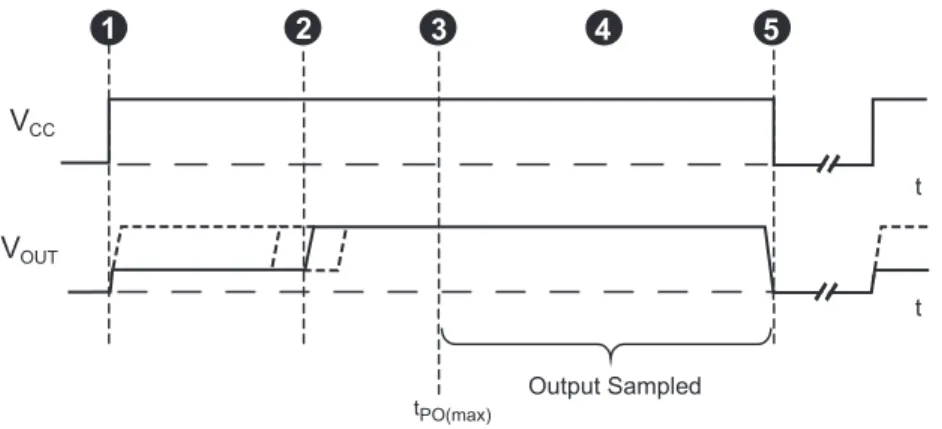
The choice between continuous-time and chopper-stabilized designs is solely determined by the application. Battery manage-ment is an example where continuous-time is often required. In these applications, VCC is chopped with a very small duty cycle
in order to conserve power (refer to figure 2). The duty cycle is controlled by the power-on time, tPO, of the device. Because
continuous-time devices have the shorter power-on time, they are the clear choice for such applications.
For more information on the chopper stabilization technique, refer to Technical Paper STP 97-10, Monolithic Magnetic Hall Sensing Using Dynamic Quadrature Offset Cancellation and Technical Paper STP 99-1, Chopper-Stabilized Amplifiers with a Track-and-Hold Signal Demodulator.
Figure 1: Switching Behavior of Unipolar Switches
On the horizontal axis, the B+ direction indicates increasing south polarity magnetic field strength, and the B– direction indicates decreasing south polarity field strength (including the case of increasing north polarity). This behavior can be exhibited when using a circuit such as that
shown in Panel B. B O P BRP BHYS VCC VOU T VOUT(SAT) S w itc h t o L ow S w itc h to H ig h B+ B– V+ 0 0 (A) (B) VCC VS Output GND VOUT RL A110x
ADDITIONAL APPLICATIONS INFORMATION
Extensive applications information for Hall-effect devices is available in:
• Hall-Effect IC Applications Guide, Application Note 27701 • Hall-Effect Devices: Guidelines for Designing Subassemblies Using Hall-Effect Devices, Application Note 27703.1
• Soldering Methods for Allegro’s Products – SMT and Through-Hole, Application Note 26009
All are provided in Allegro Electronic Data Book, AMS-702, and the Allegro Web site, www.allegromicro.com.
Figure 2: Continuous-Time Application, B < BRP
This figure illustrates the use of a quick cycle for chopping VCC in order to conserve battery power. Position 1, power is applied to the device. Position 2, the output assumes the correct state at a time prior to the maximum Power-On Time, tPO(max). The case shown is where the correct output state is HIGH. Position 3, tPO(max) has elapsed. The device output is valid. Position 4, after the output is valid, a control unit
reads the output. Position 5, power is removed from the device.
VCC VOUT Output Sampled 1 2 4 5 t t tPO(max) 3
POWER DERATING
Power Derating
The device must be operated below the maximum junction temperature of the device, TJ(max). Under certain combinations of peak conditions, reliable operation may require derating supplied power or improving the heat dissipation properties of the appli-cation. This section presents a procedure for correlating factors affecting operating TJ. (Thermal data is also available on the Allegro MicroSystems Web site.)
The Package Thermal Resistance, RθJA, is a figure of merit
sum-marizing the ability of the application and the device to dissipate heat from the junction (die), through all paths to the ambient air. Its primary component is the Effective Thermal Conductivity, K, of the printed circuit board, including adjacent devices and traces. Radiation from the die through the device case, RθJC, is relatively
small component of RθJA. Ambient air temperature, TA, and air
motion are significant external factors, damped by overmolding. The effect of varying power levels (Power Dissipation, PD), can be estimated. The following formulas represent the fundamental relationships used to estimate TJ, at PD.
PD = VIN
×
IIN (1) ΔT = PD×
RθJA (2)TJ = TA + ΔT (3) For example, given common conditions such as: TA= 25°C, VCC = 12 V, ICC = 4 mA, and RθJA = 140 °C/W, then:
PD = VCC
×
ICC = 12 V×
4 mA = 48 mWΔT = PD
×
RθJA = 48 mW×
140 °C/W = 7°CTJ = TA + ΔT = 25°C + 7°C = 32°C
A worst-case estimate, PD(max), represents the maximum
allow-able power level (VCC(max), ICC(max)), without exceeding TJ(max),
at a selected RθJA and TA.
Example: Reliability for VCC at TA =150°C, package UA, using
minimum-K PCB.
Observe the worst-case ratings for the device, specifically: RθJA =165°C/W, TJ(max) =165°C, VCC(max) =24 V, and
ICC(max) =7.5mA.
Calculate the maximum allowable power level, PD(max). First,
invert equation 3:
ΔTmax = TJ(max) – TA = 165°C–150°C = 15°C
This provides the allowable increase to TJ resulting from internal
power dissipation. Then, invert equation 2:
PD(max) = ΔTmax ÷ RθJA = 15°C ÷ 165 °C/W = 91 mW
Finally, invert equation 1 with respect to voltage:
VCC(est) = PD(max) ÷ ICC(max) = 91 mW ÷ 7.5 mA = 12.1 V
The result indicates that, at TA, the application and device can
dis-sipate adequate amounts of heat at voltages ≤VCC(est).
Compare VCC(est) to VCC(max). If VCC(est) ≤ VCC(max), then
reli-able operation between VCC(est) and VCC(max) requires enhanced
RθJA. If VCC(est) ≥ VCC(max), then operation between VCC(est) and
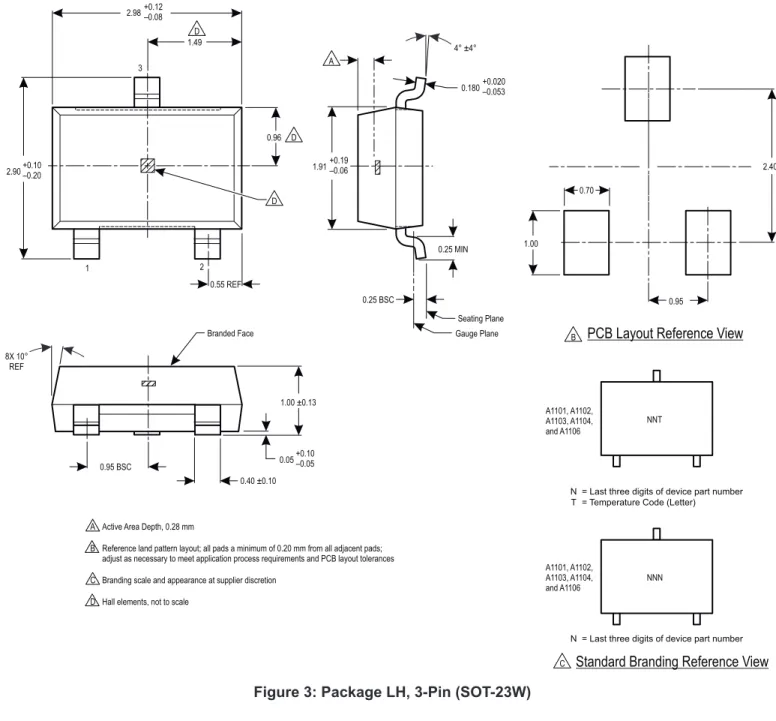
Figure 3: Package LH, 3-Pin (SOT-23W) A B C D C
For Reference Only – Not for Tooling Use
(Reference DWG-2840) Dimensions in millimeters – NOT TO SCALE Dimensions exclusive of mold flash, gate burrs, and dambar protrusions Exact case and lead configuration at supplier discretion within limits shown
Reference land pattern layout; all pads a minimum of 0.20 mm from all adjacent pads; adjust as necessary to meet application process requirements and PCB layout tolerances Active Area Depth, 0.28 mm
Hall elements, not to scale
= Temperature Code (Letter) T
Standard Branding Reference View
NNT
Branding scale and appearance at supplier discretion
Seating Plane
Gauge Plane PCB Layout Reference View 0.55 REF 0.25 BSC 0.95 BSC 0.95 1.00 0.70 2.40 2 1 B A Branded Face 2.90+0.10–0.20 4° ±4° 8X 10° REF 0.180+0.020–0.053 0.05+0.10–0.05 0.25 MIN 1.91+0.19–0.06 2.98 +0.12–0.08 1.00 ±0.13 0.40 ±0.10 D D D 1.49 0.96 3
= Last three digits of device part number N
NNN
= Last three digits of device part number N A1101, A1102, A1103, A1104, and A1106 A1101, A1102, A1103, A1104, and A1106
CUSTOMER PACKAGE DRAWING
For Reference Only – Not for Tooling Use
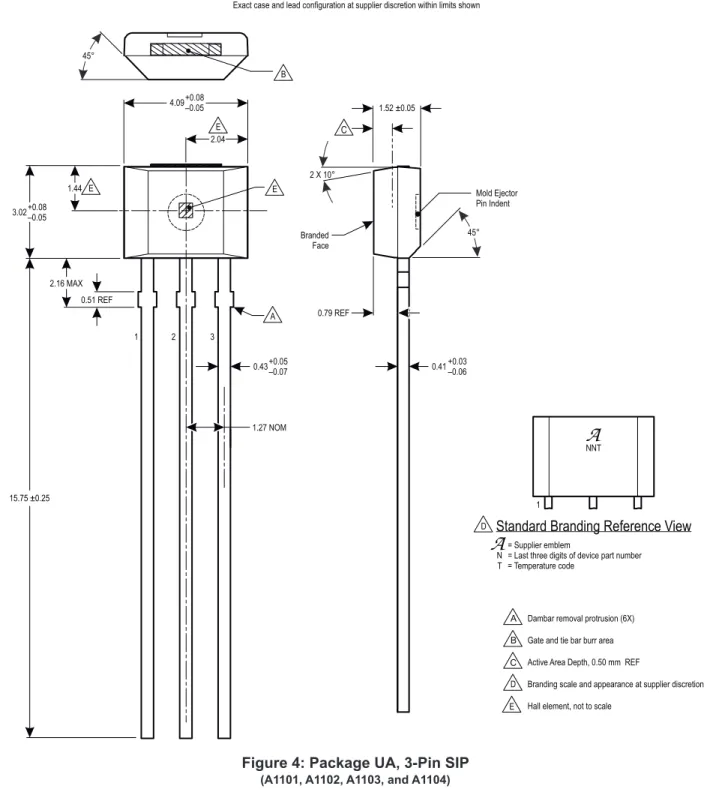
(Reference DWG-9049) Dimensions in millimeters – NOT TO SCALE Dimensions exclusive of mold flash, gate burrs, and dambar protrusions Exact case and lead configuration at supplier discretion within limits shown
2 3 1 1.27 NOM 2.16 MAX 0.51 REF 0.79 REF B A B C A D E D E E 2.04 1.44 E
Branding scale and appearance at supplier discretion Hall element, not to scale
Mold Ejector Pin Indent Branded Face 4.09+0.08–0.05 0.41+0.03–0.06 3.02+0.08 –0.05 0.43+0.05–0.07 15.75 ±0.25
Dambar removal protrusion (6X) Gate and tie bar burr area Active Area Depth, 0.50 mm REF
NNT
Standard Branding Reference View
= Supplier emblem
= Last three digits of device part number = Temperature code N 45° C 45° 2 X 10° 1.52 ±0.05 1 T
Figure 4: Package UA, 3-Pin SIP
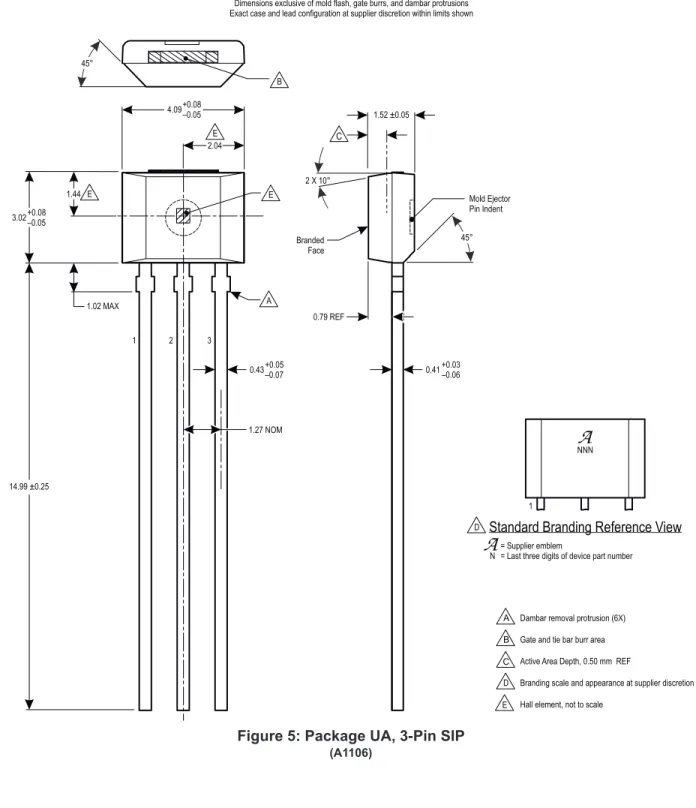
Figure 5: Package UA, 3-Pin SIP
(A1106)
For Reference Only – Not for Tooling Use
(Reference DWG-9013)Dimensions in millimeters – NOT TO SCALE Dimensions exclusive of mold flash, gate burrs, and dambar protrusions Exact case and lead configuration at supplier discretion within limits shown
2 3 1 1.27 NOM 1.02 MAX 0.79 REF B A B C A D E D E E 2.04 1.44 E
Branding scale and appearance at supplier discretion Hall element, not to scale
Mold Ejector Pin Indent Branded Face 4.09+0.08 –0.05 0.41+0.03 –0.06 3.02+0.08 –0.05 0.43+0.05 –0.07 14.99 ±0.25
Dambar removal protrusion (6X) Gate and tie bar burr area Active Area Depth, 0.50 mm REF
NNN
Standard Branding Reference View = Supplier emblem
= Last three digits of device part number N 45° C 45° 2 X 10° 1.52 ±0.05 1
For the latest version of this document, visit our website:
www.allegromicro.com
Revision History
Revision Revision Date Description of Revision
14 May 29, 2012 Add A1106 UA package drawing
15 January 1, 2015 Added the LX option to Selection Guide
16 September 30, 2015 Corrected LH package Active Area Depth value and LH package branding; added AEC-Q100 qualification under Features and Benefits