White Paper
How Operating Systems Create Network Efficiency
Lake Partners Strategy Consultants, Inc. 1000 Second Avenue, Suite 3600 Seattle, WA 98104
USA 206.428.0300 888.240.6898
How Operating Systems Create Network Efficiency
Executive Summary
Lake Partners Strategy Consultants conducted research to understand the efficiencies created by different operating systems. Research included (but was not limited to) investigation of Juniper Network’s operating system (JUNOS software). For customers who perceived a difference in efficiency between operating systems, Lake Partners quantified that difference in key network areas. Based on these customer interviews and the data collected, Lake Partners’ found that in specific network areas JUNOS software creates significant and meaningful operational efficiencies. Specifically, those who perceive the most impact from JUNOS software save a total of 25% of time on common network operations tasks compared to competitive operating systems.
Methodology
In total 122 network operations team leaders were interviewed and asked a variety of questions regarding daily operations and the hardware currently deployed in their network. Respondent companies ranged in size (mid-sized to enterprise class) and were from a variety of industry verticals (including but not limited to healthcare, finance, telecommunications, government, and education). Data was collected in one of two ways: through a detailed online survey or by phone. One hundred decision makers who had visibility to network operations completed Lake Partners’ survey online via email. An additional twenty two respondents were interviewed in depth over the phone.
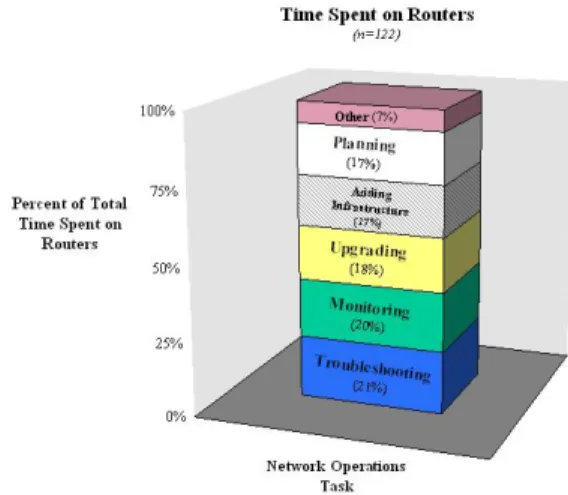
As a starting point, Lake Partners created a baseline of how much network operations time was devoted to routers (as opposed to other network infrastructure). On average, respondents spend 57% of their total network operations time on routers. Of the time they spend on routers, on average 76% of that time is devoted to four areas: troubleshooting, monitoring, upgrading, and adding infrastructure (see Figure 1).
Subsequently, respondents were asked to describe ways that their operating system did (or did not) impact their network. Three areas (reliability, flexibility, and efficiency) emerged as the most critical to operations. Each of these topics was discussed in the context of specific network operations tasks (adding infrastructure, upgrading,
troubleshooting, and monitoring). Respondents were also asked if they perceived a benefit from JUNOS software. Quantitative data collected from the survey and interviews is presented in this paper.
Key Findings
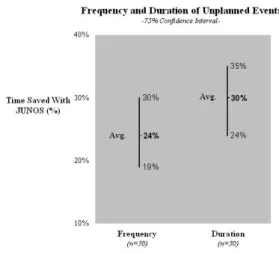
Reliability: On average, JUNOS software reduces the frequency of unplanned events by 24% compared to other operating systems.
Respondents conceptualize reliability as the ability to maintain high uptime. Lake Partners measured reliability based on three factors: time spent troubleshooting, frequency of unplanned events, and duration of unplanned events. Reliability is considered higher when operations teams spend less time troubleshooting and have fewer (and/or shorter) unplanned events. “Modularity is a huge benefit - it reduces the severity of unplanned events. It’s like driving a car – with JUNOS software if one wheel goes flat you can still drive. With other solutions you don’t have that and the whole thing shuts down.” – Network Manager, Government Facility
Compared to other vendor solutions, Juniper customers report that JUNOS software reduces the frequency of unplanned events by an average of 24% and makes unplanned events an average of 30% shorter (see Figures 2 and 3). When interviewed, Juniper customers also report that JUNOS software reduces the time they spend troubleshooting an average of 30%.
Customers commonly identified five features of their operating system that contributed the most to high reliability:
• Modular architecture prevents a failure of one process to affect the entire system and allows for continued forwarding during control plane restarts.
• Independent control and forwarding plane processors allow for the separation of functions.
• Redundancy enables recovery from unplanned events and graceful switchover for planned and unplanned outages.
• Commit checkfunctions reduce the frequency of unplanned events by catching configuration errors prior to implementation.
• Advanced troubleshooting tools allow configuration changes to be checked and compared to previous settings before widespread implementation. Respondents agree that a highly reliable network is of paramount importance. Downtime (for any amount of time) is generally unacceptable but if an unplanned event does occur, the ability to recover quickly is critical. Network reliability is becoming even more important as enterprise businesses and service providers carry multiple high-demand services (e.g. voice, streaming video, and business VPN services). Customers recognize that having multiple high-demand services creates network congestion and increases the frequency of disruptive system failures which are often slow to recover and can cause cascading failures. With service level agreements in place, customers expect carrier class reliability despite growing congestion from high-demand services. This expectation validates the importance of having an operating system (like JUNOS software) that has technology capable of maintaining the highest standard of reliability. Flexibility: JUNOS software can reduce time spent adding network infrastructure by an average of 29% over competitive solutions.
In the context of network operations, flexibility is the ability to add infrastructure and new services easily without loss of network stability or reliability. Interestingly, interviewees report that not all operating systems allow for the same level of flexibility. Specifically, they indicate that JUNOS software is significantly easier to deploy than other operating systems.
“In a lot of cases Juniper comes out ahead when a d d i n g infrastructure. Even though I have more experience with other vendors, I find Juniper routers easier to integrate.” – CTO, Technology Company
“[With JUNOS software] you can add in new functionality without affecting traffic. Other solutions are monolithic and you often have to re-load the entire device which
requires additional time.” – Network Operations
Manager, Government Facility
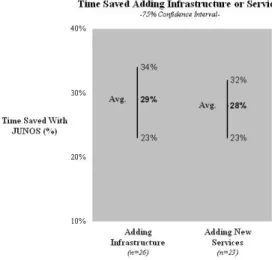
Compared to other vendor offerings, Juniper takes an average of 12% less time to deploy at the core and an average of 40% less time to deploy at the edge. Furthermore, Juniper customers report that JUNOS software reduces the time it takes to add infrastructure (routers) or services to the network by an average of 29% and 28% respectively (see Figures 4 and 5).
Fig. 2: Reduction of frequency and duration of
unplanned events with JUNOS software
How Operating Systems Create Network Efficiency
Just as increased congestion necessitates network reliability, it also makes flexibility critical to network success. As the consumer use of high-demand services (such as VoIP and VPN services) continues to grow, enterprises and service providers alike will need to expand the capabilities of their networks to absorb increased traffic and bandwidth congestion. Customers cite several means by which operating systems allow for flexibility:
• Interoperability with existing network infrastructure allows new components to be added incrementally as capacity thresholds are reached or new services are necessary.
• Modularity allows network growth through component expansion.
• Separation of the control and forwarding planes allows networks to scale easily.
• Multiple supported IP protocols
make handling network growth less complicated.
• A consistent operating system
makes planning easier, day-to-day operation intuitive and implementation faster.
Operational Efficiency: Compared to the competition, JUNOS software saves customers an average of 24% of their time monitoring and an average of 22% of their time when upgrading.
Creating operational efficiency means that network operations teams spend less time on frequent system maintenance (i.e. monitoring and upgrading) and more time on critical network tasks. Lake Partners’ research shows that for maintenance tasks, different operating systems had varied impact on network efficiency. In particular, customers perceive that JUNOS software creates significant operational efficiencies. On average, Juniper customers report that JUNOS software reduces time spent monitoring by an average of 24% (see Fig. 6). “The modularity of JUNOS really helps…Juniper allows the system to keep running regardless of what you are
doing (monitoring, upgrading etc.).” – IT Director,
Educational Institution
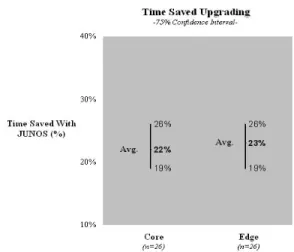
Upgrading with JUNOS software is also quicker than with other operating systems. Specifically, JUNOS software saves customers an average of 22% of time when upgrading at the core and 23% when upgrading at the edge (see Fig. 7).
Fig. 4: Mean time to deploy hardware at core vs. edge
Fig. 5: Time saved adding infrastructure or services with
JUNOS software
Above all, customers appreciate their operating system’s ability to increase operational efficiency. By reducing time spent on a variety of daily tasks (e.g. monitoring and upgrading), customers can maximize group productivity and devote more time to network critical tasks. Those interviewed report that JUNOS software’s single code train across all network components makes carrying out daily tasks intuitive and quick. Customers point to JUNOS software’s advanced monitoring tools as allowing them to more effectively monitor network hardware at both a system wide and granular level. The ability to manage bandwidth across all network components with one QoS tool reduces the amount of time Juniper customers spend monitoring their systems. Juniper customers indicate that upgrading is easier because the number of upgrades released is less than for other brands. Also, the smaller size of update packages allows them to push changes quickly to other network hardware.
Network Infrastructure Priorities
Customers have different priorities for their network infrastructure based, in part, on their corporate strategies. Lake Partners identified several different customer priorities for network infrastructure. Though each customer is different, most agree that their priorities align with one (or more) of the following objectives:
• Network performance
• Financial returns
• Network expansion
• Network manageability
• Risk minimization
Customers approach these priorities differently and many (but not all) perceived a significant benefit from JUNOS software. Those who report the greatest performance enhancement from JUNOS software are those who focus on increasing network performance and network expansion. Typically, these customers are willing to consider having multiple vendors and have a preference for technology that can be easily upgraded to the next generation. Interestingly, their desire for network performance growth and hardware brand diversity also makes them more likely to switch vendors as new functionality or technology arises.
Summary
Lake Partners’ research indicates that operating systems play an important role in network operations. Certainly, every operating system has some features and functionality that make it unique. However, based on customer responses, JUNOS software is most consistently reported to save time and create operational efficiency. Juniper customers recognize and are able to quantify meaningful time savings across a number of key activities. When customers use JUNOS software, they experience a total of 25% time savings compared to when they use a competitor’s operating system. This increased efficiency allows them to focus on other network priorities and increase their added value to the company.
Lake Partners is a Seattle based strategy consulting firm. We blend data and analysis with expertise and experience to help mid to large sized companies achieve their financial and business goals. For more information please visit our website
(http://www.lakepartners.com/).
Fig. 7: Time saved with JUNOS software upgrading at
the core and edge
Fig 9: Average time saved with JUNOS software in key
operational areas
Fig 8: JUNOS software impact on frequency and duration of