Dynamic channel filtering method for multi-mode & multi-service
software radio communication systems
Ryo SAWAI
†, Hiroshi HARADA
‡, Hiroshi SHIRAI
†, Masayuki FUJISE
‡† Chuo University -- Graduate School of Science and Engineering -- 1-13-27 Kasuga, Bunkyo, Tokyo -- Japan Ph.: +81 3 3817 1849, e-mail: [email protected]
‡ Communications Research Laboratory -- Independent from Administrative Institution -- 3-4 Hikarino-oka, Yokosuka, Kanawaga -- Japan Ph.: +81 468 47 5074, Fax: +81 468 47 5089, e-mail: [email protected]
ABSTRACT
This paper proposes a dynamic digital channel filter-ing method based on wavelet packet algorithm to real-ize a simplified and efficient multi-mode & multi-service software radio receiver which can provide the func-tions of several systems as well as several services si-multaneously via one handset. The method can extract several different bandwidth signals adaptively, for the change of service being offered, by a filtering process-ing without preparprocess-ing a set of filters. By applyprocess-ing for the concept of multiple service wireless communica-tions based on Common Frequency Band Radio On Fiber (CFB-ROF) transmission scheme [1], it would be possible to be shared the demodulation processing part from an antenna to a channel selection processing for several different service signals.
1 INTRODUCTION
Currently, there is a great demand from the public for radio communication services, and the forms of service being offered are becoming more diverse. The future radio communication services, such as the Intelligent Transport Systems (ITS) and 4th-generation mobile tele-communication systems, will provide more intelligent services, like support for automated driving and multi-media communications using motion pictures. In the near future, more flexible and intelligent smart communi-cation systems that will be capable of providing not just one fixed service but a variety of services via a single handset will be heightened.
The realization of just such a flexible and intelligent smart communications system was the goal of a number of reported studies made of software radio technology [2]-[8]. Software radio technology provides the func-tions of several radio communication systems by chang-ing flexibly the software program used on the Digital Signal Processor (DSP) and the Field Programmable Gate Array (FPGA), in accord with user requests. Moreover, the Multi-mode & Multi-service Software Radio commu-nications (MMSR) system, which provides not only the functions of several systems but also several services simultaneously via one radio terminal, has been pro-posed [6]. The realization of software radio technology will widely expand the possible offerings of radio com-munication services to several fields such as the integra-tion of car navigaintegra-tion, the Internet, and TV programs.
However, before the implementation of the software radio technology can occur, there are many difficulties to be solved. One of such difficulties involves finding a flexible architecture that provides efficient and speedy radio modulation and demodulation processing in ac-cord with user requests and improvements of device
technology. Moreover, an efficient and simple terminal structure must be developed to realize an MMSR system, as this system integrates the components of severa l different radio communication systems in one radio ter-minal.
In this paper, therefore, a common digital channel fil-tering method based on wavelet packet algorithm [9], [10] is proposed for realizing a simplified and efficient multi-mode & multi-service software radio receiver. The method can extract several different bandwidth signals being offered adaptively by a filtering processing with-out preparing a set of filters with unequal bandwidths. By combining the concept of multiple service wireless communications based on Common Frequency Band Radio On Fiber (CFB-ROF) transmission scheme [1], which is a multiple service transmission techniques by reconverting several different service signals in the same transmission band, it would be possible to be shared the demodulation processing from an antenna to a channel selection processing for several different service signals. As an evaluation of the proposed method, a two -mode multi-mode & multi-service software radio receiver, which are integrated Japanese ETC (Electric Toll Collec-tion system) and PHS (Personal Handy-phone System), is assumed. The magnitude responses of the two sys-tem channels in the same transmission band, extracted by the proposed method, are shown here.
2 PROPOSAL OF A DYNAMIC CHANNEL
FILTERING METHOD BASED ON WAVELET
PACKET ALGORITHM
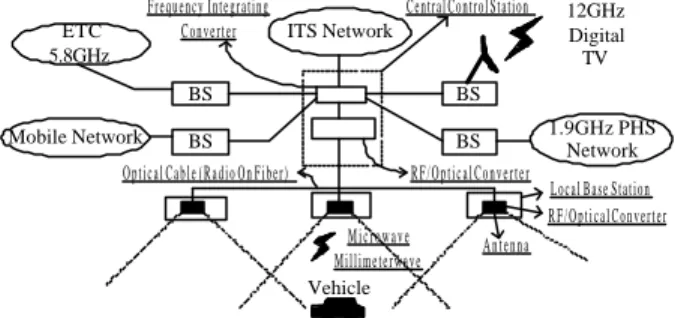
In multiple service wireless communications technique, several different service signals are transmitted in a same transmission band by millimeter wave and optical fiber links as shown in Fig. 1 [1]. Accordingly, in the receiver side, the demodulation processing such as an antenna and ADC can be shared for several service signals, and the simplicity & efficiency of a MMSR receiver would be realized. However, in the digital signal processing part, a set of filters with unequal bandwidths shown in Fig. 2 must be prepared to extract the channel of interest in accord with services requested by users, but it might be not a desirable configuration method from viewpoints of simplicity and efficiency. Therefore, in this section, a dynamic channel filtering method based on wavelet packet algorithm, which can extract adaptively several different bandwidth signals according to user requests by a common filtering processing, is introduced.
ITS Network ETC 5.8GHz Mobile Network 1.9GHz PHS Network BS BS BS BS 12GHz Digital TV Central Control Station Frequency Integrating
Converter
RF/Optical Converter Optical Cable (Radio On Fiber)
M i c r o w a v e Millimeterwave
Local Base Station RF/Optical Converter A n t e n n a
Vehicle
Fig.1 Concept of the ITS multiple based on CFB-ROF system (Ref. [1])
0
π
Channel 1
Channel 2
Channel 3 Band pass filter
Fig. 2 Example of multi-band filtering
2.1 Wavelet Packet
2.1.1 Discrete Wavelet Transform (DWT)
First, let us describe the DWT algorithm, which com-poses a basic idea of wavelet packet algorithm, by two channels filter bank as shown in Fig. 3. In this figure, g(z) and h(z) show the low-pass and high-pass filters in the analysis bank, and g’(z) and h’(z) also show the low-pass and high-low-pass filters in synthesis bank,
respec-tively. Then, the output x’(z) for the input signal x(z)
can be expressed as follow:
( )
z k( ) ( ) ( ) ( )
z xz k z x z ' x = 0 + 1 − , (2.1) where,( ) ( ) ( ) ( )
[
g' zg z h' zhz]
k = + 2 1 0 , (2.2)( ) ( ) ( ) ( )
[
g' z g z h' zh z]
k = − + − 2 1 1 (2.3)show the signal and aliasing components, re spectively. To perform perfect reconstruction,the aliasing comp o-nents shown by Eq.(2.3) should be canceled out, and output signal x’(z) needs to appear as the time delay of input signal x(z). That is, if the conditions ofk0=z−( )L−1and k1=0 can be satisfied in these equa-tions, the system can compose a perfect reconstruction filter bank, since the equationx'
( )
n =x(
n−(
L−1)
)
is also satisfied. First, to cancel out the aliasing component (k1=0), the analysis bank and synthesis bank should have a follo w-ing relation each other:( )
z h( )
z 'g =2 − ,h'
( )
z =−2g( )
−z . (2.4)Next, to output x’(z) as the time delay component for x(z), it should be to satisfy the following equation;
( ) ( ) ( ) ( )
− − = −( )L−1 z z h z g z h z g . (2.5) where,( ) ( ) ( )
z gz h z L = ⋅ − . (2.6)Hence, Eq.(2.5) can be expressed as
( ) ( )
z −L−z =z−( )L−1 L . (2.7) g(n) h(n) 2 2 2 2 g'(n) h'(n) x(n) x'(n) yhigh ylowAnaysis Bank Synthesis Bank
Fig. 3 Two channels filter bank
x(n) gh2(n) ghh3(n) g1(n) 8 4 2 h1(n) g1(n) x(n) hh2(n) 2 2 hhh3(n) ghh3(n) gh2(n) 2 hgh3(n) ggh3(n) hg2(n) 2 2 hhg3(n) ghg3(n) gg2(n) 2 hgg3(n) ggg3(n)
Noble identity expression
Fig. 4 Example of wavelet packet algorithm and the no-ble identity expression in analysis part, where gray com-ponents show the analysis filters which decompose the channels of interest.
Equation (2.7) shows the condition of perfect recon-struction of two channel filter bank, and then in Eq.(2.7),
L(z) should be a half-band filter .
Here, to generate the orthogonal bases, the equation of
( )
= −( )−1( )
− −1 z g z z h B (2.8)must be satisfied [10], where B show the number of tap in filter g(z).
2.1.2 Wavelet Packet Algorithm
Next, let us describe wavelet packet algorithm extended the idea of two channels filter bank in Sec. 2.1.1. Figure 4 shows an example of the algorithm. Similarly for the filtering procedure, a signal is split into a high-pass component and a low-pass component. The high-pass component is then itself split into second-level high-pass and low-high-pass components, and the process is re-peated as shown in the left figure of Fig. 3. Here, each component in all levels filtered by the analysis filters (h1, g1, hh2, gh2, hg2, gg2, hhh3,…), which are generated from a mother wavelet function, can be perfectly recon-structed by the DWT synthesis procedure described in Sec. 2.1.1. Moreover, the filtering procedure can be in-terchanged to a non-uniform filter bank by noble iden-tity [9], and the simplicity of filtering process can be realized. For instance, when the channel information being offered appears in gray components, the channel information is possible to reconstruct by three synthesis filters corresponded to three analysis filters (g1, gh2,
ghhh3), since the synthesis part can be also expressed
by the idea d escribed in Sec 2.1.1.
By applying this algorithm, a common channel
filter-ing method for several different bandwidth signals just by setting decimation and interpolation values and
sev-eral half-band filters given from a mother wavelet
func-tion might be realized. In next subsecfunc-tion, a dynamic channel filtering method based on this concept is intro-duced.
H0(z) n0 H1(z) n1 HM-1(z) nM-1 Signal from ADC Controller (2) Weight Control Adaptive Processing (1) Analysis
Bank (3) Synthesis Bank
Programmable Demodulator F0(z) F1(z) FM'-1(z) n'0 n'1 n'M-1 Signal
Fig. 5 Flow of a dynamic channel filtering method
ETC PHS Frequency Converter EAM LD PD AM LD: Leaser Diode EAM: Electroabsorption Modulator
PD: Photo Diode
Optical Fibre
(a) Transmitter (Ref. [1])
BPF AGC
Low-IF Conversion
(Ref. [12])
ADC FilteringChannel Pocessing partDemodulation
Evaluation of the frequency response of channel extracted (Sec.4) (b) Receiver
Fig. 6 Integrated transmitter and receiver
2.2 Proposed Method
In order to adopt the wavelet packet algorithm for the channel filtering processing part in a mode & multi-service receiver, it would be quite important how the filtering procedure can be optimized for the case that the integrated service being offered changes by user
re-quest. Hence, the processing needs to reconfigure
dy-namically for the change of service being offered.
Therefore, a channel filtering method, which is
com-posed by a fixed analysis bank and a reconfigurable synthesis bank, is proposed here to satisfy such demand. This method is totally based on the conventional non-uniform filter bank, but it is possible to interchange the synthesis bank adaptively according to services re-quested from users just by setting decimation and inter-polation values and several half-band filters information
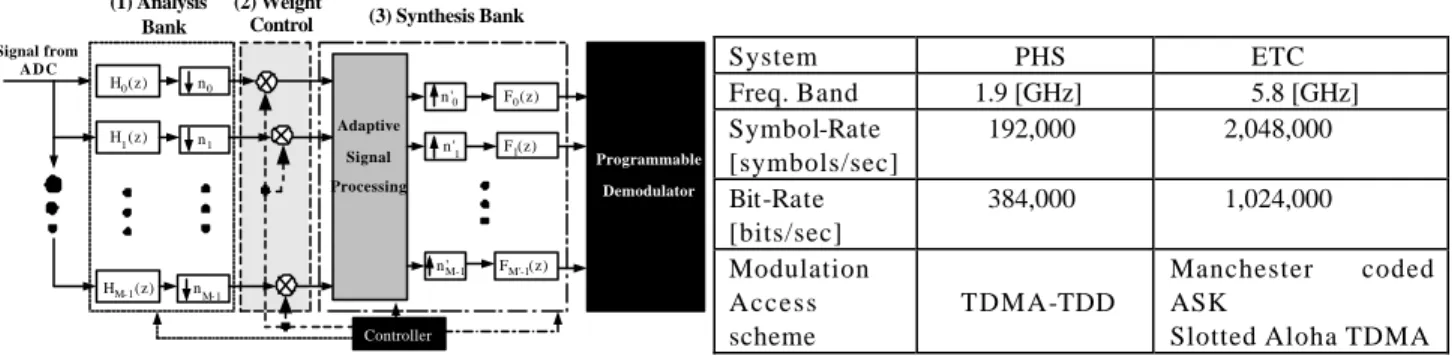
given from a mother wavelet function. Figure 5
illus-trates the flow of the method. Hereafter, let us explain the procedure of the filtering task followed by (1)-(3) in this figure.
Table 1. Simulation model
System PHS ETC Freq. Band 1.9 [GHz] 5.8 [GHz] Symbol-Rate [symbols/sec] 192,000 2,048,000 Bit-Rate [bits/sec] 384,000 1,024,000 Modulation Access scheme TDMA-TDD Manchester coded ASK
Slotted Aloha TDMA Table 2. Simulation parameters
Channel A B
System PHS ETC
Local freq. 10 [MHz] 20[MHz]
Sampling rate 50 [M samples/sec]
Mother wavelet Meyer wavelet [9]
(1) Firstly, in analysis bank, the signal digitized by an ADC is decomposed by analysis filter (H0, H1, H2,
…, HM-1), which are generated by a mother wavelet
function, and each output is decimated to an ade-quate sample rate for each system bandwidth. Here, the spectrum resolution should be enough to decompose each channel information for all possible service being offered.
(2) Next, the weight controller normalizes each correla-tion values by the maximum correlacorrela-tion value. Zero value is then multiplied to the filtering output if the service is then not requested.
(3) In synthesis bank, first, the adaptive synthesis processing part detects which channel information is wanted from users, and sets the parameters of synthesis filter and interpolation values to
recon-struct only the channel of interest. Also, if the
correlation values are lower than a threshold, it is informed to be impossible to connect the target service for users. Finally, the channel information of interest is reconstructed by synthesis filters, and each output is sent to the programmable de-modulation processing part.
By following this procedure, the method realizes a dy-namic channel filtering for several service signals being offered.
3.Simulation Model
In order to show the effectiveness of the proposed method, an example is given here. The two systems (ETC and PHS) are integrated as a multi-mode handset. Table 1 shows the specified parameters of each system. The configuration of the multiple service wireless communi-cations based on CFB-ROF transmission technique [1] is shown in Fig. 6 (a) and (b). In this transmitter shown by Fig. 6 (a), a channel of interest from a PHS network is first up-converted by frequency converter from 1.9 GHz band to 5.8 GHz band, and the output is added with an-other channel of interest from an ETC network. Next, the combined electrical radio signal
-100 -50 0 Amplitude [dB] -150 0.5 0 1 Normalized frequency Channel A Channel B
Fig. 7 Amplitude response of the signal inputted to the proposed method Input signal -80 -60 -40 -20 0 -100 0 1 Normalized frequency Amplitude [dB] Lowpass filter 0 -100 -80 -60 -40 -20 0 1 Normalized frequency Amplitude [dB] Highpass filter Channel Exstracted by analysis filter
Fig. 8 Amplitude response of the channel extracted by the analysis filter
derives Electro-Absorption Modulator (EAM) and the modulated optical signal is delivered to the Local Base Station (LBS). Then, by using Photo Diode (PD), the optical signal is converted to the radio signal and is transmitted by an antenna. Accordingly, in the receiver side, the analog signal processing parts such as an an-tenna, analog band-pass filter, Automatic Gain Control-ler (AGC) and analog down-conversion device for differ-ent service signals as shown in Fig. 6(b) can be shared for several service signals, since the two transmitted channels information is in the same transmission band. Each system channel digitalized by an ADC is extracted by the proposed method in accord with user requests. Finally, the outputs are sent to a programmable demodu-lator, and the transmission data is regenerated by the coherent detection circuit.
4.Feasibility Study
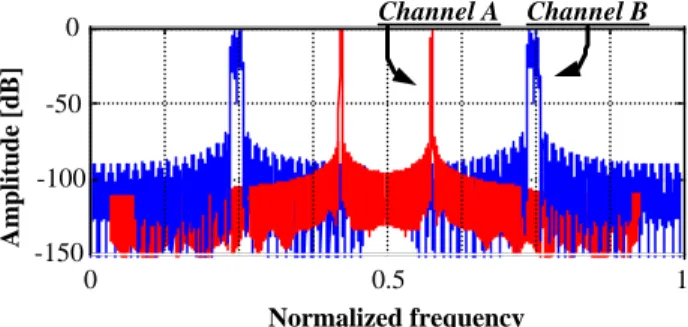
Let us show a result of the channel filtering processing by the proposed method. As an inputted signal, the ETC and PHS channels down-converted to Low-IF sig-nal in the same transmission band are assumed. The simulation parameters utilized here such as the sampling rate and local frequency for each channel are summa-rized in Table 2. Figures 7 and 8 show the amplitude responses in frequency domain of the two system chan-nels digitized by an ADC, and of the chanchan-nels extracted by the low-pass and high-pass filters in analysis bank, respectively. Meyer wavelet [9] was then utilized as an example, where the amplitude response in frequency domain is shown in Fig. 9. From
0 1 -120 -80 -40 0 0.5 Normalized frequency Amplitude [dB] Highpass Lowpass
Fig. 9 Amplitude response of the analysis filter bank (Meyer wavelet)
this figure, this may be due to the fact that the two sys-tem channels are possible to be extracted by the
pro-posed method without spectrum distortion. Moreover,
in an environment of Eb/No=
∞
, error free was identified.5.Conclusion
In this paper, a dynamic channel filtering method based on wavelet packet algorithm is proposed to realize a sim-plified and efficient multi-mode & multi-service software radio receiver. Adaptive channel extraction of several different bandwidth signals in the same transmission
band could be realized by setting a filtering waveform.
By combing the concept of multiple service wireless communications based on CFB-ROF transmission scheme, it would be possible to be shared the demodula-tion processing from an antenna to a channel selecdemodula-tion processing for several different service signals. As an evaluation of the proposed method, a multi-mode & multi-service software radio receiver, which are inte-grated ETC and PHS, is assumed. Each spectrum of two channels extracted by the proposed method is evaluated, and it was shown that the method could provide the channel selection without spectrum distortion.
In this presentation, we would like to show the fur-ther evaluation results from the points of theoretical by computer simulation and experimental views when the number of channels requested from users are increasing more.
References
[1] M. Fujise, K. Sato, H. Harada, and F. Kojima,
“Millimeter-wave ROF Multiple Service Road-Vehicle Communication Experiments,” in the Pro-ceeding of the 1st Workshop on ITS Telecommuni-cations-ITST, Oct. 2000.
[2] J. Mitola, “The Software Radio Architecture,”
IEEE Communication Magazine, May 1995.
[3] European Commission DG XIII-B: in the
Proceed-ing of Software Radio Workshop, May 1997.
[4] J. Mitola, “Technical Challenges in the
Globaliza-tion of Software Radio,” IEEE CommunicaGlobaliza-tion Magazine, Feb. 1999
[5] H. Harada and M. Fujise, “Multi-mode Software Radio System by Parameter Controlled and Tele-communication Toolbox Embedded Digital Signal Processing Chipset,” IEICE Transactions on Com-munications, Vol.J83-B, June 2000.
[6] H. Harada, “A Proposal of mode &
Multi-service Software Radio Communication Systems for Future Intelligent Telecommunication Systems,” in the Proceeding of WPMC’99, Sept. 1999.
[7] R. Sawai, H. Harada, H. Shirai, and M. Fujise,
“An Adaptive Symbol Timing Synchronization Method for Multi-mode & Multi-service Software Radio Communications System,” IEICE Transac-tions on CommunicaTransac-tions, Vol.J84-B, Sep. 2001.
[8] R. Sawai, H. Harada, H. Shirai, and M. Fujise,
“Adaptive Sampling Processing Method for Multi-mode & Multi-service Software Radio Communica-tions System,” in the Proceeding of IEEE VTC2001-Spring, May 2001.
[9] G. Strang, T. Nguyen, Wavelets and Filter Banks,
Wellesley-Cambridge Press, 1996.
[10] http://engineering.rowan.edu/~polikar/WAVELE
TS/WTtutorial.html.
[11] M.J.T.Simith and T.P.Barnwell III, “A Procedure for Designing Exact Reconstruction Filter Ba nks for Tree Structured Sub-band Coders,” in the Proceed-ing of 1984 IEEE Int. Conf. On Acoustics, Speech and Signal Processing ICASSP, 1984.
[12] H. Yoshida, T. Kato, T. Tomizawa, S. Otaka, and
H. Tsurumi, “Multi-mode Software Defined Radio Receiver using Direct Conversion and Low-IF
Prin-ciple: Implementation and Evaluation,” IEICE Trans.
on Communications, Vol.J84-B, Sep. 2001.
Acknowledgement
This work is partially supported by 2001 joint research project for Graduate School of Chuo University.