32 IEEEpower & energy magazine 1540-7977/03/$17.00©2003 IEEE march/april 2003
by Steve Haacke,
Sam Border,
Dehn Stevens,
and Bob Uluski
Building a business case ensures
that costs and benefits, both
monetary and strategic, are well
understood ahead of time and
are supportive of company
business drivers.
Plan Ahead
for Substation
Automation
T
TECHNOLOGICAL IMPROVEMENTS TO INTELLIGENT ELECTRONIC DEVICES (IEDs) and the communication facilities and protocols that enable their integration are occurring at a rapid pace. To ensure that ongoing internal efforts to integrate the IEDs has proper direction given indus-try developments, MidAmerican Energy Company developed a substation automation (SA) plan and is in the process of implementing it at two pilot substations.Before proceeding with system implementation activities, MidAmerican elected to develop a business case to ensure that the operational and strategic benefits that would be achieved and the costs to achieve these benefits were well understood ahead of time. Lack of a solid business case has always been one of the leading obstacles to the successful implementation of electric utility automation projects. Building a business case for the automation project will ensure that the costs and the benefits, both monetary and strategic, are well understood ahead of time and are support-ive of company business drsupport-ivers.
This article describes the methodology used to develop the business case for expanding the implementation of SA technologies at MidAmerican’s substations and summarizes the results of this analysis.
MidAmerican’s Goals and Objectives
MidAmerican Energy Company is the largest utility in Iowa, providing service to more than 668,000 electricity customers in a 10,600 square-mile area from Sioux City, Iowa, to the Quad Cities area of Iowa and Illinois. The largest communities served by MidAmerican are Des Moines, Sioux City, Waterloo, Iowa City, and Council Bluffs, Iowa, and the Quad Cities area of Iowa and Illinois. Figure 1 shows MidAmerican’s service territory.
MidAmerican meets the needs of its electric customers with more than 4,400 MW of generat-ing capability. Their record peak load was 3,833 MW, set in July 1999.
MidAmerican’s primary goal for its substation automation facilities is to develop an integrated approach for implementing SA systems in a cost-effective manner that will enable corporate per-sonnel to exploit the wealth of information that is available in IEDs that are being installed in MidAmerican substations.
The overall objective of the study was to determine what additional functional-ity changes, if any, to MidAmerican’s current standard approach to sub-station monitoring and control architecture are justified to accomplish the primary goal.
The specific objectives of the study are threefold:
✔ identify additional SA functions that produce significant operational benefits
✔ determine the eco-nomic justification
for implementing some or all of these functions using benefit-cost analysis
✔ determine what architecture should be used to implement cost-justified application functions (enhanced RTU-centered approach versus distributed LAN approach).
This article focuses on two of these objectives: the identification and cost justification of addi-tional SA functions.
Methodology for Developing
a Business Case
There are three main parts to the methodology:
✔ information exchange
✔ benefit-cost analysis
✔ presentation of results.
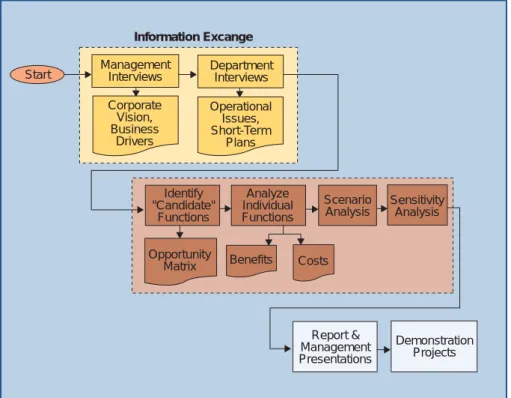
Figure 2 depicts the methodology used to develop the SA business case. Key activities performed in each part of the process are described as follows.
Information Exchange
Gathering information needed to perform this study is a two-part process, consisting of interviews with senior manage-ment personnel followed by interviews with representatives of operating groups impacted by the SA system. The results of these interviews were then documented, and a list of “candidate” SA functions was prepared. Each of these activ-ities is briefly described as follows.
Management Interviews
The most effective SA system is one that addresses the
com-pany’s most significant business problems today while pro-viding the ability to add future functionality when needed. An important step in determining the SA functionality is to iden-tify the business problems experienced by key individuals who “own” the problems. The SA system characteristics will attempt to alleviate and/or solve these business problems. As the first step in this process, senior management officials were interviewed to obtain a broad assessment of the major busi-ness problems faced by MidAmerican, along with their vision and future plans for the company.
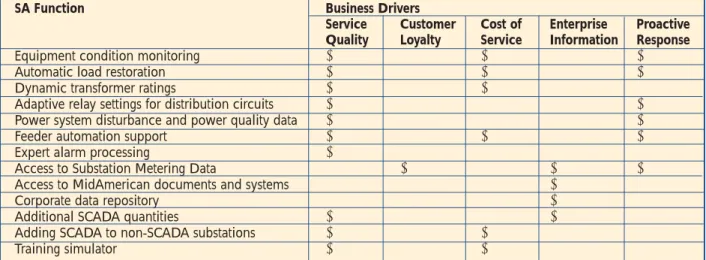
One of the most important results of the management inter-views was a list of business “drivers” to be addressed in the SA business case. MidAmerican’s key business drivers per-taining to SA are:
✔ reliability and quality of service
✔ customer loyalty
✔ cost of service
✔ deliverance of information to the enterprise
✔ proactive response to industry developments.
Departmental Interviews
Managers and representatives of departments responsible for planning, designing, construct-ing, operatconstruct-ing, maintainconstruct-ing, and marketing MidAmerican’s power system were interviewed as the next step in identifying operating problems and needs that should be considered in the evaluation of substation automation opportunities. Cur-rent automation facilities and their limitations, desired improvements, and future plans were also discussed. In addi-tion, information needed to per-form the benefit-cost analysis was collected.
Candidate SA Functions
Following the completion of interviews, a list of candidate functions was prepared. These are the SA functions that appear to provide solutions to
IEEEpower & energy magazine march/april 2003
figure 2.Business case methodology.
Start Information Excange Management Interviews Department Interviews Corporate Vision, Business Drivers Operational Issues, Short-Term Plans Identify "Candidate" Functions Analyze Individual Functions Scenario Analysis Sensitivity Analysis Opportunity
Matrix Benefits Costs Report & Management Presentations Demonstration Projects 34
Effective SA systems address the company’s most significant
business problems today while providing the ability to add future
functionality when needed.
MidAmerican’s business problems and needs identified dur-ing the interviews. Table 1 is an opportunity matrix listdur-ing the candidate functions along with the expected benefits. Detailed benefit-cost analysis was performed on these poten-tial SA functions.
Benefit-Cost Analysis
All new SA functions must be economically justified. Only those SA functions that have incremental monetary and strate-gic benefits that outweigh the incremental cost to implement the function should be implemented. A benefit-cost analysis was performed to determine which of the candidate SA func-tions identified during the information-exchange process is economically justified. The benefit-cost analysis procedure is summarized as follows.
Compute Incremental Benefits and Costs for Each Candidate Function
Incremental, “hard” benefits were calculated for each individ-ual candidate SA function. Incremental benefits are benefits that cannot be achieved using the existing complement of hardware and software. (For example, the SA system cannot be credited with construction cost savings due to reduced con-trol panel size, because MidAmerican has already achieved this benefit by using IEDs in its substations.) Hard benefits are those benefits that produce actual dollar savings to MidAmer-ican. Hard benefits include:
✔ reduction of electrical losses
✔ reduction of power supply demand charges
✔ labor savings (reduction in overtime or contract labor costs)
✔ elimination or postponement of capital expenditures
✔ savings in construction costs
✔ reduction in operating and maintenance (O&M) costs for power system equipment.
Incremental costs to implement each individual candidate function were calculated. Incremental cost is the additional expenditure needed to incorporate the candidate function on
the SA system platform. Costs to purchase, implement, and maintain each function were included. One-time costs (such as equipment purchase and installation) were converted to equivalent levelized annual expenditures to support the analy-sis of revenue requirements.
Handling of Reliability Improvement Benefits
Improving the reliability of the electric system is one of MidAmerican’s most important business drivers. However, direct monetary benefits assignable to reductions in outage duration and frequency are small. Since MidAmerican is not presently subject to performance-based rates (which can result in significant monetary benefits), the monetary benefits associated with reliability improvement are limit-ed to the rlimit-eduction of lost revenue due to kilowatt-hour sales and labor savings by employing automated rather than manual switching, both of which are typically very small dollar amounts.
To quantify the benefits of reliability improvement proj-ects, MidAmerican assigns a value to customer outage costs, which reflects the value that customers assign to avoid an out-age. Customer outage costs include unserved-energy costs, which are determined by multiplying the unserved kilo-watthours by a $/kWh factor established by MidAmerican for its customers, and momentary-outage costs, which are
deter-figure 3.Single-transformer substation. SA Function Business Drivers
Service Customer Cost of Enterprise Proactive Quality Loyalty Service Information Response
Equipment condition monitoring ✓ ✓ ✓
Automatic load restoration ✓ ✓ ✓
Dynamic transformer ratings ✓ ✓
Adaptive relay settings for distribution circuits ✓ ✓
Power system disturbance and power quality data ✓ ✓
Feeder automation support ✓ ✓ ✓
Expert alarm processing ✓
Access to Substation Metering Data ✓ ✓ ✓
Access to MidAmerican documents and systems ✓
Corporate data repository ✓
Additional SCADA quantities ✓ ✓
Adding SCADA to non-SCADA substations ✓ ✓
Training simulator ✓ ✓
mined by multiplying the power interrupted in kilowatts by a predetermined $/kW factor.
Customer outage cost savings, which are typically much higher than the direct monetary savings to MidAmerican, were not included in the analysis of revenue requirements, which included the direct monetary savings only. Instead, customer outage costs were analyzed separately for compar-ison with other reliability improvement initiatives contem-plated by MidAmerican.
Analysis of Revenue Requirements
The annual SA system benefits were compared to the annual SA system costs for each year over the life of the investment. The investment life was assumed to be ten years. Two commonly used financial indicators were com-puted to measure the economic viability and merit of the investment.
✔ Benefit-cost ratio (BCR) is the ratio of cumulative
ben-efits during the first ten years of SA system operation to the cumulative costs to operate and maintain the system during the first ten years of operation.
✔ Payback year is the first year during the life of the
sys-tem when the cumulative benefits exceed the cumula-tive costs by the initial purchase cost.
To determine which SA system candidate functions (if any) should be implemented, the analysis of revenue require-ments was repeated for various combinations (scenarios) of candidate functions. This analysis of scenarios enabled
MidAmerican to determine which combination of SA func-tions was economically most attractive. Since the analysis was performed using spreadsheets, it was possible to analyze all possible combinations of candidate functions.
By removing the candidate functions one at a time from the complete set of functions, MidAmerican was able to identify the individual functions that offered the highest payback. For example, if the overall benefit-cost ratio goes way down (becomes less attractive financially) when a function is removed, that individual function is economically attractive. On the other hand, if the overall benefit-cost ratio does not change significantly or actually improves when a function is removed, that function is not economically attractive and should not be implemented.
Sensitivity Analysis
The results of the revenue requirements analysis depend on many assumptions about key economic and technical parameters, many of which are not controllable by MidAmerican. Minor changes in some key variables could produce a significant change in the results that could impact the recommendations. To determine which input parameters have the most significant impact on the results of the analysis, a sensitivity analysis was performed. All input parameters were varied (one at a time) by ±20% of its base value to determine the impact on the final results. Those variables that produced the most impact on the ben-efit-cost ratio are key variables that were carefully
exam-ined to ensure accuracy.
Presentation of Results
The ongoing success of the project depends heavily on management acceptance of the findings, conclu-sions, and recommendations of the study. Therefore, in addition to preparing a clearly written report to document the study, several meetings were held with key management officials to inform them of project plans, projected costs, and expected benefits. This ensured that all of their questions were answered to their satisfaction, ensuring their continuing support during the actual implementation.
Business Case Results
Candidate FunctionsCandidate SA functions identified for MidAmerican are:
IEEEpower & energy magazine march/april 2003
figure 4.Two-transformer substation.
A benefit-cost analysis determines which of the candidate SA
functions identified during the information-exchange process is
economically justified.
✔ online equipment condition monitoring
✔ dynamic transformer ratings
✔ adaptive relay settings
✔ power system disturbance analysis
✔ automatic load restoration. A brief description of each follows.
Online Equipment Condition Monitoring
Many electric utilities have employed online equipment condition monitoring (ECM) to maintain electric equip-ment in top operating condition while minimizing the num-ber of interruptions and reducing the frequency of routine inspections. With ECM, equipment operating parameters are tracked automatically to detect the emergence of vari-ous abnormal operating conditions. This allows operations personnel to take timely action when needed to improve reliability and extend equipment life. For MidAmerican, ECM for high-voltage, supply-line circuit breakers and ECM for substation transformers were identified as candi-date SA functions.
The projected benefits of ECM for high-voltage supply-line circuit breakers and substation transformers include:
✔ Fewer routine inspections: By implementing an
effective online monitoring system for this equip-ment, fewer routine maintenance inspections will be needed. For MidAmerican, it was assumed that the major maintenance inspection interval for high-volt-age supply-line circuit breakers (based on number of fault operations, results of testing dielectric medium, and time since last maintenance period) could be increased from three years to six years. It was also assumed that the maintenance inspection interval for substation transformers (based on testing dielectric medium, load tap changer operations, and time since last maintenance period) could be increased from two years to five years. The benefit of fewer inspections attributable to this candidate SA function is a reduc-tion in labor and material costs associated with these inspections.
✔ Fewer catastrophic failures: By implementing
contin-uous online monitoring, some equipment problems can be detected early, so that corrective action can be taken before a catastrophic failure occurs. For MidAmerican, it was assumed that 15% of high-volt-age supply-line circuit breaker problems and 20% of substation transformer problems could be detected before catastrophic failure occurs. In most cases, the cost to repair equipment problems will be significant-ly less if the problem is addressed before a cata-strophic failure occurs. For MidAmerican, it was assumed that the repair costs could be reduced by 10% for circuit breakers and by 67% for substation trans-formers. Furthermore, equipment outages to perform such repairs can be planned so that customer outages can be minimized, resulting in a reliability
improve-ment benefit that can be attributed to this SA system candidate function.
✔ Equipment life extension: The average life of a piece
of equipment can be extended if the equipment shows no significant signs of wear. Therefore, it was assumed that the life expectancy of a high-voltage supply-line circuit breaker or substation transformer can be extended by employing better monitoring to identify such signs of wear. By increasing the life expectancy of the monitored equipment, it will be possible to defer capital expenditures to replace this equipment. For MidAmerican, it was assumed that the average life expectancy of its high-voltage supply-line circuit breakers and substation transformers could be extended by one year by employing continuous equip-ment monitoring. Therefore, the monetary savings associated with deferred capital expenditures can be attributed to this SA system candidate function.
Dynamic Equipment Ratings
Newer transformers being procured by MidAmerican all have short-term overload capabilities. Older transformers have the capability of being overloaded as long as internal temperature limits are not being exceeded. Even though transformers have some inherent overload capacity, system operators are reluc-tant to load transformers beyond their nameplate limits due to lack of specific information on current conditions.
Detailed equipment measures provided by the ECM devices, such as transformer winding temperatures, would allow MidAmerican to determine equipment ratings based on actual conditions rather than on conservative assumptions about operating and ambient conditions. Under some circum-stances, this will enable MidAmerican to gain additional capacity from existing equipment during peak load periods. This, in turn, will allow MidAmerican to defer capital expen-ditures and, in some extreme cases, can help avoid load shed-ding to avoid equipment overloads.
Adaptive Relay Settings
The SA system will enable MidAmerican to change protective relay settings from one group of predetermined settings to another group of predetermined settings from a remote loca-tion. This application function will enable MidAmerican to change normal feeder protective-relay settings to fuse-saving settings under conditions (such as storms) when numerous momentary faults are likely to occur. Fuse saving will prevent feeder branch line fuses from blowing for momentary faults, thus avoiding unnecessary extended outages for some cus-tomers at the expense of numerous momentary outages for all customers on the feeder. Significant improvement in reliabili-ty indicators (SAIDI and SAIFI) can be achieved at MidAmerican by employing remote controlled fuse saving. Analysis performed on one of MidAmerican’s feeders showed that the average outage duration could be reduced by at least 20% by implementing fuse-saving settings during stormy (or
windy) weather conditions. Therefore, significant reliability improvement benefits can be attributed to this SA system can-didate function.
The capability to switch protective relay settings remotely to alternate predetermined settings will reduce the number of field trips made by relay technicians to make these changes locally. Such protective-relay setting changes are often required when feeder circuits are reconfigured. The result is a small savings in labor costs that can be attributable to this SA system candidate function.
Power System Disturbance Data
Protective-relay IEDs contain a wealth of data that can be use-ful in analyzing power system disturbances. Protective-relay IED information, such as relay targets, fault current magnitude, and fault location information, can assist system operators, substation operators, field crews, and others in determining the cause and location of the faulted equipment to speed switching to restore service to customers. Oscillographic (waveform) data and sequence-of-event data available in the protective-relay IEDs provide valuable information that can be used by relay engineers and relay technicians to diagnose possible relay misoperations. This after-the-fact analysis is used to zero in on the problems, identify any misoperations, and ensure proper operation of these devices for future problems.
Currently, MidAmerican personnel can access much of this protective-relay information via dial-up connections. Howev-er, the SA system will provide MidAmerican with a more con-venient and secure mechanism to access the IED data. Having more convenient access to the power system disturbance data contained in IEDs (relay targets, fault location and magnitude, etc.) will assist field crews in investigating and locating the
fault and thereby reduce both investigation time and feeder patrol time. This reduces the average customer outage dura-tion, which in turn results in a significant reliability improve-ment benefit. Reduced fault investigation and feeder patrol times also produce a small labor savings that can be attributed to this SA system candidate function.
Automatic Load Restoration
This SA system candidate function will enable MidAmerican to automatically restore power to customers whose service has been interrupted due to a high-voltage supply-line or substa-tion transformer failure.
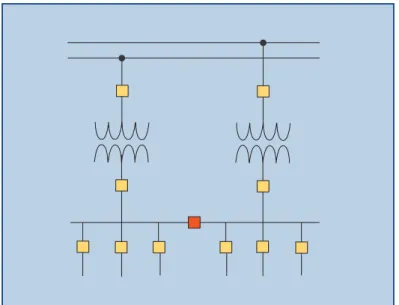
Some of MidAmerican’s smaller single-transformer sub-stations do not have high-side circuit breakers that can be used to sectionalize a faulted supply line. Figure 3 depicts this type of substation. As a result, when a supply-line fault occurs, customers served by these substations would be with-out power until field crews repair the faulted line or manual-ly sectionalize the suppmanual-ly line to isolate the faulted segment of the supply line. The SA system, using fault-location infor-mation received from protective relays at opposite ends of the supply line, can determine the approximate location of the fault, open appropriate motor-operated disconnects, and sig-nal system operators to close the appropriate supply line, thus speeding the restoration of power to the substation. Fully automated operation is possible, but MidAmerican has elect-ed to use the semiautomatelect-ed version of this application at this time due to the complexity of the automated solution. A sig-nificant reliability improvement benefit can be attributed to this SA system candidate function. A small monetary benefit for reduced manual switching activities (labor savings) and reduction of lost revenue from kilowatthour sales can also be
attributed to the SA system.
The automatic load-restoration function will also provide additional benefits at two-transformer substations. A typical two-trans-former substation is depicted in Figure 4. Simple automatic transfer schemes that are designed to transfer feeder load following a supply line or substation transformer have been disabled in some substations due to concerns that additional load will overload the remaining healthy transformer. The auto-matic load-restoration function will be able to determine how much load can be trans-ferred safely to the backup transformer and then issue appropriate switching commands
figure 5.Direct monetary benefits.
Online Equipment Condition Monitoring Other Benefits: Adaptive Relay Settings, Access to Disturbance Data, Autoamtic Load Restoration Dynamic Equipment Ratings 2% 14% 84%
IEEEpower & energy magazine march/april 2003
38
Ongoing project success depends heavily on management
acceptance of the study’s findings, conclusions, and
to transfer the maximum possible load. The benefit that is attributable to the SA system would be the reduction of outage duration, lost revenue, and customer outage costs.
Summary of Benefits
Direct Monetary Benefits
The relative percentages of the direct monetary benefits for each candidate SA function are illus-trated in Figure 5.
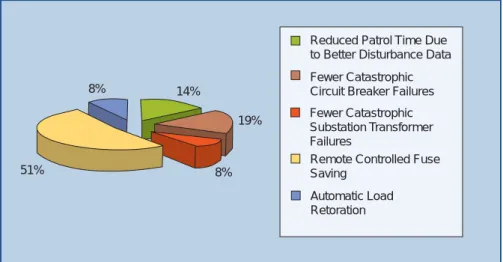
Customer Outage Benefits
The relative percentages of the customer outage benefits for each candidate SA function are illus-trated in Figure 6.
SA System Costs
The SA system costs used in the benefit-cost analysis include basic SA system hardware and software plus additional costs to implement the candidate SA functions on the basic SA sys-tem platform, including special-ized sensors and application software. Procurement and installation costs were included in the analysis, and costs to maintain the equipment over the life of the SA system were also factored in. The relative cost percentages for each item are shown in Figure 7.
Benefit-Cost Analysis
Analysis of Monetary Benefits
The analysis was repeated with various combinations of the SA functions under consideration being implemented or not
figure 6.Customer outage benefits.
Reduced Patrol Time Due to Better Disturbance Data Fewer Catastrophic Circuit Breaker Failures Remote Controlled Fuse Saving 51% 14% 8% Automatic Load Retoration Fewer Catastrophic Substation Transformer Failures 8% 19%
figure 7.Relative cost percentages.
Hardware Software Services 67% 15% 5% Special Sensors 19%
ECM Adaptive Automatic Dynamic
Overall for HV ECM for LTC Relay Disturbance Load Equipment BCR Payback Rank Breakers Transformers Settings Data Restoration Rating
1 0 1 1 1 1 1 1.597 8 2 0 1 0 0 0 0 1.408 12 3 1 1 1 1 1 1 1.354 16 4 1 1 1 1 0 1 1.346 16 5 1 1 1 0 1 1 1.341 17 6 1 1 1 1 1 1 1.337 17 7 1 1 0 1 1 1 1.334 17 8 1 1 0 0 0 0 1.183 99 9 1 1 1 1 1 0 1.162 99 10 0 0 0 0 0 1 0.954 99 11 0 0 1 1 1 1 0.894 99 12 1 0 1 1 1 1 0.670 99 13 1 0 0 0 0 0 0.289 99 14 0 0 1 0 0 0 0.200 99 15 0 0 0 0 1 0 0.172 99 16 0 0 0 1 0 0 0.170 99
implemented to determine the combination of SA system functions yielding the highest returns. Only the hard mone-tary benefits were included in this analysis. Table 2 identi-fies the scenarios that were analyzed along with the results (BCR and payback period) for each scenario. The table entries have been ranked by hard dollar benefit-cost ratio, with scenarios offering the highest payback appearing at the top of the list. Note that a “1” indicates that the function was included in the scenario; “0” indicates that the function was excluded from the scenario.
Analysis of Customer Outage Benefits
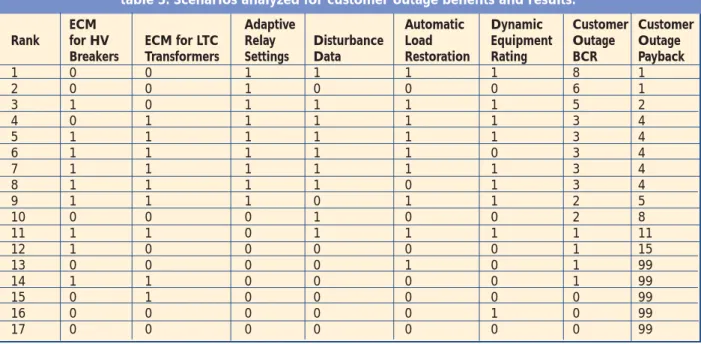
The analysis of revenue requirements was repeated for the same scenarios using only the customer outage cost benefits. Table 3 identifies the scenarios that were analyzed along with the results (BCR and payback period) for each scenario. The table entries have been ranked by customer outage benefit-cost ratio, with scenarios offering the highest payback ranked the highest.
Combined Ranking
To account for both monetary benefits and
reliability-IEEEpower & energy magazine march/april 2003
40
ECM Adaptive Automatic Dynamic Customer Customer Rank for HV ECM for LTC Relay Disturbance Load Equipment Outage Outage
Breakers Transformers Settings Data Restoration Rating BCR Payback
1 0 0 1 1 1 1 8 1 2 0 0 1 0 0 0 6 1 3 1 0 1 1 1 1 5 2 4 0 1 1 1 1 1 3 4 5 1 1 1 1 1 1 3 4 6 1 1 1 1 1 0 3 4 7 1 1 1 1 1 1 3 4 8 1 1 1 1 0 1 3 4 9 1 1 1 0 1 1 2 5 10 0 0 0 1 0 0 2 8 11 1 1 0 1 1 1 1 11 12 1 0 0 0 0 0 1 15 13 0 0 0 0 1 0 1 99 14 1 1 0 0 0 0 1 99 15 0 1 0 0 0 0 0 99 16 0 0 0 0 0 1 0 99 17 0 0 0 0 0 0 0 99
table 3. Scenarios analyzed for customer outage benefits and results.
ECM Adaptive Automatic Feeder Dynamic Monetary Customer for HV ECM for LTC Relay Disturbance Load Automation Equipment Benefits Outage Total Breakers Transformers Settings Data Restoration Support Rating Rank Rank Rank
0 1 1 1 1 1 1 1 4 5 1 1 1 1 1 0 1 3 4 7 1 1 1 1 0 1 1 4 4 8 1 1 1 1 1 1 1 6 4 10 0 0 1 1 1 1 1 11 1 12 1 1 1 1 1 1 0 9 4 13 1 1 1 0 1 1 1 5 9 14 1 0 1 1 1 1 1 12 3 15 0 0 1 0 0 0 0 14 2 16 0 1 0 0 0 0 0 2 15 17 1 1 0 1 1 1 1 7 11 18 1 1 0 0 0 0 0 8 11 19 1 0 0 0 0 0 0 13 11 24 0 0 0 1 0 0 0 16 9 25 0 0 0 0 0 0 1 10 15 25 0 0 0 0 1 0 0 15 11 26 0 0 0 0 0 1 0 17 15 32
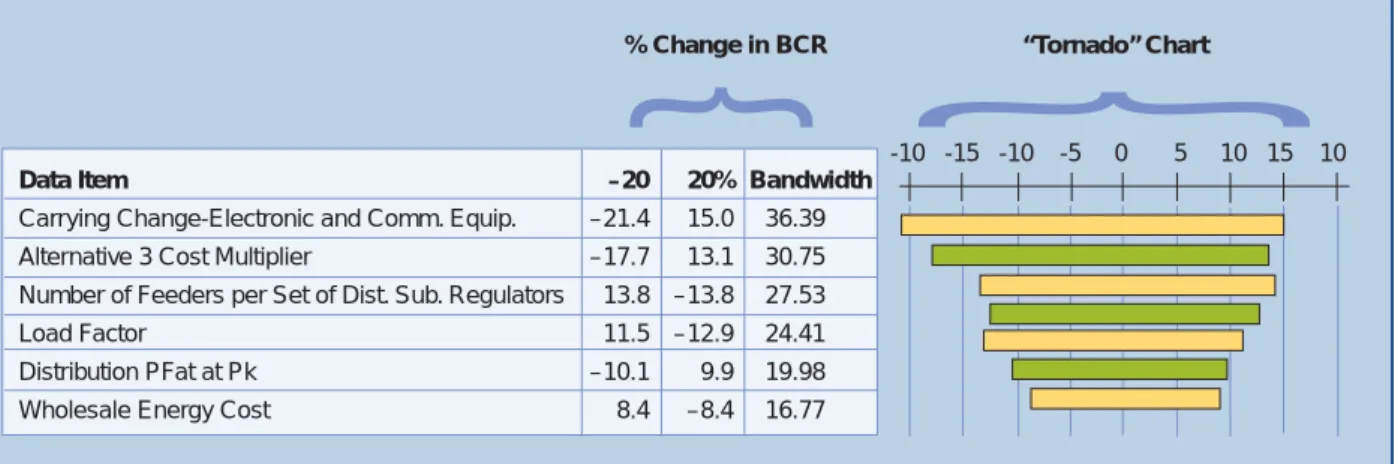
figure 8.Sensitivity analysis results.
% Change in BCR
Data Item –20 20% Bandwidth
Carrying Change-Electronic and Comm. Equip. –21.4 15.0 36.39 Alternative 3 Cost Multiplier –17.7 13.1 30.75 Number of Feeders per Set of Dist. Sub. Regulators 13.8 –13.8 27.53 Load Factor 11.5 –12.9 24.41 Distribution PFat at Pk –10.1 9.9 19.98 Wholesale Energy Cost 8.4 –8.4 16.77
-10 -15 -10 -5 0 5 10 15 10
“Tornado” Chart
improvement benefits, a total rank was calculated for each scenario by adding the monetary rank and the customer out-age rank. The results are shown in Table 4.
Sensitivity Analysis
The results of the revenue requirements analysis depends on many assumptions about key economic and technical parame-ters, many of which are not controllable by MidAmerican. Minor changes in some key variables could produce a signifi-cant change in the results that could impact the recommenda-tions. A sensitivity analysis has been performed to determine which input parameters have the most significant impact on the results of the analysis (Figure 8). Each input parameter was varied by ±20% of its base value to determine the impact on the final results.
Project Status
MidAmerican is proceeding with an SA validation project based on the results of the business case and currently plans to install SA systems at two substations. MidAmerican has elect-ed to implement an SA system at a large two-transformer dis-tribution substation that has only a limited amount of IED integration but a fair payback in terms of MidAmerican and customer outage benefits. MidAmerican has also selected a newer one-transformer substation with a high degree of IED integration that is a good model for future substation con-struction projects. MidAmerican plans to install SA systems at these pilot locations and then review the actual benefits before proceeding with further projects.
Biographies
Steve Haacke, manager of Substation Engineering for
MidAmerican Energy, has over 23 years of experience in the electric utility industry. He has held various engineering positions with MidAmerican Energy, primarily in the
distri-bution, transmission, and substation design departments. He has a B.S. degree in electrical engineering from the Univer-sity of Nebraska.
Sam Border, a senior engineer at MidAmerican Energy
Company, has over 29 years of experience as an electrical engineer. He is currently a project manager in the company’s Substation Engineering department and is actively working on MidAmerican Energy’s substation automation validation project. He was formerly supervisor of the EMS operations group and was project manager for an EMS installed in 1990. He has a B.S. degree in electrical engineering from the Uni-versity of Illinois at Urbana. He is a registered professional engineer in Iowa and a member of the IEEE Power Engi-neering Society.
Dehn Stevens is a supervisor in the Electric System
Plan-ning department at MidAmerican Energy Company. His responsibilities at MidAmerican include supervisory respon-sibility for electric transmission and distribution system planning for several regions of MidAmerican’s system as well as administering generation interconnections to the MidAmerican electric system. He served on the substation automation investigation team. He has a B.S. degree in elec-trical engineering from Iowa State University. He is a regis-tered professional engineer in Iowa and Illinois.
Bob Uluski, senior principal consultant at KEMA
Con-sulting, has over 29 years of experience in the electric utili-ty industry. He has assisted numerous North American and international electric utilities with the procurement and implementation of distribution automation systems. He spe-cializes in developing the business case for implementing substation and feeder automation and has developed com-puter programs to assist in performing the detailed benefit-cost analysis for such projects. He has an M.S. degree in power system engineering from the University of Wisconsin at Madison. p&e