Government
financial liabilities
beyond public
sector net debt
This article clarifi es the scope of liabilities used to calculate public sector net debt before focussing on the liabilities that are not included. National accounting principles are compared with international accounting standards for governments and businesses. The current public reporting of non-public sector net debt liabilities in the UK is considered, with particular attention being paid to future spending under the private fi nance initiative, unfunded pension schemes, and government guarantees.
SUMMARY FEATURE
Fenella Maitland-Smith
Bank of England (formerly Offi ce for National Statistics)
T
he previous article ‘Th e public sector balance sheet’ discusses the calculation of public sector net debt (PSND), whereas this article discusses the relationship between the scope of liabilities inside the National Accounts boundary (which is almost equivalent to the boundary of PSND), and the wider range of liabilities reported to comply with the International Monetary Fund’s (IMF) Code of Good Practices on Fiscal Transparency (see IMF 2007), which states:‘Th e public should be provided with comprehensive information on past, current, and projected fi scal activity and on major fi scal risks.’
Th is article will:
■ discuss frameworks for analysing fi scal obligation and risk, introducing the idea of a ‘spectrum of risk/liability’
■ clarify the boundary for National Accounts balance sheet liabilities with reference to existing guidelines in international manuals, and compare this boundary with the fi nancial reporting boundary as set out in the International Accounting Standards (IAS), and the International Financial Reporting Standards (IFRS) and the IMF’s guidelines for Government Finance Statistics (see IMF 2001), and
■ discuss the UK reporting of non-PSND liabilities such as future expenditure under the private fi nance initiative
(PFI), unfunded pension schemes and government guarantees, and clarify their treatment in National Accounts, Public Sector Finances, departmental resource accounts and Whole of Government Accounts
Th e article attempts to draw out the relationships between obligation and risk, between current and future obligation, and between National Accounts and resource accounts balance sheets. Box 1 provides basic defi nitions for the key terms used in this article.
Frameworks for analysing fi scal
risk
Th e Offi ce for National Statistics (ONS) has a role to play in presenting the data necessary for assessment of fi scal burden and risk, and as such needs to understand users’ requirements. Th ese requirements have driven the guidance on fi scal reporting produced by the International Public Sector Accounting Standards Board (an interpretation of IAS and IFRS) and the IMF’s Government Finance Statistics (GFS) Manual (see IMF 2001).
Th e framework most widely used for understanding and analysing fi scal risk is the matrix articulated by Polackova (1998), reproduced here as Table 1. One dimension of the matrix relates to the legal basis of a government’s obligations which are either:
■ Explicit liabilities, whose repayments are established by a law or a contract, or
Box 1
Basic defi nitions
Liability: a present obligation arising from past events, the settlement of which is expected to result in an outfl ow of resources (IAS 37). In the 1993 System of National Accounts (SNA 1993), liabilities are not defi ned explicitly, but a defi nition is implied as counterparty to an asset (see later section of this article).
Commitment: the government’s responsibility for a future liability based on an existing contractual agreement which does not yet give rise to a present obligation. This is because no exchange has yet taken place, and the obligation, and therefore the liability, normally arises on delivery of the goods or services. IAS requires the disclosure of commitments, in particular capital expenditure, in notes to the accounts. IAS 17 (leases) requires the disclosure of commitments for minimum payments under fi nance leases, and non-cancellable operating leases with a term of more than one year.
Provision: a liability of uncertain timing or amount, which is recognised in the main accounts since payment is probable and a reasonable estimate of the amount can be made. Provisions may be made for contingent liabilities where there is a high probability of actual liability (IAS 37, International Public Sector Accounting Standards (IPSAS) 19). SNA 1993 does not record provisions (except consumption of fi xed capital). The Government Finance Statistics Manual (GFS Manual, see IMF 2001) discloses them as memorandum items or notes to the accounts.
Contingent liability: an obligation activated by a discrete event that may or may not occur. The event is determined ex-ante, but its occurrence and timing are uncertain. If it does occur, then the commitment becomes a direct liability for the government. Both the probability of its occurrence and the magnitude of the resulting outlays are often very complex to estimate. Contingent losses can be recognized by reducing the value of an asset
(impairment) or increasing the value of a liability (creating a provision) (IAS 37, IPSAS19). SNA 1993 does not record contingent liabilities (unless tradable). GFS Manual discloses them as memorandum items or notes to the accounts. Guarantees: in broad terms are commitments to bear a risk, or more specifi cally, ’a contractual arrangement under which a third party (the guarantor) agrees to fulfi l the fi nancial or other obligations of the guaranteed party (the principal obligor) to another party (the benefi ciary) in the case of default by the principal obligor.’
Guarantees:
■ are the most common form of contingent liabilities
■ may shield against political and regulatory risks, exchange risks, interest rate risks, default and credit risks, construction cost risks, force majeure risks, and demand risks, among many others
■ may be full or partial guarantees, depending on the level of support a government considers it convenient to provide and the degree of risk exposure it is willing to bear, and
■ may create moral hazard in the markets
Other (implicit) contingent liabilities of government For example, state insurance schemes for deposits or minimum returns on pension funds, bailout of sub-national entities or fi nancial system, military spending in cases of war and disaster relief.
In line with the position held by the IMF, these obligations are not offi cially recognized by the government, and not reported in the fi scal expenditure plans, in order to avoid increasing moral hazard.
Table 1
Fiscal risk matrix
1Note: Source: Polackova (1998)
1 Items included in the UK National Accounts and PSND are italicised.
Items reported to Eurostat by ONS in bi-annual Excessive Defi cit Procedure returns, and published in UK departmental resource accounts (and will be in Whole of Government Accounts) are in red.
Items published in HM Treasury’s annual Budget documents, but not by ONS, are in bold.
Liabilities (of fi scal authorities, not central bank) Direct (obligation in any event) Contingent (obligations if a particular event occurs) Explicit (liability is recognized by law or contract) ■ Sovereign debt
■ Budgetary expenditures considered by law
■ Budgetary expenditures legally binding in the long term (civil service salaries and pensions)
■ State guarantees on obligations issued by sub-national governments and public and private sector entities
■ Umbrella State guarantees for various types of loans (mortgages, student loans, agriculture, small businesses)
■ State guarantees on interest and exchange rates [may be in PSND]
■ State insurance schemes (deposits Financial Sector Compensation Scheme in PSND, minimum returns on pension funds, fl oods)
Implicit (‘moral’ or expected obligation due to public expectations or political pressures)
■ Future recurrent costs of public investment projects ■ Social security schemes if not required by law ■ Future public pensions (as opposed to civil service
pensions) if not required by law
■ Future health care fi nancing if not required by law
■ Default on non-guaranteed debt issued by sub-national governments or public and private sector entities ■ Cleanup of privatised entities
■ Bank failure beyond state insurance
■ Investment failure of non-guaranteed pension fund or social security fund
■ Central Bank defaults on its obligations (currency defence, balance of payments stability, foreign exchange contracts) ■ Bailouts following a reversal in private capital outfl ows ■ Residual environmental damage, disaster relief, military
■ Implicit liabilities, which involve a moral or expected obligation on the part of the government that is not mandated by law, but rather based on public expectations, political pressures, or the role of the state as understood by the corresponding societies
Th e other dimension relates to the certainty of the liability crystallising:
■ Direct liabilities, which will occur for certain and thus are predictable based on determined factors, or
■ Contingent liabilities, which are obligations activated by a discrete event that may or may not occur
Th e area commanding the most attention in the IMF’s manuals, but also as a result of the current fi nancial crisis, is that of explicit contingent liabilities, which are predominantly guarantees.
An alternative to this analytical matrix which groups obligations by their type is to group them along a spectrum of risk, or uncertainty, such as that developed by Heller (2004) and shown in Table 2. Heller argues that:
‘Rather than focusing on the liabilities that fall squarely on the balance sheet, it is more appropriate to conceive of a spectrum of obligations and risks to which a government is exposed.’ Th e spectrum could be viewed as running from certainty to uncertainty around whether an expenditure will become due, and also around the timing and size when (if), it does.
Polackova (1998)suggests:
‘Upon completion of the fi scal risk matrix, it is possible to easily calculate and report the maximum possible losses implied by each government’s obligations. Also, it is possible to identify the particular risk exposures borne by a government.’
It would not be straightforward to derive meaningful values for all cells in the matrix (Table 1), given the nature and uncertainty around many of the contingent liabilities that a government implicitly assumes - for example natural disasters, corporate bail-outs, environmental clean-up and so on. Th is would require estimation of maximum
possible losses and likelihoods of risks crystallising.
Th e IMF Code takes a more pragmatic line, advising governments that estimates should be published for explicit
(contractual) obligations, whether direct or contingent:
‘Th e central government should publish information on the level and composition of its debt and fi nancial assets, signifi cant non-debt liabilities (including pension rights, guarantee exposure, and other contractual obligations), and natural resource assets.’
But for implicit liabilities, qualitative descriptions only may be published:
‘Statements describing the nature and fi scal signifi cance of central government tax expenditures, contingent liabilities, and quasi-fi scal activities should be part of the budget documentation, together with an assessment of all other major fi scal risks.’
Th e remainder of this paper will discuss the accounting treatment, estimation and publication of ‘signifi cant non-debt liabilities’ in the UK, with particular focus on government pension schemes (employee and state), guarantees and PFI.
Accounting treatment of
liabilities
Accounting standards
Diff erent accounting standards exist to serve diff erent purposes:
■ Financial accounting – the standards issued by the IAS and IFRS are designed
‘to provide the world’s integrating capital markets with a common language for fi nancial reporting.’ Th e aim of the standards is to serve the public interest by strengthening the credibility of information upon which investors and other stakeholders make decisions, and they are promoted by the International Federation of Accountants (IFAC). For the compilation of UK government resource accounts, the IAS and IFRS are interpreted by the Financial Reporting Advisory Board, whose guidance is published in the Financial Reporting Manual.
■ Government accounting – the IMF’s Government and Financial Statistics Manual (GFS Manual, see IMF 2001) provides a specialised system designed to meet the needs of fi scal analysis, and to encourage governments to provide comparable public fi nance statistics. It is concerned with the general government sector and its sub-sectors. Eurostat’s interpretation of the GFS Manual is the Manual on Government Defi cit and Debt.
■ National accounting – the United Nation’s 1993 System of National Accounts (SNA 1993), interpreted by Eurostat in the 1995 European System of Accounts (ESA 1995), provides a framework for the production of aggregate macro-economic statistics for the whole economy, particularly national income and net worth, and a system of integrated accounts for the diff erent sectors, such as the corporate, household and government sectors. Although the SNA and GFS system are largely based on the same framework and principles, they have quite diff erent objectives and have evolved over time to
Table 2
Spectrum of fi nancial risk
Source: Heller (2004) On Balance Sheet Off Balance Sheet
As liability or provision Other types of guarantee
Constructive budget obligations
Fiscal risk exposures derived from role of government Explicit debt Public
guarantees (provisioned) Public guarantees (not provisioned) Contractual Non-contractual Implicit obligations Contingent PPPs [NB these are on balance sheet in the UK] Hard Soft Explicit contingent liabilities
meet the needs of particular groups of users. In a sense, the GFS system resonates with the IAS/IFRS world, focusing on the health of an entity’s balance sheet, but makes every eff ort to be compatible with the SNA so that its results can be used directly in National Accounts
Th e SNA is necessarily more limited than the other two accounting standards, given its wider sectoral scope and fundamental need for internal integrity across all sectors of the economy. Th is means that fi nancial transactions must always have identifi able counterparties and be recorded symmetrically for both. Th e result is that liabilities are defi ned more narrowly in SNA 1993 than in the other accounting standards which are concerned principally with a single entity or sector.
While SNA 1993, and the GFS Manual record only current liabilities in the main accounts, the GFS Manual does recommend that commitments to future expenditure should be disclosed as memorandum items.
Liabilities and debt in SNA 1993
Liabilities
As Pitzer (2002) points out, liabilities are defi ned in SNA 1993 only as counterparts to fi nancial claims, where a fi nancial claim is defi ned as:
‘An asset that entitles its owner, the creditor, to receive a payment, or series of payments, from the other unit, the debtor, in certain circumstances specifi ed in the contract between them.’ As the opposite of a fi nancial claim, a liability can then be defi ned as an obligation of one unit to make a payment, or a series of payments, to another unit in certain circumstances specifi ed in a contract between them.
SNA 1993 is very clear, however, about the treatment of contingent liabilities and provisions:
‘Contingent assets or liabilities are not treated as fi nancial assets or liabilities in SNA, as discussed in chapter XI. Sums set aside in business accounting to provide for transactors’ future liabilities, either certain or contingent, or for transactors’ future expenditures generally are not recognized in SNA. (Th e only ‘provision’ recognized in the System is accumulated consumption
of fi xed capital.) Only actual current liabilities to another party or parties are explicitly included. When the anticipated liability becomes actual - for example, a tax then - it is included.’
It does, however, recommend presentation of ‘important’ contingent liabilities:
‘By conferring certain rights or obligations that may aff ect future decisions, contingent arrangements obviously produce an economic impact on the parties involved. Collectively, such contingencies may be important for fi nancial programming, policy and analysis. Th erefore, where contingent positions are important for policy and analysis, it is recommended that supplementary information be collected and presented as supplementary data in the SNA.’
Th e 2008 revision to SNA 1993 (SNA 2008) will soft en slightly, and will require the inclusion of provisions for ‘standardised guarantees’, such as loans to small businesses and student loans, in a parallel treatment to that for insurance technical reserves.
Debt
Debt is not identifi ed as an aggregate or balancing item in SNA 1993. Net worth is defi ned as ‘the value of all the non-fi nancial and non-fi nancial assets owned by an institutional unit or sector less the value of all its outstanding liabilities’ and the closest SNA 1993 comes to defi ning debt is:
‘Th e balance sheet (at market value) records the fi nancial assets and liabilities for all institutional sectors by type of fi nancial instrument. For each sector, the balance sheet shows the fi nancial liabilities that the sector has incurred to mobilise fi nancial resources and the fi nancial assets that the sector has acquired. Th e balance sheet, like the fi nancial account, thus presents a two-dimensional view of a sector’s fi nancial instruments and whether the sector is a creditor or a debtor.’
To allow monitoring under the European Commission’s Excessive Defi cit Procedure (see EC 1993), government debt is defi ned more narrowly, taking a sub-set of liabilities, and at nominal value. Government debt
is constituted by the liabilities of general government in the following categories:
■ currency and deposits
■ securities other than shares, excluding fi nancial derivatives, and
■ loans
Liabilities and Debt in IAS / IFRS
Liabilities
IAS 37 describes liabilities more loosely than SNA 1993 as:
‘Present obligations of the entity arising from past events, the settlement of which is expected to result in an outfl ow from the entity of resources embodying economic benefi ts or service potential.’ Th is diff ers signifi cantly from SNA 1993 in that it does not require an identifi able counter-party, and it includes the idea of expected outfl ows, that is future expenditure and contingent obligations where a reliable estimate of the amount can be made. Where the liability is probable and measurable, it is recognised as a provision, but where the contingency is uncertain (but not remote) then relevant information is disclosed in the notes to the accounts.
Debt
Th e IFAC also has a clear view about the disclosure of liabilities beyond the SNA 1993 defi nition of government debt:
‘Governments have signifi cant liabilities beyond debt, which may have important implications for fi scal sustainability. Th e disclosure of information about the potential cost of unfunded public pension funds, and government guarantees and other contractual obligations (such as commitments under Public Private Partnerships), is an important element of fi scal transparency.’
As a result of the SNA 1993 requirement of specifi city about the party to whom the obligation is owed, and that the liability currently exists (accrual principle), it diff ers from fi nancial accounting standards in not recognising provisions for future expenditure or contingent liabilities.
Th is is why unfunded pension schemes, government guarantees, and the future service payments for PFI schemes not judged to be on the government balance
sheet, are all outside the National Accounts liability boundary. Th e treatment of these signifi cant non-debt liabilities in the GFS Manual is discussed in the following sections.
Non-debt liabilities in the GFS Manual
Th e GFS Manual treads a middle ground. It is consistent with SNA 1993 in terms of the ‘main accounts’:
‘Contingent assets or liabilities are not treated as fi nancial assets and liabilities. Also, sums set aside in business accounting as provisions to provide for a unit’s future liabilities, either certain or contingent, or for a unit’s future expenditures are not recognized in the GFS system. Only actual current liabilities to another party or parties are included.’
But goes on to say:
‘Nevertheless, contingencies, especially those that may result in an expense, can be particularly signifi cant for the general government sector. Aggregate data on all important contingencies should be recorded as memorandum items. In addition to the gross amount of possible revenue or expense, estimates of expected revenue or expense should be presented. Th is position is somewhat diff erent from that of fi nancial accounting standards, which recognize contingent liabilities when it is probable that future events will confi rm that an asset has been impaired or a liability incurred and that a reasonable estimate of the amount can be made.’
It goes further and suggests that guarantees, and even implicit social benefi ts, should be recorded as memorandum items:
‘Contingencies, such as loan
guarantees and implicit guarantees to provide social benefi ts when various needs arise, can have important economic infl uences on the general economy but do not result in transactions or other economic fl ows recorded in the GFS system until the event or condition referred to actually occurs. As a result, provision is made for recording contingencies as memorandum items.’
Note that implicit insurance for
corporations, such as bail-outs and clean-up, should not be recorded due to moral hazard.
Pension liabilities
SNA 1993
In SNA 1993 the treatment of employee pension schemes depends on whether the scheme is funded or unfunded: if funded, a liability for pension benefi ts is recognized as insurance technical reserves, if unfunded, no liability for pension benefi ts is recognised.
An important feature of the new SNA 2008, however, is the recording, on an accrued-to-date basis, of pension entitlements of households and thus liabilities of employers and governments, for all pension schemes including social security schemes, i.e. state pensions. SNA 2008 is likely to allow the option of presenting these data either as part of the core National Accounts, or in a supplementary table. Work in Europe to resolve methodological and practical issues is being led by Eurostat and the European Central Bank, and involves workshops with member states and international organisations and the draft ing of a pensions chapter for the 2012 update of ESA 1995 (ESA 2012). Th e supplementary table on pensions and social insurance will be integrated into the future ESA transmission programme.
GFS Manual
In draft ing the GFS Manual it was felt that all employee pension schemes are legally binding agreements between an employer and its employees, and that the present value of all defi ned-benefi t pension obligations should be treated as liabilities and recognised in the main accounts (in addition to defi ned-contribution schemes which are funded and thus included anyway).
For social benefi t schemes, on the other hand:
‘No liability is recognized in the GFS system for government promises to pay social security benefi ts in the future, such as retirement pensions and health care. All contributions to social security schemes are treated as transfers (revenue) and all payments of benefi ts are also treated as transfers (expense). Th e present value of social
security benefi ts that have already been earned according to the existing laws and regulations but are payable in the future should be calculated in a manner similar to the liabilities of an employer retirement scheme and be shown as a memorandum item.’
PFI and other leases
Th e accounting treatment of leases is set out in IAS 17, IPSAS 13, and ESA 1995 (Eurostat’s Manual on Government Defi cit and Debt gives further guidance). Th e particular application to PFI contracts is explained in Chesson and Maitland-Smith (2006). PFI contracts and related assets are treated in one of two ways in government accounts depending on whether the government is considered to bear the risks and rewards of the asset, meaning the government is the economic owner of the asset. If so, then the asset is recorded on the government balance sheet, and a fi nancial lease is recorded refl ecting the economic reality of the government taking a loan from the private sector partner, which is then repaid over the life of the contract. Th is imputed loan is recorded in National Accounts and included in PSND.
If the asset is not judged to be on the government’s balance sheet, then an operating lease is recorded, which is equivalent to the government having a contract with a private sector service provider, and the payments are equivalent to rental (in practice the payments may be a combination of rental and service payments).
Under IAS 17, commitments for future payments under both fi nance and operating leases should be recorded in the notes to the accounts.
Publication of UK non-debt
liabilities
Departmental accounts
UK government departmental resource accounts are compiled in line with the Financial Reporting Manual, which sets out the interpretation of the relevant IAS and IFRS according to the Financial Reporting Advisory Board. Once
departments are reporting according to the IFRS-based Financial Reporting Manual, each department should recognise in its main accounts all provisions, including those for employee pension liabilities and fi nance and operating lease liabilities, and
should disclose in the notes, its contingent liabilities.
Whole of Government Accounts
Until 2002/03, the non-debt liabilities of central government were submitted to Parliament by HM Treasury in aggregate form in the Supplementary Statements to the Consolidated Fund and National Loans Fund Accounts, and published every December.
Since 2002/03 aggregate fi gures have not been published in one place, but estimates for various of the non-debt liabilities may be published on a more ad-hoc basis by HM Treasury or HM Revenue and Customs.
HM Treasury made a commitment in the 1998 Code for Fiscal Stability to produce accounts for the whole of the public sector, on a consolidated basis if possible, to provide better transparency and accountability to Parliament as well as greater certainty for fi scal planning.
Th e Whole of Government Accounts (see HM Treasury 2009) will provide, on an annual basis, an IFRS-based consolidated statement of account for the public sector and its sub-sectors. Th is will show, therefore, all provisions and contingent liabilities.
HM Treasury will also provide commentary to accompany Whole of Government Accounts including analysis of signifi cant risks and uncertainties inherent in the government’s fi nancial position and a reference to the strategies and policies adopted to manage those risks and uncertainties, information about any signifi cant trends related to fi nancial assets and liabilities, revenues and expenditure and cash fl ows associated with long-term provisions.
Th e current target is to publish the fi rst set of Whole of Government Accounts for 2009/2010, when all departments have switched to IFRS reporting.
Provisions and guarantees
Th e aggregate value of provisions at end March 2007 is over £80 billion (or just below £80 billion if student loans provisions are excluded from the total in line with IFRS). More than half of this aggregate value (about £45 billion) is for the costs of nuclear decommissioning. Other large provisions are for clinical negligence (£9 billion), legal claims (£3 billion) and early departure costs (£2 billion).
Th e majority of provisions by value are in a relatively small number of departments,
seven departments and their non-departmental public bodies account for 85 per cent of provisions with one department (the Department for Business, Innovation and Skills) holding more than half of the total value due to nuclear decommissioning
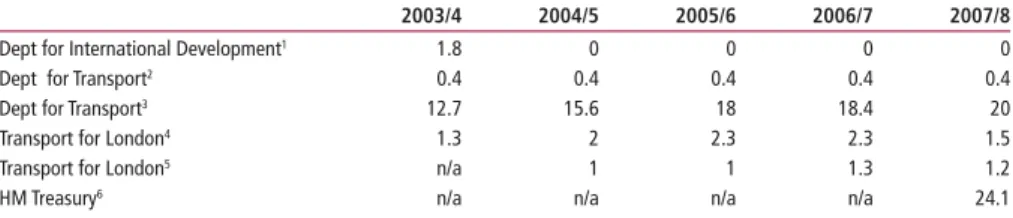
ONS does not publish statistics on total provisions or contingent liabilities, but does submit data to Eurostat on government guarantees as part of the twice-yearly Excessive Defi cit Procedure return which is subsequently published by Eurostat. Th e most recent data are shown in Table 3.
Published estimates of guarantees for amounts equal to or over £ 0.1 billion are outlined below. Additionally for local government, Transport for London has some contingent liabilities.
PFI and other leases
In September 2006, ONS included in PSND for the fi rst time estimates of imputed fi nance lease liabilities, the majority of
which are associated with those PFI projects judged as being on the public sector balance sheet.
Table 4 shows that the estimate of the total public sector imputed fi nance lease liability at the end of March 2009 is nearly £5 billion. Th is is equivalent to roughly a third of a per cent of GDP.
As always, it is important to take care with boundary issues when considering the measurement of net debt. Th e central government PFI liability is considerably larger than the fi gures shown in Table 4 since Metronet and Tube Lines are classifi ed as public sector bodies, resulting in the consolidation of PFI liabilities and assets within the public sector boundary. Note, however, that when the reclassifi cation of the two bodies was eff ected, in 2007, PSND was actually revised up overall, due to the inclusion of their total net debt. Th is does mean, however, that the fi gures in Table 4 are not consistent with those published
Table 3
Central government guarantees as of end-March 2009
£ billions
Notes: Source: ONS Public Sector Finances
1 UK share of EC collective guarantees of European Investment Bank lending.
2 London and Continental Railways (LCR)– Government guaranteed bonds. (nb. LCR have additionally undertaken a securitisation involving an ‘effective guarantee’ from government. This is recorded as government borrowing). LCR is a public corporation.
3 Guarantees of Network Rail- Government supports their credit facility (if needed- none have been) and smaller support if needed (none have been) for a debt issuances programme. There are a number of facilities in place but also a maximum exposure limit. The fi gure given is derived from information supplied by Network Rail. Network Rail is a Private non-fi nancial corporation. 4 London Underground Public Private Partnership.
5 Other.
6 HM Treasury in respect of Bank of England loan to Northern Rock.
2003/4 2004/5 2005/6 2006/7 2007/8
Dept for International Development1 1.8 0 0 0 0
Dept for Transport2 0.4 0.4 0.4 0.4 0.4
Dept for Transport3 12.7 15.6 18 18.4 20
Transport for London4 1.3 2 2.3 2.3 1.5
Transport for London5 n/a 1 1 1.3 1.2
HM Treasury6 n/a n/a n/a n/a 24.1
Table 4
Public sector fi nance lease liabilities including ‘on balance sheet’ PFI deals
£ billionsSource: ONS Public Sector Finances Financial Year Central Government Public Corporations Local Government Total 1996/97 0.31 0.18 0.01 0.5 1997/98 0.61 0.16 0.01 0.78 1998/99 1.32 0.26 0.01 1.59 1999/00 1.65 0.78 0.01 2.44 2000/01 1.97 0.61 0.01 2.59 2001/02 2.12 0.45 0.01 2.58 2002/03 2.48 0.45 0.03 2.96 2003/04 2.9 0.41 0.04 3.35 2004/05 3.63 0.35 0.08 4.06 2005/06 3.78 0.33 0.07 4.18 2006/07 4.06 0.32 0.07 4.45 2007/08 4.31 0.44 0.07 4.82 2008/09 4.53 0.33 0.07 4.93
in Chesson and Maitland-Smith (2006), because they take into account the 2007 reclassifi cation.
HM Treasury estimated the capital value of assets for signed projects at more than £46 billion in March 2006 and the current estimate is in the region of £60 billion. In both periods, roughly half of the value is judged to be on the public sector balance sheet (risks and rewards held by the public sector partner).
Th e estimates of imputed fi nance lease liabilities in PSND are much smaller than the capital values because:
■ fi nance lease debt and capital value are not the same thing
■ fi nance lease debt relates to assets judged to be on public sector balance sheets only
■ timing of recording – where the accountants and auditors judge the asset should be on the public sector balance sheet the transfer of economic ownership, and so the recognition of the liability, will usually occur when all of the construction is completed and the asset becomes operational. Th e fi nance lease debt is imputed at this point, and
■ contingent liabilities are not included – the capital value of assets for signed projects includes forecasts of future asset values, where the work may be incomplete or not yet started. Th ese liabilities are contingent therefore on the construction or improvement being completed satisfactorily, and contingent liabilities are not included in National Accounts
Since decisions regarding whether or not a body is exposed to the risks and rewards of a PFI project are made independently by the private partner’s auditors and the public partner’s auditors, it is possible that both the public and private sector partners record the capital formation on their own balance sheets (on-on) or for a deal to appear on neither balance sheet (off -off ).
Estimates of current spending and PSND are not aff ected by on-on or off -off recording since all decisions about public balance sheet recording are audited by the NAO and the Audit Commission. So, the size of the stock of imputed loans of the public sector will be consistent with the auditors’ assessment of the risk borne by the public sector.
In the National Accounts overall,
however, this will lead to double-counting of gross fi xed capital formation (GFCF) for on-on projects, and missed GFCF for off -off . ONS is currently undertaking work to assess the extent of this issue and to take corrective action.
It should be noted that the
implementation of IFRS in government fi nancial reporting, will not of itself lead to any changes in PSND. Although it is anticipated that the implementation of IFRS will bring PFI-type assets onto the balance sheets of departmental resource accounts, PSND is a statistic that is derived from the National Accounts framework and not from IFRS (see Kellaway 2008).
Pension liabilities
Employee schemes
UK local authority employees’ pensions schemes are mostly defi ned benefi t funded contributory schemes and thus the liabilities associated with them are included in the UK National Accounts, but not in PSND.
Most central government public sector occupational pension schemes, on the other hand, are defi ned benefi t unfunded schemes, with pension benefi ts being paid out of general government revenue. Th e main unfunded schemes are for civil servants, the armed forces, the NHS and teachers as well as for locally administered schemes for the police and fi re-fi ghters. Although they do not appear in the National Accounts, the liabilities of the main unfunded schemes are reported by departments as part of the annual resource accounting process, and are then reported in aggregate form either by the Government Actuary’s Department or in HM Treasury’s Long Term Public Finance Report (see HM Treasury 2008) as part of the annual Budget documentation. Th ese liabilities are estimates of the rights that have been built up during service already provided by employees, and not projections of rights likely to be accrued in the future. Th e most recently reported aggregate fi gures appeared in the March 2008 Long Term Public Finance Report:
2003/04 £460bn 2004/05 £530bn 2005/06 £650bn
Th e estimated size of the liability at any point is extremely sensitive to the assumptions made about discount rates and the unwinding of those rates. A fuller
analysis of this issue is provided in the Long Term Finance Report (Box 4.3 on page 38), with particular reference to the change in assumptions between the estimates made at 31 March 2005 and 31 March 2006.
Table 14.7 in chapter 14 of Pension Trends (see ONS 2009) gives the latest fi gures for the liabilities of the four largest schemes (civil servants, the armed forces, the NHS and teachers), as published in resource accounts, as follows:
2005/06 £530bn 2006/07 £687bn
Social benefi t scheme
UK state pensions are in eff ect unfunded. Th ere is a notional insurance fund but this does not have a strong link to the accrued benefi t entitlements. Estimates of the liabilities from state pension obligations are compiled by the Government Actuary’s Department and published by HM Revenue and Customs. Th e most recent published estimate is £1,170 billion at end March 2003, which was published in 2006.
Conclusion and
recommendations
It is found that UK measures of public sector debt are compiled in line with international guidance:
■ the measure of government gross debt complies with the requirements of the Excessive Defi cit Procedure and
■ the measure of PSND is based on National Accounts guidelines, using a UK interpretation of ‘liquid’ assets National Accounts are compiled to provide tools for whole economy analysis, and a premium is placed on internal coherence across all sectors of the economy.
Government and public sector accounts are vital for the analysis of fi scal sustainability and risk, but inevitably involve a degree of modelling and assumption which cannot be accommodated in the National Accounts. As a result, only a subset of total government liability will be recorded in the core National Accounts.
ONS has a key role to play, however, in presenting the data necessary for assessment of fi scal burden and risk, and as such needs to understand user requirements beyond the National Accounts boundary. Th e liabilities in this category which will attract the most attention are; future expenditure under PFI, unfunded pension
schemes and government guarantees. While estimates of these liabilities are disclosed as memorandum items or notes in departmental resource accounts, they are not systematically presented in aggregate (whole of government) form.
ONS should consider its role in presenting a wider range of data on government and public sector liabilities, as is the case in other countries. Th is should take into account HM Treasury’s commitment to publish Whole of Government Accounts, to include these aggregate liabilities.
CONTACT
REFERENCES
Chesson A and Maitland-Smith F (2006) ‘Including Finance Lease Liabilities in Public Sector Net Debt: PFI and Other’, Offi ce for National Statistics mimeo
EC (1993) ‘European Commission - COUNCIL REGULATION (EC) No 3605/93 of 22 November 1993 on the application of the Protocol on the excessive defi cit procedure annexed to the Treaty establishing the European Community’
Heller S (2004) ‘Are Governments
Overextended? Assessing the Spectrum of a Government’s Obligations’, World Economics (October-December 2004), vol. 5, no. 4, pp. 1-33 .
HM Treasury (2009) ‘Whole of Government Accounts’, available at:
www.hm-treasury.gov.uk/psr_government_ accounts.htm
HM Treasury (2008) ‘Long Term Public Finance Report’, available at:
www.hm-treasury.gov.uk/bud_bud08_ longterm.htm.
IMF (2001) ‘International Monetary Fund – Government Finance Statistics Manual 2001’, available at:
www.imf.org/external/pubs/ft/gfs/manual/ index.htm
IMF (2007) ‘International Monetary Fund - Code of Good Practices on Fiscal Transparency, and Manual on Fiscal Transparency’, available at:
www.imf.org/external/np/fad/trans/index. htm
Kellaway M (2008) ‘Private Finance Initiative and Public Debt’, Offi ce for National Statistics mimeo
Polackova H (1998) ‘Contingent Government Liabilities: A Hidden Risk for Fiscal Stability’, World Bank Policy Research Working Paper No. 1989
Pitzer J (2002) ‘Government Assets and Liabilities: Licenses, Leases and Other Issues’, 27th Conference of International Association for Research in Income and Wealth (IARIW)