
Young Women and Persistence in
Information Technology
Tiffany Barnes
Department of Computer Science University of North Carolina at Charlotte
9201 University City Blvd. Charlotte, NC 28223 Phone: 704-687-8577
Fax: 704-687-3516 Email: [email protected]
Sarah Berenson
Center for Research in Science and Mathematics Education Poe Hall, Box 7801
North Carolina State University Raleigh, NC 27695 Phone: 919-515-6919
Fax: 919-515-0138
Email: [email protected]
Mladen Vouk
Department of Computer Science, Box 8206 North Carolina State University
Raleigh, NC 27695 Phone: 919-515-7886
Fax: 919-515-7896 Email: [email protected]
Young Women and Persistence in
Information Technology
I N T R O D U C T I O N
*The under-representation of women in science, technology, and engineering careers is of growing national concern (Vesgo, 2005; National Science Foundation, 2004; National Academy of Engineering, 2002; National Research Council, 2001). While the information technology (IT) workforce appears to be becoming more diverse in terms of race and country of birth, it is becoming less diverse in terms of gender (Malcom, et. al, 2005; Vesgo, 2005; NSF, 2004; AAUW, 2000). This trend is of particular concern, since women may face unequal access to rewarding IT careers, while society and the IT workforce suffer without the valuable contributions that women might make through the creation of new information technologies (Cohoon, 2005; Freeman & Cuny, 2005).
Past studies have highlighted a tendency of talented young girls to enroll in less rigorous mathematics courses beginning in the middle grades (e.g., Kerr, 1997), and have hypothesized that this lack of preparation creates a barrier to science, technology, and engineering disciplines. In response to the increased under-representation of women in IT, Girls on Track, a year round enrichment program and summer camp, was created in 1998 to
*
encourage talented middle school girls to persist in taking college-bound courses in math, science, and computer science through high school. It was our conjecture that some of these well-prepared girls would later become creative future IT workers.
We have undertaken a longitudinal study of approximately 200 girls who were enrolled in the NSF funded 1999-2001 Girls on Track program, with the goal of creating a model of persistence of these young women into IT careers. This study is now in its seventh year. In this chapter, we present our somewhat surprising findings. It would appear that talented young women, though prepared and able, are not choosing to pursue IT careers. We suggest some ways the thinking about IT may need to change to encourage broader career-level participation.
B A C K G R O U N D
The demand for information technology workers is projected to surpass demand for all other occupations through 2012 (Sargent, 2004), yet overall enrollments in IT-related fields continue to decline (Zweben, 2005). The percentage of women in IT has also continued to decline (Malcom, et. al, 2005; Vesgo, 2005). The reasons for this are not well understood, although the “dot-com bubble” deflation in the 2000 may play a part (Malcom, et. al, 2005). In recent years, the achievement gap in mathematics and science has been closing as more women select advanced courses in high school science and mathematics (National Science Board, 2000). However, enrollments of young women in computer science courses and advanced placement (AP)
exams in high school continue to remain low (Freeman & Cuny, 2005; CCAWM, 2000; AAUW, 2000).
Some researchers examine girls’ experiences from the middle grades to high school for the root causes of women’s under-representation in IT. For example, Freeman and Aspray (1999) note that girls have less experience with computers and perceive IT-related work to be solitary and competitive, requiring long hours and unsafe working environments. During this age range, many girls become more involved in extra-curricular activities and take less rigorous courses (Kerr, 1997). At the same time, girls lower their career aspirations between the middle grades and high school (Kerr, 1997), through choosing less competitive careers and post-secondary institutions. Since the rigorous preparatory courses for prestigious fields, including courses in advanced math, science, and technology, are often filters for technical fields, these factors may have a strong influence on women’s participation in IT. Our previous findings indicate that parental influence may also be a strong factor in girls’ choices (Howe, Berenson, & Vouk, 2005).
Several studies that explore recruiting and retention of women in undergraduate IT curricula have reported factors that positively influence the enrollment and persistence of women in IT-related fields. Margolis and Fisher found that prior class experiences, as well as interest in computers and the promise of the field, were primary motivators for majoring in computer science (2001). In the first national study exploring gendered outcomes in
undergraduate computer science programs, Cohoon found that faculty attitudes and behaviors could have a powerful influence on gendered attrition. Factors significantly correlated with higher retention rates for women include: having sufficient faculty, responsiveness to the job market, and faculty who mentored for the purpose of retaining underrepresented minorities (Cohoon, 2005). The availability of same-sex peer support and professional experiences are also important factors in women’s retention in computer science programs (Cohoon, 2005; Blum and Frieze, 2005).
Recent results from efforts to gender-balance the undergraduate program at Carnegie Mellon indicate that fundamental misconceptions about computer science, as opposed to gender differences, may be the root cause of the under-representation of women in IT, as well as the declining interest in computer science overall (Blum and Frieze, 2005; Vesgo, 2005; Zweben, 2005). Computer science, Blum and Frieze (2005) argue, is not equal to programming, although the advanced placement exam in computer science reinforces this unfortunate misconception.
In January 2005, Freeman and Cuny identified several areas where efforts could make a difference in broadening participation in computing, including defining computer science to override popular misconceptions, training faculty in cross-cultural mentoring, provide research experiences for undergraduates, and to work with K-12 teachers to define computer science curricula.
A recent study sponsored by the American Association for the Advancement of Science and the Commission on Professionals in Science and Technology includes an insightful discussion of the complexities of the IT educational and employment markets, and recommends policies to support the increased diversity of the IT workforce (Malcom, et. al, 2005). These recommended policies include a change in admissions criteria – by shifting the emphasis from programming experience to problem solving skills that are relevant to IT/CS. Four year institutions should offer more career guidance and workplace experiences, as well as opportunities for nontraditional students to take courses online or while working full-time. These recommendations align with findings at Carnegie Mellon, where these types of changes have been effective in increasing the participation of women to about a third (Blum & Frieze, 2005), while national averages of participation for women are less than 20% (Vesgo, 2005).
G I R L S O N T R A C K : I N S I G H T S
Girls on Track, a program funded by the National Science Foundation (NSF #9813902) from 1999-2001, was created in response to the need to increase women’s representation in IT-related careers. The Girls on Track
program provided1 year-round enrichment for mathematically high achieving girls in grades 7 and 8. We define high achieving girls as those selected to take Algebra I on the “fast track”, thus enabling them to take Advanced
Placement Calculus in high school, a necessary preparation for college courses in mathematics, sciences, engineering, or computer science. The age range was 11-13, with about 60% being Caucasian, about 30% African American, and about 10% Asian.
Girls selected for Girls on Track participated in a two-week summer learning experience that included group projects using math and information technologies to address community problems, increasing girls’ awareness of gender issues and career planning, along with time for active math-related games. A mentoring program provided continuing support and enrichment activities throughout the school year. Girls on Track also incorporated a professional development component for middle school math teachers, pre-service teachers, and guidance counselors.
In the creation of Girls on Track, we assumed that high achieving young women would be excellent candidates for future IT careers. However, as we have followed these participants through our NSF funded Women in Technology (NSF #0204222) longitudinal study, we have discovered that few of these same young women are taking computer science courses in high school, and although one girl has shown interest, so far none of the initial program cohort (1999) have elected IT programs in college. A parallel study at North Carolina State University, Pair Programming and Agile Software Development, revealed a theme of the perceptions of the time needed for IT careers, which we found echoed in our interviews of Girls on Track (GoT) participants.
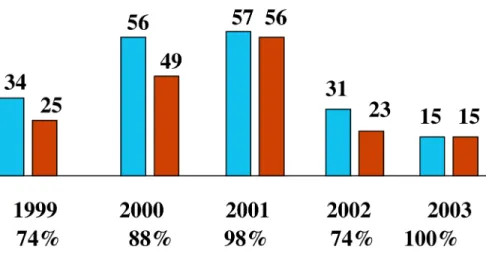
There are certainly social, personal and school components that enter into the decisions of the girls to stay involved with IT. In our studies, we are tracking 207 girls using a number of indicators such as proportional reasoning test scores, annual math achievement scores, math attitude (8 factors), courses taken in math, science, and computer science, and PSAT and SAT scores. We have found that a surprisingly large number stayed “on the fast math track” as we have defined it. Approximately 90% of the girls in this study remain on the fast math track until their junior year. At this time, some girls are advised to take a third year of algebra, while others are tracked into advanced mathematics, leaving about 75% of the GoT girls on the fast track. Figure 1 illustrates these percentages for each year of the program; the first bar for each year indicates the total number of students we have been able to follow over time while the second bar shows the number who are taking advanced math courses.
Phone interviews of 39 girls from the first and second cohorts found only one who expressed an interest in an IT career in high school, and only 6 who have elected computer science courses in high school. Five of these six girls noted the low numbers of girls in the courses, and expressed their dissatisfaction with the course content. Only one reported that she liked her CS class and enjoyed solving problems. Only one student took four CS classes in high school, reporting that she enjoyed her CS classes but she is not considering a career in IT.
Reasons a sample of interviewed girls gave for this low CS enrollment in high school include: a) a lack of interest in computer science, b) computer science was not an advanced or advanced placement (AP) class (and therefore also provided no extra GPA points), c) students had no room in their schedules of other advanced classes, d) computer science is not a college entrance requirement, and e) some students preferred other electives, such as music or medical academy. These successful young women are willing to work hard, but do not wish to be bored by the work, and as these reasons for avoiding CS classes show, they wish to enroll in courses which show clear evidence of advancing them toward college entrance requirements.
These results show both positive and negative aspects. High achieving girls continue to enroll in advanced math courses, and are motivated to learn and to find a career that will be both interesting and beneficial to society. They receive strong support from their families and teachers. However, most
of these girls do not elect CS courses in high school, do not enjoy CS courses when they do, and few express interest in IT careers, even though 35 to 40% of Girls on Track participants were interested while in middle school.
Although firm data are not available on the effects of the low involvement of girls in high school CS courses on collegiate IT enrollments, evidence seems to indicate that the limited computer and programming experiences of talented girls can affect admissions into IT/CS departments (e.g. Blum & Frieze, 2005). How to influence the choices of these girls, however, remains an open issue.
In-depth interviews with 30 high school girls revealed that more than half have no image or have incorrect images about “computer science” careers. Some perceive “computer science” as the use of tools such as spreadsheets and databases rather than the design and development (creation) of tools, and the repairing of hardware rather than the engineering of hardware. The creative and inventive benefits of IT careers were hidden from these girls.
Parents are a powerful influence in these girls’ lives: two-thirds of the young women we interviewed attribute their academic success to their parents. Many of the young women have parents working in the IT industry yet had little to no idea what their parents’ work really involved. For those who were more informed about IT careers, more than 20% commented that work with computers required too much time while nearly the same number stated that they did not want to work in a cubicle environment.
One young woman who planned to pursue an IT career spoke positively of her father’s IT career in a large company acknowledged for its campus-like, worker-centered environment. This lead us to conjecture that parents’ workplace experiences and attitudes may be an important factor in high achieving girls’ decisions (not) to pursue IT careers. One possible way to counter these effects would be to provide computer science and engineering experiences that engage girls in inventing, rather than simply using the technology.
The girls in our Girls on Track program exhibited an enthusiastic view towards information technologies while in middle school. However, in our follow-up Women and Information Technology study we found few of these same young women interested in high school computer science courses 2-4 years later. None of these high achieving young women have yet elected IT concentrations in college. Yet 75% of the young women in these longitudinal studies take calculus before high school graduation. On the other hand, the study is not over yet. We do not know whether, once they finish the college, these girls who are certainly capable of succeeding in IT careers, may still choose to re-enter IT career paths laterally.
A parallel study at North Carolina State University, Pair Programming and Agile Software Development, is a pedagogical intervention to increase face-to-face collaboration in an upper level software engineering course. Interviews with young college women taking this course revealed that the instructional interventions of pair programming and agile development
methods saved time, an important value for them (Berenson, Slaten, et. al, 2004). Examining the transcripts of the high school girls’ interviews for evidence of the “time” theme, we found that some believed that computer science careers demanded too much time, based on their observations of their parents’ career experiences in IT and their observations of high school computer “boy geeks”.
Having “enough time” for other activities was not an issue for these same girls while in middle school. This difference implies that young women place more value on time and on having freedom to engage in several activities as they mature. This suggests that long hours of university study combined with the long working hours necessary to advance in IT careers may not be attractive to many young women. Margolis and Fisher speak of the discouragement college women feel when comparing their values with the intensity and focus found in the computer geek culture (2001). To attract women into IT careers, the existing cultures of IT in the university and in the workplace may require a change.
F U T U R E T R E N D S
A balanced inclusion of women and men into IT should introduce new innovations and improved working conditions for all IT workers (CCAWM, 2000). This balance should also provide the peer support that is particularly needed in recruiting and retaining women in IT (Cohoon, 2005), and should
lead to increased opportunities for leadership and full participation (Blum & Frieze, 2005).
However, to achieve this balance, substantial changes may need to be made in the culture and perceptions of IT from within, such as those changes made at Carnegie Mellon University in recent years (Blum & Frieze, 2005). University admissions criteria, advanced placement courses should emphasize the creative and problem-solving aspects of IT, and shift away from a focus on programming (Malcom, et. al, 2005). In addition, introductory IT/CS courses should de-emphasize programming and provide a broader view of IT/CS. In order to achieve this goal, it may be necessary to foster IT/CS education programs to prepare teachers and students for new ways of teaching and learning IT/CS concepts and skills, including pair programming and agile software development practices (Berenson, Williams, et. al, 2005). Professional experiences, including mentoring and opportunities for early exposure to real IT applications and careers, should be made available to all students.
C O N C L U S I O N
Providing all U.S. citizens with the “opportunity to gain the skills and knowledge to compete” in the IT workforce will enable the U.S. to remain competitive on a global scale (Malcom, et. al, 2005, p. 20). Creativity and innovation, which require a much higher level of preparation, are key in our nation’s ability to compete. The participation of women and
underrepresented minorities will ensure a diversity of perspective that can enrich the quality of innovation in IT.
Findings from our Girls on Track and Women in Technology studies indicate that, although girls are participating to a greater degree in advanced mathematics preparation, high achieving girls are not enrolling in IT/CS courses or choosing IT careers. To recruit these talented girls, we believe it will be necessary to make substantial changes in the culture of IT, including both perceptions and education. Respecting the values of young women and other nontraditional populations, including the need for time for life outside of work, while also maintaining high standards and emphasizing the problem-solving and creative aspects of the field, can make broad improvements in working conditions, diverse participation, and innovation in IT.
R E F E R E N C E S
American Association of Undergraduate Women (AAUW)’s Educational Foundation. (2000). Tech-Savvy: Educating girls in the new computer age. Washington, DC: American Association of Undergraduate Women.
Berenson S., Williams L., Michael J, and Vouk M. (2005). Examining time as a factor in young women’s IT career decisions. In Proceedings of the Crossing
Cultures, Changing Lives International Research Conference. Oxford, England,
Berenson, S., Slaten, K., Williams, L., & Ho, C. (2004). Voices of women in a software engineering course: reflections on collaboration.
Journal on Educational Resources in Computing, 4(1).
Blum, L. and Frieze, C. (2005, May). In a more balanced computer science environment, similarity is the difference and computer science is the winner. Computing Research News, 17(3).
Cohoon, J.M. (2005). Just get over it of just get on with it. To appear in
Women and Information Technology: Research on Under-Representation. MIT Press.
Congressional Commission on the Advancement of Women and Minorities in Science, Engineering and Technology Development (CCAWM). (2000, September). Land of plenty: Diversity as America's competitive edge in science, engineering and technology. Washington, DC: CCAWM.
Freeman, P., & Aspray, W. (1999). The supply of information technology workers in the United States. Washington, DC: Computing Research Association.
Freeman, P., & Cuny, J. (2005, January). Common ground: A diverse CS community benefits all of us. Computing Research News, Vol. 17, No. 1.
Kerr, B.S. (1997). Smart girls: A new psychology of girls, women and giftedness. Scottsdale, AZ: Gifted Psychology.
Malcom, S., Babco, E., Teich, A., Jesse, J.K., Campbell, L., & Bell, N. (2005). Bringing Women and Minorities into the IT Workforce. American
Association for the Advancement of Science & the Commission on Professionals in Science and Technology.
Margolis, J., & Fisher, A. (2001). Unlocking the clubhouse: Women in computing. MIT Press.
National Academy of Engineering. (2002). Diversity in engineering: Managing the workforce of the future. Washington, DC: National Academy Press.
National Research Council. (2001). Building a workforce for the information economy. Washington, DC: National Academy Press.
National Science Board. (2000). Science & engineering indicators. Arlington, VA: National Science Board (NSB 00-1).
National Science Foundation (NSF). (2004). Women, minorities, and persons with disabilities in science and engineering. Arlington, VA: National Science Foundation (NSF 04-317).
Sargent, J. (2004). An overview of past and projected employment changes in the professional IT occupations. Computing Research News, 16(3), May 2004.
Vesgo, Jay. (2005). CRA Taulbee Trends: Female Students & Faculty.
Computing Research Association Taulbee Survey 2005.
http://www.cra.org/info/taulbee/women.html
Zweben, S. (2005, May). 2003-2004 Taulbee Survey: Record Ph.D. production on the horizon; Undergraduate enrollments continue in decline.
Terms and Definitions
Girls on Track: An intervention program designed to keep talented middle school girls on the “fast math track;” http://ontrack.ncsu.edu.
Women in Technology (WIT): A longitudinal study of Girls on Track program designed to model the educational persistence of young women in IT-related fields;
http://wit.ncsu.edu.
IT career: A career requiring an electrical engineering, computer science, or computer engineering degree. Emphasis is placed on technical and creative roles rather than support roles.
Agile software development: A philosophy of software development that values people, collaboration, response to change, and working software; http://agilemanifesto.org
Pair programming: An agile software development process wherein two programmers work side-by-side at one computer, collaborating to write software.
IT Education: A proposed new field to prepare teachers to introduce students to IT in more effective ways.
Nontraditional student: Women and underrepresented minorities often enter the IT workforce through nontraditional pathways, including part-time education, through for-profit trade schools, or starting a baccalaureate degree after the age of 21.
![Synthesis, spectral, thermal, crystal structure, Hirschfeld analysis of [bis(triamine)Cadimium(II)][Cadimum(IV)tetra-bromide] complexes and their thermolysis to CdO nanoparticles](data:image/gif;base64,R0lGODlhAQABAIAAAP///wAAACH5BAEAAAAALAAAAAABAAEAAAICRAEAOw==)