Developing a
Code of Behaviour:
Guidelines for
Copyright © 2008, National Educational Welfare Board ISBN: 978-0-9553409-2-5
These Guidelines contain a general account of relevant legislation and legal instruments and are not a complete or definitive statement of the law. Specific legal advice should be obtained where a Board of Management has queries on particular aspects of the law or in relation to individual situations.
Foreword
The Guidelines for the development of codes of behaviour now being published constitute another strand in NEWB’s overall strategy to support school attendance and participation.
At this point in our modern society, the work of schools in encouraging and developing in their students a strong sense of personal responsibility and responsibility towards others is a truly critical task, and one for which society as a whole owes its support for, and acknowledgement of, the work of Boards of Management, Principals, teachers and parents.
The Guidelines recognise the importance of the leadership of Boards of Management and Principals and place a welcome emphasis on the value of engaging everyone in the school community, and especially the students themselves, in the task of shaping the school environment and making it a happy place for teaching and learning.
Virtually every school now has a code of behaviour, as required by law. The NEWB Guidelines will be an important support for schools as they work continuously with students and their families to ensure that the code of behaviour can maintain the best possible educational environment in the school. The Guidelines have been prepared with the help of an Expert Group established by the Board, and wide-ranging inputs from management bodies, teacher unions, parent organisations, students, the Department of Education & Science and its agencies and services, non-governmental organisations, State agencies and many other contributors. This inclusive approach will help to maximise their benefit and value to schools.
In conclusion, I wish to express my gratitude to the staff of NEWB and to all those practitioners who contributed to and supported the development of the Guidelines.
Cathal Flynn Chairperson
National Educational Welfare Board May 2008
Contents
Foreword
iii
1 Introducing the Guidelines
1
2 Auditing and reviewing the code of behaviour
11
3 Principles underpinning an effective code of behaviour
21
4 Understanding behaviour
25
5 A whole-school approach to the code of behaviour
31
6 Setting standards of behaviour
35
7 Promoting good behaviour
41
8 Responding to inappropriate behaviour
45
9 Implementing the code of behaviour
57
10 Suspensions and expulsions: legal and procedural requirements
65
11 Suspension
69
12 Expulsion
79
Appendix: Expert Group
89
Bibliography
90
Introducing the Guidelines
1
Key to use of terms in the Guidelines
Parent
The Guidelines adopt the legal definition of parent as set down in the Education Act 1998:
Parent includes a foster parent, a guardian appointed under the Guardianship of Children Acts 1964 to 1997, or other person acting in loco parentis who has a child in his or her care subject to any statutory power or order of a court and, in the case of a child who has been adopted under the Adoption Acts 1952 to 1998, or where the child has been adopted outside the State, means the adopter or adopters or the surviving adopter.
Education Act 1998 Student
In these Guidelines, student means any child or young person who is enrolled in a recognised primary or post-primary school.
School
The Guidelines apply to any recognised school that provides primary education or post-primary education. Board of Management
In these Guidelines, Board of Management refers to a Board of Management or equivalent structure as recognised under section 14 of the Education Act 1998.
Use of must and should
In these Guidelines, the term must is used to denote legal obligations; the term should is used to denote what the Guidelines expect of schools.
Abbreviations
DES Department of Education and Science EWO Educational Welfare Officer
HSE Health Service Executive
NEPS National Educational Psychological Service NEWB National Educational Welfare Board
1.1 Why Guidelines?
Under section 23 of the Education (Welfare) Act 2000, the Board of Management of each school must prepare and make available a code of behaviour for its students. The Act requires that the school code of behaviour is prepared in accordance with Guidelines issued by the National Educational Welfare Board (NEWB).
These Guidelines are now being issued by NEWB to assist schools in the preparation of their codes of behaviour.
1.2 The code of behaviour
The code of behaviour is the set of programmes, practices and procedures that together form the school’s plan for helping students in the school to behave well and learn well.
The code of behaviour helps the school community to promote the school ethos, relationships, policies, procedures and practices that encourage good behaviour and prevent unacceptable behaviour. The code of behaviour helps teachers, other members of staff, students and parents to work together for a happy, effective and safe school.
The code expresses the vision, mission and values of the school and its Patron. It translates the expectations of staff, parents and students into practical arrangements that will help to ensure continuity of instruction to all students. It helps to foster an orderly, harmonious school where high standards of behaviour are expected and supported.
The code of behaviour enables school authorities to strike an appropriate balance between their duty to maintain an effective learning environment for all and their responsibility to students whose behaviour presents a challenge to the teaching and learning process. The code of behaviour is a key tool in enabling the school authorities to support the learning of every student in the school.
Maintaining a harmonious environment can present a challenge to schools, given competing needs, time pressures and varying capacities or readiness to learn. A code of behaviour that has the support of the school community can go a long way to helping schools to meet this challenge successfully.
1.3 The content of the code of behaviour
The Education (Welfare) Act 2000 sets out certain matters that must be included in a code of behaviour. Section 23(2) of the Education (Welfare) Act 2000 says:
A code of behaviour shall specify—
(a) the standards of behaviour that shall be observed by each student attending the school;
Introducing the Guidelines
Introducing the Guidelines
1
1
Introducing the Guidelines
1
(b) the measures that may be taken when a student fails or refuses to observe those standards; (c) the procedures to be followed before a student may be suspended or expelled from the
school concerned;
(d) the grounds for removing a suspension imposed in relation to a student; and
(e) the procedures to be followed relating to notification of a child’s absence from school.
In order to comply with these requirements, and in order to have the best chance of achieving its objectives, the code of behaviour should address:
• the standards of behaviour expected in the school • the plan for promoting good behaviour
• the ways in which the school responds to unacceptable behaviour • the plan for implementing the code of behaviour
• school procedures for the use of suspension and expulsion.
Guidance on each of these aspects of the code of behaviour is provided in these Guidelines.
1.4 The purpose of the Guidelines
The Guidelines set out a framework of good practice to assist primary and post-primary schools in developing their code of behaviour for the first time, or in strengthening an existing code.
Schools operate in a complex legal environment. The code of behaviour must comply with the provisions of several laws, as well as a range of Constitutional provisions and international Conventions that have been adopted by Ireland. The Guidelines aim to assist Boards of Management and Principals to act in accordance with their legal obligations when drawing up and operating the code of behaviour. With this in mind, the Guidelines have integrated information about the most relevant current legal and constitutional provisions. There is a list of relevant legislation and legal instruments on pages 7-9 at the end of this chapter. The Guidelines recognise that the exercise of professional judgement by all who work in the school is the foundation of effective practice. That judgement must be exercised in a manner that is consistent with good practice and in line with the legal obligations of Boards of Management, and accompanied by a process of accountability.
1.5 The status of the Guidelines
The Guidelines have their basis in law. The code of behaviour must be prepared in accordance with them.
A code of behaviour shall be prepared in accordance with such guidelines as may, following consultation by the Board with national associations of parents, recognised school management organisations and trade unions and staff associations representing teachers, be issued by the Board.
Education (Welfare) Act 2000, section 23(3)
Developing a Code of Behaviour: Guidelines for Schools Page 3 Introducing the Guidelines
1
1
The Guidelines supersede the following Department of Education and Science (DES) Circulars:
• Rule 130 (as amended by Circular 7/88) of the Rules for National Schools, insofar as it applies to matters dealt with in these Guidelines
• Circular 20/90: Guidelines towards a positive policy for school behaviour and discipline, and a suggested code of behaviour and discipline for national schools
• Circular M33/91: Guidelines towards a positive policy for school behaviour and discipline: A suggested school code of behaviour and discipline for post-primary schools.
1.6 Using the Guidelines
In order to comply with the Education (Welfare) Act 2000, the school should ensure that its code of behaviour is prepared in accordance with these Guidelines.
The Guidelines recognise that each school community has its own particular and unique characteristics. Each school should apply the Guidelines in ways that fit with and reflect the ethos of the school and the character of its own community of students, teachers and parents.
The Guidelines should be used for:
• auditing an existing code of behaviour
• regular review and updating of an existing code or developing a code for the first time • promoting ongoing discussion and reflection about behaviour and learning in the school. Auditing an existing code of behaviour
As a first step in implementing these Guidelines, Boards of Management are required to arrange for an audit of the existing code of behaviour. The audit will enable the school to identify how well their current code reflects good practice and meets relevant legal obligations.
Reviewing an existing code of behaviour or developing a code for the first time
Where the audit identifies aspects of the code that need to be reviewed, the Board of Management, together with the Principal, should prioritise areas for review.
Where the Board of Management is overseeing the development of a code of behaviour for the first time, the Guidelines should be used to inform the development work.
Both the process of developing or reviewing the code, and the content of behaviour policy should take full account of the good practice set out in the Guidelines. Particular attention should be paid by school authorities to ensuring that legal obligations are met and that school procedures that give effect to relevant legal obligations are in keeping with the Guidelines.
A plan for undertaking the review or development should be prepared, together with timeframes for undertaking this work. This plan should be approved and adopted by the Board of Management.
Introducing the Guidelines
1
1
Introducing the Guidelines
Promoting discussion and reflection
One of the aims of the Guidelines is to prompt discussion and reflection among teachers and other staff, and dialogue between staff, students and parents, about behaviour policy in the school. The Guidelines can be used to provide briefings and to stimulate discussion and debate on behaviour matters.
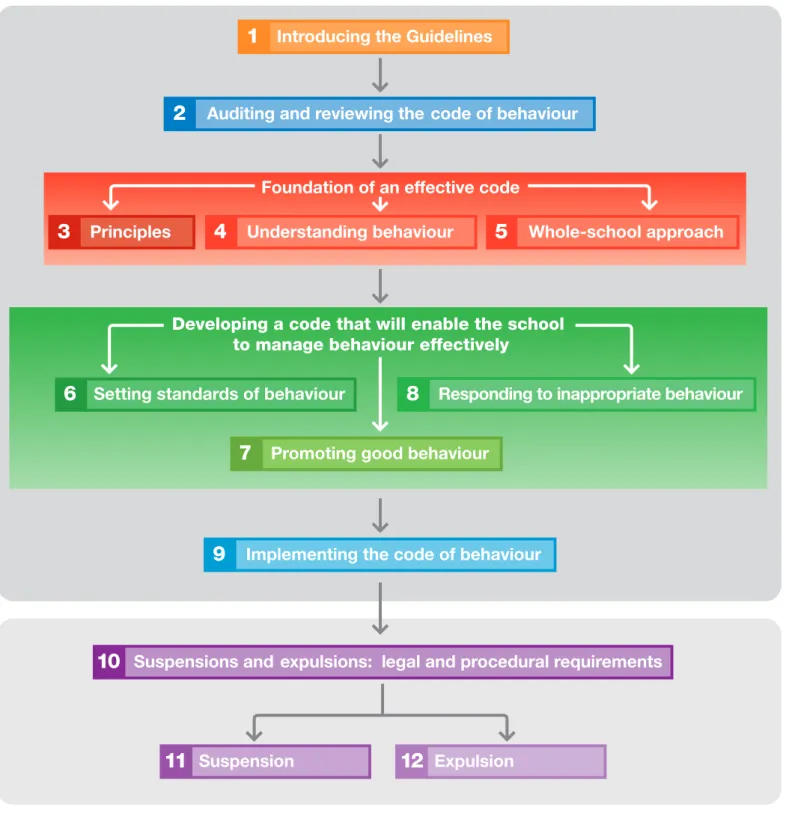
1.7 The content and structure of the Guidelines
Chapter 2Auditing and reviewing the code of behaviour offers advice about the process of auditing a code of behaviour, reviewing specific aspects of a code or developing a code for the first time.
Chapter 3 sets out principles to guide the audit, review, development and implementation of the code of behaviour.
Chapter 4Understanding behaviour makes the case for enabling everyone with a stake in the code of behaviour to have a common understanding about what influences behaviour and how behaviour can be changed.
Chapter 5A whole-school approach to the code of behaviour highlights the need for such an approach and describes how it can be translated into practice.
Chapter 6Setting standards of behaviour offers guidance on setting standards and using those standards to promote good behaviour.
Chapter 7Promoting good behaviour deals with the task of promoting good behaviour as a foundation of behaviour policy.
Chapter 8Responding to inappropriate behaviour offers guidance about a whole-school response to unacceptable behaviour.
Chapter 9 Implementing the code of behaviour sets out the ways in which the school can plan to make sure the code of behaviour works well in the school.
Chapters 10, 11 and 12 describe the legal and procedural requirements governing the use of suspension and expulsion, and the features of good educational practice in the use of these serious sanctions.
Figure 1.1 summarises the structure of the Guidelines.
In order to assist schools in preparing their code in accordance with the Guidelines, the key requirements of the Guidelines are summarised at the end of each chapter.
Developing a Code of Behaviour: Guidelines for Schools Page 5 Introducing the Guidelines
1
1
Introducing the Guidelines
Figure 1.1
The structure of the Guidelines
Introducing the Guidelines
1
1
Introducing the Guidelines
Developing a Code of Behaviour: Guidelines for Schools Page 7
Relevant legislation and legal instruments
The Constitution of Ireland The rights of parents and of the child in the matter of education as set out in Articles 42 and 44.2.4. of the Constitution of Ireland must be respected as fundamental in the school code of behaviour. The requirement for fair procedures derives from Articles 4.3 and 42.4 of the Constitution of Ireland.
The European Convention
on Human Rights (1950) The right to education and the right to fair procedures are provided for in the ECHR which was transposed into Irish law in the European Convention on Human Rights Act (2003).
The UN Convention on the
Rights of the Child (1989) This Convention, ratified by Ireland in 1992, provides that the State shall ensure that school discipline is administered in a manner consistent with the dignity of the child.
The Convention requires that the voice of the child must be heard on matters that affect them, having regard to the age and maturity of the child.
Education Act 1998 Key provisions relevant to the code of behaviour provide for:
• access to records (section 9(g))
• publication of policies (section 15(2))
• the responsibilities of the Board of Management (sections 14–21)
• the Principal’s responsibility for setting objectives (sections 22 & 23)
• information for students and Student Councils and student involvement (section 27)
• provision for appeals (section 29).
Education (Miscellaneous Provisions) Act 2007
This Act amends the provisions of section 29 of the Education Act 1998. It provides for a range of factors which must be considered by an Appeals Committee in relation to suspensions and expulsions. It also makes a number of procedural changes to the section 29 appeals process in relation to time limits and the circumstances in which an appeal can be made.
Education (Welfare) Act 2000
The provisions of the Education (Welfare) Act 2000 most relevant to the code of behaviour are the following:
• general duties of NEWB towards schools (sections 10 & 11)
• provisions relating to notification by parents of reasons for a student’s non-attendance at school (section 18)
• provisions for school codes of behaviour (section 23)
• provisions relating to expulsion of a student (section 24)
• provisions relating to appeals (section 26).
Vocational Education Acts 1930-1999
Vocational Education (Amendment) Act 2001
This legislation governs the operation of Vocational Education
Committees (VECs) and schools or colleges established or maintained under their auspices.
Introducing the Guidelines
1
1
Introducing the Guidelines
Relevant legislation and legal instruments
Equal Status legislation The Equal Status Acts 2000 to 2004 apply to primary and post-primary schools. The Acts promote equality of opportunity and prohibit discrimination, harassment and sexual harassment on these nine grounds:
• gender
• marital status
• family status
• sexual orientation
• religion
• age
• disability
• race
• membership of the Traveller Community.
They require reasonable accommodation for people with disabilities and allow a broad range of positive action measures.
These Acts also prohibit victimisation of any person who makes a complaint about discrimination, who opposes any acts that are unlawful under the equal status legislation, or who gives evidence in proceedings under the Equal Status Acts 2000 to 2004, or who gives notice that they intend to do any of these.
Ombudsman for Children
Act 2002 The Ombudsman for Children is empowered to investigate any action taken by, or on behalf of, a school in connection with its functions under section 9 of the Education Act 1998, where the school’s own complaints procedure has been exhausted.
Education of Persons with Special Needs Act 2004 (EPSEN Act)
The EPSEN Act 2004 provides for the provision of education plans for students with special educational needs (SEN). Under the Act, children with SEN will be educated “in an inclusive environment with children who do not have SEN”, unless this should be inconsistent either with the best interest of the child, or with the effective provision for the other children.
Disability Act 2005 The Disability Act 2005 establishes a basis for an independent assessment of individual needs, including education needs, a related service statement and independent redress and enforcement for persons with disabilities. From 1st June 2007 the provisions of the Act are in place for children up to the age of 5 years and will apply to older children at a future date.
Introducing the Guidelines
1
1
Introducing the Guidelines
Developing a Code of Behaviour: Guidelines for Schools Page 9
Relevant legislation and legal instruments
Non-Fatal Offences against the Person Act 1997
The Non-Fatal Offences against the Person Act removes the legal immunity of teachers from criminal liability in respect of physical chastisement of students (section 24).
Section 15 of the Act forbids false imprisonment.
The Act also forbids threats, intimidation, assault and the use of force and also sets out specific circumstances under which the use of force may not be unlawful (section 18).
Health and Safety legislation
The legislation requires Boards of Management, as employers, to provide in as far as reasonably practicable, a safe place of work for employees. The Boards of Management are also required to ensure, as far as reasonably practicable, that students, parents and visitors, who may be on the school premises, are not exposed to risks to their health and safety.
The legislation further requires the Boards of Management to conduct their business, as far as reasonably practicable, in ways that prevent improper conduct or behaviour likely to put the safety, health or welfare at work of employees, or the health and safety of students, parents or visitors, at risk.
Data Protection Act, 1988 Data Protection
(Amendment) Act, 2003
Schools that record, maintain and/or store personal data are required by the Data Protection Acts 1998 & 2003 to protect the privacy rights of individuals. Section 2 of the Act requires that any data schools process is:
• obtained and processed fairly
• accurate and kept up to date
• kept for a specified and lawful purpose
• used or disclosed in a manner consistent with the purpose
• adequate, relevant and not excessive
• not kept longer than is necessary
• kept secure.
The Act also requires that an individual be given a copy of the records upon request (section 3).
Age of Majority Act, 1985 This Act provides that a person aged eighteen or over is an adult and has capacity to enter contracts and make decisions which affect the adult’s legal and other rights. The Education Act 1998 and the
Education (Welfare) Act 2000 reflect these provisions.
Introducing the Guidelines
1
1
Introducing the Guidelines
Auditing and reviewing the code
of behaviour
Most schools already have a code of behaviour. For these schools, the use of the Guidelines will involve carrying out an audit of their existing code and undertaking a more detailed review and revision of particular areas identified through the audit.
The way in which the code is developed shapes
its success.
Section 23 of the Education (Welfare) Act 2000 requires the Board of Management to consult with the Principal, teachers, parents and the educational welfare officer in preparing the code of behaviour. These Guidelines also highlight, as a matter of good practice, the importance of including students in the consultation.
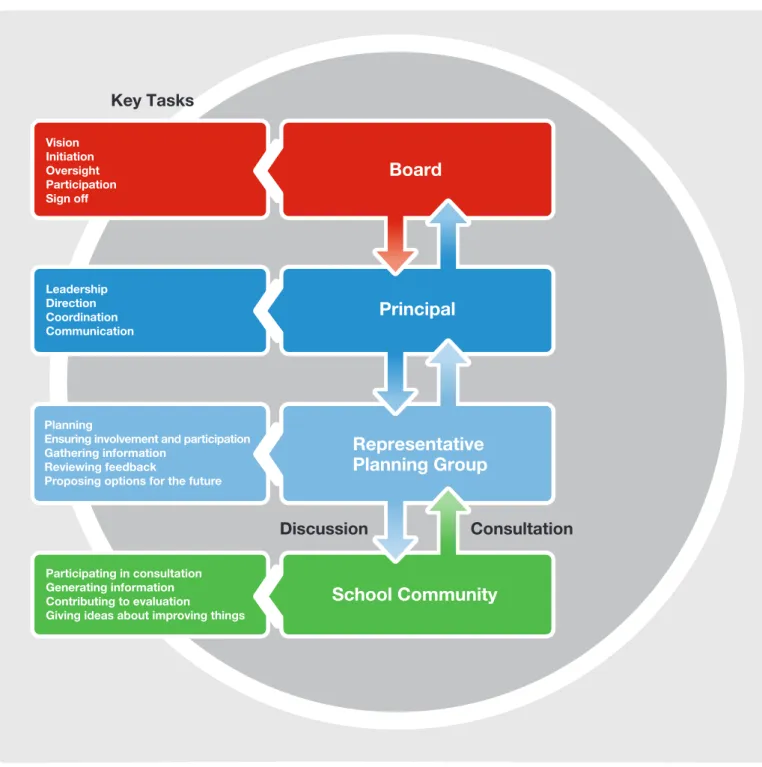
The work of auditing and reviewing the code of behaviour is enriched when all the members of the school community have an opportunity to contribute. The school community should be understood to include the Board of Management, students, parents, all staff, including teachers, the school secretary, the caretaker, canteen staff and any others who are in regular contact with the students. For example, school bus drivers could make a valuable contribution to the code as it relates to behaviour on school buses. Figure 2.1 outlines a whole-school approach to working on the code of behaviour.
Work on the code should take advantage of the diversity of the experience, insights, skills, needs and knowledge of people in the school community. It is important to include groups or individuals who might be marginalised or who are hard to engage.
Working together on the code provides the school with an opportunity to: • help to build a shared commitment to the values and ethos of the school • give all the partners in the school community a sense of ownership of the code • create consensus about the kinds of behaviour and relationships that foster learning • build a shared understanding of how behaviour affects learning
• strengthen positive relationships of respect and trust.
2.1 Auditing the code
An audit of the existing code is the starting point for every school that already has a code of behaviour. What is an audit?
An audit is an examination of every area of the content and operation of the code of behaviour to check for completeness and compliance with legal requirements and good practice as set out in these Guidelines.
Auditing and reviewing the code of behaviour
Auditing and reviewing the code of behaviour
2
2
Developing a Code of Behaviour: Guidelines for Schools Page 13 The Principal and staff, or a small group representing staff, parents and the Board of Management, will usually conduct the audit, having familiarised themselves with the Guidelines.
The audit will identify those aspects of the code that are working well, and will reveal any differences between the practice suggested by the Guidelines and the operation of the code. The audit will also identify areas that the Guidelines suggest should be covered but that are not addressed by the existing code. Where the audit identifies aspects of the school code that need to be reviewed or addressed, the Board of Management, together with the Principal, should prioritise these areas and develop an action plan for doing this work.
An audit checklist is available on the NEWB website.
2.2 Reviewing the code
The process of reviewing the code of behaviour is part of a continuous cycle arising from the use of the code in the school. The school will engage in different activities and processes depending on where it is in this cycle.
A review follows the audit and looks at how a particular aspect of the code of behaviour is working. It draws on a range of sources of information and evidence, including the experience and views of students, teachers and other staff and parents. It uses this information and analysis to plan ways to strengthen this area of the code.
A review of a specific area of the code should: • describe what is happening now in this area • evaluate how well this is working
• explore and generate options for improvement or development • make a plan for implementing agreed proposals.
Auditing and reviewing the code of behaviour
2
2
Auditing and reviewing the code of behaviour
2
2
Auditing and reviewing the code of behaviour
Conducting a review
Stages of review Specific review questions Possible sources of information
Description of current
practice What are we doing now?Describing what is happening at the moment in enough detail to help to identify how the code is working
• Staff reports
• School records and documents • Student and parent accounts • Appeal decisions if any Evaluation of current
practice
Does our practice comply with our legal obligations?
How well is it working? How do we know? What is not working well? Is it working consistently, throughout the school? How is it connected with other aspects of the code of behaviour and linked policies?
• Check against Guidelines • Views of staff, students and
parents
• Records and patterns of problems and complaints • Whole-school evaluation
(if relevant) • EWO
• Appeal decisions if any Options for improvement What should we do differently?
How can we build on what is working well?
What do we know about other ways of working on this area? What would work better - for students?
- for teachers? - for parents?
• Guidelines
• Views and experience • Good practice
• Research
Action plans for improvement and implementation
What, specifically, are we going to do?
What is the plan (time, process, resources)?
How are we going to
communicate this and to whom? What additional knowledge or skills do we need?
How are we going to monitor implementation?
School development planning support service
Auditing and reviewing the code of behaviour
2
2
Auditing and reviewing the code of behaviour
Developing a Code of Behaviour: Guidelines for Schools Page 15 Outcomes of the review process
A review will provide the school with:
• a deep understanding of the current operation of a particular area of the code • a revised approach to the area, a commitment to it and a plan for its implementation.
The review will give rise to a whole-school approach to this aspect of the code and will also enable every member of the school staff and the wider school community to know their part in using or supporting the revised policy, practice or procedure.
The review should help to identify staff training needs for skills in supporting an effective code.
2.3 Roles and responsibilities
The Patron
Under the provisions of the Education Act 1998, each school has a Patron who carries out certain functions specified in the Act.
The Board of Management manages the school on behalf of the Patron and for the benefit of the students and their parents. The Board must:
• uphold the characteristic spirit of the school and be accountable to the Patron in this respect • consult with and keep the Patron informed of decisions and proposals
• publish its policies on admissions, participation, suspension and expulsion in a manner that has been agreed with the Patron (section 15(d), Education Act 1998).
In order to comply with these provisions, the Board of Management should submit the code of behaviour to the Patron for approval.
The Board of Management
The overall responsibility for ensuring that a code of behaviour is prepared in the school rests with the Board of Management. Each school has its unique identity, ethos, values and culture. The Board has particular responsibility for the ethos of the school, as well as having overall responsibility for school policies. The Board should play an active role in exploring the kinds of relationships and behaviours that will reflect the school’s ethos and responsibilities.
The Board should make sure that all the members of the school community have the opportunity to be involved in work on the code of behaviour. The Board of Management should formally record the adoption of the code of behaviour, the commencement date and decisions about when the code will be reviewed. The Principal
Leading the audit and review of the code of behaviour, and ensuring that it is implemented in the school, are important leadership tasks. It is the responsibility of the Principal, under the direction of the Board, to lead the work on the code of behaviour.
Auditing and reviewing the code of behaviour
2
2
Auditing and reviewing the code of behaviour
Teachers and other staff members
Teachers and other staff members can play important roles in the work in the review and updating of the code. They bring to this work their professional expertise in understanding the links between behaviour and learning; their experience of what works to help students to behave well; and their knowledge of the school and of the school community.
Parents
The code of behaviour will be more likely to work well where parents have meaningful ways of
contributing to the development or review of the code. Their involvement will draw on their expectations, insights and experience. It will help to underline their responsibilities for their children’s behaviour. Joint work between parents and staff in the development of the code of behaviour can:
• give parents insight into what teachers need in order to be able to teach effectively
• equip parents to reinforce at home the messages about learning and behaviour that are conducive to a happy school
• help parents to have a strong sense of pride in the school and ownership of its work
• help to ensure that parents give consistent messages to students about how to treat others. Students
Students are more likely to support a code of behaviour when they have helped to develop it.
Relationships of trust between teachers and students can grow stronger through the process. Through their involvement, students can:
• hear directly from teachers about what is needed for teaching and learning
• experience being part of a collective effort to make sure the school is a good place to teach and learn • learn about taking personal responsibility for their behaviour and for each other’s wellbeing and the
wellbeing of the teachers
• learn essential skills of listening, negotiating and managing differences • have their experience, insights and expectations recognised and used.
Auditing and reviewing the code of behaviour
2
2
Auditing and reviewing the code of behaviour
Developing a Code of Behaviour: Guidelines for Schools Page 17
2.4 Time and opportunity for working on the code of behaviour
Using opportunities that arise in the day-to-day work of the school
Board members, staff, parents and students have many demands on their time. Schools might consider using existing opportunities to work on the code, for example:
• using groups and times when people are together (e.g. meetings of parents) • setting aside a period of time at staff meetings
• using part of in-career development and planning days • devoting a meeting of the Board of Management to the code
• devoting time at Student Council and Parent Association meetings to the code
• using aspects of the curriculum for work with students on the code (for example, Social, Personal and Health Education, Art or Drama)
• using extra-curricular opportunities (for example, music, sport, after-school or homework clubs) to build awareness of the contribution and impact of each person’s behaviour.
Joint work
While each of the partner groups needs time and space to explore their own views and ideas relating to the code of behaviour, opportunities for teachers, parents and students to work together on areas of the code are invaluable. They help to build shared understandings and agreement about behaviour
(see Chapter 4 Understanding behaviour), and shared views about how to strengthen the code. One useful way of doing joint work is to set up a planning group, involving representatives of the management, staff, students and parents when work is beginning on the review or development of the code of behaviour. This group can take on the work of planning the review process, gathering and evaluating information and co-ordinating ideas about new approaches. Students might be directly involved in such a group through representatives from the Student Council or by having a separate student group that gives ideas and suggestions to the adult planning group/working group.
2.5 Involvement through consultation
All members of the school community can and should be consulted about all the important areas of the code. Particular care should be taken to ensure the inclusion of the full diversity of students, parents and teachers in this process. Ways of consulting include:
• inviting collective views from the Board, staff groups, Parent Association, Student Council • class discussions
• questionnaires to individual Board members, staff members, parents, students • suggestion boxes
• general consultative meetings.
Consultation should take account of the limits on the time that teachers, students and parents can invest in the process.
Auditing and reviewing the code of behaviour
2
2
Auditing and reviewing the code of behaviour
Consulting students Consultation can happen with all age groups. Even very young students can contribute well to the development of the code, at their own level, and with the support of their teacher. The Bibliography lists some relevant resources.
The Student Council at second level (or at primary level, if there is one) can play an important role in planning and managing the consultation process with students. They will need support for this work, for example through training inputs.
Some students may not feel connected to the Student Council. The school will need ways of involving young people who might not usually participate in formal committees. Their support for, and sense of ownership of, the code may be vital to ensuring its success. The school’s pastoral care structure may present appropriate opportunities for engaging students in the development of a code based on shared values and objectives.
Consulting parents The Parent Association in the school can play a lead role in planning and managing consultation with parents. Some parents may not ordinarily feel connected with the work of the Parent Association. Creative ways will be needed to include all parents in the work on the code.
Consulting the The EWO can advise the Board of Management about its responsibilities Educational Welfare Officer under the Education (Welfare) Act 2000, about good practice in the
drawing up of the school’s code of behaviour and about the principles of good practice and legal obligations underpinning the Guidelines.
Developing a Code of Behaviour: Guidelines for Schools Page 19 Auditing and reviewing the code of behaviour
2
2
Auditing and reviewing the code of behaviour
2
Auditing and reviewing the code of behaviour
Key Requirements: Auditing and reviewing the code of behaviour
Applying the Guidelines means:
Undertaking an audit of the code
Preparing an action plan, with a timeframe, for reviewing and updating the code
Implementing the action plan
Providing staff with time and opportunities to engage in work on the code of behaviour
Ensuring that staff, students, parents and other members of the school community
are involved in the review and revision of the code
Principles underpinning an
effective code of behaviour
There are some basic principles that underpin an effective code of behaviour. When the code takes account of and is in keeping with these principles, it is likely to be successful in achieving its goals. These goals include:
• creating a climate that encourages and reinforces good behaviour • creating a positive and safe environment for teaching and learning
• encouraging students to take personal responsibility for their learning and their behaviour • helping young people to mature into responsible participating citizens
• building positive relationships of mutual respect and mutual support among students, staff and parents • ensuring that the school’s high expectations for the behaviour of all the members of the school
community are widely known and understood.
3.1 Basic principles
Providing clarity The code of behaviour describes the school’s expectations about how each member of the school community (students, staff and parents) will help to make the school a good place for teaching and learning.
The code also describes how the school will respond to behaviour that interrupts, diminishes or prevents teaching and learning in the school. An effective code makes clear that an orderly, harmonious school requires students to behave in accordance with that code.
Affirming that everyone’s The school climate and atmosphere are created by the actions and behaviour matters behaviour of everyone in the school. The behaviour of the adults in a
child’s life, including parents and teachers, is a significant influence on how a child acts.
Focusing on promoting The code gives priority to promoting good behaviour. The tone and good behaviour emphasis of the code should be on setting high expectations and
affirming good behaviour.
Balancing needs The code makes clear that the educational needs of a student whose behaviour is unacceptable will be balanced with the educational needs of other students in the school.
Recognising that The quality of relationships between teachers and students relationshipsare crucial is a powerful influence on behaviour in a school. The school code
fosters relationships of trust between students and teachers. Adults have more responsibility than students for building these relationships.
Principles underpinning an effective code
of behaviour
Principles underpinning an effective code of behaviour
3
3
Focusing on personal The code helps young people to experience the value of being responsibility responsible, participating members of the school community. Ensuring fairness The code is informed by the principle of fairness. It
and equity respects the principles of natural justice, and ensures a consistent approach to behaviour on the part of all school personnel.
Promoting equality The code promotes equality for all members of the school community. The code prevents discrimination and allows for appropriate
accommodation of difference, in accordance with Equal Status legislation. Recognisingeducational The code of behaviour reflects the school’s commitment to
vulnerability provide positive support, including active teaching of relevant skills, for those students who are more vulnerable to behaviour problems. Attending to the welfare The code of behaviour is based on a commitment to the welfare of of students every student, including the right to participate in, and benefit
from, education.
Attending to the welfare The code helps to promote a positive and safe working environment for of staff all staff, including a positive and safe classroom environment for teachers. Promoting safety and The code promotes the conditions for learning and teaching, dignity freedom from threat and freedom from threat of violence for both staff and students.
The principles can be used in the following ways:
As an audit tool The principles are used to help to decide whether the code warrants detailed revision.
As a starting point for Management, staff, students and parents begin to explore how best to developing or reviewing translate each principle into practice.
the code
As a way of evaluating The principles offer a standard against which to evaluate a draft code. draft proposals
Developing a Code of Behaviour: Guidelines for Schools Page 23 Principles underpinning an effective code of behaviour
3
3
Understanding behaviour
Understanding behaviour
Understanding behaviour
4
4
An understanding of the factors that influence behaviour is fundamental to developing and implementing the code of behaviour.
Teachers, parents and students need a shared
understanding of the factors that influence behaviour.
4.1 Need for a shared understanding
Teachers, parents and students may have different understandings about behaviour. A common understanding will provide a sound foundation for a whole-school approach to promoting good behaviour and for responding to inappropriate behaviour.
A shared understanding amongst staff members
Knowledge about what shapes the behaviour of children and young people, as individuals and as groups, enables teachers and other school staff to:
• plan and implement a team approach to helping students to behave well
• develop ways of responding to unacceptable behaviour that are more likely to work and avoid responding in ways that may worsen it
• avoid an individualised or personal stance about the behaviour of students. Sharing insights about behaviour with parents
Parents need insight into the factors that affect a student’s behaviour in class and in school. They need to have a grasp of the way in which home values and parental attitudes can help or hinder a student’s behaviour and learning in school. This may be especially important where cultural norms and values in the home are different from those of the school.
When parents understand the rationale for the school’s behaviour policy, they are more likely to support that policy.
Sharing insights about behaviour with students
By giving students insight into their own and others’ behaviour, the school can equip them to think about and understand what makes people behave in particular ways. It can build their capacity to take responsibility for their behaviour and to help each other to behave well.
Understanding behaviour
4
4
4.2 Principles and influences
Learning, relationships and behaviour are inextricably linked. Good behaviour is an outcome of effective learning and good relationships, as well as an influence on how students learn.
Learning, relationships and behaviour are inextricably linked.
Some key principles are shared by almost all developed models of behaviour.
• Behaviour has meaning. It is not random. It serves a purpose and has goals, though these goals may not be easy to recognise.
• Behaviour can be learned. This means it can change.
• Behaviour takes place within a particular context and in relation to other people. Understanding the context is central to understanding the behaviour.
• What teachers, other adults and other students do in response to a student’s behaviour is critical in influencing the choices students make about how they behave.
• Effective teaching and learning are closely linked to good behaviour.
• Positive acknowledgement is a very effective way of influencing and promoting good learning behaviour. • The quality of relationships affects behaviour.
Influences on behaviour
It is useful to think about influences on behaviour in terms of factors primarily within the person and those that are external or interpersonal.
Within-person factors include: • age and stage of development • personality and temperament • personal history and experience
• physical, sensory or medical characteristics • skills, ability to learn
• beliefs about self and others • resilience and self-efficacy.
External and interpersonal factors include: • parental and family patterns and relationships • social networks, including friends and peer groups • neighbourhood and community factors
• the status and standing of different groups in society • school factors
• time, opportunity and support for personal and social development.
The social nature of school
A knowledge of the influence of groups and the relationships within and between the many groups and subgroups in the school environment is an important part of the understanding of behaviour. School life is fundamentally social, and individual students and teachers are part of many groups and subgroups in the course of a single day. The dynamics that operate within and between these groups are very powerful and are themselves significant influences on individual and group behaviour.
Labels and definitions
Some students come to school carrying a label that describes some aspect of their pattern of learning or behaviour. SEN (Special Educational Needs), ADHD (Attention Deficit Hyperactivity Disorder) and EBD (Emotional Behavioural Disorders) are among the shorthand descriptions for complex and individual sets of needs.
Definitions can be helpful in alerting schools and teachers to particular learning needs. However, labelling may also colour the interpretation or understanding of the student’s behaviour.
4.3 Changing behaviour
It is important that teachers believe that students’ behaviour can change and know what they can do to make this more likely. With a good understanding of behaviour in general, and with accurate observation and good analysis of particular behaviours, teachers can influence some of the factors involved in helping students to manage or change their behaviour. Those factors include:
• motivation • goals • skills
• previous experience of trying to change, especially experience of success • parental, family, teacher or other adult and peer support
• incentive/reward.
There is more on this topic in Chapter 7 Promoting good behaviour.
Understanding behaviour
4
4
Understanding behaviour
Key Requirements: Understanding behaviour
Applying the Guidelines means:
Providing opportunities for staff to deepen their understanding of the factors that
affect behaviour and that help students to change behaviour
Having ways of helping parents to understand how they can help students to
behave well at school
Having ways of helping students to understand their own behaviour, the reasons
for it and how to take responsibility for their behaviour and relationships
Developing a Code of Behaviour: Guidelines for Schools Page 29 Understanding behaviour
4
4
Understanding behaviour
A whole-school approach to the
code of behaviour
Students’ behaviour is influenced by school climate, values, policies, practices and relationships. The code of behaviour, on its own, cannot create the environment that makes it possible for students to learn and behave well.
School climate, values, policies, practices and
relationships must support the code of behaviour.
5.1 What is a whole-school approach to behaviour?
The elements of a whole-school approach to behaviour include: • an ethos, policies and practices that are in harmony
• a teamwork approach to behaviour
• a whole-school approach to curriculum and classroom management • an inclusive and involved school community
• a systematic process for planning and reviewing behaviour policy. Consistent ethos, policies and practices
One of the challenges and opportunities for school management and staff is to create a positive school climate that will support and promote good behaviour. All school policies and practices have the potential to impact on student behaviour and should be assessed from this perspective.
A teamwork approach to behaviour
Staff as a team should have opportunities to confirm that all school policies and practices support the objectives of the code of behaviour.
A whole-school approach to curriculum and classroom management
The foundation of positive learning behaviour is effective teaching, and an inclusive and engaging curriculum. The learning programme in the school and how it is presented to the students have a significant effect on student behaviour. Where students are engaged and motivated to learn, it is more likely that their behaviour will be positive.
Classroom management and teaching methods have a strong influence on students’ behaviour. The classroom environment, like the wider school environment, gives students clear messages about teachers’ expectations and creates consistent boundaries. The skill of the teacher in managing the routine engagement with students is a critical factor in preventing problems.
A whole-school approach to the code
of behaviour
A whole-school approach to the code of behaviour
5
5
An inclusive and involved school community
Boards of Management, Principals, teachers, other school staff, parents and students have responsibilities at different levels for behaviour in the school.
A whole-school approach requires the school to provide opportunities and support for these groups to understand and live up to these responsibilities. This means, for example, that parents have opportunities to learn how their commitment to, and their relationship with, the school can impact on behaviour
and learning. Students learn how their behaviour and learning, the learning of other students, and the wellbeing of staff, are linked together.
A systematic planning process
The school development planning process will help schools to ensure that all of their policies, protocols and procedures work harmoniously to sustain a positive environment for learning and teaching.
5.2 Aspects of school life that may impact on behaviour
School management and teaching staff can draw on considerable research evidence, as well as their own professional training and experience, to guide them in examining and reviewing the ways in which school policies and practices may impact on behaviour. The list that follows draws attention in a general way to links between behaviour and some of these areas of school life. As part of the review of the code of behaviour, it is important to check that these aspects of school life are impacting positively on student behaviour.
Aspects of school life that may impact on behaviour
• Approaches to addressing educational disadvantage
• Making adjustments for, and valuing, diversity; and preventing any form of discrimination • Availability of pastoral care teams and programmes
• Relationships among teachers and students
• Students’ sense of belonging to the school community • School and classroom environment
• Relevance of curriculum to students’ lives • Classroom management
• Ability grouping • Timetabling
• Break-time management
• Extra-curricular and co-curricular activities • Student participation
• Parental involvement
Developing a Code of Behaviour: Guidelines for Schools Page 33 A whole-school approach to the code of behaviour
5
5
Key Requirements: A whole-school approach to the code of behaviour
Applying the Guidelines means:
Using all of the policies and practices in the school to create an ethos that
supports good behaviour
Identifying the aspects of school life most likely to affect behaviour in the school and
ensuring that those aspects are working to promote good behaviour
Providing opportunities for staff to work as a team on whole-school approaches
to behaviour
Reviewing the involvement of students and parents in the life of the school and
ensuring they have opportunities to contribute to policy and practice.
Setting standards of behaviour
Setting standards of behaviour
6
6
Students are more likely to benefit from their education and to be happy in a structured, caring environment where high standards of behaviour are expected and adhered to.
The school’s standards of behaviour express the kinds of behaviour and relationships that will create a positive environment for teaching and learning. They describe the behaviour expected of all members of the school community. Standards are the means by which the school will:
• provide clarity for students about the school’s high expectations for their behaviour
• set goals for students that will guide them in moving towards mature and appropriate behaviour • serve as a practical tool for teaching and learning.
The process of developing the code of behaviour provides opportunities to: • agree the content and focus of the standards expected in the school
• develop rules or charters that reflect the standards
• agree ways of using the standards to promote good behaviour.
6.1 The content and focus of standards
The standards should expect all members of the school
community to behave in ways that show respect for others.
Standards signal positive values
Standards of behaviour should reflect values such as: • respect for self and others
• kindness and willingness to help others • courtesy and good manners
• fairness
• readiness to use respectful ways of resolving difficulties and conflict • forgiveness.
The standards should describe the commitment that the school expects from students to their own learning and to that of their peers. This commitment might include:
• attending school regularly and punctually • doing one’s best in class
• taking responsibility for one’s work • keeping the rules
Setting standards of behaviour
6
6
• helping to create a safe, positive environment • respecting staff
• respecting other students and their learning • participating in school activities.
Standards signal unacceptable behaviour
Standards are also a way of signalling to members of the school community the kinds of behaviours that are not acceptable in the school, for example:
• behaviour that is hurtful (including bullying, harassment, discrimination and victimisation) • behaviour that interferes with teaching and learning
• threats or physical hurt to another person • damage to property
• theft.
6.2 School and classroom rules
The school and classroom rules translate standards into practical guidance about the behaviour expected of students. Rules provide clear boundaries. They describe in simple terms how to behave in order to learn well and to develop into mature and responsible individuals.
Schools may have both school rules and classroom rules, which will have different levels of detail. It is useful to distinguish between good housekeeping (routine, effective organisation and management) and rules that relate to behaviour and learning.
Some schools may wish to use the term expectations instead of rules. One of the benefits of using the term expectations is that expectations can be described for parents and staff, as well as for students. Schools may wish to use the term charter or agreement at class or year level particularly when students have helped to decide on the forms of acceptable and unacceptable behaviour in the group. While the standards are common to everyone in the school, rules should reflect the age and stage of development of the students.
Criteria for developing rules/charters/agreements School and classroom rules work best when they are: • kept to a minimum
• written in clear, simple language
• stated positively, telling students what to do, as well as what not to do • based on a clear rationale that is explained, understood and agreed • developed through consultation with students, parents and staff • communicated and referred to regularly.
6.3 Using the standards to promote good behaviour
Standards are learning goals
Standards of behaviour are goals to be worked towards. Just as schools measure progress towards academic goals, the standards of behaviour provide a yardstick for measuring students’ progress towards behavioural goals.
Students need opportunities to think and talk about behaviour, learning and rules, so that they can understand what the rules mean for them. Individual class and subject teachers can:
• involve the students in discussing how to translate the standards into school rules and classroom rules • ensure that all students have a good understanding of what is expected of them and why
• identify the skills students need in order to observe the rules and explore possible ways of promoting and teaching these skills.
Modelling the standards: the responsibility of adults
The adults in the school have a responsibility to model the school’s standards of behaviour, in their dealings both with students and with each other, since their example is a powerful source of learning for students.
Parents should be expected to model the standards that students are asked to respect. In order to do this, they need to be familiar with the standards and to understand the importance of expecting students to behave according to these standards.
The ways in which parents and teachers interact will provide students with a model of good working relationships.
6.4 The school rules and students with special educational needs
Class teachers and specialist personnel (such as the Learning Support Teacher, Resource Teacher, Special Needs Assistant) should check that standards and rules are communicated in a way that students with special educational needs can understand. It will be helpful to check for this understanding from time to time, especially where a student with special needs is acting in a way that would usually be seen as being in breach of the rules. Teachers may need support in understanding how best to help a student with special educational needs to conform to the behavioural standards and expectations of the school.
For some students, visual prompts or pictures may be needed. Some students may need opportunities to practise observing the rules, with feedback on their progress.
Setting standards of behaviour
6
6
Setting standards of behaviour
Key Requirements: Setting standards of behaviour
Applying the Guidelines means:
Developing a set of standards for behaviour in the school
Involving the school community in discussions about standards
Involving the students in developing school and classroom rules
Modelling the standards
Teaching students about the standards and how to live up to them
Having ways of ensuring that students with special needs understand what is
expected of them
Developing a Code of Behaviour: Guidelines for Schools Page 39 Setting standards of behaviour
6
6
Setting standards of behaviour
Promoting good behaviour
Promoting good behaviour is the main goal of the code. School management and staff should actively foster a school ethos, policies, and practices that help to promote positive behaviour and prevent inappropriate behaviour.
Promoting good behaviour is the goal of the code.
7.1 Strategies to affirm and promote good behaviour
The day-to-day excellence of school management and classroom teaching will enable most students to behave in ways that support their own learning and development.
Teachers and other school staff also need a range of strategies for promoting good behaviour at class and school level. There should be consistency across the teaching team as to how best to promote good behaviour.
Students are more likely to behave well when:
• they are given responsibility in the school and are involved in the development of the code of behaviour • they understand why the code is important and their part in making it work
• they can see that the code works in a fair way
• there are standards that set high expectations for student behaviour • the standards are clear, consistent and widely understood
• parents support the school by encouraging good learning behaviour
• there are good relationships between teachers, parents and students and a happy school atmosphere • adults model the behaviour that is expected from students.
Other strategies to encourage and promote good behaviour include: • positive everyday interactions between teachers and students • good school and class routines
• clear boundaries and rules for students
• helping students themselves to recognise and affirm good learning behaviour • recognising and giving positive feedback about behaviour
• exploring with students how people should treat each other
• involving students in the preparation of the school and classroom rules.
Promoting good behaviour
Promoting good behaviour
7
7
7.2 Relationships between students and teachers
The quality of relationships between teachers and students is one of the most powerful influences on student behaviour. For many students, their teachers are a major source of support, adult empathy and pastoral care, and are hugely significant figures in their lives.
As adults and professionals, teachers have a strong capacity to develop good relationships with students, and a greater responsibility for the relationship.
Mutually respectful relationships balance warmth and empathy with objectivity, professional detachment, fairness and consistency.
The school should explore ways of reviewing the quality of relationships in the school from time to time. This can be done formally through questionnaires and discussion groups, suggestion boxes, tutor groups or Circle Time, as well as through informal day-to-day communication in the school.
7.3 Use of reward systems
Reward systems may be part of an overall school or class strategy, or may form part of a planned intervention to help an individual student to manage their own behaviour. The school community should consider and agree any use of reward systems.
Rewards for students with special needs should take account of their particular learning style. In the case of students with a sensory disability, the reward should be communicated in ways that take account of that. For all students, and especially those with learning difficulties, reward will have an impact when it is closely linked in time to the behaviour that is being rewarded.
Developing a Code of Behaviour: Guidelines for Schools Page 43 Promoting good behaviour
7
7
7
Promoting good behaviour
Use of rewards
Effective use of rewards Ineffective use of rewards
Reward systems are more likely to motivate students when:
• they are meaningful to the individual student or group
• the student understands what the reward is given for
• they acknowledge behaviour that is valued and wanted
• they are closely linked in time to that specific behaviour
• they are based on a knowledge of the individual and are sensitive to personal, developmental and cultural factors (for example, teenagers may prefer private acknowledgement to public praise) • they are given for effort and not only
for achievement
• they are used consistently and by all staff • they are used in an inclusive way. Rewards
must not be used in a way that discriminate against any student or group of students, for example, students from a particular background, gender or ethnic group.
Care is needed to ensure that rewards do not: • become the goal of learning
• result in unhelpful competition • repeatedly reward the same students
• seem unattainable to some students and, as a result, de-motivate them.