ETSI TS 184 002
V1.1.1
(2006-10)
Technical SpecificationTelecommunications and Internet converged Services and
Protocols for Advanced Networking (TISPAN);
Identifiers (IDs) for NGN
Reference
DTS/TISPAN-04005-NGN
Keywords
addressing, architecture, ID
ETSI
650 Route des Lucioles
F-06921 Sophia Antipolis Cedex - FRANCE
Tel.: +33 4 92 94 42 00 Fax: +33 4 93 65 47 16
Siret N° 348 623 562 00017 - NAF 742 C Association à but non lucratif enregistrée à la
Sous-Préfecture de Grasse (06) N° 7803/88
Important notice
Individual copies of the present document can be downloaded from:
http://www.etsi.org
The present document may be made available in more than one electronic version or in print. In any case of existing or perceived difference in contents between such versions, the reference version is the Portable Document Format (PDF). In case of dispute, the reference shall be the printing on ETSI printers of the PDF version kept on a specific network drive
within ETSI Secretariat.
Users of the present document should be aware that the document may be subject to revision or change of status. Information on the current status of this and other ETSI documents is available at
http://portal.etsi.org/tb/status/status.asp
If you find errors in the present document, please send your comment to one of the following services:
http://portal.etsi.org/chaircor/ETSI_support.asp
Copyright Notification
No part may be reproduced except as authorized by written permission. The copyright and the foregoing restriction extend to reproduction in all media.
© European Telecommunications Standards Institute 2006. All rights reserved.
DECTTM, PLUGTESTSTM and UMTSTM are Trade Marks of ETSI registered for the benefit of its Members.
TIPHONTM and the TIPHON logo are Trade Marks currently being registered by ETSI for the benefit of its Members.
Contents
Intellectual Property Rights ...4
Foreword...4
Introduction ...4
1 Scope ...5
2 References ...5
3
Definitions, symbols and abbreviations ...6
3.1 Definitions ...6
3.2 Abbreviations ...7
4
Background on identifiers for NGN ...9
4.1 Circuit switch network identifiers ...9
4.2 Packet switch network identifiers...9
5
3GPP concept on the use of IDs ...10
5.1 An Introduction to UICC, USIM, ISIM, Public IDs, Private IDs, Home Domain IDs ...10
5.2 USIM...11
5.3 ISIM ...11
5.4 Backward Compatibility...13
6
Concept on the use of IDs in NGN...13
6.1 Introduction ...13
6.2 IDs used in TISPAN NGN ...14
6.2.1 IDs for Users...15
6.2.1.1 Home Domain Name...15
6.2.1.2 Private User Identifiers ...15
6.2.1.3 Public User Identifiers...15
6.2.1.4 Relationship of Private and Public IDs ...16
6.2.1.5 Handling of dialled number formats ...17
6.2.1.6 Termination of session with the tel URI format Public User ID ...17
6.2.2 Access IDs in the NGN...17
6.2.3 Identification of Network Nodes ...19
6.2.4 IDs for Services ...19
6.2.5 IDs for NGN operators ...20
6.3 ID translation in NGN ...20
6.3.1 E.164 to SIP URI translation for routeing (ENUM) ...20
6.3.2 Accessibility of ID Translation ...21
7
Administration of NGN IDs ...21
7.1 Overview on administration ...21
7.1.1 E.164 Numbers ...21
7.1.2 IP Addresses ...22
7.1.3 Domain Names ...23
7.1.4 International Mobile Subscriber Identity - IMSI (ITU-T Recommendation E.212) ...23
Annex A (normative):
3GPP and TISPAN IDs ...24
A.1 Identifiers already defined in 3GPP ...24
A.2 Additional Identifiers necessary for TISPAN NGN...30
A.2.1 Organization of User Data...30
A.2.2 Network Attachment Subsystem (NASS) ...30
A.2.3 Resource and Admission Control Subsystem (RACS)...30
A.3 Summarization of Access IDs ...30
Annex B (informative):
Bibliography...32
History ...33
1Intellectual Property Rights
IPRs essential or potentially essential to the present document may have been declared to ETSI. The information pertaining to these essential IPRs, if any, is publicly available for ETSI members and non-members, and can be found in ETSI SR 000 314: "Intellectual Property Rights (IPRs); Essential, or potentially Essential, IPRs notified to ETSI in respect of ETSI standards", which is available from the ETSI Secretariat. Latest updates are available on the ETSI Web server (http://webapp.etsi.org/IPR/home.asp).
Pursuant to the ETSI IPR Policy, no investigation, including IPR searches, has been carried out by ETSI. No guarantee can be given as to the existence of other IPRs not referenced in ETSI SR 000 314 (or the updates on the ETSI Web server) which are, or may be, or may become, essential to the present document.
Foreword
This Technical Specification (TS) has been produced by ETSI Technical Committee Telecommunications and Internet converged Services and Protocols for Advanced Networking (TISPAN).
Introduction
The present document describes some identifiers used within 3GPP which are considered applicable to TISPAN with the aim to identify a common set of global standard identifiers, at least few of them, that will allow NGN operators to satisfy both TISPAN NGN requirements [19] and quality control, security, authentication, emergency, law interception and privacy requirements, clause 6 of ITU-T Recommendation Y.2001 (see bibliography).
1 Scope
The present document provides an overview of the identifiers used within 3GPP which are considered applicable to NGN. It is intended that the information contained in the present document are not referred to any specific TISPAN Releases, and it shall be used as the basis for defining additional identifiers and related parameters to facilitate the implementation of TISPAN NGN standards.
2 References
The following documents contain provisions which, through reference in this text, constitute provisions of the present document.
• References are either specific (identified by date of publication and/or edition number or version number) or non-specific.
• For a specific reference, subsequent revisions do not apply.
• For a non-specific reference, the latest version applies.
NOTE: While any hyperlinks included in this clause were valid at the time of publication ETSI cannot guarantee their long term validity.
Referenced documents which are not found to be publicly available in the expected location might be found at
http://docbox.etsi.org/Reference.
[1] ETSI TS 122 228: "Digital cellular telecommunications system (Phase 2+); Universal Mobile Telecommunications System (UMTS); Service requirements for the Internet Protocol (IP) multimedia core network subsystem (IMS); Stage 1 (3GPP TS 22.228 Release 6)". [2] IETF RFC 1035: "Domain names - implementation and specification".
[3] IETF RFC 3966: "The tel URI for Telephone Numbers".
[4] ETSI TS 131 102: "Universal Mobile Telecommunications System (UMTS); Characteristics of the Universal Subscriber Identity Module (USIM) application (3GPP TS 31.102 Release 6)".
[5] ETSI TS 122 101: "Universal Mobile Telecommunications System (UMTS); Service aspects; Service principles (3GPP TS 22.101 Release 6)".
[6] ETSI TS 123 003: "Digital cellular telecommunications system (Phase 2+); Universal Mobile Telecommunications System (UMTS); Numbering, addressing and identification (3GPP TS 23.003 Release 6)".
[7] ETSI TS 123 228: "Digital cellular telecommunications system (Phase 2+); Universal Mobile Telecommunications System (UMTS); IP Multimedia Subsystem (IMS); Stage 2 (3GPP TS 23.228 Release 6)".
[8] ETSI TS 129 228: "Digital cellular telecommunications system (Phase 2+); Universal Mobile Telecommunications System (UMTS); IP Multimedia (IM) Subsystem Cx and Dx Interfaces; Signalling flows and message contents (3GPP TS 29.228 Release 6)".
[9] ITU-T Recommendation E.212: "The international identification plan for mobile terminals and mobile users".
[10] ITU-T Recommendation E.164: "The international public telecommunication numbering plan". [11] IETF RFC 3261: "SIP: Session Initiation Protocol".
[12] IETF RFC 3761: "The E.164 to Uniform Resource Identifiers (URI) Dynamic Delegation Discovery System (DDDS) Application (ENUM)".
[14] ETSI ES 282 004: "Telecommunications and Internet converged Services and Protocols for Advanced Networking (TISPAN); NGN Functional Architecture; Network Attachment Sub-System (NASS)".
[15] ETSI ES 282 003: "Telecommunications and Internet converged Services and Protocols for Advanced Networking (TISPAN); Resource and Admission Control Sub-system (RACS); Functional Architecture".
[16] ETSI ES 282 001: "Telecommunications and Internet converged Services and Protocols for Advanced Networking (TISPAN); NGN Functional Architecture Release 1".
[17] ETSI ES 282 002: "Telecommunications and Internet converged Services and Protocols for Advanced Networking (TISPAN); PSTN/ISDN Emulation Sub-system (PES); Functional architecture".
[18] IETF RFC 4282: "The Network Access Identifier".
[19] ETSI TS 182 006: "Telecommunications and Internet converged Services and Protocols for Advanced Networking (TISPAN); IP Multimedia Subsystem (IMS); Stage 2 description (3GPP TS 23.228 v7.2.0, modified)".
[20] ITU-T Recommendation E.164.1: "Criteria and procedures for the reservation, assignment and reclamation of E.164 country codes and associated identification codes (ICs)".
[21] ITU-T Recommendation E.164.2: "E.164 numbering resources for trials".
[22] ITU-T Recommendation E.164.3: "Principles, criteria and procedures for the assignment and reclamation of E.164 country codes and associated identification codes for groups of countries". [23] ITU-T Recommendation E.190: "Principles and responsibilities for the management, assignment
and reclamation of E-series international numbering resources".
[24] ITU-T Recommendation E.195: "ITU-T International numbering resource administration".
3
Definitions, symbols and abbreviations
3.1 Definitions
For the purposes of the present document, the terms and definitions given in TR 180 000 (see bibliography) and the following apply:
address: identifier for a specific termination point and used for routeing to this termination point
E.164 number: string of decimal digits that satisfies the three characteristics of structure, number length and
uniqueness specified of ITU-T Recommendation E.164 [10]
NOTE: The number contains the information necessary to route the call to the subscriber or to a point where a service is provided. The hierarchical structures of International E.164-numbers [10] are as follows:
identifier: a series of digits, characters and symbols used to identify uniquely subscriber(s), user(s), network
element(s), function(s) or network entity(ies) providing services/applications
NOTE 1: Identifiers can be used for registration or authorization. They can be either public to all networks or private to a specific network (private IDs are normally not disclosed to third parties).
NOTE 2: In 3GPP the term 'Identity' or 'ID' is typically used instead.
identity: identifier allocated to a particular entity, e.g. a particular end-user, provides an Identity for that entity
NOTE: The definition currently provided in TR 180 000 (see bibliography): The attributes by which an entity or person is described, recognized or known.
name: identifier of an entity (e.g. subscriber, network element) that may be resolved/translated into an address short code: string of digits in the national telephony numbering plan as defined by the national Numbering Plan
Administration (NPA) which can be used as a complete dialling sequence on public networks to access a specific type of service/network
NOTE: The short code is a non-E.164 number and its length does not exceed five digits, in exceptional cases six digits. An example is the emergency number 112 used in the EU.
tel URI: representation of an international E.164 number or another number with the context defined (e.g. private
number, short code)
NOTE: RFC 3966 [3], which defines the use of the tel URI, also uses the term "local number" , but uses it in a totally different way from E.164.
RFC 3966 [3] recognizes:
"Global number" - which always start with +CC.
"Local number" - which is anything that is not a "global number".
Thus what E.164 refers to as national numbers, "local numbers" and short codes (as well as other types such as private numbers) would all be treated by RFC 3966 [3] as "local numbers". In the case of "local numbers", RFC 3966 [3] uses a context qualifier to distinguish the type of number.
In the context of the present document, the term "local number" will be used in the E.164 sense and international/national format issues has to be defined in the SIP context.
3.2 Abbreviations
For the purposes of the present document, the following abbreviations apply: 3GPP 3rd Generation Partnership Project
AESA ATM End System Address
AS Application Service
ATM Asynchronous Transfer Mode BGCF Breakout Gateway Control Function
CC Country Code
ccTLD country code Top Level Domain (e.g. .fr)
CLF Connectivity session Location and repository Function
CLI Calling Line Identity
CN Core Network
CPE Customer Premises Equipment
CS Circuit Switched
CS/GPRS Circuit Switched/General Packet Radio Service CSCF Call Session Control Function
DHCP Dynamic Host Configuration Protocol
DNS Domain Name System
DSL Digital Subscriber Line
EDGE Enhanced Data GSM Environment
ENUM E.164 Number Mapping
GERAN GSM/EDGE Radio Access Network GPRS General Packet Radio Service
GRX GPRS Roaming eXchange
GSM Global System for Mobile Communication
GSMA GSM Association
gTLD generic Top Level Domain (e.g. .org)
HPLMN Home PLMN
HSS Home Subscriber Server
ICANN Internet Corporation for Assigned Names and Numbers
I-CSCF Interworking CSCF
ID Identifier/Identity IIN Issuer Identifier Number IM CN IP Multimedia Core Network
IM IP Multimedia
IMPU IMS Public User Identity IMS IP Multimedia Subsystem
IMSI International Mobile Subscriber Identity
IP Internet Protocol
ISDN Integrated Services Digital Network ISIM IM Services Identity Module I-WAN IP-Wide Area Network LIF Location Information Forum LIR Local Internet Registry
MCC Mobile Country Code
MGCF Media Gateway Control Function
MNC Mobile Network Code
MSIN Mobile Station Identification Number MSISDN Mobile Station ISDN Number
NACF Network Access Configuration Function
NAI Network Access Identifier
NASS Network Attachment SubSystem
NDC National Destination Code NGN Next Generation Network NIR National Internet Registry
NPA Numbering Plan Administration
NRA National Regulatory Authority
PBX Private Branch Exchange
P-CSCF Proxy CSCF
PDBF Profile Data Base Function
PDN Public Data Network
PLMN Public Land Mobile Network
PPP Point-to-Point Protocol
PSI Public Service Identifier
PSTN Public Switched Telephone Network QoS Quality of Service
RACS Resource and Admission Control Subsystem
RAN Radio Access Network
RFC Request For Comments
RIR Regional Internet Registry
S-CSCF Serving CSCF
SGSN Serving GPRS Support Node SIM Subscriber Identity Module SIP Session Initiation Protocol
SLF Subscription Locator Function
SN Subscriber Number
SS7 Signalling System No. 7
TETRA Terrestrial European Trunked Radio
TLD Top Level Domain
TMSI Temporary Mobile Subscriber Identity
UE User Equipment
UICC Universal Integrated Circuit Card UML Unified Modelling Language
UMTS Universal Mobile Telecommunication System UPSF User Profile Server Function
URI Universal Resource Identifier USIM UMTS Subscriber Identity Module UTRAN UMTS Radio Access Network
VPLMN Visited PLMN
WLAN Wireless Local Area Network
WTSA World Telecommunication Standardization Assembly
4
Background on identifiers for NGN
NGN must be able to support the existing Naming, Numbering and Addressing plans for fixed and mobile networks. It is therefore important to have a full understanding of how these plans work.
For networks like PSTN/ISDN, GSM-based PLMNs and the Internet there is a common terminology used concerning the present identifiers (IDs) used in these networks. The terms, which are defined in ITU-T Recommendation
E.191 (see bibliography), are name, number and address. In the PSTN the ID is the E.164 number [10] and that number is used for identifying and routeing the call to the subscriber/user or services. With the introduction of services based on non-geographic numbers and number portability the function of the number has been split between a name role for identifying the user or service and an address role to indicate how to route the call to the subscriber's network termination point.
In GSM-based PLMNs the E.164 number is often called an MSISDN to indicate that the E.164 number is used for mobile services. Another ID used in GSM networks is the IMSI, based on ITU-T Recommendation E.212 [9]. The IMSI provides a unique identifier of the mobile subscription for registration purposes. It is also used to identify the home PLMN (HPLMN) when the mobile subscriber/terminal is roaming in a visited mobile network (VPLMN). Most of the present SIM cards used in GSM networks are marked with another ID called the Issuer Identifier Number (IIN) according to ITU-T Recommendation E.118 (see bibliography). An introduction to different IDs used in PLMNs based on 3G systems can be found in clause 5.
4.1
Circuit switch network identifiers
For circuit switched networks there are also some IDs used for different network functions. For example Signalling Point Codes for the ITU-T Signalling System No. 7 (SS7). Some of the signalling point codes are used in the
international signalling network, ISPCs according to ITU-T Recommendation Q.708 (see bibliography), and some are used as NSPCs between national networks. These addresses can be seen as public IDs but there are also signalling point codes, with Network Indicator 2, used solely as a private ID inside one operator's network and therefore never disclosed to other operators.
4.2
Packet switch network identifiers
For packet switched networks like the Internet and other IP based networks names in the form of Domain Names according to RFC 1035 [2] are well known and used. For the Internet the separation between a name and an address have been used from the early days of the Internet (from the beginning although only IP addresses was the major ID). The Domain Name is used to identify the user/host and the IP address used for routeing to the interface to which the host is connected (for IP address format IPv4 and IPv6, see clause 7.1.2). The IP address is received through a name resolution with the help of the Domain Name System (DNS). Before the growth and success of the Internet other public data networks (PDN) based on X.25 (see bibliography) and X.21 (see bibliography) was used and some are still in function. For these PDNs a numbering plan based on ITU-T Recommendation X.121 (see bibliography) is used. For ATM networks there exist specific address resources named ATM End System Addresses (AESA). Different AESAs are used and one (ITU-IND AESA) is administered by the ITU TSB and is based on ITU-T Recommendation E.191 (see bibliography).
There are also IDs from other naming, numbering, addressing or identification plans, like the numbering plan (ITU-T Recommendation F.69, see bibliography) for the diminishing telex service, IDs for TETRA networks and more network specific IDs like NSAPs (Network Service Access Point), but this clause has no intention to cover all kind of IDs in present public networks.
As mentioned in this clause, identifiers are used throughout the network to identify sources/destinations of traffic and also resources within the network and the E.164 number is for example used by PSTN users to identify the destination of a call. In the context of an NGN, E.164 numbers need to be translated into other kind of IDs (e.g. IP addresses) usable within the NGN. This will be further elaborated in the present document.
5
3GPP concept on the use of IDs
In UMTS based PLMNs there are many specific IDs used and they are described in detail in TS 123 003 [6] . The following clauses will highlight some of these 3GPP IDs that also will be applicable in some form in the NGN.
5.1
An Introduction to UICC, USIM, ISIM, Public IDs, Private
IDs, Home Domain IDs
This clause provides an understanding to the Universal Integrated Circuit Card (UICC), the UMTS Subscribers Identity Module (USIM), and the IM Services Identity Module (ISIM) and the relationship between all three entities.
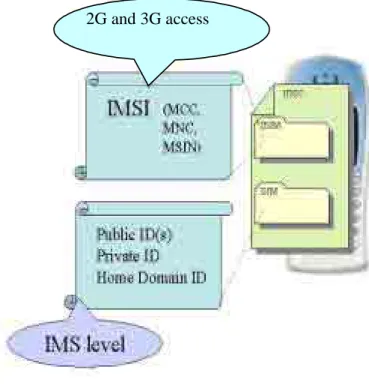
With the introduction of the IMS Domain within 3GPP a single level of registration was found to be insufficient. To provide the necessary attributes for registration to IMS to be carried out, an ISIM application was added to the UICC. In summary the USIM application is used to gain access to the UMTS access network (CS/GPRS network) and the ISIM is used to gain access to the IMS Domain (3GPP Release 6 or greater).
A subscriber may access the IMS Domain:
• with the values of the ISIM identifiers derived from the USIM (in the absence of ISIM);
• with the value of the ISIM identifiers provisioned independently from the USIM.
It should be made clear from this clause that to access the IMS Domain an ISIM is required (note that the required private identifier provided and validated by the operator can be derived from the USIM if the ISIM is absent). As stated above, it is possible the ISIM resides or not on a UICC.
2G and 3G access
Figure 2: Key 3GPP IDs
The introduction of the SIM card introduced not only a method of uniquely identifying a subscription irrespective of the GSM device being used, but also a higher level of security that was absent from the previous analogue system where cloning the handset was common. Cloning a SIM card is much more complex.
As with the SIM card the UICC resides inside the mobile device. However, whereas the SIM is seen as the physical card together with the software to authenticate, authorize, and identify the subscriber, the UICC merely defines the physical characteristics of the smart card. The USIM and ISIM are seen as software applications resident on the UICC. As previously stated a USIM must be present and an ISIM may be present.
The UICC should remain the property of the mobile network operator who will need to have the authority to decide as to which applications can reside on it, e.g. USIM, ISIM.
NOTE: When accessing IMS over GERAN/UTRAN or I-WAN using ISIM, a USIM needs also to be present to access the rest of the 3GPP system.
The general requirements being that the subscriber can be uniquely identifiable by the network, the service network can authenticate the subscriber, and that if a subscriber is being served by a network other than its home network, the visiting network shall be able to identify the associated home network.
Clause 13 from TS 122 101 [5] provides further clarification of the USIM module and the ISIM module in relationship to the UICC.
5.2 USIM
USIM is an application and not an identifier, this application is to reside on the UICC module. The following is a summary of the requirements for the USIM application:
- Every USIM has a unique identifier and is associated with one and only one home network. - It is possible for a home network to uniquely identify a subscription by the USIM.
- The USIM is used to provide security features.
- For access to services, provided by Packet Switched or Circuit Switched Core Networks, a valid USIM is required.
- The USIM resides on a UICC. USIM specific information is protected against unauthorized access or alteration.
- Access to the IMS services is possible using the USIM derived private identifier in the event of no ISIM being present on the UICC. If an ISIM is present on the UICC it is used to access the IMS.
The specification does not preclude the support of more than one USIM per UICC associated with the same or different home networks so long as the security problems which arise from such coexistence are solved. However, only one USIM can be active at any given time.
The USIM's private ID is based on the IMSI which contains the Mobile Network Code (MNC) allocated by the
appropriate country's NRA. The IMSI (based on ITU-T Recommendation E.212 [9]) can be used for registering the user on Circuit Switched networks and Packet Switched networks.
5.3 ISIM
ISIM is an application and not an identifier, this application is optional to the UICC module. The following is a summary of the requirements for the ISIM application:
- Access to the IMS Domain is possible using an ISIM application.
- The ISIM is sufficient for providing the necessary security features for the IMS.
- The ISIM may reside on a UICC. ISIM specific information is protected against unauthorized access or alteration.
The ISIM consist of Public ID(s), Private ID and Home Domain ID. The Home Domain ID provides the means by which that IMS routes a users" registration request to the Home IMS Network. The Private ID is how the user is authenticated by the user's Home IMS Network and the Public ID is how the user is contactable by other users for IMS based services.
If there is no ISIM application, a backward compatibility mechanism is in place to derive the Home Network Domain name (ID)from the IMSI as described in the following steps:
1) Take the first 5 or 6 digits, depending on whether a 2 or 3 digit MNC is used (see TS 131 102 [4] ) and separate them into MCC and MNC; if the MNC is 2 digits then a zero shall be added at the beginning. 2) Use the MCC and MNC derived in step 1 to create the "mnc<MNC>.mcc<MCC>.3gppnetwork.org" Domain
Name.
3) Add the label "ims." to the beginning of the domain. An example of a Home Network Domain Name is:
IMSI in use: 234150999999999; Where:
MCC = 234; MNC = 15;
MSIN = 0999999999,
which gives the Home Network Domain Name: ims.mnc015.mcc234.3gppnetwork.org. NOTE 1: An MCC is assigned by the ITU-T to a member state.
MNCs under this MCC are assigned by the NRA of this member state to an operator. MSINs are assigned by the operator to its customers.
The use of the Home Domain Name works best in a globally agreed and unique domain name space which all operators (e.g. fixed and mobile) who need to use it can access directly.
NOTE 2: Having to use the Domain Name '3gppnetwork.org' requires access to the 3GPP DNS system. The Domain Name 3gppnetwork.org is controlled by GSMA for registration in a private extranet.
If there is no ISIM application, the private identifier is not known, in that case the private identifier could be derived from the IMSI (TS 123 003 [6] clause 13.3). However, this derived identifier is not visible for end-users and it is replaced by the actual public identifier obtained during the registration procedure (see GSMA IR.65 subclause 8.1, see bibliography)
The following steps show how to build the Private Identifier out of the IMSI: 1) Use the whole string of digits as the username part of the private identifier.
2) Convert the leading digits of the IMSI, i.e. MNC and MCC, into a domain name, as described in clause 6.2.1.1.
The result will be a Private User identifier of the form "<IMSI>@ims.mnc<MNC>.mcc<MCC>.3gppnetwork.org". For example: If the IMSI is 234150999999999 (MCC = 234, MNC = 15), the private user identifier then takes the form [email protected]
The private ID is used only in the Home Domain operator's network.
The approach for 3GPP UEs roaming into the NGN is specified ( TS 123 003 [6] clause 13.2).
The realm can take a number format as defined by the Home Domain operator , except in the case where the Private ID (containing the realm) is derived from the IMSI. The whole of the username@realm needs to be unique in the Home Domain operator's network.
5.4 Backward
Compatibility
3GPP have provided backward-compatibility with the UMTS Services Identity Module (USIM) and thus with IMSIs and MSISDN numbers.
There are other identifiers that ETSI will need to address in time, but these ones are critical to the whole NGN structure and so are focussed on initially.
Interoperabiltiy betweeen operators who specify their networks by reference to different families of standards, e.g. ETSI TISPAN or 3GPP, is an important issue.
Future work must consider compatibility of identifiers in an environment where such interoperability occurs as there will be an evolution to a fully encompassing NGN.
6
Concept on the use of IDs in NGN
In principle, it should be possible for any user of the ISDN, PSTN, PLMN or an IP-based NGN network to identify users in a global basis. That implies that Public IDs are globally unique.
6.1 Introduction
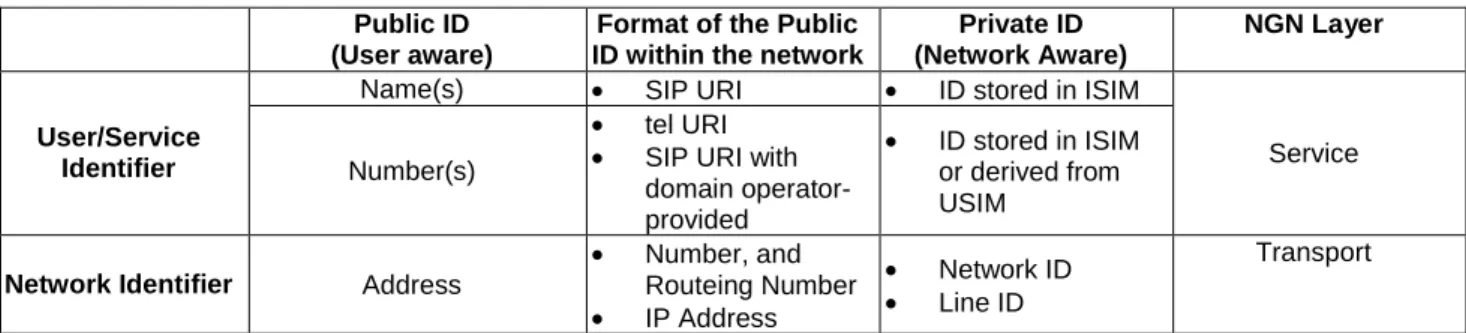
Due to the ubiquitous use of identifiers, the list below should not be considered as providing a complete list. Table 1: Overview of Identifiers
Public ID
(User aware)
Format of the Public ID within the network
Private ID (Network Aware)
NGN Layer
Name(s) • SIP URI • ID stored in ISIM
User/Service
Identifier Number(s)
• tel URI
• SIP URI with domain operator-provided
• ID stored in ISIM or derived from USIM
Service
Network Identifier Address
• Number, and Routeing Number
• IP Address
• Network ID
• Line ID
Transport
The format SIP URI and tel URI is a means to translate the identifiers used by the network in order to format E.164 numbers in coherence with SIP protocol requirements, as described in table 1.
The NGN Layers are according to [16]:
• Service Stratum/Layer
The different services/applications are located here, together with the databases keeping the user related information and identifiers.
• Transport Stratum/Layer
This part provides for the transport of the media streams and also supports the users in gaining access to the applications and also control of resources and admissions.
• Customer and Terminal functions
Figure 3 shows the NGN stratum/layer (more generic than the figure contained in [16].
ResourceandAdmission ControlFunctions
RACS
Bas e d o n 3GPPIMS
IPConnectivity AccessNetwork Andrelatedfunctionality
NetworkAccess AttachmentFunctions
NASS
OtherMultimedia ComponentsÉ
StreamingServices
(RTSPbased) Application Functions
Core transport Functions
3GPP IP-CAN Access Transport
Functions
3GPPTerminals NGN Terminals
Customer Networks
User Profile Functions
Othe
r Networ
ks
Legacy Terminals
GW
PSTN/ISDNEmulation
(SIP-Ibased)
IPMultimedia Component(CoreIMS)
(SIPbased)
NNI
TransportStratum
Service Stratum
UNI
Network Entry Functions
Customer and Terminal Functions Service and Control Functions Common Components
Figure 3: Functional model of the TISPAN NGN Identifier required:
• User and NGN Terminals IDs.
• NASS IDs: see clause A.2.2.
• RACS IDs: see clause A.2.3.
• Use Data IDs: see clause A.2.1.
• IMS/PES IDs.
• Common components IDs (see [16] and [17]), are used by several subsystems, such as those required for accessing applications, charging functions, user profile management, security management, routeing data (e.g. ENUM), etc.
6.2
IDs used in TISPAN NGN
To enable access to NGN using the existing mobile subscriptions (that are based only on USIM) also a mechanism to derive these values from USIM could be evaluated. This results in the requirement to support Home Domain Names in the 3GPP format based on the use of MNC, MCC.
NOTE: If MNC and MCC are to be used by fixed network operators, this might require changes to national regulations.
6.2.1
IDs for Users
An NGN operator can store User IDs in ISIMs provided to its subscribers or directly inside the terminals, if necessary. 3GPP specify that the ISIM itself is made up of various attributes. The main 3GPP attributes used for registration and authentication are the Home Domain Name, the Public and the Private Identifier. These identifiers are explained below.
6.2.1.1
Home Domain Name
The Home Domain Name is used to identify the home domain of the user. This is used during authentication and registration. The format of the Home Domain Name is based on the Domain Name e.g. 'operator.com' as specified in RFC 1035 [2]. Note that there is no requirement for having the domain part of the private and public identifier being equal to this Domain Name since the two values are independent, but some operators may choose to link these two identifiers.
The Home Network Domain Name is the parameter which is used to route the initial SIP registration requests to the home operator's IMS network. The Home Network Domain Name is stored in the ISIM. Upon receipt of the register information flow, the P-CSCF examines the Home Network Domain Name to discover the entry point to the home network (i.e. the I-CSCF). Note also that for the initial registration message routeing, the Domain Name resolution mechanism is made available to the user equipment at network attachment when the DHCP provides it with the domain name of a P-CSCF and the address of a Domain Name Server (DNS) that is capable of resolving that P-CSCF name:
• e.g. if there is no ISIM application (i.e. when there is no IMS-specific module), the Home Domain Name must be derived from the data available "locally" to the UE.
6.2.1.2
Private User Identifiers
Every NGN user has at least one private identifier. Private user identifiers are assigned by the home operator and are used to identify the IMS user's subscription. Its main role is to support the authentication procedure during
registration/re-registration/de-registration, authorization, administration and accounting purposes at the home IMS. It is also used as the primary means of identifying the user within a dialog between network entities (e.g. UPSF or S-CSCF selection). The private user identifier is not used in SIP call routeing, but is conveyed in all registration requests. A private user identifier is "permanent" (i.e. not tied to a particular call instance/session.) and stored locally in the ISIM (IM Services Identity Module) that will be used to instantiate the registration message parameters. In some cases, the private user identifier may also be instantiated with default values when no ISIM is available.
For its syntax, the private user identifier shall take the form of an NAI, and shall have the form username@realm as specified in clause 2.1 of RFC 4282 [18] in accordance with TS 123 003 [6] and TS 123 228 [7]. In case there is no ISIM on the UICC, the private user ID is derived from the IMSI. The username is replaced with the complete IMSI value. However for the realm the Home Domain Name value is used.
Further, there is no functional requirement for mandating a single private ID structure for a given IMS network. In IMS, the Home Domain Name, which is part of the private identifier, is used to route from a P-CSCF to the home operator's I-CSCF.
6.2.1.3
Public User Identifiers
Every IMS user has one or more public identifiers, which are primarily used for user-to-user communication. The public identifier serves as a basis for message routeing, possibly after a translation mechanism when appropriate, both for IMS session-based SIP messages (e.g. INVITE) or off-session SIP messages (e.g. NOTIFY). There is at least one public identifier stored in the ISIM, but like the private identifier, in some cases, it may also be instantiated with default values when no such ISIM is available. Note also that public identifiers are not authenticated during registration, but the correspondence between private identifier and public identifier can be checked by the UPSF.
For its syntax, the public identifier shall take the form of either a SIP URI or a tel URI. A SIP URI shall take the form "sip:user@domain" (TS 23.003 or TS 23.228). Note that tel URIs public user identifiers (whether they are based on E.164 (i.e. public) or private number) can not be used for SIP call routeing in IMS and must be translated in SIP URI using ENUM.
Every IM CN subsystem user must have one or more public identifier(s). This identifier is used between users who wish to communicate with each other. Hence this identifier may be found on such items such as business card, web sites etc. It is the equivalent to how a web site or number is used today. However it should be noted that the number is not used to authenticate the user during registration. Neither is it used to identify the user's information within the UPSF.
A public user ID, e.g. stored on the ISIM, is needed by NGN to access ordinary services like e.g. E-mail, Instant messages. Access to e.g. emergency services may be possible without having a public user ID.
The IMS Public User ID (IMPU) is in the format of a SIP URI. However both Internet naming and telephone
numbering is supported, so technically the format is either a SIP URI, or a tel URI. At least one IMPU is stored on the ISIM and cannot be modified by the UE. However, additional IMPUs do not have to be stored on the ISIM, although it is recommended.
The IMPU can be registered either explicitly or implicitly, but must be registered before the identifier can be used to originate IMS sessions and IMS session unrelated procedures. The identifier also has to be registered, either explicitly or implicitly, before terminating IMS sessions.
If a UICC is used that does not contain an ISIM then a temporary IMPU can be derived from the USIM's IMSI and used for the initial SIP registration process only. The temporary IMPU takes the format of a SIP URI. The format is as follows:
SIP:<private user identifier>;
where <private user identifier> is derived as described in clause 6.2.1.2.
NOTE: The ISIM does not need to reside on a UICC for ETSI NGN purposes.
The UPSF provides a public user ID to the user which will be used in the subsequent messages in the 'FROM' field of the SIP INVITE message. As a consequence, the temporary IMPU will never be displayed at the called party's UE.
6.2.1.4
Relationship of Private and Public IDs
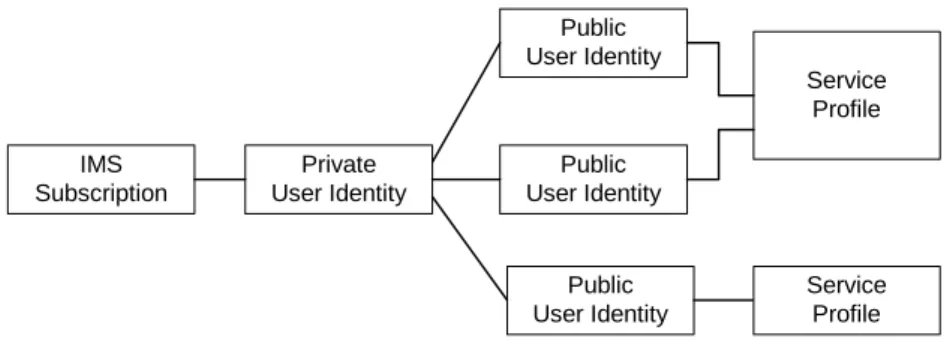
An important starting point is to consider the main IDs used by 3GPP IMS and their relationships in the key IMS databases. These issues are considered in clause 4.3.3.4 of TS 123 228 [7] as endorsed by TISPAN in TS 182 006 [19], where object diagrams illustrate some of the required relationships.
For ease of reference the figures 4.5 and 4.6 of TS 123 228 [7] are reproduced below.
IMS Subscription
Private User Identity
Public User Identity
Public User Identity
Public User Identity
Service Profile
Service Profile
Figure 4: Relationship between the Private User Identity and Public User Identities
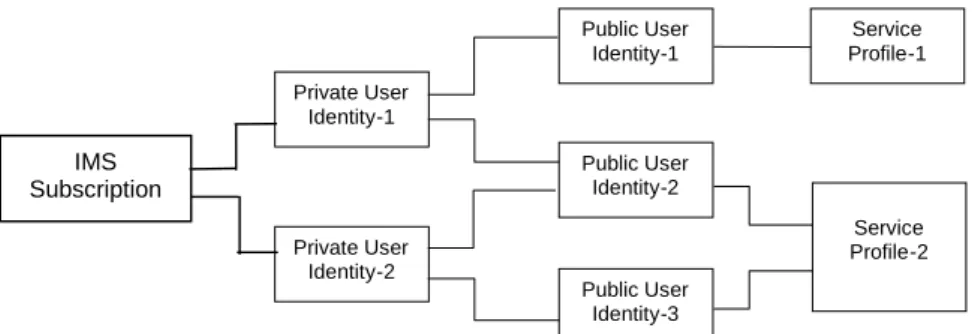
Public user identities may be shared across multiple Private User Identities within the same IMS subscription. Hence, a particular Public User Identity may be simultaneously registered from multiple UEs that use different Private User Identities and different contact addresses. If a Public User Identity is shared among the Private User Identities of a subscription, then it is assumed that all Private User Identities in the IMS subscription share the Public User Identity. The relationship for a shared Public User Identity with Private User Identities, and the resulting relationship with service profiles and IMS subscription, is depicted in figure 5.
Private User Identity-1
Private User Identity-2
Public User Identity-1
Public User Identity-2
Public User Identity-3
Service Profile-1
Service Profile-2
IMS Subscription
Figure 5: The relation between a shared Public User Identity (Public-ID-2) and Private User Identities In particular, clause 4.3.3.4 of TS 123 228 [7] identifies that the combination of the Private ID and the Public ID is used to register the users" details to their allocated S-CSCF from their HSS User Profile.
As well as the Public ID used for registration, more Public IDs can be registered and stored in the S-CSCF during this process. Each Public ID is associated with one and only one Service Profile (from clause 4.3.3.4 in TS 123 228 [7]), though a Service Profile can be associated with many public IDs.
Another valuable, though different description of the object relationships is provided for when user data structures are passed from the HSS to the S-CSCF. These are described in the UML in TS 129 228 [8]. These descriptions are not necessarily incompatible, since the data structures passed from the HSS to the S-CSCF are a description of the IDs required for session/call processing, not of the full underlying structure of the database.
These 3GPP descriptions are not necessarily incompatible, since the data structures passed from the HSS to the S-CSCF are a description of the IDs required for session/call processing, not of the full underlying structure of the database. The implication of the UML in TS 129 228 [8] is that at any one time, only one private ID represents the user for session/call processing. In 3GPP the private ID could only be used to register one single user equipment at one instance of time, whereas in NGN a multiplicity of user equipment should be allowed to use the same private ID for concurrent registration. Thus this conflicts with TISPAN requirements to use private IDs to represent different user roles or for registering from different equipment simultaneously and needs further investigation.
It should be possible to change the private ID without changing the public ID allocated to a subscriber and vice versa.
6.2.1.5
Handling of dialled number formats
The user may use E.164 numbers in local, national or international format. Whenever possible the dialling sequence must be converted into E.164 international numbering format to allow for ENUM lookup. When this is not possible the URI should specify the nature of the format of the sequence of digits that is being conveyed by the URI.
6.2.1.6
Termination of session with the tel URI format Public User ID
If in a terminating session a tel URI is used, the UPSF and the SLF (in the case that more than one independently addressable UPSF is utilized by a network operator) shall support the tel URI format Public User Identifier.
6.2.2
Access IDs in the NGN
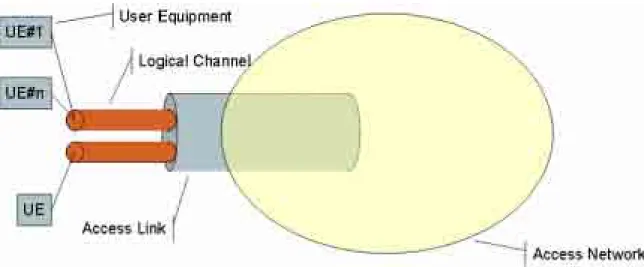
The Access up to the User Entity is identified using:
• Identifier for the Access Network.
• Identifier for the Termination Point of the Physical Transport on the Access Network (e.g. Access Link).
• Identifier(s)for the Logical Channel (possibly recursive).
• Identifier(s) for the User Entities (UE) using the same Logical Channel. Figure 6 shows a simplified view of the above.
Figure 6: Relation between Access Link, Logical Channel, User Equipment In later TISPAN Releases the above nested structure of identifiers needs to be supported.
In TISPAN Release 1 Access network level registration involves the access authentication which is authentication and authorization procedures between the UE and the NASS to control the access to the access network. Two authentication types are considered for access networks: implicit authentication and explicit authentication.
• Explicit authentication is an authentication procedure that is explicitly conducted between the UE and the NASS. It requires a signalling procedure to be performed between the UE and the NASS.
• Implicit authentication does not require the NASS to explicitly conduct an authentication procedure directly with the UE, however the NASS performs the implicit authentication based on identification of the L2 connection the UE is connected to.
It is a matter of operator policy whether implicit authentication or explicit authentication is applied.
There shall be mutual authentication between the UE and the NASS [14] during access network level registration. Both implicit authentication and explicit authentication may be used independently as network level access authentication mechanism, notwithstanding the fact that implicit authentication may be a consequence of explicit authentication (e.g. the implicit line authentication used together with an explicit method such as Point-to-Point Protocol (PPP) RFC 1661 (see bibliography) in xDSL access).
Authentication between users/subscribers and application/service providers shall be explicit or implicit (based on trust/security assertions).
Through the Network Attachment Subsystem it is possible to:
• Provide registration at access level and initialization of User Equipment (UE) for accessing to the TISPAN NGN services.
• Provide dynamic provisioning of IP address and other user equipment configuration parameters (e.g. using DHCP).
• Authenticate the user, prior or during the IP address allocation procedure.
• Authorize of network access, based on user profile.
• Access network configuration, based on user profile.
• Location management.
The Network Access Configuration Function (NACF) is responsible for the IP address allocation to the UE. It may also distribute other network configuration parameters such as address of DNS server(s), address of signalling proxies for specific protocols (e.g. address of the P-CSCF when accessing to the IMS).
The NACF should be able to provide to the UE an access network identifier. This information uniquely identifies the access network to which the UE is attached.
The Connectivity Session Location and Repository Function (CLF) registers the association between the IP address allocated to the UE and related network location information provided by the NACF, i.e.: access transport equipment characteristics, line identifier (Logical Access ID), IP Edge identity, etc. The CLF interfaces with the NACF to get the association between the IP address allocated by the NACF to the end user equipment and the Line ID. The CLF responds to location queries from service control subsystems and applications. The actual information delivered by the CLF may take various forms (e.g. network location, geographical coordinates, post mail address, etc.), depending on agreements with the requestor and on user preferences regarding the privacy of its location. The CLF holds a number of records representing active sessions.
The definition of this format shall also be lined up with OCG EMTEL who has decided that the LIF (Location Information Forum) is required in certain environments according to regulatory requirements.
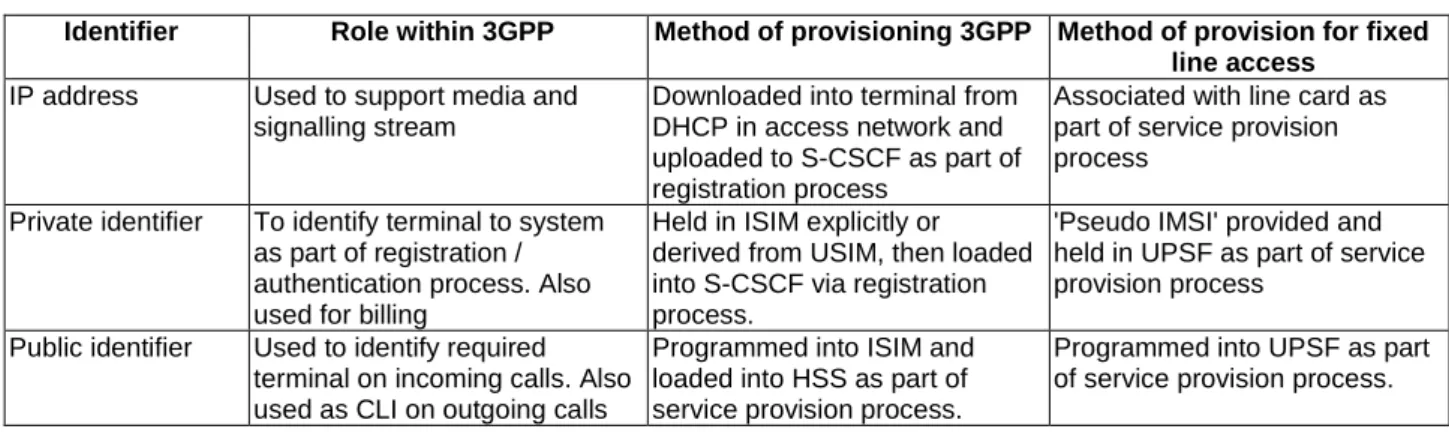
Correct operation of a 3GPP IMS based network requires a number of different identifiers to be present in the IMS. The key identifiers, together with the role they fulfil in NGNs and how they come to be present in the system, are shown in table 2.
Table 2: Overview showing the role of different identifiers and associated handling
Identifier Role within 3GPP Method of provisioning 3GPP Method of provision for fixed line access
IP address Used to support media and signalling stream
Downloaded into terminal from DHCP in access network and uploaded to S-CSCF as part of registration process
Associated with line card as part of service provision process
Private identifier To identify terminal to system as part of registration / authentication process. Also used for billing
Held in ISIM explicitly or derived from USIM, then loaded into S-CSCF via registration process.
'Pseudo IMSI' provided and held in UPSF as part of service provision process
Public identifier Used to identify required terminal on incoming calls. Also used as CLI on outgoing calls
Programmed into ISIM and loaded into HSS as part of service provision process.
Programmed into UPSF as part of service provision process.
6.2.3
Identification of Network Nodes
The CSCF, BGCF and MGCF nodes (functionalities I-BCF and IBGF) shall be identifiable using a valid SIP URI (Host Domain Name or Network Address) on those interfaces supporting the SIP protocol, (e.g. Gm, Mw, Mm, and Mg). These SIP URIs would be used when identifying these nodes in header fields of SIP messages. The names should be allocated in the public DNS system, however, this does not require that the nodes be reachable from the global Internet. These URIs will not be resolvable via the public DNS, they will only resolve from within the operators' network. Globally unique identifiers for certain network elements (e.g. x-CSCFs) will be required so that a shared interconnect model, e.g. a GRX/IPX type interconnect model can be supported. Element identifier can be left to the choice of the service provider since the operator identifier and root domain uniquely identify the service provider. However the element name should be compliant with RFC 1093 [13] and it is possible that further constraints, yet to be identified, may be required.
6.2.4
IDs for Services
Public Service Identifiers shall take the form as defined in TS 123 003 [6].
All public service identifiers need to meet the specific requirements of services such as:
• Voice.
• Instant Messaging Service.
• Presence Service.
• Location Service.
The public service identifier shall take the form of either a SIP URI (see RFC 3261 [11]) or a tel URI (see RFC 3966 [3]).
A public service identifier defines a service, or a specific resource created for a service.
The domain part is pre-defined by the NGN operators and the IMS system provides the flexibility to dynamically create the user part of the PSIs.
The SIP URI shall take the form of a distinct PSI "SIP:service@domain", where 'service' identifies a service. EXAMPLE: sip:[email protected].
Generally for SIP URIs three different contexts have to be differentiated:
• international E.164 number;
• private number which must include a context;
• short codes.
6.2.5
IDs for NGN operators
Proposals have been made for a naming scheme for NGN network elements. This takes the format <element
id>.<service provider>.<root domain>. The nature of the root domain needs further consideration in the light of recent initiatives outside ETSI (e.g. GSMA). However there is general agreement that this needs to be allocated from within the public DNS name space. A name per operator/service provider will need to allocated, and this must be unique within the root domain if misrouteing is to be avoided. To ensure that uniqueness is achieved, the entity responsible for governance of the route domain will need to be responsible for allocation of SP identifiers. A user friendly name for the root domain is favourable.
Additional requirements may occur in the situation, where same services are supplied to the user from different service providers. In such circumstances separate public service provider identifiers would be required and must be supported by the NGN.
6.3
ID translation in NGN
Identifiers are used throughout the network to identify sources/destinations of traffic and also resources within the network. One special kind of identifier is an E.164 number that is used by PSTN users to identify the destination of a call. In the context of an NGN, E.164 numbers need to be translated into an identifier format usable within the NGN.
6.3.1
E.164 to SIP URI translation for routeing (ENUM)
There is currently no decision that the public DNS/ENUM as specified in RFC 3761 [12] be used. This topic is for further study.
In some cases when the subscriber provided an E.164 number only, 3GPP foresees an E.164 to SIP URI translation especially if the requested E.164 number is not under control of the IMS (e.g. in the case of Interconnection).
Case 1: derived according to TS 123 228 [7]
In the case where the Request-URI of the incoming INVITE request to S-CSCF contains a tel URI [3], it has to be translated to a globally routable SIP-URI before applying it as Request-URI of the outgoing INVITE request. For this address translation the S-CSCF uses the services of an ENUM-DNS protocol based on to RFC 3761 [12]. Database aspects of ENUM are outside the scope of this specification.
Case 2: derived according to TS 122 228 [1]
The S-CSCF shall support the ability to translate the E.164 number contained in a Request-URI in the non-SIP URI Tel: URI format RFC 3966 [3] to a SIP routable SIP URI using an ENUM DNS translation mechanism based on RFC 3761 [12]. If this translation fails, then the session may be routed to the PSTN or appropriate notification shall be sent to the mobile, depending on network operator configuration.
Case 3: derived according to TS 123 228 [7]
An Application Service (AS) is hosting Public Service IDs (PSI) and may originate requests with the PSI as the originating party. For such originating requests, the home IMS network shall be capable to perform the following function:
- If the target identifier is a tel URI, ENUM translation needs to be performed, and the request shall be routed based on the translation result.
Routeing from the Originating AS hosting the PSI can be performed as follows:
a) The AS may forward the originating request to the destination network without involving an S-CSCF. If this option is applied where the target identifier is a tel URI, the AS shall perform an ENUM query and route the
request based on the translation result. ENUM support for an AS is optional, therefore, if an AS does not
support ENUM and the target identifier is a tel URI, it shall be configured to use b).
b) If the PSI has an S-CSCF assigned, the AS forwards the originating request to this S-CSCF, which then processes the request as per regular originating S-CSCF procedures (including a possible DNS/ENUM query).
6.3.2 Accessibility
of
ID
Translation
TISPAN NGN supports the E.164 number translation based on RFC 3966 [3] for routeing.
3GPP tackles the critical issue of how tel URIs should be used for IMPUs. In particular, for routeing, tel URIs are translated into SIP URIs. This highlights the importance of the location of such an Infrastructure ENUM DNS translation mechanism. This translation mechanism can be located in:
1) Publicly accessible DNS; or 2) Private DNS.
In the first case this is based on RFC 3966 [3]. In the second case this routeing data tree will only be accessible by a single or a group of cooperating operators and needs only to be agreed between the participating operators.
7
Administration of NGN IDs
Identifiers fall into 3 classes (not mutually exclusive):
• Those generated automatically by network elements (e.g. call identifiers). For these, no human intervention is required (or possible).
• Those that may be allocated by operators without reference to external bodies (e.g. customer account number).
• Those for which operators must go to external bodies (e.g. NRA and others) to receive allocations (e.g. E.164 numbers, public IP addresses).
Framework Directive, Article 10.1 (see bibliography) requires that National regulatory authorities control the assignment of all national numbering resources and the management of the national numbering plans. Adequate numbers and numbering ranges shall be provided for all publicly available electronic communications services. Framework Directive, Article 10.1 (see bibliography) also requires that National regulatory authorities establish objective, transparent and non-discriminatory assigning procedures for national numbering resources.
7.1
Overview on administration
7.1.1 E.164
Numbers
According to the WTSA, ITU-T Study Group 2 ('SG2') is the lead ITU-T Study Group with regard to the
Administration of International Numbering Resources. SG2's responsibilities, under this mandate, include overseeing the administration of all such resources in order to ensure uniformity and equity in their assignment, despite the technical responsibilities for these resources being dispersed across multiple ITU-T Study Groups.
Specifically, ITU-T Recommendation E.164 [10], defines the number structure and functionality for four principal categories of numbers used for international public telecommunication – namely geographic areas, Global Services, Networks, and Groups of Countries ('GoCs'). For each of the categories, Recommendation E.164 details the components of the numbering structure and the digit analysis required to successfully route calls. Other specific Recommendation E.164-based global service applications (e.g. Universal International Freephone Numbers), which differ in usage, are defined in separate ITU-T Recommendations related to E.164, include, inter alia:
• ITU-T Recommendation E.164.1 [20]: "Criteria and procedures for the reservation, assignment and reclamation of E.164 country codes and associated Identification Codes (ICs)";
• ITU-T Recommendation E.164.2 [21]: "E.164 numbering resources for trials";
• Determined ITU-T Recommendation E.164.3 [22]: "Principles, criteria and procedures for the assignment and reclamation of E.164 country codes and associated identification codes for Groups of Countries";
• ITU-T Recommendation E.190 [23]: "Principles and responsibilities for the management, assignment and reclamation of E-series international numbering resources";
• ITU-T Recommendation E.195 [24]: "ITU-T International numbering resource administration".
7.1.2 IP
Addresses
Currently there are two types of Internet Protocol (IP) addresses in active use: IP version 4 (IPv4) and IP version 6 (IPv6). IPv4 was initially deployed on 1 January 1983 and is still the most commonly used version. IPv4 addresses are 32-bit numbers often expressed as 4 octets in "dotted decimal" notation (for example, 192.0.32.67). Deployment of the IPv6 protocol began in 1999. IPv6 addresses are 128-bit numbers and are conventionally expressed using hexadecimal strings (for example, 1080:0:0:0:8:800:200C:417A).
Both IPv4 and IPv6 addresses are assigned in a delegated manner. Users are assigned IP addresses by Internet service providers (ISPs). ISPs obtain allocations of IP addresses from a local Internet registry (LIR) or national Internet registry (NIR), or from their appropriate Regional Internet Registry (RIR):
• AfriNIC (African Network Information Centre) - Africa Region
• APNIC (Asia Pacific Network Information Centre) - Asia/Pacific Region
• ARIN (American Registry for Internet Numbers) - North America Region
• LACNIC (Regional Latin-American and Caribbean IP Address Registry) - Latin America and some Caribbean Islands
• RIPE NCC (Réseaux IP Européens) - Europe, the Middle East, and Central Asia
The IANA's role is to allocate IP addresses from the pools of unallocated addresses to the RIRs according to their established needs. When an RIR requires more IP addresses for allocation or assignment within its region, the IANA makes an additional allocation to the RIR.
Important links:
• IPv4 Address Space
(http://www.iana.org/assignments/ipv4-address-space)
• IPv6 Address Allocation and Assignment Policy
(http://www.iana.org/ipaddress/ipv6-allocation-policy-26jun02)
• IPv6 Address Space
7.1.3 Domain
Names
The Domain Name System (DNS) helps users to find their way around the Internet. Every computer on the Internet has a unique address - just like a telephone number - which is a rather complicated string of numbers: the IP address. However IP addresses are hard to remember. The DNS makes using the Internet easier by allowing a familiar string of letters (the "Domain Name") to be used instead of the arcane IP address.
The Internet Corporation for Assigned Names and Numbers (ICANN - www.icann.org) is an internationally organized, non-profit corporation that has responsibility for gTLD and ccTLD name system management.
The responsibility for operating each TLD (including maintaining a registry of the Domain Names within the TLD) is delegated by ICANN to a particular organization. These organizations are referred to as 'registry operators'. Currently, the gTLD of .aero, .biz, .com, .coop, .info, .museum, .name, .net, .org and .pro are in use, and the corresponding registries are under contract with ICANN. Separate arrangements apply to .edu, .mil, .gov, under United States Government responsibility, and .int which is directly under ICANN's responsibility.
Domain Names can be registered through many companies known as "registrars". The registrar collects various contact and technical information that makes up the user's registration. The registrar keeps then records of the contact
information and submit the technical information to the registry operator. The latter provides other computers on the Internet the information necessary to resolve the Domain Name in the correct IP address.
SIP addresses used as public user ID in NGN are based on Domain Names. A SIP address (or a SIP URI) is a type of Uniform Resource Identifier that identifies a communication resource in SIP. A SIP URI usually contains a user name and a host name and is similar in format to an email address (example: [email protected]).
7.1.4
International Mobile Subscriber Identity - IMSI
(ITU-T Recommendation E.212)
The IMSI is a string of decimal digits, up to a maximum of 15 digits, that identifies a unique mobile terminal or mobile subscriber internationally. IMSIs may also be used for terminal or subscriber identification within fixed or wireline networks that offer mobility services, or to achieve compatibility with networks that have mobility services. The IMSI consists of three fields: the MCC, the MNC, and the MSIN. The IMSI conforms to the ITU-T Recommendation for E.212 numbering.
MCCs are assigned by the ITU in response to formal requests from national administrators of ITU Member States. Additional MCCs will be assigned only in anticipation of exhaust of assigned code(s). MNCs are administered by the designated administrator within each country or by the TSB in the case of shared MCCs. Additional MNCs are assigned to MNC assignees within a shared MCC only for exhaust of the assigned code(s). MSINs are administered by the MNC assignee.
In principle, only one IMSI shall be assigned to each mobile terminal or mobile user. In case of multiple subscriptions (subscriptions to more than one mobility service from one or more service providers), a mobile terminal or mobile user may be assigned a different IMSI for each subscription.
Annex A (normative):
3GPP and TISPAN IDs
A.1
Identifiers already defined in 3GPP
Identifier name
Clause in [6]
Definition in TS 123 003 [6] TISPAN statements 2 Identification of mobile subscribers
IMSI 2.2 A unique International Mobile Subscriber Identity (IMSI) shall be allocated to each mobile subscriber in the GSM/UMTS system.
Not used within NASS
TMSI 2.4 In order to support the subscriber identity confidentiality service the VLRs and SGSNs may allocate Temporary Mobile Subscriber
Identities (TMSI) to visiting mobile subscribers. The VLR and
SGSNs must be capable of correlating an allocated TMSI with the IMSI of the MS to which it is allocated.
Not used within NASS
P-TMSI 2.1 Packet TMSI
An MS may be allocated two TMSIs, one for services provided through the MSC, and the other for services provided through the SGSN (P-TMSI for short).
Not used within NASS
TLLI 2.6 For addressing on resources used for GPRS, a Temporary Logical
Link Identity (TLLI) is used. The TLLI to use is built by the MS
either on the basis of the P-TMSI (local or foreign TLLI), or directly (random TLLI).
Access network type specific (ID specific to 3GPP networks)
LMSI 2.5 In order to speed up the search for subscriber data in the VLR a supplementary Local Mobile Station Identity (LMSI) is defined. The LMSI may be allocated by the VLR at location updating and is sent to the HLR together with the IMSI. The HLR makes no use of it but includes it together with the IMSI in all messages sent to the VLR concerning that MS.
Access network type specific (ID specific to 3GPP networks)
NRI 2.4 Network Resource Identifier
If intra domain connection of RAN nodes to multiple CN nodes as described in 3GPP TS 23.236 is applied in the MSC/VLR or SGSN, then the NRI shall be part of the TMSI. The NRI has a configurable length of 0 to 10 bits. A configurable length of 0 bits indicates that the NRI is not used and this feature is not applied in the MSC/VLR or SGSN. The NRI shall be coded in bits 23 to 14. An NRI shorter than 10 bits shall be encoded with the most significant bit of the NRI field in bit 23.
Access network type specific (ID specific to 3GPP networks)
3 Numbering plan for mobile stations
MSISDN 3.3 Mobile station international PSTN/ISDN number (E.164)
The number consists of:
- Country Code (CC) of the country in which the MS is registered, followed by:
- National (significant) mobile number, which consists of:
- National Destination Code (NDC); and
- Subscriber Number (SN).
A number of this format (i.e. an E.164 number) is required for NGNs, however, the term MSISDN is 3GPP specific
MSRN 3.4 Mobile station roaming number for PSTN/ISDN routeing (E.164)
The Mobile Station Roaming Number for PLMN/ISDN routing shall have the same structure as MSISDN numbers in the area in which the roaming number is allocated.
Needed only in a circuit switched environment
3.5 Mobile station international data number
The structure of MS international data numbers should comply with the data numbering plan of ITU-T Recommendation X.121 as applied in the home country of the mobile subscriber.
Not needed, as all services can be provided using the same number
3.6 Handover number
The structure of the handover number is the same as the structure of the MSRN.
Handover implies "session continuity" which is for further study (ffs) in TISPAN
Identifier name
Clause in [6]
Definition in TS 123 003 [6] TISPAN statements 4 Identification of location areas and base stations
LAI 4.1 Location Area Identity
The LAI is composed of the following elements:
- Mobile Country Code (MCC) identifies the country in which the GSM PLMN is located. The value of the MCC is the same as the three digit MCC contained in international mobile subscriber identity (IMSI);
- Mobile Network Code (MNC) is a code identifying the GSM PLMN in that country. The MNC takes the same value as the two or three digit MNC contained in IMSI;
- Location Area Code (LAC) is a fixed length code (of 2 octets) identifying a location area within a PLMN. This part of the location area identification can be coded using a full hexadecimal representation except for the following reserved hexadecimal values:
- 0000, and
- FFFE.
These reserved values are used in some special cases when no valid LAI exists in the MS (see 3GPP TS 24.008 ,
3GPP TS 31.102 and 3GPP TS 51.011 ).
Access network type specific (ID specific to 3GPP networks).
RAI 4.2 Routing Area Identity
The RAI is composed of the following elements:
- A valid Location Area Identity (LAI) as defined in clause 4.1. Invalid LAI values are used in some special cases when no valid RAI exists in the mobile station (see 3GPP TS 24.008 , 3GPP TS 31.102 and 3GPP TS 51.011).
- Routeing Area Code (RAC) which is a fixed length code (of 1 octet) identifying a routeing area within a location area.
Access network type specific (ID specific to 3GPP networks)
CI 4.3.1 The BSS and cell within the BSS are identified within a location area or routeing area by adding a Cell Identity (CI) to the location area or routeing area identification, as shown in figure 5. The CI is of fixed length with 2 octets and it can be coded using a full hexadecimal representation.
Access network type specific (ID specific to 3GPP networks)
CGI 4.3.1 The Cell Global Identification is the concatenation of the Location Area Identification and the Cell Identity. Cell Identity shall be unique within a location area.
Access network type specific (ID specific to 3GPP networks) BSIC 4.3.2 The Base Station Identity Code is a local colour code that allows
an MS to distinguish between different neighbouring base stations. BSIC is a 6 bit code which is structured as shown in figure 6.
Access network type specific (ID specific to 3GPP networks) RSZI 4.4 A PLMN-specific regional subscription defines unambiguously for
the entire PLMN the regions in which roaming is allowed. It consists of one or more regional subscription zones. The regional
subscription zone is identified by a Regional Subscription Zone
Identity (RSZI). A regional subscription zone identity is composed
as shown in figure 7.
Access network type specific (ID specific to 3GPP networks)
5 Identification of MSCs, GSNs and location registers
GSN address 5.1 GSN: GPRS Support Node address SGSN: Serving GPRS Support Node GGSN: Gateway GPRS Support Node
MSCs, GSNs and location registers are identified by international PSTN/ISDN numbers and/or Signalling Point Codes ("entity
number", i.e., "HLR number", "VLR number", "MSC number", "SGSN number" and "GGSN number") in each PLMN.
Additionally SGSNs and GGSNs are identified by GSN Addresses. These are the SGSN Address and the GGSN Address.
Access network type specific (ID specific to 3GPP networks) (similar functionalities required in TISPAN to identify the access to the NGN)
HLR ID 5.2 Home Location Register
HLR may also be identified by one or several "HLR id(s)", consisting of the leading digits of the IMSI (MCC + MNC + leading digits of MSIN).
Not needed in TISPAN Release 1
![Figure 3 shows the NGN stratum/layer (more generic than the figure contained in [16]. R e so u r c e an d A d m i s s i o n C o n tr o l F u n c ti o n s R A CSBasedon3GPPIMSIPConnectivityAccessNetworkAndrelatedfunctionalityNetworkAccessAttachmentFunction](https://thumb-us.123doks.com/thumbv2/123dok_us/8562961.2316341/14.892.132.766.148.643/figure-shows-stratum-generic-figure-contained-csbasedon-gppimsipconnectivityaccessnetworkandrelatedfunctionalitynetworkaccessattachmentfunction.webp)