Eurocode 4: Design of composite
steel and concrete structures
Dr Stephen Hicks, Manager Structural Systems, Heavy Engineering Research Association, New Zealand
Introduction
BS EN 1994 (Eurocode 4) is the Structural Eurocode that deals with composite steel and concrete structures. It replaces the following national standards: BS 5400-5, BS 5950-3.1 and BS 5950-4. Eurocode 4 consists of three Parts: • Part 1-1, General rules and rules for buildings (BS EN 1994-1-1); • Part 1-2, General rules — Structural fi re design (BS EN 1994-1-2); and • Part 2, General rules and rules for bridges (BS EN 1994-2).
To enable Eurocode 4 to be used, designers also need to make reference to the national annex, which includes the national decision for Nationally Determined Parameters (NDPs), the national decision regarding the use of informative annexes and reference to Non-Confl icting Complementary Information (NCCI). For BS EN 1994-1-1 and BS EN 1994-1-2, the website http://www. steel- ncci.co.uk will provide all the necessary NCCI, whilst for BS EN 1994-2 NCCI is given in PD 6696-2. In the interests of improving free circulation of products and services in Europe, it is intended to reduce the number of NDPs in the future, thereby leading to a gradual alignment of safety levels across the member states. As a fi rst step in this process, the European Commis-sion Joint Research Centre (JRC) has commenced a pilot project that is consider-ing the harmonization of NDPs, whose initial focus is Eurocode 2, Eurocode 3 and Eurocode 4 (http://eurocodes.jrc.ec.europa.eu/showpage.php?id=52). To assist designers in understanding Eurocode 4, references [1], [2] and [3] provide background information on the origin and objectives of the code provisions, which are supplemented by a selection of worked
examples that illustrate the use of a particular clause. In addition, background information is freely available through the Eurocodes website of the JRC (http://eurocodes.jrc.ec.europa.eu/).
The objective of this chapter is to provide an overview of the key aspects to Eurocode 4 and consider the principal changes for UK designers. The convention used is that, when the provisions are similar in different parts of this Structural Eurocode, Eurocode 4 is referenced. However, when the rules are specifi c to a certain type of structure, the relevant part is identifi ed (e.g. BS EN 1994-1-1 for buildings).
Materials
Structural steelAlthough the use of structural steel with a nominal yield strength of not more than 460 N/mm2 is permitted in bridge designs conforming to BS 5400-5,
Eurocode 4 offers opportunities for building designers, where previously a yield strength of not greater than 355 N/mm2 was allowed in BS 5950-3.1.
According to Eurocode 3, the modulus of elasticity for steel should be taken as 210 kN/mm2, rather than the value of 205 kN/mm2 given in BS 5400 and
BS 5950.
Concrete
The strength and deformation characteristics for normal weight and light-weight concrete are given in Eurocode 2. The compressive concrete strengths used in the design rules in according to Eurocode 4 are based on cylinder strengths. Strength classes are defi ned as Cx/y for normal weight concrete and LCx/y for lightweight concrete, where x and y are the characteristic cylinder and cube compressive strengths respectively. For example, C25/30 denotes a normal weight concrete with a characteristic cylinder strength of 25 N/mm2
and a corresponding cube strength of 30 N/mm2.
While BS 5950-3.1 covers the use of concrete grades C25/30 to C40/50 and LC20/25 to LC32/40, the range of concrete grades that are permitted in designs conforming to Eurocode 4 are much wider at C20/25 to C60/75 and LC20/22 to LC60/66 respectively. Although Eurocode 2 provides guidance for
lightweight concrete with dry densities of between 800 kg/m2 and 2000 kg/m2,
it is unlikely that a density of less than 1750 kg/m3 will be used in composite
design, owing to the fact that this is the lowest value that is permitted in the Eurocode 4 equations for evaluating the resistance of headed stud connectors.
Profi led steel sheeting
Yield strengths of 280 N/mm2 and 350 N/mm2 are the common grades for
steel strip in the UK. Typically, profi led steel sheeting (or decking) is galvanized for durability purposes and, for internal environments, a total zinc coating of 275 g/m2 is normal. Grades of steel for profi led steel sheeting are specifi ed in
BS EN 10326 (this replaces BS EN 10147, which is the reference given in the current version of BS EN 1994-1-1), which distinguishes both the yield strength and the level of zinc coating. For example, the designation S 280 GD + Z 275 means 280 N/mm2 yield strength and 275 g/m2 of zinc coating.
The rules in BS EN 1994-1-1 are only appropriate for profi led steel sheeting thicknesses above a certain bare metal thickness. The UK national annex uses the recommended value of t ≥ 0.70 mm. Although an identical minimum sheet thickness is given in BS 5950-4, bare metal thicknesses of between 0.86 mm to 1.16 mm have generally been used in the UK to date. The thickness of a 275 g/m2 zinc coating is equivalent to approximately 0.02 mm on each face,
resulting in overall sheet thicknesses commonly used in the UK of between 0.9 mm to 1.2 mm. For design calculations the smaller bare metal thickness should be used.
Reinforcement
In a similar way as BS 5950-3.1, to simplify calculations the modulus of elas-ticity of the reinforcement may be taken as equal to the value for structural steel in Eurocode 4 (i.e. 210 kN/mm2 rather than 200 kN/mm2 given in Eurocode 2).
Shear connectors
Headed stud connectors should be supplied according to BS EN ISO 13918 (rather than EN 13918, which is the reference incorrectly given in Eurocode 4).
To distinguish studs used for shear connectors, the designation SD is used, for example, SD 19 × 100, is a headed stud shear connector with a 19 mm diameter shank and a nominal height of 100 mm. Due to the limitations to the Eurocode 4 design equations for calculating the resistance of headed stud connectors, the stud shank diameters that will be used in practice are likely to be between 16 mm and 25 mm for solid concrete slabs, and not greater than 19 mm for studs through- deck welded within the ribs of profi led steel sheeting. The performance of other types of shear connector may be evaluated from standard tests given in the informative Annex B.2 of BS EN 1994-1-1, in the absence of guidelines for a European Technical Approval (ETA).
In Eurocode 4, the nominal height of the stud rather than the length- after- welding (LAW) is used in the design equations. However, LAW is needed for detailing purposes, and is sometimes used to ensure that limits to design rules are satisfi ed (e.g. LAW is required to determine whether a stud may be taken as ductile in the rules for partial shear connection). As a consequence of this, two values of stud height need to be considered by the designer: the nominal height for calculating resistance; and LAW when detailing the shear connection. Traditionally, the LAW is taken as 5 mm shorter than the nominal height.
Composite beams
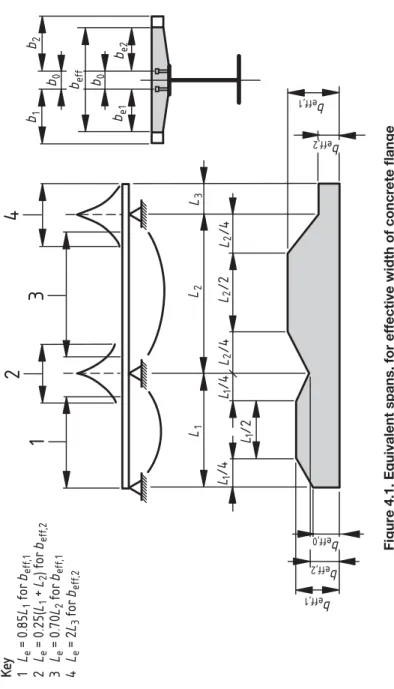
Effective width of concrete fl anges to composite beams for shear lag The rules for the effective width in Eurocode 4 are simpler than BS 5400-5, but similar to those in BS 5950-3.1. The effective width at the ultimate limit state is taken as a constant value for the middle portion of the span and tapers towards the points of zero moment, as shown in Figure 4.1 (as opposed to BS 5950-3.1 where a constant width is taken along the full length for simply- supported beams); similar results for effective widths of steel plated structural elements can be calculated from BS EN 1993-1-5. In addition, when multiple shear connectors are provided, the effective width may be increased by the distance between the outermost shear connectors measured from their centre- lines, b0 (see Figure 4.1). However, for the serviceability
limit state, the Eurocode 4 provisions are similar to BS 5950-3.1 in that a constant effective breadth may be assumed to act over the entire span, based on the mid- span value.
L2 b1
b2
b0 beff b0 be1 be2
1
2
3
4
L1 L3 L /41 L /21 L /41 L /42 L /22 L /42 b eff,1 b eff,2 b eff,0 b eff,1 b eff,2Figure 4.1. Equivalent spans, for effective width of concrete fl
ange
KeyKey 1 L
e = 0.85 L1 for beff,1 2 Le = 0.25( L1 + L2 ) for beff,2 3 Le = 0.70 L2 for beff,1 4 Le = 2 L3 for beff,2
In both BS 5950-3.1 and Eurocode 4, the maximum value of the effective width be1 = be2 = span/8 on each side of the beam (see Figure 4.1). As well
as considering this limit, the width assumed in design must not exceed the actual slab width available, which is particularly relevant to edge beams and beams adjacent to openings. The rules in Eurocode 4 are more generous for cases when the slab is spanning parallel to the span of the beam in that, in BS 5950-3.1, the width assumed in design could not exceed 80% of the actual slab width available.
Creep and shrinkage
One of the differences from previous UK practice is that the elastic modulus for concrete under short- term loading is a function of its grade and density. As a consequence of this, instead of the short- term value, n0, of 6 and 10 for
normal weight and lightweight concrete respectively, a range of values should be used. For design conforming to Eurocode 4, n0 ranges between: 5.2 to
6.8 for normal concrete; and 8.3 to 10.8 for lightweight concrete with a dry density r = 1750 kg/m3.
In BS 5950-3.1, the effective modular ratio that should be used in design is based on a consideration of the short- and long- term modular ratio, and the proportion of the total loading that is long term. However, BS EN 1994-1-1 introduces a useful simplifi cation for composite beams in buildings in that the modular ratio may be taken as 2n0 for both short- and long- term loading if:
• fi rst- order global analysis is acceptable (which is expected to occur in the majority of cases);
• the fl oor is not mainly intended for storage; and
• the fl oor is not prestressed by controlled imposed deformations.
Shear connection
Partial shear connection
Ductile shear connectors are defi ned as those having suffi cient deformation capacity to justify the assumption of ideal plastic behaviour of the shear connection (measured in terms of the slip at the interface between the steel beam and the concrete slab). Suffi cient slip capacity enables the longitudinal
shear to be redistributed between the shear connectors before any of them fail, such that they may be taken to be equally loaded at the ultimate limit state. In these situations, it is permitted to space the connectors uniformly, which is helpful when the connectors are used with profi led steel sheeting, due to the fi xed pitch of the ribs. Unlike BS 5950-3.1, whose only requirement is that other types of shear connectors should have at least the same defor-mation capacity as headed studs, Eurocode 4 specifi es that a shear connector may be taken to be ductile if its characteristic slip capacity, duk, is at least
6 mm. In situations when the shear connector is not a headed stud, duk may
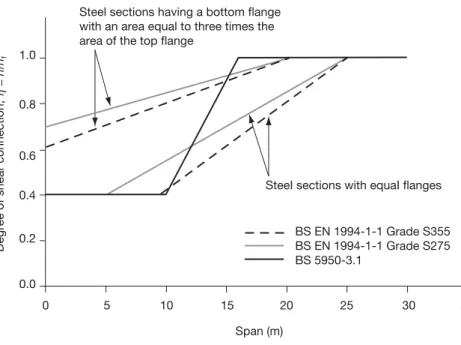
be evaluated from the standard test given in Annex B.2 of BS EN 1994-1-1. According to BS EN 1994-1-1, headed studs with a shank diameter, d, of between 16 mm and 25 mm, and an overall length after welding (LAW) of not less than 4d may be considered ductile within defi ned limits to the degree of shear connection, h. Unlike BS 5950-3.1, where the limits to the degree of shear connection depended only on the beam span, the limits in BS EN 1994-1-1 are a function of the beam span, the steel grade and whether the steel section is symmetric or asymmetric (defi ned by the ratio of the bottom fl ange area to top fl ange area of the steel section). The maximum asymmetry that is permitted is for steel sections with a bottom fl ange area equal to three times the area of the top fl ange. For steel sections in which the ratio of fl ange areas is between 1 and 3, linear interpolation is permitted. A graphical representation of the degree of shear connection requirements in BS 5950-3.1 compared with BS EN 1994-1-1 is presented in Figure 4.2. As can be seen from Figure 4.2, for symmetric steel sections, a much lower degree of shear connection is permitted than in BS 5950-3.1.
A third set of rules where headed stud connectors may be considered as ductile over a wider range of spans is given in BS EN 1994-1-1. However, these are more restrictive in scope and only apply to profi led steel sheeting spanning perpendicular to the supporting beam, with ribs not greater than 60 mm in height and one 19 mm diameter stud per rib. Moreover, this third set of rules can only be used when the simplifi ed method is used (where the composite moment resistance is linearly interpolated between full shear connection and no shear connection), as opposed to the rules in Figure 4.2 where the tradi-tional stress- block method is used, which gives a larger lever arm and moment resistance.
The use of non- ductile shear connectors is permitted in Eurocode 4 (such as headed studs used outside the ranges given in Figure 4.2, or block connectors).
However, the spacing of the shear connectors must be based on an elastic analysis of the longitudinal shear.
Resistance of shear connectors embedded in solid slabs and concrete encasement
Although only design rules for headed stud connectors are given in Eurocode 4, the UK national annex to BS EN 1994-2 provides guidance for block connec-tors with hoops through PD 6696-2. Specifi c design rules for horizontally lying studs are provided in Annex C of BS EN 1994-2 which, according to the UK national annex to BS EN 1994-1-1, may also be used for buildings. Unlike BS 5950-3.1 and BS 5400-5, where the characteristic resistances of headed stud connectors were presented in tabular form, the stud resistance in Eurocode 4 is taken to be the lesser of two equations (one representing stud shank failure, the other representing crushing of the concrete around the stud). A comparison of the characteristic resistances of typical 19 mm
Degree of shear connection,
h
=
n
/
nf
BS EN 1994-1-1 Grade S355 BS EN 1994-1-1 Grade S275 BS 5950-3.1
Steel sections having a bottom flange with an area equal to three times the area of the top flange
SteeI sections with equaI flanges
Span (m)
0 5 10 15 20 25 30 35
0.0 0.2 0.4 0.6 0.8 1.0
Figure 4.2. Minimum shear connection requirements from BS 5950-3.1 and BS EN 1994-1-1
diameter studs embedded in solid concrete slabs is presented in Table 4.1 and Table 4.2 for normal weight and lightweight concrete respectively.
Unlike BS 5950-3.1, where the design stud resistance is reduced in hogging moment regions, in Eurocode 4 it is assumed that the design resistance is not dependent on whether the surrounding concrete is in compression or tension. Although test evidence suggests this assumption is slightly unconservative for hogging moment regions [4], this is compensated by the fact that only full shear connection is permitted by BS EN 1994-1-1 in these areas.
While BS 5950-3.1 and BS 5400-5 recognize that appropriate resistance to uplift should be provided by the shear connectors, only BS 5400-5 provides specifi c rules on the infl uence of tension on the shear resistance of headed studs. According to Eurocode 4, the design shear resistance of headed studs,
PRd, may be assumed to be unaffected, provided that the design tensile force
does not exceed 0.1PRd; for situations when the design tensile force exceeds
this value, the connection is not within the scope of Eurocode 4. However, for situations where signifi cant tension forces may develop in shear studs (such as may be encountered over long web- openings, tension- fi eld action, etc.), guid-ance to UK designers is given in PD 6696-2.
Table 4.1. Characteristic resistances of 19 mm diameter × 95 mm LAW stud connectors embedded in normal weight concrete
Standard Characteristic resistances of shear connectors (kN) for concrete grade
C20/25 C25/30 C30/37 C35/45 C40/50 Eurocode 4
BS 5400 and BS 5950-3.1 81 95 93 100 104 106 113 114 113 119
Table 4.2. Characteristic resistances of 19 mm diameter × 95 mm LAW stud connectors embedded in lightweight concrete (with a dry density
r = 1750 kg/m³)
Standard Characteristic resistances of shear connectors (kN) for concrete grade
LC20/22 LC25/28 LC30/33 LC35/38 LC40/44 Eurocode 4
BS 5400 and BS 5950-3.1 64 83 74 88 83 92 91 97 99 102
Design resistance of headed studs used with profi led steel sheeting in buildings
The BS EN 1994-1-1 reduction factors that are applied to stud connectors welded within the ribs of profi led steel sheeting are calculated using identical equations to those in BS 5950-3.1, except that a lower multiplier is used for cases when the sheeting ribs are perpendicular to the supporting beams. Also, while the limiting values to the reduction factors in BS 5950-3.1 were based on the number of studs per rib, the limits in BS EN 1994-1-1 are a function of the number of studs per rib, the thickness of the sheet and whether the studs are through- deck welded or welded through holes in the sheet. Unlike BS 5950-3.1, no reduction factor equations are provided for more than two studs per rib.
The geometry of existing UK profi led steel sheets have been designed such that the limiting value dominates, so the reduction factors in BS EN 1994-1-1 are independent of the geometry and are therefore based on the number of studs per rib and the orientation of the sheet. As a consequence of this, for through- deck welded 19 mm diameter × 95 mm LAW studs, the reduction factor values from BS EN 1994-1-1 are identical to those given in BS 5950-3.1 for sheet thicknesses greater than 1.0 mm, but up to 15% lower for sheet thicknesses less than 1.0 mm. Nevertheless, when concrete grades less than C35/45 and LC40/44 are used, the resistance of headed stud connectors will be lower than those given by BS 5950-3.1, irrespective of the sheet thickness (see Table 4.1 and 4.2).
Detailing of the shear connection
One of the signifi cant differences in the detailing rules to Eurocode 4 compared to BS 5950-3.1 is the requirement that the underside of the head of a stud should extend not less than 30 mm clear above the bottom reinforce-ment to provide adequate resistance to separation; this rule appears to have been developed from a consideration of the performance of studs in solid slabs, or composite slabs with shallow re- entrant profi led steel sheeting. In 60 mm deep profi led steel sheets commonly used in the UK, the presence of a shallow re- entrant stiffener to the top fl ange of the sheet results in an overall depth closer to 70 mm, meaning that this detailing rule cannot be achieved for typical 19 mm diameter × 95 mm LAW studs. Nevertheless, recent full- scale
beam tests have indicated that this rule could be relaxed for typical 60 mm deep profi led steel sheets used in the UK [5].
Design resistance to longitudinal shear in concrete slabs
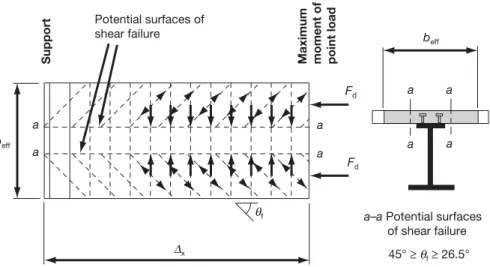
In evaluating the amount of transverse reinforcement required to prevent longi-tudinal splitting caused by the forces from the shear connectors, Eurocode 4 refers to the provisions in Eurocode 2 for reinforced concrete T- beams. The rules in Eurocode 2 are based on a truss analogy, where it assumed that successive concrete struts form in the fl ange to the beam with the transverse reinforcement acting as ties to maintain equilibrium and prevent the concrete struts from rotating (see Figure 4.3). This approach is a signifi cant depar-ture to the rules for transverse reinforcement in BS 5400-5 and BS 5950-3.1, which were developed from a semi- empirical relationship.
Like BS 5950-3.1 and BS 5400-5, the design longitudinal shear resistance of the concrete slab should exceed the design resistance of the shear connectors to ensure that the more ductile shear connectors are the critical design case. Where a combination of precast and in- situ concrete is used, the longitudinal shear resistance should again be evaluated according to Eurocode 2, but in these situations using the provisions for shear at the interface for concrete
Support
Potential surfaces of shear failure
Maximum moment o
f
point load
beff
a–a Potential surfaces of shear failure
45° ≥qf≥ 26.5°
a a
a a
Fd
Fd
a a a
a
beff
Dx
qf
cast at different times. These rules are different to those currently recom-mended in UK practice [6].
In a similar way as in BS 5950-3.1, when profi led steel sheeting spans perpen-dicular to the supporting beam and is either continuous, or discontinuous but anchored (from the provision of through- deck welded stud connectors), the sheet may be taken to contribute to the transverse reinforcement. However, for the case when the sheets are discontinuous and anchored, the rules in BS EN 1994-1-1 are more consistent than BS 5950-3.1 and BS 5950-4, in that the basis for calculating the bearing resistance of the stud is identical for both transverse reinforcement considerations and end anchorage in composite slabs.
Serviceability limit state
Defl ections
The additional defl ection due to partial shear connection need not be consid-ered if the shear connection is:
• designed according to the methods for headed studs in BS EN 1994-1-1 (see Figure 4.2);
• the degree of shear connection, h, is not less than 50%; and
• when the ribs of the profi led steel sheet are perpendicular to the supporting beam their height does not exceed 80 mm.
Shrinkage of the concrete results in forces on the shear connectors to act in the opposite direction to that due to the vertical loads, and can therefore be neglected when designing the shear connection. However, the shrinkage forces can cause the beam to defl ect in the same way as if the beam was subject to vertical loading, which leads to additional defl ections and fl exural stresses. In BS 5950-3.1, it was not necessary to consider the effects of shrinkage if the calculation procedures provided in that Standard were adopted. According to BS EN 1994-1-1, the additional defl ection due to shrinkage need not be included in design if the span- to- depth ratio of the beam is not less than 20 and normal weight concrete is used. For other cases, guidance is given by Johnson and Anderson [1].
Irreversible deformation
As opposed to BS 5950-3.1, there are no specifi c requirements to limit stresses at the serviceability limit state in BS EN 1994-1-1. However, to ensure that it is appropriate to base the calculations for defl ections on elastic theory, it is considered good practice to use similar limitations as BS 5950-3.1. On this basis, it is recommended [7] that in designs conforming to BS EN 1994-1-1 the calculated stresses should be limited to the yield strength of the steel, fy,
and the concrete stress to 0.63fck.
Vibrations
Owing to the fact that limits to vibrations are material- independent, Eurocode 4 refers designers to BS EN 1990. For vibration limits in buildings, BS EN 1990, Annex A1.4.4 refers to ISO 10137. However, no guidance is given to the designer on how these limits should be verifi ed; it is expected that, for steel- framed buildings, an appropriate NCCI will be given, such as reference [8]. For bridges, specifi c vibration limits are provided in Annex A2.4 of BS EN 1990.
Crack widths
Where composite beams and composite slabs are designed as simply- supported, but the slab is continuous, a minimum percentage of reinforcement should be provided over the intermediate supports. According to BS 5950-4, rein-forcement equivalent to 0.1% of the cross- sectional area of the concrete should be provided as a minimum for unpropped construction. However, UK industry has already moved away from this value and adopted the following BS EN 1994-1 provisions as good practice when the control of crack widths is not required:
• 0.2% of the cross- sectional area of the concrete (taken as the depth above the ribs of the sheeting, hc, for composite slabs) for unpropped
construction;
• 0.4% of the cross- sectional area of the concrete (taken as the depth above the ribs of the sheeting, hc, for composite slabs) for propped construction.
When limits to the crack widths are required, reference should be made to Eurocode 2 for composite slabs and slabs to beams.
Design for fi re resistance
The fi re resistance of a composite beam may be evaluated using the bending moment resistance model in BS EN 1994-1-2, which is similar to the moment capacity method given in BS 5950-8. When the ribs of the profi led steel sheeting are perpendicular to the supporting beam, voids are created between the sheeting and the top fl ange of the steel beam. Unlike BS 5950-8, where limiting temperatures were only provided when the voids were fi lled with non- combustible fi ller, according to BS EN 1994-1-2 the voids may be ignored if at least 85% of the surface of the top fl ange is in contact with the slab. As a consequence of this, the voids do not need to be fi lled for re- entrant profi les, but they must be fi lled for trapezoidal profi les (or the effect of the voids on the beam temperature must be considered).
An alternative method for evaluating the fi re resistance of a composite beam is the critical temperature model in BS EN 1994-1-2, which is used to estimate the critical temperature of the lower fl ange of the steel beam under a given sagging bending moment. Although this method is simple, for a composite beam designed for partial shear connection at ambient temperature, the crit-ical temperature method is likely to be more conservative compared to that achieved using BS 5950-8.
Composite columns
Rules for composite columns in buildings were intended to be provided in BS 5950-3.2, but this standard was never published. However, rules for composite columns were published in BS 5400-5, and have been used in the UK for the design of bridge piers. The rules for composite columns in Eurocode 4 are appropriate for concrete fi lled steel hollow sections, fully concrete- encased and partially concrete- encased steel H- sections. The advan-tages of using composite columns are that they possess a high bearing resist-ance and, in buildings, signifi cant periods of fi re resistresist-ance can be achieved without the need for applied external protection.
Composite joints
Although design guidance for composite beam- to- column connections has been available since 1998 [9], the design rules are formalized through the publication of BS EN 1994-1-1. The benefi t of using composite connec-tions in braced frames is that beam depths and section sizes can be reduced, improved serviceability performance is achieved (in terms of defl ections) and, due to the improved continuity between the frame members, greater robust-ness is possible.
Composite slabs
FlexureThe m- k method in BS 5950-4 is the traditional approach for evaluating the longitudinal shear resistance of composite slabs; however, this method has limitations and is not particularly suitable for the analysis of concentrated line and point loads. As well as the m- k method, in BS EN 1994-1-1 another approach known as the partial connection method is given, which is based on the principles of partial shear connection. This method provides a more logical approach to determine the slab’s resistance from applied concentrated line or point loadings, but may only be used when ductile longitudinal shear behaviour has been demonstrated by tests on composite slabs.
Both the m- k and partial connection method in BS EN 1994-1-1 rely on tests on composite slabs to evaluate the longitudinal shear strength, or ‘shear bond’ value, for the variables under investigation. However, design values that have been evaluated from tests according to BS 5950-4 cannot be used directly in Eurocode 4, unless they have been converted by a method such as that described in [10]. It is expected that, once the national standards are withdrawn, design tables and software according to the Eurocodes will be provided by profi led steel sheeting manufacturers for their specifi c products.
Concentrated point and line loads
Concentrated point and line loads often occur in buildings from, for example, temporary props during construction, wheel loads, columns, solid masonry
partitions, etc. In these situations, the effect of the smaller effective slab width available for bending and vertical shear resistance needs to checked at the locations of these loads. The BS EN 1994-1-1 equations for determining the effective width of composite slabs are identical to those given in BS 5950-4, with the exception that their applicability is limited to cases when the ratio of the sheet height to the overall slab depth hp/h does not exceed 0.6.
More-over, although an identical nominal transverse reinforcement area of not less than 0.2% of the area of concrete above the ribs of the sheet is specifi ed in BS EN 1994-1-1, a signifi cant difference is that this level of reinforcement is only appropriate for characteristic imposed loads not exceeding 7.5 kN for concentrated loads, and 5.0 kN/m2 for distributed loads. In situations when
this loading is exceeded, the appropriate transverse reinforcement should be determined in accordance with Eurocode 2.
Vertical shear
The vertical shear resistance of a composite slab should be determined using Eurocode 2, which depends on the effective depth of the cross- section to the centroid of the tensile reinforcement. Although not specifi ed in BS EN 1994-1-1, in BS 5950-4 and the ENV version of BS EN 1994-1-1 it was permitted to take the profi led steel sheeting as the tensile reinforcement provided that it was fully anchored beyond the section considered. However, for heavily loaded slabs additional reinforcement may be required at the support when the profi led steel sheeting is discontinuous and only has limited anchorage.
Design for fi re resistance
The required fi re performance of fl oor slabs is defi ned by the Approved Docu-ment B to the UK National Building Regulations. The Approved Document requires the slab performance to be assessed based on criteria for insulation (criterion I), integrity (criterion E) and load bearing capacity (criterion R). In BS EN 1994-1-2, it may be assumed that composite slabs satisfy the integrity criterion. Moreover, according to BS EN 1994-1-2, composite slabs that have been designed to BS EN 1994-1-1 may be assumed to possess 30 min fi re resistance when assessed according to the load bearing capacity criterion. Nevertheless, the slab’s ability of achieving the insulating criterion still needs to be verifi ed.
The insulation criterion is satisfi ed by providing adequate slab thickness to ensure that the temperature of the unexposed surface of the slab does not exceed 140 °C. The UK national annex to BS EN 1994-1-2 provides a table of recommended slab thicknesses for both trapezoidal and re- entrant profi les to satisfy the insulation requirements for common periods of fi re resistance. These slab thicknesses are identical to those given in BS 5950-8.
Despite the fact that Annex D of BS EN 1994-1-2 provides a calculation model for estimating the fi re resistance of composite slabs, the UK national annex does not recommend its use, owing to the fact that many UK profi led steel sheets are outside the limits to its fi eld of application. In an attempt to resolve this issue, alternative design temperatures based on BS 5950-8 are presented in the UK national annex.
Typically, design tables that satisfy the load bearing criterion are given by profi led steel sheeting manufacturers, which are based on the extended appli-cation of a single fi re test on a particular product. Although the extended application of fi re test results in the UK is already based on a design model that is in the spirit of BS EN 1994-1-2, extending the application of fi re tests will be formalized in the future through the publication of a series of European Standards with the designation EN 15080. For projects in other European countries, where the use of Annex D of BS EN 1994-1-2 is recom-mended, it is likely that the manufacturer’s fi re design tables will be the only valid method of design for UK profi les; in particular, when the contribution of the tensile resistance of the profi led steel sheet is included in the calculation of the sagging moment resistance (a practice that has hitherto been included in UK design, which often eliminates the need for reinforcement bars within the ribs).
Conclusions
Eurocode 4 brings both benefi ts and challenges to UK designers who are familiar with the earlier national standards for composite steel and concrete structures. To assist designers in the transition to the Eurocodes, the Steel Construction Institute (SCI) have issued a suite of design guides that provide advice on designing structural elements and frames.. In addition to the design guides, the European steel industry’s multilingual Eurocode 3 and Eurocode 4 website, Access Steel (www. access- steel.com), contains further guidance.
References
[1] Johnson R.P. and Anderson D. Designers’ Guide to EN 1994-1-1: Eurocode 4: Design
of Composite Steel and Concrete Structures, Part 1-1: General Rules and Rules for
Buildings, Thomas Telford, London, 2004
[2] Moore D., Bailey C., Lennon T. and Wang, Y. Designers’ Guide to EN 1991-1-2,
EN 1992-1-2, EN 1993-1-2 and EN 1994-1-2, Thomas Telford, London, 2007
[3] Hendy C.R. and Johnson R.P. Designers’ Guide to EN 1994-2 Eurocode 4: Design
of composite steel and concrete structures, Part 2: General rules and rules for bridges,
Thomas Telford, London, 2006
[4] Johnson R.P., Greenwood R.D. and van Dalen K. Stud shear- connectors in hogging
moment regions of composite beams, The Structural Engineer, Vol. 47, No. 9,
September 1969, pp345–350
[5] Hicks S.J. Strength and ductility of headed stud connectors welded in modern profi led
steel sheeting, The Structural Engineer, Vol. 85, No. 10, May 2007, pp32–38
[6] Hicks S.J. and Lawson R.M. Design of Composite Beams using Precast Concrete
Slabs, SCI Publication 287, The Steel Construction Institute, Ascot, 2003, p92
[7] Rackham J.W., Couchman G.H., and Hicks S.J. Composite Slabs and Beams using
Steel Decking: Best Practice for Design and Construction (Revised Edition), SCI
Publication 300/MCRMA Technical Paper No. 13, The Metal Cladding and Roofi ng Manufacturers Association in partnership with the Steel Construction Institute, Wirral, 2009, p110
[8] Smith A.L., Hicks S.J. and Devine P.J. Design of Floors for Vibration: A New Approach,
SCI Publication 354, Steel Construction Institute, Ascot, 2007, p124
[9] Couchman G.H. and Way A.G.J. Joints in Steel Construction – Composite
Connec-tions, SCI Publication 213, Steel Construction Institute, Ascot, 1998, p98
[10] Johnson R.P. Models for the longitudinal shear resistance of composite slabs and the
use of non- standard test data, In Composite Construction in Steel and Concrete V,