Report On Information Technology
Infrastructure
Submitted to the
SPATIAL PLANNING UNIT
Department of the Environment & Local Government
November 2000
Table of Contents
Executive Summary . . . 5
1
Introduction . . . 9
2
Information Society Developments . . . 11
2.1 Introduction . . . 11 2.2 Communications trends . . . 12 2.3 Convergence . . . 12 2.4 Access . . . 13 2.5 Mobility . . . 13 2.6 The Internet . . . 14 2.7 Conclusions . . . 14
3
Telecommunications Infrastructural Trends . . . 15
3.1 Introduction . . . 15
3.2 Networks . . . 16
3.3 Access technologies . . . 19
3.4 Conclusions . . . 20
4
Market Development Aspects . . . 23
4.1 Emerging market structures . . . 23
4.2 Telecommunications deregulation and competition . . . 25
4.3 Other infrastructural aspects . . . 28
4.4 Other development issues . . . 29
4.5 Conclusions . . . 30
5
Telecommunications infrastructure . . . 31
5.1 Fixed Line Telecommunications . . . 31
5.2 Overview of the coverage . . . 40
6
Demand for telecommunications services . . . 45
6.1 E-economy . . . 45
6.2 Overview of telecommunication service provision . . . 46
6.3 Delivery aspects . . . 47
6.4 Demand Aspects . . . 47
6.5 Factors that effect demand . . . 51
6.6 Education . . . 53
6.7 e-Commerce . . . 54
6.8 Other demand stimulation supports . . . 57
6.9 Conclusions . . . 58
7
Overall Conclusions . . . 61
Appendix 1: Glossary of Terms
Information Technology Infrastructure
Executive Summary
This report by NWLabs, with mapping input from Compass Informatics, to the Department of the Environment and Local Government deals with Information Technology Infrastructure as an input to a National Spatial Strategy.
The report outlines global changes that are taking place in the nature of telecommunications and their importance in the context of the emerging Information Society. Key technologies that are fundamental to the provision of advanced telecommunications based services are identified. Changes resulting from the process of deregulation in the Irish telecommunications marketplace and their impact on information technology are noted.
These changes are on-going and the character of Irish telecommunications is changing on a daily basis. The report identifies the broader trends and the implications of what this means in the context of spatial planning.
The report concludes that:
- Telecommunications infrastructure will continue to remain the most important component of national infrastructure provision for the immediate future. - The range of technical options or possibilities available means that every part of the country could be equipped or serviced with an appropriate
telecommunications infrastructure within the short to medium term.
- The de-regulation process will deliver competitive telecommunications access mainly in urban areas. Industry based in predominantly rural areas will not benefit from this process to the same extent. As a result the "digital divide" will widen between urban and rural areas.
- Local groups or communities need to address the provision of alternative infrastructures in these rural areas.
Infrastructure
- It is apparent that nearly all the larger towns and urban areas have access to an appropriate infrastructure at this moment. The coverage of smaller towns and rural areas is extremely erratic and these areas are in danger of being by-passed or of under participating in the impending information society unless this situation changes.
- Other interim infrastructure solutions (e.g. FWPMA/FWA) have the potential to deliver services into neglected areas at this moment. These can provide an alternative to the incumbent network and accelerate the deployment of broadband. Nevertheless these solutions may not result in significant end-user cost reductions if alternative and competing network infrastructure is not available to these new service providers.
- The physical typology or location of the national backbone network is not a significant factor. Bandwidth capacities in the national backbone networks are not considered to be an issue. It is expected that on-going innovation in network technology will continue to increase these capacities where suitable optic fibre cable exists.
- Investment in network upgrades and in network technology is likely to continue to be demand related. This means that where demand is weak or dispersed as in rural areas, demand may not materialise to justify investment.
Competitive supply
- The speed with which an appropriate telecommunications infrastructure covering all the country can be achieved is more dependent on nontechnical issues than technical solutions. The stimulation of local or alternative network infrastructures and the creation of competition at the level of local network supply is a key issue.
- Major progress is being achieved by the ODTR in de-regulating the telecommunications industry. De-regulation may however result in a more pronounced imbalance in the supply of competitively priced services for end-users in certain areas of the country.
- Unless competing networks evolve it is unlikely that dramatic reductions in the cost of leased circuits of bandwidth will materialise or network resilience issues will be addressed throughout all the country. This will have a knock-through impact on the possibility of locating "e-commerce" type companies in many areas of the country. It will also impact on the speed of roll-out of advanced services to residences and SMEs in these areas.
- Local authorities or planning regions need to address this local
telecommunications infrastructural issue. Solutions could range from the requirement to install optic fibre capacity in new roads infrastructure or the creation of a national or regional "carriers carrier" which would lease interconnect capacity to individual operators.
- The speed of roll-out of alternative local networks is also a cause for concern. It is apparent that local planning bottlenecks exist. Planning permission for masts and other facilities needed locally should be prioritised. The future telecommunications access needs of business parks, new housing estates or communities should be addressed as part of local government planning.
Demand Stimulation
- Clusters of multinational software companies have successfully developed in Dublin, Galway, Limerick and Cork. Such clusters are likely to be sustained due to the attractiveness of these four locations. In turn these locations are also likely to be the primary locations of new software firms created by former employees of these multinationals. However due to the continued preference of e-business based businesses for Dublin locations for reasons of telecommunications infrastructural costs, the view is that ecommerce and related businesses, will concentrate in Dublin. The establishment of the "Digital District" in Dublin will further add to this concentration.
- The provision of low cost bandwidth and dark fibre to Galway, Limerick and Cork would encourage greater e-commerce activity in these locations, building on established software clusters.
- In parallel with providing physical infrastructure other initiatives are required to increase Internet awareness, improve IT literacy skills and NSS - Information Technology Infrastructure generally stimulate accessibility in a broader context. In turn these initiatives will also help stimulate local demand for better and cheaper infrastructure and meaningful e-services that utilises this infrastructure. - Some of these initiatives are already underway and these should encourage general widespread awareness and take-up throughout the country.
However they will have limited success in locating new companies who are intensive users of telecommunications into many areas of the country. The viability of these companies is determined by the cost of telecommunications access.
- The barrier to the growth of e-commerce providing firms outside of Dublin is primarily structural rather than educational. Barriers comprise the cost of telecommunications, availability of dark fibre, low level of IT support services outside of the main cities and hence investment and funding credibility for new ventures. This situation is likely to continue until ecommerce "flag-ship" projects are established by IDA Ireland in say the BMW region.
- Specific educational initiatives are less important than the emergence of relevance and meaningful IT services/applications which are needed in the day-to-day work and home environment.
- Access, content, literacy, pedagogy and community may not be enough to ameliorate the "digital divide" in Ireland. Giving people access to technology is important, but it’s just one of many issues that need to be considered. Schools, libraries, and community centres are taking that first step in getting wired, but they must also consider the needs of the learners, the teachers, and the
Legislation & Regulation
- The Telecommunications (Infrastructure) Bill should be progressed to assist the roll out of infrastructure nation-wide, particularly FWPMA/FWA, UMTS and DTT.
- Consideration needs to be given to empowering the local authorities to streamline processes and assist the infrastructure roll out. As the current regulatory framework was created for an era of state owned utilities.
- The ODTR should consider licensing MMDS for the provision of interactive services and allow FWPMA/FWA operators to engage in secondary allocations of unused spectrum. This should result in earlier competitive service provision in rural areas.
- Central co-ordination of assets suitable for collocation, which are owned by the state and its agencies, e.g. masts, rooftops and way-leaves.
1
Introduction
The Government has mandated the Department of the Environment & Local
Government to prepare a National Spatial Strategy (NSS). The document “The
Scope and Delivery of the National Spatial Strategy” sets out the Objectives, Challenges and Issues that the NSS will address. This study on Information Technology Infrastructure is one component of an assemblage of key data sets necessary to allow an analysis of current trends and spatial development patterns in Ireland in the context of the NSS.
The Objectives of the Study on Information Technology Infrastructure are: • To comprehensively map and report on the distribution and capacity of the
various advanced telecommunications systems and their penetration into Ireland in spatial terms.
• To map and report on the current distribution of e-commerce enterprises in Ireland by town, county and region, including the identification of
clustering, with the scale of the enterprises outlined in terms of turnover, employment levels and skills profile.
• To examine, in particular, the national backbone and broadband access communications networks (including ISDN, ADSL and fibre optic cabling etc.) and identify their current strengths and weaknesses, as a support to regional and national development of E-commerce.
• To examine the position of different areas in terms of benefiting from the theoretical potential of the information society.
• To identify any opportunities for the development of E-Commerce, with particular reference to areas currently not on the existing proposed systems, including use of non network systems such as remote satellite link ups. • To identify any danger of disadvantaging areas, through concentration of
investment in information technology infrastructure.
• To identify any educational needs or other supports necessary to facilitate the development of E-Commerce as a source of employment in the regions. The report is divided into the following sections:
- Section 2: overviews how telecommunications developments are enabling
the emergence of the Information Society.
- Section 3: deals with the telecommunications infrastructure in the context of how it can be deployed or configured to support e-business.
- Section 4: addresses non-technical issues that will impact on the roll-out, nature and use of the telecommunications infrastructure.
- Section 5: deals with available and planned infrastructure throughout the country.
- Section 6: deals with perceived demand for telecommunications and ebusiness services whether from business or residential customers and assesses the educational needs together with the distribution of e-commerce firms.
- Section 7: highlights the policy implications of the findings of the report. A glossary of terms and a list of references are appended to the report.
2
Information Society Developments
This section overviews the broader Information Society trends. Telecommunications developments are enabling the emergence of the Information Society. Telecommunications is only one aspect of these broader developments. However it is the key platform on which all the developments which are underway at this moment will be built.
Section 3 following will deal with specific telecommunications technologies developments and trends that will impact on the nature and roll-out of this infrastructure nationally.
2.1
Introduction
Until 1998 Eircom (formally Telecom Eireann) had a monopoly in the provision of fixed telecommunications infrastructure. This infrastructure consisted primarily of copper wire, optic fibre and some radio transmission links. Eircom essentially provided the public switched telephone network (PSTN)1, the network of interconnections between telephone subscribers, operated for public use.
Since then a number of other licensed operators (OLOs) have started to provide infrastructure and services in the Irish market and a further number are planning to launch services in the immediate future. Nearly all the new telecommunication operators are
Dublin based, with Chorus (the former Irish MultiChannel) located in Limerick being the major exception to this trend.
Liberalisation of the use of non-telecommunications networks means that other access platforms, such as cable television and broadcast networks, can now offer and deliver telecommunications related services.
In the context of spatial planning, mapping these planned and existing networks will indicate how different areas of the country are serviced from a
telecommunications perspective. Nevertheless this will not indicate what potential demand exists in the areas served or how technology developments will evolve which will impact on the level of services that can be delivered to users whether residential or business.
1. A glossary of terms is provided in Appendix 1
On the 30th November 1998, the Director of Telecommunications Regulation awarded 29 new telecommunications licences.
Currently 44 licensed operators have commenced services, and a further 32 licences have been issued.
2.2
Communications trends
Advances in physical telecommunication networks have progressed from copper based to satellite and mobile. Copper wires have gone from supporting plain voice telephony, through ISDN towards ADSL technology capable of delivering high speed data and video content to the household. In turn telecommunication switches have progressed from being subscriber to bandwidth based. Cable TV has progressed from one way TV and radio re-broadcast towards supporting interactive voice, video and data. Fixed antenna wireless access (FWPMA/FWA)2 has gone from an analogue narrow band technology to a broadband digital technology capable of delivering fibre equivalent services to businesses and capable of supporting a host of residential services.
This trend is set to continue due to developments in semiconductor devices, the need for more bandwidth that is being fuelled by the explosion in the use of the Internet, falling hardware prices and increased competition as a result of the deregulation of the national telecommunications infrastructure.
The Internet, the need for greater access and mobility combined with the emergence of the phenomenon of convergence are driving these infrastructural developments.
2.3
Convergence
Convergence of media types is in progress as media production, transmission and storage move from analogue to digital and in end user equipment whether PCs or TVs. Convergence in distribution chains is also occurring, as the previously separate broadcasting, computing and telecommunications industries work ever more closely together in delivering the same product or content to end-users. Convergence is understood as:
• the ability of different network platforms to carry essentially similar kinds of services, and
• the merging together of consumer devices such as the telephone, television and personal computer.
This industry convergence is a key to facilitating a range of entertainment and e-commerce type applications. However to date most convergence has occurred at the tele-communications network level with few examples of convergence at the level of end-user devices.
Digital technology is the key building block underpinning convergence. The sectors that are converging are at the forefront in the adoption of digital technology in creating, processing and transmitting content. Computer
technology now plays a key role in content creation and production in the media industries. Digitally created content can be used in different environments and delivered on different network infrastructures. The networks handling such content are oblivious to the nature of the source material, whether image, sound or text.
The convergence trend is a recent phenomenon and how this will impact on society and economic activity is as yet poorly understood. There is a consensus that convergence will radically transform the current approach to delivery and use of information. However it is not clear how much these developments will change existing business practices and over what time-scales. Current indications are that developments will become more user rather than technology driven.
2.4
Access
Access in relation to tele-communications infrastructure development, particularly the increase in network capacity and the need for greater access capability to the home is the priority. This access factor is becoming more complicated with the increasing choice and complexity in the supply structure as new networks and suppliers emerge. Access is no longer a gradual upgrading of access lines from simple copper pairs to ISDN, bringing fibre steadily closer to the home and business. Telecommunications access now reflects competing technologies and infrastructure and is regulated at a national and EU level to ensure competition.
2.5
Mobility
Mobility has become a key component of the telecommunications environment. Although the primary application for mobility is, and will remain, basic voice transmission, value-added services are becoming more important. Mobile has gone from 1st generation analogue to second generation GSM with a natural
migration path from GPRS3 and EDGE towards 3rd generation UMTS. The
licensing of UMTS is identified by the ODTR4 as a major task for this year. Mobility is normally equated with the digital cellular network, but it also occurs in the fixed network depending on the local network intelligence. The emergence of the global satellite communications services and cellular systems enabling broadband multi-media mobile applications further blur the distinction between networks, services, operators and countries. This is particularly important in the context of globalisation and services that are provided for corporate customers.
3. These technologies are explained later in Section 3. 4. Office of the Director of Telecommunications Regulation
2.6
The Internet
The main driver of these trends over recent years has been the Internet. This has created a demand for easy and widespread access to digital information and forced a shift in the concept of networking. The Internet has benefited from the widespread adoption of a networking Internet protocol, IP, and the emergence of "browser" software which allows relatively easy search and retrieval techniques.
The need for simple e-mail and file transfer facilities drove the early adoption of the Internet. This in turn led to the wide spread use of the World Wide Web (WWW) and to the development of the purchase and sale of goods and services over the Internet. The emergence of such activity termed "e-commerce" is now a core driver that is expected to radically transform commercial and trading relationships in the early years of the 21st. Century.
In parallel computer equipment prices have substantially lowered. From 1995 to 1999, the prices of computing power fell by 10% annually. The next generation Internet connections, largely considered by computer experts to be a few years away, are expected to achieve speeds as high as 22 megabits per second, roughly ten times faster than most current broadband services.
2.7
Conclusions
This overview of the facilitating technologies illustrates their role as the engine of change. Technology is continuously developing and the rate of change is accelerating. However technology development itself is not as important as the development of innovative applications and services which are based on these technologies.
In an Irish context the issue is the rate of deployment of the facilitating
technologies at the origination, transmission and receiving levels and the rate of emergence of new innovative services and products which will produce the dramatic changes that we expect as part of the emerging e-economy. The immediate concern in the context of spatial planning is:
- The speed of roll-out of the existing and planned telecommunications networks,
- The coverage and capacity of these networks, in relation to the location of users whether business or residential,
- The emergence of competition nationally, and
3
Telecommunications Infrastructural
Trends
This section overviews telecommunications infrastructure in the context of how it can be deployed or configured to support e-business. The aim is to overview some of the developments or bottlenecks to providing an adequate
infrastructure. Section 4 will address emerging telecommunications market structures and barriers to development.
3.1
Introduction
Among the objectives of this study is the need to comprehensively map and report on the distribution and capacity of the various advanced
telecommunications systems and to examine, in particular, the national
backbone and broadband access communications networks. By doing this we should be able to identify the capacity of the infrastructure to support e-business and establish whether a "digital divide" exists in certain areas of the country. Ideally the "spatial plan" should be able to make recommendations to ameliorate this "digital divide" in the future.
Technology advances and the emergence of different types of networks are now blurring the boundaries of what could be considered broadband or narrow band. Networks that were previously considered narrow band in certain instances or conditions can now be used for broadband communications.
Bandwidth is significant because the greater the capacity of the facility, the greater the opportunities for usage and business application. Broadband
technologies allow for the
transmission of voice, data and video
signals over the one medium. The Internet has been born of the possibility of transmitting data over telephone lines, for example, with the use of a modem. The expansion of bandwidth capacity is effectively catapulting the world of communications into a whole new realm, that of the Information Age and the e-economy.
The following sections outline the emerging infrastructural options and the types of services (broadband or narrow band) that these could be used to deliver. These options demonstrate that infrastructure can be no longer viewed as one particular solution or approach, but is rather a mixture of technologies or infrastructure(s) which collectively provide a communications transport layer throughout the country.
"Digital Divide" refers to individuals, firms or areas who have or have not access to the appropriate information and communications technologies needed to access the Internet or engage in e-commerce.
Narrowband communications are generally viewed as communication speeds of up to 64,000 bits per second (64Kbit/s).
The minimum speed normally
associated with broadband is 2 million bits per second (2Mbit/s).
3.2
Networks
Fixed Networks
The main all pervasive network is the Public Switched Telecommunications
Network (PSTN). The PSTN is the main telecommunications access used by
firms and residential users through out the country. The Universal Service Provider (USP) Eircom provides the connections to the PSTN. Users access the PSTN through local exchanges or in some cases remote subscriber units (RSUs) which are connected to the local exchange. In turn these local exchanges are interconnected using a backbone network.
"Wireless in the local loop" (WLL),
also known as FWPMA (Fixed
Wireless Point to Multipoint Access) or FWA (Fixed Wireless Access), uses
radio communications to connect customers' premises to an operator’s network (radio and/or fibre). From a user perspective, it differs from mobile telephony through the use of fixed antenna at the customer premises, hence it is a fixed rather than a mobile service. FWPMA licences have been issued by the ODTR for both broadband and narrow band transmission rates. The broadband licences are aimed at larger businesses in the main population centres and narrow band at the smaller business and residential markets.
The licences are particularly well suited to the needs of medium to large users of telecommunications services and will allow for the high-speed transmission of large volumes of information including voice, video and data.
Broadband access will enable services such as PABX connection, high speed ‘always-on’ Internet access, multimedia and fast file transfer.
FWPMA/FWA allows the introduction of broadband and narrow band access to areas that are not particularly well serviced by traditional fixed line
telecommunications networks. This technology is particularly relevant in the context of the NSS in that it can be rapidly deployed into areas where appropriate services do not exist. It can also be used to provide an alternative to the incumbents local loop network in certain areas.
FWPMA provides a less expensive alternative to connecting local customers than would be the case with copper wire or optic fibre.
Operators could rapidly deploy services in areas where they do not provide services at present, hence increasing local competition.
The technology could also be used to augment the local infrastructure in response to increased local demand.
FWPMA operators have to "back-haul" traffic from remote users through fixed line infrastructure. The cost of leasing circuits or optic fibre from another operator may severally impact on the economics of service provision.
Nevertheless FWPMA/FWA is a relatively untried technology in Europe, that requires line of sight between the transmission and receive points, has
transmission distance limitations and its viability can depend on the density of customers within a transmission cell. The growth of FWPMA/FWA in Europe is partly being driven by delays in both unbundling of the local loop and in the roll out of DSL based services. In reality most FWPMA/FWA deployment will be used to develop local markets which could eventually be serviced using other fixed line communications as volume develops.
Cable TV networks offer another type of infrastructure for telecommunications services delivery. Certain cable television (CATV) operators have started upgrading their networks to facilitate the provision of interactive TV, voice and data services. Cable modems can be used to send and receive high-speed data transmission over the cable TV network.
This has a bearing on potential communications access throughout the country, nevertheless it is
restricted to those areas of the country that are cabled, that is the major
towns and cities. In less populated areas, MMDS5 and/or deflector type services for the provision of video services are available but these are not licensed to provide interactive services.
In the context of the NSS the impact of these networks may have a limited relevance to the needs of the local business community, as their primary focus to date is the residential market.
Broadcast infrastructures
Digital terrestrial television (DTT) is scheduled for launch, once the necessary legislation is in place. This is essentially a broadcast and one-way transmission technology that will deliver broadcast broadband services to the users premises. Users would require a return path through the PSTN to specific service
providers.
The relevance of this technology to the NSS depends on how the service is regulated and the extent, through legislation/regulation, that it can be used for data transmission, particularly business services. Once digital television legislation is introduced in Ireland, it is proposed to dispose of 72% of RTE’s transmission infrastructure to the private sector.
5. MMDS Microwave Multipoint Distribution System
The ODTR estimates that there are 615,000 cable and MMDS subscribers nationally and that a further 1 million households could avail of these services through existing infrastructure.
Satellite systems are ideal for broadcast services. Digital satellite TV
transmissions are available and the Department of Public Enterprise is making available funding for a number of VSAT (very small aperture terminals) trials of satellite Internet access. VSAT is considered appropriate for both rural and remote areas.
There is no spatial dimension to VSAT coverage in that all areas of the country can be covered. However deployment will impact on the market for CATV video services and possibly on the market for ADSL (see below) type services. Using the PSTN for the terrestrial link normally provides interactivity in these systems, but latency is a major issue.
Mobile networks
The current mobile networks are the Eircell and ESAT Digifone networks. The Meteor network, the third licensed operator, is currently being developed and service roll out is scheduled for early 2001. These networks have limited data
transmission potential, irrespective of WAP6 technology. The existing networks cover, for all practical purposes, almost 100 percent of the county. Because of this ubiquitous coverage, mobile networks have little or no impact from a spatial planning perspective.
UMTS7, 3rd generation mobile, will be licensed by the ODTR next year. This will allow transmission speeds of up to 2Mbit/s in certain instances. Local availability will impact on the ability of firms to provide or access UMTS enabled services in certain areas of the country. Generally UMTS will deliver the range of services that we currently expect from fixed line communications. However, it will necessitate a doubling in the number of base stations and masts as higher bandwidth and data transmission requirements will result in smaller cells.
GPRS8 is a wireless technology that is a stage between GSM and UMTS. It allows users to log into a data network for example and is ‘an always on’ service. WAP type services at present being developed for GSM systems are more feasible using GPRS technology and will eventually use UMTS when it becomes available.
TETRA, a national digital terrestrial trunked radio licence award is in progress. This will be used by the emergency services and by firms to manage vehicle fleets and for communications on large construction sites and as such has limited relevance to the NSS.
6. Wireless Access Protocol
7. UMTS Universal Mobile Telecommunications Service 8. GPRS General Packet Radio Services
GSM is normally limited to 9.6 Kbit/s transmission speeds.
GPRS offers up to five times GSM speeds.
The next step up from GPRS is EDGE (Enhanced Data GSM Environment) evolving towards UMTS or 3rd generation (3G) services.
3.3
Access technologies
Integrated Services Digital Network(ISDN) has been available in Ireland since the mid-nineties. However, until recently the take-up rate was low. Essentially ISDN converts the signal at the users premises to a digital format before it is transmitted through the PSTN to the local exchange or access point. It is not universally available throughout the country due to the technical limitations of some local exchanges.
Digital Subscriber line (DSL) technology is a modern technology that uses existing twisted-pair telephone lines to transport highbandwidth data, such as multimedia and video, to service subscribers. xDSL is drawing significant attention from operators and service providers because it promises to deliver high-bandwidth data rates to dispersed locations with relatively small changes to the existing infrastructure.
From an NSS perspective, (x)DSL will be limited in the immediate future to those exchanges that can support ISDN. The effectiveness of DSL is dependent upon line conditions such as the length of the copper wire and becomes less effective the greater the distance from the telephone exchange.
Eircom are presently assessing what parts of the network can support DSL. As noted above DSL has strict limitations on the distance between the users premises and the local exchange, as a result large numbers of rural inhabitants will be outside the range of potential DSL services.
Cable TV modems can also provide high-speed Internet access over a shared cable television line. Cable modems have greater downstream (from the Internet into the home) bandwidth capability than other access devices such as DSL. However this bandwidth is shared among all users on each network node, and will therefore vary, perhaps dramatically, as more users in a neighbourhood ‘node’ get on-line at the same time. Reduction in node sizes will become crucial. From an NSS perspective cable modems will only be relevant to those areas where NTL and Chorus (formerly Irish Multichannel) are upgrading their cable television networks, primarily in the cities. Exceptions to this are in Dungarvan, Co Waterford where CaseyVision has deployed cable modems on its cable TV network and in Kilkenny and Clonmel where the Suir Nore cable network is being upgraded. Generally, it would appear that these cable modem areas would overlap with the same areas where DSL will be initially rolled out!
ISDN defines a standard interface for the transmission of two 64Kbit/s channels together with a signalling channel. This is known as "Basic Rate" ISDN. Eircom's "hi-speed"
connections, as presently marketed, are effectively "basic rate" ISDN. A higher capacity "Primary Rate" ISDN also exists consisting of 30 by 64Kbit/s channels together with a 64 kbit/s signalling channel. This is effectively 2Mbit/s (broadband) transmission. ISDN is delivered over the existing copper line to the customer.
Network technologies
Until recently most of the provincial telecommunications network was PDH
(Plesiochronous Digital Hierarchy), built predominately to support voice traffic and not as cost effective, suitable or flexible for data transmission. By the end of 2000, Eircom will have connected all of its core exchanges and some RSUs9 to an SDH (Synchronous Digital Hierarchy) based trunk network.
SDH technology is needed in the network between the customer and the core network otherwise access to broadband is restricted. It is more cost effective to use an SDH network to provide data connectivity rather than use a PDH network. PDH can carry data only at the expense of voice traffic.
DWDM (optical switching)
technology enables fibre transmission capacity to be increased by a factor of 32. Most of Eircom's broadband backbone network uses DWDM technology. The trend to increasing
capacity using DWDM technology is set to continue.
From an NSS perspective this means that national backbone network capacity should not remain a major concern. How this capacity is broken out or re-sold to other operators will remain an issue, as it will impact on the viability of regionally hosted services.
3.4
Conclusions
This section has overviewed technology developments in the context of telecommunications infrastructure. It can be seen that there are a number of infrastructural options and different means of delivering advanced
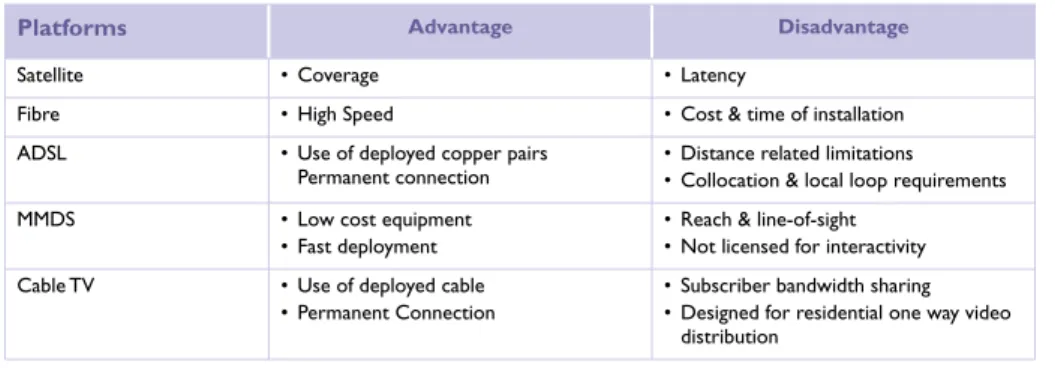
telecommunications based services to users. Table 3.4.1 below compares some of these infrastructural options. Some of these infrastructure platforms compete, for example, cabled TV areas with xDSL services delivered over the PSTN. Broadband FWPMA/FWA will compete with the incumbent through providing an alternative to the local loop. Others infrastructure platforms are
complementary, for example using narrow band FWPMA/FWA technology or VSAT solutions to deliver services into areas where the PSTN is inadequate.
9. Remote subscriber units
Table 3.4.1: Telecommunications platforms suitability
Platforms Advantage Disadvantage
Broadband FWPMA/FWA
• Fast deployment • Available bit-rate
• Reach & line of sight
UMTS • Mobility • Geographical coverage • Availability of handsets
For example Nortel expects to ship in volume DWDM equipment capable of deriving one hundred and sixty, 40Gbps wavelengths on a single fibre pair by this time next year, an increase from their current volume shipments of thirty-two, 10Gbps wavelengths.
From a spatial planning perspective:
- The physical typology or location of the national backbone network is not a significant factor. The perception is that upgrades in network technology (e.g. DWDM) combined with building new networks will provide ample bandwidth capacity.
- Other interim infrastructure solutions (e.g. FWPMA/FWA) have the
potential to rapidly deploy services into areas poorly serviced at this moment and to provide both an alternative to the local loop and rapid deployment of broadband services. Nevertheless these solutions may not result in
significant end-user cost reductions if alternative and competing network infrastructure is not available to these new infrastructure providers. - The range of technical options or possibilities means that potentially every
part of the country could be equipped or serviced with an appropriate telecommunications infrastructure within the short to medium term. In reality the possibility of equipping all areas of the country will depend more on non-technical issues, such as local demand, than on technical solutions. Investment in network upgrades and in network technology will continue to be demand related. The speed of rollout of alternative infrastructures will also be demand related.
The emergence of competition at the level of local network supply will stimulate this demand through the provision of cheaper end-user access. This becomes more apparent when we look at the nature of the built infrastructure in Section 5. Ubiquitous cheap access is only one aspect in a range of factors that will stimulate widespread broadband take-up and use. The emergence of relevant and meaningful services (content) is critical, as are appropriate educational and awareness initiatives. These will all help to stimulate demand and help to overcome social inclusion problems.
Satellite • Coverage • Latency
Fibre • High Speed • Cost & time of installation ADSL • Use of deployed copper pairs
Permanent connection
• Distance related limitations • Collocation & local loop requirements MMDS • Low cost equipment
• Fast deployment
• Reach & line-of-sight • Not licensed for interactivity Cable TV • Use of deployed cable
• Permanent Connection
• Subscriber bandwidth sharing • Designed for residential one way video
distribution
Table 3.4.1: Telecommunications platforms suitability (continued)
4
Market Development Aspects
The previous section outlined technical developments in telecommunications infrastructure provision. This section addresses non-technical issues that will impact on the roll-out, nature and use of such infrastructure. The main issues revolve around competition in the supply of infrastructure and related to this "cost of use" (demand-side) from the perspective of users whether companies or residential.
4.1
Emerging market structures
Since deregulation in 1998, the telecommunications market in Ireland has been transformed and the pace of change continues at a rapid rate. New
telecommunications infrastructure providers, new delivery platforms, technology advances and new forms of operators are contributing to this process.
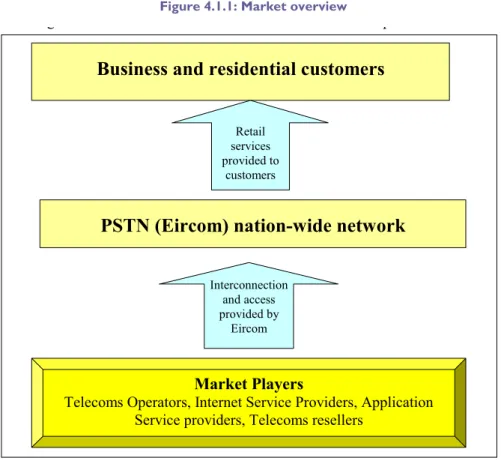
Some telecommunication operators in this market do not own any physical networks, but rather lease capacity from other providers that they then re-sell to their own customers. Irrespective of this the PSTN, the ubiquitous nation-wide network operated by Eircom, will remain the channel through which nearly all connections will be made. New operators, with the exception of FWPMA/FWA and cable TV operators, do not build local loop networks so they must
The diagram below illustrates a view of this market relationship. Figure 4.1.1: Market overview
As a result nearly all telecommunications service provision routes through Eircom's network. Exceptions may occur where a customer uses an Other Licensed Operator (OLO) to communicate with other customers of the OLO or through the use of alternative access platforms, with local loop elements, such as FWPMA/FWA and cable TV.
The significance of this is that irrespective of what new telecommunications infrastructure or services appear on the scene, the PSTN will remain the predominant local access for the vast majority of customers whether business or residential for the foreseeable future.
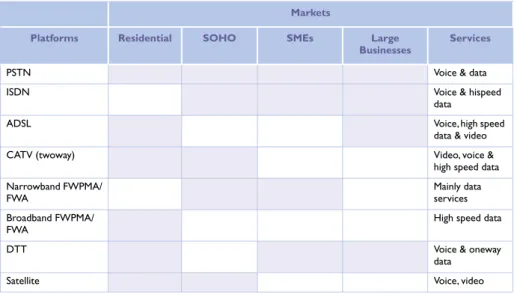
The table below illustrates how some technologies/infrastructures are suitable for delivery of specific services to market segments. These market segments are based on the historic activity of both Eircom and cable TV companies together with the market positioning of broadcasters and of advanced telecommunication services such as ISDN, FWPMA/FWA and ADSL. The PSTN has the potential to deliver the range of services, however other platforms such as cable TV, fixed wireless access, broadcast and satellite networks, will in the future deliver some of these services.
g p
Business and residential customers
Retail services provided to customers Interconnection and access provided by Eircom
PSTN (Eircom) nation-wide network
Market Players
Telecoms Operators, Internet Service Providers, Application Service providers, Telecoms resellers
4.2
Telecommunications deregulation and
competition
Telecommunications (de)-regulation is focussed on managing the transition from a market dominated by a former state-owned monopoly towards a competitive market. Ireland is moving rapidly to becoming one of the more liberalised telecommunication markets in the EU. This process is in its infancy and is a direct consequence of the establishment of the National Regulatory Authority, the Office of the Director of Telecommunications Regulation (ODTR).
Much progress has been made with a sizeable number of new players entering the market. Competition is growing significantly and this is being
reflected in reduction in tariffs for end-users. As the dominant supplier, Eircom is now privatised, however pending the unbundling of the local loop and the provision of competing services from cable TV, FWPMA/FWA or DTT platforms, consumers whether residential or business will not reap all the benefits of deregulation.
At present the degree of competition in Irish tele-communication services is less than that in the US and other parts of Europe. Eircom still controls the vast majority of revenues. As a result,
the average end-user in Ireland is only beginning to see the benefit of lower costs and few have yet experienced the wider choice associated with a competitive marketplace. Section 5 will highlight areas of the country where competitive service provision has yet to appear.
Table 4.1.2: Relationship between platforms and markets
Markets
Platforms Residential SOHO SMEs Large Businesses
Services
PSTN Voice & data
ISDN Voice & hispeed
data
ADSL Voice, high speed
data & video
CATV (twoway) Video, voice &
high speed data Narrowband FWPMA/ FWA Mainly data services Broadband FWPMA/ FWA
High speed data
DTT Voice & oneway
data
Satellite Voice, video
By September 2000, some 44 General licences were issued by the ODTR of which 25 had commenced operations.
The ODTR estimates that Eircom (September 2000) accounts for 85% of the fixed line market and that Eircell accounts for 60% of the mobile communications market.
It is expected that, in line with more liberated markets, as competing infrastructure and services are rolled out, access costs will drop and services supplied will improve. The experience to date would indicate that access costs are indeed reducing, although not as rapidly as in our trading countries, and that the main beneficiaries are large businesses in urban locations, particularly the greater Dublin area.
The Eircom monopoly has effectively been replaced by a duopoly, Eircom and the BT owned ESAT, both refusing to provide dark fibre as an alternative to circuit leasing. It may be at least another two years before significant competition develops in the market. The real possibility exists that in rural and remote areas competition will still not emerge and local users will have to survive with a second rate and costly telecoms service. There is a real possibility that these areas will be part of the "digital divide" that does not have an appropriate
infrastructure necessary to access broadband services.
The ODTR is presently progressing through an ambitious workload and addressing issues such as interconnection charges, number portability, facilities sharing and unbundling of the local loop. Resolution of these issues will contribute to greater competition and transparency in service prevision.
4.2.1 Local Loop Unbundling
Local Loop Unbundling (LLU) refers to the physical link between the household or business premises and the local exchange. It would be inconceivable that every telecom operator would install physical wires or links to each individual user or business. Unbundling the local loop is particularly relevant for users and small businesses who are located in areas which are not directly serviced by competing networks. At issue here is the possibility of third parties offering services to local businesses and residents through the Eircom network.
In the interest of competitive service provision different approaches to "unbundling" the local loop are pursued by telecommunications regulators. Under "full physical unbundling" the incumbent opens up its local infrastructure by providing leased copper pair links to new operators. These would then install their own equipment at the local exchange, "collocating" with Eircom. The new operator would then attach its own broadband equipment to one end of the loop and provide matching equipment at the customer’s end.
In this manner the new operator would share the physical operation of the local loop and offer an alternative range of services, from simple voice telephony to advanced broadband services. Under "Line Sharing" the incumbent provides the telephone service, while the new operator offers high speed data services (broadband) over the same lines using their own high speed ADSL modems. The new operator installs a DSL Access Muliplexer (DSLAM) at the local exchange.
Under this approach a user can continue to use the incumbent's telephone service and use another operator to provide broadband type services. With "bitstream access" the incumbent installs all equipment within the local loop. The new operator would then be responsible for routing traffic from the local
exchange to other destinations. Generally the new operator connects to the broadband digital bit stream circuit provided at the local exchange and then takes the data onto its own network.
In an Irish context the local loop between the local exchange and the users premises will be unbundled. The backbone network will still remain under control of the incumbent (Eircom). This means that advanced services can be offered from the local exchange to the customers' premises by an OLO10. However the interconnection or re-routing of this traffic will depend on whether the OLO has their own independent network or is depending on the national backbone network for certain of the links.
There are a number of other issues that can impact on the viability of OLO local service provision. For example the routing principles for calls terminating on Eircom's network are different to those for calls originating on Eircom's network. For calls terminating on Eircom's network, Eircom tandem
interconnect nodes will accept Eircom national termination traffic destined for all geographic number ranges.
Where an OLO interconnects with the Eircom tandem exchange for the local call area in which the relevant call is initiated, this will be routed up the Eircom network to a tertiary node which is capable of delivering Eircom call origination traffic for all geographic number ranges. The result of this routing up the network instead of across the network, from a tandem node to another tandem node, as is the case for traffic terminating on the Eircom network, is that extra distance related routing charges might be incurred by the OLO.
Transit rates apply to calls handed over to the Eircom network from an originating OLO’s network for termination in networks other than the Eircom network.
The availability of collocation facilities at exchanges and network access services provided by the incumbent operator is an essential part of the process of unbundling the local loop. Eircom currently offers collocation to Internet Service Providers (ISPs) Points of Presence (PoPs) when the PoP is owned by Eircom and leased to the ISP. However, Eircom does not currently offer collocation
10.OLO Other Licensed Operator
Universal Service Provider (USP) In May 1999, Eircom was designated the "universal service provider" of certain designated services, independent of geographical location. These services include:
- Connections to the PSTN and access to telecommunications services, - Provision of payphones,
- Provision of directories and directory enquiry services.
interconnection services of any form to interconnecting operators. Obviously unbundling the local loop should speed the competitive roll-out of advanced services (e.g. ADSL) to end-users. However where an operator has to interconnect using Eircom's or Esat’s backbone networks, additional costs (transit) will arise which may retard this roll-out in different areas of the country.
4.3
Other infrastructural aspects
All barriers to the creation of a competitive telecommunications supply-side will not disappear through de-regulation activities alone. Local planning and road opening permits still remain a major impediment to the roll-out of an
appropriate telecommunications infrastructure. Local planning has emerged as a major issue that urgently needs to be addressed or resolved. Opposition to planning applications for masts in the past has curtailed the operations of mobile operators and it would appear that new entrants such as the FWPMA/FWA operators are now facing similar installation problems.
It is apparent that a bottleneck exists in the area of local planning and road opening approval for construction of infrastructure, whether laying cable or erecting transmission masts. Method of streamlining planning approvals, road opening permits and of ensuring a standard "county" approach to infrastructure installation regulation in this area needs to be urgently addressed.
New infrastructural operators find it difficult to get a consistent approach to "way-leave" approvals and road opening permits from local authorities and from state bodies such as Ducas. Not all problems are related to local authority regulations. It is apparent that established operators will not readily allow the use of their existing transmission sites, e.g. collocation of transmission equipment on existing masts by new entrants, who may be developing competitive services. The passage of the Telecommunications Infrastructure Bill11, designed to address these issues, appears to be faltering. In addition there is the absence of a co-ordinated strategy for access to rooftops and to the transmission masts of state bodies and departments.
Before telecommunication liberalisation the local authorities, in the major centres, could just about cope with five or six utilities - telecoms, water, gas, electricity, roads etc. After liberalisation a significant number of telecoms utilities were added, all entitled to equal treatment. Consideration now needs to be given to empowering the local authorities to streamline processes and assist the infrastructure roll out.
Current issues include, 3 months notice to open roads for duct laying and/or for customer connections, location of public pay phone boxes of new operators, and capacity of roads and bridges for additional ducts e.g. some canal bridges in Dublin cannot carry any more ducts. The provisions in the Road Traffic Act '61 are not considered adequate and questions are raised about the ability of the proposed Telecommunications (Infrastructure) Bill to improve matters. Each county seems to adopt a different approach to road opening permits, planning permission and the conditions imposing for duct laying, hence infrastructure installation costs can vary between counties and installation delays become commonplace.
Local authorities need to deal with telecommunications infrastructure like any other infrastructure such as roads, water and sewage. In this context insisting that network ducting is laid alongside new roads or as part of road improvement schemes or in new housing developments, would be a start. Such ducting should be made available to OLOs at cost to encourage the emergence of low cost telecommunications networks.
4.4
Other development issues
This report concentrates on the telecommunications aspect of IT infrastructure on the basis that the emerging information society is facilitated through telecommunications developments. The ability of users whether individual or corporate to access this infrastructure is of paramount importance in the context of spatial planning. Availability, ease and cost of use of this infrastructure will influence the extent of widespread access.
Resilience and lack of competition by Service Providers within the BMW Region is causing difficulty according to a recent report on the National Plan.
Polarisation in favour of urban areas is the most likely trend, according to the report.12
However providing physical access alone will not automatically result in universal adoption of these technologies throughout Irish society. This aspect is dealt with in considerable detail in the Information Society Commission's report on "IT Access for All"13.
In this document the need to increase awareness of new technology and the understanding of the opportunities that it offers is seen as a factor which determines access. The need to increase IT literacy skills, provide access through local access points, undertake community based initiatives, provide government services on-line, launch awareness campaigns are seen as equally necessary to promote wider access.
12.Will the National Development Plan bridge the widening economic Gap between East and West? Special Programmes Manager, Donegal County Council, September 2000
4.5
Conclusions
- The importance of deregulation cannot be overstated. It has already delivered reduced tariffs to end-users. Nevertheless it may produce an even greater imbalance in the supply of competitively priced services for endusers. For example there may be a reduced incentive for Eircom to upgrade local exchanges to SDH switching technology if OLOs will reap the benefits. - Likewise many local areas, particularly in the BMW region, will not have
enough market demand to stimulate the provision of competitively priced services by OLOs. The expectation that a range of platforms and competing suppliers will result in a competitively priced access infrastructure for all users may not materialise. Thus it is conceivable that in certain
circumstances deregulation could result in a further widening of the gap in telecommunications service provision in many parts of the country.
- Local planning issues remain a major impediment to the rollout of an appropriate telecoms infrastructure. Planning permission for transmission masts and other facilities needed locally needs to be prioritised.
- A co-ordinated approach is required towards the utilisation of building rooftops, transmission towers, canals and other infrastructure in public ownership and suitable for telecommunications infrastructure. New housing estates, roads etc. should have network ducting as a planning requirement. This should be treated like insisting on sewage, roads and electricity, as part of the planning approval process and should be made available at cost to infrastructure providers.
- In parallel with providing physical infrastructure other initiatives are required to increase telecommunication and IT awareness, improve IT literacy skills and generally stimulate accessibility in a broader context. In turn these initiatives will also help stimulate local demand for better and cheaper infrastructure and meaningful services that utilises this
5
Telecommunications infrastructure
This section deals with available and planned infrastructure throughout the country.
Until 1998 the fixed telecoms market was covered by a single large monopoly provider, Eircom, but now this market has been opened to competition from other licensed operators (OLOs) such as Chorus Communications, C&W, ESAT, MCIWorldcom, NTL, GTS, Stentor and others.
Of these new operators few will actually build infrastructure. Many of these will rent, resell or purchase capacity from other providers. These factors all contribute to the new dynamism and increased complexity of the Irish telecoms marketplace. It also means that for commercial reasons factual details on development and plans are increasingly difficult to ascertain from individual operators.
The following sections profile a number of these players concentrating on operators who are building networks that will deliver telecommunications services covering significant parts of the country. Other operators exist, however not all of these are building significant networks which would be important in the context of spatial planning.
5.1
Fixed Line Telecommunications
The main network operators are Eircom and ESAT.
Eircom as the "incumbent" controls the national network and will remain the main provider of telecommunications especially in rural and remote areas for the foreseeable future. Major investment has been made over the past decade to modernise the network and continuous investment is required to ensure that all areas of the country have equal access to comparable infrastructure.
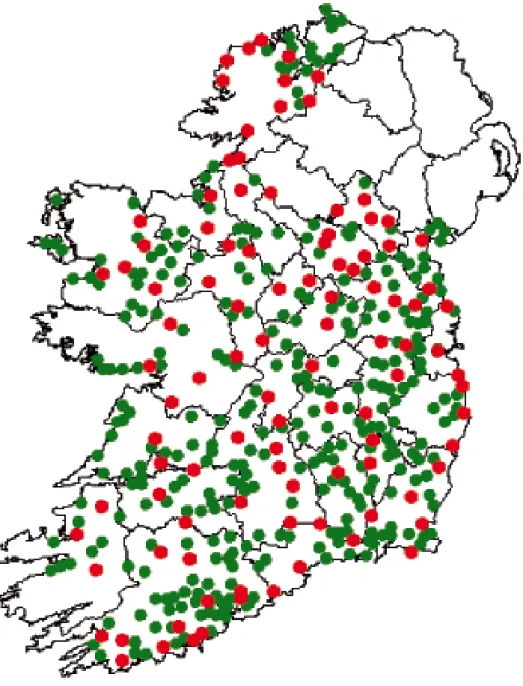
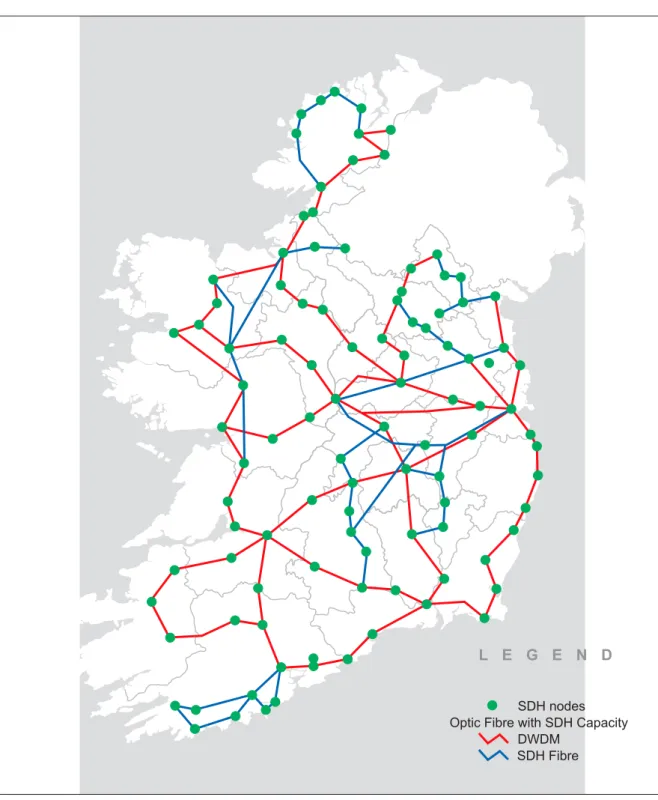
In the context of broadband access available network technologies such as PDH or SDH has a major bearing on the use of the network for local business. Figure 5.1.1 displays the fibre access nodes provided by Eircom. The figure includes some planned SDH nodes that will be implemented before the end of 2001. The Dublin located nodes have not been displayed.
The map illustrates how the majority of optic fibre nodes throughout the country use PDH technology which is less suited for the provision of advanced data services such as ISDN or ADSL.
Eircom has in excess of 1,000 exchanges and RSUs around the country, of these 120 exchanges are covered by the planned roll out of SDH. Because of their concentration in the urban areas and larger towns this covers some 60% of all fixed lines.
Some 277 exchanges are connected with fibre using PDH technology, these have limited flexibility in offering advanced data services.
The remaining exchanges and RSUs are not directly connected to the optic fibre network. These are connected using copper, coaxial and microwave links. Until these are upgraded local firms and users are disadvantaged in their ability to participate fully in the emerging e-economy. It is expected that some of the areas covered by these exchanges will benefit in the short term from the deployment of FWPMA/FWA infrastructure.
Interconnection capacity between the nodes is important in the context of regional service provision and demand. Figure 5.1.2 illustrates Eircom's existing and planned interconnection of SDH nodes. Nearly all links shown are STM-16 links operating at 2.5Gbit/s. Fibre counts on many of these routes will be increased in the immediate future and a greater number of the main regional routes will use DWDM technology that can increase capacity, currently by a factor of 32.
By the end of 2001, Eircom will have connected all of its core telephone exchanges and some remote subscriber units (RSUs) to an SDH-based trunk network.
Since the late 1980s Irish telecommunications infrastructure has benefited from EU Structural Funds support, including the EIOP. The present EIOP projects include the development of a 75 km fibre optical backbone in Donegal with INTERREG fund support and the upgrade of the Suir Nore Relays cable TV system. Such European regional development support is also to be provided for the deployment of a fibre optical backbone along the west coast from Sligo to west Cork. The map has included the proposed Donegal ring and the planned interconnection between Castlebar, Westport, Tuam and Galway.
It is expected that a series of additional projects will be supported in the BMW and SE regions, in addition to ‘in-fill’ projects in the Dublin region, under the call for projects for Structural Funding that is being undertaken by the Department of Public Enterprise at present14.
14.Structural Funds for the Development of e-Commerce and Communications Infrastructures and Services in Ireland. Competition announced in July 2000.
Figure 5.1.2: Broadband Network
L E G E N D
SDH nodes Optic Fibre with SDH Capacity
DWDM SDH Fibre
The ESAT network is the other main national network. ESAT has been building a fixed line backbone network along the CIE rail network linking the main cities and towns throughout the country. However for most users local access still means access through the Eircom local loop network.
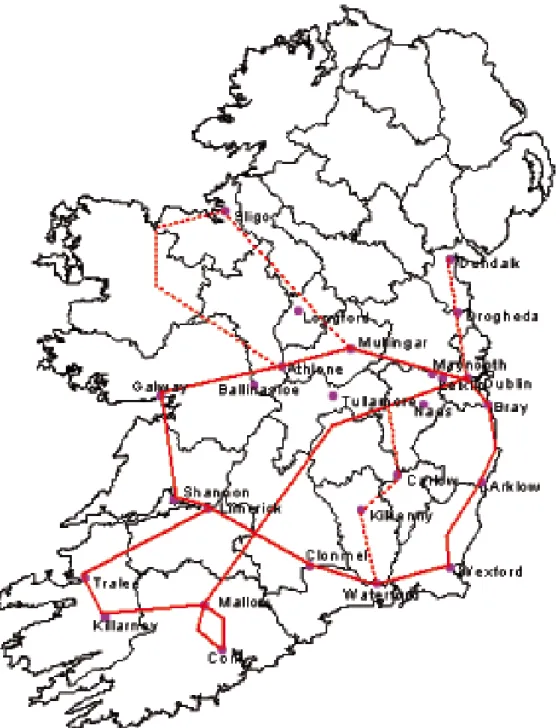
In addition to this, ESAT has deployed optic cable in industrial estates in Dublin, Cork, Galway, Shannon, Waterford and the National Technology Park in Limerick. Figure 5.1.3 illustrates the ESAT network where it can be seen that the focus is on the cities and larger urban areas.
NTL has constructed a network linking Dublin to Belfast. A number of other networks are being built. For example the ESB Dublin to Shannon diverse network. The OCEAN backbone from Dublin to Galway and the Ocean/Chorus network from Galway to Cork.
It would appear that areas, primarily the cities and major towns, that are already reasonable well favoured with telecommunications facilities are being targeted by the additional alternative carriers and suppliers. Competition in these areas will result in lower tariffs and a greater and more rapid uptake of Information Society developments.
FWPMA (Wireless local loop)
Narrow band and Broadband FWPMA licences have been issued to:
- Eircom
- ESAT
- Chorus (Irish Multichannel):
A Broadband licence has been issued to Formus Communications Ireland. It is proposed by the ODTR to issue three further FWA licences during the first quarter of 2001, two broadband and one narrow band licence.
These alternative wireless local loop infrastructures (FWPMA/FWA) will provide access to both the business and residential sectors. FWPMA access can be rapidly deployed to customers by line of sight from the nearest transmit antenna. These networks are currently being deployed and the licensees are not prepared, for commercial reasons, to disclose their individual planned coverage and roll-out programmes. Currently, Chorus and ESAT are conducting technical trials and Formus Communications has commenced providing service to 20 companies. Each broadband licence holder is required to have a minimum of 15 base stations in 15 counties within three years.
Nevertheless the early deployment of FWPMA/FWA should have significant impact on local access to telecommunications. FWPMA/FWA will be used for local access that is then interconnected to the national Eircom backbone or to a network node provided by an OLO. Deployment will provide alternative localloop facilities as part of national network access.
OLOs who are deploying services will have to interconnect to Eircom's network unless there is local access to an alternative supplier. As a result it is not immediately apparent that competitive service provision will arise in areas that have not already access to an alternative network or infrastructure. What will likely happen is that when an alternative supplier targets an underdeveloped area, Eircom will respond competitively by upgrading its local facilities in the area.
Cable and MMDS
The Cable and MMDS sector is controlled by NTL and Chorus (Irish
Multichannel), both of whom are currently upgrading their cable networks in Dublin, Limerick and Cork for the provision of Internet access, voice services and Digital television.
NTL controls the earlier Cablelink networks. Chorus in addition to its cable and MMDS operations also controls CMI and Suir Nore Relays cable and MMDS networks. Chorus is installing an optic fibre network linking Galway to Cork. This will enhance the microwave backbone network which links its MMDS transmitters.
In all probability the use of cable modems to access and deliver Internet type services will only occur in the major urban areas in the medium term. The urban areas that will have access to modern cable systems will also have access to SDH systems and thus will be able to access ADSL broadband services, when they are rolled out.
DTT
The plan is to spin off Digico, the transmission network business unit, from RTE to run the national digital terrestrial television (DTT) network. The DTT network will be built using the transmission sites presently used by the existing analogue network, but will require a significant number of additional
transmission sites and masts. DTT is relevant in the context of spatial planning provided that it is licensed to carry significant data business services.
In addition to terrestrial digital TV trials by RTE, both NTL and Chorus have conducted Digital MMDS trials. Both NTL and Chorus have announced digital TV roll out plans which are not dependent on the roll out of digital services by either RTE or TV3. Currently Southcoast Community Television, a Cork based TV deflector operator, is undertaking a trial of local digital TV transmission.
Satellite transmission services
Of immediate interest is the use of VSAT to provide broadband access to remote communities. The Department of Public Enterprise is presently conducting a call for VSAT based broadband infrastructure pilot projects. The aim is to stimulate developments in this area. Trial applications for industry, educational institutes, public services are expected. Broadband access capacity of 2 Mbit/s or higher is envisaged.
Satellite TV operators, such as BskyB, could offer high speed Internet using satellite as the forward path and the phone line as the return channel.
Essentially broadband services will be delivered through by-passing the national backbone and local loop infrastructure. This will prove that a latent demand exists in areas not presently covered by adequate infrastructure.
GPRS
Eircell is scheduled to commence trials of GPRS with corporate customers shortly and to roll out the service over the next few years. GPRS allows users to log into a data network, such as a company LAN or an Internet service provider.