Tony DiVenti
Reliability and Risk Analysis Branch – Code 322
[email protected]
(301) 286-6507
How can you support
RIDM/CRM/RM through the
use of Risk Analysis
Supply Chain Conference 2011
Panel Session – NASA’s Approach to Integrated Risk Management
Agenda
•
What does Risk Analysis mean in the context of RIDM & CRM
•
NASA’s newest PRA requirements
•
How does GSFC flow down PRA requirements
–
Two Approaches
•
In-House PRA Development
•
Out-of-House PRA Development
–
GSFC’s Standard Mission Assurance Requirements (MAR) Document
3
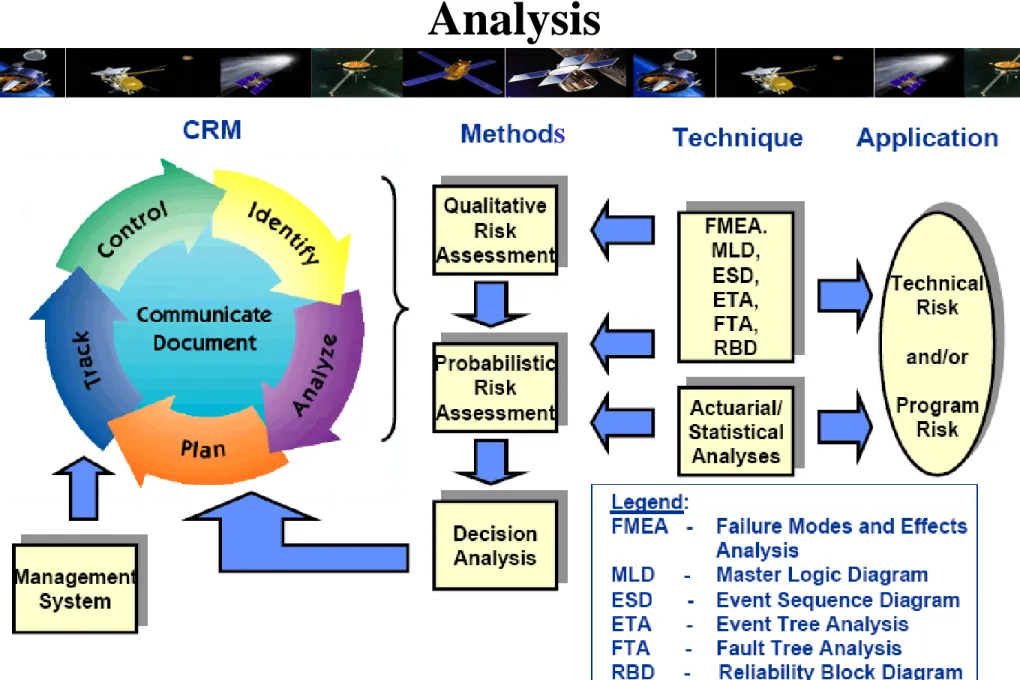
Relationship between RM and Risk
Analysis
Diagram taken from Source 7
What is PRA?
Definition:
Probabilistic Risk Assessment (PRA) is one of the key RIDM tools.
It is a scenario-based methodology (e.g., Event Trees, Fault Trees,
Quantification) aimed at identifying and assessing Safety and
Technical Performance risks in complex technological systems.
PRA characterizes:
1) What can go wrong?
2) How likely is it?
3) What are the consequences
5
What is PRA?
PRA Scenario Concept:
Taken from Source 7
What is PRA?
What makes PRA appealing is its ability to integrate several
sources of information together that may contribute to Risk.
7
What is PRA?
The integrated
risk scenario
model allows for
a robust and
ordered ranking
of the risk
contributors that
may lead to the
undesired states
of interest
Taken from Source 5
Two-Sets of Requirements governing
PRA activity at GSFC
Applicable requirements pulled from:
• NPR 8705.5A PRA Procedures for NASA
Programs and Projects (2010)
• NPR 8715.3C NASA General Safety Program
Requirements (2012)
9
Some of the Significant Changes to NPR
8705.5 made in conjunction with RIDM
•
Removed language addressing Full, Simplified, and Limited
Scope PRA.
•
Greater emphasis on PRA Planning/PRA Plan Documentation
- Formal PRA Plan shall be developed by PRA Lead and approved by
Program/Project Manager to:
-
Identify specific end-states (undesirable consequences, performance
measures, figures of merit) of interest consistent with PRA objectives
-
Define quantitative performance measures and numerical criteria that are to
be evaluated by the PRA consistent with objectives
-
Develop a PRA schedule compatible with objectives, applications, and life
cycle phases approved by the Program/Project manager
- Greater tie-in with Program/Project characterization of
NPR 7120.5 NASA Space Flight Program and Project
Management Requirements
- Use of Category 1 (i.e., LCC greater than 1 Billion dollars,
Nuclear Payloads, Human Spaceflight)
New NPR 8705.5 Requirements for GSFC
– Formal submittal of PRA Decisions – Cat I and Cat II,
Class A or Class B.
– Formal submittal of PRA plans, including scope and
rationale
– Requires Program Manager approval (note: PRA
decision/scope determination is the primary
responsibility of the Project subject to OSMA/Center
SMA Concurrence)
– Formal coordination of Independent PRA Review with
OSMA.
How is GSFC Flowing Down PRA
Requirements to Developers/Suppliers
• GSFC’s Mission Assurance Requirements (MAR)
PROBABILISTIC RISK ANALYSIS (PRA) AND RELIABILITY
Tailoring note: The PRA and reliability engineering section requires tailoring per the classification requirements of NPR
8705.4, NPR 8705.5, and project-specific requirements.
RELIABILITY PROGRAM PLAN
Tailoring note: If PRA is being invoked in section 4.2, change section 4.1to read from “...implement a Reliability Program Plan
(RPP)” to “...”implement a Reliability Program Plan, including the developer’s approach to PRA requirements in section 4.2, ..”
The developer shall document and implement a Reliability Program Plan (RPP) using both qualitative and quantitative techniques
to support decisions regarding mission success and safety throughout system development. The RPP shall include a detailed
approach to the analysis of hardware and software for their contributions to system reliability and mission success. The developer
shall present the implementation of these plans and related activities at milestone reviews beginning with the System Requirements
Review (DID 4-1).
PROBABILISTIC RISK ASSESSMENT
Tailoring notes: See paragraph 2.2.1a of NPR 8705.5 for criteria regarding the requirement to perform a PRA. If a PRA is not
required, delete this section and the related DIDs. If a PRA will be performed, delete the non-applicable paragraph and related
DID.
The developer shall perform a Probabilistic Risk Assessment in accordance with NPR 8705.5, Probabilistic Risk Assessment (PRA)
Technical Procedures for Safety and Mission Success for NASA Programs and Projects (DID 4-2).
The developer shall provide the information for a Probabilistic Risk Assessment per NPR 8705.5, Probabilistic Risk Assessment
(PRA) Technical Procedures for Safety and Mission Success for NASA Programs and Projects (DID 4-2).
11
October 19, 2011
Greenbelt, MD - GSFC
How is GSFC Flowing Down PRA
Requirements to Developers/Suppliers
• MAR Data Items Description (DID 4-1)
Title: Reliability Program Plan DID No.: 4-1
MAR Paragraph: 4.1 Use:
Planning and implementation of Probabilistic Risk Assessment (PRA) and reliability activities. Reference Documents:
- NPD 8720.1, NASA Reliability and Maintainability (R&M) Program Policy
- NASA-STD-8729.1, Planning, Developing and Managing an Effective Reliability and Maintainability (R&M) Program.
- NPR 8705.4 Risk Classification for NASA Payloads
- NPR 8705.5 PRA Procedures for NASA Programs and Projects
Place/Time/Purpose of Delivery:
- Deliver draft plan to the Project Office sixty (60) days after contract award for review.
- Deliver final plan to the Project Office thirty (30) days prior to the Systems Requirements Review for approval.
- Deliver activity reports related to implementation of the plan at milestone reviews beginning with the Systems Requirements Review for review.
Preparation Information:
The Reliability Program Plan shall include:
- A discussion of how the developer intends to implement and comply with Reliability program requirements.
- Charts and statements describing organizational responsibilities and functions conducting each task to be performed as part of the Program.
- A summary (matrix or other brief form) that indicates for each requirement, the organization responsible for implementing and generating the necessary documents.
- Identify the approval, oversight, or review authority for each task.
How is GSFC Flowing Down PRA
Requirements to Developers/Suppliers
MAR DID 4-1 –
use
this DID if the developer is performing the
PRA
13
Title: Probabilistic Risk Assessment DID No.: 4-2 MAR Paragraph: 4.2
Use:
To provide a structured and disciplined approach to: analyzing system risk; supporting management decisions; improving safety, operations, performing maintenance and upgrades; improving performance; reducing costs.
Reference Documents:
- NPR 8705.4 Risk Classification for NASA Payloads
- NPR 8705.5 Technical Probabilistic Risk Assessment (PRA) Procedures for Safety and Mission Success for NASA Programs and Projects
- NPR 8715.3 NASA General Safety Program Requirements
- PRA Procedures Guide for NASA Managers and Practitioners (http://www.hq.nasa.gov/office/codeq/doctree/praguide.pdf) Place/Time/Purpose of Delivery:
- Deliver a PRA plan to the Project office sixty (60) days after contract award for review (Note: PRA may be stand-alone document or included as part of the Reliability Program Plan (RPP), Risk Management Plan (RMP), etc. The PRA Plan shall meet requirements delineated in DID 4-1.).
- Deliver interim PRA to the Project Office thirty (30) days prior to PDR for review.
- Deliver updated interim PRA to the Project Office thirty (30) days prior to CDR for review.
- Deliver updated interim PRA to the Project Office thirty (30) days prior to MOR for review.
- Deliver final PRA to the Project Office thirty (30) days prior to FOR for approval. Preparation Information:
The PRA shall be performed in accordance with NPR 8705.5 and include the following:
- The objective and scope of the PRA
- End-states-of-interest to the decision-maker,
- Definition of the mission phases and success criteria,
- Initiating event categories,
- Top level scenarios,
- Initiating and pivotal event models (e.g., fault trees and phenomenological event models), including assessments of common cause failure modes
- Data development for probability calculations,
- Integrated model and quantification to obtain risk estimates,
- Assessment of uncertainties,
- Summary of results and conclusions, including a ranking of the lead contributors to risk.
How is GSFC Flowing Down PRA
Requirements to Developers/Suppliers
MAR DID 4-2 –
use
this DID if the GSFC is performing the PRA
Title: Information for the Probabilistic Risk Assessment (PRA) DID No.: 4-2 MAR Paragraph: 4-2
Use:
To provide a structured and disciplined approach to: analyzing system risk; supporting management decisions; address safety, operations, maintenance, and upgrades; manage performance; manage costs.
Reference:
- NPR 8705.4 Risk Classification for NASA Payloads
- NPR 8705.5 Technical Probabilistic Risk Assessment (PRA) Procedures for Safety and Mission Success for NASA Programs and Projects
- NPR 8715.3 NASA General Safety Program Requirements
- PRA Procedures Guide for NASA Managers and Practitioners (http://www.hq.nasa.gov/office/codeq/doctree/praguide.pdf)
Related Documents None
Place/Time/Purpose of Delivery:
- Deliver preliminary heritage information, including the percent applicable, to the Project Office sixty (60) days after contract award for information.
- Deliver updated heritage information, including the percent applicable heritage to the subject mission, to the Project Office thirty (30) days to prior major milestone reviews beginning with the SRR for information.
- Deliver product information and process information for elements within the scope of the Mission PRA to the Project Office thirty (90) days prior to the PDR and thirty (30) days prior to subsequent major milestone reviews for information.
PreparationInformation:
The government will provide a notification to the developer of the scope and/or area of inputs needed to support the risk assessment 30 days prior to needing information in preparation of the PRA. Types of information needed may include heritage information (e.g., current flight history, current operating hours, operational and storage environments, TRLs, etc.), product information (e.g., hardware and/or software configurations, parts lists, schematics), interim analysis (e.g, working-level copies of fault tree analysis, failure modes and effects analysis, reliability predictions, etc) and/or process information (e.g., design documents, manufacturing documents, parts program documents,etc)