International Journal of Advanced Research in
Computer Science and Software Engineering
Research Paper
Available online at: www.ijarcsse.com
A Web- Based Project Management System
Aaron. A. Izang, Chinyere. C. Ihesiulo, Miracle Ofuru, Chukwuebuka Okafor
Department of Computer Science Babcock University, Ilishan-Remo, Ogun Sate, Nigeria
Abstract— As business become increasingly dependent on Information Technology for their operations, project managers find themselves under pressure to remain innovative and go forward to deliver quality projects, on time and within budget constraints. However, some organizations still find it hard to plan and track project components, stakeholders and resources. Additionally, project managers, team members and customers do not communicate frequently to share their expert opinions. Projects tend to extend beyond scheduled deadlines, not necessarily due to lack of resources or incompetence of projects members, but often because of inability to elicit requirements completely and inadequacy of proper communication. To this end, with the advent of Information Technology, there has been an increase in the demand for software that make jobs easier for people, as a result, to keep up with rising demand, project managers need a way to effectively manage their software projects. Using the iterative methodology, a web based software project management system was developed, that fully monitors project progress, allocates tasks, creates milestones and provides an avenue for stakeholders to track project progress during its development phase. The developed system solves the problem of unity and lack of communication. With the system, once added to a new project, all participating members may send messages to one another and keep tabs on the progress of the project so as to implement the stakeholder’s requirements efficiently.
Keywords— Web-Based, Project, Management System, Software, Stakeholders
I. INTRODUCTION
A project can be simply defined as a task to be completed within a given time. Projects can be grouped into three major categories; Industrial projects (civil engineering, construction, petrochemical, mining and quarrying), manufacturing projects and management projects [1].
Projects may differ in scale, but there are some notable characteristics that each project has, these characteristics may include [2];
i. projects are to be completed within a specified time period.
ii. projects have specific, measurable, achievable, and realistic objectives.
iii. projects are completed within a specified budget.
Project management is the employment of knowledge, expertise, tools and methods to project activities that satisfy project requirements [3]. The term project management is sometimes used to describe an organizational approach to the management of ongoing operations [4]. This approach, more properly called management by projects, treats many aspects of ongoing operations as projects to apply project management techniques to them.
II. WHATISAPROJECTMANAGEMENTSYSTEM?
A project management system is a software that has the ability to help strategize, organize, and manage resource streams and develop resource approximations. Depending on the complexity of the software, resource breakdown structures, resource availability, resource rates and various resource calendars can be defined to assist in optimizing resource utilization. [3]
There are different types of project management systems used to handle projects. They are unique in operation, depending on the kind of project one is managing. [4] listed the types as;
i. A desktop project management system is implemented as a program that runs on the desktop of a particular user.
Users and organizations can purchase it as a desktop package. The advantage of this type is the highly responsive and graphically-intense user interface.
ii. A web-based project management system is implemented as a web application to be accessed via a web browser, or an extranet. It is multi-user, and can be accessed from any computer without installing the software. They are usually less responsive than desktop applications, and users cannot access project information if they are offline.
iii. A personal project management system is designed for handling simple or home projects. It usually has a simple
April - 2016, pp. 39-45
iv. A single-user project management system is programmed with the conjecture that only one user will ever need
to work on the project plan at once. This may be used in small firms, or where only a few people are associated in top-down project planning. Desktop applications are commonly classified in this category.
v. A collaborative or client server is specially designed to support multiple users. It easily allows the multiple users who are working on different parts of a project at the same time. It incorporates multiple collaboration tools so that users can share knowledge and expertise.
III. RELATEDWORKS
Redmine is an open source software that provides budgeting, collaboration, customization, issue tracking, learning, support, notifications, resource management, and traditional project management functionality for small/medium businesses [5]
The best functional area of Redmine is traditional project management. It operates on online, mobile, and on premise platforms. Its features include: Gantt Chart and calendar (time tracking), web feeds and email notifications, tracking of multiple projects, simple time tracking, supports 34 languages, integrates news, documents, and file management, issue tracking system, flexible role-based access control.
Asana is a software that puts tasks and conversations together to help teams manage projects and rely less on email. Organize team projects, create and assign tasks, comment on progress, attach files and track due dates to keep your team mates accountable, and focused on results. It is free for teams up to 15 people, available on web, Android and IOS. Its features include: bug tracking, collaboration, email integration, file sharing, idea management, issue management, milestone tracking, project planning, status tracking, task management, time and expense tracking.
So also [6] developed a web-based system that helps organizations to recruit competent project managers before assigning of projects to such persons, but such system does not in cooperate communication among project team members as well as stakeholders.
To this end, this study was able to build on some of the lapses of the related works and literatures reviewed to come up with a perfect system that will not only help in software project development but will also satisfy all stakeholders involved in a particular project as most of their requirements will be meant.
IV. METHODOLOGY
The software development model that was used is the iterative model. This model was used because the iterative model allows for requirement changing.
WAMP was used for the development of the web-based project management system which has the following:
Windows operating system
Apache web server
MySQL to create the database for the application using PHPMyAdmin
HTML, CSS,PHP and JavaScript was used to design the web pages.
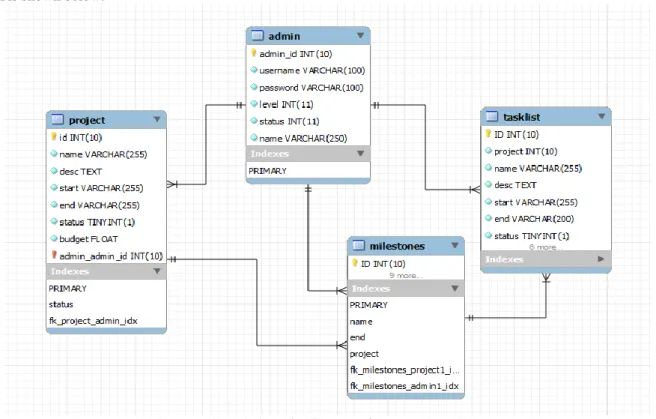
The entity relationship diagram for the web based project management system illustrating all components of the system is shown below.
April - 2016, pp. 39-45
Fig. 2 shows the system architecture of the web based project management system
Fig. 2 System architecture of the web-based project management system.
Fig 3 shows the use case diagram of the system of the system showing the actors, their roles and actions.
Fig. 3 The use case diagram of the system.
RELATIONAL DATABASE (MySQL, Oracle, MS SQL server) Web Server (Apache, IIS) Middleware PHP, ColdFusion, ASP, JSP Web Browser (Internet Explorer, Mozilla Firefox, Netscape)
administrator user Login Create Project Create Milestone Create tasklist Create User Send Message Logout Attach file Receive message Login View Project View milestone View tasklist Send Message Logout View Users
April - 2016, pp. 39-45
V. IMPLEMENTATIONOFTHEWEB-BASEDPROJECTMANAGEMENTSYSTEM
The system designed comprises of the front-end and the back-end. The front-end of the system includes the interface of the system, i.e. what the users can see. The front-end components include the various pages of the system i.e. Login page, the Admin page, the homepage, the project members page. Furthermore, these pages (front-end) are linked to the back-end component which contains the database of the system. Using PHP scripting language, the database was connected to the front end.
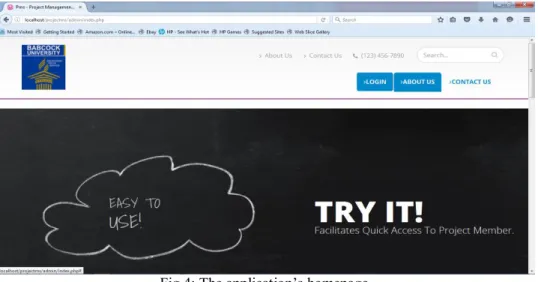
Fig 4: The application’s homepage.
The home page of the software is the first page of the system. From here users can login to the system, know more about us and contact us.
Fig 5: The login page.
This is the page that enables users gain access to the system through the use of their unique usernames and passwords. In this screenshot, a user named Salami is attempting to login using his username which is his email address and his confidential password.
April - 2016, pp. 39-45
This is a user’s home page, it displays the user’s name, the role the user plays and a calendar. From this page the user can view projects, milestones and task lists that he/she is working on.
Fig 7: The add project page.
This is the page that enables the administrator create new projects. In creating a new project, the admin assigns a start and end date to the project and a brief description of the project.
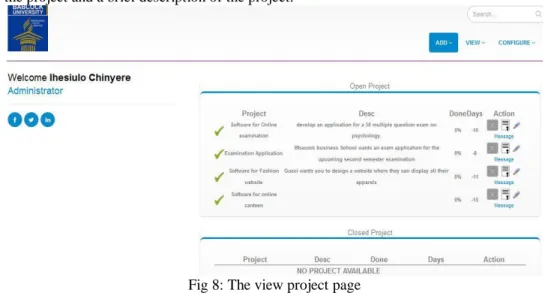
Fig 8: The view project page
This page displays all the projects that have been created on the system and their properties which includes the project name, the description of the project, the percentage of the project that is complete, the days that has been spent on a project and the actions the user can perform.
April - 2016, pp. 39-45
This is the page that enables the admin add new users to the system and assigns them to existing projects.
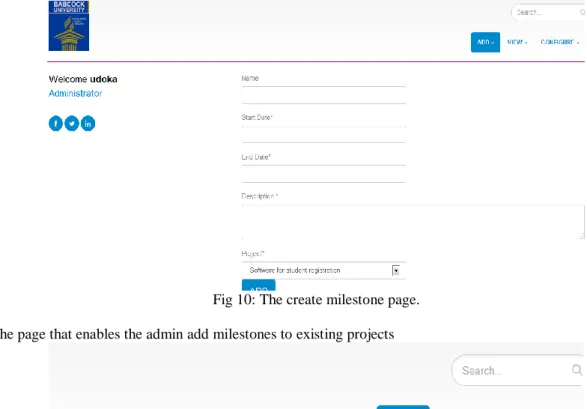
Fig 10: The create milestone page. This is the page that enables the admin add milestones to existing projects
Fig 11: The view milestone page. This displays the milestones of a particular project.
Fig 12: The create task page.
Here a new task “Follow up” is being created and assigned to Frank Dalusi with start and end dates as 2/25/2016 and 3/27/2016 respectively.
April - 2016, pp. 39-45
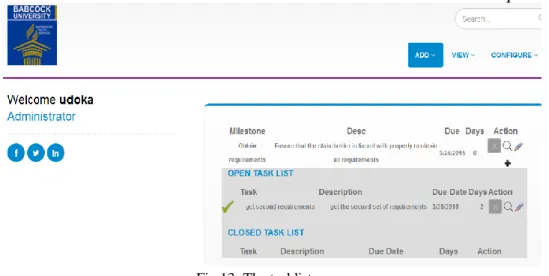
Fig 13: The tasklist page. This page displays the tasks needed to be carried out to complete a milestone.
VI. CONCLUSIONANDRECOMMENDATIONFORFURTHERSTUDIES
In conclusion, the developed system solves the problem of unity, and lack of communication. The system also breaches the gap between the stakeholders and the project manager by offering a platform whereby the stakeholder can monitor the progress of the system. With the system, all members once added to a new project can message each other, and keep tabs on the progress of the project. It is recommended that this web based project management systems should be deployed wherever the need to manage projects efficiently arises. They are convenient to use, save time and resources, and reduce both stationery and labour costs. For further studies, this system can be modified by other researchers to be adapted in their various areas of study.
REFERENCES
[1] Reynolds, J. (2015). PROJECT MANAGEMENT: THE 3 MAJOR PROJECT TYPES. Retrieved from Project
Smart: https://www.projectsmart.co.uk/project-management-the-3-major-project-types.php
[2] Brown, S. (2012, May 4). What are the three key characteristics of a project. Retrieved from Projects Projects
Projects:
www.projectsprojectsprojects.com/project-management/what-are-three-key-characteristics-of-a-project/what-are-the-three-key-characteristics-of-a-projects
[3] Institute, P. M. (2008). A Guide to the Project Management Body of Knowledge(PMBOK Guide). Newton
Square, Pennsylvania, USA: Project Management Institute Inc.
[4] Mohamed, A. (2016). Project management software- Essential Guide. Retrieved from ComputerWeekly.com:
www.computerweekly.com/feature/Project-management-software-Essential-Guide
[5] Lang, J.-P. (2014). Redmine. Retrieved from Redmine: www.redmine.org
[6] Izang, A. A; Ogbonna, A.C; Kuyoro, S.O; Omotunde, A.A & Akande, O. (2015) A Web-Based Decision
Support System for Project Manager’s Proficiency, International Journal of Advanced Research in
Computer Science and Software Engineering, Volume 5, Issue 11, November 2015 ISSN: 2277 128X. Research Paper Available online at: www.ijarcsse.com