WARES PROJEC T PUBLICATIONS
Financial Support for Renewable
Energy Implementation
in Finland, Norway, Scotland, Northern Ireland and Ireland
Victor Pavlov, Niko Hänninen and Eva Pongrácz
Castlebrae Business Centre, Peffer Place
FI-90014 University of Oulu, P.O.Box 7300
Edinburgh EH16 4BB
Environmental Sciences Building
Scotland
(UK)
Finland
Tel. +44 131 202 2750
Tel. +358 294 48 7417
[email protected]
[email protected]
http://www.waresnpp.eu
https://twitter.com/WARES_npp
Graphic design Hannele Heikkilä-Tuomaala Printed in Juvenes Print – Oulu, 2014 ISBN 978-952-62-0571-7
Table of Contents
Introduction
3
1
Finland
5
2
Norway
7
3
Scotland
9
3.1
Loans for renewable energy producers
9
3.2
Feed-in tariff system in Scotland
10
3.3
The
Renewables
Obligation
11
3.4
Tax
regulation
mechanisms 12
3.5
Crowdfunding
13
4
Northern
Ireland
15
5
Ireland
17
6
Summary 20
Introduction
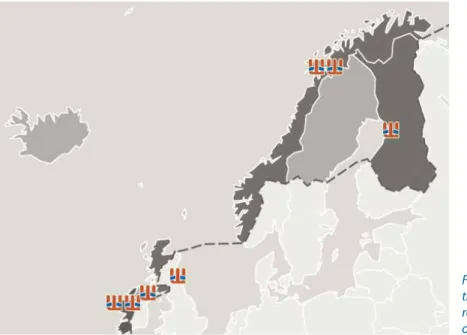
This report is published within the Water Asset Re-newable Energy Solutions (WARES) project. WARES is a two-year strategic project of the Northern Pe-riphery Programme, which explores the opportuni-ties to generate renewable energy at water utility as-sets. The project is led by the International Resourc-es and Recycling Institute in Scotland, in partnership with Action Renewables in Northern-Ireland, Mayo County Council and Clár-ICH in Ireland, Narvik Sci-ence Park and Northern Research Institute in Nor-way, and the University of Oulu in Finland. The map of the Northern Periphery region and the location of partners is illustrated in Figure 1.
The aim of WARES is to provide innovative re-newable energy solutions to remote areas by
find-Figure 1. The map of the Northern Periphery region and the location of partners.
ing unused opportunities for renewable energy generation within the activities and property of the water sector. WARES will establish partnerships between the water industry and neighbouring communities and help sourcing the capital invest-ment required to commercialise these opportuni-ties, such as creating Public Private Partnerships.
This report describes the types of financial support, which can be used by water companies for renewable energy implementation in Finland, Norway, Scotland, Northern Ireland and Ireland. In addition, the report will also provide a brief over-view of renewable energy potential and types of technologies supported in these countries.
1 Finland
Financial support for renewable energy implemen-tation is provided by the Finnish Energy Authority and the Ministry of Employment and Economy. The two key categories of financial support are subsi-dies and the feed-in tariff.
Subsidies, or energy aid, for implementing re-newable energy can cover up to 15-30% of invest-ment cost. Energy aid is also applicable for research projects dealing with renewable energy solutions. The extent of support varies depending on the re-newable energy technologies. In Finland, support is provided for solar photovoltaic and solar ther-mal, anaerobic digestion, bioenergy, wind pow-er, geothermal energy, heat recovery from waste-water and small-scale hydropower. In addition, if a project is aiming at improving energy efficiency and decreasing environmental impacts from the energy sector, it can also be eligible for support. These investments are expected to implement state-of-the-art technologies. If a research and de-velopment (R&D) project intends to implement a new technology, the financial support can be up to 40% of total costs. Private companies, municipali-ties or organization are all eligible applicants. The applications for subsidies are sent to regional Cen-tres for Economic Development, Transport and the Environment (ELY Centres). The ELY Centres are in charge of funding decisions for renewable energy projects with a budget up to 250 000 euros and for research projects or implementation of new tech-nologies – up to 5 000 000 euros. In case the budg-et is higher, the decisions are made by the Ministry of Employment and Economy. The received ener-gy aid is paid either in several parts or at once de-pending on the decision of the competent
authori-ty. The only limitation for the subsidy holder is that at least 25% of the total project cost should come from non-state financial sources. Subsidies can-not be given to farms, households, co-operatives and construction projects that already have been granted state aid. If a project is done in collabora-tion with several organizacollabora-tions, the subsidy is given to the lead partner of the project. All the subsidies are paid by the Ministry of Employment and the Economy, which is the main responsible authori-ty, and provide from the state budget. (Mikkonen, 2013; Brückmann, 2013)
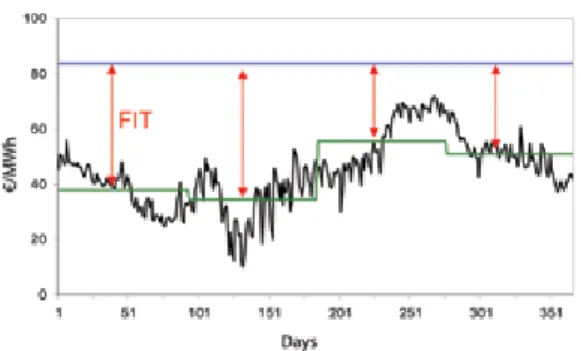
Figure 2. Schematic representation of feed-in tariff (FIT) support in Finland. The blue line represents the target price, the black line the daily power market price fluctuation and the green line the three months average of power market price. The amount of feed-in tariff is represented by the red arrows.
The feed-in tariff (FIT) support became availa-ble in Finland in 2010. In 2012 about 100 million eu-ros were provided to subsidize renewable energy. The concept of FIT is illustrated in Figure 2. In gen-eral, FIT makes it profitable for a renewable pow-er producpow-er to be present on the enpow-ergy market with the help of financial support from the
govern-6
ment. This support is meant to cover the difference between the average energy market price and the target price. Currently, the target price in Finland is 83,5 €/MWh.
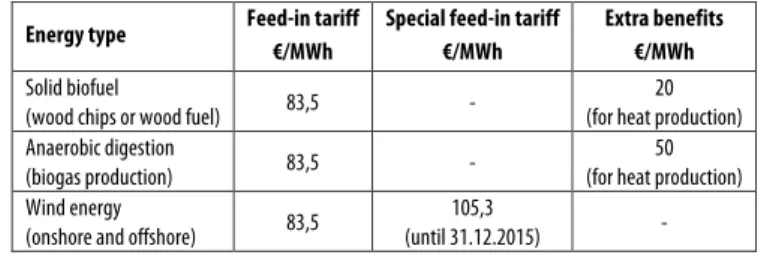
As illustrated in Figure 2, the energy mar-ket price varies daily (black line). FIT is the differ-ence between the target price and the average of last three months’ market price. If, for example, a biogas plant can sell for the energy market for an average of 38 € per MWh, the Finnish government will support bioenergy production by paying the biogas plant an extra 45,5 € per MWh. (MEE, 2013b; Brückmann, 2013) This financial support can relate to different renewable energy sources; however, in focus are especially wind energy, energy produc-tion from wood chips or wood fuels and anaerobic digestion. There is a special feed-in tariff of 105,3 €/ MWh for wind energy, which is valid until the end of 2015, as shown in Table 1. In addition, if a bioener-gy or biogas production utility generates also heat, they are allocated extra 20 and 50 €/MWh. (Brück-mann, 2013)
The application process starts when energy producer with an already constructed plant informs the Finnish Energy Authority about the intention to start energy production. The energy producer pro-vides the authority with all the technical specifica-tions of the facility. The exception is a wood chips energy production plant, which can
start operation and then apply for the feed-in tariff support. If all the formal requirements are met, the Energy Authority decides about the allocation of financial support. The allocation criteria are as fol-lows (Brückmann, 2013):
• The feed-in support holder should be based on Finnish terri-tory or in Finnish waters, and con-nected to the electricity grid; • All the technical and
eco-nomic requirements related to energy production should be met;
• No previous grants or state support;
• The energy utility should be entirely construct-ed from new parts;
• Minimal capacity requirements: a) For wind energy – at least 500 kVA, b) For anaerobic digestion (AD) and bio-
energy based on solid biofuel – at least 100 kVA;
• The energy efficiency of AD and bioenergy must be at least 50%;
• There should be both heat and power produc-tion with AD;
• If the average energy market price for the last three months is lower than 30 €/MWh, according to the Finnish regulations, the target price should be lowered to 30 €;.
• The feed-in tariff is applicable only until a pro-duction limit is achieved, which is:
a) 2 500 MVA for Wind energy; b) 19 MVA for AD
c) 150 MVA for bioenergy based on solid biofuels
The Ministry of Employment and the Econo-my (MEE) and the Energy Authority are in charge of feed-in tariff support decisions. The MEE, as the main competent authority, is responsible for man-agement, supervision and assessments, whereas the EA deals with practical legal matters and pay-ments of the tariffs and the bonuses. The
maxi-mum period a company can receive the support is 12 years. The feed-in tariff is funded from the state budget (Brückmann, 2013).
5
Figure 2 Schematic representation of feed-in tariff (FIT) support in Finland.
The blue line represents the target price, the black line the daily power market price fluctuation and the green line the three months average of power market price. The amount of feed-in tariff is represented by the red arrows.
As illustrated in Figure 2, the power market price varies daily (black line). FIT is the difference between the target price and the average of last three months’ market price. If, for example, a biogas plant can sells power on the power market for an average of 38 € per MWh, in order to support bioenergy, the Finnish government pays the biogas plant an extra 45,5 € per MWh. (MEE, 2013b; Brückmann, 2013) This financial support can relate to different renewable energy sources; however, in focus are especially wind energy, energy production from wood chips or wood fuels and anaerobic digestion. In the case of wind energy, there is a special feed-in tariff of 105,3 €/MWh until the end of 2015, as shown in Table 1. In addition, if a bioenergy or biogas production utility generates also heat, they are allocated extra 20 and 50 €/MWh. (Brückmann, 2013)
Table 1. Amount of feed-in tariff support for renewable energy solutions in Finland. (based on Brückmann, 2013).
Energy type Feed-in tariff €/MWh Special feed-in tariff €/MWh Extra benefits €/MWh
Solid biofuel
(wood chips or wood fuel) 83,5 - (for heat production) 20 Anaerobic digestion
(biogas production) 83,5 - (for heat production) 50 Wind energy
(onshore and offshore) 83,5 (until 31.12.2015) 105,3 -
The application process starts when energy producer with an already constructed plant lets the Finnish Energy Authority know about the intention to start energy production activity. The energy producer informs also about all the technical specifications of the facility. The exception here is a wood chips energy production plant. It can start operation and then apply for the feed-in tariff
Table 1. Amount of feed-in tariff support for renewable energy solu-tions in Finland. (based on Brückmann, 2013).
2 Norway
In Norway, if a water company is interested to im-plement renewable energy technology as an on-site installation, the Norwegian authorities can help the company through “Electricity certificates with-in the quota obligation program”. This quota pro-gram was established to support the development of renewable energy market in Norway. The parties under the quota obligation system are electricity suppliers and electricity consumers. The program is based on electricity certificates, which are tradable in the electricity certificates market and function as medium of renewable energy exchange between producers and consumers. Under the program, en-ergy producers are interested to sell the renewable energy certificates, whereas consumers are obliged by the government to buy them in certain propor-tion or quota. (Pobłocka, 2013) The scheme of the quota program is illustrated in Figure 3.
Figure 3. The scheme of joint quota system for elec-tricity market in Norway and Sweden (NVE, 2012). Key stakeholders: 1) authorities, 2) energy producers, 3) certificates market, 4) quota obligation, and 5) con-sumers.
The quota system originates from Sweden where it was established in 2003. Since 2012 the electricity certificate market has been carried out as
a Swedish-Norwegian collaboration. The main ob-jective of the energy market union is to meet the requirements of the Europe 2020 strategy and the Renewable Energy Directive. Among the mutual advantages are more efficient use of renewable re-sources, more participants on the energy market, good financial support for renewable energy tech-nologies and more cost-efficient renewable energy production. (NVE, 2012)
The quota system applies to all renewable en-ergy solutions: wind, wave, solar, geothermal, hy-dropower, anaerobic digestion as well as bioen-ergy. As Figure 3 illustrates, the electricity certifi-cate flow is directed towards electricity end users and the financial support toward the energy pro-ducers. The main source of funding is electricity end-users. The authorities responsible for electric-ity certificates in Norway are the Norwegian Wa-ter Resource and Energy Directorate (NVE), which is in charge of the management and monitoring of the quota system, and the Norwegian transmission grid operator Statnett. Statnett registers the elec-tricity certificates and supports renewable energy production. Each electricity certificate is worth 1 MWh of production. If for instance a water compa-ny would generate 5 MWh of saleable power, they would receive five electricity certificates (or green certificates). (Pobłocka, 2013; NVE, 2012) The water company would also have the right to sell the tificates to energy consumers on the electricity cer-tificate market. The market is open for Norwegian and Swedish electricity consumers. Energy con-sumers are obliged to buy certificates by law; they must have a certain proportion of electricity us-age originating from renewable sources. The
quo-8
ta program is set by the Electricity Certificate Act and the yearly quota obligation cofficients are seen from Table 2. (NVE, 2012)
Table 2. Quota obligation values in Norway between 2012-2035. (Based on NVE, 2012).
The maximum value of quota obligation is set for the year 2020, which is 0,183; after which it de-creases. The peak corresponds with the 2020 Strat-egy. Based on this quota obligation, in 2020, for instance, at least 18,3% of the total energy con-sumption of the end users must be covered by re-newable sources. To meet this goal, energy users must buy electricity certificates sold by renewable energy producers. As the energy price with the re-newable energy certificates is higher than the reg-ular price of energy, this makes the system attrac-tive for renewable energy producers. (NVE, 2012)
8
producers. The the main source of funding are electricity end-users. The authorities responsible for
electricity certificates in Norway are the Norwegian Water Resource and Energy Directorate (NVE)
that is in charge of management and monitoring of the quota system, and the Norwegian
transmission grid operator Statnett that registers the electricity certificates and supports renewable
energy production. Each electricity certificate is worth 1 MWh of production, if for instance a water
company would generate 5 MWh of salable power, they would receive five electricity certificates
(or green certificates). (Pob�ocka, 2013; NVE, 2012) The water would also have the right to sell the
certificates to energy consumers on the electricity certificate market. The market is open for
Norwegian and Swedish electricity consumers. Energy consumers are obliged to buy certificates by
law; they must have a certain proportion of electricity usage originating from renewable sources.
The quota program is set by the Electricity Certificate Act and the yearly quota obligation
cofficients are seen from Table 2. (NVE, 2012)
Table 2
. Quota obligation values in Norway between 2012-2035. (Based on NVE, 2012).
Obligation year Quota obligation coefficient (proportion of renewable energy)
2012 (first year) 0,030 2016 0,108 2020 0,183 2026 0,164 2030 0,094 2035 (last year) 0,009
The maximum value of quota obligation is in the year 2020: i.e. 0,183. After 2020, it is set to
decline. The peak corresponds with the 2020 Strategy and means that, in 2020, electricity end users
need to have at least 18,3% of their total energy consumption coming from renewable sources. To
satisfy this, energy users must buy electricity certificates sold by renewable energy producers. As
the energy price with the renewable energy certificates is higher than the regular price of energy,
this makes the system attractive for renewable energy producers. (NVE, 2012)
The certificates are cancelled by the end of the year and the consumers need to buy new ones to
meet the quota obligation. This creates continuous demand. Failure to meet the quota will result in a
fine, which is 150% of the electricity certificates yearly average price. (NVE, 2012) The price for
electricity certificates is included in the customer’s electricity invoice and they would only pay for
their actual consumption. The system is easy to use for the end-user. For companies to be involved,
the conditions are the following (NVE, 2012):
!
Renewable energy production should be built within licensing terms;
!
Renewable energy production was started after 2009. The exception is hydropower plants;
The certificates expire at the end of the year and the consumers need to buy new ones to meet the quota obligation. This creates continuous de-mand. Failure to meet the quota will result in a fine, which is 150% of the electricity certificates yearly average price. (NVE, 2012) The price for electricity certificates is included in the customer’s electricity invoice and they pay only for their actual consump-tion. The system is easy to use for the end-user. For companies to be involved, the conditions are the following (NVE, 2012):
• Renewable energy production should be built within licensing terms;
• Renewable energy production was started af-ter 2009. The exception is hydropower plants; • Renewable energy producers that would be-gin to function after 2020 are not eligible;
• The assignment period is 15 years. However, if company has been present on the energy market before 2012, the years of presence shall be deduct-ed from the assignment period. For instance, if Nor-wegian wind park was launched in 2010, the assign-ment period is 13 years;
• If a renewable energy producer has received previously government state grants, which have not been repaid before 2012, then this producer is not eligible for the quota program.
3 Scotland
In Scotland, (as well as in Wales and England), a wa-ter company as a producer of renewable energy has access to the following financial support instru-ments:
• Loan; • Feed-in tariff;
• Quota system (Renewables obligation); • Tax regulation mechanisms; and • Other economic mechanisms (e.g. crowdfunding).
3.1 Loans for renewable energy producers
Loans have been available for renewable energy producers since 2013; however, they apply only to the solar energy. This campaign was launched as part of the British Green Deal (Qualifying Energy Im-provements) Order 2012. The Green Deal consists of 45 different measures to improve energy efficiency in buildings, including solar energy. Figure 4 illus-trates the loan scheme. (Tallat-Kelpšaitė, 2013)
Figure 4. The scheme of loans for solar energy in Scotland.
The targeted parties are property owners, both business and private. The idea is to reduce the need to buy energy and create savings through
so-lar installation. The loans can be paid in two possi-ble ways. The first option is to repay it during the lifetime of the solar panel investment, whereas the second option is to pay it back during a certain re-payment period specified in the Green Deal. The specified period can be 25 years at maximum. To receive the loan with the purpose of solar energy production, a property owner should address the Green Deal Oversight and Registration Body, which is the main competent authority. In the Green Deal Oversight and Registration Body, the property own-er should be in contact with a Green Deal Assessor. The Green Deal Assessor is responsible for assess-ing the potential and applicability of solar energy technology on the property. The Green Deal Asses-sor produces a Green Deal Advice Report on the feasibility of solar energy solution, which contains also recommendations about potential energy-ef-ficiency measures to be taken. Furthermore, the re-port contains estimates of potential savings from a financial point of view, if all the recommendations are implemented. After this, the property owner should find an appropriate Green Deal Provider to implement the recommendations. The Green Deal Provider is an entity that will receive the loan. Then the property owner and the Green Deal Provider sign a Green Deal Plan, which is a contract between them. The contract states the amount of the loan, that it should be repaid by the property owner to the Green Deal provider and the period of repay-ment. When this step is completed, the Green Deal Provider should find a Green Deal installer, who is in charge of solar panels installation. After finishing all the installations and implementations, the loan should be paid back by the property owner to the
10
Green Deal Provider via electricity bills. The loan is supposed to be lower than the actual savings in-curred by the implemented solar energy solution or any other stated energy efficiency measure. The latter is the so-called “Golden Rule” of the Green Deal. The source of funding originates from the Green Deal Finance Company created by the gov-ernment. (Tallat-Kelpšaitė, 2013)
3.2 Feed-in tariff system in Scotland
The feed-in tariff system has been available since 2010 and is applicable for such renewable energy solutions as hydropower, anaerobic digestion, solar photovoltaic energy and wind energy. The main lim-itation is that the capacity of the technologies has to be fewer than 5 MW. The aim is to support the im-plementation of renewable energy technologies by making production of renewable energy financial-ly viable for the producers. This extra support helps them to enter the energy market easier and receive guaranteed pay-back of their investments. The gen-eral scheme of the feed-in tariff in Scotland is pre-sented in Figure 5 (Tallat-Kelpšaitė, 2013)
Figure 5. The scheme of feed-in-tariff in Scotland. The entitled parties are renewable energy pro-ducers. With the help of the feed-in tariff, they are able to sell electricity to energy markets under the actual production cost, but still cover their own costs. This mechanism lowers the barriers of entry to the energy markets for potential renewable en-ergy technologies. (Tallat-Kelpšaitė, 2013)
In order to become a feed-in tariff support holder, a renewable energy producer first needs to know what is the planned capacity of the pro-posed energy installation. If it is less than 50 kW, re-newable energy producer has to inform the elec-tricity supplier about the energy installation. The electricity supplier then registers the installation in the Central Feed-in Tariff Register. If the renewable energy producer generates more than 50 kW, then the application for feed-in tariff support has to be directed to the competent authority, which is the Gas and Electricity Markets Authority (Ofgem). At Ofgem the application goes through an accredita-tion process. For some technologies, there is a pre-liminary accreditation available, e.g. for anaerobic digestion, solar energy and wind energy with the capacity of more than 50 kW. After all the require-ments are met, the accreditation is issued, the en-ergy installation is connected to the grid, and the renewable energy producer can receive the feed-in tariff support. The support is paid by the elec-tricity supplier, or feed-in tariff licensee, that must purchase it from the energy producers. The feed-in tariff licensees are obliged to take part in the feed-in tariff system and buy electricity from renewable energy producers. Small electricity suppliers cover-ing fewer than 250 000 households can participate in the feed-in tariff support on a voluntary basis. In turn, electricity suppliers include the feed-in tariff payments in energy bills that are paid by electricity end users. (Tallat-Kelpšaitė, 2013)
Ofgem also has a levelisation fund, which was created to ensure that all the costs for feed-in tar-iff licensees are in balance. The levelisation fund is formed by payments paid by the licensees, and is used to redistribute finances between electrici-ty suppliers. In case the fund is in deficit, the licen-sees need to cover this with additional payments. (Tallat-Kelpšaitė, 2013)
The levels of feed-in tariff support are decided on annual basis by Ofgem, in collaboration with the Secretary of State for energy. The common trend is that small-scale wind energy along with hydro-power production receives more support per duced kWh. In large-scale renewable energy
pro-Table 3. Feed-in support rates in Scotland (based on Tallat-Kelpšaitė, 2013).
The conditions of the system are as follows (Tallat-Kelpšaitė, 2013):
• For solar energy (up to 250 kW) there are three feed-in tariff support levels: lower, middle and higher. To get the higher feed-in tariff, solar pan-el installations (up to 250 kW) must have an Energy Performance Certificate of Level D or higher. Those installations, which do not meet this requirement, can receive only the lower feed-in tariff. The instal-lations with 25 or more solar panels receive the middle feed-in tariff that is considered a multi-in-stallation tariff;
• The rates of feed-in tariff for solar panel installa-tions decrease every 3 months since November 2012; • The period of guaranteed feed-in tariff sup-port is 20 years at maximum;
• Renewable energy installations supported by the quota system are not eligible for feed-in tariff.
3.3 The Renewables Obligation
The Renewables Obligation, or quota system, is similar to that of Norway. The difference is that, in Scotland, the idea is to oblige electricity
suppli-13 sterling to euro based on currency rates of March 27th, 2014
Table 3 Feed-in support rates in Scotland (based on Tallat-Kelpšait�, 2013). Renewable energy type Capacity, kW Feed-in tariff support, €/kWh
Small scale Solar energy 10 – 50 0,1520 Anaerobic digestion up to 250 0,1833 Hydropower 15 – 100 0,2443 Wind energy 15 – 100 0,2618 Large scale Hydropower 2000 – 5000 0,0391 Wind energy 1500 – 5000 0,0502 Solar energy 250 – 5000 0,0828 Anaerobic digestion 500 – 5000 0,1117
The conditions of the system are as follows (Tallat-Kelpšait�, 2013):
! For solar energy (up to 250 kW) there are three levels of feed-in tariff support: lower, middle and higher. To get the higher feed-in tariff, solar panel installations (up to 250 kW) should supply electricity with Energy Performance Certificate at Level D or higher. The installations which do not meet this requirement can receive only the lower feed-in tariff. The installations with 25 or more solar panels receive the middle feed-in tariff that is considered a multi-installation tariff;
! The rates of feed-in tariff for solar panel installations decrease every 3 months since November 2012;
! The period of guaranteed feed-in tariff support is 20 years at maximum;
! Renewable energy installations supported by the quota system are not eligible for feed-in tariff.
3.3 The Renewables Obligation
The Renewables Obligation or quota system, is similar to that of Norway. The difference is that, in Scotland, the idea is to oblige electricity suppliers to have a certain proportion of renewable energy
feed-in tariff is the capacity of renewable energy. In the Renewables Obligation, preference is given to higher generation capacities, those more than 5 MW. However, also 50 kW to 5 MW capacities can be supported. An energy producer, whose production capacity is between 50 kW and 5 MW, can choose between the feed-in tariff or quota system. (Tallat-Kelpšaitė, 2013) The scheme of the quota system in Scotland is represented in Figure 6.
Figure 6. The scheme of the quota system in Scotland. According to the quota scheme, electricity suppliers should verify that they met their obliged proportion of renewable energy supply by pre-senting Renewables Obligation Certificates, or Green Certificates. A Green Certificate is awarded for every MWh of electricity generated by the ener-gy producer and respectively received by the elec-tricity supplier. The names of the green certificates are different in Scotland and Northern Ireland, but the general scheme is the same. To get the Green Certificate, the electricity supplier needs to buy it from the competent authority, Ofgem. The pur-chase should be done within a certain period dur-ing the obligation year: from April of the previous calendar year to March of the next calendar year. All
12
the obligation payments for the Green Certificates are collected into a special fund. When all electrici-ty suppliers have made the payments, the financial support is distributed among the electricity suppli-ers. If the electricity supplier did not buy obligat-ed proportion of the Green Certificates by Septem-ber, apart from the price of the Green Certificate, there is special penalty of 5% interest per day of the price of the Green Certificate that should be cov-ered by the end of October. In case of shortfall (e.g. due to failure of one electricity supplier to meet an obligation) in the fund, electricity suppliers need to make additional payments. The sources of funding are electricity end users through payments of ener-gy bills. (Tallat-Kelpšaitė, 2013)
Under the quota system, support can be pro-vided to onshore and offshore wind energy, solar photovoltaic energy, geothermal energy, anaero-bic digestion, hydropower and bioenergy based on solid biofuels. (Tallat-Kelpšaitė, 2013) The quota obligation for electricity suppliers in Scotland and Northern Ireland is presented in Table 4.
Table 4. Quota system in Scotland and Northern Ire-land (based on Tallat-Kelpšaitė, 2013).
The conditions of funding are as follows (Tallat-Kelpšaitė, 2013):
• The installations completed before 1990 with-out further renovation, offshore wind mills older than 20 years and large-scale hydropower plants (>20 MW) launched before 2002 are not eligible for the quota system;
• The renewable energy installations supported by the feed-in tariff are ineligible for the quota system; • The period of the financial support under the quota scheme is 20 years;
• Applications delivered after 2017 are not con-sidered.
3.4 Tax regulation mechanisms
There are two types of the tax regulation mecha-nisms (Tallat-Kelpšaitė, 2013):
a) Climate Change Levy. This is a tax created for greenhouse gas reduction and climate change mit-igation. It is applied energy, which has been gen-erated from sources of energy considered as non-renewable. It applies to both industrial and com-mercial electricity end users as well as households. Coal, gas, liquefied petroleum gas are referred as the traditional, non-renewable energy sources. The Climate Change Levy (CCL) is charged from elec-tricity suppliers. The renewable elecelec-tricity suppli-ers are supported in this case by being excluded from the Climate Change Levy obligation. The elec-tricity end users as elecelec-tricity suppliers include the CCL costs in the energy bills, which means that the end users pay for it in the end. To prove that an en-ergy producer generates renewable enen-ergy, they have to hold a special license. The competent au-thority, Her Majesty’s (HM) Revenue and Customs, is responsible for issuing the licenses. To receive the license, the electricity supplier should enter into an agreement with the electricity end user, which states that a certain portion of energy originates from renewable sources. The other way to achieve this is through a Levy Exemption Certificate (LEC) which means that the electricity supplier provides the electricity end users with renewable energy. The amount of renewable energy provided is relat-ed to one LEC. LECs are issurelat-ed on a monthly basis by an appropriate regulatory authority. In case an electricity supplier owns a LEC, it gives the supplier the right to receive the license. Once the electricity supplier has either of the options, HM Revenue and Customs can issue the license to free an electrici-ty producer from the Climate Change Levy. In 2013 the CCL was 0,00633 euro per kWh.
15
meet an obligation) in the fund, electricity suppliers need to make additional payments. The sources
of funding are electricity end users through payments of energy bills. (Tallat-Kelpšait�, 2013)
Under the quota system, support can be provided to onshore and offshore wind energy, solar
photovoltaic energy, geothermal energy, anaerobic digestion, hydropower and bioenergy based on
solid biofuels. (Tallat-Kelpšait�, 2013) The quota obligation for electricity suppliers in Scotland and
Northern Ireland is presented in Table 4.
Table 4 Quota system in Scotland and Northern Ireland (based on Tallat-Kelpšait�, 2013)
Obligation period
Quota obligation coefficient (proportion of renewable energy)
Scotland Northern Ireland
April, 2009 – March, 2010 0,097 0,035 April, 2010 – March, 2011 0,104 0,040 April, 2011 – March, 2012 0,114 0,050 April, 2012 – March, 2013 0,158 0,081 April, 2013 – March, 2014 0,206 0,097
The conditions of funding are as follows (Tallat-Kelpšait�, 2013):
!
The installations completed before 1990 without further renovation, offshore wind mills
older than 20 years and large-scale hydropower plants (>20 MW) launched before 2002 are
not eligible for the quota system;
!
The renewable energy installations supported by the feed-in tariff are ineligible for the quota
system;
!
The period of the financial support under the quota scheme is 20 years;
!
Applications delivered after 2017 are not considered.
3.4 Tax regulation mechanisms
There are two types of te tax regulation mechanisms (Tallat-Kelpšait�, 2013):
a)
Climate Change Levy. It is a tax created for greenhouse gas reduction and climate change
mitigation. It is applied to electricity consumption from sources of energy considered
non-renewable. It applies to both industrial and commercial electricity end users as well as
households. By the non-renewable energy traditional sources, coal, gas, liquefied petroleum
gas are meant. The Climate Change Levy (CCL) is charged from electricity suppliers. The
renewable electricity suppliers are supported in this case by being excluded from the
Climate Change Levy obligation. The source of funding is electricity end users as electricity
suppliers include the CCL costs in energy bills. To prove that an energy producer generates
13
b) Carbon Price Floor. This is a tax with a main objective to increase the use of renewable ener-gy sources in electricity production. Non-renewa-ble energy producers are charged the Carbon Price Floor (CPF) tax. Approximate rates (converted from pound sterling to euro) are shown in Table 5. Main renewable energy technologies supported by the tax mechanisms, which free them from the de-scribed taxes, are solar energy, geothermal ener-gy, bioenergy based on solid biofuels, wind enerener-gy, hydropower and anaerobic digestion. The compe-tent authority is HM Revenue and Customs. Table 5. Carbon Price Floor (CPF) tax mechanism in Scotland.
3.5 Crowdfunding
The concept of crowdfunding is usually referred to internet based platforms, where different parties (e.g. individuals, organizations, institutions, com-panies, public authorities) can support a project of a company or individual, who is seeking extra fund-ing. With the help of this funding, the planned pro-ject can be completed and the parties, who have in-vested in it, can benefit from its realization. Crowd-funding has been used in Crowd-funding of software development, cultural projects, etc., and has been implemented quite recently also in renewable en-ergy projects. In the UK for instance, crowdfunding
is still in its beginning phase and is rapidly increas-ing its popularity. One of these was the installation of hydropower generator in the Osney Lock Hydro project, which gathered via crowdfunding about 665 000 euro for installation of a hydropower gen-erator. Another example is in the Gen Community project, which raised approximately 555 000 euro for implementation of solar panels in Newport. The largest amount of financial support gathered for a renewable energy projects was in the Abundance Generation project, around 7 308 000 euro. (NFI, 2013; ANRG, 2014)
16
supplier provides the electricity end users with renewable energy. The amount of renewable
energy provided is related to one LEC. Levy Exemption Certificates are issued on a monthly
basis by an appropriate regulatory authority. Presence of a LEC at an electricity supplier
gives the right to receive the license. If the electricity supplier has either of the options, HM
Revenue and Customs can issue the license to free an electricity producer from the Climate
Change Levy. In 2013 the CCL was 0,00633 euro per kWh
b)
Carbon Price Floor. It is a tax with a main objective to increase use of renewable energy
sources in electricity production. Non-renewable energy producers are charged the Carbon
Price Floor (CPF) tax. Approximate rates (converted from pound sterling to euro) are shown
in Table 5. Main renewable energy technologies supported by the tax mechanisms which
free them from the described taxes are solar energy, geothermal energy, bioenergy based on
solid biofuels, wind energy, hydropower and anaerobic digestion. The competent authority
is HM Revenue and Customs.
Table 5
Carbon Price Floor (CPF) tax mechanism in Scotland
Non-renewable source CPF rates, euro per kWh
Gas from gas utility
0,00404
Hydrocarbon gas
0,06415
Coal
1,9649
3.4 Crowdfunding
The concept of crowdfunding normally means a platform based on internet sites where different
parties (e.g. individuals, organizations, institutions, companies, public authorities) can support a
project of a company seeking extra funding. After raising capital the company spends it all on the
project implementation. Thus, the community where this method was applied or the parties
interested in the project get benefits of its realization. Among the possible fields of application of
crowdfunding there can be music/film rewards, fashion projects, donations, loans, software
development and others. Crowdfunding in renewable energy appeared quite recently. And if we
consider its development in the UK, it basically just in the beginning of becoming popular. When it
comes to some examples of renewable energy projects, there was funding raised for installation of
hydropower generator in the Osney Lock Hydro project. The amount of financial support collected
loan scheme is used in the whole Northern Ireland, and for example in 2012 Invest Northern Ireland granted interest free loans for over 6 145 500 euros. As a rule, the loans should be paid back within 4 years after receiving the loan. (Carbon Trust, 2014a; Carbon Trust, 2014b)
The quota system under the Renewables Ob-ligation in Northern Ireland is similar to the quota system in Scotland. The general scheme is illustrat-ed in Figure 7.
Figure 7. General scheme of quota system in Northern Ireland. The key players of the system are authority, energy producers, traders and brokers, electricity sup-pliers and electricity end users. The main flows in the scheme are energy flow (the red arrows) towards the electricity end users, certificate flow (the green arrows) towards the electricity suppliers and money flow (the yellow arrows) with special role towards the energy producers.
The key players are, as listed (DETI, 2013): • The Gas and Electricity Markets Authority
(Ofgem) in collaboration with the North- ern Ireland Authority for Utility Regula- tor, as an authority;
In Northern Ireland, the following financial support mechanisms can be used in the implementation of renewable energy technologies (Tallat-Kelpšaitė, 2013):
• Loan;
• Quota system (Renewable obligation); and
• Tax regulation mechanisms;
• Other economic mechanisms such as crowdfunding
The tax regulation and crowdfunding system have already been described for Scotland. This sec-tion discusses only the loan and the quota system. The loan support in Northern Ireland is rep-resented by the free loan scheme. The principle is similar to that of Scottish. However, there are some small differences. The loans in Northern Ireland are available for any business, which intends to in-vest in energy efficient, low carbon and environ-ment friendly technologies. The free loan scheme is available to projects that include such techno-logical solutions as air conditioning, heating con-trol, recovery of heat, building insulation, energy-efficient lighting and renewable energy, for exam-ple solar energy. The only exemption to the free loan scheme are the public organizations, which are not eligible for this scheme. The size of the loan, which the organizations can apply for, depends on the amount of carbon dioxide savings achieved through the implementated investment. For every annual 1 500 kg of carbon dioxide saving an inter-est free loan for 1 200 euros can be granted. Invinter-est Northern Ireland, which is in charge of these loans, can grant loans from around 3 700 to 491 500 euros and invest in renewable energy investments. The
16
• Renewable energy producer; • Traders and brokers; • Electricity supplier; and • Electricity end users.
According to the Renewables Obligation, the electricity supplier must provide the end users with a certain amount of electricity (i.e. quota) from re-newable energy sources. Suppliers have to veri-fy this to the authorities by purchasing Green Cer-tificates. The Green Certificates are also known as Northern Ireland Renewables Obligation Certifi-cates (NIROC). The NIROCs can be bought either di-rectly from the energy producer or from the trad-ers and broktrad-ers. As in Scotland and Norway, eve-ry megawatt of power, which has been produced from renewables, is worth one certificate. The or-ganization responsible for issuing these Green Cer-tificates is the authority (Ofgem). The NIROCs are provided to the energy producer on free of charge basis. The renewable energy producer shall apply for accreditation from Ofgem; once this has been done, then financial support can be granted to the applicant. The certificates make the renewable en-ergy investments more viable by closing the gap between higher energy production prices of re-newable energy technologies and the lower pric-es of energy in the markets. The financial support comes directly from the electricity supplier. The source of funding of the quota system originates from electricity end users through payments for energy bills. (DETI, 2013)
If the electricity supplier cannot present the authority with sufficient Green Certificates to meet the Renewables Obligation, then the so-called “buy-out” fee is used in Northern Ireland. The elec-tricity supplier can pay “buy-out” fee, which is a di-rect alternative to the Green Certificate. If the elec-tricity supplier, for instance, does not have access to the renewable energy producer, they can com-ply with the Renewables Obligation by paying the charge. It also works as a combination of the two. The electricity supplier can purchase the NIROCs and pay the “buy-out” fee. When the obligation pe-riod is over and all the obligations (NIROCs or “buy-out” fees) have been met, the “buy-“buy-out” fees are
distributed among the electricity suppliers. The re-distribution is done according to the proportion of the NIROCs that the electricity suppliers have at the end of the obligation period. For instance, those suppliers, who have the highest amount of NIROCs, get the highest financial support in the form of the redistributed finances. Currently, Northern Ireland does not meet the Renewable Obligation set for it, which has led to the use of “buy-out” fees, which are consequently redistributed among the electric-ity suppliers. Due to this fact, NIROCs have a cer-tain value on the energy market. The latter condi-tion plays a motivating role for renewable ener-gy developers to make appropriate investments. (DETI, 2013)
The quota system provides support for the fol-lowing renewable energy technologies: wind ener-gy, solar photovoltaic enerener-gy, anaerobic digestion, hydropower and bioenergy based on solid biofu-els. (DETI, 2013)
There are some limitations, which restrict quo-ta scheme. These are the following ones (DETI, 2013):
• The Green Certificates are valid only for one Obligation Period;
• The applications energy producers should ap-ply for it by the end of 2017;
• The maximum period of the financial support is 20 years or until 2037.
The general scheme for all the REFITs is the same. Every REFIT will provide PPA-holders with guaranteed support, which can be calculated in two ways. The first one is based on the the refer-ence prices represented in Table 6. (Maroulis, 2013; Devitt, et al. 2011)
Water companies as renewable energy producers can be supported by the Irish government through two financial support mechanisms, which are (Ma-roulis, 2013):
• Renewable Energy Feed-in Tariffs (REFITs); and
• Tax relief scheme.
REFITs are available for renewable energy pro-ducers (REPs). Renewable energy can originate from such technologies as wind energy, anaero-bic digestion, hydropower and bioenergy based on solid biofuels. However, a partnership with an electricity supplier (ES) is required. This REP-ES un-ion is called a Power Purchase Agreement (PPA). Only when the PPA document is presented can the renewable energy producer start the application process for financial support. The renewable en-ergy producer does not receive the financial sup-port directly; it is the electricity supplier who does. The renewable energy producer generates and sells energy to the electricity supplier, who sells it to electricity end users and receives the REFIT as fi-nancial support. This general scheme is represent-ed in Figure 8 (DCENR, 2012; Maroulis, 2013).
Three types of REFITs are currently used in Ire-land, which support various renewable sources, as illustrated in Figure 9. They are REFIT 1, REFIT 2 and REFIT 3. The period of application for the REFIT 1 ended in 2009, whereas the REFIT 2 and the REFIT 3 opened up for applications in 2012 and should be closed in 2015. The financial support for Irish re-newable energy implementation should last un-til 2027 for the REFIT 1 and unun-til 2030 for the RE-FIT 2 along with the RERE-FIT 3. (DCENR, 2012; Marou-lis, 2013)
5 Ireland
Figure 8. General scheme of Renewable E.nergy Feed-in Tariff (REFIT) support Feed-in Ireland.
Figure 9. The types of Renewable Energy Feed-in Tar-iff (REFIT) financial support in Ireland. The respective renewable energy technologies are mentioned below each REFIT scheme. The application periods are given in brackets (based on Maroulis, 2013).
18
The electricity supplier will be paid 15 percent of the reference price of the appropriate technol-ogy. If the producer of the energy is a small scale wind energy plant, then the support is 15 percent of the reference price of 7,1 euro cent per every kWh per every kWh (1,065 euro cent). If the mar-ket price is lower than the reference price, then the difference between the market price and ref-erence price will be paid. The REFIT is funded and paid ultimately by the electricity end users, who are obliged to pay the costs within the Public Service Obligation (PSO) and appropriate Irish regulation. (Maroulis, 2013; Devitt, et al. 2011)
The renewable energy producers has to com-plete an application process in order to get bene-fits from the REFIT scheme. The application is sent to the the Irish Department of Communications, Energy and Natural Resources together with doc-uments regarding planning permission for the en-ergy production installation; a document about date of construction; and connection offer to the grid from an operator. If the planned investment is combined heat and power (CHP) plant, then the ap-plication should be accompanied with appropriate documents which can verify that all high efficien-cy standards (Directive 2004/08/EC) are met. Addi-tionally, there should be also a certificate from the Commission for Energy Regulation (CER). When the process is completed and the application has been accepted, the renewable energy producer receives
a so-called letter of offer. After that the renewable energy pro-ducer should enter in Power Pur-chase Agreement with a licensed electricity supplier. (DCENR, 2012; Maroulis, 2013)
Competent authorities in the application process are the CER and the Department of Commu-nications, Energy and Natural Re-sources (DCENR). The CER pro-duces certificates and does the calculations related to the REFIT financial support. In addition, the CER is in charge of Public Service Obligation and payments to the electricity suppli-ers. The DCENR is responsible for REFIT administra-tion and processing of REFIT applicaadministra-tions. (DCENR, 2012; Maroulis, 2013)
The renewable energy feed-in tariff scheme has several limitations, which restrict its use. They are as follows (DCENR, 2012; Maroulis, 2013): • The renewable energy feed-in tariff is limited and dependent on the duration and terms of Pow-er Purchase Agreement: e.g. price and electricity amount to be bought;
• 15 years is the maximum period for the Power Purchase Agreement between a renewable energy producer and a licensed electricity supplier; • Duration of the REFITs: REFIT 1 support is due until 2027, REFIT 2 and REFIT 3 – until 2030.
The tax relief scheme has been used as a fi-nancial support for renewable energy implemen-tation also in Ireland since 1999. There are several renewable energy sources that can be supported under the tax relief scheme: e.g. solar energy, hy-dropower, ocean, tidal and wave energy, wind en-ergy, and bioenergy. The responsible authority for the tax relief application process is the Irish Reve-nue Commissioners. A company, which is going to implement a renewable energy production invest-ment on behalf of the energy producer, can ap-ply for the tax relief. Thus, there are two key play-ers: the investment company and the renewable energy producer. The renewable energy
produc-23
ended in 2009, whereas the REFIT 2 and the REFIT 3 opened up for applications in 2012 and should be closed in 2015. The financial support for Irish renewable energy implementation should last until 2027 for the REFIT 1 and until 2030 for the REFIT 2 along with the REFIT 3. (DCENR, 2012; Maroulis, 2013)
Figure 9 The types of Renewable Energy Feed-in Tariff (REFIT) financial support in Ireland. The respective renewable energy technologies are mentioned below each REFIT scheme. The
application periods are given in brackets (based on Maroulis, 2013).
The general scheme for all the REFITs is the same. Every REFIT is created to provide PPA-holders with guaranteed support. Basically, electricity suppliers receive the support via two options. The first one represents percentage (15%) of the reference prices represented in the Table 6. (Maroulis, 2013; Devitt, et al. 2011)
Table 6 Financial support in Ireland within Renewable Energy Feed-in Tariff (REFIT) scheme. The support varies depending on REFIT and related renewable energy solutions (based on Maroulis, 2013).
Renewable energy source Reference price, euro cent per kWh
Renewable energy feed-in tariff (REFIT) Large-scale wind energy (>5 MW) 6.9
REFIT 2 Small-scale wind energy (≤5 MW) 7.1
Landfill gas 8.5 Hydropower (≤5 MW) 8.8 Biomass combustion (other) 8.9
REFIT 3 Biomass combustion (crops) 9.9
Anaerobic digestion (non-CHP) (>500 kW) 10.4 Anaerobic digestion (non-CHP) (≤500 kW) 11.5 Combined heat and power (biomass) (>1,5 MW) 12.5 Anaerobic digestion (CHP) (>500 kW) 13.6 Combined heat and power (biomass) (≤1,5 MW) 14.6 Anaerobic digestion (CHP) (≤500 kW) 15.6
The latter is fixed and independent on market price. For example, if an electricity supplier gets power from a small-scale wind energy producer, the support would be 15% from 7,1 euro cent which is 1,065 euro cent per every kWh. The second option is when the electricity supplier gets
Table 6. Financial support in Ireland within Renewable Energy Feed-in Tariff (REFIT) scheme. The support varies depending on REFIT and related renewable energy solutions (based on Maroulis, 2013).
an agreement about the terms of investment. In the end, the investment company applies for the tax relief to the Irish Revenue Commissioners that makes the final decision. The tax relief support can-not be more than 50% of the investment cost of the renewable energy project, or 9 525 000 euros. The funding is paid from the state budget. (Revenue, 2014; Maroulis, 2013)
20
Renewable energy technologies are becoming more and more popular in northern and sparse-ly populated areas of Europe. Wind power, hydro-power, bioenergy produced through anaerobic di-gestion and solar energy are all commonly used technologies in the discussed countries. Howev-er, depending on local geographical conditions and policies, there is often preference toward cer-tain technological solutions. For instance, geother-mal energy utilization is rather common in Finland, Norway, Scotland and Northern Ireland, wave en-ergy is considered in Norway and heat recovery is practiced in Finland.
6 Summary
What is common for almost all the renewable energy technologies in all of the discussed coun-tries, is that all of them need some sort of sup-port in order to enter the energy markets in ear-nest. Some of these mechanisms are used in sever-al countries, e.g. feed-in tariff in Finland, Scotland, Ireland. However, there are differences and special features to be found in each of the countries in re-lation to economic support mechanisms. The num-ber of economic mechanisms for renewable ener-gy support is highest in Scotland and in Northern Ireland: five and four respectively, while in Norway the number is lowest: one. This can be explained by the high share of renewable energy production in the country: 46% of total primary energy supply (IEA, 2011).
Sources: Brückmann, 2013; Pobłocka, 2013; NVE, 2012 Tallat-Kelpšaitė, 2013 Maroulis, 2013
26
technological solutions. To illustrate, geothermal energy is quite common in Finland, Norway,
Scotland and Northern Ireland. Wave energy is among its concerns in Norway. And heat recovery
takes place in Finland.
Table 7 Renewable energy potential in Finland, Norway, Scotland, Northern Ireland, Ireland,and available economic support mechanisms
Country Renewable energy potential Economic support mechanisms
Finland
! Wind energy
! Biomass energy jointly with anaerobic digestion
! Solar energy
! Geothermal energy
! Hydropower (small-scale)
! Heat recovery from wastewater
! Energy aid (Subsidy)
! Feed-in tariff Norway ! Hydropower ! Wave energy ! Wind energy ! Solar energy ! Geothermal energy
! Biomass energy jointly with anaerobic digestion
! Electricity certificates (Quota obligation)
Scotland
! Wind energy
! Solar energy
! Hydropower
! Biomass energy jointly with anaerobic digestion
! Geothermal energy
! Loan
! Feed-in tariff
! Quota system (Renewables obligation)
! Tax regulation mechanisms
! Other economic mechanisms (e.g. crowdfunding)
Northern Ireland
! Wind energy
! Solar energy
! Hydropower
! Biomass energy jointly with anaerobic digestion
! Geothermal energy
! Loan
! Quota system (Renewables obligation)
! Tax regulation mechanisms
! Other economic mechanisms (e.g. crowdfunding)
Ireland
! Wind energy
! Hydropower
! Biomass energy jointly with anaerobic digestion
! Solar energy
! Renewable energy feed-in tariffs
! Tax relief scheme
Sources:
Brückmann, 2013; Pob�ocka, 2013; NVE, 2012 Tallat-Kelpšait�, 2013 Maroulis, 2013There are six financial support options considered in this report in total. Some of the names are
repeated in different countries: e.g. feed-in tariff in Finland, Scotland, Ireland. However, there are
differences and special features to be found in each of the countries in relation to economic support
mechanisms. Each of them is discussed in detail in respective Parts 1-5. What is important to
mention is that in Scotland and Northern Ireland the amount of economic mechanisms of renewable
energy support is the highest: five and four respectively. The least number of financial mechanisms
Table 7. Renewable energy potential in Finland, Norway, Scotland, Northern Ireland, Ireland, and available economic support mechanisms.
ANRG (Abundance NRG Ltd). (2014). Investments that build a better world to spend your money in. https:// www.abundancegeneration.com/.
Brückmann, R. (2013). Electricity Promotion in Finland. RES Legal Europe, Legal sources on renewable en-ergy, European Commission <http://www.res-legal. eu/en/search-by-country/finland/> Carbon Trust. (2014a). Northern Ireland. Reducing Northern Ire-land’s carbon footprint in business and the public sector. http://www.carbontrust.com/client-services/ northern-ireland.
Carbon Trust. (2014b). 0% business loans eligibility. http://www.carbontrust.com/client-services/north-ern-ireland/loans-eligibility.
Department of Communications, Energy and Natural Re-sources (DCENR). (2012). Electricity Regulation Act 1999 (Public Service Obligations) (Amendment) Or-der 2012. Source: http://www.dcenr.gov.ie/
Department of Enterprise, Trade and Investment (DETI). (2013). The Northern Ireland Renewables Obligation (NIRO). http://www.detini.gov.uk/niro_-_how_it_ works-2.pdf.
Devitt, C., Malaguzzi L.V. (2011). The Effect of REFIT on Irish Electricity Prices. http://www.tara.tcd.ie/jspui/ bitstream/2262/54955/1/WP374.pdf.
Maroulis, G. (2013). Electricity Promotion in Ireland. RES Legal Europe, Legal sources on renewable energy, European Commission <http://www.res-legal.eu/ en/search-by-country/ireland/>. Mikkonen, L. (2013). The utilization of renewable energy potential in wa-ter utilities in Northern Finland. Oulu, Finland: Uni-versity of Oulu, Faculty of Technology. 96
References
Ministry of Employment and Economy (MEE). (2013b). Feed-in Tariffs. http://www.motiva.fi/en/energy_in_ finland/key_policies/feed-in_tariffs.
NFI (New Finance Innovations) (2013). A Guide to Crowd-funding in the UK.http://files.meetup.com/2243521/A Guide to Crowdfunding in the UK v1.0.pdf.
NVE (Norwegian Water Resources and Energy Directo-rate). (2012). The Swedish-Norwegian Electricity Cer-tificate Market. Annual report 2012. http://www.nve. no/Global/Elsertifikater/Elcertifikat2013_Eng_TA%20 (2).pdf.
Pobłocka, A. (2013). Electricity Promotion in Norway. RES Legal Europe, Legal sources on renewable energy, European Commission <http://www.res-legal.eu/en/ search-by-country/norway/> Revenue. (2014). Re-lief for Investment in Renewable Energy Generation. http://www.revenue.ie/en/business/incentives/re-newable-energy-generation-taxrelief.html.
Tallat-Kelpšaitė, J. (2013). Electricity Promotion in United Kingdom.
RES Legal Europe, Legal sources on renewable energy, European Commission <http://www.res-legal.eu/en/ search-by-country/united-kingdom/>
WARES PROJEC T PUBLICATIONS
Financial Support for Renewable
Energy Implementation
in Finland, Norway, Scotland, Northern Ireland and Ireland
Victor Pavlov, Niko Hänninen and Eva Pongrácz
WARES (Water Asset Renewable Energy Solutions) is a 2-year Northern Periphery Programme strategic
project which explores the opportunities to generate renewable energy at water utility assets. The focus is
on sites with previously unused, hidden potential. The outcomes of the project will be used to propose a
scheme of policy refinements for each region. The project is implemented during 2012-2014.
CONTACT INFORMATION
International Resources and
University of Oulu
Recycling Institute
Thule Institute, NorTech Oulu
Ewan
Ramsay
Eva
Pongrácz
Castlebrae Business Centre, Peffer Place
FI-90014 University of Oulu, P.O.Box 7300
Edinburgh EH16 4BB
Environmental Sciences Building
Scotland
(UK)
Finland
Tel. +44 131 202 2750
Tel. +358 294 48 7417
[email protected]
[email protected]
http://www.waresnpp.eu
https://twitter.com/WARES_npp
Graphic design Hannele Heikkilä-Tuomaala Printed in Juvenes Print – Oulu, 2014 ISBN 978-952-62-0571-7