1 | P a g e
Satish Chandra a Traveler of Lonely Path’s
Abdul Salam Khan
1, Saroj Bhargava*
2Department of Performing & Visual Arts, Mewar University, Gangrar, Rajasthan, India
ABSTRACT:
He was a rambler of lonely paths, found of messy jungle and a true follower of silent mountains. His soul was mingled with raw nature. His canvases speak the sublime beauty and divine truth of atmospheres.
The subject of Chandra are ordinary, composition was simple and prominence in its true values but the application and the treatment of applying color are contemporary approach which stand Chandra a unique position not only Indian art world but also in contemporary world. The textural expression of Chandra evolve the polyphonic genre of un-sculpted nature and the richness of color scheme was an integral part of his composition.
Key Words:
Composition, Contemporary, Devine, Evolve, Found of, Genre, Integral, Lonely Paths,
Messy, Mingle, Prominence, Polyphonic, Rambler, Sublime, Textural, Un- Sculpted.
I.
INTRODUCTION
Satish Chandra was one of the most renowned landscape painters of India. He was the true artist of India's
northern plains, and as special, gentle and dignified a person as his art was uplifting.
He was revival of traditional approach of landscape Painting he rejected the traditional approach to landscape
painting and instead of copying old masters he had been learning the nature itself and he observed variations of
color and light caused by the daily or seasonal changes. As innovative user Chandra was chiefly known for the
evanescent aspects of his landscapes and his innovative use of air, light, and color—factors that have prompted
critics often to ignore other aspects of his art, such as content, composition, and floral relevance.
He was so confidence enough in his art, and love for Nature, he devoted his whole life for painting landscapes.
2 | P a g e
II.
UNTAMED EVENUE:
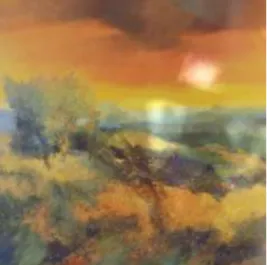
In most of his painting he use vibrant shades of yellow, sap green,
blue, violet etc. but in this particular work Chandra maximum
part of canvas covered by the shades of yellow along with orange
at upper part of sky which gives the dynamics to the painting. In
foreground a messy jungle was shown which is almost filled with
different shades of sap green juxtaposing. Just next to the
foreground some mountain are placed that treat as a mid-ground
and the rest part is blended with background. The overall
composition and execution of this painting is outstanding as his
classical romantic‟s work of messy jungle series.
The composition is based on informal
division here Chandra articulated his first
focal point is a bunch of tree just placed extreme left of the fore ground and due to give the
importance Chandra placed this tree at left peak of the bushy mountain. Leaf of the tree are
articulated by given the volume by followed impressionist brush strokes in light blue shades
and the back side of tree leaf are filled with pitch yellow and sap green.
The upper part merge with the blue sky and the lower part is covered with pitch
yellow so the subject is visible with low intensity and to articulated the trunk he use grey
color which is prominent and easily visible.
In the second focal point Chandra put small part of foreground just middle of it
having dark patch showing the depth part of covered land. The lower part having
the tint of cadmium yellow which shows the raising area of land then a dark patch
of bluish green is shown and above this again light shades of pale yellow and light
sap green are used to create prospective and an uniformly small irregular granular
dots are creates which given the impression of wild bushy flowers that enhance the
values of composition.
The third focal point is a group of mountain just above the second focal point at the
extreme right of the mid-ground. To shows prospective Chandra articulated all mountain in
low intensity almost merging with foreground. The counter line of the mountain are just
parallel above to each other and the upper part is filled with yellow which shows the
vastness of the sky.
Figure 1Untamed Evenue
Figure 1.1. Untamed Evenue
Figure 1.2. Untamed Evenue
3 | P a g e Fourth focal point is a part of sky just above the second focal point right hand side of the
top of sky, here Chandra put dark orange to the whole patch then some dark brown shade is
fill at the extreme left. When we focus particularly to the patch it gives the feelings of
abstraction but when we go through the whole work it is clear that this dark shades of
brown is seems to be the cloud which creates the dramatic effect not only to the sky but it
also add aesthetics to the whole painting.
III.
MUDDY PATHWAY:
In every 200 hundred kilometer Indianclimate would be change and
according to that habitant also changed so India have numerous variety
of habitant and every habitant have its own design and aesthetics in
terms of its landscaping, formation of mountain, village scene etc.
The foreground cover the maximum part in which Chandra shows a
muddy pathway comes out from bushy shrubs and at the extreme left of
the foreground have a bunch of tree and just back to this tree some
shades of yellow cohere and crimson red patches are seen which give the
impression of a hut.
At the extreme right of the foreground two tree are shown which are almost merge
with the background only the impression can see. In mid-ground Chandra placed
some plant and village but their opacity is very low so it is almost partially shown and
the treatment of pale yellow and cobalt blue are sodull and antique as a result a
defused sky will form. Just like a thin film is covered over the whole painting that
given a pleasant and cool look to the painting. Two tiny landscape figure at the
middle of path in foreground are treat as Chandra first focal
point.
To articulate this two figure he put the tiny dab of crimson red, small amount of black and
for the upper body part he use the up white color, for the head light black is used. One of
the figure is having basket on his head may be he bring something while returning the
village. Both the figures are merge with its surrounding at the left side muddy up-white
mingle with color scheme of second figure and other then this area rest is filled with pith
green of bushes and shrubs. Individual this small part is not so much prominent but as a whole composition it
creates an interesting focal point for the viewer and gives lively ness to the painting.
Figure 1.4. Untamed Evenue
Figure 2 Muddy Pathway
Figure 2.1. Muddy Pathway
4 | P a g e The second focal point is a bunch of tree at the left of the foreground. The counter drawing of the tree is slightly
tilted towards left. Front one is the thick in comparison of others trees and trunk are filled with yellowish black
and to shows the highlight he used titanium white. The lower part is covered with pitch green and light grey that
given the impression of bushes and upper part of tree is filled with sap green and the volume of leaf shown by
filling of dark yellowish black tone. Just back of this bunch of trees Chandra put a prominent patch of yellow
ochre that‟s form an impression of a hut. This small part is complete in its real
sense and also fruitful along with whole composition.
The third focal point is a middle part of mid ground lies at the horizon. Here he
put only the two or three color shades for complete the whole composition. At
the middle he put violet which is already merge with background only the outline
demarket the upper shapes of tree and both the side he placed pitch green and sap
green patches right side patches almost merge with the background while left is
prominent in comparison with other one.
Whole color are blend with each other and form blur effect beside this also Chandra succeed to create
prospective by changing the plane. In mid part we found two dab of white patches that‟s creates impression of
hut and front of it a horizontal white line is seen that gives the impression of river shore.
Fourth focal point is a pair of tree extreme right of the foreground. The lower ground is
covered with newly born grasses and shrub‟s which are pitch yellow in color and to show the
depth of land here Chandra add some darker tone. The shapes of tree was articulated by
impression only just like a water mark so, it is almost merge with background and its
visibility is less so if one can overlap that area then he/she cannot see the result but after
focusing one can get the glimpse of its existence. It creates a dramatic and magical effect to
environments. So Chandra succeed to captures the fragrances and beauty of nature in this
way he justified his earn title Master of Atmosphere‟s.
IV.
CONCLUSION:
He experiments with the naturalistic colour palatte and draws almost exactly what is preserved in the original
landscape. There is a concept of „space‟ in his paintings to breadth. He maintains the soothing effect through
that empty space and gives some rest to the eyes and let it settle while you are admiring the rest of it. He
maintains the background, foreground and midground and never let one of these hide on another. From the sky
to the bushes he takes care of the slightest of all thigs to deliver the best everlastng impression.
He has devoted almost whole of his life for nature and from there he had gained the confidance to trap its beauty
into his canvas. He lived with the tribals, fisherman or natives and that had left an indelible mark on him and his
paintings.All that he saw found its way to his creative workspace.
Figure 2.3. Muddy Pathway
5 | P a g e Chandra palette included all the colours in the spectrum and beyond. All the trees are motivatively putted in the
landscape keeeping in mind their importance. The small huts and the people almost seems to be real. The birds
and the canopy drives the viewer to almost into a different world alltogether.
V.
ACKNOWLEGEMENT:
Authors are thankful to the Head of Department, Department of Performing & Visual Arts, Mewar University,
Gangrar, Chittorgarh for providing valuable times and analytical data.
REFERENCES:
1. Menakshi Chandra, the Master of Atmospheres, Roli Book, 2006.
2. RanjitHoskote, the Times of India, Mumbai, 31 March 1990.
3. Suneet Chopra, Art Critic, Satish Chandra Catalogue, August 2006.
4. Suneet Chopra, Art Critic, Satish Chandra: Master of Atmospherics 1stDecember 2005
BIBLIOGRAPHY:
“Master of atmosphere” in 2006 a biographical sketch of Satish Chandra life by his wife Menakhshi Chandra.
Truth with felt 31 March 1990 The Times of India by RanjitHoskote.
Master of atmosphere 1stDecember 2005 Satish Chandra catalogue by Suneet Chopra, Art Critic.
A Great Artist roli books in 2006 by Dr. Mansoor Hassan, luckhnow.
Remembrance Satish roli books in 2006 by SunitaGhai, luckhnow.
A Great Persona roli books in 2006 by Rita Sinha, Director, NCZCC, Nagpur.
Master of nature Suneet Chopra, Art Critic, Satish Chandra Catalogue, August 2006.
JOURNAL:
Art Journal (RanjitHoskote, The Times of India, Mumbai, 31 March 1990)
Journal of Satish Chandra catalogue (1stDecember 2005) by Suneet Chopra, Art Critic.
Kala of Satish Chandra journal published by razyalalitkala academy, lukhnow.
Journal Satish Chandra Nature Panorama by India Today.
Master of atmosphere a journal by dhoomimal art gallery, Delhi.
WEB LINK:
6 | P a g e http://www.rolibooks.com/index.php?option=com_virtuemart&page=shop.product_details&flypage=flypage.tpl
&category_id=4&product_id=425&Itemid=5
http://indiatoday.intoday.in/story/exhibition-of-paintings-by-late-satish-chandra-at-habitat-centre/1/180941.html
http://www.artprice.com/artist/298470/sintra-satish-chandra
http://www.gallerieganesha.com/artist/satish-chandra/satish-chandra-6.html