Journal of Global Pharma Technology
Available Online at:
www.jgpt.co.in
RESEARCH ARTICLE
Topical Applications of Caulerpa spp. Extract Preventing Skin
Aging through Improving Skin Moisture, Pigmentation and
Decrease Laxity
Anak Agung Gde Putra Wiraguna*
,I Gusti Ayu Agung Elis Indira
,Ni Luh Putu
Ratih Vibriyanti Karna
Dermatology and Venereology Department, Faculty of Medicine, Universitas Udayana-Sanglah General Hospital, Denpasar, Bali-Indonesia.
*Correspondence Author:Anak Agung Gde Putra Wiraguna
Abstract
Background: Caulerpa spp. extract contains neoxanthin, free astaxanthin, antheraxanthin, canthaxanthin, astaxanthin monoester, fucoxanthin, astaxanthin diester, and beta carotene, vitamins A, C, and E, minerals, amino acids and polyphenols which are photocemoprotective as to protect skin from damage caused by exposure to UV-B rays. This study aims to determine the effectiveness of topical 0.2%
Caulerpa spp. extract in preventing premature skin aging in research subjects assessed by the parameters of skin moisture, pigmentation, and laxity of the skin. Method: This study was purely experimental research, using the randomized double-blind pretest-posttest control group design. A total of 40 research subjects participated in this study and were divided into two groups, namely the treatment group of 20 subjects, who were given interventions in the form of topical 0.2% Caulerpa spp. extract gel on the face, and the control group of 20 subjects who were given intervention in the form of application topical base cream on the face. All groups performed a pretest with a simple A-one scanner to assess skin aging with moisture, pigmentation, and laxity parameters on the skin. The two study groups were then treated for one month and post-tested. The research data was then collected for statistical analysis of using independent t-test and paired sample t-test. Results: Differences in skin assessments were analysed before and after therapy. Differences in assessment before therapy obtained p<0.05 on laxity and pore variables. Differences in assessment after treatment were found to be p<0.05 also in laxity and pores. Test differences in skin assessment in the two groups with Mann-Whitney using the difference in values after and before therapy obtained p<0.05 in pigmentation, laxity, humidity, pores, sebum U zone, and sebum T zone. Conclusion: Topical administration of topical Caulerpa spp. gel on the face has a photo protective effect by reducing pigmentation and laxity and increasing skin moisture.
Keywords:Caulerpa spp., Skin aging, Pigmentation, Laxity.
Introduction
The aging process is a process of progressive accumulation of various pathological changes in cells and tissues that occur over time. One of the most widely adopted concepts of skin aging is the theory of free radicals [1]. Overall the effect of UV light on the skin results in collagen damage due to increased levels of the matrix metalloproteinase-1 (MMP-1), decreased collagen synthesis due to high levels of 8-hydroxy-2-deoxyguanosine (8-OHdG), inflammation and oxidative stress, and reduced ability of damaged cells to be eliminated by the process of apoptosis [2, 3].The body has a natural antioxidant defense system (AO) to neutralize free
radicals, but due to continuous exposure to UV light, this AO supply rapidly decreases [4]. Antioxidants used topically on the surface of the skin can reduce the effects of reactive oxygen species (ROS) [5]. Many skincare products use natural ingredients that contain antioxidants, both found in fruit, leaves, flowers, roots, and other parts of plants [6, 7]. In Bali, several types of seaweed are often consumed by the public, one of
which is Caulerpa spp. Seaweed is often
consumed as a vegetable or snack, but not yet commonly used topically to prevent or
improve skin aging. Research conducted by
Found nine types of carotenoids contained in
Caulerpa spp. extract namely neoxanthin,
astaxanthin free, antheraxanthin,
canthaxanthin, astaxanthin monoester,
fucoxanthin, chlorophyll b, astaxanthin
diester, and beta carotene [8]. Caulerpa spp.
Also contain vitamin A, vitamin C, and vitamin E, 15 kinds of amino acids, total polyphenols of 567.06 mg/100 ml, and several minerals, and their antioxidant activity by
39.25% [9].
In studies on Wistar rats that were exposed to UV-B rays then smeared with astaxanthin
gel, and Caulerpa spp. extract gel with doses
of 0.01%, 0.02%, 0.05%, and 0.2% proved that
Caulerpa spp. extract began with a dose of 0.02% to 0.2% have a protective effect on the skin of Wistar rats by increasing the
expression of dermal collagen. The
application of 0.2% Caulerpa spp. extract gel
showed no significant difference with 0.02% astaxanthin gel in providing protection to the skin of Wistar rats exposed to UV-B rays [9].
Based on description above, it is necessary to conduct a research and develop sources of
antioxidants derived from natural
ingredients found in the oceans of Indonesia
such as Caulerpa spp. This development is a
strategy that can prevent and control skin damage from UV exposure.
Chemoprevention by natural compounds is a new concept in an effort to control the process of skin aging, specifically preventing
premature skin aging, delaying the
appearance of clinical symptoms or even reducing the clinical symptoms that already exist [10]. Active compounds contained in
Caulerpa spp. are thought to affect one or more stages of the process skin aging.
Method
Study Design and Population
This research is a pure experimental study (true-experimental) with the randomized double-blind pretest-posttest control group design. This research was carried out in the Dermatology and Cosmetics Medical Sub-division in Sanglah Hospital Denpasar, while
the production of Caulerpa spp. extract was
carried out at the Agricultural Technology Laboratory of the Faculty of Agriculture, Universitas Udayana and the manufacturing
of 0.2% Caulerpa spp. gel extract was done at
the pharmaceutical company of PT United Farmaric Indonesia (UFI).
This research will be conducted for six months, which runs from June 2019 to December 2019. The samples in this study are people aged 18-65 years with skin aging, both men and women who are willing to participate in this study until completion. The exclusion criteria in this study were patients with skin aging therapy such as laser, filler or botox injection, oral or topical drugs, pregnant, suffering from chronic skin inflammatory diseases such as psoriasis and atopic dermatitis had severe systemic disease, consumed oral antioxidants like vitamins A, C, E, selenium, and zinc in the
last four weeks. In this study 40 samples
were selected based on inclusion and exclusion criteria which were divided into
two groups randomly, namely the
intervention group (receive Caulerpa spp. gel
extract 0.2%) and the control group (placebo gel cream), the intervention was carried out by blinding and assisted by volunteers, then measurements were carried out at conditions before and after the intervention
Rating Parameters
The assessment parameters in this study are skin moisture, skin pigmentation, skin laxity, and the change in the protective effect of
0.2% Caulerpa spp. extract. Other variables
measured in this study include elasticity, pores, sebum T zone and, sebum U zone.
Research Protocol
Freshly picked Caulerpa spp. is then aerated
and extracted. Caulerpa spp. extract is
processed and then made in the form of gel in a concentration of 0.2% and put in a tube.
Caulerpa spp. extract gel was applied to the skin of the study subjects according to the group. The treatment was given for 1 month for each group and then observed. To assess the skin aging of all study subjects before and after treatment (pretest and post-test) was done with an A-one simple scanner using the parameters of moisture, pigmentation, and laxity on the skin.
Statistical Analysis
Statistical analysis in this study using SPSS
25.0 program (Armonk, NY, USA).
Comparative analysis using independent t-test (if the data distribution is normal) or the Mann-Whitney test (if the data distribution is not normal) to determine the effect of the
pigmentation, and laxity of the skin. All values are considered significant if p<0.05.
Result
Sample Characteristics
In this study there were a total of 40 samples that met the inclusion criteria and were included in this study. Samples were divided into the intervention group (n = 20) given
topically 0.2% Caulerpa spp. extract gel and
the control group (n = 20) given topical base
cream on the face. The overall age of the sample (n = 40) was 45.25 ± 7.40 years with the youngest age being 31 years and the oldest age being 57 years. The sex of the entire sample (n = 40) was 25 women (62.5%) and 15 men (37.5%). Skin type based on Fitzpatrick in the whole sample (n = 40) was dominated by skin type IV by 32 people (80%), followed by type V by 7 people (17.5%) and type III by 1 person (2.5%). All samples (n = 40) had group III skin types based on Glogau (100%) (Table 1).
Table 1: Sample characteristics
Characteristics Intervention Group (n=20) Control Group (n=20) Sex
Male Female
8 (40.0%) 12 (60.0%)
7 (35.0%) 13 (65.0%)
Fitzpatrick skin type
Type III Type IV Type V
0 (0) 15 (75.0%)
5 (25.0%)
1 (5.0%) 17 (85.0%)
2 (10.0%)
Glogau skin type
Group III 20 (100%) 20 (100%)
Age (years)
Mean ± SD 45.25±7.40 43.55±7.28
Normality Test
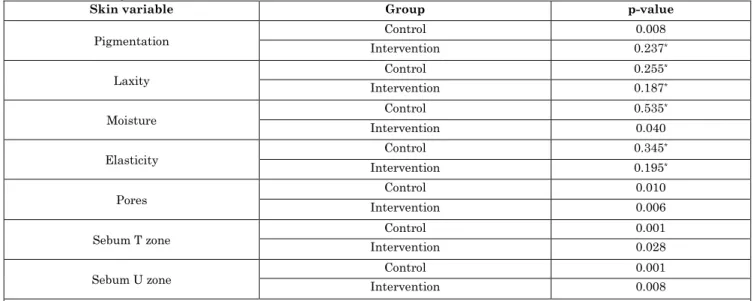
The normality test for all skin assessments
by group can be seen in Table 2. Analysis of
the normality of the data at the assessment after administration of therapy in both groups was performed with the Shapiro-Wilk test.
Table 2: Normality test of skin variable
Skin variable Group p-value
Pigmentation Intervention Control 0.2370.008 *
Laxity Control 0.255
*
Intervention 0.187*
Moisture Control 0.535
*
Intervention 0.040
Elasticity Control 0.345
*
Intervention 0.195*
Pores Intervention Control 0.010 0.006
Sebum T zone Intervention Control 0.001 0.028
Sebum U zone Intervention Control 0.001 0.008
*Normally distributed p>0.05
Differences in Skin Assessment in the Intervention Group with the Control Group before and After Therapy
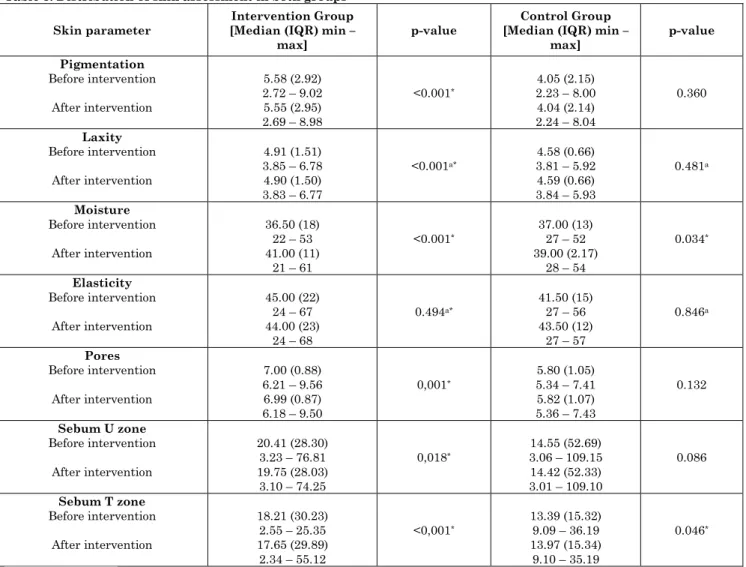
The distribution of skin assessments in the intervention group and control group can be
seen in Table 3. The data shown are the
median value (interquartile range), minimum
value, and maximum value.Assessment tests
after and before therapy with the Wilcoxon
test, found significant values (p <0.05) in all skin assessments (pigmentation, laxity, humidity, elasticity, pores, sebum T zone and sebum zone U) in the intervention group. In the placebo group, significant values were found (p<0.05) in humidity and sebum in the
T zone (Table 3). Analysis of skin
t-tests because the data were normally
distributed (Table 2). Within 1 month of therapy, no side effects were found in either group (100%).
Table 3: Distribution of skin assessment in both groups
Skin parameter
Intervention Group [Median (IQR) min –
max] p-value
Control Group [Median (IQR) min –
max] p-value Pigmentation
Before intervention
After intervention
5.58 (2.92) 2.72 – 9.02 5.55 (2.95) 2.69 – 8.98
<0.001*
4.05 (2.15) 2.23 – 8.00 4.04 (2.14) 2.24 – 8.04
0.360
Laxity
Before intervention
After intervention
4.91 (1.51) 3.85 – 6.78 4.90 (1.50) 3.83 – 6.77
<0.001a*
4.58 (0.66) 3.81 – 5.92 4.59 (0.66) 3.84 – 5.93
0.481a
Moisture
Before intervention
After intervention
36.50 (18) 22 – 53 41.00 (11)
21 – 61
<0.001*
37.00 (13) 27 – 52 39.00 (2.17)
28 – 54
0.034*
Elasticity
Before intervention
After intervention
45.00 (22) 24 – 67 44.00 (23)
24 – 68
0.494a*
41.50 (15) 27 – 56 43.50 (12)
27 – 57
0.846a
Pores
Before intervention
After intervention
7.00 (0.88) 6.21 – 9.56 6.99 (0.87) 6.18 – 9.50
0,001*
5.80 (1.05) 5.34 – 7.41 5.82 (1.07) 5.36 – 7.43
0.132
Sebum U zone
Before intervention
After intervention
20.41 (28.30) 3.23 – 76.81 19.75 (28.03)
3.10 – 74.25
0,018*
14.55 (52.69) 3.06 – 109.15 14.42 (52.33) 3.01 – 109.10
0.086
Sebum T zone
Before intervention
After intervention
18.21 (30.23) 2.55 – 25.35 17.65 (29.89)
2.34 – 55.12
<0,001*
13.39 (15.32) 9.09 – 36.19 13.97 (15.34) 9.10 – 35.19
0.046*
*Significant (p<0.05) aPaired sample t-test
Test Differences in Skin Assessment in the Intervention Group with the Placebo Group
Differences in skin assessments were
analysed before and after therapy.
Differences in assessment before therapy obtained p values <0.05 on laxity and pore variables. Differences in assessment after treatment were found to be p <0.05 also in laxity and pores. Test differences in skin
assessment in the two groups with Mann-Whitney using differences in values after and before therapy obtained p <0.05 on pigmentation, laxity, humidity, pores, sebum U zone, and sebum T zone. Test the difference in the assessment of laxity and elasticity uses paired t test because the data
are normally distributed (Table 2). The
results of differences in skin assessment before and after therapy can be seen in
Table 4.
Table 4: Test differences in skin assessment between the two groups
Skin parameter p-value
Before intervention After intervention Δ Assessment
Pigmentation 0.130 0.168 <0.001*
Laxity 0.038a* 0.043a* <0.001a*
Moisture 0.654 0.135 <0.001*
Elasticity 0.787a 0.873a 0.795a
Pores <0.001* <0.001* <0.001*
Sebum U zone 0.607 0.626 0.006*
Sebum T zone 0.892 0.914 <0.001*
Δ Assessment = Assessment after intervention – before intervention
Discussion
Research on the effectiveness of topical 0.2%
Caulerpa spp. extract gel on the face showed significant results decreased in pigmentation, decreased laxity, and increased skin moisture (p<0.05).
Decreased pigmentation in the intervention group was associated with the content of
Caulerpa spp. such as phenols hydroquinone, flavonoids, steroids, and saponins which have inhibitory effects on the melanin pigment [10, 11]. Research by Wiraguna et al. with Wistar rats exposed to UV-B rays and given
Caulerpa spp. extract at a dose of 0.02% to 0.2% found to increase the expression of dermal collagen in Wistar mice [9].
The photoprotective effect on Caulerpa spp. is
known to have the ability to reduce MMP-1 levels, an enzyme that degrades type I, II and III collagen in the skin. Decreased expression of 8-OHdG (increased at the time of DNA damage), decrease in MMP-1 (p<0.05) and improvement in the structure of Wistar rat collagen was found after applying 0.2% and
0.4% Caulerpa spp. extract gel [10].Findings
decreased laxity (p<0.05) and increased elasticity (p<0.05) in this study are new findings that support the results of previous studies conducted in rats by Wiraguna et al. increased collagen expression in the dermis will increase skin elasticity.
In addition, phenolic extracts decrease the activity of proteinases which prevent the degradation of skin proteins such as collagen and elastin. Collagen plays a role in the strength of the skin and elastin fibers play a role in skin elasticity. Anticolagenase, antielastase, and antioxidant effects will reduce MMP-1 thus preventing skin protein
degradation [12]. In addition, Caulerpa spp.
contains vitamins A, C, and E. Vitamin A in the form of carotenoids is known to inhibit MMP-1 thereby inhibiting the degradation of
collagen, vitamins C decreases ROS activity and has an important role in collagen synthesis, and vitamin E prevents fat
peroxidation, thus maintaining cell
membrane structure [10, 13].
Skin moisture was found to increase significantly in the intervention group based on assessment after and before therapy was given (p<0.05). In addition, in this study a significant effect was found to decrease pores, decrease in T zone sebum, and decrease in U zone sebum (p<0.05). This shows that the use
of topical Caulerpa spp. extract 0.2% on the
face has a photoprotective effect compared to only using base cream in the control group. This is in accordance with the function of most algae which can moisturize the skin [11, 14].
The antioxidant content of Caulerpa spp.
moisturise inhibits lipid peroxidase decreases the destruction of the skin barrier and decreases the performance of ROS, then controls oxidative stress [5, 11].Which shows a decrease in sebum production in the T and U zones in this study. No side effects were found during the study. At present there are no studies that test the effectiveness of
extract of Caulerpa spp. on human skin, so
the research is a new finding and cannot be compared with similar studies using
Caulerpa spp.
Conclusion
Application of topical Caulerpa spp. gel on
the face has a photoprotective effect by reducing pigmentation and laxity and increasing skin moisture.
Publication Ethics
Current study has been approved by Ethical Committee Faculty of Medicine Universitas Udayana/Sanglah General Hospital, Bali-Indonesia.
References
1. Beckman KB, Bruce NA (1998) The free
radical theory of aging matures. Physiol Rev., 78: 547-81.
2. Fisher GJ, Kang S, Varani J, Bata-Csorgo
Z, Wan Y, Datta S, Voorhees JJ (2002)
Mechanisms of photoaging and
chronological skin aging. Arch
Dermatology, 138: 1462-70.
3. Helfrich YR, Sachs DL, Voorhees JJ (2008)
Overview of skin aging and photoaging.
Dermatology Nursing, 20(3):177-83.
4. Chen L, Hu JY, Wang SQ (2012) The role
of antioxidants in photoprotection: a
critical review. J. Am Acad. Dermatol., 63:
1-12.
5. Pinnell SR (2003) Cutaneous
antioxidant protection. J. Am Acad Dermatol., 48: 1-19.
6. Baumann L (2008) Cosmetics and skincare
in dermatology. In: Wolff K, Goldsmith LA, Katz SL, Gilchrest BA, Paller AS, Leffell DJ, editors. Fitzpatrick’s Dermatology in
General Medicine. 7th. Ed. New York:
McGrawHill, 2357-63.
7. Stallings AS, Lupo MP (2009) Practical
uses of botanicals in skin care. J. Clin Aesthetic Derm., 2(1): 36-40.
8. Julyasih KSM (2011) Caulerpa spp.
Extract and Gracilaria spp. extract
improve lipid profile, decrease
malonaldehid, and ezym HMG-CoA reductase in hyperlipidemic Wistar rats (Medical Disertation Report). Denpasar: Universitas Udayana.
9. Wiraguna AAGP (2013)
Photochemoprotection effect of active
component of Caulerpa spp. on Rats Skin.
IJBS., 7(2):52-56.
10.Wiraguna AAGP, Pangkahila W, Astawa
INM (2018) Antioxidant properties of
topical Caulerpa spp. Extract on
UVB-induced photo aging in mice. Dermatology Reports, 10: 20-5.
11.Pereira L (2018) Seaweeds as Source of
Bioactive Substance and Skin Care
Therapy-Cosmeceuticals, Algotheraphy,
and Thalassotherapy. Cosmetics, 5(68):1-41.
12.Zillich OV, Schweiggert-Weisz S, Eisner P,
Kerscher M (2015) Review Article: Polyphenols as active ingredients for cosmetic products. International Journal of Cosmetics Science, 37: 455-464.
13.Nurjanah, Nurilmala M, Hidayat T,
Sudirjo F (2016) Characteristics of Seaweed as Raw Materials for Cosmetics. Aquatic Procedia., 7: 177-180.
14.Saric S, Notay M, Sivamani RK (2017)