PV Active Power Filter Combination Supplies Power To Non Linear Load
S Anusha*1 , P Koteswara Rao2
M.Tech Student, Department of EEE, KIET, Kakinada, India.1 Asst. Professor, Department of EEE, KIET, Kakinada, India.2
Abstract- These days the photovoltaic (PV) era
is progressively step by step, while the normal loads require all the more high-control quality. Essentially, one PV generator providing to nonlinear loads is wanted to be coordinated with a capacity as a dynamic power channel (APF). In this paper, a three-stage three-wire framework, including a nitty gritty PV generator, dc/dc support converter to separate greatest radiation control utilizing most extreme power point following, and dc/air conditioning voltage source converter to go about as an APF, is displayed. The momentary power hypothesis is connected to outline the PV-APF controller, which indicates solid exhibitions. In this venture Fuzzy controller is actualized keeping in mind the end goal to diminish the aggregate consonant twisting. The MATLAB/Simpower Systems device has demonstrated that the consolidated framework can at the same time infuse greatest power from a PV unit and remunerate the symphonious current drawn by nonlinear loads.
INDEX TERMS Active power channel (APF), immediate power hypothesis, photovoltaic (PV), control quality,renewable vitality.
I.INTRODUCTION
Power supply and power quality have been basic issues in control framework as of late. The network associated photovoltaic (PV) generator has these days turn out to be more prevalent as a result of its dependable execution and its capacity to produce control from clean vitality assets [1]–[3]. The dc yield voltage of PV exhibits is associated with a dc/dc support converter utilizing a greatest power point following (MPPT) controller to expand their created vitality [5]. At that point, that converter is connected to a dc/air conditioning voltage source converter (VSC) to let the PV framework push electric energy to the air conditioner utility. The nearby heap of the PV framework can particularly be a nonlinear load, for example, PCs, smaller fluorescent lights, and numerous other home apparatuses, that requires mutilated streams [4]. Advancement of a way to repay the appropriation framework sounds is similarly pressing. For
this situation, PV generators ought to give the utility twisted remuneration ability, which makes streams infused/consumed by the utility to be sinusoidal [7]. In this way, the symphonious remuneration capacity can be acknowledged through adaptable control of dc/air conditioning VSC. Prompt power hypothesis has effectively finished dynamic power channel (APF) outlining with great execution [8]. Be that as it may, the PV-APF blend has quite recently been steadily produced for quite a while [9]. This mix is able to do at the same time remunerating power factor, current awkwardness, and current music, and furthermore of infusing the vitality produced by PV with low aggregate consonant contortion (THD). Notwithstanding when there is no vitality accessible from PV, the blend can in any case work to improve the power nature of the utility. To the best of our insight, this thought was started in 1996 by Kim et al. [10]. In this examination, the PV framework needs vitality stockpiling components, which adversely increment the whole cost. Plus, the scientific show was not adequately given. From that point forward, the control methods have been enhanced in some later endeavors to create PV inverters with genuine power infusion and APF highlights [11]–[16]. Be that as it may, their examination did not demonstrate reliable outcomes got by their proposed hypotheses, and they are appropriate for a solitary stage PV as it were. The latest totally discharged paper in 2013 [17] utilizes current references as the principle elements of the dc/air conditioning controller, which agrees with the fundamental thoughts of this paper. By another way in this paper, the proposed PV-APF controller using power references demonstrates some noteworthy demonstrate ments in principle and a basic control topology. The PV-APF framework enables the utility supply a solidarity to control factor and immaculate sinusoidal streams to the neighborhood nonlinear loads
[18]. The fundamental commitments of this paper are triple
1) For the first run through, a completely entire PV-APF blend framework is exhibited.
2) The controller in view of momentary power hypothesis and quick power adjust is proposed to supplant the ordinary dq-current controller for a PV unit.
3) Flexible operation methods of the PV-APF blend framework are conceivable in the proposed show.
Whatever is left of this paper is composed as takes after. Area II quickly presents the executed PV-APF blend framework with the PV displaying procedure and the chose MPPT topology. Segment III depicts the immediate power adjust among the parts of the framework specified in Section II. Segment IV clarifies the proposed controller. Area V assesses the execution of the proposed technique in view of reproduced test cases in the MATLAB/Simpower Systems condition.
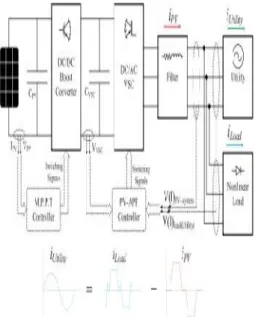
Fig:1 Proposed design of PV-APF combination
The detailed PV-APF configuration is shown in Fig. 1, which consists of the following.
II. PV-APF COMBINATION SYSTEM
1) The PV 5series-66parallel exhibit, which is Sun Power SPR-305-sort, conveys a most extreme of 100-[kW] control at 1000-W/m2 sunlight based irradiance, accepting that there is no battery stockpiling framework associated with the dc transport.
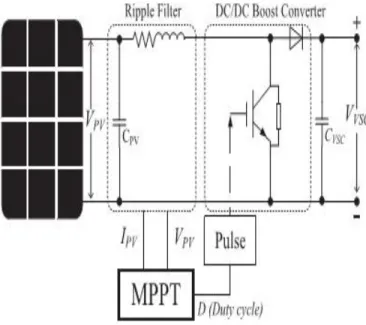
2) A 5-kHz support dc/dc converter actualizes MPPT by an incremental conductance–integral controller system, which consequently differs the obligation cycle to create the expected voltage to remove most extreme power.
3) The dc transport is associated with a two-level three-stage dc/air conditioning VSC with a CVSC capacitor. The dc/air conditioning VSC changes over the 500 [V] dc to 260 [V]/60 [Hz] air conditioning providing to nearby nonlinear loads and associates with a solid utility. The dq-current and PV-APF and APF controllers are connected for this dc/air conditioning VSC therefore.
4) A 10-kVAr capacitor bank sift through exchanging music delivered by the dc/air conditioning VSC.
5) The burdens incorporate a three-stage diode rectifier providing a current of 450 or 50 [A] at dc side and one stage diode rectifier with 50-[A] dc current associating between stage An and stage B to make a general unbalance stack.
6) This PV-APF blend framework is associated specifically to the utility for shunt dynamic channel execution.
A.DYNAMIC MODEL OF PV ARRAY
The PV array involves N strings of modules connected in parallel, and each string consists of M modules connected in series to obtain a suitable power rating. The dynamic model of PV cell is shown in Fig. 2 [3]
FIGURE 2. Equivalent electrical circuit of the PV cell
in RSh. A little increment in RS can diminish the PV yield essentially.
The two most imperative parameters broadly utilized for depicting the cell electrical execution are the open-circuit voltage Voc = Vout + RSI acquired when the heap current is zero (I = 0) and the short out current Isc. Disregarding the little diode and the ground-spillage streams under zero terminal voltage, the short out current under this condition is the photocurrent IL. The PV modules are demonstrated around as a consistent current source with respect to the electrical examination. The fundamental condition portraying the I–V normal for a down to earth PV cell is
(1)
Where ID is the immersion current of the diode, Q is the electron charge (1.6 × 10⁻¹⁹ C), An is the bend fitting consistent (or diode outflow factor), K is the Boltzmann steady (1.38×10⁻²³ J/◦K), andT (◦K) is thtemperature on total scale. The ISh, that, in useful cells, is littler than IL andId, can be overlooked. The diode-immersion current can, along these lines, be resolved tentatively by applying voltage Voc oblivious (IL = 0) and measuring the present entering the phone. This current is frequently called the dull current or the switch diode-immersion current Id.
B. MPPT IN DC/DC CONVERTER
The cell delivers the greatest power at voltage relating to the knee purpose of the I–V bend, as appeared in Fig. 3. Vmax and Imax are voltage and current at most extreme power
point, separately. The dc/dc converter is set to work at ideal voltage to accomplish greatest power by MPPT calculation. In this paper, exchanging obligation cycle is upgraded by the MPPT controller that uses the incremental conductance and necessary controller strategy [6]. This MPPT strategy depends on the way that the power slant of the PV is invalid at MPP point (where dp/dv = 0), positive in the left, and negative morally justified. In the accompanying conditions, dv and di are acquired by one-specimen postponed values:
FIGURE 3. I–V curve and remarkable points.
The regulator output of MPPT is the duty cycle correction for semiconductor switches. In summary, the controller of the dc/dc boost converter is shown in Fig. 4.
Instantaneous Power Balance And Controllers For Dc/Ac Converter were explained in the ref.paper[1].
III.FUZZY CONTROLLER
The word Fuzzy means ambiguity. Fuzziness happens when the limit of snippet of data is not obvious. In 1965 Lotfi A. Zahed propounded the Fuzzy set hypothesis. Fuzzy set hypothesis displays monstrous potential for compelling tackling of the instability in the issue. Fuzzy set hypothesis is an astounding scientific instrument to deal with the vulnerability emerging because of dubiousness. Understanding human discourse and perceiving manually written characters are some normal examples where Fuzziness shows.
Fuzzy set hypothesis is an expansion of established set hypothesis where components have differing degrees of participation. Fuzzy rationale utilizes the entire interim in the vicinity of 0 and 1 to portray human thinking. In FLC the information factors are mapped by sets of enrollment capacities and these are called as "Fuzzy SETS".
Fuzzy set includes from a participation work which could be characterizes by parameters. The incentive in the vicinity of 0 and 1 uncovers a level of participation to the Fuzzy set. The way toward changing over the fresh contribution to a Fuzzy esteem is called as "fuzzificaton." The yield of the Fuzzier module is interfaced with the guidelines. The fundamental operation of FLC is built from Fuzzy control rules using the estimations of Fuzzy sets when all is said in done for the blunder and the change of mistake and control activity. Fundamental Fuzzy module is appeared in fig.6.
The outcomes are consolidated to give a fresh yield controlling the yield variable and this procedure is called as "DEFUZZIFICATION."
Fig5 : block diagram fuzzy logic
IV.SIMULINK BLOCK DIAGRAMS AND RESULTS
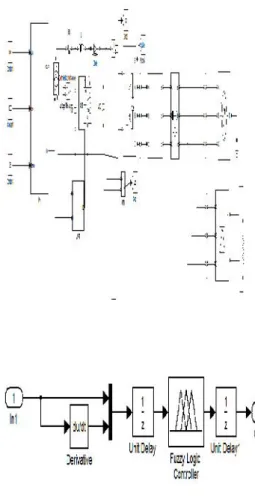
Fuzzy logic controller diagram
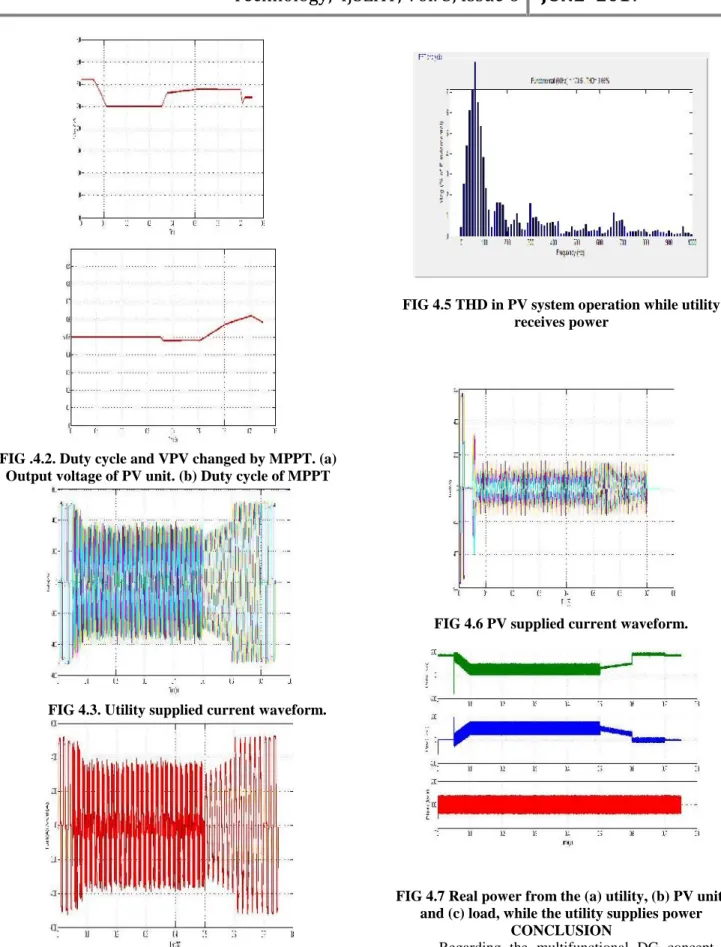
Fuzzy Simulation results:
FIG .4.2. Duty cycle and VPV changed by MPPT. (a) Output voltage of PV unit. (b) Duty cycle of MPPT
FIG 4.3. Utility supplied current waveform.
FIG 4.4 Utility supplied current and PCC voltage
FIG 4.5 THD in PV system operation while utility receives power
FIG 4.6 PV supplied current waveform.
FIG 4.7 Real power from the (a) utility, (b) PV unit, and (c) load, while the utility supplies power
CONCLUSION
the PV-APF combination system with a local controller is proposed. The controller implements two purposes, which are supplying power from the PV unit and filtering the harmonics of the local nonlinear load. The new controller based on instantaneous power balance has been explained accordingly. The MATLAB/SimpowerSystems simulation shows good performances of this controller. The positive influence of MPPT on maximizing PV power output is also validated. The switching among three controllers to dc/ac VSC brings different current waveforms. As a result, the conventional dq-current controller should not be applied when PV is connected to a local nonlinear load regarding power-quality viewpoint. . In this project fuzzy controller is implemented in order to reduce the total harmonic distortion. The MATLAB/Simpower Systems tool has proved that the combined system can simultaneously inject maximum power from a PV unit and compensate the harmonic current drawn by nonlinear loads.
REFERENCES
[1] Nguyen Duc Tuyen (Member, Ieee) And Goro Fujita (Member, Ieee)” Pv-Active Power Filter Combination Supplies Power To Nonlinear Load And Compensates
Utility Current”
[2] L. Hassaine, E. Olias, J. Quintero, and M. Haddadi, ‘‘Digital power factor control and reactive power regulation for grid-connected photovoltaic inverter,’’
Renewable Energy, vol. 34, no. 1, pp. 315–321, 2009.
[3] M. G. Villalva, J. R. Gazoli, and E. R. Filho, ‘‘Comprehensive approach to modeling and simulation of photovoltaic arrays,’’ IEEE Trans. Power Electron., vol.
24, no. 5, pp. 1198–1208, May 2009.
[4] N. R. Watson, T. L. Scott, and S. Hirsch, ‘‘Implications for distribution networks of high penetration of compact fluorescent lamps,’’ IEEE Trans. Power Del., vol. 24, no. 3, pp. 1521–1528, Jul. 2009. [5] I. Houssamo, F. Locment, and M. Sechilariu, ‘‘Experimental analysis of impact of MPPT methods on energy efficiency for photovoltaic power systems,’’Int. J. Elect. Power Energy Syst., vol. 46, pp. 98–107, Mar. 2013.
[6] M. A. G. de Brito, L. P. Sampaio, G. Luigi, G. A. e Melo, and C. A. Canesin, ‘‘Comparative analysis of MPPT techniques for PV applications,’’ in Proc. Int. Conf. Clean Elect. Power (ICCEP), Jun. 2011, pp. 99– 104.
[7] M. El-Habrouk, M. K. Darwish, and P. Mehta, ‘‘Active power filters: A review,’’ Proc. IEE – Elect. Power Appl., vol. 147, no. 5, pp. 403–413, Sep. 2000. [8] H. Akagi, Y. Kanagawa, and A. Nabae, ‘‘Generalized theory of the instantaneous reactive power in three-phase
circuits,’’ in Proc. Int. Conf. Power Electron., Tokyo,
Japan, 1983, pp. 1375–1386.
[9] Y. W. Li and J. He, ‘‘Distribution system harmonic compensation methods: An overview of DG-interfacing inverters,’’ IEEE Ind. Electron. Mag., vol. 8, no. 4, pp.