Emerging Session Management and Secured User Access Control for
Internet services
Konduru Sandeep1, M Murali Krishna2
1
M.Tech Scholar, Department of Computer Science & Engineering,
2Assist.Professor, Department of CSE, Sri Sivani College of engineering, chilakapalem, Srikakulam, AP, India.
Abstract:
These days, it ends up open worry to give greater security to web services. Along these lines, secure user authentication is the central undertaking in security frameworks. Customarily, the greater part of the frameworks depend on sets of username and password which checks the character of user just at login stage. Once the user is related to username and password, no checks are performed promote amid working sessions. Yet, developing biometric arrangements substitutes the username and password with biometric data of user. In such approach still single shot check is less effective on the grounds that the personality of user is lasting amid entire session. Subsequently, an essential arrangement is to utilize brief time of timeouts for every session and intermittently ask for the user to enter his qualifications again and again. Be that as it may, this is anything but an appropriate arrangement since it intensely influences the administration ease of use and at last the fulfillment of users. This paper explores the framework for continuous authentication of user utilizing his qualifications, for example, biometric characteristics. The utilization of continuous biometric authentication framework gets accreditations without expressly advising the user or requiring user connection that is, transparently which is important to ensure better execution and administration ease of use.
Keywords: Web Security, Authentication, Continuous user check, biometric authentication.
I. Introduction
Session administration in dispersed Internet services is generally in light of username and password. Session time out may happen amid unperformed working sessions or it lapses when user is out of gear movement period. Security of web based application is vital as there is increment in many-sided quality of digital assaults. Biometric application gives more security to authentication process than demonstrating the username and
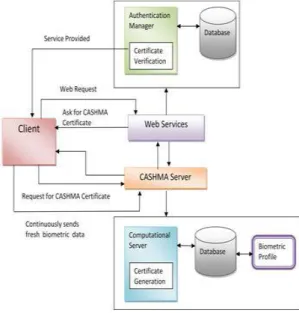
password. Bio-metric user authentication is commonly defined as a solitary shot giving user confirmation just amid login stage when at least one biometric attributes might be required. Once the users character has been checked, the framework assets are accessible for a settled timeframe or until express logout from the user. This approach accept that a solitary confirmation is adequate, and that the character of the user is steady amid the entire session. To identify the abuses of the PC assets and keep that from the unapproved user replaces an approved one by giving the arrangement in view of the multimodal biometric continuous authentication turning the user authentication as the continuous procedure as opposed to the one time event. To maintain a strategic distance from that a solitary biometric characteristic is fashioned, biometrics authentication can depend on various biometrics qualities. At last, the utilization of biometric authentication enables qualifications to be obtained transparently, i.e. without unequivocally advising the user or requiring his/her association, which is basic to ensure better administration convenience. Here is available another approach for user check and session administration that is connected in the CASHMA (Context Aware Security by Hierarchical Multilevel Architectures) framework for secure biometric authentication on the Internet. CASHMA can work safely with any sort of web benefit.
II. Related Work
vulnerabilities exist, and security viewpoints ought to be painstakingly considered, particularly when it is embraced to secure the entrance to applications controlling basic frameworks and foundations. In that exploration they played out a quantitative security assessment of the CASHMA multi-biometric authentication framework, evaluating the security gave by various framework setups against assailants with various abilities. The investigation is performed utilizing the ADVISE demonstrating formalism, a formalism for security assessment that broadens assault charts; it permits to consolidate data on the framework, the assailant, and the measurements important to create quantitative outcomes. The got comes about give valuable knowledge on the security offered by the diverse framework arrangements, and exhibit the possibility of the way to deal with show security dangers and countermeasures in genuine situations. S.kumar, T.sim "Utilizing Continuous Biometric Verification to Protect Interactive Login Sessions", 2012 This paper we depict the hypothesis, engineering, execution, and execution of a multi-modular latent biometric check framework that ceaselessly confirms the nearness/investment of a signed in user. We expect that the user signed in utilizing solid authentication preceding the beginning of the continuous check process. While the usage depicted in the paper joins a computerized camera-based face check with a mouse-based unique mark peruser, the design is non sufficiently specific to oblige extra biometric gadgets with various exactness of arranging a given user from a faker D.M.Nicol,W.H.Sanders, "Display Based Evaluation: From Dependability to Security", IEEE TRANSACTIONS 2004 In this work, we overview existing model-based methods for assessing framework trustworthiness, and abridge How they are presently being reached out to assess framework security. We locate that numerous methods from constancy assessment can be connected in the security area, however that noteworthy difficulties remain, to a great extent because of essential contrasts between the coincidental idea of the issues generally expected in trustworthiness assessment, and the deliberate, human instinct of digital assaults.
III. Problem Statement
Once the user’s identity has been verified, the system resources are available for a fixed period of time or until explicit logout from the user. This approach assumes that a single verification (at the beginning of the session) is sufficient, and that the identity of the user is constant during the whole
session. In existing, a multi-modal biometric verification system is designed and developed to detect the physical presence of the user logged in a computer. The work in another existing paper, proposes a multi-modal biometric continuous authentication solution for local access to high-security systems as ATMs, where the raw data acquired are weighted in the user verification process, based on i) type of the biometric traits and ii) time, since different sensors are able to provide raw data with different timings. Point ii) introduces the need of a temporal integration method which depends on the availability of past observations: based on the assumption that as time passes, the confidence in the acquired (aging) values decreases. The paper applies a degeneracy function that measures the uncertainty of the score computed by the verification function.
IV. Security through Biometrics
Biometrics is the science of establishing identity of an individual based on the physical, chemical or behavioural attributes of the person. The relevance of biometrics in modern society has been reinforced by the need for large scale identity management systems whose functionality relies on the accurate determination of an individual’s identity in the context of several different applications. Some of biometric data is illustrated as follows.
A .Face Biometrics
A general face recognition system includes many steps 1. Face detection, 2. Feature extraction, and 3.face recognition.
Face detection and recognition includes many complementary parts, each part is a complement to the other[10].
B. Keystroke Biometrics
Keystroke biometrics or monitoring keystroke dynamics is considered to be an effortless behavioural based method for authenticating users which employs the person’s typing patterns for validating his identity [4]. Keystroke dynamics is “not what you type, but how you type.” In this approach, the user types in text, as usual, without any kind of extra work to be done for authentication. Moreover, it only involves the user’s own keyboard and no other external hardware.
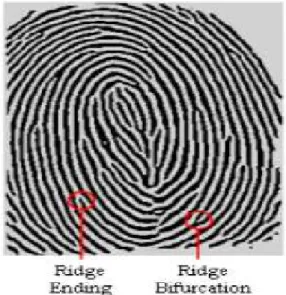
Fingerprint identification is one of the most well-known and publicized biometrics. Because of their uniqueness and consistency over time, fingerprints have been used for identification for over a century. Fingerprint identification is popular because of the inherent ease in acquisition, the numerous sources (ten fingers) available for collection, and their established use and collections by law enforcement and immigration .The images below present examples of
Figure 1: Other Fingerprint Characteristics
Figure 2: Minutiae
D. Voice Biometrics
Speech recognition is the process by which a computer identifies spoken words. Basically, it means talking to your computer, and having it correctly recognized what you are saying. Voice or speech recognition is the ability of a machine or program to receive and interpret dictation, or to
understand and carry out spoken commands. For the voice recognition part the following steps have to be followed [5].
I) at first, we have to provide the user details as input in the form of voice asked by system.
II) The system will then generate a “.wav” file and the generated file will be saved in the database for future references.
III) At the time of log in by the user, user needs to provide the same information given at the time of registration and the system compares the recorded voice with the one saved in database. If both match, user logs in successfully, otherwise not.
V. Fingerprint Exposure and Recognition Algorithm
Fingerprints of every individual is thought to be extraordinary. Unique finger impression discovery and acknowledgment is the most acknowledged biometric acknowledgment strategy. Fingerprints have been utilized from long time for distinguishing people. A decent quality unique finger impression contains 30 - 80 particulars focuses. Fingerprints comprise of a customary surface example made out of edges and valleys [6]. These edges are portrayed by a few land check focuses, known as particulars, which are for the most part as edge endings and edge bifurcations. The details focuses is be remarkable to each finger, it is the accumulation of particulars focuses in a unique finger impression that is principally utilized for coordinating two fingerprints. There exists some crevice between the edges, called valleys. In a unique mark, the dull lines of the picture are known as the edges and the white territory between the edges is called valleys.
VI. Challenges
Here we composed the central boundaries in Biometrics into four fundamental classes: (I) exactness (II) scale (III) security and (IV) protection [1] [2].
Precision:
announces a fruitful match between the information design and a Non-coordinating example in the database or the example related with an erroneously asserted character. (II) False Non-coordinate: the biometric framework erroneously proclaims disappointment of match between the info design and a coordinating example in the database or the example related with the accurately guaranteed personality (confirmation) [8].
Scale:
How does the quantity of characters in the selected database influence the speed and exactness of the framework? On account of check frameworks, the measure of the database does not so much make a difference since it basically includes a 1:1 match, contrasting one arrangement of submitted tests with one arrangement of enrolment records [9]. On account of vast scale distinguishing proof and screening frameworks containing a sum of N personalities, consecutively performing N 1:1 match is not compelling there is a requirement for effectively scaling the framework to control throughput and false-coordinate mistake rates with an expansion in the measure of the database.
Security:
The honesty of biometric frameworks is vital. While there are various ways a culprit may assault a biometric framework there are two intense reactions against biometric innovation that have not been tended to agreeably: (I) biometrics are not privileged insights and (II) biometric examples are not revocable. The main certainty infers that the assailant has a prepared learning of the data in the true blue biometric identifier and, along these lines, could deceitfully infuse it into the biometric framework to get entrance [9] [1]. The second truth infers that when biometric identifiers have been "bargained", the true blue user has no plan of action to denying the identifiers to change to another arrangement of uncompromised identifiers. We trust that the learning of biometric identifiers does not really suggest the capacity of the aggressor to infuse the identifier estimations into the framework. The test then is to outline a secure biometric framework that will acknowledge just the real introduction of the biometric identifiers without being tricked by the caricature estimations infused into the framework [10].
Protection:
A solid biometric framework gives an obvious verification of personality of the individual. The
issue of planning data frameworks whose usefulness is
VII. Proposed Methodology
its own strengths and weaknesses, and the choice depends on the application.
Fig. Proposed Architecture
VIII. Conclusion and Future Work
This Authentication System provides a novel approach of continuously validating the identity of a user in real time through the use of biometrics traits. This system shows efficient use of biometrics to identify the legitimate user. Also, it continuously verifies the physical identity of legitimate user through their biometric data. This authentication is able to achieve a good balance between security and usability with continuous and transparent user verification. Hence, continuous authentication verification with biometrics improves security and usability of user session.
In future research user satisfaction, security level, cost and maintenance, I think this is the important and main challenges. The next step would be to put more attention to the check level of security, also to do more testing in order to get more accurate results in research area.
References
[1] Andrea Ceccarelli, Leonardo Montecchi,, Continuous and Transparent User Identity Verification for Secure Internet Services IEEE, VOL. 12, NO. 3, MAY/JUNE 2015.
[2] CASHMA-Context Aware Security by Hierarchical Multilevel Architectures, MIUR FIRB, 2005.
[3] L. Hong, A. Jain, and S. Pankanti, “Can Multibiometrics Improve Performance?” Proc. Workshop on Automatic Identification Advances
Technologies (AutoID ’99) Summit, pp. 59-64, 1999.
[4] S. Ojala, J. Keinanen, and J. Skytta, “Wearable Authentication Device for Transparent Login in Nomadic Applications Environment,”Proc. Second Int’l Conf. Signals, Circuits and Systems (SCS ’08), pp. 1-6, Nov. 2008.
[5] BioID “Biometric Authentication as a Service (BaaS),” BioID Press Release, https://www.bioid.com, Mar. 2011
[6] T. Sim, S. Zhang, R. Janakiraman, and S. Kumar, “Continuous Verification Using Multimodal Biometrics,” IEEE Trans. Pattern Analysis and Machine Intelligence, vol. 29, no. 4, pp. 687-700, Apr.
[7] Udayakumar R., Khanaa V., Saravanan T., Saritha G., "Retinal image analysis using curvelet transform and multistructure elements morphology by reconstruction", Middle - East Journal of Scientific Research, ISSN : 1990-9233, 16(12) (2013) pp.1781-1785.
[8] CASHMA-Context Aware Security by Hierarchical Multilevel Architectures, MIUR FIRB, 2005.
[9] C. Roberts, “Biometric Attack Vectors and Defences,” Computers & Security, vol. 26, no. 1, pp. 14-25, 2007.
[10] S.Z. Li and A.K. Jain, Encyclopedia of Biometrics. first ed., Springer, 2009.
Authors
Konduru Sandeep completed his B.Tech at Sri Sivani College of engineering chilakapalem. Presently he is pursuing m.tech in Sri Sivani College of engineering chilakapalem, Srikakulam, AP, India.
M Murali Krishna is working as Assistant Professor in the Department of CSE at Sri Sivani College
Of Engineering,