Abstract— In this the promise offered by software agent which made changes in electronic commerce trading which helps traders for purchasing of product based on the users preferences. The Ecommerce system based on cloud also provide the experience of customize transactions. The main aim of the paper is to create dealer agent mechanism based on ecommerce cloud that allow pro-active and personalization including agent and dealer with the profile that are maintained independently. The proposed aim of this paper is to give the respond for the request initiated for the product as services initiated by buyer and delivering them appropriate service. The Cloud ecommerce agent based framework is demonstrated with the prototype that is implemented. In addition agent protocol is been implemented for the interaction between dealer and agent. In this project we will evaluate the product service performance of ecommerce web sites. Agent is the one who will maintain all ecommerce sites product database and payment database. Agent searches the product in which ecommerce site the product is available. To start with web services enables the agent to service the product JAX-WS (web service) is used. Trading system is brought in a sense enabling trading between dealer and buyer. Direct payment is the default feature for buying product which then security concern is solved by PayPal sandbox gateway implementation for secure transaction.
Index Terms— Cloud Software Agent, JAX-WS, Protocol module for Communication, testbed for agent cloud.
I. INTRODUCTION
Ecommerce dealer agent mechanism transaction that enables business minded approach for the customers which is carried out from cloud computing. The main aim of this paper is to implement the mechanism such that the dealer is the actual ecommerce sites who will add its own product to the agent database. Agent is the one who will maintain all ecommerce sites product database and payment database. Agent searches the product in which ecommerce site the product is available. To start with Web Services enables the agent to service the product. Trading system is brought in a sense of enabling trading between agent & dealer. Direct payment is the default feature for buying products. The problem which occurs for searching the information about trading partners in the business area related to globally needs the intermediate for electronics to guide and immolate the services. This paper determines such a mechanism where
the agent that connects buyers and sellers for ecommerce business. The focus of this paper is to:
i)To develop dealer agent mechanism.
ii)For the implementation of the algorithm that connects buyers and sellers, search algorithm for searching the services.
iii)Protocols that specifies the structuring between buyers and sellers. Many existing works in Cloud computing focus on the development on infrastructures and tools for pooling together computational resources, this work complements and supplements existing works in Cloud computing by introducing “agent-that works in cloud computing” The server manages service providers’ and clients’ portfolio data as well as service providers’ trust data. Some well-known e-commerce websites have taken Centralized trust management system to build up trust [1].
II. LITERATURESURVEY
The papers which I have referred is (Rajkumar Buyya, Chee Shin Yeo), Cloud Computing and Emerging IT Platforms: Vision, Hype, and Reality for Delivering Computing as the 5th Utility, How to Use Google App Engine, Integration of SOA and cloud computing in RM-ODP IEEE papers. There are many platform used to design cloud computing in which I have used the technique for how agent based cloud ecommerce system can be implemented how business oriented application can be created through using such platforms. The system presented by (Kwang Mong Sim, 2011 ), helps to design and develop software agent.( Domenico Talia, 2012) the paper that presents how cloud that meets the agent which ultimately provide could enable high-performance, complex systems and intelligent applications, making clouds more flexible and autonomic and providing agent system with a reliable and scalable computing infrastructure on which to execute large-scale applications.( Yi Wei and M. Brian Blake, 2010) service how service oriented and cloud computing relationship has mentioned in this paper which then explains how one provides the computing services. (Min Wu Jiaxing College, Jia Xing, 2010) this paper presents the trust management in ecommerce based on cloud computing is prospered. (Kwang Mong Sim and Raymond Chan, 2000) agent based system is created with initiating brokering protocols (Tarek Helmy, 2007), (Raymond Y.K. Lau , 2007) web services and agent based system in ecommerce is presented in this paper.This
Ecommerce Dealer Agent Mechanism in Cloud
Computing Environment
Ms.DivyaJyothi, ME in Computer Engineering Pursuing, MGMCET, Kamothe, Navi Mumbai.
above papers are surveyed for making cloud dealer agent mechanism system for this paper.
III. AGENTSOFTWAREINCLOUDECOMMERCE An agent is the software agent that has the capability to determine the needs of the buyers and fulfill their objectives. An agent system that consists of dealers and the interaction between buyers and sellers takes place with the agent software. For the successful business the agent has to coordinate and cooperate with the dealers. Coordination is nothing but the implementation for the state achieving the dealer process to coordinate well with each other. The essential features of cloud computing that serves the resources to number of users. Cloud computing that establish the contract between the buyers and the sellers. Agent protocols are used to for the automation and the activities of polling resources and sharing in clouds. The following cloud agent is as follows which this paper includes:
A. Agent Services in Cloud
Services that are concern with cloud agent are the challenging task for dynamically arranging sets of services to number of service provider for formation of single service to the customer to be delivered. For the cloud agent services following works to be adopted:
i) Record database is maintained for all the service provider sites (dealer sites).
ii) Payment transaction is maintained for all the dealer sites. iii) Protocols implemented for selection of cloud services.
Cloud computing based on agent is concerned with the development of software agent for service discovery of cloud. Each Service is an independent software entity with a well defined standard interface that provide certain functions over network [2].In the requirement phase of service, for service consumption the agent software is accomplished. The required services of buyer that gets match in the cloud agent sites. The service level agreement established between providers and the consumers, and then the service is delivered [3].
B. Participants of cloud
Cloud computing for composition of service required. Participants of cloud that are (Agent, consumers, dealer ecommerce sites) required interaction and coordination between them. Protocol that are implemented for the interaction between agent, ecommerce sites and consumers
C. Cloud Agent
An cloud agent software for the services of cloud composition is implemented used Java (jdk 1.6) framework. The software consists of web services (WSs), Agent Resources (ARs), Service Providers (SPs), Dealer; broker Agent (Bas), Consumers
D. Agent Resources
Agent resources controls and manages the resources to access. Agent based cloud computing is concerned with designing and development of software agent for cloud
service discovery [4]. SLA generation and direct payment modules are handled by enterprises effectively [5].
The agent middle-ware is primarily designed to act as a bridge between distributed physical networks, creating an agent-friendly communication infrastructure [6]. The resources accept the ecommerce dealer site request and it then grant the requirement to consumers through the ecommerce dealer sites. It manages the resource and had to handle the resource to be organized service provider agent accepts the task for the objective to search for the service product request. It also interacts with ecommerce sites for service providing. Will serve valuable resource for providing leading technologies, development, ideas, and trends to an international readership for researchers, engineers, and business leaders in the field of services Computing [8]
E. Consumers
Consumers, that request for the services of product required to the service provider (Ecommerce dealer sites), if request not found in the dealer site then the site request to agent and through the requested site only the product service is received to the consumers.
IV. ARCHITECTUREDEALERAGENTCLOUD ECOMMERCE
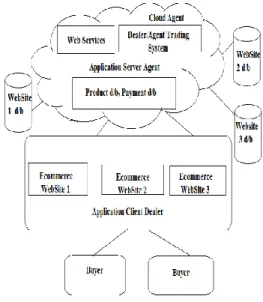
Cloud Enterprise comprises of Agent and the dealer (Ecommerce Sites) on the cloud with respective products along with enterprise service. These services include Cloud service, trading system, and direct payment. Cloud services allow the buyer to purchase or find the product to access their computing needs. Trading between the Agent and the Dealer is handled by trading system, which use the controller to search the particular ecommerce site with respective to the product needed for the buyer. Buyer depends on the services from the dealer ecommerce site. The Cloud providers will need to consider and meet different QoS parameters of each service.
A. Cloud Enterprise Working
Cloud Enterprises in Fig 1, comprises of the entire agent and the dealer on the cloud with respective products along with enterprise service. These services include web services, trading system and direct payment. Web services allow that provide services to the customer through dealer site. Trading between the dealer and customer is handled by trading system. SLA generation and direct payment modules are handled by enterprises effectively. The difficulty of finding information about trading partners in global business arena accentuates the need for electronic intermediaries to assist, navigate, and mediate the invocation of these services [7].
B. Service Provided by the Cloud Enterprise
The three main features involved under trading by the enterprise are web services, trading system and direct payment. These features along with the building up of service level agreement will constitute the delivery of requested product and handling the agreement between dealer and customer
V. DEALERAGENTMECHANISMEVALUATION
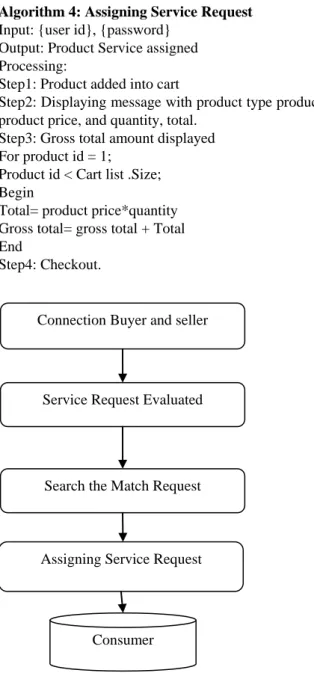
The connection between the buyer and the sellers address the buyer to upload the information for the profile database and trading electronic purpose. In Fig 2, the seller buyer mechanism process are carried out with stages of
i)Connection between buyer and sellers (Algorithm) ii) Request of service evaluated
iii)Request that matches filtered iv)Assigning Service request to Buyers
The agent middle-ware is primarily designed to act as a bridge between distributed physical networks, creating an agent friendly communication infrastructure on which agents can be organized in a hierarchical fashion more easily and freely like:
• The Buyers starts by initiating a communication with the dealer using the communication protocol.
• The dealer identifies the buyers and replies with either accept/reject response.
• The Buyers sends the original/refined customer's request to the dealer.
• The dealer delegates the request to the registered agent if request not found.
• The Seller upon receiving a request attempts to interpret it by itself. If interpretation is successful, the Seller will report to the agent with a certainty value.
• If the seller cannot interpret the request as its own then it reports with zero certainty value.
• The Seller returns the result to the agent
A. Connection between buyer and sellers
Connection is issued between buyers and seller for the task to be accomplished for the purpose of electronic trading and electronic business. Predefined process that are determined for the purpose of connection this stage receives the request from the buyer. The algorithm for the connection of buyers and seller is based on criterion.
i)Requesting for the services of product. ii)with profile details of consumers.
Criterion1. Before requesting for the product services the user has to sign up with their new user id and password so that the consumer’s database is also maintained and connection that is established between buyers and sellers. Criterion2. For the trading Purpose the connection get established
Algorithm 1: For Connection Buyer and Seller Input: {User id}, {Password}
Output: Connection Established Processing:
If User id & password >4 < 20 Begin
/* Criterion1 If user id & password exists in dealer d/b */ Begin
Set Services
/* Dealer site will open for Access */ End
{Connection}=new connection generated If connection generated
/* Criterion 2. Begin Set Trading process */
Else if User id & password not match
/* Then show error message “Please enter correct user id & password”.*/
End End End Else Begin
/* notify Error msg “Please enter user id & password >4 >20 */
End
B. Request for service evaluated.
The connection gets established service for the product request is evaluated, where the consumer or buyer enters the product detail. The product details are broke into words. The product request is done with the basis of product type, product name. Search query task take place where the product will be searched. If the product found in the particular site then the service is forwarded in case if the product is not found then the cloud agent that maintains all the product detail will gather the information about the request to be assigned. Service that is evaluated based on the criteria the buyer set based on the price also for e.g. product price that that buyer requested is for 5000 or less than 5000 the search will be taken place accordingly.
Algorithm 2: For Service Request Evaluated
Input: {Product type}, {Product name}, {Product Price}. Output: Service request evaluated
Processing
Step1: Buyer Enters Product details Step1: Search string break into words
Step2: Compose the search query targeting known data fields like (product name, product type)
Step3: If word like product name (%Samsung %) and product type (%mobile %) found
*/Result will be displayed related to Samsung*/ End
If product type like = mobile Begin
*/Then Notify “Result displayed for all mobiles” */ End
If product name like=%Samsung%, product type like =%mobile%, price <5000 >10000
Then display Order by Price in Ascending Order & Order by Dealer.
Begin
Result will be displayed End
Else message display record not found If product request forwarded
Then search query forwarded to cloud agent Go to step 1
End End
C. Request for matches are Searched
Algorithm 3: Product Search Match
Input: {User id}, {Password}, {Product Price}, {Product Type}
Output: Search matched
Step1.Enter user id and password login Begin
If product price < = Product Price Begin
*/ Show match found */ End
If product type = (%Videocon %) & price < = 5000 Begin
*/ Notify Match Found Detail*/ Else
Begin
*/ notify Match not found */ End
The match request is searched in the cloud agent system. The request is from the dealer site not from the customer directly. The input is product type and product price. This stage that indicates the selection cycle completes for the request and the connection between buyer and the seller. The match searching stage together provides the path that is optimized which allow buyers and sellers to go through cycles for connection. Product search is done for the site perspective so that the concern site can provide the services to consumers or buyers. The web services which communicate between the applications. The service that is assigned is described with the help of algorithm.
D. Assigning Service request to consumers
For the connection that is established and the search that has taken place if the product found then the buyers receives the services of product type. Once the customer select the product from the catalogue the product that get added into cart. The message is displayed with product name, Product Detail, Product Price ,Quantity and total. The gross total is calculated and the amount is displayed. Total is calculated Total= Product Price * Quantity
When the total is been calculated the consumers checkout with transaction.
Algorithm 4: Assigning Service Request Input: {user id}, {password}
Output: Product Service assigned Processing:
Step1: Product added into cart
Step2: Displaying message with product type product name, product price, and quantity, total.
Step3: Gross total amount displayed For product id = 1;
Product id < Cart list .Size; Begin
Total= product price*quantity Gross total= gross total + Total End
Step4: Checkout.
Fig 2 Stages of Dealer Agent Cloud Ecommerce
VI. CLOUDSEARCHENGINEBASEDAGENT For the service required the query that runs against the cloud to registered service in the database of search engines that matches with the requirement of consumers. Agent search engine threads that are gathered together for collection of information for the request coming from the dealer ecommerce sites (Service to be provided .The architecture of a Agent cloud searching product services and database. It includes the following agent database, agent search engine, and dealer sites. The agent search engine extracts the match product from its database. The agent search engine maintains all the dealer ecommerce sites databases of product which then examines the match product to be matched. The ecommerce dealer site module fetcher stores the matching product services that are extracted from the cloud agent software system. Agent the
Connection Buyer and seller
Service Request Evaluated
Search the Match Request
Assigning Service Request
Filters the match product by scanning the product text of all database maintained of all ecommerce dealer site product. Request is delivered based on the forwarded request and with the match of product, the product thus received to the customer followed by the transaction. Agents have to be more selective in choosing trusted agents from their limited agent pool, basing decisions around the established topology as well as the trust metrics [9].
VII. SECURITYMEASUREFORTRADING TRANSACTION
For secure transactions between buyer and seller PayPal sandbox is implemented in this system. It is a self contained environment within which developer can prototype and test PayPal features and APIs. Its purpose is to give developers a shielded environment for testing and integration purposes and to help avoid problems that might occur while testing PayPal integration solutions on the live site. PayPal products features in this system are as follows:
Website Payments with Buy Now Buttons: The Sandbox is to test accepting PayPal as a payment mechanism on a website.
Shopping Cart Purchases: The Sandbox is used to test the purchase of multiple items in a single transaction using a single payment.
Instant Payment Notification (IPN): The PayPal Sandbox is used to test IPN for updates and payment notifications.
VIII. PROTOCOLSFORINFORMATIONEXCHANGE A. Protocols in each Stage
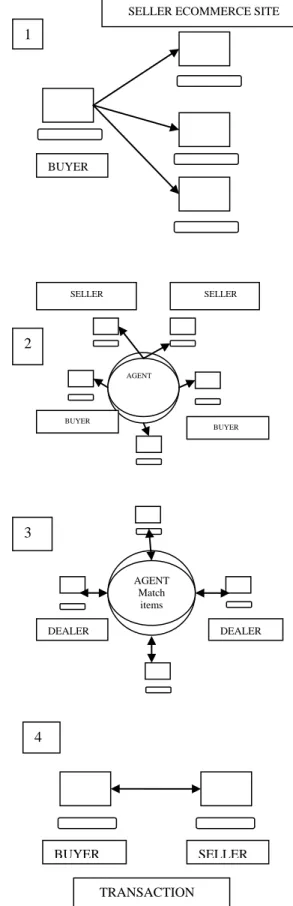
The information exchange between the agent and dealer and the interaction between them is specified with brokering protocols. The stage of information exchanged is follows in Fig 3:
1) Consumer or buyer send request to the ecommerce dealer site with the preference and the profile that is the user fills up the sign up details, for the purpose of trading to be secure. In the specification of product item the buyer send the product type and the price. The request then it is connected to dealer ecommerce site.
2)The dealer then connect the sellers and buyer for the request that is specified, if the request is found in that particular database request will be fulfilled if not then the seller that connects to the cloud agent where the entire product database is maintained. Multiple connections are followed.
3) The agent that are connected to dealer ecommerce sites if the product is match with the request that is sent and the communication between them is taken with web services where the interaction id done with xml message. If the match found then the agent then assign to maintain the record of payment details of number of ecommerce sites. Agent maintains the trading details and transaction.
4) The transaction is complete between buyers and sellers. In this stage the buyer add the product item in its cart and view the total and gross total depending upon the quantity. Buyer then checks out with the payment transaction. ) A service is different from a traditional software artifact in that it’s autonomous [10]. The connection between dealer and agent and the transaction between them is explained with the
tested electronic infrastructure. The protocol that specifies the interaction and exchange of information using web services in this paper the web services that is used as the communication protocol is JAX WS which is explained in the later in this paper. The agent-based brokering system exposed in this paper partially solves the connection problem in the product brokering and the merchant brokering stages of ecommerce [11]. In solving the connection problem using the protocol.
Fig 3 : Buyer and Seller Protocol Stages
AGENT
BUYER BUYER
SELLER SELLER
2
SELLER ECOMMERCE SITE
BUYER
1
AGENT Match
items
DEALER DEALER
3
BUYER SELLER
TRANSACTION 4
IX. PROTOCOL MODULE FOR COMMUNICATION
The dealer ecommerce sites and cloud agent cannot talk or cannot have the interaction between them until and unless there is the web services used between the application communication purpose so to transfer message or protocols required for communication. The communication process module is the backbone that is considered for the process of communication between dealer and agent (service provider). XML based message is used for the purpose of communication between the systems. The TCP Socket client is used for the transfer of message between the dealer and agent. Several messages that are handled by XML message the web services which are JAX-WS stands for Java API for XML Web Services. JAX-WS is a technology for building web services and clients that communicate using XML. JAX-WS allows developers to write message-oriented as well as RPC-oriented web services. In JAX-WS, a web service operation invocation is represented by an XML-based protocol such as SOAP. The SOAP specification defines the envelope structure, encoding rules, and conventions for representing web service invocations and responses. These calls and responses are transmitted as SOAP messages (XML files) over HTTP. Although SOAP messages are complex, the JAX-WS API hides this complexity from the application developer. On the server side, the developer specifies the web service operations by defining methods in an interface written in the Java programming language. The developer also codes one or more classes that implement those methods. Client programs are also easy to code. A client creates a proxy (a local object representing the service) and then simply invokes methods on the proxy. With JAX-WS, the developer does not generate or parse SOAP messages. It is the JAX-WS runtime system that converts the API calls and responses to and from SOAP messages. With JAX-WS, clients and web services have a big advantage: the platform independence of the Java programming language. In addition, JAX-WS is not restrictive: a JAX-WS client can access a web service that is not running on the Java platform, and vice versa. This flexibility is possible because JAX-WS uses technologies defined by the World Wide Web Consortium (W3C): HTTP, SOAP, and the Web Service Description Language (WSDL). WSDL specifies an XML format for describing a service as a set of endpoints operating on messages. SOA involves the use of loosely coupled, independent application services made available across a network. These services communicate via a standardized, platform-independent protocol that hides the underlying implementation details of each service. So a .NET client can access a service implemented in Java.
i) JAX-WS is typically used in conjunction with other technologies.
ii) JAX-WS represents remote procedure calls or messages using XML-based protocols such as SOAP, but hides Soap's innate complexity behind a Java-based API. The JAX-WS
runtime system converts API calls and matching replies to and from SOAP messages.
iii) Invoking Web services asynchronously.
VIII. RESULTEVALUATION
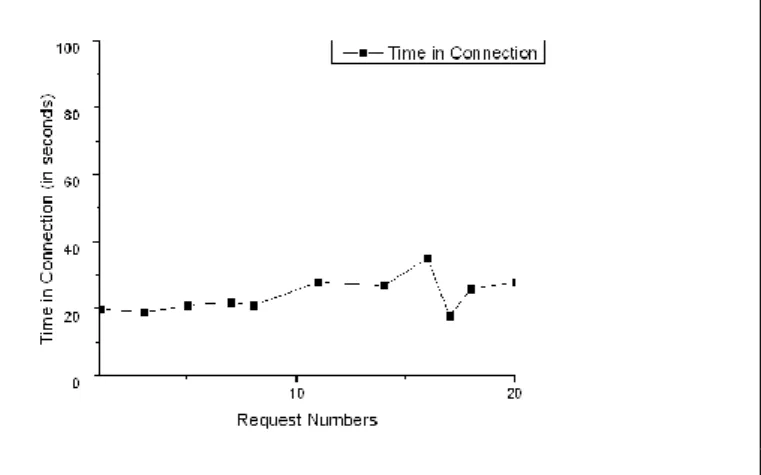
Fig 4: Result of Experiment 1
In Fig 4 the experiment 1, that is conducted for evaluation of product that is requested. The buyer that request for the product the requested product that receives in stimulated time with maintain quality of service .Window XP that is running on a PC. In the Experiment the scenario which is chosen is the 6 buyer and dealer ecommerce site that is registered in agent. The experiment that states the buyer with 6 requests for the first time with ecommerce dealer sites which in turn the request is refined based on the availability of service to be fulfilled. If the request not found then the request if forwarded to agent through ecommerce dealer site with stimulated time that is few seconds the request get fulfilled and the buyer will not know the background mechanism. Both the result is evaluated by web tool to check the performance of the system.
Fig 5: Result of experiment 2
that is generated by the buyer with product displayed details for every request. The time for connection were measured and determined in the graphical format.
X. CONCLUSION
The project focuses on developing business services because of core concept of cloud computing revolves around providing software as a services. Services handle request and responses using XML. The project is using a local environment instead of a public cloud. Our project involves two services namely web services and trading services. These services are used to trade agent and dealer products. Dealer agent mechanism transaction is the transaction of product between them, has been developed and satisfies all proposed requirements. The system is highly scalable and user friendly. Almost all the system objectives have been met. All phases of development were conceived using methodologies. The Software will be executed successfully by fulfilling the objectives of the project. Further extensions to this system can be made required with minor modifications. The agent software system in this paper solves the problem for connection in ecommerce stages. Each process id defined with the protocols. The goal of this paper to develop dealer agent based mechanism which is been achieved by agent software system architecture.
ACKNOWLEDGMENT
I thanks to our guide who directed us till the completion of this work and for his valuable suggestion and unconditional help. I sincerely express my deep sense of gratitude to my guide and head of department of Information Technology their valuable guidance, encouragement and timely need given to me throughout the course of this work.
REFERENCES
[1] Min Wu Jiaxing College, Jia Xing,” Cloud Trust Model in E-Commerce,” China ISBN 978-952-5726-09-1 (Print Proceedings of the Second International Symposium on Networking and Network Security (ISNNS ’10) Jinggangshan , P. R. China, 2-4, April. 2010, pp. 271-274
[2] Stephen S, Yau,”Software Engineering meets Services & Cloud Computing,” IEEE Computer Society
[3] Mario Macias, J Oriol,”Rule Based Management For Revenue, Maximization in Clod Computing Market,” IEEE Communication Society Network & Service Management.
[4] Kwang Mong Sim Senior Member,” Agent-based Cloud Computing,,”IEEE Transaction On Services Computing.
[5] Seokho Son and Kwang Mong Sim, Senior Member” A Price- and-Time-Slot-Negotiation Mechanism for Cloud Service Reservations” IEEE Transactions On Systems, Man, And Cybernetics—PART B. [6] Tarek Helmy,”Collaborative Multi Agent Based Ecommerce
Framework,” International Journal of Computer System & Signal Vol 8, No 1, 2007
[7] Kwang Mong Sim , Raymond Chan, “ A Brokering Protocol for Agent based Ecommerce,” IEEE Transaction on System Man and Cybernet Vol 30, No 4, November 2000.
[8] Liang-Jie, Zhang,” Introuction to the IEEE transaction on Service Computing,” IEEE Transaction on Service Computing Vol 1,No 1, January 2008.
[9] John F. Borowski, Kenneth M,” Reputation-Based Trust for a CooperativeAgent-Based Backup Protection Scheme,” IEEE Transaction On Smart Grid, Vol. 2, No. 2, JUNE 2011
[10] Yi Wei, M.Brian Blake,”Service Oriented Computing & Cloud Computing,” IEEE Internet Computing.