447
STUDIES AND MEASUREMENTS OF EMANATED DUST IN THE
ATMOSPHERE DURING THE PRODUCTION OF DIFFERENT TYPES
OF COMPOUND FEED
CRISTIAN VASILE, MIHNEA GLODEANU, TUDOR ALEXANDRU Faculty of Agronomy, University of Craiova, Romania
Keywords: technological flow, granules, air jet, dust, compound feed
ABSTRACT
Compound feed are very used in animal alimentation from livestock, because due to the complexity of the types of the cereals used and its nutritional and caloric contributions, it ensures a high productivity at a relatively low cost price. It is well known that a certain recipe of compound feed must be used in function of the breed and age of the animals which will be nourished and that is why this field of activity is so diversified.
The activities carried out in compound feed factories form a very complex technological flow. In order to obtain the final product in the form of granules, the mixture of nutrients must be passed through in a special molds, then it needs to be sterilized with steam jets at high temperatures and, finally, cooled by air jets
In this article have been made experimental measurements about the dust concentrations eliminated in air in view of testing the reliability of the installations used for compound feed production and compliance with the standards of environmental protection.
INTRODUCTION
Due to the increasing demand for food worldwide, the growth of various animal species has become a necessity, because it ensures the necessary of meat and other products for consumption. Also there can be set up zootechnical farms by the numerical expansion, which can shortly become good profit generators in areas where grain can be effectively utilized at an advantageous price.
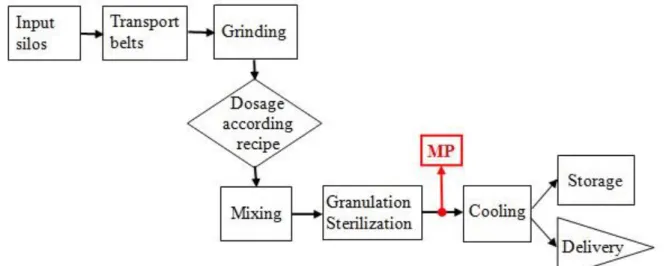
That is why there have been a growing number of combined feed factories that produce a wide variety of recipes depending on the breed and age of the animals which are to be fed. The technology implies to carry out several stages: the supply of raw materials in the form of cereals and grains, their storage in bunkers, the transport of raw materials by means of horizontal or vertical strips, grinding the grains and mixing them in the amounts indicated by each recipe separately. Afterwards there comes the granulating, homogenizing, sterilizing, and cooling the finished product.
The homogenization stage by the form of granules of the combined fodder are made using very high temperature steam jets and the cooling stage of the final product is carried out by means of strong cold air jets. Due to the strong pressure of the hot steam and cold air jets, this equipment removes a certain amount of dust in the air, which can cause damage to the air in the enclosure of the working process and can also damage the surrounding nature.
To avoid exceeding the permitted limits of pollution, in compound feed factories are used special filters for nox and dust. There have been done some experimental measurements for air dust emissions from production of different types of compound feed, which attest to the adherence of the European standards.
MATERIAL AND METHOD
448
contributions which they bring to animal feed, the compound feed determine a growth of productivity of zootechnical farms at a prix relatif low.[3, 7]
The process of producing compound feed is quite complex, taking into account that during the technological flow (figure 1) are carried out storage, transportation, grinding, mixing, granulation, sterilizing and cooling activities. Also in figure 1 it is marked the measuring point (PM), the place in which there were performed the experimantal researches presented in this work.[8, 9]
In the stage of obtaining the finished product in granular form it use an installation for steam production at a very high temperatures, for the homogenisation of mixture which form the granules and also to sterilize them so as to completely eliminate all the existent pests, microbs and other pathogenic agents. [1] Another activity from the technological flow is the cooling of the compound feed granules obtained to deposit them inside special bunkers or to pack them in bags or sacks so to be delivered to the customers. This operation is done using a very powerful air jet, which is used as thermal cooling agent.[4]
In this two stages of technological flow from a CFF, steam and air jets drive in motion very small particles which detach during homogenization and drying of the compound feed granules, forming a dust cloud which is eliminated in the atmosphere and can have harmful effects for the human health and also for the environment.
For these reasons, considerable efforts are being made by specialists in the field for construction of high performance working installations, with a higher degree of automation and computerization, that will check permanently the dust concentrations in the air and will announce instantly any exceeded of the admitted threshold, in which case, the installations will be off automat until the situation is regulated.[2]
Analyzes and experimental research presented in this paper were made during the operation of the working installations of a compound feed factory, precisely to verify their reliability and to certify full compliance with the European rules on noxes and dust eliminated in the atmosphere.[7, 9]
Figure 1: Technological flow of CFF and the measuring point (MP) of eliminated dust
Analyses and experimental measurements have been performed on the spot, at the measuring point (MP) using STROHLEIN STE4, which is a specialized device in measuring concentrations of dust emitted into the atmosphere by the continuous iscocinetic sampling method in the filtering sieves.[5, 6, 8, 9]
449
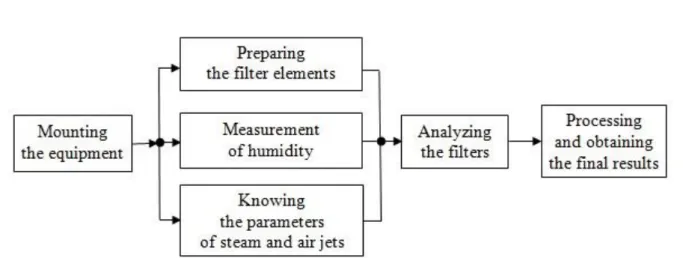
Figure 2: Steps performed for determining dust concentrations eliminated in air
An essential element of the device is represented by the probe through which the jet of air passes and which has an area where is mounted the filter cartridge which retains the dust particles from the effluent that cross the probe (figure 3).
Figure 3: The probe through which the jet of air passes
1-Calibrated nozzle; 2,10,11-Connecting piece; 3,7-Clamping nut; 4-Garnishes; 5-Filter cartridge body; 6-Filter with wool; 9-Flat filter; 12-Connector
In order to obtain the correct final results, the flow parameters of steam or air jets (temperature, humidity, pressure, speed) are constantly followed and the measured values are noted periodically.[5, 6]
Due to the the fact that there is an uneven distribution of the dust in the travel section of the steam or air jets,the experimental measurements are made with the help of many sampling points existing in the section of the filter from the used probe, which will allow for the most accurate determination of the medium concentration of the dust eliminated in the air. In figure 4 it is showed the layout of the prelevation points according to the section type of the working probe of the measuring device.
Figure 4: Layout of dust sampling points in a rectangular (a) or circular section (b)
450
the filter used opens, then it weigh both the filterable cartridge’s box and the flat filter used to obtain the final results of the dust concentrations from the analyzed air.
THE OBTAINED RESULTS
Speciality analyses and the experimental measurements of dust concentrations eliminated in the atmosphere during the production of compound feed were carried out at the homogenization, sterilization and cooling installations of compound feed granules, more exactly at the evacuation chimney of the thermal agent used in the technological flux, this being the place where the dust is eliminated in the air.
The modern working installations of the compound feed factories were designed as to retain by special filters the dust emanations resulted during the working process.
The experimental measurements were made to verify compliance with European rules regarding the environmental protection at the evacuation chimneys of the compound feed factories. Thus, these measurements concerned the quantities of dust eliminated in the atmosphere and the efficacy of the dedusting devices used.
For a more secure analysis of the environment protection, the experimental analyzes were carried out during the production processes of compound feed for two different species of animals : pigs and rabbits. Each assortment of compound feed assume some technological parameters, so the working installations are requested in a different way and thus can be checked more clearly the capacity of dust retaining in order to protect the persons handling these facilities and also the environment.
A) Measurements made in the case of the production of compound feed for pigs
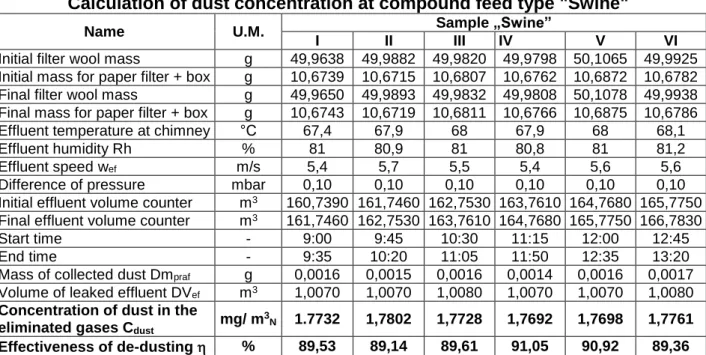
The calculation of dust concentrations for this type of compound feed is presented in the table 1. For the confirmation of the correct functioning of the working installations were carried out more determinations termotechnical, in different times, for more samples produced from this sortiment of compound feed.
Table 1
Calculation of dust concentration at compound feed type "Swine"
Name U.M. Sample „Swine”
I II III IV V VI
Initial filter wool mass g 49,9638 49,9882 49,9820 49,9798 50,1065 49,9925
Initial mass for paper filter + box g 10,6739 10,6715 10,6807 10,6762 10,6872 10,6782
Final filter wool mass g 49,9650 49,9893 49,9832 49,9808 50,1078 49,9938
Final mass for paper filter + box g 10,6743 10,6719 10,6811 10,6766 10,6875 10,6786
Effluent temperature at chimney °C 67,4 67,9 68 67,9 68 68,1
Effluent humidity Rh % 81 80,9 81 80,8 81 81,2
Effluent speed wef m/s 5,4 5,7 5,5 5,4 5,6 5,6
Difference of pressure mbar 0,10 0,10 0,10 0,10 0,10 0,10
Initial effluent volume counter m3 160,7390 161,7460 162,7530 163,7610 164,7680 165,7750
Final effluent volume counter m3 161,7460 162,7530 163,7610 164,7680 165,7750 166,7830
Start time - 9:00 9:45 10:30 11:15 12:00 12:45
End time - 9:35 10:20 11:05 11:50 12:35 13:20
Mass of collected dust Dmpraf g 0,0016 0,0015 0,0016 0,0014 0,0016 0,0017
Volume of leaked effluent DVef m3 1,0070 1,0070 1,0080 1,0070 1,0070 1,0080
Concentration of dust in the
eliminated gases Cdust mg/ m 3
N 1.7732 1,7802 1,7728 1,7692 1,7698 1,7761
Effectiveness of de-dusting % 89,53 89,14 89,61 91,05 90,92 89,36
451
B) Measurements made in the case of the production of compound feed for rabbits
The calculation of dust concentrations eliminated in the atmosphere during the production of this type of compound feed is shown in Table 2.
Table 2
Calculation of dust concentration at compound feed type "Rabbits"
Name U.M. Sample „Rabbits”
I II III IV V VI
Initial filter wool mass g 49,9829 49,9783 49,8369 50,1439 49,9912 50,0486
Initial mass for paper filter + box g 10,7042 10,7026 10,7042 11,0048 10,8851 10,6991
Final filter wool mass g 49,9840 49,9795 49,8381 50,1450 49,9923 50,0498
Final mass for paper filter + box g 10,7045 10,7029 10,6745 11,0052 10,8854 10,6993
Effluent temperature at chimney °C 71,9 72,1 72 71,9 72,1 72
Effluent humidity Rh % 87,8 87,9 88 87,9 88,2 88,1
Effluent speed wef m/s 5,6 5,7 5,7 5,8 5,6 5,6
Difference of pressure mbar 0,10 0,10 0,10 0,10 0,10 0,10
Initial effluent volume counter m3 166,7830 167,7880 168,7940 169,7990 170,8050 171,8090
Final effluent volume counter m3 167,7880 168,7940 169,7990 170,8050 171,8090 172,8140
Start time - 9:00 9:45 10:30 11:15 12:00 12:45
End time - 9:35 10:20 11:05 11:50 12:35 13:20
Mass of collected dust Dmpraf g 0,0014 0,0015 0,0015 0,0016 0,0014 0,0014
Volume of leaked effluent DVef m3 1,0050 1,0060 1,0050 1,0060 1,0040 1,0050
Concentration of dust in the
eliminated gases Cdust mg/ m 3
N 1,5587 1,5604 1,5591 1,5682 1,5573 1,5589
Effectiveness of de-dusting % 90,26 90,38 89,97 89,85 90,21 90,07
Thus, it can be seen that for this type of compound feed the concentration of dust in the air did not exceed the admissible limits, being even a little lower than at the previous case analyzed.
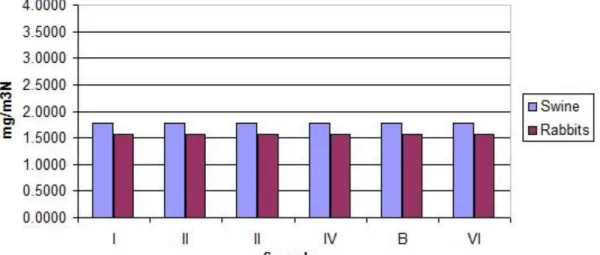
In figure 5 is graphically shows the experimental values measured for the concentrations of dust released in the atmosphere in the case of successive production of several samples of compound feed for pigs and rabbits, which attesting that is not exceeded the maximum admissible level of 4 mg/m3N.
Figure 5: Values of concentrations of dust eliminated in the air
CONCLUSIONS
452
Based on the experimental results obtained for the two assortments of compound feeds that were analyzed it is noted the perfectly functioning of the filtering installations by ensuring an increased yield of the retention of dust particles from the released air.
A main feature of the working installations from the compound feed factories is the ability to retain the dust before its elimination it in the air by using filtering devices and also automatic devices for technological flow monitoring.
By using some specialized and performance equipment, with a high degree of automation and computerization which allow the correct adjustement of the working parameters to obtain the mixture according to the desired recipe of compound feed, adjusting the effluent flow through the exit chimney, controlling the correct functioning of the filtering devices, detecting possible filter cracks it is ensure compliance with the national limits specified by Order 492/1993, as well as the European environmental protection limits.
BIBLIOGRAPHY
1. Bond, T.C., Covert D.S., Kramlich J.C., Larson T.V., Charlson R.J., 2002 – Primary
particle emissions from residential coal burning: Optical properties and size distributions, Journal of Geophysical Research: Atmospheres, vol. 107, no. D21, pag. 1-14.
2. Brîndușa, P., Iliescu C., Faur D., 2006 – Mesures electriques et transducteurs, Matrix
Rom Publishing House, Romania, pag. 36-44.
3. Căproiu Magdalena, ş.a., 1982 – Maşini şi instalaţii zootehnice, Editura Didactică şi
Pedagogică, Bucureşti, pag. 19-26.
4. Gaceu, L., 2006 – Tehnici moderne de uscare a cerealelor si plantelor tehnice, Editura
Universitatii “Transilvania” Brasov, pag. 97-102.
5. Ionel, I., ş. a., 1994 – Măsurarea emisiilor din gazele de ardere cu ajutorul senzorilor
electrolitici, The National Conference of Thermodynamics, Vol. I, Timişoara, pag. 231-235.
6.Ionel, I., ş.a., 2002 – Protecţia mediului, obiect de cercetare si dezvoltare al laboratorului
de analize de combustibili şi investigaţii ecologice, Revista AGIR, Nr. 1, ISSN 1224-7928, pag. 35-41
7. Popescu, C., 2008 – Ecopedologie, Editura Universitaria, Craiova, ISBN
978-973-742-912-4, pp 125-128.
8. Vasile, C., 2011 – Analysis of the Correlations Between Fodder's Productions and
Dynamic Livestock Farms Activities of our Country, Vasile C., Annals of the University of Craiova – Agriculture, Montanology, Cadastre Series, Vol. XLI, no. 2, ISSN: 1841-8317, pag. 403-410.
9. Vasile C., 2016 – The implementation of an automated system of monitoring of the