271
RESEARCHES ON WEED CONTROL ON STRAWBERRIES
SĂLCEANU C., OLARU L.
Keywords: weeds, strawberries, herbicides.
ABSTRACT
Strawberries are, usually planted using black special plastic film for weed protection yet the interval between planted rows is still susceptible to weed infestation which can cause important damages to the crop. However, some growers prefer the multiannual crop with straw mulch applied before fruit ripe. These two situations need chemical control of weeds in order to decrease the manual labor need. The experiment has tried three soil
applied active ingredients (S – metolaclor, pendimetalin and oxyfluorfen) and
threepostemergent ones (quizalofop, linuron, oxyfluorfen and S – metolaclor). The soil applied substances gave very good results yet, among the postemergence ones, linuroncan not be applied on strawberries because the plant will not produce flowers and fruits anymore, eventhough the leaves are not affected.
INTRODUCTION
Weeds can affect the strawberries growth and yield in several ways. They compete with the strawberry plant for water, minerals and light, they increase the pressure of diseases, nematodes and insects and reduce the quality of fruits. The efficacy of harvesting can be reduced because the workers cannot see the fruits that are hidden among weeds. In plus, the weeds increase the cost of production because their control can add up to several hundreds of euros per hectare per year. The strawberry plant can easily be outrun by taller and faster growing weeds and the strawberry plantation can be compromised in matter of weeks in the absence of weed control measures. Proper control of weeds can enhance the duration of strawberry plantation to 2-3 years.
Both autumn and summer weeds can affect strawberry plantation. However, the autumn weeds are harder to control than the warm climate ones because they grow during the cold season when the soil is moist and there cannot be applied control measures like manual hoeing. The annual typical cold climate weeds are: chickweed (Stellaria media),
shepherd’s purse (Capsella bursa pastoris), henbit (Lamiumamplexicaule), lambsquarters
(Chenopodium album), wild mustard (Sinapisarvensis), bindweed (Convolvulus arvensis),
thistle (Cirsiumarvense). These weeds emerge either in autumn or in spring but they grow
until hot summer month come. The warm climate weeds emerge during the late spring and
grow during the summer. Examples of them are: redroot pigweed (Amaranthusretroflexus),
black nightshade (Solanum nigrum), common cocklebur (Xanthium strumarium), spiny
cocklebur (Xanthium spinosum), yellow foxtail (Setariaglauca), bermuda grass
(Cynodondactylon), Johnson’s grass (Sorghum halepense).
MATERIAL AND METHOD
272
Figure 1. The sketch of the experiment
The soil applied herbicides that have been used are:
1. GOAL 4F is an herbicide that contains 480 g/l oxyfluorfen. It is formulated as emulsionable concentrate. The active ingredient acts both as soil herbicide as well as postemergent herbicide. As soil applied herbicide, oxyfluorfen is very strongly attracted by soil particles where creates a film at the soil surface that does not permit the emergence of most dicotiledonous weeds, except the ones that have very large seeds as cocklebur. The experimented dose was 0.5 l/ha in 300 l water.
2. Stomp contains 330 g/l pendimetalin as active ingredient. Pendimetalin is, also very strongly attracted by soil particles. It does not migrate into weed plantlet roots and affects the small roots and shots of newly emerged weed by accumulating into cell membrane. This substance is an excellent grass weeds controller from seeds. It also controls most of broadleaved weeds with small seeds. The experimented dose was 5 l/ha in 300 l water.
3. Dual Gold contains 960 g/l S – metolaclor as active ingredient. This active
ingredient affects the synthesis of fatty acids as well as cell division. It mainly controls grass weeds from seed as well as the most important broadleaved weeds. It can be applied on early postemergence. The experimented dose was 1.2 l/ha in 300 l water.
The postemergence experimented herbicides have been:
1. Killer 5 EC that contains 50 g/l quizalofop P etyl. This active ingredient belongs to the family of antimonocotiledonous substances, including fluazifop butyl, propaquizafop and others. They affect the synthesis of fatty acids in grasses. They can be applied on all broadleaved crops and they do not affect broadleaved weeds at all. The injury consists in accumulating in meristematic zones at stem nodes and death of susceptible weeds in a matter of 7-10 days. The experimented dose was 1.5 l/ha in 300 l water.
2. Afalon contains 450 g/l linuron as active ingredient. This active ingredient has a complex action on soil as well as on weed leaves. It affects photosynthesis. The experimented dose was 1.0 l/ha in 300 l water.
3. Dual Gold as foliar applying on strawberries. The experimented dose was 1.2 l/ha in 300 l water.
273
Table 1. European Weed Research Society scale for herbicide efficacy on weeds
Mark Control (%) Description
1 100 Total control
2 99.0-96.5 Very good control
3 96.5-93.0 Good control
4 93.0-87.5 Fair control
5 87.5-80.0 Poor control
6 80.0-70.0 Very poor control
7 70.0-50.0 Very poor control
8 50.0-1.0 Very poor control
9 1.0-0.0 Lack of control
Table 2. European Weed Research Society scale for herbicide phytotoxicity on crops
Mark Crop
phytotoxicity (%)
Description
1 0 No simptom
2 1.0-3.5 Light discoloration
3 3.5-7.0 More evident simptoms but
not lasting
4 7.0-12.5 More severe effect but with
low duration
5 12.5-20.0 Middle effects as severity and
duration
6 20.0-30.0 Grave effects
7 30.0-50.0 Very grave effects
8 50.0-99.0 Almost destroyed crop
9 100 Crop destroyed
RESULTS AND DISCUSSIONS
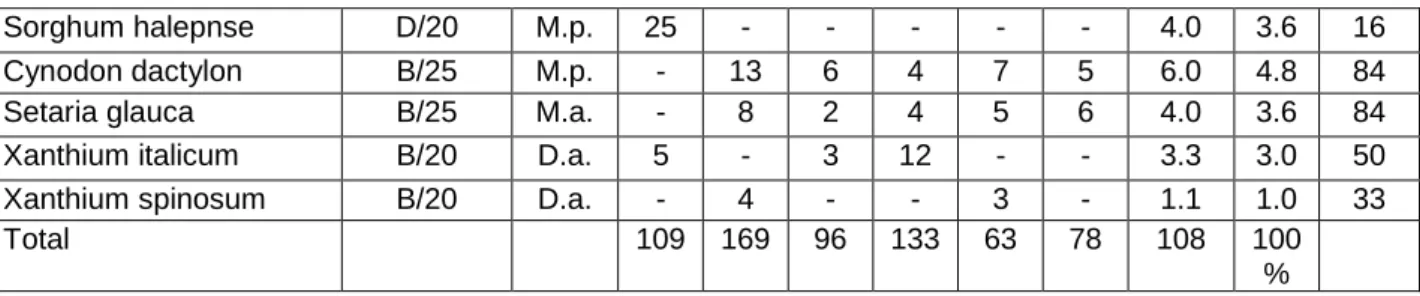
The weeds present in the untreated variant are presented in the table below as number per square meter, average number per species, total number of weed per square meter, participation (P%) and constancy (K%) during 2016 year of experiment.
Table 3. The weed degree with not treated variant
Species phase/ H,cm
Biol. cat.
Repetition Av. P% K% I II III IV V VI
Cirsium arvense B/25 D.p. 5 - - - 0.7 0.8 16 Convolvulus arvensis D/30 D.p. 3 - - - 0.5 0.5 16 Chenopodium album B/15 D.a. 54 - - - 8.0 7.0 16 Stellaria media B/15 M.a. 12 22 - 25 - - 6.0 6.0 48 Amaranthus retroflexus B/25 D.a. 5 75 58 53 24 36 42.0 39 100 Portulaca oleracaea B/15 D.a. - 12 14 24 16 21 14.5 13 84 Galinsoga parviflora B/15 D.a. - 21 9 15 8 10 10.5 9.7 84
274
Sorghum halepnse D/20 M.p. 25 - - - 4.0 3.6 16 Cynodon dactylon B/25 M.p. - 13 6 4 7 5 6.0 4.8 84 Setaria glauca B/25 M.a. - 8 2 4 5 6 4.0 3.6 84 Xanthium italicum B/20 D.a. 5 - 3 12 - - 3.3 3.0 50 Xanthium spinosum B/20 D.a. - 4 - - 3 - 1.1 1.0 33
Total 109 169 96 133 63 78 108 100
%
From this determination there can be seen that the most encountered weeds are
Amaranthusretroflexus, Cynodondactylon, Galinsogaparviflora and Portulacaoleracea.
After herbicide applying the effect on weeds is presented in table below.
Table 4. The efficacy of soil applied and postemergent applied herbicides
on strawberry and their selectivity for the crop
Weed Biol. cat. V1 V2 V3 V4 V5 V6
Cirsium arvense d.p. 7 7 7 9 3 9
Convolvulus arvensis
d.p. 7 7 7 9 2 9
Chenopodium album
d.a. 1 1 2 9 1 9
Stellaria media d.a. 1 1 2 9 1 9
Amaranthus retroflexus
d.a. 1 1 1 9 1 9
Portulaca oleracaea
d.a. 1 1 1 9 1 9
Galinsoga parviflora
d.a. 1 1 1 9 1 9
Abutilon theophrasti
d.a. 3 3 4 9 1 9
Sorghum halepnse
m.p. 9 9 9 1 9 9
Cynodon dactylon
m.p. 9 9 9 1 9 9
Setaria glauca m.a. 2 1 1 1 2 7
Digitaria sanguinalis
m.a. 2 1 1 1 2 7
Ambrozia artemisiifolia
d.a. 1 3 4 9 2 9
Xanthium italicum
d.a. 7 7 9 9 2 9
Xanthium spinosum
d.a. 7 7 9 9 2 9
Selectivitate 1 7 1
Treatments Goal
4F
Stomp Dual Gold
Killer Afalon Dual Gold
275
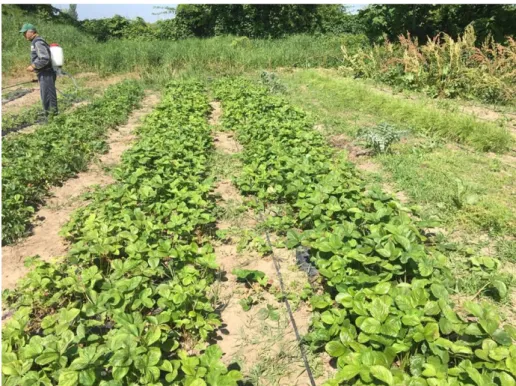
Figure 2. Aspect of the experiment
CONCLUSIONS
1. Strawberries can be easily compromised by weeds if no control measures are applied because weeds can grow faster and, generally, taller than strawberry plant. 2. Soil applied herbicides can control very well most of annual weeds, both grasses
and broadleaved weeds. Perennial weeds are very hard to control, so, the advice is to avoid these weeds where strawberry plantation will be put in place.
3. Killer herbicide does control grass weeds very well and has a very good selectivity for strawberry crop. It does not affect broadleaved weeds at all.
4. Afalon herbicide cannot be applied on strawberries because it determine the lack of flowers and fruits even though it does not affect the leaves.
5. Dual Gold can be applied on strawberries crop in spring, after rackling. It will protect against most of annual weeds from seed.
BIBLIOGRAPHY
1. Dobre M., 2008. Cum aplicăm erbicidele. Editura Morin Craiova. 2. Mihaescu Grigore, 1998.Cultura căpşunului, Ed Ceres.
3. Nick Waipara, 2001. Sustainable Farming Fund, Ministry of Agriculture and Forestry, New Zeeland.
4. Sean L. Swezey, 2003. Organic strawberry production short course, University of California.