LANDOWNERS PERCEPTIONS TOWARDS THE CULTIVATION OF
ENERGY CROPS: EMPIRICAL EVIDENCE FROM THE REGION OF
EVROS GREECE
KARELAKIS C.(1), VLADU M.(2)
Democritus University of Thrace School of Agricultural and Forestry Sciences Department of Agricultural Development Pantazidou 193, 68200 Orestiada, Greece e-mail: [email protected](1) *Universitatea din Craiova, Facultatea de Agronomie Craiova, Craiova, Dolj, 200421, str. Libertăţii nr. 19, www.ucv.ro, [email protected](2) Coprresponding author: [email protected]
Keywords: Energy crops, landowners perceptions, innovation adoption
ABSTRACT
Energy crops offer substantial benefits to the energy-environmental sector along with incentives for growth in the agricultural sector and regional economies. Their contribution to the regional rural economy has been strengthened by the reduction of stocks of conventional crops, the environmental pollution, and the need to strengthen energy independence of countries that require the use of renewable energy sources (RES). The present paper examines the positions and opinions landowners in the prefecture of Evros towards their will to adopt energy crops. Primary data were collected through a survey (structured questionnaire) to 400 owners of farms at the prefecture of Evros. The results indicate that the majority of respondents agreed to adopt an energy crop with important factors in this judgment the low production costs and greater profitability.
INTRODUCTION
The use of renewable energy sources (RES) and the gradual independence from fossil fuels comprises a key parameter in solving the energy problem and probably the only way that enables the European Union (EU) to meet its ambitious target to limit the pollutant carbon dioxide (Koutelidakis 2010). As the EU moves towards the goals of renewable energies and biofuels in 2020 (20% energy consumption from renewable sources and at least 10% of transport fuels), thus increasing the use of biomass, a policy framework is becoming necessary that encourages sustainable development of the bioenergy sector (Van Dam et al 2008). The introduction of new crops that address the emerging energy market can be an important factor, both to develop new perspective for agriculture and a new solution to the global energy problem. The advantages of these new crops include large returns, low demand on irrigation and nutrients, environmental friendliness etc. Moreover, they are promoted by the EU and a special arrangement has been made in order to be grown in set-aside land. However, the economic viability of energy crops is still considered uncertain under the present market conditions, despite the significant growth of agricultural technology. Yet, it is evident the need to replace the traditional crops due to the decline in agricultural income caused by the fall in prices and subsidies and the high input costs along with the environmental degradation due to monoculture and high environmental outputs.
consequences for sectors other than agriculture, such as the viability of rural areas. The remainder of the paper is oulined as follows: the next section presents the theoretical background relating to energy crops and the factors affecting their adoption by farmers. Then, the research methodology and the results are described and the last section summarizes the main conclusions.
THEORETICAL BACKGROUND
The farmer is considered as the biggest polluter and destroyer of the natural environment, as the industrial pollution is clearly identified and associated with the production process (Gardner 1996). Conversely, pollution from agricultural production has a diffuse character, since in rural areas farms are many, usually small, scattered and heterogeneous. The new Common Agricultual Policy (CAP) offers new opportunities in agriculture for the production of alternative crops, while at the same time, farmers are given the opportunity to develop business operations in the area of biofuel production, founding, for example, one biodiesel plant and ensuring priority remission by domestic cultivation of raw materials. Nevertheless, supporting energy crops may have negative consequences on the environment (Alliance Environment, 2007), as they have largely developed at the expense of the corresponding food crops, and crop substitution phenomena have observed (notably, replacement of cereals by rapeseed). The technical agricultural practices for energy crops do not differ from those for food crops, and hence, the consequences of the crop are the same. However, the expansion is accompanied by the gradual development of the intensive cultivation of rape and to a lesser extent maize, which have a more negative impact on the environment than the winter cereals which replace them.
Taking into consideration the increased academic interest on the future role of production of energy crops, it is very interesting to identify the factors affecting the intention of landowners to adopt these crops. Because these crops are "relatively" new to Greek agriculture, limited knowledge of past experiences can be used to assist identifying the key factors that will influence the adoption by farmers. The neoclassical economic theory states that "individuals seek for profit maximization" and many studies have applied this reasoning in the farmer’s decision making process. Perloff (1991), Ryan and Gross (1943) and Hennessy (2002), considered the "relative efficiency" as an explanatory variable in the process of adoption in agriculture. The literature shows that current profit levels of farms have a significant positive influence on the willingness of farmers to adopt new agricultural practices. Other features involve the farm size (Hennessy 2002, Rogers 1995, Ryan & Gross 1943, Rogers & Pitzer 1960), the production system (Austin et al 1998, Rosenqvist et al 2000 ), the required reliability level (Diederen et al 2003), and the communication with the available staff who will assist the farm expansion (Boahene et al 1999, Rogers & Pitzer 1960).
and Rosenqvist et al (2000) found that farmers were more likely to directly adopt the production of energy crops based on their previous experience of farming systems.
The impact of off-farm income on the adoption of alternative crops are analyzed in many studies (Jensen et al 2007, Adesina 1996, Norris & Batie 1987, Fernandez-Cornejo et al 2005). Jensen et al (2007) found that non-agricultural income has no effect on the adoption of an innovative practice, while Norris and Batie (1987) found that non-agricultural income has a statistically significant negative impact on the adoption of an innovative practice. Fernandez-Cornejo et al (2005) argue that the non-agricultural income have a significant positive influence on the adoption of an innovative practice, whereas Jensen et al (2007) hypothesized that an increase in agricultural income would have a positive impact on the adoption of a new cultivation, but the increase of farm income per hectare will have negative effects due to increased opportunity costs of converting land to an energy crop (sorghum).
MATERIAL AND METHOD
The research methodology was based on the collection and analysis of primary data derived from a structured questionnaire, which was filled in during in-depth personal interviews with landowners in the prefecture of Evros. The questionnaire included a total of 46 questions, mainly closed-ended or pre-defined answers, and it was divided into four categories that involved: socio-demographic characteristics of landowners, structural characteristics and problems of farms, the relationship of the respondents with the new CAP (views, features) and their entrepreneurial ability and their attitude towards the cultivation of energy crops. The sampling frame totaled 20,000 landowners, out of which a random sample of 400 people were selected that was distributed proportionally throughout the area. The quantitative survey took place during November 2013 and February 2014. The obtained data were analyzed through SPSS 17.0, applying the statistical procedures
of descriptive statistics, statistical hypothesis testing (X2) and the non-parametric Friedman
test.
RESULTS AND DISCUSSIONS Sample profile
Respondents consisted of 61% men and 39% women with the majority (34.25%) being in the age class of 46-55 years with significant percentage at the ages of 56-65 and 36-45 years old (27.75% and 23.75% respectively). 45.25% were secondary school graduates (high school graduates (38.75%) and technical school graduates (6.5%), while a large percentage have only finished primary school (29.75%). It is worth mentioning that the graduates from higher education is only 1.25% of the sample. Regarding their professional situation, the majority of landowners were farmers (74.75%), while only 2.5% were public servants. 37.5% deals mainly with agriculture for over 20 years, while the 25.25% of respondents are not farmers by main occupation. As regards the income of landowners, 23.25% reported a gross farm income as main income below 10,000 euros and the same percentage of 11000-20000 euros, while a relative large percentage (18%) had a gross farm income over 50,000 euros. 25.25% of the sample who are not farmers by main occupation gave no main agricultural income. As regards the years employing in agriculture as a secondary job, the results show that 9% of respondents involved secondarily in agriculture more than 20 years, 6.5% for 6-10 years, 5% for 11-20 years and 5% secondarily dealt with agriculture during the last five years. The 74.75% of the sample are the main occupation farmers.
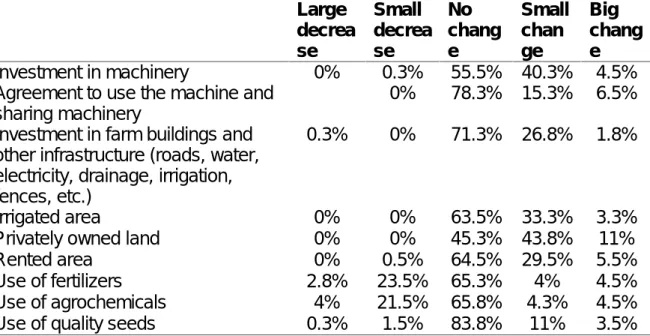
As concerns the main production method or practice that is about to be changed in the future, the landowners point out some interesting resutls illustrated in the following table 1.
Table 1. Landowners views (percentages) about what major method or technique cultivation
may change in the coming years
Large decrea se
Small decrea se
No chang e
Small chan ge
Big chang e
Investment in machinery 0% 0.3% 55.5% 40.3% 4.5%
Agreement to use the machine and sharing machinery
0% 78.3% 15.3% 6.5%
Investment in farm buildings and other infrastructure (roads, water, electricity, drainage, irrigation, fences, etc.)
0.3% 0% 71.3% 26.8% 1.8%
Irrigated area 0% 0% 63.5% 33.3% 3.3%
Privately owned land 0% 0% 45.3% 43.8% 11%
Rented area 0% 0.5% 64.5% 29.5% 5.5%
Use of fertilizers 2.8% 23.5% 65.3% 4% 4.5%
Use of agrochemicals 4% 21.5% 65.8% 4.3% 4.5%
Use of quality seeds 0.3% 1.5% 83.8% 11% 3.5%
The results show that the majority of respondents do not intend in the coming years to make any significant changes regarding the method or production practices. Furthermore, in smaller percentage, landowners will proceed to an increase (large and small changes) in the future concerning the private area 54.8%, investments in machinery (40.25%) in irrigated land 33%, in the rented area of 30%, investments in agricultural buildings 26.8%, in machine use agreement and sharing machinery 15.3% and in the use of quality seeds 11.5%. Finally, the respondents will make minor changes as regards the use of agrochemicals (21.5%) and fertilizers (23.5%).
The next step of the methodology examined if there is a statistical difference between the landowners views about the changes in methods or techniques of their crops in the coming years. Therefore we applied the non-parametric Friedman's test, from which it was revealed that the method or technique to be changed in the future is the privtate
land (obviously want to increase their private land) with mean score 6.34 (X2= 704.688. P
= 0.00), followed by the investments in equipments with a mean score of 5.76 (Table 2).
Table 2
. Friedman test results for evaluating changes in production practices in the future
Changes in methods or production practices Mean Rank
Friedman Test Statistics
Investment in machinery 5.79 N 400
Agreement to use the machine and sharing machinery
4.94
Χ2 704.688
Investment in farm buildings and other 5.09
irrigation, fences, etc.)
Irrigated area 5.46 Asymp. Sig. 0.000
Privately owned land 6.34
Rented area 5.42
Use of fertilizers 3.70
Use of agrochemicals 3.72
Use of quality seeds 4.55
Concerning the adoption and the reasons for possible adopting energy crops, the 79.50% of the landowners is positive about adopting an energy crop and only 20.5% seems skeptical in this perspective. The main reasons why would adopt an energy crop are shown in Table 3. Specifically, landowners perceive as importa in their decision to adopt an energy crop the low production costs, the high profitability and the increased production with an aggregated percentage of 79%. Moreover, important factors at high rates, the increased demand for the product (78.8%), the best product price (78.3%), the low use of fertilizers and agrochemicals (75.3% and 73.1% respectively). There were also less important factors to consider as the non-environmental pollution (61%), the best agricultural product (50.6%) and the higher subsidies (50%). Finally, far fewer landowners consider as important factors for the installation of an energy crop the use of quality seeds (47.6%), the professional challenge (41.8%) and their perceptions about life (37.6%). Neutral factors for adopting an energy crop include the business challenge (23.8%), the use of quality seeds (21%), higher subsidy (20,5%) the best agricultural product (11.3%) and the non-environmental pollution (9.8%). Insignificant incentive (more or less) consider at a much smaller percentage, the best agricultural product (16.8%), life attitude (15.6%), the business challenge (14.1%), the use of quality seeds (11.1%), the highest subsidy (9.1%) and the non-pollution of the environment (8.8%).
Table 3 Reasons for adopting an energy crop (percentages)
Very
insignificant Insignificant Neutral Significant
Very Significant
High profitability 0.5% 0.5% 78.5%
Low production costs 0.5% 0.5% 78.5%
Increased product demand
0.5% 0.3% 4.5% 74.3%
Best agricultural product 7.8% 9% 11.3% 25.8% 25.8%
No pollution of the environment
2.5% 6.3% 9.8% 25% 36%
Breater production 0.3% 0.3% 4.8% 74.3%
Best Price for the Product 0.3% 1% 3% 75.3%
Less fertilizers 1.5% 2.8% 25.3% 50%
Less use of agrochemicals
0.5% 2% 4% 26.3% 46.8%
Use of quality seeds 3.3% 7.8% 21% 25.8% 21.8%
Perceptions about life 6.8% 8.8% 26.5% 21.8% 15.8%
Business challenge 6.8% 7.3% 23.8% 21% 20.8%
Highest subsidy 5.3% 3.8% 20.5% 9.5% 40.5%
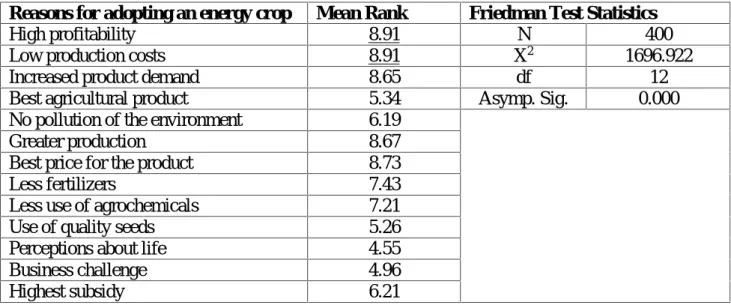
(X2 = 1696.922, p = 0.00). Notably the next important reason is the best price for the
product with a mean score of 8.73 (Table 4).
Table 4 Friedman test for evaluating the important reasons for adopting an energy crop
Reasons for adopting an energy crop Mean Rank Friedman Test Statistics
High profitability 8.91 N 400
Low production costs 8.91 Χ2 1696.922
Increased product demand 8.65 df 12
Best agricultural product 5.34 Asymp. Sig. 0.000
No pollution of the environment 6.19
Greater production 8.67
Best price for the product 8.73
Less fertilizers 7.43
Less use of agrochemicals 7.21
Use of quality seeds 5.26
Perceptions about life 4.55
Business challenge 4.96
Highest subsidy 6.21
CONCLUSIONS
The main purpose of the study was to investigate the landowners perceptions regarding the most important reasons for adopting an energy crop in the rpefecture of Evros. Landowners appear pessimistic about the future in agriculture and mostly hesitant to adopt new crops and the proceed with major changes in methods or techniques in their crops. Studying some factors influencing the adoption of innovations (new-new farming techniques) points out that demographic characteristics such as age, education level, the time employed in agriculture, the gross farm income and farm size have a positive correlation with the landowners willingness to adopt innovative techniques or practices.
BIBLIOGRAPHY
1. Alliance Environment, (2007), Αξιολόγηση των περιβαλλοντικών επιπτώσεων των
ΚΟΑ και των μέτρων άμεσης στήριξης της ΚΓΠ σχετικά με τις αροτραίες καλλιέργειες» Ευρωπαϊκή Επιτροπή, Γενική Διεύθυνση Γεωργίας, Ετήσια Συνάντηση, Corpus Christi, TX, Φεβρουάριος 5-8, 2011.
2. Adesina, A., (1996), Factors Affecting the Adoption of Fertilizers by Rice Farmers in Côte d’Ivoire, Nutrient Cycling Agroecosystem, Vol.46, No. 1, pp. 29-39.
3. Austin, E.J.J., Willock, I.J., Deary, G.J., Gibson, J.B., Dent, G.E., Jones, O.,
Morgan, R., Baidu-Forson, J., (1999), Factors Influencing Adoption of
Land-Enhancing Technology in the Sahel: Lessons From A Case Study In Niger, Agricultural Economics, Vol.20, Νο.3, pp. 231-9.
4. Boahene, K., Snijders, T.A.B., Folmer, H., (1999), An integrated socioeconomic
analysis of innovation adoption: The case of Hybrid cocoa in Ghana. Journal of Policy Modeling. Vol.21, No. 2, pp.167–184.
5.Danalatos, N.G., Archontoulis, S.V., Mitsios, I., (2007), Potential growth and biomass
productivity of Miscanthus sinensis as affected by plant density and N-fertilization in central Greece, Journal of Biomass & Bioenergy, Vol.31, No.? pp.145−152.
6. Diederen, P., Van Meijl, H., Wolters, A., Bijak, K., (2003), Innovation Adoption in Agriculture: Innovators, Early Adopters and Laggards. Cahiers D’économie et Sociologie Rurales. No. 67, pp. 30-50.
7. Fernandez-Cornejo, J., Hendricks, C., Mishra, A., (2005). Technology Adoption and
Offfarm Income: The Case of Herbicide-Tolerant Soybeans. Journal of Agricultural and Applied Economics. Vol.37, No.3, pp.549-563.
8. Gardner, B. (1996). European Agriculture: Policies, Production and Trade. New York:
Routledge.
9. Hennessy, T., (2002), Modelling succession on Irish dairy farms. Paper presented at the10th EAAE Congress, August, Zaragoza.
10. Hoff, K., Braverman, A., Stiglitz, J. (1993). The Economics of Rural Organization: Theory, Practice and Policy, New York: Oxford University Press.
11. Huffman, W., Lange, M. (1989). Off-Farm Work Decisions of Husbands and Wives:
Joint Decision Making. Review of Economics and Statistics. Vol.71, No.3, pp.471-480.
12. Jensen, K., Clark, C.D.P., Ellis, M., Walsh, B.C., English, R.J., De La Torre Ugarte
D.G. (2007). Farmer Willingness to Grow Switchgrass for Energy Production.
Biomass and Bioenergy. Vol.31, No. 11, pp.773-781.
13. Just, R.E., Zilberman, D. (1983). Stochastic structure, farm size, and technology adoption in developing agriculture. Oxford Economic Papers. Vol. 35, No.2, pp.307-328.
14. Koutelidakis, Κ. (2010). Εφαρμογή Ανανεωσιμών Πηγών Ενέργειας σε Στρατόπεδο.
Πτυχιακή Εργασία, Τμήμα Μηχανολόγων Μηχανικών, Ε.Μ.Π., Αθήνα. Ανακτήθηκε στις 18/9/2013 from: http://dspace.lib.ntua.gr/handle/123456789/3568?show=full. 15. Lipton, M. (1976). Agricultural finance and rural credit in poor countries. World
Development. Vol. 4, No. 7, pp.543-553.
16. Nkonya, E., Schroeder, T., Norman, D. (1997). Factors affecting adoption of
improved maize seed and fertilizer in Northern Tanzania. Journal of Agricultural Economics. Vol.48, No. 1-3, pp.1-12.
17. Norris, P., Batie, S. (1987). Virginia farmers’ soil conservation decisions: An
application of tobit analysis. Southern Journal of Agricultural Economics. Vol.19, No. 1, pp.79-90.
19.Rogers, E.M.(1995). Diffusion of Innovations. 4th edition. New York: Free Press. 20. Rogers, E.M., Pitzer, R.L. (1960). The adoption of irrigation by Ohio farmers. Ohio
Agricultural Experiment Station Research Bulletin. 851 Wocester.
21. Rosenqvist, H., Roos, A., Ling, E., and Hektor, B., (2000), Willow growers in Sweden, Biomass and Bioenergy, Vol.18, pp.137–145.
22. Ryan, B., and Gross, N.C., (1943), The diffusion of hybrid seed corn in two Iowa communities. Rural Sociology Vol.8, pp.15-24.
23. Tatlidil, H., (1989), A research on the diffusion and adoption of sprinkler irrigation system in Polatli District. Ankara University Faculty of Agriculture publications no. 1157, Scientific research series no. 639. Ankara, Turkey.
24. Van Dam, J., Junginger, M., Faaij, A. (2008). Overview of the recent development in
sustainable biomass certification. Biomass and Bioenergy. Vol. 32, No. 8, pp.749-780.
25. Von Pischke, J.D. (1978). Towards an Operational Approach to Savings for Rural Developers. Savings and Development.Vol.2, No.1, pp. 43-55.
26. Willock, J., Deary, I.A., Edwards-Jones, G., Gibson, G. J., McGregor, M.J.,
Sutherland, A., Dent, J. B., Morgan, O., Grieve, R. (1999). The role of attitudes and