622
THE BEHAVIOR OF WILLOW COMMERCIAL CLONES IN THE FIRST
GROWING SEASON. A CASE STUDY FOR THREE DIFFERENT SITES
FROM BANAT AREA
HERNEA CORNELIA, CORNEANU MIHAELA, SĂRAC IOAN, PETRESCU IRINA Banat`s University of Agricultural Sciences and Veterinary Medicine ”Regele Mihai I al Romaniei” from Timisoara, Romania; e-mail: [email protected]
Keywords: willow, short rotation coppice, biometrical observation
ABSTRACT
Willow short rotation coppice is an option for raising demand for bioenergy. But willows are also important for phytoremediation or salicylic acid content. In order to develop willow SRC in Romania, three experimental plots with fourteen clones (seven Swedish clone and seven Romanian ones) have been established in Banat area: ash pond Timisoara, saline soil and control (Ghilad, Timis county). Results were very different in terms of biometrical observation. The Swedish clones (Inger, Jörr, Olof, Tora, Tordis, Torhild, Sven) performed very well in control plot, the Romanian clone RO892, RO1077, RO1082 performed very well in Ghilad area (saline soil and control) and also showed good survival rate in ash pond. The other Romanian clone, Cozia, Fragisal, Pesred and Robisal did not show good results in any experimental plots.
INTRODUCTION
The production of biomass for energy crops it will become more and more important in Europe (Weih and Nordh, 2005) and worland in the next years. In the search of
perennial energy crops, Salix sp. are front-runners because their high yielding and
capacity to grow in different site conditions (Weih, 2009). Willows have many others important characteristics: coppice ability after multiple harvests, low investments after its establishment, a broad genetic base (Ledin and Willebrand, 1996), and capacity to efficiently use the land with positive effects on rural economy (Dimitriou and Arosson, 2005) and ability to recycle wastewater (Dimitriou et al, 2009). The largest area with willow short rotation coppice is in Sweden where, more than 14.000 ha were established starting from 1970 (Mola-Yudego and González-Olabarria, 2010). In Romania, willow SRC for biomass production started after 2005 (Nicolescu and Hernea, 2015). About 800 ha of willow SRC was established in our country but only few research have been made in order to test the capacity of willow clones to adapt in different sites condition. The aim of this study is to assess the ability of seven Swedish and seven Romanian willow clones to perform on marginal land: salty soil and ash pond.
MATERIAL AND METHOD
Material. Seven Swedish clones (Inger, Jörr, Olof, Tora, Tordis, Torhild and Sven) and seven Romanian clones, three of them provided by National Institute for Research and Development in Forestry “Marin Drăcea” – NIRDF (RO892, RO1077, RO1082) and four of them provided by Fruit Growing Research and Development Unit of Vâlcea (SCDP Vâlcea) and CHPs Govora (Cozia_1, Fragisal, Pesred and Robisal) were used for establishment.
623
Timisoara (45041’26” Lat. 21007’50” Long., 83 m elevation, pH 8.3). Field preparation
included plowing and harrowing for both Ghilad sites and only harrowing for ash pond. The field was planted manually using 20 cm long cuttings, in double rows at a spacing 150 x 75 cm and 70 cm between cuttings. Weeding control was performed using herbicides and mechanical tilling.
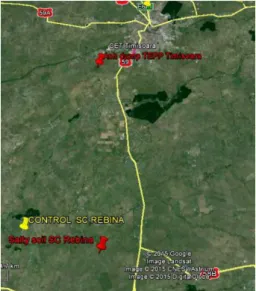
Figure 1 Location of the experiment: Control Ghilad, Salty soil Ghilad, ash pond Timisoara.
Plant survival and biometrical observation. Observations were made in order to establish the survival rate and also biometrical parameters. The number of shoots per stool and the maximum height of the shoots (cm) were registered in June for all plants. In November 2015, for 50 willow plants were registered the number of shoots per stool, the maximum height of the shoots (cm) and the diameter (cm) of the highest shoot per stool.
Data analysis. Analyses of variance (ANOVA) were used to assess the effect of site conditions and clones and of the interaction between them. Statistics were computed by STATISTICA 10 software.
RESULTS AND DISCUSSIONS
After establishment, the survival rate of the willows has depended on the quality of the cuttings and pedoclimatic conditions (Fig. 2). The best results in terms of survival rate, in the Western of Romania, were registered for Romanian clones. In field trial ”Ghilad salty soil", a rate of survival more than 80% were registered for Romanian clones provided by NIRDF, 60-80% for clones provided by SCDP, and less than 50% for Swedish clones. In field trial "Ghilad Control", a rate of survival between 50-60% were registered for Romanian clones provided by NIRDF, 20-40% for clones provided by SCDP, 40-60% for Swedish clones, except clone Inger with a survival rate less than 20%. In field trial "ash pond Timisoara”, a rate of survival between 40-60% were registered for Romanian clones provided by NIRDF (except clone RO1082 with a survival rate less than 20%), 20-30% for clones provided by SCDP, less than 20% for Swedish clones. All Romanian clones were registered a higher rate of survival on trial with "salty soil” compare with trial ”Control” probably because the higher water availability on salty soil compares with alluvial soil and their ability to tolerate the alkaline pH. Not the same results were obtained by Swedish clones probably because that, for these clones soil pH requirement should be in the range
5.5 – 7.5 (Castlin at al. 2010). In field trial ”ash pond”, only Romanian clones RO892
624
Figure 2 Survival rate of willow commercial clones in different sites from Banat area
Analysis of variance revealed that all analyzed characteristics were greatly affected by location (pedoclimatic conditions), genotype and their interaction (Table 1).
Table 1
The effect of location (pedoclimatic conditions) and genotype on yield parameters of willow field trial (Fisher Test)
Analysis of Variance Salix sp. (Marked effects are significant at p < ,05000). 1 = location 2 = genotype
Parameters Factors (F, p)
1 2 1 x 2
Survival rate (%) June 2015
40,090200 0,000000
7,007800 0,000000
97,894500 0,000000 Survival rate (%)
November 2015
43,668700 0,000000
4,709300 0,0000010
181,412600 0,000000 No of shoots per
stool
7,973100 0,000355
5,482200 0,000000
4,710300 0,000000 diameter at the
base of the shoot
262,434800 0,000000
16,767200 0,000000
39,935700 0,000000 Maximum height
of shoot per stool
311,143900 0,000000
42,970500 0,000000
88,111600 0,000000
The yield parameters evaluated after the first growing season were: no of shoots per stool, diameter at the base of the shoot (mm) and the maximum height of the shoots (cm). All of these are positively correlated with shoot biomass.
Mean Plot (%, survival rate, June and November 2015)
Genotype
%
su
rvi
va
l
ra
te
Field trial: Ghilad Control
R
O
8
9
2
R
O
1
0
7
7
R
O
1
0
8
2
C
o
zi
a
1
F
ra
g
isa
l
P
e
sr
e
d
R
o
b
isa
l
In
g
e
r
Jo
rr
O
lo
f
T
o
ra
T
o
rd
is
T
o
rh
il
d
S
ve
n
-20 0 20 40 60 80 100 120
Field trial: Ghilad salty soil
R
O
8
9
2
R
O
1
0
7
7
R
O
1
0
8
2
C
o
zi
a
1
F
ra
g
isa
l
P
e
sr
e
d
R
o
b
isa
l
In
g
e
r
Jo
rr
O
lo
f
T
o
ra
T
o
rd
is
T
o
rh
il
d
S
ve
n
Field trial: ash pond Timisoara
R
O
8
9
2
R
O
1
0
7
7
R
O
1
0
8
2
C
o
zi
a
1
F
ra
g
isa
l
P
e
sr
e
d
R
o
b
isa
l
In
g
e
r
Jo
rr
O
lo
f
T
o
ra
T
o
rd
is
T
o
rh
il
d
S
ve
n
-20 0 20 40 60 80 100 120
% survival rate June 2015 % survival rate November 2015
625
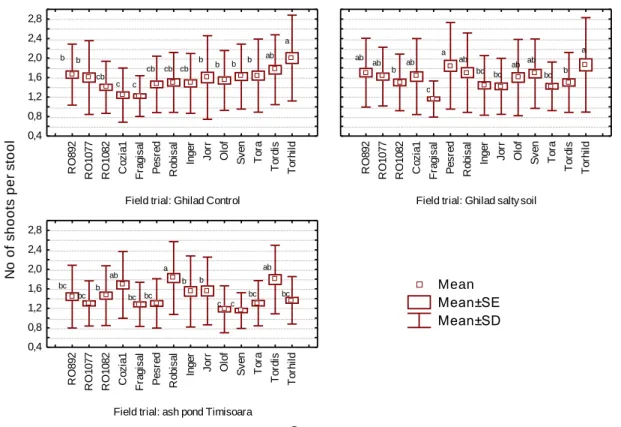
Sprouting capacity is a parameter with genetic determinism but it is also expressed by pedoclimatic conditions (Fig. 3).
The number of shoots per stool was between 1,22 (Fragisal) and 2,0 (Torhild) în filed trial Ghilad Control. A good sprouting capacity has been noticed for Swedish clones and Romanian ones provided by NIRDF. No significant differences were registered for field trial „Ghilad salty soil”. Clones Torhild, Tordis, RO892, RO1077, Sven, Tora showed a significant positive spouting capacity compare with the mean of the experiences, both in Control and salty soil field trial. In ash pond Timisoara field trial, the parameter values were
lower for all clones, except Robisal (1,82 no of shoots per stool – significant positive
differences compared to Control) and Tordis (1,79 no of shoots per stool - unsignificant positive differences compared to Control).
Figure 3 Sprouting capacity of willow commercial clones in different sites from Banat area
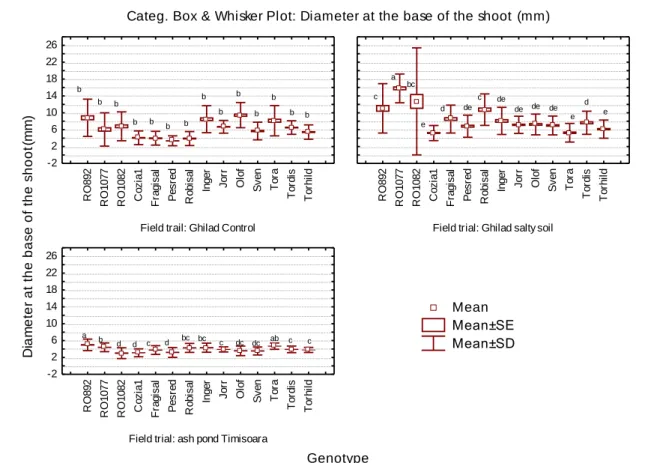
Diameter at the base of the shoot and shoot height are positively correlated (r = 0,7263; p =0,0000), depend on pedoclimatic conditions but have a genetic determinism. For most clones, the values registered on field trial „salty soil Ghilad” were higher than „Control” field trial. Best results were noticed for Romanian clones RO892, RO1077, RO1082: 11,0-15,8 mm diameter at the base of the shoot and 107,6 -148,12 cm shoot height. These values revealed significant positive differences compared to Control. The willow culture established on ash pond have been stressed by soil toxicity, summer extreme temperature and water deficit. In these circumstances the best results were obtained by Romania clone RO892: 62.75% survival rate, 1.44 no of shoots per stool, 4.98 mm diameter at the base of the shoot and de 51.56 cm shoot height (Fig. 4 and 5).
Categ. Box & Whisker Plot: No of shoots per stool
Genotype
N
o
o
f
sh
o
o
ts
p
e
r
st
o
o
l
Field trial: Ghilad Control
R
O
8
9
2
R
O
1
0
7
7
R
O
1
0
8
2
C
o
zi
a
1
F
ra
g
isa
l
P
e
sr
e
d
R
o
b
isa
l
In
g
e
r
Jo
rr
O
lo
f
S
ve
n
T
o
ra
T
o
rd
is
T
o
rh
il
d
0,4 0,8 1,2 1,6 2,0 2,4 2,8
Field trial: Ghilad salty soil
R
O
8
9
2
R
O
1
0
7
7
R
O
1
0
8
2
C
o
zi
a
1
F
ra
g
isa
l
P
e
sr
e
d
R
o
b
isa
l
In
g
e
r
Jo
rr
O
lo
f
S
ve
n
T
o
ra
T
o
rd
is
T
o
rh
il
d
Field trial: ash pond Timisoara
R
O
8
9
2
R
O
1
0
7
7
R
O
1
0
8
2
C
o
zi
a
1
F
ra
g
isa
l
P
e
sr
e
d
R
o
b
isa
l
In
g
e
r
Jo
rr
O
lo
f
S
ve
n
T
o
ra
T
o
rd
is
T
o
rh
il
d
0,4 0,8 1,2 1,6 2,0 2,4 2,8
Mean Mean±SE Mean±SD
b
bc bc b
ab
bc bc a
b b
c c bc
ab
bc b
cb c
cb cb cb b
b b b
ab a
ab ab
b ab
c a
ab
bc bc ab ab
bc b a
626
Figure 4 Diameter at the base of the shoot of willow commercial clones in different sites from Banat area
Figure 5 Maximum height of the shoots per stool for willow commercial clones in different sites from Banat area
Categ. Box & Whisker Plot: Diameter at the base of the shoot (mm)
Genotype D ia m e te r a t th e b a se o f th e sh o o t( m m )
Field trail: Ghilad Control
R O 8 9 2 R O 1 0 7 7 R O 1 0 8 2 C o zi a 1 F ra g isa l P e sr e d R o b isa l In g e r Jo rr O lo f S ve n T o ra T o rd is T o rh il d -2 2 6 10 14 18 22 26
Field trial: Ghilad salty soil
R O 8 9 2 R O 1 0 7 7 R O 1 0 8 2 C o zi a 1 F ra g isa l P e sr e d R o b isa l In g e r Jo rr O lo f S ve n T o ra T o rd is T o rh il d
Field trial: ash pond Timisoara
R O 8 9 2 R O 1 0 7 7 R O 1 0 8 2 C o zi a 1 F ra g isa l P e sr e d R o b isa l In g e r Jo rr O lo f S ve n T o ra T o rd is T o rh il d -2 2 6 10 14 18 22 26 Mean Mean±SE Mean±SD b b b b b b b b b b b b b b c a b d
d c d bc bc c dc dc ab c c
a bc
e
d de
c de
de de de e
d e
Categ. Box & Whisker Plot: Maximum height of the shoots per stool (cm)
Genotype M a xi m u m h e ig h t (cm )
Field trial: Ghilad Control
R O 8 9 2 R O 1 0 7 7 R O 1 0 8 2 C o zi a 1 F ra g isa l P e sr e d R o b isa l In g e r Jo rr O lo f S ve n T o ra T o rd is T o rh il d 0 40 80 120 160 200
Field trial: Ghilad salty soil
R O 8 9 2 R O 1 0 7 7 R O 1 0 8 2 C o zi a 1 F ra g isa l P e sr e d R o b isa l In g e r Jo rr O lo f S ve n T o ra T o rd is T o rh il d
Field trial: ash pond Timisoara
R O 8 9 2 R O 1 0 7 7 R O 1 0 8 2 C o zi a 1 F ra g isa l P e sr e d R o b isa l In g e r Jo rr O lo f S ve n T o ra T o rd is T o rh il d 0 40 80 120 160 200 Mean Mean±SE Mean±SD bc d cd c bc a c b a b c
d d c d cd
d cd b
c c c
a a
e de de
c
de d e de e
de e c
b
b
627
Botu et al. reported similar results for Romanian clones provided by SCDP and CHPs (Cozia, Fragisal, Pesred and Robisal) and Swedish clones Tordis and Inger but not the same results were registered in the trial from Ghilad area.
CONCLUSIONS
The behavior of willow clones in the marginal area, salty soil and ash pond have been evaluated after the first growing season. Under saline stress, the best result was registered for Romanian clones RO892, RO1077, RO1082: 77-92% survival rate; 1,5-1,7 no of shoots per stool; 11,0-15,8 mm diameter at the base of the shoot and 107,6 -148,12 cm shoot height. These value revealed significant differences for the mean of the experiences. Under ash toxicity and hydric stress, the best results were obtained by RO892: 62,75% survival rate, 1,44 no of shoots per stool, 4,98 mm diameter at the base of the shoot and 51,56 cm height (significant positive differences, for the mean of the experiences). The Swedish clone Inger, the most cultivated clone in Romania, did not show expected results for analyzed characteristics.
Acknowledgements
The researches were financially supported by MEN UEFISCDI, Programme PN II 2014- 2017, project no. 111/2014 SAROSWE.
BIBLIOGRAPHY
1. Botu, I., Botu, M., Preda, S., Achim, G., Lazăr, A., Alecu, A., 2013 - Comparative evaluation of Romanian and introduced Salix cultivars for short rotation coppice. Southwest J Hortic Biol Environ 4 (1): 35-42.
2. Caslin, B., Finnan, J., McCracken, A., 2010 - Willow best practice guide. Teagasc & AFBI. 72p
3. Dimitriou, I., Aronsson, P., 2005 - Willows for energy and phytoremediation in
Sweden. Unasylva FAO 56(221):47-50.
4. Dimitriou, I., Baum, C., Baum, S., Busch, G., Schulz, U., Köhn, J., Lamersdorf, N.,
Leinweber, P., Aronsson, P., Weih, M., Berndes, G., Bolte A., 2009 - The impact of short rotation coppice (SRC) cultivation on the environment. Landbauforschung–vTI Agriculture and Forestry Research (59): 159-162
5. Ledin, S., Willebrand, E., 1996 - Handbook on how to grow short rotation forests. Sweden: Swedish University of Agricultural Sciences, Dep. of Short Rotation Forestry. 6. Mola-Yudego, B., González-Olabarria J.R., 2010 - Mapping the expansion and distribution of willow plantations for bioenergy in Sweden: Lessons to be learned about the spread of energy crops. Biomass and bioenergy 34:442–448.
7. Nicolescu, V.N., Hernea C., 2015 - Romania. In Evolution and perspectives of coppice forests in European countries and South Africa. Editura Universitatii Transilvania din Brasov, pp:30-31
8. Weih, M., 2009 - Perennial energy crops: Growth and management In: Crop and Soil Sciences - Encyclopedia of Life Support Systems (EOLSS), developed under the Auspices of the UNESCO Edited by:Willy H. Verheye. Eolss Publishers, Oxford ,UK.