THE POLITICAL WINE IN WINE POLICY AND THE EROS
OF THE WINE LABEL
IRIMESCU L., GIUGEA N., MĂRĂCINEANU L.C.
Keywords: politics, symbol, sensuality, money, composition.
ABSTRACT
"The image" of wine is the subject of a contemporary human theme which creates a link between power, money and eroticism. In this triangle, a transitive element as the money is considered to be the balance between the political power and a binomial composed of sensuality which leads to the ambience of wine that show sometimes an explicit eroticism.
The politics presents the wines with an image lesser known but highly influential as business and the politics behind it. The politics systematically affects what we buy, how much it costs, which wine has a special taste, what appears on labels, and even what we can "read" behind the label, but for sure not on the reverse label. A deep comparative view of wine production that is represented on geo-political axes or on economic routes, can be influenced by following different routes that travel in time from the vine to the table of those already mentioned. The globalization in the wine business and identifying the role of the players behind the scenes, such as governments, major distributors and critics exercise an enormous influence.
There are records that may or may not circumvent the power of stigma or the favours of sensations spiced with sensuality. Along the type, the wine and wine policy reveal how deeply the policy matters and influences the taste of the wine from the bottle served during evening.
Sensuality, eroticism and labels of the natural wine go through issues arising from the feminine forms of the amphora, they metamorphose in the silhouette of Côtes de Provence bottle, nicknamed Mae West after the body of the famous American actress, or shakes into the dance moves by the nickname "Josephine" by J.P. Chenet. These types of containers generate labels, offer prospects of female voluptuousness, but still cause sexist controversies between sensuality and explicit scenes, close to pornography. It is well known and obvious that male and female representations do not seem to have an equal position, the dominant of the imaging representations favours only one of the two parts-the female one.
INTRODUCTION
The wine is a mirror which accurately reflects the human becoming. This study highlights issues that are on one side and on the other side of morality. Politics and erotica are two forms of humanity, one of the reality and social rules and the other of intimacy and spiritual depth. The interrelations are exposed to offer human perspectives determined by limits and order in dialogue with the signs of the senses, poetry, creation and innovation. The two contradictory considerations are defined together by contrasts and similarities as a social convention accredited contemporarily states that "behind every successful man stands a woman just as strong and successful as him". Politics as aggregate of power is complemented by a feminine appearance that softens the matrix system generally associated with man, paradoxically, by the very gender of the noun (feminine noun)...
deepening the "mystery" of creation. It is a religious landmark, created between terrestrial, moon and solar on an axis at the origin of life and death.
These ancient containers had markings engraved on wooden plaques, or painted, indicating the origins and validity and there were precursory of what we call today the designation of origin.
Nowadays there is still appreciated the customization of an image through the techniques of the beginning of labelling (engraving, lithography, printing or photo-zincography) with additions of manual works and implementation of modern printing techniques. The labels go through stylistic stages made by classic printing techniques (lithography, aqvaforte, photo, photo-zincography) or using modern printing techniques (offset or laser) along with the latest experimental techniques (Digigraphie®, Wet plate collodion or Braille varnish). All these have become examples of performance that can keep the main origin, uncompromised by a timeline and a natural evolution of printing techniques. The numerous techniques listed are complemented with digital systems for preparing the printing and election of the printing material (paper of wood or canvas, plastic or metal).
MATERIAL AND METHOD
The present work has been realised through the documentary research method and critical analysis by corroborating the means of plastic or artistic imagistic expression with the compositional ratio and colour. The documentation took into account the information concerning the discoveries and innovation of the printing methods as the main form of expression. Images have been analysed by comparaison with numerous sources of information.
RESULTS AND DISCUSSIONS
The performance of the production techniques of some containers and the manners of engraving and printing are related to the aesthetic theme of the wine label consonantly with two themes at the opposite pole, but paradoxically they combine stylistically and especially functionally. These facts of union of form and content are determined mainly by a coherent involvement of the policy makers that are sometimes contemplating the inspiring female muse.
Placing the image of political figures on the label bring to the attention of contemporaries the facts, treaties between regions or countries, symbols, customs, costumes, objects that outlines a period or a wine culture. Empires, countries or continents trace their origins through the scrupulosity of some artists of the age and through the perseverance of producers with love and respect for traditions and for their socio-cultural sources. The images speak about the glory or decadence of kings or empires and of economic or political relations between the countries of the world.
The label in figure 1 presents a famous wine associated with French emperor Napoleon Bonaparte (Napoleon I, 1769-1821), with Frederick the Great (Frederick II of Prussia, 1712-1786), or Louis Philippe (Louis -Filip of France, 1773-1850).
Jan van Riebeeck brought the first vines largely Muscadelle to Cape Town (Africa) in 1650, which later became (in 1684), under the experience of Simon van der Stel, what today we call "Constance Wine". Hendrik Cloete in 1778 called the vineyard Klein associated with Constance wine with the best results in quality after many years of experience. Also the British writer Jane Austen in "Sense and Sensibility" for the first time puts her character, Mrs. Jennings, to recommend a little Constantia wine to learn "its healing powers on a disappointed heart."
deathbed, refusing anything, he asked for a glass of the same Constantia wine. Later the writer Charles Baudelaire in "Les fleurs du mal" (published in 1857) also reveals the benefits of Constantia wine which is like opium and glorification of love. Charles Dickens in the novel "The Mystery of Edwin Drood" (published in 1870) suggests the benefits of Constantia wine served with a biscuit against the character's or Septimus Reverend `s sullenly anxiety (Baikoff J., 1990).
The label is organized perfectly symmetrical with a hierarchy of information specific to African wines, labelled on the principle of a separate readability. In the first row, the name of the manufacturer appears (Klein Constantia), then the vineyard domain (Constance) and country of origin (South Africa). The next rows are the varieties of grapes (Constance - signifying Muscat of Frontignan) meaning that the minimum percentage of 85% is present in the variety indicated on the label. The crop year (2006) has the same assurances that 85% of the grapes come from the year specified on the label.
The label is classic, with emphasis on the information presented in Times New Roman font and Kuenstler Script Black adapted to the label. The adornment around the year presents floral ornaments specific to the Napoleonic style. Not least the original bottle shape which is kept even today and features a unique design with a base cast left asymmetrically with the purpose of collecting residual sediments.
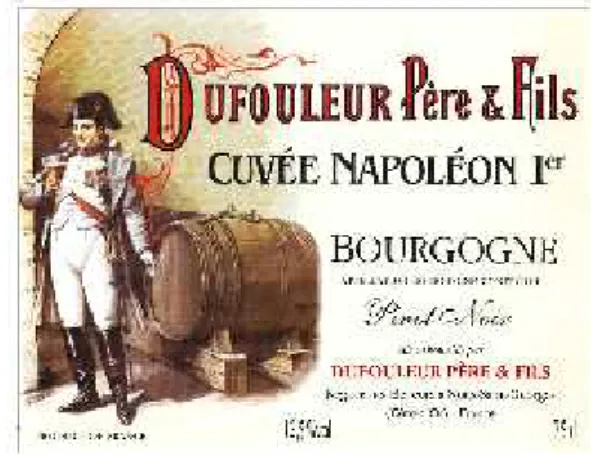
The label in figure 2 represents a wine of the producers' ”Dufouleur Père & Fils "-produced in 2010 and of Pinot Noir, "Cuvée Napoléon 1er "(Premier). The composition of the graphics is organized asymmetrically. The centre depicts Emperor Napoleon in a figurative description a little strange in an association of parade outfit with decorations and gallons sipping a glass of wine (Pinot Noir) and posing standing in front of a rack of barrels placed in a cellar.
The French label is made by the winemakers "Négociants éleveurs à Nuits-Saint-Georges." The image signifies and glorifies the beginning of Napoleon Bonaparte's march through the famous wine-producing region, Burgundy, recovering the land from the papacy and returning it to the French nationals (M. Gonzales, 2014). The label confirms that the notion of terroir, especially in French Burgundy, means that the winemaking tradition from father to son may be inherited outside the rules of the church from that time until today. The information is communicated through numerous fonts that are linked together in an eclectic style.
Figure 1. Klein Constantia“ Vin de
The Romanian label in Figure 3 proposes a pyramidal composition with rounded tops as a shield crossed by a hook.
The font of the "Muscat Ottonel" wine variety, made with volumetric letters, is the only volumetric graphic sign. The font of the vineyard "DEALU MARE - URLAŢI" is similar to the bold "Arial Black" and elongated vertically. The surface geometry results in a balanced label with a built compositional centre at the intersection of diagonals in the middle of two areas of interest: a seal and a historical portrait. The contrast of the areas is the following: with weight on two thirds of the surface by the blue colour, in contrast with a third of the surface by the golden-brown colour from frontispiece. The portions are divided by a red belt in ribbon around a seal bearing the insignia I. A. S. (State Agricultural Enterprise).
The portrait of "Constantin (Basarab) Brâncoveanu" in Figure 4, "martyr leader of the Romanian Land" (done by the lithographer Auguste-Alexandre Hirsch, Paris, 1860), in ovoid effigy, a sign of historic appreciation, is positioned in the front of the label between two red scarves, affronted, stretched horizontally (Dumitrescu, R.G., 2010). It is the first effigy portrait, which appears on a label in the communist period, representing a different portrait than that of the communist leader Nicolae Ceausescu at that time (Scurtu, I., 2011).
"Wine brightens the life and thinking of anyone" are the words of US President Thomas Jefferson (1743-1826).
Figure 3. State Agricultural Enterprise DEALU MARE – URLAȚI
MUSCAT OTTONEL Sparkling wine
Figure 4. Romanian Country leader Constantin Brâncoveanu Lithographer: “Auguste-Alexandre
There is a whole arsenal of legends, images, communications and labels that characterize the American presidents’ propensity to consume a quality wine as the wines Château Lafite, Château d'Yquem, Haut-Brion and Brann-Moutonde or the famous bottles of the wines Lafitte 1787 associated with Thomas Jefferson in Figure 4. (Buren, M.V., 2015). The Portuguese wine Madeira in Figure 5 consumed between the 13th -19th centuries, inspires and gathers together the main architectural political buildings of America alongside Presidents Thomas Jefferson and Benjamin Franklin portraits in the article "Historic Series Madeira" of the wine critic Eric Asimov, published in the New York Times, 2009 (Asimov E., 2009). From Andrew Jackson, John F. Kennedy and Richard Nixon, who preferred the French wines and Champagne, or Cabernet Sauvignon's favourite Ronald Reagan, one can deduce an entire epic of the American wine which is called generic "Happy President's Day Wine Enthusiasts! ".
The erotica of wine labels. Illustrations of books or individual papers are adorned with erotic images of the most representative image creators since prehistory, antiquity to contemporary times: "Erotica Antiqua" or "Erotica Classica" (Figure 7 and Figure 8) witness with images associated with wine at parties or symbolic events (Néret G., 1994).
The anonymous creators and artists such as Balthus (1993) for the French manufacturer Chateau Mouton Rothschild, or Horts Janssen (1990) for the Italian manufacturer Fattoria Nittardi, signed pictures, paintings or erotic labels for wines. "Madonna del Diavolo" is a series of erotic illustrated labels based on paintings by the famous German writer Dolly Buster with Tuscany red wine. "Retro" and "Ecstase" identifies the same area of Tuscany with the blended wines Merlot and Syrah. "Sex, wine and Rock 'N Roll" is the motto of the German manufacturer Luke Krauss for the label "Pornfelder". More recently, in 2014, "Some Young Punks - Quickie!" is the advertising for the Australian Sauvignon Blanc (Figure 12).
The themes of eroticism are a constant challenge, and the concept itself draws its sources in the specific art and trend, so older or newer projects find their hosting on the contemporary wine label.
Figure 7. Greek ancient vase “party” or “symposium” - “Athenian drinking”
From the British Museum
These are questions which raise and heats the groups of purists and lovers of wine and sensuality. You may serve a wine called "Big tits" or "Panty Remover"? The answer of most of the persons will be "absolutely not!". Otherwise, in all establishments, the wine gesture contradicts the theory (Rémy Charest, 2014).
The labels in Figure 9 and Figure 10 are chosen because they exemplify compositions performed on the same topic of the sensuality of the female body. They capture about the same posture, but there are graphics that embroider two labels of wines completely different. The French label, famous for the scandal over American BATF
(Bureau of Alcohol, Tobacco, Firearms and Explosives) refusal to receive officially the Rothschild wine in 1993 for explicit sensuality of the body of the young girl drawn by Polish-German-French artist Balthasar Klossowski de Rola (1908-2001), is analyzed in comparison with another label, also French, which is part of a collection of ten spicy labels titled " Cuvée Sexy" of the wine producer's Chevalier BRIGAND in the area of Orange and illustrated by another famous French illustrator Michel Gourdon (1925-2011).
The label in Figure 9 is no exception to the compositional organization of the Rothschild wine labels which reserve to an artist, a different one each year, since 1924, to richly decor the frontispiece of the label with a picture dedicated to the wine from his personal collection. The rest of the label has centrally the classical logo of Rothschild family with two rampant and symmetrical rams placed under a princely crown surrounding the shield "Mouton and the five arrows". This shield was relaunched in 1922 by the young, then, Baron Philippe de Rothschild. The information on wine, year and manufacturer are made with different sizes of the same font and calligraphic lettering that resembles the handwritten signature of "Philippe de Rothschild", posted diagonally on labels and from another colour.
The label in figure 10 is divided vertically into two distinct areas apparently unconnected. The first area hosts the information of the vineyard (Côtes du Rhône), wine category, wine producer, manufacturer and other data, but the title of the collection -"Cuvée Sexy" – by a distinct colour (red) catches the attention. In the 2nd area a youthful
Figure 9. Chateau Mouton Rothschild 1993 – Drawing by
Balthus
The hyperrealist description in detail of colour and brushing drawing specific to the illustrator Gourdon, make us resemble the image after the reproduction of a picture with the signature that appears between the foams of the bath tub...
Due to the lack of male representation, Michael Jackson tried to patent (in 2004 at the USPTO: US Patent and Trademark Office) the wine label "The Juice of Jesus" for the Rheins producer, only that the crucified body image gathered only negative feedbacks such as: "blasphemy, outrageous and offensive"(Figure 11).
The recognizable silhouette of the famous singer and dancer, the glove, hat and finger gestures with the victory sign occupies centrally and symmetrically the label. The figurative element is flanked by the biblical slogan "the body and blood of Jesus" (the Holy Gospel of John) – similar to the wine (juice) interpreted in contemporary modern manner, including the year, wine type and manufacturer name. The Steinburg Modern Bold font character expresses the title "Jesus Juice" (Nichols, S., 2005).
Figure 12 shows the 2014 Australian wine label, referring to the fashion of "Some young Punks", suggestively entitled "Quickie!". The wine shown is a blend made from varieties of 50% Nebbiolo and 50% Shiraz, produced in "Adelaide Hills Wines". The image is inspired by the cover of the fiction novel by Gerald Foster "Quickie!" in 1950.
The mandatory information are posted compositionally in the same position as the cover of the novel determining the label to be associated with the vision of the retro-realistic American artistic style characteristic for the ending of the war period, when the Hollywood celebrities images were maintaining the spirit and inspiration of allies.
Figure 11. “Jesus Juice” Down The Drain 2005 – Merlot, Michael Jackson
Rheins – Westlake Winery
Figure 12. “Some Young Punks” 2006 - Sauvignon Blanc “Quickie!”
CONCLUSIONS
The ingredients of the image success, according to the international market, are at the crossroads of a balance between law (order) or instinct (inspiration and imagination). The border between them, with distinct nuances, makes a project of art and wine to evidence a classical vision, ranked by systematized regulations and to evidence an erotic vision, more or less the limit of discussion between "geo-political strategies" or "purists and progressives".
The labels communicate visually the poise of policymakers with their determination which are obvious or hidden, or cryabout "the Freudian stages (oral, anal, phallic, latency, genital) or about the literary steps – ardent love, carnal love, mature passion and comprehensive view of the wise"(Hoza, Nicoleta 2013).
BIBLIOGRAPHY
1. Asimov E., 2009,Historic Series Madeira, Perfect flavors and subtle bouquet ... perfect balance and harmony..., Articol internet: www.rarewineco.com/rare-wine-co-historic-series-madeira, ultima accesare: 23.06.2016
2. Baikoff J., 1990, Vin de Constance, Articol internet: www.kleinconstantia.com/wp-content/uploads/2013/03/Vin-de-Constance-Klein-Constantia-Extended-History.pdf, ultima accesare: 20.06.2016
3. Buren M. V., 2015, These 8 Presidents Really Knew How to Drink, Articol internet: www.yahoo.com/style/, ultima accesare: 22.06.2016
4.Gonzales M., 2014,The French Kiss”, Articol internet: http://blog.saloondavis.com/269/, ultima accesare: 21.06.2016
5. Neret G., 1994, “Erotica Universalis”, “Erotica Antiqua” - Pag. 28., “Erotica Classica”
-Pag. 137., Editura Taschen, Köln.
6. Nichols S., 2005, CBS Producer Markets “Jesus Juice”, Articol internet: http://randomresponses.blogspot.ro/2005_11_01_archive.html, ultima accesare: 24.06.2016
7. Rémy Charest, 2014, Sex, Sexism and the Natural Wine Label, Articol internet: http://punchdrink.com/articles/sex-sexism-and-the-natural-wine-label/, ultima accesare: 24.06.2016
8. Scurtu I., 2011, Istoria Românilor de la Carol I la Nicolae Ceausescu, Editura Mica Valahie, București, Pag. 65.
9. Sfânta Evanghelie după Ioan, Biblia, Cap. 6, 53