338
INNOVATIVE EQUIPMENT FOR CULTIVATING
MEDICINAL AND AROMATIC PLANTS
ON SMALL SURFACES
MUSCALU A., BOLINTINEANU G., SORICĂ C., GRIGORE I., TUDORA C.
National Institute of Research Development for Machines and Installations Designed to Agriculture and Food Industry, 6 Ion Ionescu de la Brad Blvd., Bucharest, Romania;
E-mail: [email protected];
Keywords: medicinal plants, basil, sowing, harvesting
ABSTRACT
Medicinal and aromatic plant cultures are part of the niche culture category. Although the local pedoclimatic conditions are favourable, the application of culture technologies is carried out on small farms. To this fact also contributes, in addition to other factors, the lack of adequate technical means, farmers usually using physical workforce (family or local labour). In order to support the
small growers, it was necessary to design and develop equipment for the cultivation of medicinal and aromatic plants on small surfaces.
This paper presents the tests performed on the experimental plots at INMA Bucharest, regarding the sowing and harvesting works, on a culture of Basil - Ocimum basilicum L., Lamiaceae family.
INTRODUCTION
At present, about 25% of allopathic medicinal products contain natural compounds extracted from plants and according to the WHO, more than 3/4 of the world population (approximately 80%) depend on traditional medicine to meet their primary health needs (Beyene et al. 2016). The general term of medicinal and aromatic plants includes plants that have medicinal properties but also seasoning, ethereal, etc. ones. No rigid categories can be established because of the complexity and double use of the active compounds as well as the large number of plant species involved (Ibrahim Singab 2012, Őztekin & Martinov 2007).
Cultivation of medicinal and aromatic plants under controlled growth conditions can improve the yields of active compounds, ensuring production stability, possibility of mechanization using, better harvest access, conservation and processing of the raw material (Chen et al. 2016).
Although the cultivation of these species is an opportunity for Romania, being part of the niche culture category, it is generally practiced on small and medium surfaces. The evolution of cultivated areas has been affected by the lack of dedicated technical devices and the fluctuations in the markets due to the economic context. In 2016, the cultivated area reached 5.6 thousand hectares, rising slightly compared to 2014 and 2015, when it remained at a low level of 4.2 thousand hectares (2017 Yearbook).
339 The sowing process occupies an important place in the culture technology of these species, optimizing the equipment supposing a uniform distribution of the seeds on the entire parcel, respecting the prescribed sowing depth (Verzea et al., 2001).
The harvesting of medicinal and aromatic plants is a difficult operation that is carried out differently depending on the useful parts of the plants to be collected.
The content of active substances should be as little affected as possible by the manual or mechanical execution of the operation (Őztekin & Martinov 2007).
The paper presents the study of the capability of the seeder experimental model to achieve the sowing rate foreseen in the culture technology of Basil - Ocimum basilicum L., Lamiaceae family, as well as harvesting the same species using low capacity specialized equipment.
MATERIAL AND METHOD
In order to increase the productivity and the quality of the plant material obtained from the medicinal and aromatic plant cultures grown on small and medium surfaces, experimental models of sowing and harvesting equipment were designed, made and tested in the field.
The experimental model of the sowing equipment for medicinal and
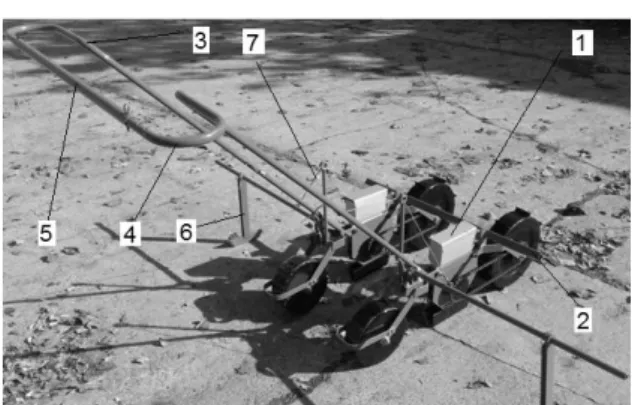
aromatic plants (fig. 1) is intended to incorporate in the soil the seeds of these species in greenhouses/solariums, as well as directly in the field, on medium and small plots. It consists of: 1. sowing section; 2. sections’ support frame; 3. left handlebar pipe; 4. right handlebar pipe; 5. handlebar; 6. trace marker; 7. support cable.
Fig. 1 Sowing equipment for medicinal and aromatic plants SPM-0
Depending on the row spacing, one can achieve: changing the position of the two identical sowing sections by moving left and right, adjusting the handlebar, adjusting the position of the marker.
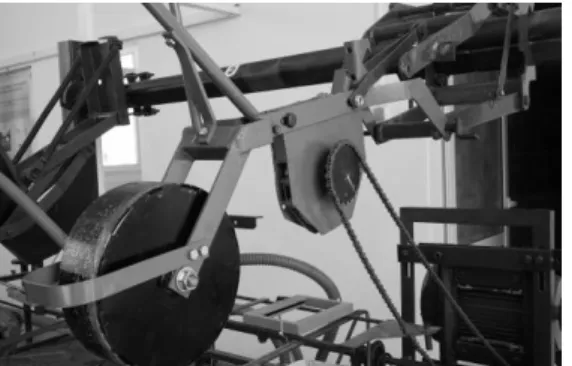
Figure 2 shows the mechanical distribution section mounted on the equipment frame and consisting of: 1. frame, 2. distribution device, 3. drive wheel, 4. compaction wheel, 5. compaction wheel scraper.
The distribution device is the main element of the sowing section because it contains the cylindrical distributor made of aluminum in order to avoid the electrostatic charge of the seeds. On the median circumference of the lateral
340
moves freely on the shaft as the drive wheel does.
Fig. 2 Sowing section mounted on the seeder frame
The main technical and functional characteristics of the experimental model of sowing equipment for medicinal and aromatic plants are : type of equipment - manally operated; no. of rows sown at one pass - 2; row spacing - 200...700 mm; sowing depth - 5...50 mm; type of distribution device - with vertical disc; overal dimension (Lxlxh) - 1500x1220x1015 mm; equipment mass - 35 kg; operating staff - 1 person.
In order to study the process of sowing medicinal and aromatic plants, we used the bench for determining the sowing precision, on the frame of which the seeder’s sowing sections can be
mounted, with the possibility of simulating a slope of the ground between 0 - 12º. To drive the distribution devices of the sowing sections, the electric motor with variable rotation frequency allows simulation of working speeds ranging from 0 to 12 km h-1.
The sowing section was mounted on the frame, as in figure 3. The movement speed of the seeder operator (2 km/h) was considered as the working speed of the equipment, adjusting the rotation frequency of the electric motor accordingly, so that it can be achieved with chain transmissions.
Fig. 3. Sowing section mounted on the bench
Considering that: the distance between the sections is 0.5m, the circumference of the drive wheel is approx. 1m, working speed v=2km h-1, it results that a 1m2 surface is made after 2 complete rotations (of the drive wheel). The tests were carried out simulating the movement of the equipment over a 20 m length, to achieve the coverage of an area of 10m2 by the two sowing sections. Basil Seeds - Ocimum basilicum L.,
341
Table 1 Physical characteristics of medicinal and aromatic plant seeds
Species No. of
seeds/1 g
TKW [g]
Germination faculty [%]
Basil (Ocimum basilicum L.,
Lamiaceae family) 700 1,320 70-80
The distribution discs used in the tests were made in 3 variants depending on the diameter of the holes: 2.2mm, 2.7mm and 3mm. All holes have a slanting position relative to the vertical of the place, so their loading/unloading is easy, avoiding crushing seeds.
For harvesting, specialized equipment was used to carry out the collection of Basil aerial parts. The harvesting equipment can be used on all medicinal and aromatic plant species that are harvested as herba. In the case of Basil, the optimal time for harvesting depends on the subsequent destination of production: as aromatic and seasoning plant, for the extraction of essential oils, as a medicinal plant, etc.
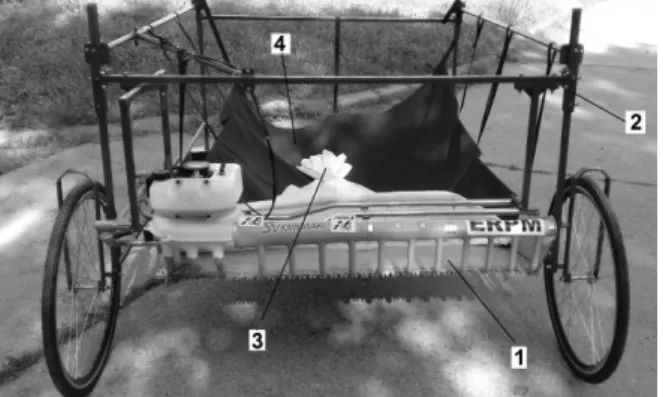
The equipment for harvesting medicinal and aromatic plants (fig.4) consists of the following main sub-assemblies: 1. mower; 2. rolling chassis; 3. collecting bag; 4. collecting bag holder. The main technical characteristics of the equipment are : mower mode - SV 120 H, (with horizontal double cutting blade); mower power - heat engine T320 (Mitsubishi Japan), engine type - single cylinder, positive ignition and air cooling; engine cylinder - 46 cm3; maximum engine power - 2.2 kW; cutting height - adjustable 40...500 mm; cutting widht - 1200 mm; fuel consumption - 1...1.7 l h-1 (depending on the working regime); speed of airflow developed by the blower - 15...21 m s-1; overall dimensions (Lxlxh) - max. 2370x1712x1300 mm; equipment mass - 51 kg; Operating staff - 2 persons;
Fig. 4 Equipment for harvesting medicinal and aromatic plants ERPM-0
In the working process, depending on the particularities of the culture and of the medicinal plant species to be harvested, the working height is established and the corresponding adjustment is made.
The equipment is pushed, with the engine stopped, to the end of the medicinal plant rows, being placed with the wheels in the direction of the rows so that they “cover” them. The equipment wheels run in the space between rows.
Then the engine is started and shortly after, the mower is engaged.
342 controls during operation, it is advisable to assume the operation by two persons.
The experiments with the equipment for harvesting medicinal plants were carried out in a culture of Basil - Ocimum basilicum L., Labiatae family, set up in the
spring of 2017, observing the technological links, on the experimental plots of INMA Bucharest. The characteristics of the basil culture are shown in Table 2.
Table 2 Characteristics of the basil culture on the experimental plots
Culture Yellow basil variety
Distance between rows 80 cm
Distance between plants/rows 50 cm
Bush height 60 cm
Bush diameter 33 cm
Number of branches 9
Inflorescence form and diameter 16 cm raceme
Maturation period July – September
Weed spreading degree approx. 7%
Surface form flat
RESULTS AND DISCUSSIONS For the basil seeds, tests were
performed with three repetitions, with the three distributing disc variants,
establishing the appropriate size of the holes. The results of the experiments are summarized in Table 3.
Table 3 Correlation between the distribution disc variant and the
sowing rate
Species Recommended seed
rate [kg/ha]
Size of disc holes [mm]
Experimental seed rate [kg/ha]
Basil 3-6 Φ 2.2 4.8
The plant material harvested from the basil culture was used for the extraction and production of essential oil and hydrosol. The qualitative working indexes
and the energetic ones determined in the tests and the results obtained are presented in table 4.
Table 4 Qualitative working indexes
No. Name of energetic and
qualitative working indexes U. M.
Average value
1 Number of harvested rows pc. 2
2 Cutting (working) height mm 250
3 Working speed Km h-1 1.38
4 Cutting process efficiency % 93.8
5 Loss (uncut plants) % 6.2
6 Collecting process efficiency % 94.4
7 Loss (uncollected cut plants) % 5.6
343
CONCLUSIONS
For Basil, following the laboratory experiments, a correlation was established between the size of the distribution disc holes and the sowing rate [kg/ha].
In the absence of specialized equipment, native farmers use conventional cereal seeders, equipped with small seed distributors and depth limiters, which have large sowing failures. Compared to this, we consider the results obtained encouraging for continuing the experiments with the experimental model of sowing equipment using basil seeds under field or solarium/greenhouse conditions.
The results showed the efficiency of medicinal plant harvesting equipment, designed to collect the herba of basil, grown on small and medium surfaces.
Following the experiments with experimental models of sowing equipment and harvesting equipment for medicinal and aromatic plants, the results obtained represent an important premise for the development of cheap and efficient specialized equipment, useful to small farmers for obtaining quality plant material.
Acknowledgments. This work was supported by one founding source the NUCLEU Program, carried out with the support of ANCSI, Project no. PN 18
30 02 03 "Technology for the establishment and superior utilization of herbal raw material obtained from medicinal plants".
BIBLIOGRAPHY
1. Beyene B., Beyene Bel. Deribe H. - 2016, Review on Application and Management of Medicinal Plants for the Livelihood of the Local Community Journal of Resources Development and Management Vol.22;
2. Chen S.L, Yu H., Luo H.M., Wu Q., Li C. F., Steinmetz A. - 2016, Conservation and sustainable use of medicinal plants: problems, progress and prospects, Chinese Medicine 11:37, DOI 10.1186/s13020-016-0108-7;
3. Ibrahim Singab A.N.B. - 2012 Medicinal & Aromatic Plants Editorials. Medicinal Aromatic Plants 1:e109. doi:10.4172/2167-0412.1000e109;
4. Meinhold T., Blum H., Budde M., Damerow L., Schulze Lammers P.- 2013, Partial Process-Analysis of the
Sowing Process for Fine Seeds. Conference proceedings Land. TechnikAgEng, Hannover, pp189-195; 5. Őztekin S., Martinov M. 2007 Medicinal and aromatic crops, Haworth Food & Agricultural Product PressTM, An Imprint of The Haworth Press, New York; 6. Salamon, I. - 2014, Medicinal Plants of High Significance in Slovakia. In: Medicinal Plants – International Journal of Phytomedicines and Related Industries. Vol. 6, Iss. 2, pp. 75-80
7. Verzea M. et al., Cultivation technologies for medicinal and aromatic plants, Orizonturi Publishing House, Bucharest 2001;