Journal of Global Pharma Technology
Available Online at:
www.jgpt.co.in
RESEARCH ARTICLE
Systemic Corticosteroids are Effective in about a Half of
pemphigus Patients
Anfisa Lepekhova
1*,Olga Olisova
1,Alexander Dukhanin
2,Natalia Teplyuk
11. I.M. Sechenov First Moscow State Medical University, Moscow, Russian Federation.
2. Pirogov Russian National Research Medical University, Moscow, Russian Federation.
*Corresponding Author:Anfisa Lepekhova
Abstract
Pemphigus is a potentially life-threatening disease with a mortality rate of approximately 5-15%. Systemic corticosteroids (CS) can control flare-ups of the disease and remain the mainstay of treatment. However, even high doses of CS sometimes fail to produce adequate symptom control. We retrospectively analyzed the rate of CS efficacy in 123 pemphigus patients seen at our Department over 16-year period. Our research shows that half (54/123) of patients with pemphigus had lack of response to treatment. PNP was noted only in CS resistant patients (8/54). Also, higher mortality, at least one exacerbation a year and exacerbation during 2-5 year of the disease associated with reduction of CS dose were significantly more frequent in the group of CS resistant patients than in CS sensitive one.We showed that half of patients had a lack of response to CS. However, we found in pemphigus onlyclinical severity subdivision by frequency and clinical manifestations of steroid resistance useful in adjuvant therapy. Adjuvant therapy can beused to treatpemphigus vulgaris to reduce sideeffects of CS or when these therapies are ineffective to achieve a complete remission.Therefore, it is important to investigate a potential molecular biomarkers of CS resistance in patients with pemphigus and other bullous disorders.
Keywords: Pemphigus, Steroid insensitivity, Potential biomarkers, Criteria of steroid insensitivity, Severity, Treatment.
Introduction
Pemphigus is a group of rare life-threatening autoimmune bullous diseases affecting the skin and/or mucous membranes and characterized by the synthesis of IgG auto antibodies against desmoglein 1 and/or desmoglein 3 [1].The strong association was confirmed of pemphigus with HLA class II genes.Over 95% of pemphigus patients carry DRB1* 0402 or DQB1* 0503 alleles [1].
T-cells also play a major role in pathogenesis of pemphigus.In blood cells from patients with pemphigus has been demonstrated a high production of cytokines involved in the inflammatory response, such as interleukin 1 (IL-1) and tumor necrosis factor α (TNF-α), while increased serum IL-6 production has been correlated to the disease activity [2]. Some suggest also that molecular interaction of the combination of NK, CD4+ T cells, and Dsg1 and 3 influences the microenvironment of the skin and mucosal membranes during the preclinical stages [3].
Pro-inflammatory cytokines IL-6 and TNFα can also play a role in systemic corticosteroids (CS) insensitivity in a subset of pemphigus patients [4]. Introduction of CS decreased the mortality from 75% to 30% [5]. CS can control flare-ups of the disease and remain the mainstay of treatment [6]. Adjuvant therapy (cyclophosphamide, azathioprine, and rituximab) is also used to inhibit the production of autoantibodies and inflammatory cytokines [6]. However, even high doses of CS sometimes cannot produce adequate symptom control [7].
The mechanisms of CSR remain unclear. Effects of CS are mediated by binding to the intracellular glucocorticoid receptor (GR) which exists as two main isoforms, CR-α and CR-β. CR-β is a negative inhibitor of CR-α [11, 12]. Some studies proved the role of GR in the development of resistant forms of bronchial asthma, rheumatoid arthritis, bullous pemphigoid, and bowel disease [9, 13, 16].Kozaci et al [12].
Showed for the first time the CR-β over-expression in CSR patients with rheumatoid arthritis. However, the GR expression was investigatedonly in some blistering disorders [15].For example, Kubinet al [15].Determined the expression of GR-α and GR-β in patients with bullous pemphigoid and the effect of prednisolone treatment on the expression of GR isoforms in these patients.
However, the molecular mechanisms involved in GC resistance to pemphigus have yet to be comprehensively investigated [17]. Only a few studies have reported mechanisms of CS resistance in pemphigus vulgaris. Sibaud et al [8]. Reported the case of a patient with pemphigus vulgaris which poorly responded to CS. The authors used four courses of high-dose intravenous immunoglobulinsto reduce doses of CS and avoid potential side effects [8]. However, the sample of patients was irrelevant. Fang et al [17].
Investigated the genetic mechanisms of CSR -association between NR3C1 gene polymorphisms and CSR in pemphigus patients. Authors didn’t observe significant differences in genotypic and allelic frequencies of the 16 SNPs between pemphigus patients and healthy controls. SNPs rs11745958 C/T (OR: 8.95) and rs17209237 A/G (OR: 4.07) may be associated with an increased risk of GCR [17].
However, the authors didn’t investigate expression of α- andβ- isoforms of GR in this study. CSR was defined as the consistent persistence of oral or skin lesions or new blisters development despite prednisolone treatment up to 0.75 mg/kg/day (medium dose) for four weeks. In our study, the doses were up to 1.0 to 1.5 mg/kg/day (high dose) for 2-3 weeks. European guidelines suggest starting treatment with prednisolone 1 mg/kg/day (or equivalent) in most cases of pemphigus [18]. Unfortunately, nowadays most patients with pemphigus die because of
complications of therapy. Thus, adjuvant therapy of pemphigus might reduce CS side effects and the need for steroids [10]. Here, we retrospectively analyzed the rate of CS (prednisolone efficacy) in 123 pemphigus patients seen at our Department over 16-year period.
Problem Statement
The problem of CS insensitivity is very important forasmuch as CSR patients suffer from the steroid-related side effects.
The aims of our studyis to identify patients with CSRto optimize therapy.
The primary objectives included:
Development of CSR clinical criteria,
Revealing the mortality and exacerbations rate in CSR and CSS patients,
Identifying the prevalence of pemphigus clinical forms in CSR and CSS patients.
This will allow detecting CSR patients in order to timely treat them with adjuvant therapy to reduce potential side effects.
The major limitations of our study include its retrospective, descriptive, and uncontrolled design. We didn’t investigate the molecular mechanisms of CSR.
Methods and Materials
The retrospective study included totally 123 pemphigus patients referred to the Department of Skin and Venereal Diseases from Jan 2004 to Jan 2020.
We recruited the subjects under the following inclusion and exclusion criteria. Inclusion criteria: 1) pemphigus patients with a confirmed diagnosis via clinical and histological findings, and direct immunofluorescence (DIF) or an ELISA; 2) the treatment duration exceeding six months. Exclusion criteria: 1) patients with other systemic diseases (e.g., tuberculosis), and (2) patients who received immunosuppressant’s other than GC.
gastroscopy; rectoromanoscopy; mammography; serum tumor marker tests. Paraneoplastic pemphigus (PNP) was confirmed in accordance to the Anhalt’s criteria [19]. All the patients were followed up for at least 5 years.
The patients took prednisolone from 1.0 to 1.5 mg/kg/day [20]. In 43 (35%) of 123 patients immunosuppressive adjuvant was added for lack of CS efficacy [20]. Based on the response to CS, we determined two groups of patients: CS-resistant (CSR) and CS-sensitive (CSS). CS resistance was defined as the consistent persistence of oral or skin lesions and by new blisters development within 2-3 weeks of CS treatment at a dose up toup to 1.0-1.5 mg/kg/day. CS sensitivity was defined as the epithelialization of 2/3 erosions within 2-3 weeks of CS treatment [18].
We input all data in parallel into Epi Data 3.0 software and EXCEL 2010, and analyzed using R-Studio program (version IDE 1.3). Bilateral Fisher's exact test was used for statistical analysis of the results.
For example, we hypothesized that the proportion of PNP is higher among the CSR patients than among the CSS, and testedthe significance of any difference of proportions observed.
Brief Report
Out of 123 pemphigus patients, 69 (56%) had pemphigus vulgaris (PV), 46 (37%) had pemphigus foliaceus (PF) and 8 (7%) suffered from paraneoplastic pemphigus (PNP). 54 (44%) of 123 patients were CSR and the remaining 69 (56%) patients were CSS.
PV was observed in 29 (53.7%) of 54 CSR cases and in 40 (58%) of 69 CSS patients. 29 (42%) of 69 CSS and 17 (31.5%) of 54 CSR patients suffered from PF. PNP was noted only in CSR patients (8/54, 14.8%, p<0.05).
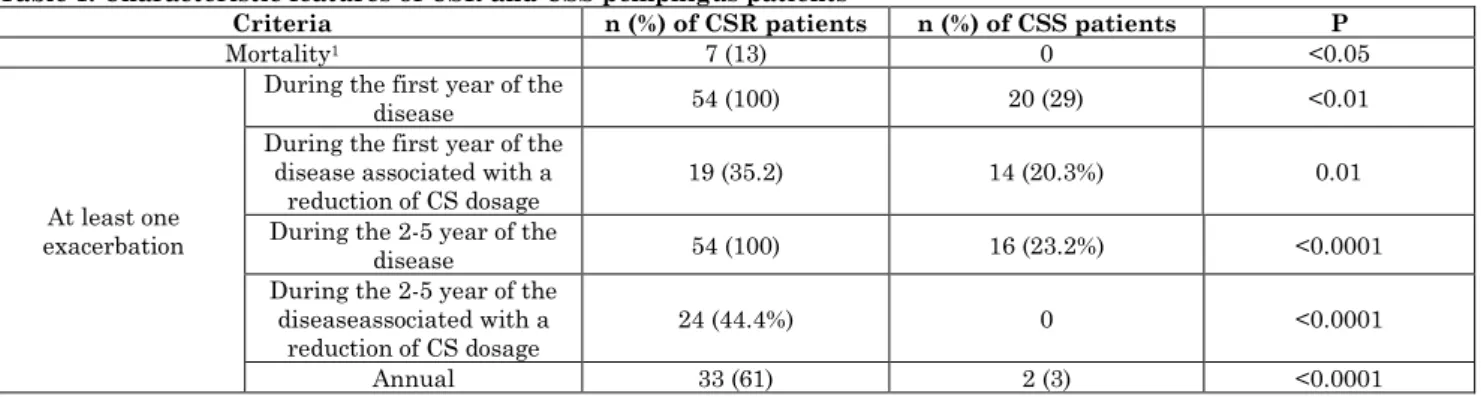
Higher mortality, at least one exacerbation a year and exacerbation during 2-5 year of the disease associated with a reduction of CS dose were significantly more frequent in the group of CSR patients (Figure 1a,b) than in CSS one (Figure 2a,b).
Figure 1: Efficacy of CS and cyclosporine A in CSR patient with pemphigus vulgaris: a, multiple disseminated erosions covered by purulent crusts on the face before the treatment; b, multiple erosions covered by purulent crusts on the face without positive change during 3-4 week of the treatment with high doses of CS and cyclosporine A
CSR patients received the following adjuvant, azathioprine -46 (85.2%), cyclosporine A-5 (9.3%), methotrexate -3 (5.5%) (Table 1).Annual exacerbations were
also significantly more frequent in the CSR patients. High mortality rate was significantly more frequent in CSR patients who died for PNP (Table 1).
Table 1: Characteristic features of CSR and CSS pemphigus patients
Criteria n (%) of CSR patients n (%) of CSS patients P
Mortality1 7 (13) 0 <0.05
At least one exacerbation
During the first year of the
disease 54 (100) 20 (29) <0.01
During the first year of the disease associated with a
reduction of CS dosage 19 (35.2) 14 (20.3%) 0.01 During the 2-5 year of the
disease 54 (100) 16 (23.2%) <0.0001
During the 2-5 year of the diseaseassociated with a
reduction of CS dosage
24 (44.4%) 0 <0.0001
Annual 33 (61) 2 (3) <0.0001
1All patients died for paraneoplastic pemphigus: bladder cancer (n=1), squamous lung cancer (n=1), ovarian cancer (n=1), cervix
cancer (n=1), rectum cancer (n=2), and renal cancer (n=1)
T cells from pemphigus patients can influence the role of the cytokines on the clinical course of the disease. First-line pemphigus treatment comprises high-dose CS [6].CS act via the cytoplasmic glucocorticoid receptor GR, which is a member of the nuclear receptor family [4]. Studies showed that the over-expression of CR-βplays a significant role in the pathogenesis of CSR [12, 15]. However, expression of CR was not investigated in pemphigus patients. It is known that significant part of pemphigus patients have a poor response tosystemic CS. These patients die for complications of CS monotherapy [6].We treated all our CSR patients with adjuvant drugs (azathioprine, cyclosporine A, and methotrexate).
In our study we developed the clinical criteria for CSR such as the consistent persistence of oral or skin lesions and new blisters development within 2-3 weeks. This will allow timely identify patients with poor response to CS monotherapy to treat them with the target therapy (adjuvant drugs) to achieve positive clinical outcome and reduce the potential side effects and relapses. There are a few reports describing patients with a poor response to CS [4].
Chriguer RS et al. 2012 observed that pemphigus patients showed an increased number, and a decreased affinity of GR to dexamethasone (DEX) compared to healthy subjects. Authors suggested a compensatory increasing in the number of CS binding sites to overcome the CSR in pemphigus [4]. IL-6 levels were elevated in the medium of PBMC culture from pemphigus patients even after
high doses of DEX, but they observed no differences in IL-8 and IL-10. This finding showed that Th1 cells and pro-inflammatory cytokines play a major role in the pathogenesis of CSR. Authors also showed the expression of TNF-α and IL-6 around the blister [4]. However, they did not present the clinical criteria of CSR.
In another study authors presented only a case report where the CSR patient was successfully treated with highdoses of intravenous immunoglobulins [8]. Fang SY et al. 2017 investigated genetic mechanisms of glucocorticoid effectiveness in patients with pemphigus. Authors found that single nucleotide polymorphisms rs11745958 C/T and rs17209237 A/G were associated with CSR pemphigus.
Also, they associated the CS efficacy with NR3C1 gene polymorphisms [17]. However, all patients received from 0.50 to 0.75 mg/kg/day of CS; and in our study they received 1.0 to 1.5mg/kg/day of CS. They defined a poor response as the consistent persistence of oral or skin lesions or the development of new blisters within four weeks, and we used in our study the period of 2-3 weeks.
with a greater number of patients involved, including those with paraneoplastic pemphigus. Previous studies reported genetic and immunological mechanisms of CSR [4, 17, 25]. However, there are no studies of α- and β-isoforms of GR expression in patients with pemphigus. There is no consensus which week from the start of CS monotherapy and what CS dose should be considered as CSR? Further studies are required to better describe this subgroup of pemphigus patients.
Conclusion
In our study, CS was ineffective in about a half of pemphigus patients. We observed the impact of CSR in a relapse of the disease and the need for high-dose CS. In CSR patients,the frequency significantly increased of at least one exacerbation a year and exacerbations during 2-5 year of pemphigus associated with a reduction of CS dose. All the CSR patients had annual exacerbations. High mortality rate was significantly more frequent in CSR patients who died for PNP. We developed theclinical criteria for CSR
patients such as the new blisters development and consistent persistence of oral or skin lesions within 2-3 weeks at a CS dose from 1.0 to 1.5 mg/kg/day. Thus, according to these clinical criteria, we subdivided the patients into 2 subtypes: CSS and CSR. This will allow to timely treat these patients with the adjuvant therapy and improve a clinical outcome.
A multidisciplinary approach to research in pemphigus is a top priority and international collaborative research into CSR as a source of biomarkers can enhance our understanding of the disease pathophysiology, clinical management of patients, and the development of novel treatment strategies. Further studies for validation of CSR biomarkers should be related to outcomes (recovery, mortality, short-term or long-term sequelae) and duration of hospitalization.
Acknowledgment
I would like to extend my sincere thanks to Dr. Dmitrii Pogorelov and Dr. PhD Pavel Kolkhir for support.
References
1. Sinha AA (2011) The genetics of pemphigus. Dermatologic clinics, 29 (3): 381-391.
2. D’Auria L, Bonifati C, Mussi A, D’Agosto G, De Simone C, Giacalone B, Ameglio F (1997) Cytokines in the sera of patients with pemphigus vulgaris: interleukin-6 and tumour necrosis factor-alpha levels are significantly increased as compared to healthy subjects and correlate with disease activity. European Cytokine Network, 8(4): 383-387.
3. Stern JNH, Keskin DB, Barteneva N, Zuniga J, Yunis EJ, Ahmed AR (2008) Possible role of natural killer cells in pemphigus vulgaris-preliminary observations. Clinical & Experimental Immunology, 152(3): 472-481.
4. Chriguer RS, Roselino AM, De Castro M (2012) Glucocorticoid sensitivity and pro-inflammatory cytokines pattern in pemphigus. Journal of clinical immunology, 32(4): 786-793.
5. Bystryn JC (1984) Adjuvant therapy of pemphigus. Archives of dermatology, 120(7): 941-951.
6. Ahmed AR, Nguyen T, Kaveri S, Spigelman ZS (2016) First line treatment of pemphigus vulgaris with a novel protocol in patients with contraindications to systemic corticosteroids and immunosuppressive agents: Preliminary retrospective study with a seven year
follow-up. International
immunopharmacology, 34: 25-31.
7. Harman KE, Albert S, Black MM (2003) Guidelines for the management of pemphigus vulgaris. British Journal of Dermatology, 149(5): 926-937.
8. Sibaud V, Beylot-Barry M, Doutre MS, Beylot C (2000) Successful treatment of corticoid-resistant pemphigus with high-dose intravenous immunoglobulins. In Annales de dermatologieet de venereologie, 127 (4): 408-410.
10.Bystryn JC, Steinman NM (1996) The adjuvant therapy of pemphigus: an update. Archives of dermatology, 132(2): 203-212.
11.Bamberger CM, Schulte HM, Chrousos GP (1996) Molecular determinants of glucocorticoid receptor function and tissue sensitivity to glucocorticoids. Endocrine reviews, 17(3): 245-261.
12.Kozaci DL, Chernajovsky Y, Chikanza IC (2007) The differential expression of corticosteroid receptor isoforms in corticosteroid-resistant and-sensitive patients with rheumatoid arthritis. Rheumatology, 46(4): 579-585.
13.Perretti M, D'acquisto F (2009) Annexin A1 and glucocorticoids as effectors of the resolution of inflammation. Nature Reviews Immunology, 9(1): 62-70.
14.Manz M, Vavricka SR, Wanner R, Lakatos PL, Rogler G, Frei P, Schoepfer AM (2012) Therapy of steroid-resistant inflammatory bowel disease. Digestion, 86(1): 11-15. 15.Kubin ME, Hägg PM, Kokkonen N,
Haapasaari KM, Väyrynen JP, Uchida T, Tasanen K (2016) Expression of Glucocorticoid Receptors GRα and GRβ in Bullous Pemphigoid. Actadermato-venereologica, 96(7): 922-926.
16.Wadhwa R, Dua K, Adcock IM, Horvat JC, Kim RY, Hansbro PM (2019) Cellular mechanisms underlying steroid-resistant asthma. European Respiratory Review, 28: 153.
17.Fang SY, Li CL, Liu XS, Chen F, Hua H (2017) Correlation between polymorphisms of the NR3C1 gene and glucocorticoid effectiveness in patients with pemphigus vulgaris. Scientific reports, 7(1): 1-8. 18.Harman KE, Brown D, Exton LS, Groves
RW, Hampton PJ, MohdMustapa MF, Buckley DA (2017) British Association of Dermatologists’ guidelines for the management of pemphigus vulgaris 2017. British Journal of Dermatology, 177(5): 1170-1201.
19.Anhalt GJ, Kim S, Stanley JR, Korman NJ, Jabs DA, Kory M, Labib RS (1990) Paraneoplastic pemphigus: an autoimmune mucocutaneous disease associated with neoplasia. New England Journal of Medicine, 323(25): 1729-1735. 20.Hertl M, Jedlickova H, Karpati S,
Marinovic B, Uzun S, Yayli S, Joly P (2015) Pemphigus. S2 Guideline for diagnosis and treatment-guided by the European Dermatology Forum (EDF) in cooperation with the European Academy of Dermatology and Venereology (EADV). Journal of the European Academy of Dermatology and Venereology, 29(3): 405-414.
21.Ratnam K V, Phay K L, Tan CK (1990) Pemphigus Therapy with Oral Prednisolone Regimens A 5‐Year Study. International journal of dermatology, 29(5): 363-367.
22.Ioannides D, Chrysomallis F, Bystryn JC (2000) Ineffectiveness of cyclosporine as an adjuvant to corticosteroids in the treatment of pemphigus. Archives of dermatology, 136(7): 868-872.
23.Benoit CC, Carvalho P, Prost C, Verret JL, Saiag P, Noblesse I, Joly P (2003) Treatment of pemphigus vulgaris by azathioprine and low doses of prednisone (Lever scheme). In Annales de dermatologieet de venereologie(130, No. 1 Pt 1, 13-15).
24.Goecke A, Guerrero J (2006) Glucocorticoid receptor β in acute and chronic inflammatory conditions: clinical implications. Immunobiology, 211(1-2): 85-96.