Contents
1 The Mathematics Study Program 1
1.1 Concept . . . 1
1.2 Specific Advantages of the Mathematics Program at Jacobs University . . . 1
1.3 Qualification Aims . . . 2
1.4 Career Options . . . 2
1.5 More Information and Contact . . . 3
2 The Curricular Structure 4 2.1 General . . . 4
2.2 The Jacobs University 3C-Model . . . 4
2.2.1 YEAR 1 - CHOICE . . . 5
2.2.2 YEAR 2 - CORE . . . 5
2.2.3 YEAR 3 - CAREER . . . 5
2.3 The Jacobs Track . . . 6
2.4 Modularization of the Mathematics Program . . . 7
2.4.1 Content . . . 7
2.4.2 Structure . . . 9
1
The Mathematics Study Program
1.1
Concept
Mathematics is the most fundamental of the sciences ranging from algebra, analysis, geome-try, or topology, to applications of immediate practical importance as for example in modeling fluids using partial differential equations. Mathematics often finds intriguing practical appli-cations in surprising areas: number theory is used in cryptography, dynamical systems and wavelets are successfully at work in engineering, and mathematical game theory has won a Nobel prize in economics. The program also includes elements of applied and computational mathematics. Math students at Jacobs University participate in research groups together with graduate students and faculty, and many have even written research articles.
One key element in our education is that we do not just teach courses to students, but accom-pany them as individuals throughout their education and help them achieve (or even identify) their personal goals.
1.2
Specific Advantages of the Mathematics Program at Jacobs
University
• We teach pure mathematics in modern high level applied contexts.
Examples: Clean discussion of Linear Algebra embedded into ubiquitous linearization techniques in applications; integral transforms and communications engineering; prob-ability theory and finance; Hilbert space methods and finite elements in computational engineering.
• Top down trumps bottom up!
Although much of the historical development of mathematics was driven by the desire to build theories bottom up from first principles, this is not a useful didactical concept, not does it reflect the way most research mathematicians work.
• Learn by immersion:
It is important to learn by discussing mathematics on a formalized regular basis with an active mathematician. This is very analogous to study at a music conservatory. Lectures augment this, not vice versa.
• Learn to interact:
Discuss with mathematicians and those who apply mathematics alike. Appreciate the complexity of mathematics in the real world, and understand that math is everywhere!
• Small classes:
Each year, about 20 students will be studying mathematics at Jacobs University. This allows for and one-on-one interaction with faculty, focused study, early research, and a holistic development of mathematical and personal skills.
• Interdisciplinary spirit:
At Jacobs, there is a lot of mathematics and mathematical modeling across campus. Links are close and personal between faculty, students, and research staff in different fields that work together on common goals.
• We care about each and everyone:
Students at Jacobs are are known personally to faculty. Individuals can and will get help to develop special interests, but also in time of special needs.
1.3
Qualification Aims
• Graduates who think clearly, formulate cleanly, and present well.
• Graduates who are confident in aquiring, understanding, und organizing information.
• Generic problem solving skills, including a sense of figuring out what is already known, what is not known, and what is required to obtain a solution.
• Broad background in the core fields of pure and applied mathematics (Analysis, Linear
Algebra, Numerical Analysis, Probability, Topology, Geometry) at a level allowing easy transition into top graduate schools worldwide.
• Practical skills in programming and the use of standard mathematical software. • A sense for the use of Mathematics in one or more fields of application.
1.4
Career Options
There are few undergraduate degrees which rival mathematics in the diversity of rewarding job options, which include the following.
• Insurance companies hire large numbers of mathematicians on actuarial and other analyst
positions.
• Quantitative Finance and Financial Engineering is another big pool of opportunities
which involves fairly deep mathematical concepts.
• Operations Researchers help organizations, businesses, and government find efficient so-lutions to organizational and strategic planning questions, including scheduling and dis-tribution problems, resource allocation, facilities design, and forecasting.
• Mathematicians are frequently employed in Information Technology positions. In fact,
a recent survey from the UK shows that while a substantial number of mathematicians work in IT, few computer scientists compete with mathematicians in any of the other fields of employment. In particular, mathematical knowledge is required for work in information security and cryptography.
• Statisticians are employed by large organizations and work in research and development
divisions from academica to industry to analyze data from surveys and experiments.
• Educationist a wide field of employment ranging from secondary school teachers to
uni-versity professors.
• Engineering Mathematics offers job opportunities from aerospace engineering and petroleum
engineering to a wide range of other engineering disciplines.
• Last, but not least, a career as a research mathematician at universities or mathematics research institutes.
1.5
More Information and Contact
For more information please contact the study program coordinators: Dr. Dierk Schleicher
Professor of Mathematics
Email: [email protected] Telephone: +49 421 200-3213
Dr. Marcel Oliver
Professor of Mathematics
Email: [email protected] Telephone: +49 421 200-3212
2
The Curricular Structure
2.1
General
The undergraduate education at Jacobs University equips students with the key qualifications necessary for a successful academic, as well as professional career. By combining disciplinary depth and transdisciplinary breadth, supplemented by skills education and extracurricular ele-ments, students are prepared to be responsible and successful citizens within the societies they work and live in.
The curricular structure provides multiple elements enhancing employability, transdisciplinar-ity, and internationality. The unique Jacobs Track, offered across all study programs, provides a broad range of tailor-made courses designed to foster career competencies. These include courses which promote communication, technology, business, (German) language, and man-agement skills. The World Track, included in the third year of study, provides extended com-pany internships or study abroad options. Thus students gain training on the job and intercul-tural experiences. All undergraduate programs at Jacobs University are based on a coherently modularized structure, which provides students with a broad and flexible choice of study plans to meet their major as well as minor study interests.
The policies and procedures regulating undergraduate study programs at Jacobs University in general can be found on the website.
2.2
The Jacobs University 3C-Model
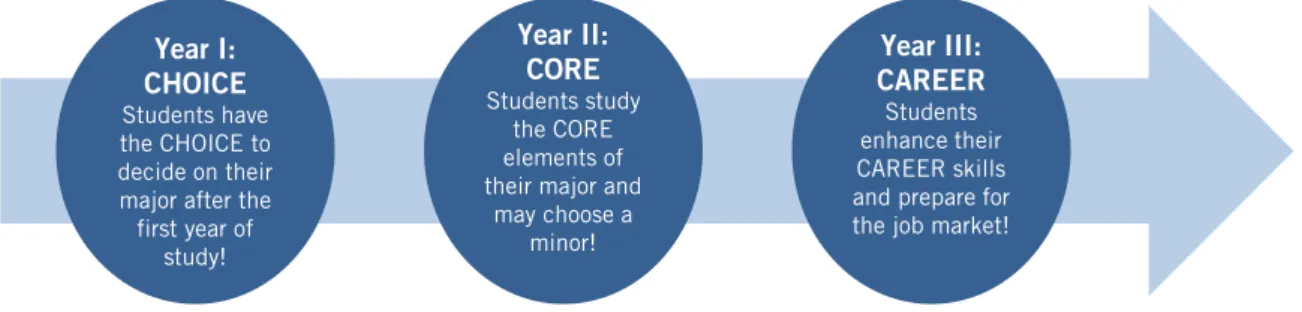
Jacobs University offers study programs according to the regulations of the European Higher Education Area. All study programs are structured along the European Credit Transfer Sys-tem (ECTS), which facilitates credit transfer between academic institutions. The three-year undergraduate program involves six semesters of study with a total of 180 ECTS credits. The curricular structure follows an innovative and student-centered modularization scheme - the 3C-Model - which groups the disciplinary content of the three study years according to overar-ching themes:
Year I: CHOICE
Students have the CHOICE to decide on their major after the first year of
study! Year II: CORE Students study the CORE elements of their major and
may choose a minor! Year III: CAREER Students enhance their CAREER skills and prepare for the job market!
2.2.1 YEAR 1 - CHOICE
The first study year is characterized by a broad offer in disciplinary and interdisciplinary edu-cation. Students select three CHOICE modules from a variety of study programs. As a unique asset, our curricula allow students to select their study program freely from among the three selected CHOICE modules during their first year of study.
2.2.2 YEAR 2 - CORE
In the second year, students take three in-depth, discipline-specific CORE modules. One CORE module can also be taken from a second, complementary discipline, which allows students to incorporate a minor study track into their undergraduate education. Students will gener-ally qualify for a minor if they have successfully taken at least one CHOICE module and one CORE module in a second field, and this extra qualification will be highlighted in the transcript.
2.2.3 YEAR 3 - CAREER
During their third year, students must decide on their career after graduation. In order to fa-cilitate this decision, the fifth semester introduces two separate tracks. By default students are registered for the World Track.
1. The World Track
In this track there are two mandatory elective options:
• Internship
The internship program is a core element of Jacobs Universitys employability ap-proach. It includes a mandatory semester-long internship off-campus (minimum 16 weeks in full-time) which provides insight into the labor market as well as practical work experience related to the respective area of study. Successful internships may initiate career opportunities for students. For more information, please contact the Career Services Center (http://www.jacobs- university.de/career-services/contact).
• Study Abroad
Students can take the opportunity to study abroad at one of our partner universities. Courses recognized as study abroad credits need to be pre-approved according to the Jacobs University study abroad procedures and carry minimum of 20 ECTS credits in total. Several exchange programs allow you to be directly enrolled at prestigious partner institutions worldwide. Jacobs University’s participation in Erasmus+, the European Unions exchange program, provides an exchange semester at a number of European universities including Erasmus study abroad funding.
For more information, please contact the International Office (http://intoffice.user.jacobs-university.de/outgoing/).
2. The Campus Track
Alternatively, students may also opt to follow the Campus Track by continuing their un-dergraduate education at Jacobs, namely by selecting an additional CORE module dur-ing their third year and redistributdur-ing the remaindur-ing courses and modules across the third year. This opportunity can be used by students to more intensively focus on their major
or to fulfill the minor requirements for a second field of interest.
In the sixth semester, all students select from a range of specialization courses within their study program and concentrate on their Bachelor thesis in the context of a Project/Thesis Module. All students attend a mandatory set of career skills courses and events throughout their studies. These equip them with necessary skills for their 5th semester and their future career.
2.3
The Jacobs Track
The Jacobs Track, another stand-alone feature of Jacobs University, runs parallel to the disci-plinary CHOICE, CORE, and CAREER modules across all study years and is an integral part of all study programs. It reflects our commitment to an in-depth methodological education, it fosters our transdisciplinary approach, it enhances employability, and equips students with ex-tra skills desirable in your general field of study. Additionally, it integrates essential language courses.
Mathematics, statistics, and other methods courses are offered to all students within a com-prehensive Methods Module. This module provides students with general foundations and transferable techniques which are invaluable to follow the study content not only in the study program itself but also in related fields.
The Skills Module equips students with general academic skills which are indispensable for their chosen area of study. These could be, for example, programming, data handling, presen-tation skills, and academic writing, scientific and experimental skills.
The transdisciplinary Triangle Module offers courses with a focus on at least one of the areas of business, technology and innovation, and societal context. The offerings comprise essential knowledge of these fields for students from other majors as well as problem-based courses that tackle global challenges from different disciplinary backgrounds. Working together with stu-dents from different disciplines and cultural backgrounds in these courses broadens the stustu-dents horizon by crossing the boundaries of traditional disciplines.
Foreign languages are integrated within the Language Module. Communicative skills and for-eign language competence foster students intercultural awareness and enhance their employ-ability in a globalized and interconnected world. Jacobs University supports its students in ac-quiring and improving these skills by offering a variety of language courses at all proficiency levels. Emphasis is put on fostering German language skills, as they are an important prerequi-site for students to learn about, explore, and eventually integrate into their host country. Hence, acquiring 10 ECTS credits in German is a requirement for all students. Students who meet the requirements of the German proficiency level (e.g. native speakers) are required to select courses in any other language program offered.
2.4
Modularization of the Mathematics Program
2.4.1 Content
Year 1
Take the module listed below and select two further CHOICE modules from different study areas.
Fundamental Mathematics (CH07-FundMath)
Fundamental Mathematics is the central first year major-specific module. It complements the first-year Service Mathematics courses in Calculus/Analysis and Linear Algebra with addi-tional in-depth material necessary for any Mathematics student and useful for students of other quantitative majors or those with an independent interest in Mathematics.
Year 2
Take all three modules or replace one with a CORE module from a different study program. Core Mathematics (CO16-CoreMaths)
The module Core Mathematics contains the courses which are taken by all second year mathe-matics students. It continues the education in Linear Algebra into the second year of study and develops the theory of integration with elements of Functional Analysis and Fourier Methods. In addition, the module complements the second year education in the Jacobs track by provid-ing additional courses in Numerical Methods and Probability.
Pure Mathematics (CO17-CorePureMath)
The module Core Pure Mathematics contains a set of courses that are central to an education in pure mathematics. It contains an introduction to Geometry and Topology including differential forms, manifolds, and tensors, a first course in Complex Analysis, and a first course in Algebra. Core Applied Mathematics (CO18-CoreAppMath)
The module Core Applied Mathematics contains a set of core courses which should be taken by all students interested in applications and mathematical modeling. It comprises a first hands-on introduction to theory and applications of dynamical systems, and an introduction to stochas-tic modeling and mathemastochas-tical finance. A crucial component of this module will be the use of computer experiments to foster intuitive understanding and develop students’ skills in using the computer to bridge between mathematical idea and concrete implementation and application. Some CORE Modules require students to have taken a specific CHOICE Module. Please see the Module Handbook for details regarding pre-requisites.
Year 3
In the 3rd year students follow the World Track by default:
1. World Track
5th Semester
• Internship / study abroad 6th Semester
• Mathematics Project / Thesis Module
• Program-specific Specialization Module
Exemplary course offering:
– Algebra and Geometry
– Manifolds and Topology
– Number Theory
– Discrete Structures and Optimization
– Stochastic Processes and Finance
– Functional Analysis and Elliptic Operators
– Numerical Analysis and Scientific Computing
– Mathematical Modeling with PDEs
– Differential Equations and Dynamical Systems
– Topics in Mathematics
2. Campus Track
Students who do not enter the World Track follow the Campus Track. 5th and 6th Semester
• Program-specific Project / Thesis Module
• Program-specific Specialization Module
(please see World Track for exemplary course offering)
2.4.2 Structure
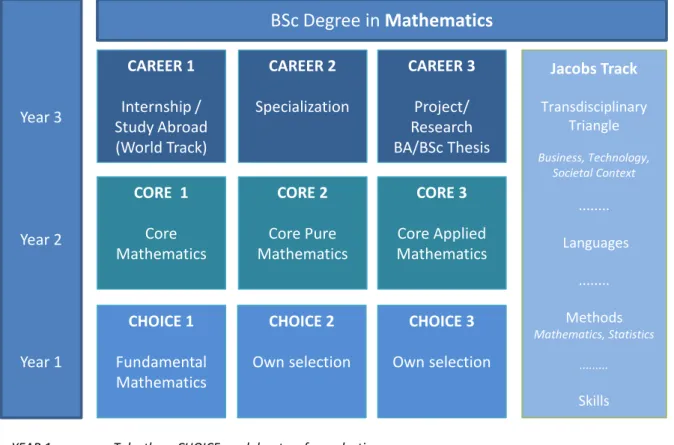
Undergraduate Modularization Structure
CAREER 1 Internship / Study Abroad (World Track) CAREER 2 Specialization Jacobs Track Transdisciplinary Triangle Business, Technology, Societal Context ... Languages ... Methods Mathematics, Statistics ... Skills
BSc Degree in
Mathematics
CAREER 3
Project/ Research BA/BSc Thesis
CORE 1
Core Mathematics CORE 2 Core Pure Mathematics CORE 3 Core Applied Mathematics CHOICE 1 Fundamental Mathematics CHOICE 2 Own selection CHOICE 3 Own selection Year 3 Year 2 Year 1
YEAR 1 Take three CHOICE modules, two free selection
YEAR 2 Take three CORE modules, one CORE module can be substituted by a CORE module from a second study program to pursue a minor
YEAR 3 Alternatively Campus Track with a 4th CORE module instead of internship/study abroad module
3
Appendix 1: Mandatory Course Plan
Jacobs University Bremen reserves the right to substitute courses by replacements and/or reduce the number of mandatory/mandatory elective courses offered
V.1.1 09/15
Mathematics – World Track
Matriculation Fall 2015
Program-Specific Modules Type Status¹ Semester Credits Jacobs Track Modules (General Education) Type Status¹ Semester Credits
Year 1 - CHOICE 45 20
Take the mandatory CHOICE module listed below, this is a requirement for the Mathematics program.
CH07-FundMath Module: Fundamental Mathematics m 15 JT-ME-MethodsMath Module: Methods / Mathematics m 10
CH07-100101 General Mathematics Lecture m 1 5 JTME-120203 Elements of Analysis I Lecture m 1 2,5
CH07-100111 Mathematical Software Lab Lab m 1 2,5 JTME-120204 Elements of Analysis II Lecture m 1 2,5
CH07-100212 Analysis II Lecture m 2 5 JTME-120112 Foundations of Linear Algebra I Lecture m 2 2,5
CH07-100122 Undergraduate Seminar Lab m 2 2,5 JTME-120113 Foundations of Linear Algebra II Lecture m 2 2,5
Module: CHOICE (own selection) e 1/2 30 JT-SK-Skills Module: Skills m 2,5
JTSK-320111/350111 Students take either Programming in C I or Programming in Python Lecture m 1 2,5
Students take two further CHOICE modules from those offered for all other study programs. ² JT-TA-TriArea Module: Triangle Area m 2,5
Take one course from the triangle (BUSINESS, TECHNOLOGY & me 1/2 2,5
INNOVATION, SOCIETAL CONTEXT) area. Each counts 2,5 ECTS ³
JT-LA-Language Module: Language m 5
Take two German courses (2,5 ECTS each). Seminar me 1/2 5
Native German speakers take courses in another offered language
Year 2 - CORE 45 20
Take all three modules or replace one with a CORE module from a different study program. ²
CO16-CoreMaths Module: Core Mathematics me 15 JT-ME-MethodsMath Module: Methods / Mathematics m 5
CO16-100231 Linear Algebra Lecture m 3 5 JTME-120201 Elements of Probability Lecture m 3 2,5
CO16-100241 Elements of Stochastic Processes Lecture m 3 2,5 JTME-120202 Numerical Methods I Lecture m 4 2,5
CO16-100232 Introductory Real Analysis Lecture m 4 5 JT-SK-Skills Module: Skills m 2,5
CO16-100242 Numerical Methods II Lecture m 4 2,5 JTSK-320112/350112 Students take either Programming in C II or Advanced Lecture m 3/4 2,5
CO17-CorePureMath Module: Core Pure Mathematics me 15 Programming in Python
CO17-100251 Introduction to Complex Analysis Lecture m 3 5 JT-TA-TriArea Module: Triangle Area m 7,5
CO17-100261 Calculus on Manifolds Lecture m 3 5 Take three courses from the triangle (BUSINESS, TECHNOLOGY & me 3/4 7,5
CO17-100252 Introduction to Algebra Lecture m 4 5 INNOVATION, SOCIETAL CONTEXT) area. Each counts 2,5 ECTS ³
CO18-CoreAppMath Module: Core Applied Mathematics me 15
CO18-110231 Applied Dynamical Systems Lecture m 3 5 JT-LA-Language Module: Language m 5
CO18-110233 Applied Dynamical Systems Lab Lab m 3 2,5 Take two German courses (2,5 ECTS each). Seminar me 3/4 5
CO18-110221 Stochastic Methods Lecture m 4 5 Native German speakers take courses in another offered language
CO18-110222 Stochastic Methods Lab Lab m 4 2,5
Year 3 - CAREER 45 5
CA02 / CA03 Module: Internship / Study Abroad m 5 20 JT-TA-TriArea Module: Triangle Area m 5
CA01-CarSkills Module: Career Skills m Take two courses from the triangle (BUSINESS, TECHNOLOGY & me 6 5
CA12-MATH Module: Project/Thesis MATH m 15 INNOVATION, SOCIETAL CONTEXT) area. Each counts 2,5 ECTS ³
CA12-100303 Project MATH m 6 5
CA12-100304 Thesis MATH m 6 10
CA-S-MATH Module: Specialization Area MATH m 10
Takefour specialization courses (2.5 ECTS each) ² me 5/6 10
Total ECTS 180
¹ Status (m = mandatory, e = elective, me = mandatory elective)
² For a full listing of all CHOICE / CORE / CAREER / Jacobs Track modules please consult the CampusNet online catalogue and / or the module handbook (on our website). ³ You are required to take six Triangle Area courses in total. Select two from each of the three triangle areas (BUSINESS, TECHNOLOGY & INNOVATION, SOCIETAL CONTEXT).