Noncoherent Decode-and-Forward Cooperative
Systems with Maximum Energy Selection
Ha X. Nguyen
1, Cuu V. Ho
2, Chan Dai Truyen Thai
3, Danh T. Nguyen
41[email protected], School of Engineering, Tan Tao University
Tan Duc Ecity, Duc Hoa, Long An Province, Vietnam
2[email protected], Department of Electronics and Telecommunications, Saigon University
273 An Duong Vuong, District 5, Ho Chi Minh City, Vietnam
3[email protected], Univ Lille Nord de France
F-59000, Lille, IFSTTAR, LEOST, F-59650, Villeneuve d’Ascq, France
4[email protected], Faculty of Electronics and Telecommunications, University of Science
Vietnam National University, Ho Chi Minh City, Vietnam
Abstract—This paper investigates the performance of a max-imum energy selection receiver of an adaptive decode-and-forward (DF) relaying scheme for a cooperative wireless system. In particular, a close-form expression for the bit-error-rate (BER) is analytically derived when the system is deployed with binary frequency-shift keying (BFSK) modulation. The thresholds used at the relays to address the issue of error propagation are opti-mized to minimize the BER. While finding the optimal thresholds requires information on the average signal-to-noise ratios (SNRs) of all the transmission links in the system, the approximate threshold at each relay that requires only information on the average SNR of the source-corresponding relay is investigated. It is also shown that the system achieves a full diversity order with the approximate thresholds . Both analytical and simulation results are provided to validate our theoretical analysis.
I. INTRODUCTION
Frequency shift keying (FSK) is a popular modulation scheme in noncoherent communications in which the receiver does not require any channel state information (CSI) to decode the transmitted signals [1]. Consequently, using FSK signals in cooperative systems has been focused recently since there is a complexity advantage in decoding [2]–[7]. It is due to the fact that there are many wireless fading channels involved in the systems [8], [9], which makes the task of channel estimation more difficult. With the decode-and-forward (DF) protocol employing FSK in cooperative systems, reference [3] proposed maximum likelihood (ML) and suboptimal piecewise linear (PL) schemes to decode the signals at the destination. However, it was shown that the system could not achieve a full diversity order due to the error forwarding at the relays. References [6], [7] proposed to use a threshold at the relays to address the issue of error propagation for binary frequency-shift keying (BFSK) modulation. While the destination in [6] combines all the signals from the retransmitting relays, the destination in [7] selects only one signal with the largest magnitude of the energy difference to decode. Unfortunately, designing the optimal thresholds to minimize the average bit-error-rate (BER) of the system relies on the MATLAB Op-timization Toolbox and a theoretical analysis of the diversity order is not available.
This paper studies the maximum energy selection (MES)
receiver, i.e., selecting the maximum output from the square-law detectors of all branches to perform a detection, for a threshold-based (i.e., adaptive) DF cooperative system. While the destination in [7] relies on the maximum magnitude of the energy difference, the destination in this paper employs the maximum energy from the square-law detectors to detect the transmitted signal. The approximate thresholds that achieve full diversity are provided in this paper. Note that the direct link between the source and destination is considered in this work while the work in [7] assumes that there is no such a link.
II. SYSTEMMODEL
Maximum Energy Selection Source
Decode and Forward th
0,K r
θ >θ
Remain Silent
Y
N Relay 1
Relay K
Destination
Decode and Forward th
0,1 r
θ >θ
Remain Silent
Y
N
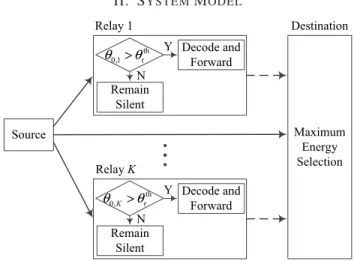
Fig. 1. System description of the proposed scheme.
Fig. 1 illustrates the signal transmission from the source (node 0) to destination (node K + 1) with the assistance of K half-duplex relays (node i, i = 1, . . . , K). The relays retransmit signals to the destination in orthogonal channels. In this paper, we assume that the fading channel coefficient between transmit nodeiand receive nodej, denoted byhi,j,
and the noise component at receive node j, denoted by ni,j,
are modeled as zero-mean complex Gaussian random variables with variances σ2
i,j and N0, respectively. The instantaneous
signal-to-noise ratio (SNR) of the channel between node i
Ei|hi,j|2/N0 where Ei is the average transmitted energy of
nodei. The corresponding average SNR isγi,j=Eiσ2i,j/N0.
In the first phase, the source broadcasts the signal xmand
the received signals at node i,i = 1, . . . , K+ 1, are written as
y0,i=
p
E0h0,ixm+n0,i, i= 1,2, . . . , K+ 1 (1)
wherexmis themth symbol of an BFSK constellation.
Without loss of generality, assume that the first symbol from the signal constellation is transmitted. The outputs of the square-law detector for the first and second symbols at node i,i= 1, . . . , K+ 1are written, respectively, as
y0,i,1 =
pE0h0,i+n0,i,1
2
, (2)
y0,i,2 =
n0,i,2
2
, (3)
As in [6], the difference of the outputs of the square-law detector, namely θ0,i =
y0,i,1 −y0,i,2
, is considered as a reliability measure of the detection at node i. There-fore, node i decodes and retransmits a BFSK signal only if
θ0,i > θrth.When nodei transmits a correct bit in the second phase, the outputs of the square-law detector for the first and second symbols at the destination are
yi,K+1,1 =
pEih0,i+ni,K+1,1
2
, (4)
yi,K+1,2 =
ni,K+1,2
2
. (5)
Meanwhile, the outputs of the square-law detector for the first and second symbols at the destination can be written as follows if nodeitransmits an incorrect bit:
yi,K+1,1 =
ni,K+1,1
2
, (6)
yi,K+1,2 =
pEih0,i+ni,K+1,2
2
, (7)
Ifθ0,i< θrth, nodeiremains silent in the second phase and the outputs of the square-law detector for the first and second symbols at the destination are
yi,K+1,1 =
ni,K+1,1|2, (8)
yi,K+1,2 =
ni,K+1,2|2. (9)
Finally, the destination compares and chooses the maximum output from all the outputs of the square-law detectors, i.e., employs the maximum energy selection, to detect the trans-mitted information. In other words, the decision rule is of the following form:
h
ˆi,mˆi = arg max
i=0,...,K m=1,2
yi,K+1,m. (10)
III. BER COMPUTATIONS ANDTHRESHOLDS
In this section, the BER analysis for MES scheme is first carried out for a network with arbitrary qualities of source-relay and source-relay-destination links. Then, the optimal thresholds are chosen to minimize the average BER are discussed. Finally, the approximate thresholds are proposed to achieve a full diversity order.
A. BER Computations
The law of total probability is employed to compute the average BER of the system. First, denoteΩ1,Ω2, andΩ3 as the sets of the relays that forward a correct bit, an incorrect bit, and remain silent, respectively. It is clear thatK=|Ω1|+
|Ω2|+|Ω3| where |Ω| denotes the cardinality of set Ω. The probability of occurrence for the specific set{Ω1,Ω2,Ω3} is [7]:
P(Ω1,Ω2,Ω3) =
Y
i∈(Ω1∪Ω2)
1−I1(θthr , γ0,i)
Y
i∈Ω3
I1(θrth, γ0,i)
× Y
i∈Ω1
1−I2(θthr , γ0,i)
Y
i∈Ω2
I2(θthr , γ0,i) (11)
whereA∪Bdenotes the union of setsAandB. The function
I1(θthr , γ0,i) is the probability of the event θ0,i< θthr and is computed as [7]:
I1(θthr , γ0,i) =
1 +γ0,i
2 +γ0,i
h
1−e−θrth/(1+γ0,i)
i
+ 1 2 +γ0,i
h
1−e−θthr
i . (12)
On the other hand, I2(θthr , γ0,i) is the probability of error
at node i, i = 1, . . . , K, given the event θ0,i > θrth and is determined by [7]
I2(θrth, γ0,i) =
1 2 +γ0,i
1 1−I1(θrth, γ0,i)
e−θthr (13) Now letWw,m(w∈ {Ω1∪ {0}}),Vv,m (v∈Ω2) andRr,m
(r∈Ω3) denote the outputs of the square-law detector for the
mth symbol,m= 1,2, measured at the destination. With the assumption that the first symbol from the signal constellation is transmitted, the probability density functions (pdfs) ofWw,m,
Vv,m andRr,m are given, respectively, by
fWw,m(x) =
(
fw,1(x), m= 1
fw,2(x), m= 2
(14)
fVv,m(x) =
(
fv,2(x), m= 1
fv,1(x), m= 2
(15)
fRr,m(x) = fr,2(x), m= 1 orm= 2 (16) wherefk,1(x) = N0(1+γ1
k,K+1)e
−x/(N0(1+γk,K+1)),x≥0 and
fk,2(x) = N10e−x/N0,x≥0.
An error occurs at the destination if among the 2(K+ 1)
statisticsWw,m,Vv,m andRr,m,w∈ {Ω1∪{0}}, n∈Ω2, r∈
Ω3, m = 1,2, the one with the largest value is 1) Case 1 (Θ = 1) one ofWw,1, 2) Case 2 (Θ = 2) one ofVv,1, and 3)
Case 3 (Θ = 3) one ofRr,1. Thus, given the set{Ω1,Ω2,Ω3}, the BER can be computed as
PΩ1,Ω2,Ω3(ε) = 3
X
i=1
PΩ1,Ω2,Ω3(ε,Θ =i)
= X
w∈Ω1∪{0}
P Ww,2−Ww,2<0
+X
v∈Ω2
P Vv,2−Vv,2<0
+ X
r∈Ω3
P Rr,2−Rr,2<0
where Ww,2 = max i6=w m=1,2
(Wi,m, Ww,1, Vv,m, Rr,m),
Vv,2 = max i6=v m=1,2
(Ww,m, Vi,m, Vv,1, Rr,m), and
Rr,2= max i6=r m=1,2
(Ww,m, Vv,m, Ri,m, Rr,1) .
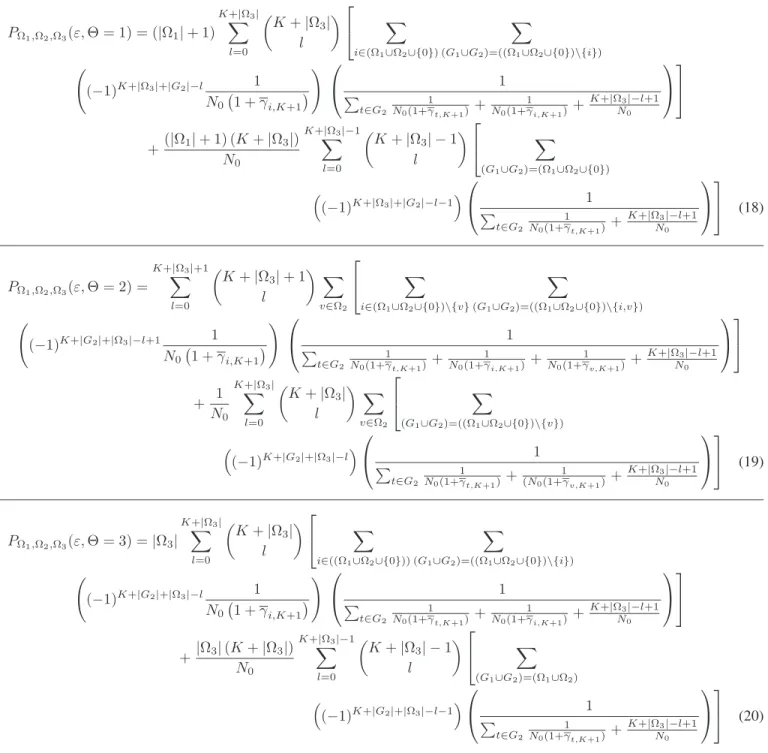
The conditional BER PΩ1,Ω2,Ω3(ε,Θ =i), i= 1,2,3, can be computed1 as (18), (19), and (20) on the top of this page, where(G1∪G2) = Ωmeans thatG1andG2are two disjoint subsets of Ω and the union of those disjoint subsets is Ω. Obviously, the average BER with a given threshold θth
r can be expressed as
BER θrth
= X
Ω1∈P(S)
X
Ω2∈P(S\Ω1) 3
X
i=1
PΩ1,Ω2,Ω3(ε,Θ =i)P(Ω1,Ω2,Ω3) (21) where P(Ω) denotes the power set of Ω. The set S =
{1, . . . , K}.
B. Optimal and Approximate Thresholds
Given the closed-form expression of the average BER in (21), one can choose the thresholdθth
r to minimize the average BER of the system by using the MATLAB Optimization Toolbox. The optimization problem can be set up as follows:
b
θthr = arg min
θth r
BER(θthr ). (22) It is clear from (21) that the system need to collect in-formation on the average SNRs of all the transmission links to find the optimal thresholds. Unfortunately, an close-form solution for optimal threshold values is very difficult, if not impossible, to find. Therefore, to further reduce the complexity of the system2, in what follows, we propose approximate thresholds and prove that by using those thresholds, the system can achieve the maximum diversity order.
Lemma 1: If the relays use the threshold θth
r = Qlogcγ whereγ=E0/N0, the system achieves a full diversity order ofK+ 1 for anyQ≥K and a positive constantc.
Proof:
To simplify our derivation, we consider the i.i.d. case, i.e.,
γ0,i = γi,K+1 = γ0,K+1 = γ0, i = 1, . . . , K where γ0 =
E0σ20/N0 andN0= 1. Sinceθthr =Qlogcγ and
lim
γ0→∞
1−cγ1 Q 1+γ0
log(γ)/γ =Q γ0
γ =Qσ
2
0, (23)
it follows from (11) that3
P(Ω1,Ω2,Ω3)≤ I1(θthr , γ0,i)
|Ω3|
I2(θrth, γ0,i)
|Ω2|
,(log(γ)/γ)|Ω3|
1/γQ+1|Ω2| (24)
1The pdfs ofW
w,2,Vv,2andRr,2 are given in Appendix A.
2By using the approximate thresholds, besides the information collection,
the system does not need to find the optimal thresholds centrally and send to the relays, hence, reducing the complexity and implementation costs of the system.
3With two positive real functionsf(x)andg(x), we sayf(x),g(x)if
lim supx→∞
f(x)
g(x) =dwhered <∞is a positive constant.
On the other hand, the conditional BER PΩ1,Ω2,Ω3(ε) =
P3
i=1PΩ1,Ω2,Ω3(ε,Θ = i) can be evaluated from the large SNR behavior by considering the value of the first non-zero order derivative of the PDF at the origin [10]. According to [11], one can verify that
PΩ1,Ω2,Ω3(ε,Θ = 1) =
Z ∞
0
fWw,1(x)e−x/N0dx
,(1/γ0)
|Ω1|+|Ω2|+1
, (25)
PΩ1,Ω2,Ω3(ε,Θ = 2) =
Z ∞
0
fVv,1(x)e−x/N0(1+γ0)dx
, (
1, if |Ω1|+|Ω2|= 1
(1/γ0)
|Ω1|+|Ω2|
, if |Ω1|+|Ω2|>1 (26)
PΩ1,Ω2,Ω3(ε,Θ = 3) =
Z ∞
0
fRr,1(x)e
−x/N0dx
,(1/γ0)
|Ω1|+|Ω2|+1
. (27)
Thus, one has
PΩ1,Ω2,Ω3(ε)
,
(1/γ0)
K+1
, if |Ω2|= 0
(1/γ0)
Q+1+|Ω3|
, if |Ω1|= 0 and|Ω2|= 1
(1/γ0)
K+|Ω2|(Q+1)
, if |Ω1|>0 and|Ω2|>0 (28)
Therefore, for sufficiently large values of SNR and θth r =
Qlogcγ whereQ≥K, it follows from (21) that
BER θrth
,(1/γ0)
K+1
. (29)
So Lemma 1 is proved.
IV. SIMULATIONRESULTS
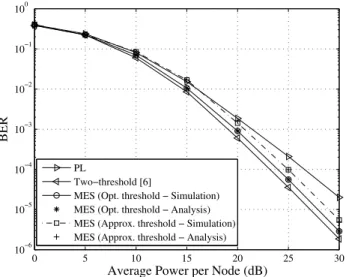
This section presents analytical and simulation results for the BER performance of different noncoherent DF cooperative systems. In conducting the simulations, it is assumed that the noise components at the receivers, i.e., relays and destination are modeled as i.i.d.CN(0,1)random variables. Fig. 2 plots the average BERs of the proposed scheme, PL scheme and the scheme in [6] in a two-relay system when the variances of Rayleigh fading channels are set to be2σ2
0,i = 0.1σi,K2 +1 =
5σ2
PΩ1,Ω2,Ω3(ε,Θ = 1) = (|Ω1|+ 1)
KX+|Ω3|
l=0
K+|Ω3|
l
X
i∈(Ω1∪Ω2∪{0})
X
(G1∪G2)=((Ω1∪Ω2∪{0})\{i})
(−1)K+|Ω3|+|G2|−l 1
N0 1 +γi,K+1
!
P 1
t∈G2 1
N0(1+γt,K+1)+ 1
N0(1+γi,K+1)+
K+|Ω3|−l+1
N0
+(|Ω1|+ 1) (K+|Ω3|)
N0
K+|Ω3|−1
X
l=0
K+|Ω3| −1
l
X
(G1∪G2)=(Ω1∪Ω2∪{0})
(−1)K+|Ω3|+|G2|−l−1
P 1
t∈G2 1
N0(1+γt,K+1)+
K+|Ω3|−l+1
N0
(18)
PΩ1,Ω2,Ω3(ε,Θ = 2) =
K+X|Ω3|+1
l=0
K+|Ω3|+ 1
l
X
v∈Ω2
X
i∈(Ω1∪Ω2∪{0})\{v}
X
(G1∪G2)=((Ω1∪Ω2∪{0})\{i,v})
(−1)K+|G2|+|Ω3|−l+1 1
N0 1 +γi,K+1
!
P 1
t∈G2 1
N0(1+γt,K+1)+ 1
N0(1+γi,K+1)+ 1
N0(1+γv,K+1)+
K+|Ω3|−l+1
N0
+ 1
N0
K+|Ω3|
X
l=0
K+|Ω3|
l
X
v∈Ω2
X
(G1∪G2)=((Ω1∪Ω2∪{0})\{v})
(−1)K+|G2|+|Ω3|−l
P 1
t∈G2 1
N0(1+γt,K+1)+ 1
(N0(1+γv,K+1)+
K+|Ω3|−l+1
N0
(19)
PΩ1,Ω2,Ω3(ε,Θ = 3) =|Ω3|
KX+|Ω3|
l=0
K+|Ω3|
l
X
i∈((Ω1∪Ω2∪{0}))
X
(G1∪G2)=((Ω1∪Ω2∪{0})\{i})
(−1)K+|G2|+|Ω3|−l 1
N0 1 +γi,K+1
!
P 1
t∈G2 1
N0(1+γt,K+1)+ 1
N0(1+γi,K+1)+
K+|Ω3|−l+1
N0
+|Ω3|(K+|Ω3|)
N0
K+|Ω3|−1
X
l=0
K+|Ω3| −1
l
X
(G1∪G2)=(Ω1∪Ω2)
(−1)K+|G2|+|Ω3|−l−1
P 1
t∈G2 1
N0(1+γt,K+1)+
K+|Ω3|−l+1
N0
(20)
detection. Such the information is required for the PL scheme and the scheme in [6].
Fig. 3 presents the average BERs obtained by simulation and analysis for two different schemes in a three-relay cooperative system. Here σ2
0,i =σi,K2 +1 =σ02,K+1 = 1,i= 1,2,3. The figure again confirms the analysis performed in Section III. At sufficient large values of SNR, the proposed scheme yields a superior performance compared to the PL scheme.
V. CONCLUSION
This paper studies the maximum energy selection receiver for an adaptive decode-and-forward (DF) relaying system with
BFSK signals. A closed-form BER expression is obtained and used to choose the optimal thresholds to minimize the average BER. Approximate thresholds are proposed and the diversity order is verified. Performance comparison reveals that the proposed scheme outperforms the other two schemes with a lower complexity.
VI. ACKNOWLEDGEMENT
0 5 10 15 20 25 30 10−6
10−5 10−4 10−3 10−2 10−1 100
Average Power per Node (dB)
BER
PL
Two−threshold [6]
MES (Opt. threshold − Simulation) MES (Opt. threshold − Analysis) MES (Approx. threshold − Simulation) MES (Approx. threshold − Analysis)
Fig. 2. BERs of a two-relay network with different schemes when 2σ2
0,i= 0.1σ2i,K+1= 5σ02,K+1= 1.
0 5 10 15 20 25 30
10−8 10−6 10−4 10−2 100
Average Power per Node (dB)
BER
PL
MES (Opt. threshold − Simulation) MES (Opt. threshold − Analysis) MES (Approx. threshold − Simulation) MES (Approx. threshold − Analysis)
Fig. 3. BERs of a three-relay network with different schemes when σ2
0,i =σ2i,K+1=σ20,K+1= 1.
APPENDIXA
PDFS OFWw,1,Vv,1,ANDRr,1RANDOM VARIABLES
The pdf ofWw,1,Vv,1, andRr,1can be found, respectively, as follows:
fWw,2(x) = d
dxP(Ww,2< x) =
X
i∈(Ω1∪Ω2∪{0})
fi,1(x)×
Y
j∈((Ω1∪Ω2∪{0})\{i})
Fj,1(x) (F1,2(x))K+|Ω3|+
K+|Ω3|
N0
×
e−x/N0(F
1,2(x))K+|Ω3|−1
Y
j∈(Ω1∪Ω2∪{0})
Fj,1(x) (30)
fVv,2(x) = d
dxP(Vv,2< x) =
X
i∈(Ω1∪Ω2∪{0})\{v}
fi,1(x)×
Y
j∈((Ω1∪Ω2∪{0})\{i,v})
Fj,1(x) (F1,2(x))K+|Ω3|+1+(K+
|Ω3|+ 1)
N0
×e−x/N0(F
1,2(x))K+|Ω3|
Y
j∈(Ω1∪Ω2∪{0})\{v}
Fj,1(x) (31)
fRr,2(x) = d
dxP(Rr,2< x) =
X
i∈(Ω1∪Ω2∪{0})
fi,1(x)×
Y
j∈((Ω1∪Ω2∪{0})\{i})
Fj,1(x) (F1,2(x))K+|Ω3|+(K+
|Ω3|)
N0
×e−x/N0(F
1,2(x))K+|Ω3|−1
Y
j∈(Ω1∪Ω2∪{0})
Fj,1(x) (32)
whereFk,1(x) = 1−e−x/(N0(1+γk,K+1)) andFk,2(x) = 1−
e−x/N0.
REFERENCES
[1] M. K. Simon and M.-S. Alouini,Digital Communication over Fading Channels. Wiley, 2005.
[2] R. Annavajjala, P. Cosman, and L. Milstein, “On the performance of optimum noncoherent amplify-and-forward reception for cooperative diversity,”Proc. IEEE Military Commun. Conf., pp. 3280–3288, October 2005.
[3] D. Chen and J. Laneman, “Modulation and demodulation for cooperative diversity in wireless systems,”IEEE Trans. Wireless Commun., vol. 5, pp. 1785–1794, July 2006.
[4] M. R. Souryal, “Non-coherent amplify-and-forward generalized like-lihood ratio test receiver,” IEEE Trans. Wireless Commun., vol. 9, pp. 2320–2327, July 2010.
[5] G. Farhadi and N. Beaulieu, “A low complexity receiver for noncoher-ent amplify-and-forward cooperative systems,”IEEE Trans. Commun., vol. 58, pp. 2499–2504, September 2010.
[6] H. X. Nguyen and H. H. Nguyen, “Adaptive relaying in noncoherent cooperative networks,”IEEE Trans. Signal Process., vol. 58, pp. 3938– 3945, July 2010.
[7] H. X. Nguyen and H. H. Nguyen, “Selection combining for noncoherent decode-and-forward relay networks,” EURASIP Journal on Wireless Communications and Networking, vol. 2011, no. 1, p. 106, 2011. [8] J. Laneman and G. Wornell, “Distributed space-time-coded protocols
for exploiting cooperative diversity in wireless networks,”IEEE Trans. Inform. Theory, vol. 49, pp. 2415–2425, October 2003.
[9] J. Laneman, D. Tse, and G. Wornell, “Cooperative diversity in wireless networks: Efficient protocols and outage behavior,”IEEE Trans. Inform. Theory, vol. 50, pp. 3062–3080, December 2004.
[10] Z. Wang and G. Giannakis, “A simple and general parameterization quantifying performance in fading channels,” IEEE Trans. Commun., vol. 51, pp. 1389–1398, August 2003.