DATING THE OUTDATED
DATIVE
The Disappearance of the Dative Inflection in
The Peterborough Chronicle
MA Thesis Philology
Student name: Jelle Kranenburg Date: 01-07-2019
First Reader: Dr. M.H. Porck Second Reader:Dr. L.M.D. Caon
Fig. 1. Chronicle of England. Additions in French (‘The Peterborough Chronicle’, E text).
c.1121-1140. Available from: Bodleian Library, University of Oxford,
https://digital.bodleian.ox.ac.uk/inquire/p/4762bcd7-a1ee-41a8-afa2-ebb76026b782
Table of Contents
INTRODUCTION ... 1
CHAPTER 1: DATES & ANNALS ... 4
Easter, West-Saxon politics & Anglo-Saxon poetry ... 4
Following The Common Stock ... 7
Circulation and tradition ... 12
The extant manuscripts ... 13
The language of The Anglo-Saxon Chronicle ... 16
CHAPTER 2: FROM SYNTHETIC TO AN(N)ALYTIC... 19
Old English: from synthetic to analytic ... 19
The Peterborough Chronicle: towards the analytic in annals ... 24
CHAPTER 3: WHAT IS YOUR DATIVE AND WHAT DOES IT DO? ... 27
Locative origins & the instrumental ... 27
Prepositions and the dative ... 30
The locative under the dative ... 31
Derivations of location ... 32
Derivations of goal ... 34
Derivations of source ... 34
Impersonal constructions ... 35
The dative of accompaniment ... 35
CHAPTER 4: DATING THE DATIVE ITERATIONS ... 38
Dative iterations overall ... 41
Locative ... 41
Location in time and space ... 42
Location in The Interpolations ... 43
Location in The First Continuation ... 43
Goal ... 46
Goal in The Interpolations ... 47
Goal in The First Continuation ... 49
Goal in The Final Continuation ... 50
Source ... 51
Ambiguous locative ... 53
Instrumental ... 54
Instrumental in The Interpolations ... 55
Instrumental in The First Continuation ... 56
Instrumental in The Final Continuation ... 56
Ambiguous dative iterations ... 57
CONCLUSION ... 61
1
INTRODUCTION
Over the years, annals regarding the deeds of kings, battles between peoples, matters of the clergy and other events of notice have been studied in The Anglo-Saxon Chronicle. The manuscripts, which together form this historiographical body, provide the modern reader with a glimpse into the life and language of the Anglo-Saxons. The Chronicle demonstrates the highly synthetic language the Anglo-Saxons exercised daily. However, in one of the texts, the Old English vernacular ostensibly evolves into another form of English. Following a large set of inherently Old English annals, The Peterborough Chronicle (MS E: Oxford, Bodleian Library, MS Laud Misc. 636) may puzzle its readers as it features an increasing number of Middle English linguistic features. Due to the perceivable transition from Old to Middle English, manuscript E is said to be one of the most prominent documents of the Early Middle English period. Compared to the initial host of annals, the concluding lines feature inflections less frequently and instead exhibit analytical tendencies:
633AD: þa genam Æðelburge Eadwines lafe 7 gewaton scipe to Cent.1
then [he] took Æðelburg Eadwin’s widow and went on a ship to Kent.
1135AD: 7 ðæt oþer dei þa he lai an slep in scip.
And that other day that he lay asleep on a ship.
In the copied annal of 633, the noun scip is inflected in the dative declension. However, in a similar construction, written after the year 1121, the annal of 1135, shows that this inflection became disused. By contrast, in other instances from the same period, the dative inflection remains in use:
1086AD: Swilce eac Scotland he him underþædde. for his mycele strengþe.
1 Unless stated otherwise, all Old English excerpts from the Anglo-Saxon Chronicle were obtained from: Tony
Jebson, “The Anglo-Saxon Chronicle,” An Electronic Edition of the Anglo-Saxon Chronicle, http://asc.jebbo.co.uk/;
2
So he also subjected Scotland to him. By his great strength.
1137AD: 7 he begæt in landes þat ricemen hefden mid strengthe.
And he received in lands that which rich men held with strength.
Here, both annals demonstrate the use of the dative singular ‘-e’ on strengϸe/strengthe in order to demonstrate by which means an event or action took place. This raises the question of why some instances of the dative remained inflected whereas others didnot.
Susan Irvine claims that by the final part of The Peterborough Chronicle, the dative inflection had disappeared in specific contexts, including where it used to mark the indirect object.2 However, a full analysis of the factors that influenced the gradual disappearance of the dative inflection in this manuscript is lacking. This thesis aims to fill this lacuna in the scholarship. Based on the distinctions made by Adam Pasicki,3 this paper analyzes the distribution of the dative inflection in a variety of semantic contexts. For instance, the locative and instrumental aspects of the dative (once expressed via distinct inflections in Proto-Indo-European) may demonstrate distinct distribution of the dative inflection in the sections of The Peterborough Chronicle.
This thesis features several theoretical chapters and a quantitative analysis. The first chapter is based on the works by Simon Keynes, Michael Swanton, Alice Jorgensen and provides a general background to the origins and nature of The Anglo-Saxon Chronicle as well as to the manuscript central to this thesis: The Peterborough Chronicle.4 Second, on basis of the studies by Alistair Campbell, Helmut Gneuss and Susan Irvine, the shift from Old to Early Middle English isdiscussed; in addition, this thesis demonstrates that The Peterborough Chronicle acts as a key witness for these linguistic changes.5 The third chapter defines various characteristics of
2 Susan Irvine, MS. E: a semi-diplomatic Edition, with Introduction and Indices,vol.7, The Anglo-Saxon Chronicle:
A Collaborative Edition(Cambridge: D.S. Brewer, 2004).
3 Adam Pasicki, “Meanings of the dative case in Old English” in The Dative, eds. Willy van Langendonck and
William van Belle,vol.2, Theoretical and Contrastive Studies (Amsterdam:John Benjamins Publishing Co., 1998),
113-142.
4
Simon Keynes, “Manuscripts of the Anglo-Saxon Chronicle,” in The Cambridge History of the Book in Britain, ed.
Richard Gameson (Cambridge: Cambridge University Press, 2011), 537-552; Michael Swanton ed. and trans., The
Anglo-Saxon Chronicles (London: Phoenix Press, 2000); Alice Jorgensen et al., Reading The Anglo-Saxon Chronicle: Language, Literature, History, ed. Alice Jorgensen (Turnhout: Brepols, 2010).
5 Alistair Campbell, Old English Grammar, (Oxford:Clarendon Press, 1959); Helmut Gneuss, “The Old English
Language,” in The Cambridge Companion to Old English Literature, eds. Malcolm Godden and Michael Lapidge,
3
the Old English dative, based on the readings by Fredericus Visser, Roger Lass and Adam Pasicki.6 Finally, a quantitative portion on dative instances in The Peterborough Chronicle revealsthe underlying patterns concerning the distribution of the dative inflection.
In completing the previously stated steps, this thesis adds to the studies of The Anglo-Saxon Chronicle and in particular that of The Peterborough Chronicle and the visible transition from Old to Middle English. The disappearance of inflections portrays numerous gaps which can be filled by examining factors from a semantic point of view. By examining the rate of inflections per dative semantic category, this paper aims to reveal patterns of deflection previously undiscussed.
6 Fredericus Visser, Syntactical Units with One Verb, vol. 2, An Historical Syntax of the English Language(Leiden:
4
CHAPTER 1: DATES & ANNALS
From genealogies to meteorological sightings, from epic battles to ecclesiastical matters, The Anglo-Saxon Chronicle (The Chronicle) forms the brunt of Anglo-Saxon historiography. The seven manuscripts (MSS A-G) and the single leaf version (MS H) together demonstrate a rich tradition of annals written in the vernacular. This bulwark can be scrutinized and analyzed with a multitude of approaches; be they literary, historical, or linguistic in nature.7 Indeed, the underlying political purposes, interwoven relationships between manuscripts and inherent formulaic traditions may all have influenced the compilation of the manuscripts. This chapter discusses the intricate framework known as The Anglo-Saxon Chronicle.
Easter, West-Saxon politics & Anglo-Saxon poetry
The genesis of The Chronicle is commonly traced to the 9th-century reign of King Alfred the Great (fl. 871-899). During this period, The Common Stock was formed: a set of Old English annals displaying a multitude of events up to c. 892 whichforms the basis of all The Chronicle’s manuscripts.8 The compiler(s) assembled annals from a variety of sources. Consequently, The Common Stock features annals which may differ in nature, ranging from simplistic brief annotations, to hegemonic imbued propaganda, to recollections hailing common Anglo-Saxon events.
The Common Stock shows a strong resemblance to a Carolingian precursor from the late 8th century: the Royal Frankish Annals (RFA). For instance, the RFA and The Chronicle share the feature of presenting short paratactic entries in an annalistic framework resembling an Easter table.9 Therefore, annalistic writing is said to be connected to paschal annotations which various monks have written within the margins of Easter tables.10 For instance, short notations, such as
7
Alice Jorgensen, “Introduction: Reading The Anglo-Saxon Chronicle,” in Reading The Anglo-Saxon Chronicle: Language, Literature, History, ed. Alice Jorgensen (Turnhout: Brepols, 2010), 20.
8 Nicholas Brooks, “Why is The Anglo-Saxon Chronicle About Kings?,” Anglo-Saxon England 39 (2010): 43. 9
Anton Scharer, “The Anglo-Saxon Chronicle and Continental Annal-Writing,” in Reading The Anglo-Saxon
Chronicle, ed. Jorgensen, 162-63.
5 “[h]er feng Tiberius to rice”11
[here, Tiberius received the kingdom],12 may have served as a helpful reminder to determine the date of Easter.13
Another shared feature between the RFA and The Common Stock, a trend continued in the rest of The Chronicle,can be found in the political motivation behind a number of annals or even the ellipsis of specific details and whole events. As such, similar to the RFA, The Common Stock demonstrates an authoritative historiography in which hegemonic tendencies are apparent. In case of The Common Stock, West-Saxon propaganda in favor of the offspring of Cerdic is prominently featured. Indeed, a pre-existing genealogy of West-Saxon kings was added to legitimize the claim of Alfred the Great and his kin; a list not added to all of the manuscripts.
Prominently, The Chronicle features an annal (755/757) illustrating the fatal struggle between King Cynewulf and Ætheling Cyneheard. The actions of the comitatus of both the contenders for the West-Saxon throne feature prominently in this relatively sizeable annal and seem to correspond to Germanic heroic ethos. Traditional readings emphasize the enduring loyalty both escorts demonstrate for their lord even in the prospect of imminent death. This sentiment is clearly demonstrated by the refusal of Cynewulf’s retainers to Cyneheard’s offer of “feoh 7 feorh” [money and life] if they acknowledged his ascent to the throne. Thomas Bredehoft
states that the focus of the annal may lie on the blood ties between the members of the opposing escorts: loyalty towards kin is subordinate to loyalty towards royalty. This aspect is demonstrated by the phrase uttered by the avenging party of Cynewulf’s followers “ϸæt him nænig mæg leofra nære ϸonne hiera hlaford” [that no kinsman was dearer to them than their lord] when answering Cyneheard’s offer of “feos 7 landes” [money and land] and argue “þet heora maga him mid
wæron ða þe him fram noldon” [that relatives of theirs were with him that did not desire to leave him].14 Afterwards, mortal combat ensued and Cyneheard and his escort perished. In the end, many noblemen and both Cynewulf and Cyneheard were slain and the crown was bestowed to Cynewulf’s brother Beorhtric.
12
Michael Swanton ed. and trans., The Anglo-Saxon Chronicles (London: Phoenix Press, 2000); ASC, s.a. 16 (MSS A and E).
13 Janet Thormann, “The Anglo- Saxon Chronicle Poems and the Making of the English Nation,” in Anglo-Saxonism and the Construction of Social Identity, eds. A. J. Frantzen and J. D. Niles (Gainsville: University Press of Florida, 1997), 60-85.
14 Thomas Bredehoft, Textual Histories: Readings in The Anglo-Saxon Chronicle (Toronto: University of Toronto
6
The epic of Cynewulf and Cyneheard was most likely placed in The Common Stock in light of late 9th-century West-Saxon politics. During this period, any West-Saxon ætheling could lay claim to the throne. During Alfred’s reign, this overall claim shifted towards a patrilineal succession as close blood ties to the preceding king became the main criterion to determine who would be next in line for the throne. Indeed, the following century, all West-Saxon kings could trace their lineage directly to King Alfred. The struggle between the two claimants for the throne as depicted in the annal of 755 may have served as warning to show that a clearer, more narrowly defined set of requirements in order to claim the throne would offer less internal conflict as seen in the struggle between Cynewulf and Cyneheard.15
Indeed, patrilineal succession was not yet accepted after the death of King Alfred as the succession of King Edward was in dispute. Ætheling Æthelwald rebelled against King Edward: “7 þa feng Eadweard his sunu to rice. Þa gerad Æðelwald his fædran sunu þone ham æt
Winburnan 7 æt Tweoxneam butan ðæs cyninges leafe 7 his witena” [and then Edward his son received the kingdom. Then Æthelwald his father’s brother’s son rode and raided the house at Wimborne and Tinham without the king’s and his advisors’ leave].16 In a scene reminiscent of that of Cynewulf and Cyneheard, the ætheling held and fortified the stronghold against the oncoming army headed by Edward. However, after stating that he would “oðer oððe þær libban oððe þær licgan” [either live there or lie there], the ætheling stole away in the night. In the end, the threat which Æthelwald posed was quelled by his death at the battle of the Holme. All in all, the inclusion of the tale of Cynewulf and Cyneheard into The Common Stock seemed to have been part of Alfred’s political endeavors to establish a clear line of succession in anticipation of potential internal struggle; that in this case did come to pass.17
To sum up thus far, The Common Stock forms the basis of all TheAnglo-Saxon Chronicle manuscripts. Its short simplistic annals were broadened by the genealogies of West-Saxon kings and prosaic entries; thus promoting and perpetuating West-Saxon hegemony. In short, The Common Stock was an Alfredian product and accomplishment.
15
Bredehoft, Textual Histories, 40-60.
16ASC, s.a. 901 (MSS A and D).
7
Following The Common Stock
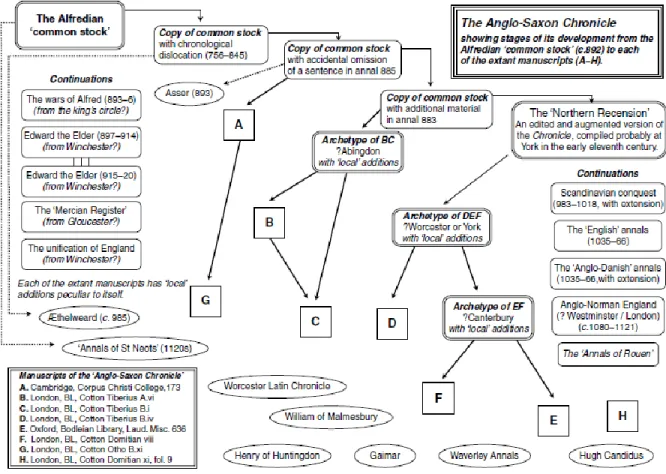
The continuation of The Chronicle in the 10th century features two major themes: the representation of the actions of Alfred’s offspring and the revision of West-Saxon focus.18 The additions that followed The Common Stock formed distinct sets of annals which were in turn employed for the compilation of other manuscripts (see figure 1.1 for a general overview).
Fig. 1.1: The Continuations, and Manuscripts which together form The Anglo-Saxon Chronicle.19
After the annal of 892, three discernable groups can be distinguished in MS A of which the first two were copied into MSS B and C. First, the annals of 893-896 mention construction of burhs [fortifications] and the erection of an Anglo-Saxon navy; both strategies made to thwart a roaming Viking army. Second, the death of Alfred the Great and a military campaign of Edward
18 Bredehoft, Textual Histories, 61-71.
19 Simon Keynes, “Manuscripts of the Anglo-Saxon Chronicle,” in The Cambridge History of the Book in Britain,
8
the Elder are illustrated in the annals of 897-914. The third set illustrates the subjugation of the Scots, Northumbrians and Strathclyde Welsh by King Edward from 915 to 920.20
In addition to the campaign of Edward the Elder, MSS B and C regale the accomplishments of Æthelflæd, lady of the Mercians, through a block of annals known as The Mercian Register. Herein, the actions and achievements of Æthelflæd are paralleled to those of her brother King Edward in a fashion which counteracts the ostensible West-Saxon bias in The Chronicle to some degree; e.g., The Mercian Register denotes how the Lady of the Mercians erected “burhs“ [buroughs] and fought against the Danes in a similar manner to that of King Edward.21
Some of the Anglo-Saxon Chronicle manuscripts deviate from the West-Saxon focus in The Common Stock and the deeds of Alfred and his offspring. In particular, a set of annals named The Northern Recension exhibits an augmentation of The Common Stock in which the focus on West-Saxon interests was removed or adapted by adding material concerning northern interests.22 This version was formed when, sometime in the 10th or early 11th century, a version of The Common Stock made its way up north where it was augmented by the supplementation of 8th-, later-9th and 10th-century northern annals from at least two sources. In this manuscript, the West-Saxon genealogies have largely made way for the genealogies of Hengist and Horsa and Æthelferth, king of Northumbria. The latter is a list of kings formulated by Bede which was set to verse in The Chronicle.23 Additionally, a preface was produced based on the Bedan description of the arrival of the Angles, Saxons and Jutes in England. In doing so, the focus on West-Saxon political interests was diminished. Furthermore, the annals concerning the reigns of 959 and 975 reflect on the reigns of King Edgar in a style commonly attributed to Archbishop Wulfstan. Consequently, Wulfstan is said to be one of the contributors of The Northern Recension. 24 Bredehoft argues that the Recension may have been an adaptation of The Common Stock rather than a revision; since much of West-Saxon material remained in this set of annals, e.g. The annal portraying the West-Saxon tale of Cynewulf and Cyneheard. Ultimately, The
20 Keynes, “Manuscripts of the Anglo-Saxon Chronicle,” 541. 21
Keynes, “Manuscripts of the Anglo-Saxon Chronicle,” 543.
22Ibid., 63.
23ASC, s.a. 593 (MS E).
9
Northern Recension offers material focusing less on Alfred’s offspring realizing a more neutral and national perspective.25
The half-century between the ascension of King Æthelstan and the assassination of King Edgar, 924 and 975 respectively, is scarcely covered by The Anglo-Saxon Chronicle. According to Simon Keynes, the events that took place were ill suited to be written down in annalistic form. Perhaps this is why this period was supplemented by poetic entries confirming the unification of England.26 For instance, in manuscripts A, B, C, and D, the beginning lines of the annal of 937 are portrayed as follows:
Her Æþelstan cyning, eorla dryhten, beorna beahgifa, 7 his broþor eac, Eadmund æþeling, ealdorlangne tir geslogon æt sæcce sweorda ecgum ymbe Brunnanburh.27
[Here King Æthelstan, lord of warriors, Ring-giver of men, and his brother also, Prince Edmund, struck life-long glory In strife with the edges of swords Round Brunanburh.]
Here, the alliterative lines present the battle of Brunanburh in accordance to Anglo-Saxon epic poetry. The same event is reported in a less embellished manner in manuscript E, exemplifying the great variety between the manuscripts of ASC after The Common Stock. In manuscript E, the battle is only mentioned in a single line: “Her Æðelstan cyning lædde fyrde to Brunanbyrig” [Here, King Æthelstan led an army to Brunanburh]. Despite their relative meagerness, the entries between 924 and 975 demonstrate the unification of England.28
As with the beginning of the mid-10th-century set of annals, the end of this block is supplemented by a poem in the annal of 975 in MSS A, B and C. However, in contrast to the
25
Bredehoft, Textual Histories, 67.
26 Keynes, “Manuscripts of The Anglo-Saxon Chronicle,” 543.
10
overall positive note of the preceding material, the concluding lines of the poem forebode a difficult time:
7 þa wearð ætywed uppe on roderum steorra on staðole, þone stiðferhþe, hæleð higegleawe, hatað wide cometa be naman, cræftgleawe men, wise soðboran. Wæs geond werðeode Waldendes wracu wide gefrege,
hungor ofer hrusan29
[And then appeared up in the heavens
A star in the firmament, which those of firm mind, Wise-minded heroes, widely call
By name of comet, knowledge-minded men, Wise truth-bearers. The Ruler’s revenge, Hunger over the earth, was known widely, Throughout the nation of men.]
Here, the closing lines of the poem culminate in foreshadowing the unrest of the subsequent reign of Edward the Martyr. Indeed, the annal of 978/979, in Manuscripts D, E and F goes on to share “nan wærsa dæd gedon þonne þeos wæs syððon hi ærest Brytonland gesohton.” [no worse deed was done than this since they first sought Britain]: the murder of King Edward I.
Named after Æthelred II, the Æthelredian annals follow the mid-10th-century lull of entries. The annals present a renewed onslaught by Viking raiding armies which extended into the early 11th century and ultimately led to a Danish Conquest. Commonly, the reign of Æthelred the Unready is regarded with criticism in post-Anglo-Saxon historiography. This perspective stems from the writings of William of Malmesbury which were based on his readings of The Chronicle. TheAnglo-Saxon Chronicle lists multiple acts of betrayal and grave leadership errors during the Viking invasions in the late 10th and early 11th century. However, it does not indicate any sign of blame directly pointed at King Æthelred. According to Courtnay Konshuh, the focus
11
of The Chronicle may lie on Æthelred’s advisors rather than the king himself.30 The Chronicle was utilized to highlight the treacherous deeds and erroneous decisions of his advisors which resulted in Æthelred’s pejorative moniker: the Unready.31
Since the Æthelredian annals were written during the reign of Cnut, the focus on treacherous behavior of noblemen in the Æthelredian annals may have been intended to support a politically driven motivation of the newly established Danish regime. Namely, by authenticating a chain of dire leadership in The Chronicle, the Danish conquest may have seemed inevitable. In other words, The Chronicle may have been used to instill the idea that the Viking invasion and consequential regime change was brought upon the English people due to corruption and incompetence. In addition, the annals may have served to quell disloyalty among Cnut’s own followers since treachery was met by severe punishment in the annals. Lastly, since Cnut himself followed in the footsteps of English kings and observed their way of rule, it was unwise for him to openly criticize the previous king since this could have undermined his own position as ruler of England.32
After the death of Cnut and up to the reign of Edward the Confessor, the more ardent entries are of a more local nature. Cnut appointed several noblemen to rule over large parts of England. Named after “jarls”, these earls vied against each other in the political arena of that period, as displayed in manuscripts C and E. The political struggle for power can be seen in the actions and events surrounding Earl Godwine that, differing per manuscript, were either depicted in an approving or critical bias. One such striking example of political bias can be found in the annals recording the murder of Æthelred II’s son: Ælfred Ætheling. According to MS C, the ætheling came to England with his companions in 1036 where he was met by Earl Godwine. In verse, the annal portrays how Ælfred was captured and his companions were cruelly marred or killed. Particularly, the line “Ne wearð dreorlicre dæd gedon on þison eared”33 [no crueler deed was performed on this earth] displays the disdain with which the conduct of Godwine was regarded. Moreover, this phrase is reminiscent to the description of the regicide of King Edward I. Manuscript D also presents the murder of Ælfred; however, it does not name Godwine
30 Courtnay Konshuh, “Anraed in their Unraed: The Æthelredian Annals (983-1016) and their Presentation of King
and Advisors,” in English Studies 97:2 (2016): 158.
31
The pejorative moniker of Æthelred II is formed by the negative element “un-” and the element “ræd” [counsel] thus indicating that he was ill-advised.
12
explicitly in the lines preceding the poem. In contrast, Manuscript E remains silent on the murder of the ætheling thus illustrating a pro-Godwine attitude.
The Norman Conquest did not end the practice of annalistic writing. The Chronicle provides a major insight into the reigns of William the Conqueror, William Rufus and Henry I. The local quality of the period preceding the Norman Conquest gave way to a more royally centered focus as the schedule of the king and engagements are listed thoroughly. Most likely, the annals were formed close to the royal center; strikingly, one of the annals mentions that the chronicler himself attended the court of William I. The final entries of The Chronicle can be found in MS E where the actions and deeds of Stephen I were added retrospectively in a single stint.34
Circulation and tradition
Currently, two theorems are prominent regarding the distribution of the additions to The Common Stock in The Anglo-Saxon Chronicle: either as a product of central dissemination or as several individual compilations. Charles Plummer suggests that the manuscripts find their basis in a 9th proto-manuscript but go their separate ways afterwards. In this regard, the manuscripts are distinct to each other and shared material was conflated from other copies of The Chronicle; which came together at some point in time. In contrast to the idea of separately kept up manuscripts, Nicholas Brooks proposes that the compilation of The Chronicle may have originated from a royal center and additions may have concurrently made their way into the various manuscripts from this single central source. If so, the disseminated contents may have been compiled at the royal abbey of New Minster in Winchester. In turn, the royally approved and produced contents of The Chronicle would then have been subsequently adapted into the various manuscripts at several monastic locations across Anglo-Saxon England.35
Whether or not the contents of The Chronicle stem from a single central source or several distinct sources, The Anglo-Saxon Chronicle invokes a sense of continuity and cohesion. Part of this steadiness stems from the use of formulaic phrases. Prime examples are “on ϸissum geare” [In this year] or “Her” [here/at this point]36 which are frequently found at the beginning of an
13
annal. By using formulaic phrases, an author could impose a sense of familiarity and connection on the chronicle’s audience. For example: “feng to rice” [received the kingdom] was the standard formula to state that a ruler had become king of England; which indicated that the throne was rightfully succeeded. The opposite was also the case; if a scribe refrained from utilizing the standard formulaic phrase, it could induce a degree of distance.37 For example, after mentioning the death of King Cnut, MSS C and D state that Harold Harefoot became king after being “geceas” or “gecuron” [chosen] in the annal of 1037.38
This particular phrase could be interpreted as the scribe’s wish to impart the reader with the notion that Harold came to be king in an unsubstantiated manner. Contrastively, the author of manuscript D chose to adhere to the standard formulation “feng to rice”39 when first mentioning Harold’s succession in the annal of 1035. Manuscript E remains silent on the matter regarding the process in which Harold became king but states: “he wæs ϸæh full cyng ofer eall Englaland” [he was nevertheless full king over all England]40. Similarly, as shown earlier, the use of “ne wearð dreorlicre dæd”, the murder of Ælfred Ætheling, may have been imparted to a reader in order to remind him of another “nan wærsa dæd”, the murder of King Edgar I. In short, the traditions and formulaic phrases discernable in the ASC can impart a sense of approval or disapproval if used or even avoided in specific contexts.
The extant manuscripts
The longest surviving version of The Anglo-Saxon Chronicle is named The Winchester
Manuscript ([A] Cambridge, Corpus Christi College MS 173, ff. Iv-32r) and was written at Old Minster, Winchester. The first lines portray the genealogy of King Alfred after which the scribe copied the annals up to 891 from an unknown proto-version of The Chronicle. In the 10th
century, the annals were written in several stints by several hands. Following four poems in Old English verse,41 MS A diverges from the other manuscripts after 975 with the exception of the description of a Danish raid in 1001. In the early 11th century, the Winchester Manuscript was moved to Canterbury, possibly after the Viking occupation of Canterbury in 1011. There, the
37 Stodnick, “Sentence to Story,” 93-95, 97-98, 111. 38
ASC, s.a. 1037 (MS C and MS D).
39ASC, s.a. 1035 (MS D). 40ASC, s.a. 1035 (MS E).
14
contents were updated by scarcely sizeable entries. The annal of 1070 marks the final vernacular entry. Latin annals form the final contents which convey matters of the church up to 1093 and a list of popes and archbishops from Canterbury who received the pallium.42
Before the Winchester Manuscript was moved to Canterbury, a copy named MS A2 ([A2] British Library MS Cotton Otho B.xi, 2) was compiled; this copy is also known as Manuscript G. Unfortunately, during the devastating fire which roamed through the Cotton Library in 1731, the manuscript was destroyed. Luckily, the contents of this manuscript have survived in the form of a 16th-century transcription.43
The Abingdon Manuscripts ([B] British Library MSS Cotton Tiberius A.iii, f. 178 + A.vi, ff. I-34; [C] British Library MS Cotton Tiberius B.i, ff. 115v-64) are said to be closely related to the Abingdon monastery. Most likely, MS B originates from the late 10th century. As with MS A, this variant of The Chronicle begins with a genealogical account of West-Saxon kings. Unlike MS A, the record was extended to include Edward the Martyr. After recording the death of King Edward I, the annals come to a conclusion in 977. Afterwards, manuscript B was sent to Christ Church in Canterbury where it received several interpolations and corrections.44
The compilation of Manuscript C is closely related to that of Manuscript B. Therefore, it is often said that manuscript C was formed at Abingdon during the mid-11th-century. However, Stephen Baxter has proposed that MS C may have been compiled at Evesham or perhaps even in the household of Earl Leofric; which would explain some of the content discrediting the standing of the earl’s rival: Earl Godwin.45 Unlike the other manuscripts, MS C begins with an Old English translation of Orosius’ Historium Adversum Paganos, a calendar and several maxims in verse. Afterwards, an author wrote the annals of 60 BC up to 490 AD. Subsequently, another scribe took over and transcribed the entries up to 1048. Most notably of these are the annals of 491 to 652 as they are identical to those in MS B. After 652, a scribe compiled material based on another source. Based on the events and actions surrounding Queen Æthelflæd, Lady of the Mercians, this scribe included the entries known as The Mercian Register. Subsequently, MS C portrays the reigns from King Athelstan to King Edgar. Ultimately, the final author of MS C
42 Swanton, The Anglo-Saxon Chronicles, xxi-xxii. 43
Ibid., xxiii.
44Ibid., xxiii-xxiv.
15
continued to write annals up to 1066.46 Unfortunately, the last leaf of the manuscript is absent and the annal of 1066 ends mid-sentence.47
The Worcester Manuscript ([D] British Library MS Cotton Tiberius Biv, ff. 3-86) was most likely compiled circa the mid-11th century. Based on ostensible local interest of various annals, this manuscript was probably formed in Worcester. Paleographical evidence exhibits that five scribes worked on the annals up to 1054. Subsequently, a singular hand continued to write entries over several intervals.48 It is Manuscript D which presents the fullest account of the events that took place in 1066.49 Unlike the Winchester and Abingdon variants, this Northern manuscript did not follow the West-Saxon format (i.e. it did not begin with a West-Saxon regal genealogy). Instead, the text was based on The Northern Recension. It features an adaptation of Bede’s Historia Ecclesiastica Gentis Anglorum and material from 8th-century Northumbrian entries. Similarly to MS C, the Worcester Manuscript features material from The Mercian Register. However, rather than copying the annals completely, the scribes adapted the annals to which end some of the annals of TheRegister were omitted and content was entered doubly.50
The E version of The Chronicle is commonly known as The Peterborough Chronicle ([E] Oxford, Bodleian Library MS Laud 636). After an unfortunate fire in the Peterborough Abbey in 1116 AD, the East-midland clergy took it upon themselves to compile a replacement for the version of The Chronicle which was lost in the fire. The basis of MS E was a version of The Common Stock which was not extended as far as those found in MSS A, B and C. In addition, The Northern Recension was incorporated. The annals in this manuscript range the furthest of all The Chronicle manuscripts; up to 1154 AD. Two different handwritings can be discerned. The first scribe copied annals up to the end of 1121 AD. In addition to merely copying the preceding annals from another source, this scribe added several interpolations concerning matters of importance to the Peterborough Abbey. Afterwards, the contents between 1121 and 1131 were most likely written near contemporaneously in six stints by the same scribe. This portion of the manuscript is known as The First Continuation and closely follows the Anglo-Saxon traditional writing as seen throughout The Anglo-Saxon Chronicle. Finally, the second scribe wrote the final contents up to 1154 in one session. This Final Continuation shows a deteriorating inclination to
46 Swanton, The Anglo-Saxon Chronicle,xxiii-xxiv. 47
Keynes, “Manuscripts of The Anglo-Saxon Chronicle,” 547. 48 Swanton, The Anglo-Saxon Chronicle, xxv.
16
observe traditional chronicle writing. The language of The Peterborough Chronicle differs slightly from that of its extant counterparts since they mark the beginnings of a language shift from a synthetic to an analytical form. Indeed, the change in manner of compilation leads Plummer to describe this version of The Chronicle as “living”.51
The Canterbury Bi-Lingual Epitome ([F] British Library MS Cotton Domitian Aviii, ff. 30-70) is a bilingual version of The Chronicle. After the Conquest of 1066 AD, Canterbury produced bi-lingual documents written in Anglo-Saxon English and Latin. Around 1100 AD, MS F was written in this fashion at Christ Church, Canterbury; perhaps by one of the scribes who added notes to MS A. Similarly to the Worcester Manuscript, this version of The Chronicle is prefaced by Bede’s Historia Ecclesiastica Gentis Anglorum. The annals were first written in Old English before a corresponding Latin equivalent was added.52
Lastly, the single leaf fragment containing ecclesiastical assignments and the itinerary of the king is named Manuscript H (British Library MS Cotton Domitian ix, f.9). The folio illustrates the final part of the annal for 1113 and the majority from an annal of 1114. It remains unclear if this page was formerly part of a larger manuscript or if it was meant as a communique meant to transfer general information.53
The language of The Anglo-Saxon Chronicle
The periods during which the contents were added to a manuscript demonstrate the manner in which the language changed over time. A prime example can be found in MS A. Herein, Early Saxon dialect is prominently featured in the early annals up to 920 after which Late West-Saxon dialect becomes more ostensible. In contrast to the Late West-West-Saxon dialect inclination for <a> and <ie> spellings, the early annals of MS A demonstrate a preference for <o> and <y> spellings:
MS A 519: Her Cerdic & Cynric Westsexena rice onfengun & þy ilcan geare hie fuhton wiþ Brettas þær mon nu nemneþ Cerdicesford.
51
Malasree Home, “The Peterborough Chronicle in Context,” in The Language of the Peterborough Chronicle, eds.
Alexander Bergs and Janne Skaffari (Bern: Peter Lang, 2007), 13-28.
52 Swanton, The Anglo-Saxon Chronicle, xxvii-xxviii.
17
MS A 1001: & hiom man raþe þas wið þingode, & hy namon frið.
519 [Here, Cerdic and Cynric received the West-Saxon kingdom and that same year they fought with the Britons in the place that men now call Cerdic’s Ford.]
1001 [and men quickly settled that with them, and they made peace.]
For instance, as seen in the annal of 519, “mon” was the preferred Early West-Saxon spelling whereas in the Late West-Saxon dialect, as seen in the annal of 1001, “man” became the standard spelling. Furthermore, as a result of the monophthongization of diphthongs, spelling conventions altered due to diachronic language change in the manuscripts. For instance, the annal of 519 depicts the third person plural accusative pronoun “hie” with the diphthong “ie”. In contrast, the annal of 1001 exhibits “hy” with the monophthong “y”. Strikingly, variation is visible in the Early West-Saxon annals. For instance the annal of 449 in MS A reads: “Se cing het hi feohtan agien Pihtas” [The king commanded they fight against the Picts.] In which the third person plural accusative pronoun “hi” is spelt with the monophthong “i”. The application of “hie” and “hi” demonstrates that both spellings were employed interchangeably in the early annals thus suggesting that monophthongization was occurring or had recently occurred in the respective dialect of the author of these annals. Ultimately, after 920, the diphthong “ie” was replaced by “y” thus representing rounding and monophthongization of words such as “wyrϸ”, “Myrcna”, “syx” and “yrfe”.54
Differences in dialect can be seen across the separate variants of The Anglo-Saxon Chronicle. Most of the manuscripts adhere to Late West-Saxon spelling conventions. However, at times a regional dialect is ostensible. For instance, Anglian smoothing (i.e. Monophthongization) before back vowels can be found in MS D and E. As can be seen in the comparison of the following iterations of the annal of 710 in MSS A, B, D and E:
MS A: Her Beorhtfriþ ealdormon feaht wiþ Peohtas
MS B: Her Byrhtferð ealdormann feaht wið Peohtas
MS D: 7 þam ylcan geare feaht Beorhtfrið ealdorman wið Pehtas
MS E: 7 þam ilcan geare feoht Beorhtfrið ealdorman wið Pyhtas
54 Janet Bately, MS. A: A Semi-Diplomatic Edition, with Introduction and Indices, vol. 3, The Anglo-Saxon
18
MSS A, B: [Here, Nobleman Berthfrith fought against thePicts]
MSS D, E: [and in the same year Nobleman Berthfrith fought against thePicts]
In these annals, the late West-Saxon dialect is ostensible in MSS A and B since the diphthong “eo” is used before a back consonant in “Peohtas”. In contrast, Anglian smoothing is ostensible
in MSS D and E since the monophthongs “e” or “y” were used before the back consonant in “Pehtas/Pyhtas”.55
Ultimately, The Anglo-Saxon Chronicle is an intricate, rich, interwoven nucleus of manuscripts which together form the brunt of Anglo-Saxon historiography. A modern reader would be wise to keep in mind the many facets which have affected the compilation of The Chronicle. Unquestionably, its contents are a prime example of Anglo-Saxon identity and the Old English language.
55
19
CHAPTER 2: FROM SYNTHETIC TO AN(N)ALYTIC
Old English is a synthetic language, and as such relies on inflections. Over the course of its history, the Anglo-Saxon language developed into a language which relied predominantly on analytic measures rather than case-endings. This chapter aims to explain the manifold changes Old English went through which have led to the dereliction of the majority of inflections. In doing so, this chapter establishes the linguistic context through which the gradual loss of the dative inflection in The Peterborough Chronicle can be discerned.
Old English: from synthetic to analytic
Old English belongs to the Germanic language branch which in turn belongs to the Indo-European language family. Similarities between languages, detected as early as the 12th century, have proven that many of the languages spoken throughout Europe hail from a single ancestral language.56 Through the Comparative Method, comparing material least prone to change (e.g., terms conveying kinship) among the similar languages, the notion of an archetypical language family became apparent: Indo-European.57 Unfortunately, no records of this common language are extant. However, the phonology and morphology of Indo-European have been carefully reconstructed. Shared features between Indo-European languages indicate that, in addition to lexical and phonological similarities, the languages were marked by an inflectional system with comparable morphology and grammatical categories. Generally, Proto (i.e. reconstructed since no written records are available) Indo-European words consisted of a root, a suffix,58 and typically an inflection.59 Words in the English language continue to feature this construction.60 For instance, the word “builders” consists of the root “build”, the suffix “-er-” and the inflection “-s”.
56
Helmut Gneuss, “The Old English Language,” in The Cambridge Companion to Old English Literature, eds.
Malcolm Godden and Michael Lapidge, 2nd ed. (Oxford: Oxford University Press, 2008), 20.
57 Elly van Gelderen, A History of the English Language (Amsterdam: John Benjamins, 2006), 38. 58
In case of Indo-European languages, the suffix also carries a thematic element indicating the class of a word.
59 Gneuss, “The Old English Language,” 26.
60 Robert Beekes, Comparative Indo-European Linguistics: An Introduction, 2nd ed. (Amsterdam: John Benjamins,
20
The Proto Indo-European language branched out into various languages, amongst which the Germanic languages. These languages, in turn, formed their own innovations thus making them distinct from one to another.61 One such innovation was the propensity shared by all the Germanic languages to stress the initial syllable of a word. As such, the emphasis on the final syllable was diminished. Therefore, since inflections were uttered in final position, the once rigid expression of case-endings gradually became less defined.62 For instance, the Proto Germanic dative plural “*dagumiz” [to the days] consists of three components: the root “dag”, the suffix “-u-” and the inflection “-miz”. By the Anglo-Saxon period, the latter two components converged and formed the mono-syllabic dative plural inflectional ending “-um”.63 The initial stress on words initiated the shift towards analytical methods to relate the function of words in a sentence. Consequently, in the transition from Proto Germanic to Old English, the Anglo-Saxons’ language was no longer able to definitively and solely mark the grammatical function of a word through inflections. For instance, the “-e” or “-an” ending is featured in multiple declensions and
marked a variety of functions.64
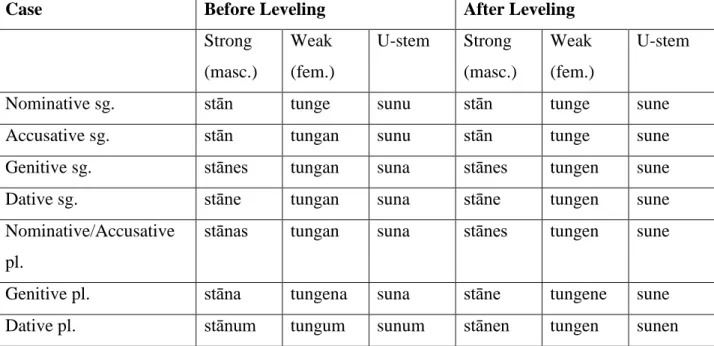
As a result of the lack of emphasis on the final syllable, inflections became less distinctive from one to another. Consequently, the vocalic vowels in inflections became increasingly less pronounced and moved towards the weakened indeterminate vowel <ǝ>. This process of ‘leveling’ can be generalized as the following: <e, o, a> came to be written as “-e-” (e.g. EME “stane” < OE “stana”), <u> as “-u-, -e-” (e.g. EME “sune” < OE “sunu”), <a> as “-a-,
-o-, -e-” (e.g. EME “tungon/tungan/tungen” < OE tungan) (see table 2.1).65
61 Gneuss, “The Old English Language,” 20.
62 Terry Hoad, “Preliminaries: Before English,” in The Oxford History of English, ed. Lynda Mugglestone (Oxford:
Oxford University Press, 2008), 20.
63 Herbert Schendl, Historical Linguistics, ed. Henry Widdowson (Oxford: Oxford University Press, 2015), 36. 64 Gneuss, “The Old English Language,” 25.
21
Case Before Leveling After Leveling
Strong (masc.)
Weak (fem.)
U-stem Strong (masc.)
Weak (fem.)
U-stem
Nominative sg. stān tunge sunu stān tunge sune
Accusative sg. stān tungan sunu stān tunge sune
Genitive sg. stānes tungan suna stānes tungen sune
Dative sg. stāne tungan suna stāne tungen sune
Nominative/Accusative pl.
stānas tungan suna stānes tungen sune
Genitive pl. stāna tungena suna stāne tungene sune Dative pl. stānum tungum sunum stānen tungen sunen Table 2.1: inflection before and after leveling took place on “stan-”, “tung-” and “sun-”.
Furthermore, this process meant that the dative “-um” ending shifted to “-an” and eventually to “-e”. For instance, Wulfstan’s Sermo Lupi ad Anglos (written in near contemporaneous manner around 1014) illustrates a multitude of dative plurals alternating between “-um” and “-an”.66 By the time The Peterborough Chronicle was written, the “-n” was dropped and dative plurals were signaled via the “-e” ending and consequently became indistinct to the majority of OE declensions. Overall, the “-e” inflection, originally featured in the nominal singular dative and
singular feminine genitive, was extended to the nominative and accusative. Hence, the once manifold distinct inflections dwindled to the single indistinct inflection “-e” as the number of cases inflected by this inflectionincreased from two to four.67
The loss of inflection is also evident in the various manuscripts of The Anglo-Saxon Chronicle. MS A demonstrates this loss of inflection in the plural dative iterations of the word “scip” [ship]: “Her on ðissum geare com Unlaf mid þrim & hund nigontigon scipum to Stane” [Here, in this year, came Unlaf with three hundred ninety ships to Stone].68 Here, the plural dative “scipum” features the standard dative plural inflection “-um”. In the subsequent annal of
66
Roger Lass, Old English: A Historical Linguistic Companion (Cambridge: Cambridge University Press, 1994),
245,250-251.
22
1001, the following iteration of “scip” can be found: “& him þær togeanes com Pallig mid þan
scipan ðe he gegaderian mihte” [and there Pallig came to meet them with those ships that he
could gather].69 Here the “-an” ending on “scip” is featured, thus verifying the leveling of “-u” towards the intermediate vowel “-e” and the alteration of “-m” to “-n”. Ultimately, the
interpolated annal in MS E of 1070 displays dative plural “scipe” in the following sentence: “Þa sona on morgen comen ealle þa utlaga mid fela scipe” [Then soon in the morning, all the outlaws
came with many ships].70 Herein, “scipe” features the originally dative singular inflection “-e” where the context clearly demonstrates a plural situation which in the Late West-Saxon dialect would have elicited the “-um” inflection. Ultimately, as seen in the previous examples, the use of case-endings to convey grammatical functions became unreliable by themselves since the uniform “-e” was no longer distinctive to a specific case.71
Eventually, since applying case endings became increasingly obsolete, Middle English came to rely on word-order, prepositions, auxiliaries and articles to determine the grammatical function of a word.72
Due to the loss of various inflections, word-order became a helpful device to signal the grammatical function of a noun. Specific word-order patterns appear to have been in place in Old English.73 Common word-orders found in Old English are: Subject-Verb, Verb-Subject and Subject […] Verb. The Subject-Verb variant can be seen as the ancestor of the Modern English
Subject-Verb-Object construction and is indeed the most common construction even during the Anglo-Saxon period.74 Since Old English sentences predominantly demonstrate SVO word-order, the grammatical function of an object could be inferred from the position it held in a sentence. Ultimately, the second position object in independent clauses with multiple noun phrases unmarked by inflection (as was potentially the case in the transition from Old English to Middle English) became a helpful tool in establishing grammatical functionality.75
Geopolitical events, over the course of the Anglo-Saxon period, may also have played a role in the eventual transition to an analytical preference. The Anglo-Saxon contact with Old Norse during the Viking Age ranks as one of the most influential linguistic contacts in the history of Old English. Scandinavian toponyms in Cumbria, Yorkshire and Lincolnshire demonstrate
69
ASC, s.a. 1001 (MS A).
70ASC, s.a. 1070 (MS E).
71 Baugh and Cable, “Middle English,” 146, 55. 72
Elly van Gelderen, A History of the English Language (Oxford: Oxford University Press), 60.
73Ibid., 31.
23
that a large number of Vikings settled in England. These settlers employed Old Norse possibly up to the twelfth century in parts of North-England. Simple contact was possible between the two groups as the Anglo-Saxon and Norse languages are similar. Old Norse shares a variety of phonological and morphological linguistic traits with of Old English. This is understandable as both languages hail from the Germanic languages. Particularly the West-Germanic Anglian dialect is said to be closely related to that of North-Germanic Old Norse. As a result of their similarities, the linguistic convergence that took place may have been facilitated without many issues. In fact, it can be said that the linguistic convergence was not a product of language contact but rather “dialect contact”.76
From a morphological perspective, Norse speakers have probably introduced their ways of constructing language to Anglo-Saxons as they came to speak Old English. This process led to the transmission of a number of Norse originating morphological practices. For example, Middle English demonstrates the use of “-laic/lec” in abstract nouns; based on ON “-leikr” (e.g. ME “godlec”).
Inflectional influences due to language contact with Old Norse are difficult to pinpoint or even to acknowledge as the Anglo-Saxons’ language was already shifting towards analytical tendencies. For instance, the adoption of 3rd person singular “-s” in indicative verbs could have been adopted from Old Norse in order to accommodate language interaction. However, this potential adaptation could also have been an extension of the 2nd person singular OE “-s”. Regardless, the usage of 3rd person singular “-s” was first attested in the North of England and subsequently made its way South. In similar fashion, the reduction in case agreement and the decline of grammatical gender could be, though not reliably nor fully, ascribed to language contact with Old Norse.77 All in all, as Norman Blake states, language contact between the Anglo-Saxons and Scandinavians “may well have encouraged speakers to replace inflections with a different system”.78
76
Richard Dance, “English Contact: Norse,” in Old English, vol. 2, The History of English, eds. Laurel Brinton and Alexander Bergs (Berlin: De Gruyter, 2017), 203-207.
77Ibid., “English Contact: Norse,” 215-216.
24
The Peterborough Chronicle: towards the analytic in annals
The transition from the use of inflections to analytical methods can only be seen in a few sources since most of the texts written in the aftermath of the Norman Conquest were not written in Old English. Fortunately, a vernacular version of The Chronicle was compiled in 1121: The Peterborough Chronicle. The contents of MS E exhibit both the characteristics of Late West-Saxon Old English and those of (Early) Middle English. Hence, The Peterborough Chronicle is a prime example for the transition from Old English to Middle English.79
Commonly, the manuscript is divided into four parts: (1) copied annals until 1121, (2) inserted entries; i.e. The Interpolations, (3) the annals from 1122 to 1131; i.e. The First Continuation and (4) the annals from 1132 to 1154; i.e. The Final Continuation. The copied annals were duplicated by a single scribe and mostly exhibit language use as practiced in the Late West-Saxon dialect. The same scribe added The Interpolations and The First Continuation. These additions are more prone to show contemporary practices and are therefore generally considered Early Middle English. The Final Continuation was written by another scribe and predominantly exhibits characteristics indicative to the inception of Middle English.80
Based on an earlier version of The Chronicle, the first scribe copied annals from an exemplar: Proto-E. The archetypical text provided annals up to 1121 AD which were copied into MS E. These annals illustrate a close resemblance to the Late West-Saxon dialect. In addition, the scribe inserted The Interpolations featuring material that was dedicated to the Peterborough Abbey. The Interpolations feature material from charters in annalistic form and, therefore, demonstrate the willingness to conform to the traditional format of The Chronicle . Despite the scribe’s display of careful deliberation and consideration in regards to emulating Late West-Saxon, The Interpolations display signs indicative to the transition from Old English to Middle English.81 For instance, see the interpolated entry of 963:
79 Alexander Bergs and Janne Skaffari, “Invitation to the Peterborough Chronicle and its Language,” in The Language of the Peterborough Chronicle, vol. 20, Studies in English Medieval Language and Literature (Bern: Peter Lang, 2007), 5.
80Ibid., 9-10; Malasree Home, “The Peterborough Chronicle in Context” in The Language of The Peterborough Chronicle, eds. Bergs and Skaffari (Bern: Peter Lang, 2007), 15-23.
25 7 hu se papa Agatho hit feostnode mid his write
And ic gife þa twa dæl of Witlesmere mid watres 7 mid wæres 7 feonnes 7 swa þurh Merelade on an to þet wæter þet man cleopeð Nen 7 swa eastweard to Cynges Dælf.82
[And how the pope Agatho confirmed it with his writ]
[And I give two parts of Whittlesey Mere with waters and with weirs and fens and so through Merelad on to the water that they name Nen and so Eastward to King’s Delph.]
In this annal, “mid his write” [with his writ] is inflected with the dative singular ending “-e”. However, in the same annal, the “-es” ending is used in “mid watres 7 mid wæres 7 feonnes” [with waters and with weirs and fens] instead of the Late West-Saxon dative plural “-um” inflection. Both instances would have warranted a dative inflection in Late West-Saxon dialect in order to mark the dative declension; yet case distinction was no longer made apparent via inflection in the latter example.
After 1121 AD, the same scribe continued to update the manuscripts and formed The First Continuation in six stints in near contemporaneous fashion. In this block, the language resembles that of Old English less than before since unstressed vowels in final syllables demonstrate ongoing analogical leveling.83 For instance, “7 se wolcne undide on fower healfe
and faht þær togeanes” [and the sky cleared on four sides and fought against it] shows the noun “healfe” [sides] inflected with the “-e” ending.84
In Late West-Saxon, the plural feminine dative “healf-” would have received the plural dative “-um” ending yet the annal shows “healfe” rather than “healfum”, thus demonstrating inflectional leveling indicative of the contemporary dialect
of the scribe.
Twenty years after the first scribe wrote his final entry, c. 1154/55, a different scribe resumed the practice of chronicling and compiled The Final Continuation in a single stretch. Rather than following the traditional ordering of annals seen in The Chronicle, this block demonstrates a topical preference rather than a chronological one; consequently, illuminating the second scribe’s unfamiliarity or lack of concern regarding the traditions of the Chronicle.
82ASC, s.a. 963 (MS E).
26
Similarly, The Final Continuation stands apart from the other sections due to its increasing lack of synthetic markers.85 For instance, see the following sentence from the annal of 1138: “On þis
gær com Dauid king of Scotlande mid ormetefærd to þis land.” [In this year, came David king of Scotland with a great army to this land]. In this entry, the initial verb placement demonstrates a stage in the English language where independent clauses lacked a clear standardized word-order; as it deviates from standard SVO word-order. Furthermore, the lack of inflections demonstrates the transitional aspect which is indicative to this period. In Late West-Saxon, “on ϸis gær” [in this year], “mid ormete færd” [with a great army], and “to ϸis land” [to this land] would have featured the dative singular “-e” ending; yet no inflections were utilized here. Indeed, as Cecily Clark remarks: “before our eyes English is beginning to change from a synthetic language to an analytic one”.86
85Ibid., 20, 22.
27
CHAPTER 3: WHAT IS YOUR DATIVE AND WHAT DOES IT
DO?
In the Germanic languages, the dative is an amalgam of several archaic cases: the dative, the locative, the ablative and the instrumental. As a result, the dative fulfilled a variety of functions. Specifically, the dative came to govern the grammatical functions of experiencer and receiver and other functions such as marking location in/on/at (i.e. point of reference), movement to/from (i.e. goal and source, respectively), instrument and cause.87 This chapter reviews the various functions of the dative declension in order to form a framework upon which the analyses of The Peterborough Chronicle in the next chapter can be based. Since morphological marking was gradually being replaced by other means, the semantic contexts which invoke the dative are of importance to determine where inflections deviate from that of Late-West-Saxon in The Peterborough Chronicle. Consequently, after mapping the various semantic contexts congruent to the dative, analyses can be performed with regard to the distribution of dative inflections. For instance, it may be that the instrumental function of the dative may have been more readily inflected than that of the locative.
Locative origins & the instrumental
According to Jerzy Kuryłowicz, each Indo-European case performed a primary and secondary function. The primary functions relate the grammatical function from which, as a logical development, the secondary functions were derived. For instance, marking the direct object is the primary function of the accusative case from which the secondary function ‘completion of a goal’ was derived; as a result, movement towards a goal became central to the accusative case and, as such, movements into or across an area came to be expressed via the accusative. Similarly to the secondary development found in the accusative regarding ‘completion of a goal’,
the dative case may have been a result of a secondary development from the Indo-European
87 Roger Lass, Old English: A Historical Linguistic Companion (Cambridge: Cambridge University Press, 1998),
28
locative case. Originally, the locative case was used to denote location. Over the course of the Germanic Period, wherever the locative object indicated a person, the dative declension came to be applied.88 Consequently, the dative ‘proper’ refers to a person who is influenced by the outcome of an occurrence or act. Visser stated that dative objects denote “persons or things towards whom or which the action expressed by the verb is directed in such a way that they may be regarded as a kind of recipient”. In other words, the core function of the dative concerns the prototypical construction of the indirect object. In this light, the object denotes a thing or person who is the target of an action that is: “advantageous, serviceable, profitable, harmful or injurious”.89
This semantic description is directly paralleled by the Modern English definition of the indirect object by Langacker: “an active experiencer in the target domain”.90
In a similar vein, van Kemenade notes that the dative case is linked to thematic roles of experiencer and goal.91 In short, the original function of the dative may have started as a secondary locative development which came to focus on persons and eventually formed its own inflectional paradigm.
For the most part, the locative case was lost and assimilated into the dative during the Proto-Germanic period.92 This assimilation is particularly clear from the following example. A phrase of the runic inscription on the Ruthwell Cross reads: “Krist wæs on rodi” [Christ was on the cross] wherein “rodi” [cross] features the locative ‘-i’ inflection. The corresponding passage
in The Dream of the Rood: “Crist wæs on rode” demonstrates the close relation between the locative and dative cases as the dative ‘-e’ replaced the locative inflection from “rodi” to “rode”.
Whereas the Ruthwell Cross and its corresponding passage in The Dream of the Rood clearly demonstrates the replacement of the locative by the dative, one persistent locative case inflection can be found throughout the Anglo-Saxon Corpus: the endingless locative declension in various
88 Lass, Old English,232-233, 237.
89 Fredericus Visser, Syntactical Units with One Verb, vol. 2, An Historical Syntax of the English Language(Leiden:
Brill, 1963), 280.
90
Ronald Langacker, Foundation of Cognitive Grammar: Descriptive Application, vol.2 (Stanford: Stanford University Press, 1991), 327.
91 Ans van Kemenade, Syntactic Case and Morphological Case in the History of English, (Berlin: Mouton de
Gruyter, 1987), 79-82.
92 Adam Pasicki, “Meanings of the dative case in Old English” in The Dative, eds. Willy van Langendonck and
William van Bellevol.2, Theoretical and Contrastive Studies (Amsterdam:John Benjamins Publishing Co., 1998),
29
toponymical elements. For instance, “-ham”, and “-burh” rarely feature inflection. By contrast, other toponymical elements such as “-ceaster” or “tun” are regularly inflected via the dative.93
In addition to the locative aspect of the dative, the dative encompasses an independent and not fully established facet: the instrumental aspect which denotes instrument, manner or means. In Proto-Germanic, the instrumental was an independent case. However, during the Anglo-Saxon period the instrumental had largely fallen together with the dative in regards to its morphology; to such a degree where nominal inflections no longer provided a clear distinction between the two. Consequently, the semantic contexts in which the instrumental was originally used may have become blurred to an Anglo-Saxon speaker which resulted in the assimilation of instrumental functionality into the dative.94 Indeed, many constructions featuring the prepositions “mid” [with] and “fram” express manner, means or instrument via the dative declension. A
prepositionless example can be found in the annal covering the battle at Brunanburh; the phrase “sweorda ecggum” [with edges of swords] exemplifies the instrument by which Æthelstan and his brother Prince Edmund “ealdorlangne tir geslogon” [struck eternal glory]. Here, “ecggum” features the plural dative ‘-um’ inflection. Ultimately, since no locative reading is ostensible, it
can be said that the instrumental is an independent sub-system of the dative.95
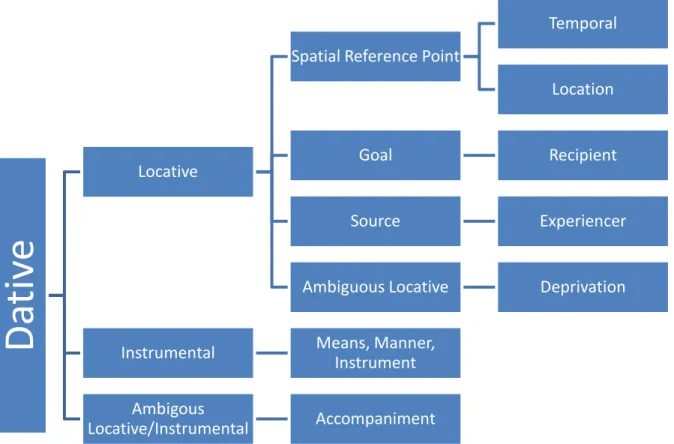
To sum up thus far, the secondary locative functionality formed its own declension: the dative; which originally marked thematic roles of experiencer and recipient. Subsequently, the dative functionality was extended as the locative and instrumental cases were subsumed into the dative. Ultimately, the semantic contexts which previously invoked instrumental and locative inflections came to be expressed via the dative (see fig 3.1).96 As such, a variety of dative semantic contexts are discussed below; namely, frameworks related to goal, source, reference point, deprivation, means, manner, instrument and accompaniment.
93
Alistair Campbell, Old English Grammar (Oxford:Clarendon Press, 1959), §572.
94 Pasicki, “Meanings of the dative case in Old English,” 114-15, 136-37, 139. 95Ibid., 136-137.