AUSTRALIAN JOURNAL OF BASIC AND
APPLIED SCIENCES
ISSN:1991-8178 EISSN: 2309-8414 Journal home page: www.ajbasweb.com
Open Access Journal
Published BY AENSI Publication
© 2016 AENSI Publisher All rights reserved
This work is licensed under the Creative Commons Attribution International License (CC BY). http://creativecommons.org/licenses/by/4.0/
To Cite This Article: Jeya Ramya V., Saranya S. and Gurupandi D.., Ship Detection from Satellite Images Using Support Vector Machine.
Aust. J. Basic & Appl. Sci., 10(1): 243-247, 2016
Ship Detection from Satellite Images Using Support Vector Machine
1Jeya Ramya V., 2Saranya S. and 3Gurupandi D.
1Asst.prof Panimlar institute of Technology 2Asst.prof Panimlar institute of Technology 3Asst.prof Panimlar institute of Technology
Address For Correspondence:
Jeya Ramya V., Asst.prof Panimlar institute of Technology. E-mail: [email protected]
A R T I C L E I N F O A B S T R A C T
Article history:
Received 10 December 2015 Accepted 28 January 2016 Available online 10 February 2016
Keywords:
Compressed domain, wavelet domain, Support Vector machine(SVM), classifier,JPEG 2000 ship detection.
Ship detection from satellite images is more important for the security of oceanic areas , identification of illegal oil spills , monitoring maritime traffic in the fisheries and the commercial transportation sector. However the earlier techniques for ship detection has drawbacks such as it is difficult to track the ship under worst weather conditions, clouds,high ocean waves and mist. In this paper , the ship detection from satellite images is analyzed with different scaling and illumination condition using compressed domain and wavelet domain with support vector machine (SVM) provides an efficient way to detect the ship. Furthermore, the SVM classifier used in this method offers an accurate result in the detection of the ship. Experiment shows that proposed algorithm achieves high probability of correct detection as well as the time consumption for detecting the ship is less (processing time).
INTRODUCTION
Ship detection from satellite imagery is very important, with a wide array of applications in areas such as fishery management, vessel traffic services. It is useful in the identification of the illegal oil spills in oceans. The previous method to detect the ship usually suffers from issues such as weather conditions like clouds, mist and ocean waves results in the difficulties to detect the ship.The main objective of the paper is to detect the ship using compressed domain and support vector machine. Getting features from the above methods are used to train the system for efficient ship detection. The scope of the project is to detect the ships from different weather conditions like clouds, mists, and ocean on satellite image and have higher detection accuracy.
The process involved to detect the ship are preprocessing, morphological filtering, segmentation, dilating and eroding and classification. The preprocessing steps includes image compression and enhancement. Super pixel segmentation algorithm plays a major role in segmentation process. Further the classification is done by support vector machine using trained and testing samples.
Proposed System:
The proposed system is, to analyze the ship detection from satellite images using compressed domain with SVM (Support Vector Machine). Getting features from these methods are used to train the system. It improves less detection time and higher detection accuracy. Furthermore the SVM classifier used in this method offers an accurate result in the detection of the ship.
The modules are preprocessing, morphological filtering, segmentation, dilating and eroding and classification. The preprocessing steps includes image compression
Preprocessing:
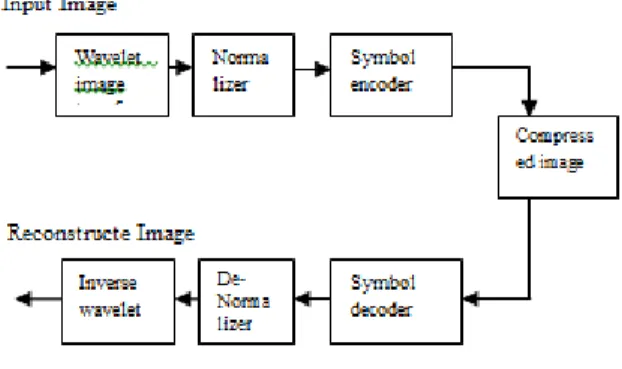
The JPEG(Joint Photographic Experts Group) for coding image files is widely used because of the compression rate it can achieve without any quality loss. Here the image is divided into blocks of m(rows) by n(columns) pixels to which DWT(Discrete wavelet Transform) is applied. JPEG 2000 is based on the idea that the coefficient of a transform that decorrelates the pixel of an imagecan be coded more efficiently than the original pixels (Xiong and T.S. Huang, 2002). Fig 1. Shows the simplified JPEG 2000 coding system.
Fig. 1: JPEG Compression.
The first step in the process, as in the original JPEG standard, is to level shift the pixels of the image by subtracting 2m-1, where 2m is the number of gray level in the image. The wavelet transform N scale transform contains 3N+1 subbands whose coefficients are LL, HL, LH, HH. After wavelet transform has been computed, the total variety of transform coefficients is adequate to the quantity of samples within the original image. Then, the resulting coefficients are mapped to different bit planes by quantization. The bit encoding will not change the properties of wavelet features and thus the detection accuracy will not be affected. The JPEG 2000 decoders simply do the inverse transform and the original image sub bands are reconstructed.
Image Enhancement Using Top Hat Transform:
The idea behind the image enchancement is to enlarge the contrast between the bright and dim areas of satellite image.The bright image regions of the image can be extracted using white top hattransform.The image enchancement is done through contrast enlarging based on top hat transform by subtracting the dim area from the bright image region of the original image .fen = fw - fb fen is final enhanced image, fw is extracted bright image regions, fb is extracted dim image regions.An efficient image enhancement algorithm not only enlarge the contrast between bright and dim images, but also enhance the image details. The ship targets in sea are very dim in original image (Jiexiong Tang, 2015). But the ship targets are bright in enhanced image. Then RGB to gray conversion and gray to black and white conversion are done. That image is called as binary image.
Morphological operation includes dilation and erosion. Let f and b represent the gray scale image and structural element. The dilation and erosion of f(x,y) by B(u,v) denoted by f~B and f^B are defined as follows f~B=max(f(x-u,y-v)+B(u,v))
f^B=min(f(x+u,y+v)-B(u,v))
Based on the dilation and erosion, closing and opening of f(x,y) by B(u,v), denoted by f ○ B and f ● B, are defined as follows
f ○ B = (f ^ B) ~ B, f ● B = (f ~ B) ^ B
Using opening and closing, the top hat transform, including white top hat transform and black top hat transform, denoted by WTH and BTH
Opening could smooth bright regions of image corresponding to the size of the used satellite. So bright region is extracted by WTH and similarly, closing could smooth dim regions of image corresponding to the size of used satellite image. So, BTH is usually used to extract dim image regions.
Segmentation:
The super pixel segmentation algorithm can be implemented by initialize cluster centers Ck = {lk ,ak,, xk, yk ]T by sampling pixels at regular grid and discompose the clusters to the lowest gradient position. Repeat for each cluster center Ck and assign the best matching pixels from a 2s by 2s square neighborhood around the cluster center according to the gap measure. Then compute new cluster centers and residual error E{L1 gap between earlier centers and new centers}. Until E<=threshold, enforce connectivity.
Finally, detect the cells from super pixel segmentation. Connect all edges and interior gaps. Then remove connected objects on borders.The proposed system is shown in fig 2.
Fig. 2: Proposed Method.
Classifier:
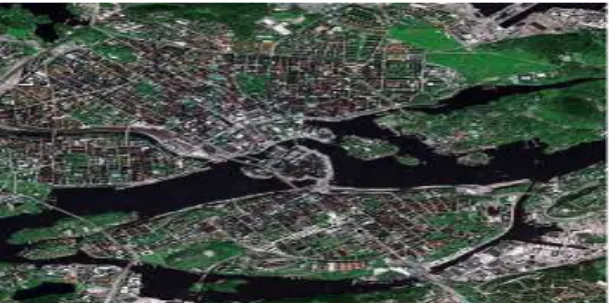
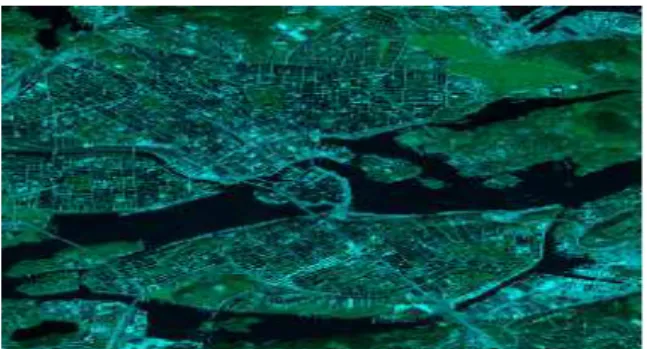
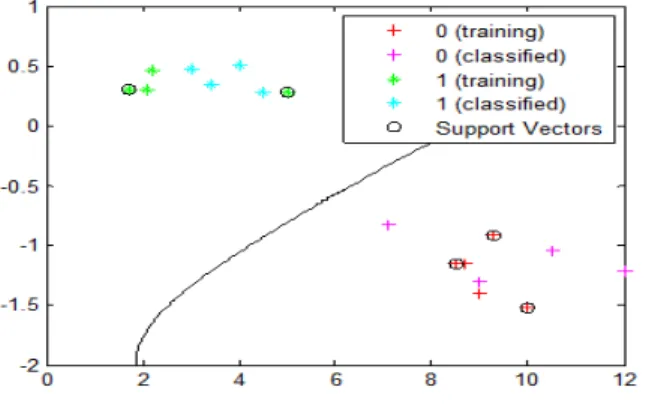
SVM algorithm are effective in detecting the ship. A classification task involves with training and testing data which consists of examples of data. Each instances in training set contains one objective value(class lables) and more attributes(features). The goal of the SVM is to produce a model which predicts objective value of example data in the test set which are given only the attributes. It provides the novel means of classification using the principle of structural risk minimization. It is one of the most sophisticated nonparametric supervised classifiers with many different configurations depending upon the functions used for generating the transform space in which decision surface is constructed. Classify the test using svm and evaluate performance of the classifier. The result of the ship detection is shown in fig 3(a) to fig 3(f).The following images show the compressed, segmented and final detected image. The fig (4) shows the classifier output.
Fig. 3: (a)Compressed Image.
Fig. 3: (c) Top Hat Image.
Fig. 3: (d) Segmented Image.
Fig. 3: (e) Super Pixel Segmentation.
Fig. 4: SVM Classifier output.
Conclusion:
The proposed system is to develop a module for the different scale and illumination invariant ship detection from satellite images using compressed domain and wavelet domain with second level decomposition based feature extraction operator and finally SVM classifier is used for classification.
REFERENCES
Xiaolong Wang, Cuixia Chen, “An Automatic Ship Detection Method Based on Local Gray-Level Gathering Characteristics in SAR Imagery”
Yu Xia, Shouhong Wan, Peiquan Jin andLihua Yue, 2014.” Novel Sea-Land Segmentation Algorithm Based on Local Binary Patterns for Ship Detection” in International Journal of Signal Processing, Image Processing and Pattern Recognition, 7(3): 237-246. http://dx.doi.org/10.14257/ijsip.2014.7.
Xiong and T.S. Huang, 2002. “Wavelet-based texture features can be extractedefficiently from compressed-domain for JPEG 2000 coded images,”in Proc. ICIP, 1: I-481, IEEE].
Jiexiong Tang, Chenwei Deng, Guang-Bin Huang, Baojun Zhao, 2015. ”Compressed-Domain Ship Detection on SpaceborneOptical Image Using Deep Neural Networkand Extreme Learning Machine”in Ieee Transactions On Geoscience And Remote Sensing.
Burgess, D.W., 1993. “Automatic ship detection in satellite multispectral imagery,”Photogramm. Eng. Remote Sens., 59(2): 229–237.
Lure, F.Y. and Y.C. Rau, 1994. “Detection of ship tracks in AVHRR cloud imagery with neural networks,” in Proc. IEEE IGARSS, 3: 1401–1403.
Zhu, C., H. Zhou, R. Wang, and J. Guo, 2010. “A novel hierarchical method of ship detection from spaceborne optical image based on shape and texture features,” IEEE Trans. Geosci. Remote Sens., 48(9): 3446– 3456.
Corbane, C., L. Najman, E. Pecoul, L. Demagistri, and M. Petit, 2010. “A complete processing chain for ship detection using optical satellite imagery,” Int. J. Remote Sens., 31(22): 5837–5854.