S O F T W A R E
Open Access
Template-based combinatorial enumeration of
virtual compound libraries for lipids
Manish Sud
1*, Eoin Fahy
1*and Shankar Subramaniam
1,2*Abstract
A variety of software packages are available for the combinatorial enumeration of virtual libraries for small
molecules, starting from specifications of core scaffolds with attachments points and lists of R-groups as SMILES or SD files. Although SD files include atomic coordinates for core scaffolds and R-groups, it is not possible to control 2-dimensional (2D) layout of the enumerated structures generated for virtual compound libraries because different packages generate different 2D representations for the same structure. We have developed a software package called LipidMapsTools for the template-based combinatorial enumeration of virtual compound libraries for lipids. Virtual libraries are enumerated for the specified lipid abbreviations using matching lists of pre-defined templates and chain abbreviations, instead of core scaffolds and lists of R-groups provided by the user. 2D structures of the enumerated lipids are drawn in a specific and consistent fashion adhering to the framework for representing lipid structures proposed by the LIPID MAPS consortium. LipidMapsTools is lightweight, relatively fast and contains no external dependencies. It is an open source package and freely available under the terms of the modified BSD license.
Background
The combinatorial virtual library enumeration method-ology is routinely used during the early stages of the small molecule drug discovery cycle. Virtual com-pound libraries containing a large of number molecules are generated and ranked based on various calculated/ predicted characteristics such as physicochemical prop-erties, activity, specificity, solubility, etc. A set of top ranked compounds are selected and synthesized/ acquired for further investigation using experimental techniques [1-7]. A variety of software packages are available for the combinatorial enumeration of virtual compound libraries. These tools fall into three broad cat-egories: open source or freely available packages [8-12]; commercially available packages [13-21]; proprietary software packages implemented for internal use on top of custom or commercial software libraries [22-25]. Al-though implementation details might differ, all virtual li-brary enumeration packages deploy similar general strategy to generate virtual compound libraries. A core
scaffold along with attachment points for R-groups is specified and lists of R-groups are provided by the user. Options to incorporate linkers between the core scaffold and R-groups are also available in some packages. The core scaffold, R-groups and linkers are specified either as SMILES [26,27] or SD [28] files. All possible structures are enumerated by the combinatorial attachment of R-groups to the core scaffold along with the placement of any linkers between them and a virtual compound library is generated as a SMILES or SD file. The 2D structure representations generated for the compounds in virtual libraries are rather arbitrary. Although input SD files contain 2D atomic coordinate information for core scaf-folds and R-groups, it is not possible to specify the exact orientation of R-groups around scaffolds for the struc-tures enumerated for virtual libraries in any available software package, to the best of our knowledge. Different software packages end up generating completely different orientations of R-groups around scaffolds due to different internal strategies deployed for their optimal placement in the enumerated structures. Consequently, 2D struc-ture layouts for the enumerated strucstruc-tures are not always consistent across software packages.
We have developed a software package called Lipid-MapsTools for the combinatorial enumeration of * Correspondence:[email protected];[email protected];[email protected]
1San Diego Supercomputer Center, University of California San Diego, 9500,
Gilman Drive, La Jolla, CA 92032, USA
2Departments of Bioengineering, Chemistry and Biochemistry, University of
California San Diego, 9500 Gilman Drive, La Jolla, CA 92093, USA
virtual compound libraries for lipids. Virtual libraries are enumerated for the specified lipid abbreviations using matching lists of pre-defined templates and chain abbre-viations, instead of core scaffolds, linkers and lists of R-groups provided by the user as SMILES or SD files. 2D structures of the enumerated lipids are drawn in a spe-cific fashion; their representation is consistent and adheres to the framework for representing lipid struc-tures proposed by LIPID MAPS consortium [29,30]. The structure data for the enumerated virtual library is writ-ten to a SD file along with additional ontological infor-mation such as abbreviation, systematic name, category, main class, sub class, etc. LipidMapsTools is capable of generating large virtual compound libraries for lipids with minimal input from the user.
Methodology
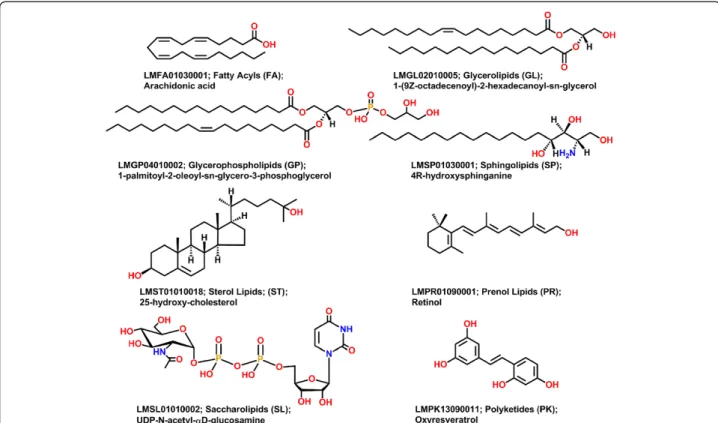
We previously developed a LIPID MAPS Structure Data-base (LMSD) [31] containing structures and annotations of biologically relevant lipids. It is a relational database and currently contains over 37,000 structures. All lipids in the LMSD have been classified, named and drawn according to the comprehensive classification, nomen-clature and drawing system [32,33] proposed by the LIPID MAPS consortium. Based on this classification system, lipids are divided into eight categories: fatty acyls (FA), glycerolipids (GL), glycerophospholipids (GP), sphingolipids (SP), sterol lipids (ST), prenol lipids (PR), saccharolipids (SL) and polyketides (PK). Each category is further divided into classes and subclasses. Figure 1 shows representative lipid structure for each lipid cat-egory along with its LIPID MAP ID (LM ID) and name.
In general, the acid/acyl or head group is drawn on the right side and the hydrophobic radyl chain is shown on the left. For two out of the eight lipid categories, GL and GP, the radyl hydrocarbon chains -sn1,sn3and
sn3chains at positions 1, 2 and 3 on the glycerol back-bone corresponding to stereo chemical numbering (sn) scheme - are drawn with the chain termini on the left using attachment points on the template backbone and the appropriate head groups are shown on the right (Figure 2). The term radyl chain is used to represent acyl, alkyl or 1Z-alkenyl chains. For sphingolipids (SP), the two chains corresponding to a long chain base and an N-acyl chain are also drawn with the chain termini on the left of the ceramide template backbone and the head groups are on the right.
The three lipid categories of GL, GP and SP along with the cardiolipins (CL), a lipid class under GP, have a fixed backbone with chains and head groups attached to the specific attachment points on the backbone. These char-acteristics make these types of lipids amenable to the template-based combinatorial enumeration of virtual compound libraries, using the pre-defined lists of most
likely chains and templates containing the appropriate head groups.
Lipid abbreviations
The lipid abbreviation format (Figure 2) consists of the specifications for chains and head groups. The individual chain specifications are delimited by a backslash (/). For glycerolipids, three different lipid abbreviation formats are used: MG(sn1Chain/0:0/0:0), DG(sn1Chain/sn2Chain/0:0) and TG(sn1Chain/sn2Chain/sn3Chain). MG, DG and TG refer to monoradylglycerols, diradylglycerols and triradyl-gylcerols. Representative examples of the lipid abbrevi-ation format for GL are: MG(16:0/0:0/0:0), DG(18:1(9Z)/ 16:0/0:0) and TG(16:0/16:0/18:1(11E)).These abbreviations correspond to 1-hexadecanoyl-sn-glycerol, 1-(9Z-octade-cenoyl)-2-hexadecanoyl-sn-glycerol and 1,2-dihexadeca-noyl-3-(11E-octadecenoyl)-sn-glycerol respectively.
The glycerophospholipid abbreviation format consists of the specifications for a head group and twosnchains: Headgroup(sn1Chain/sn2Chain). The cardiolipins abbre-viation format is similar to the glycerophospholipids with additional specifications for extra set of snchains: CL(1'-[sn1Chain/sn2Chain],3'-[sn1Chain/sn2Chain]). It has two sets of sn1and sn2chains at two different glycerol back-bones attached to two phospho groups that are further connected to another glycerol backbone at 1' and 3' posi-tions; no head group is specified. Representative examples of lipid abbreviations for GP are: PC(16:0/20:4(5Z,8Z, 11Z,14Z)) and PE(16:0/18:1(9Z)). These abbreviations cor-respond to hexadecanoyl-2-(5Z,8Z,11Z,14Z-eicosatetrae-noyl)-sn-glycero-3-phosphocholine and hexadecanoyl-2-(9Z-octadecenoyl)-sn-glycero-3-phosphoethanolamine. The cardiolipin abbreviation, CL(1'-[16:0/18:1(11Z)],3'-[16:0/18: 1(11Z)]), corresponds to 1',3'-Bis-[1-hexadecanoyl-2-(11Z-octadecenoyl)-sn-glycero-3-phospho]-sn-glycerol.
The sphingolipid abbreviation format includes the spe-cifications of a long chain base and an N-acyl chain on the ceramide backbone along with the specification of a head group: Headgroup(LongChainBase/NAcylChain). One of the three letters - d, t, or m - must precede the chain length specifier of the long chain base; the format of rest of the long chain base and N-acyl chain abbre-viation is similar to the format of chain abbreabbre-viation for other lipid categories. The letters t and m are used to represent 4R-hydroxy and 3-keto groups at positions 4 and 3 respectively in the long chain base. Representative examples of the lipid abbreviations format for SP are: Cer(d18:1(4E)/14:0), Cer(t18:0/18:2(9Z,12Z)) and Cer (m14:0/16:1(9Z)). These abbreviations correspond to N-(tetradecanoyl)-sphing-4-enine, N-(9Z,12Z-octadeca-dienoyl)-4R-hydroxy-sphinganine and N-(9Z-hexadece-noyl)-3-keto-tetradecasphinganine.
Figure 1Representative lipid structures from the LIPID MAPS structure database for different lipid categories.LIPID MAPS LM ID, lipid category and name are shown under each structure.
Figure 2Lipid categories amenable to the combinatorial enumeration of virtual compound libraries.Lipid structure for each category is color coded to highlight chain, backbone and head group. Virtual libraries are generated from the specific lipid abbreviations by the
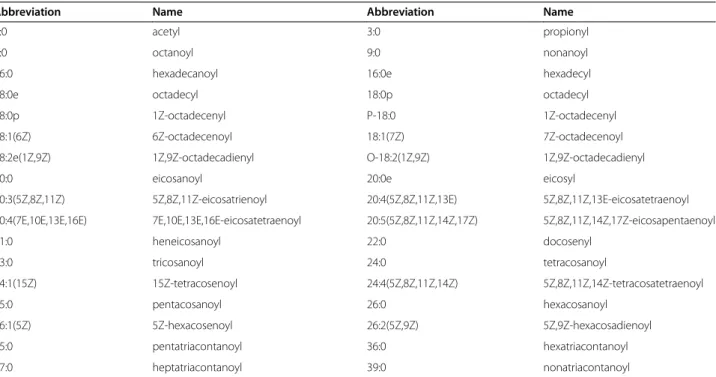
with their geometry, and substituents. The chain length specification is mandatory; all other specifications are optional. The substituent specification includes its name, position in the chain and an optional value for stereochemistry (R or S). The stereochemistry for the substituents is determined using CIP (Cahn-Ingold-Pre-log) [34-36] priority rules. For example, the acyl chain specification 16:0 corresponds to hexadecanoyl, and 20:4(7E,10E,13E,16E) implies 7E,10E,13E,16E-eicosate-traenoyl. A hydroxyl group at position 6 with R stereo-chemistry in 18:2(2E,4E) acyl chain corresponding to 2E,4E-octadecadienoyl is shown as 18:2(2E,4E)(6OH(R)). Table 1 shows representative examples of the sn chain specifications available during the combinatorial enu-meration of virtual compound libraries for GL, GP and CL. Complete lists of thesnchain specifications for GL, GP and CL are shown in Additional file 1: Table S1; the long chain bases and N-acyl chain lists are shown in Additional file 1: Table S2 and Table S3; and Additional file 1: Table S4 provides the list of all available substituents.
Wild card specifications of chain lengths and double bonds along with their geometry are supported in the lipid abbreviation format, in order to specify a set of lipids to enumerate from the pre-defined lists of most likely sn chain abbreviations and head groups. Allowed wild card characters are: * (asterisk), + (plus), - (minus), > (greater than) and < (less than). The wild card character
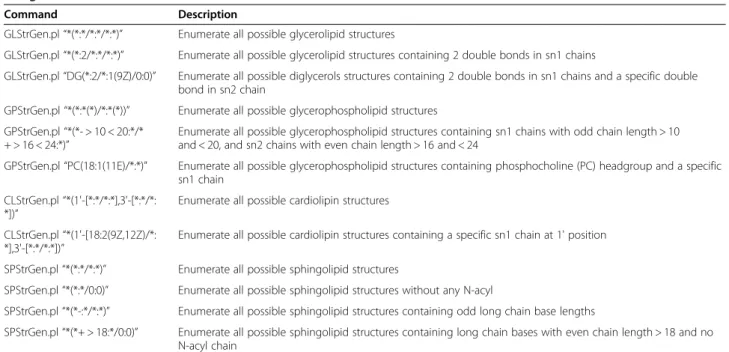
* is used for the specification of chain length and number of double bonds along with their geometry. It refers to all available chain abbreviations for lipids. The wild card characters + and - refer to even and odd chain lengths. The wild card characters > and < are used along with a number after them to indicate chain lengths greater than or less than a specified number; these are only valid for chain length specifications. For example, the lipid abbre-viation TG(*/*/*) or TG(*:*/*:*/*:*) represents all possible triradylglycerolipid structures. The abbreviation DG(*:2/ *:1(9Z)/0:0) corresponds to all possible diradylglyceroli-pid structures containing 2 double bonds in sn1 chains and a specific double bond in sn2chains. The abbrevi-ation PC(*- > 10 < 20:*/*+ > 16 < 24:*) implies all possible GP structures containing the phosphocholine head group,sn1chains with odd chain lengths greater than 10 and less than 20, andsn2chains with even chain lengths greater than 16 and less than 24. Table 2 shows represen-tative examples of the lipid abbreviations for various lipid categories. Additional file 1: Tables S5, to S8 provide a comprehensive set of examples for the lipid abbreviations corresponding to GL, GP, CL and SP respectively.
Combinatorial library enumeration workflow
Figure 3 provides an overview of the methodology used by LipidMapsTools for the template-based combinatorial enumeration of virtual compound libraries for lipids. The process of virtual library enumeration starts out by
Table 1 Representative examples of chains available forsnpositions during the combinatorial enumeration of virtual compound libraries
Abbreviation Name Abbreviation Name
2:0 acetyl 3:0 propionyl
8:0 octanoyl 9:0 nonanoyl
16:0 hexadecanoyl 16:0e hexadecyl
18:0e octadecyl 18:0p octadecyl
18:0p 1Z-octadecenyl P-18:0 1Z-octadecenyl
18:1(6Z) 6Z-octadecenoyl 18:1(7Z) 7Z-octadecenoyl
18:2e(1Z,9Z) 1Z,9Z-octadecadienyl O-18:2(1Z,9Z) 1Z,9Z-octadecadienyl
20:0 eicosanoyl 20:0e eicosyl
20:3(5Z,8Z,11Z) 5Z,8Z,11Z-eicosatrienoyl 20:4(5Z,8Z,11Z,13E) 5Z,8Z,11Z,13E-eicosatetraenoyl
20:4(7E,10E,13E,16E) 7E,10E,13E,16E-eicosatetraenoyl 20:5(5Z,8Z,11Z,14Z,17Z) 5Z,8Z,11Z,14Z,17Z-eicosapentaenoyl
21:0 heneicosanoyl 22:0 docosenyl
23:0 tricosanoyl 24:0 tetracosanoyl
24:1(15Z) 15Z-tetracosenoyl 24:4(5Z,8Z,11Z,14Z) 5Z,8Z,11Z,14Z-tetracosatetraenoyl
25:0 pentacosanoyl 26:0 hexacosanoyl
26:1(5Z) 5Z-hexacosenoyl 26:2(5Z,9Z) 5Z,9Z-hexacosadienoyl
35:0 pentatriacontanoyl 36:0 hexatriacontanoyl
37:0 heptatriacontanoyl 39:0 nonatriacontanoyl
the identification of a lipid template for the specified lipid abbreviation. The abbreviation is analyzed to iden-tify the presence or absence of chains and head groups. The chain abbreviations are parsed to retrieve the speci-fied chain length and number of double bonds along
with their geometry. Any wild cards specified for chains and head groups are identified and marked for further combinatorial enumeration. An appropriate template or set of templates are selected from a pre-defined list of templates that match the specified lipid abbreviations. Table 2 Representative examples of the commands for generating virtual compound libraries for different lipid categories
Command Description
GLStrGen.pl“*(*:*/*:*/*:*)” Enumerate all possible glycerolipid structures
GLStrGen.pl“*(*:2/*:*/*:*)” Enumerate all possible glycerolipid structures containing 2 double bonds in sn1 chains
GLStrGen.pl“DG(*:2/*:1(9Z)/0:0)” Enumerate all possible diglycerols structures containing 2 double bonds in sn1 chains and a specific double bond in sn2 chain
GPStrGen.pl“*(*:*(*)/*:*(*))” Enumerate all possible glycerophospholipid structures
GPStrGen.pl“*(*- > 10 < 20:*/* + > 16 < 24:*)”
Enumerate all possible glycerophospholipid structures containing sn1 chains with odd chain length > 10 and < 20, and sn2 chains with even chain length > 16 and < 24
GPStrGen.pl“PC(18:1(11E)/*:*)” Enumerate all possible glycerophospholipid structures containing phosphocholine (PC) headgroup and a specific sn1 chain
CLStrGen.pl“*(1'-[*:*/*:*],3'-[*:*/*: *])”
Enumerate all possible cardiolipin structures
CLStrGen.pl“*(1'-[18:2(9Z,12Z)/*: *],3'-[*:*/*:*])”
Enumerate all possible cardiolipin structures containing a specific sn1 chain at 1' position
SPStrGen.pl“*(*:*/*:*)” Enumerate all possible sphingolipid structures
SPStrGen.pl“*(*:*/0:0)” Enumerate all possible sphingolipid structures without any N-acyl
SPStrGen.pl“*(*-:*/*:*)” Enumerate all possible sphingolipid structures containing odd long chain base lengths
SPStrGen.pl“*(*+ > 18:*/0:0)” Enumerate all possible sphingolipid structures containing long chain bases with even chain length > 18 and no N-acyl chain
Additional file1: Tables S5 to S8 show a comprehensive list of examples for generating virtual libraries for different lipid categories.
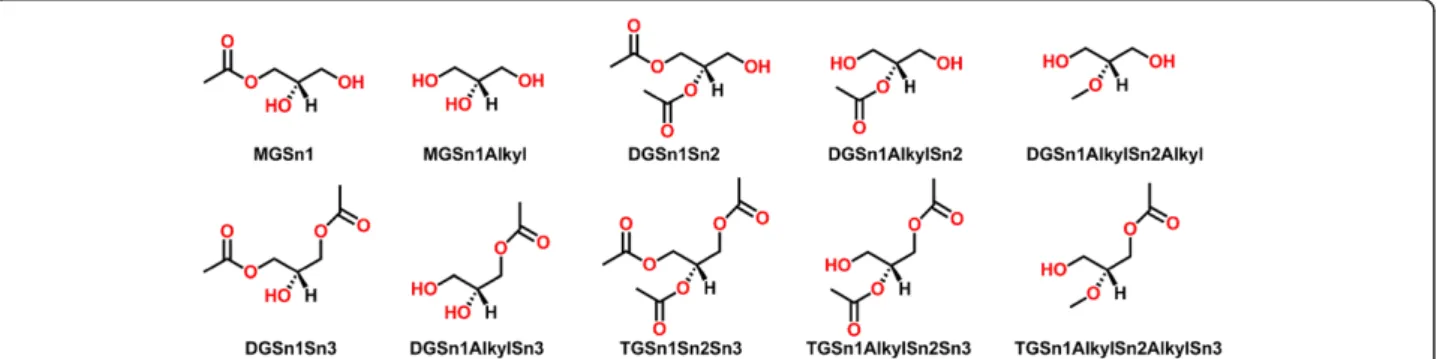
The templates are internally stored as MDLMOL strings containing structure data, along with mapping of each template ID to additional information such as atom numbers and atomic coordinates for attachment points, number of chain carbons in the template, head group name, lipid category, etc. The examples of available tem-plates for GL, GP, CL and SP are shown in Figure 4, Figure 5 , Figure 6 and Figure 7 respectively (The Complete lists of templates GP and SP are available in Additional file 1: Figure S1 and Figure S2). After an ap-propriate template or set of templates have been identi-fied for the specified lipid abbreviation, chain abbreviations that match the specified abbreviation are retrieved from the pre-defined list of most likely chain abbreviations spanning chain lengths from 2 to 39 for GL, GP and CL, and the most likely long chain bases and N-acyl groups for SP. Appropriate head groups are selected from the lists of supported head groups for GP and SP (Additional file 1:Table S9 and Additional file 1: Table S10). A virtual compound library for lipids is gen-erated by the combinatorial enumeration of all selected chains at appropriate attachment points on the lipid templates. A SD file is written out containing structure data along with additional ontological data such as lipid abbreviation, systematic name, lipid category, main class, sub class, etc. Table 2 shows representative examples of the lipid abbreviations and commands for generating virtual compound libraries for various lipid categories.
In addition to the complete enumeration of all possible structures for various lipid categories using wild card characters for chain lengths, number of double bond along with their geometries and head groups, the Lipid-MapsTools software package allows the generation of subsets of these virtual libraries corresponding to cific chain lengths, number of double bonds with spe-cific double bond geometry and head groups. For example, the lipid abbreviation "CL(1'-[* > 17 < 21: */* > 17 < 21:*],3'-[* > 17 < 21:*/* > 17 < 21:*])" generates a subset of virtual compound library for the cardiolipins containingsnchain lengths between 17 and 21.
Implementation
LipidMapsTools is implemented using the Perl [37,38] programming language and is available on a variety of plat-forms. The software architecture (Figure 8) consists of a
bin sub-directory under thelipidmapstools root directory containing command line scripts for generating virtual compound libraries from the lipid abbreviations corre-sponding to the specific lipid categories, which in turn make use of the functionality available in Perl modules res-iding in the lib sub-directory to generate the structures along with the additional ontological information. The modules in thelibdirectory are divided into two categor-ies: specific and generic modules. The specific modules contain functionality for virtual library generation corre-sponding to the specific lipid categories; the generic mod-ules implement the core functionality such as chain abbreviation parsing, structure generation by attaching chains to the template, etc. The command line scripts make use of the specific modules to generate virtual com-pound libraries for lipids, which in turn rely on the core functionality to perform specific tasks. The separation of the core functionality from the lipid specific functionality facilitates the maintenance and enhancement of the Lipid-MapsTools package. Two external modules, TextUtil.pm and FileUtil.pm, available from an open source package MayaChemTools [39] are also distributed with LipidMap-sTools. These modules provide functionality for processing data from text files and various file manipulation utilities.
The templates for lipid categories are stored in each category specific module as MDLMOL strings corre-sponding to template structure data, along with mapping of each template ID to additional information such as atom numbers and atomic coordinates for attachment points, number of chain carbons in the template, head group name, lipid category, main class, sub class, etc. No external MDLMOL data files are needed.
Results and discussion
LipidMapTools provides command line scripts for the combinatorial enumeration of virtual compound libraries
for lipids from the specified lipid abbreviations. Virtual compound libraries are generated by the combinatorial enumeration of most likely chains around the specific templates, with chain lengths varying from 2 to 39 con-taining specific number of double bonds and their geom-etry. Some radyl chains corresponding to alkyl and 1Z-alkenyl chains instead of acyl chains are skipped from
sn2andsn3positions during the combinatorial enumer-ation, wherever they are not permitted by the LIPID MAPS classification scheme for lipids. For example, the LIPID MAPS classification scheme doesn’t contain any sub classes for alkyl and 1Z-alkenyl chains atsn2andsn3
positions for the glycerolipids, and the structures corre-sponding to these chains atsn2andsn3positions are not generated.
Virtual compound libraries containing all possible structures for GL, GP, CL and SP are generated using the commands GLStrGen.pl "*(*/*/*)", GPStrGen.pl "* (*/*)", CLStrGen.pl "CL(1'-[*/*],3'-[*/*]) and SPStrGen.pl "*(*/*)" respectively. These command line scripts gen-erate SD files containing the 2D structure data for all the enumerated structures along with additional
information such as abbreviation, systematic name, chain length and double bond count, lipid category, main class, sub class, etc. The subsets of complete virtual libraries containing specific chain lengths and head groups are generated by their explicit specifica-tion in the specified lipid abbreviaspecifica-tions. For example, the command GLStrGen.pl "PC(*:*/*:*)" generates a subset of GP virtual library containing all possible structures with the phosphocholine (PC) head group. A SP virtual library containing structures with the sphing-nomyelin (SM) head group and the long chain bases be-tween length 15 and 21 is generated by the following command: SPStrGen.pl "SM(* > 15 < 21:*/* > 15 < 21:*)". The complete lists of available head groups for GP and SP are shown in Additional file 1: Table S7 and Table S8.
The cardiolipins, a class of the glycerophospholipids, may contain up to 4snchains. Due to the combinatorial nature of the enumeration of all possible structures con-taining all 4 sn chains, the size of the CL virtual library gets to be quite large and it takes a substantial amount of time (Table 3) to generate the complete virtual library. A subset of the CL virtual library containing sn chain
Figure 5Representative examples of template structures for glycerophospholipids (GP).Additional file 1: Figure S1 shows complete list of supported template structures for GP. Template IDs containing head group specification are shown below the structures. The head group abbreviations shown in template IDs are: PC (Glycerophosphocholines), PE (Glycerophosphoethanolamines), PS (Glycerophosphoserines), PG (Glycerophosphoglycerols), PI (Glycerophosphoinositols), PnC (Glycerophosphonocholines).
lengths between 17 and 21 can be generated using the following command: CLStrGen.pl "CL(1'-[* > 17 < 21: */* > 17 < 21:*],3'-[* > 17 < 21:*/* > 17 < 21:*])". It is, how-ever, feasible to speed up the task of the combinatorial enumeration of virtual compound libraries for CL and other lipid categories. Instead of running a single script to enumerate all possible structures corresponding to all combinations of chains, the virtual library gener-ation script is started in parallel on multiple CPUs where each instance of the script enumerates a subset of a virtual compound library for a specific combina-tions of the chain lengths, and individual SD files are joined into a single SD file after all the jobs have completed.
The current focus of LipidMapsTools for the combina-torial enumeration of virtual compound libraries is on the mammalian lipids. The pre-defined lists of radyl chains and long chain bases contain the specifications for chain lengths with degrees of unsaturation that are most likely to occur in the mammalian lipids. Although these pre-defined lists are quite comprehensive, it is im-possible to cover all the scenarios not only in terms of novel mammalian lipids but also different types of radyl chains or long chain bases that may be present in non-mammalian species such as plants, insects, bacteria, fungi and marine organisms. LipidMapsTools is designed
to allow addition of new radyl chains and long chain bases in a relatively straight forward manner. The core Perl modules ChainAbbrev.pm and SPChainAbbev.pm contain the pre-defined lists of radyl chains and long chain bases respectively. After the pre-defined lists in the appropriate modules have been updated, the newly added radyl chains or long bases are available for the enumeration of virtual compound libraries through the command line scripts.
In addition to the combinatorial enumeration of virtual compound libraries for lipids from the specified abbre-viations containing wild card characters, LipidMapsTools is capable of generating the specific lipid structures from the specific lipid abbreviations. For example, the com-mand, GPStrGen.pl "PC(16:0/20:4(5Z,8Z,10E,14Z)(12OH [S]))", generates a SD file containing structure and onto-logical data for one glycerophospholipid corresponding to 1-hexadecanoyl-2-(12S-hydroxy-5Z,8Z,10E,14Z-eico-satetraenoyl)-sn-glycero-3-phosphocholine.
LipidMapsTools also provides the capability to generate individual lipid structures containing arbitrary specifica-tions for radyl chains or long chain bases which are not present in the pre-defined lists available in the package, without requiring any customization by the user. This functionality is available in the scripts provided with the LipdMapsTools package through a command line option.
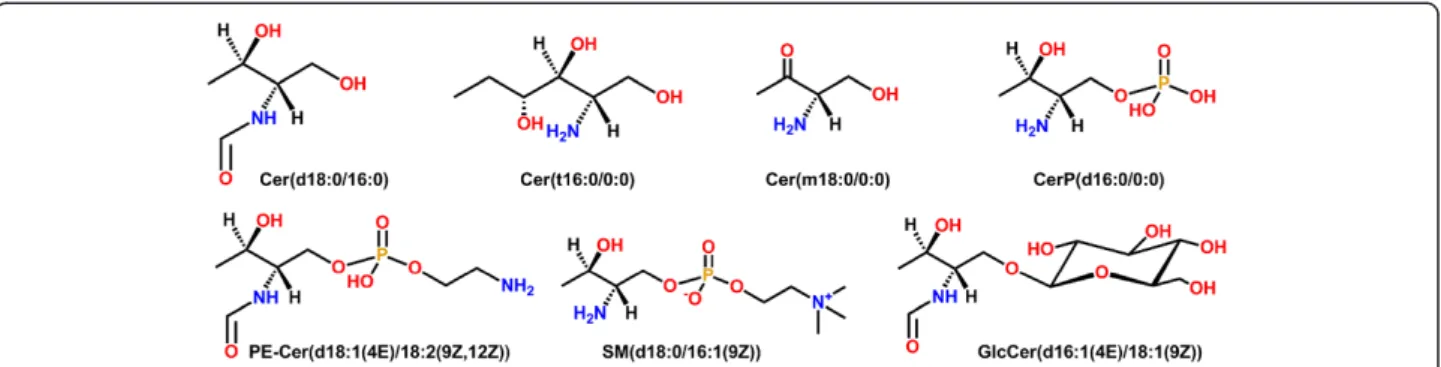
Figure 7Representative examples of template structures for sphingolipids (SP).Additional file 1: Figure S2 shows complete list of supported template structures for SP. A representative example of an abbreviation matching a template is shown below the template structure. The head group abbreviations are: ceramide, 4R-hydroxy-ceramide, 3-keto-ceramide, CerP (ceramide-1-phosphate), PE-Cer
(ceramide-1-phosphoethanolamine), SM (sphingomyelin), GlcCer (1-β-glucosyl-ceramide).
For the lipid abbreviations containing arbitrary specifica-tions, the structure generation methodology used in the LipidMapsTools package skips the step to confirm the presence of the specified radyl chains or long chain bases in the pre-defined lists of most likely chain lengths, and proceeds to generate the structure as long as the format of the specified abbreviation is valid. For example, the com-mand, SPStrGen.pl –ChainAbbrevMode Arbitrary “SM (d30:4(4E,8E,12E,16E)/34:4(5Z,8Z,11Z,14Z)(16OH[R]))", parses the arbitrary specifications for the long chain base and N-acyl chain not present in the pre-defined lists avail-able in the package, generates the appropriate sphingo-myelin structure and writes it out to a SD file. This functionality facilitates the generation of individual struc-tures for both mammalian and non-mammalian species containing radyl chains or long chain bases currently not present in the LipidMapsTools package. The capability to generate individual structures from the specific lipid ab-breviation is quite useful for on-the-fly structure gener-ation for populating databases and on line structure display.
Conclusions
The LipidMapsTools software package has been devel-oped for the template based combinatorial enumeration of virtual compound libraries for lipids. A set of command line scripts is provided to enumerate all pos-sible structures corresponding to the specified lipid abbreviations without any additional input requirements from the user. It is relatively straight forward to generate subsets of complete virtual libraries by explicit specifica-tions of chains and head groups in the lipid abbreviaspecifica-tions. 2D structures of the enumerated lipids are drawn in a spe-cific fashion; their representation is consistent and adheres to the framework for representing lipid structures proposed by LIPID MAPS consortium. The customization and enhancement of existing functionality along with de-velopment of new functionality is facilitated by modular
nature of the software architecture. LipidMapsTools is under continuous development and we anticipate the addition of the new templates along with the radyl chains and long chain bases for both mammalian and non-mammalian lipid species in the future versions of the package.
Availability and requirements
•Project name:lipidmapstools
•Project home page:www.lipidmaps.org/downloads/
•Operating system(s):Platform independent
•Programming language:Perl
•Other requirements:None
•License:Modified BSD License
•Any restrictions to use by non-academics:None
Additional file
Additional file 1:Supplementary information as a PDF file. Complete lists of the pre-defined chains specifications and examples of the enumeration of virtual compound libraries for GL, GP, CL and SP; lists of the head groups available for GP and SP; the structures of all available templates for GP and SP.
Competing interests
MS also works as a part time independent consultant/contractor in the area of computational drug discovery and is involved in development of an open source software package called MayaChemTools. EF and SS declare that they have no competing interests.
Authors’contributions
MS performed research & development of the LipidMapsTools software package. EF contributed to design, prototype and testing of the package. SS provided feedback during the development cycle. MS drafted the manuscript and all co-authors contributed to the manuscript. All authors read and approved the final manuscript.
Acknowledgements
Research reported in this publication was supported by the National Institute of General Medical Sciences of the National Institutes of Health under award number U54 GM069338. The content is solely the responsibility of the authors and does not necessarily represent the official views of the National
Table 3 Command line format along with some relevant statistics for enumerating virtual compound libraries of lipids corresponding to various lipid categories
Lipid category Command1 Library size2 Speed3 Enumeration time4
Glycerolipids (GL) GLStrGen.pl“*(*/*/*)” 971,268 181.6 1 h 29 m 10s
Glycerophospholipids (SP) GPStrGen.pl“*(*/*)” 211,615 213.2 16 m 33 s
Cardiolipins (CL) CLStrGen.pl“*(1'-[*/*],3'-[*/*])” 88,584,132 129.3 190 h 18 m 36 s
5CLStrGen.pl "CL(1'-[* > 17 < 21:*/* > 17 < 21:*],3'-[* > 17 < 21:*/* > 17 < 21:*])" 3,652,813 135.9 7 h 28 m 12 s
Sphingolipids (SP) SPStrGen.pl”*(*/*)” 20,720 225.3 1 m 32 s
1
Command line format for the combinatorial enumeration of virtual compound library of lipids for various lipid categories and generation of a SD file containing structures data along with additional ontological data such as abbreviation, systematic name, lipid category, main class, sub class, etc.2
Total number of lipid structures generated for virtual library in SD file.3
Average number of lipid structures generated per second.4
Time taken by the command line script to enumerate all possible lipid structures for each lipid category. Timing benchmarks were performed on a dual IntelR
CoreTM
CPU 6700 (2.6 GHz) PC running Windows 7 Enterprise Service Pack 1 with 2.00 GB of RAM using single CPU per command line script.5
Institutes of Health. We thank the reviewers for their suggestions to improve the quality of the manuscript.
Received: 30 July 2012 Accepted: 20 September 2012 Published: 25 September 2012
References
1. Lessel U, Wellenzohn B, Fischer JR, Rarey M:Design of combinatorial libraries for the exploration of virtual hits from fragment space searches with LoFT.J Chem Inf Model2012,52:373–379.
2. Gillet VJ, Khatib W, Willett P, Fleming PJ, Green DV:Combinatorial library design using a multiobjective genetic algorithm.J Chem Inf Comput Sci
2002,42:375–385.
3. Klon AE, Diller DJ:Library Fingerprints: A novel approach to the screening of virtual libraries.J Chem Inf Model2007,47:1354–1365.
4. Krovat EM, Frühwirth KH, Langer T:Pharmacophore identification, in silico screening, and virtual library design for inhibitors of the human factor Xa.J Chem Inf Model2005,45:146–159.
5. Lobanov VS, Agrafiotis DK:Stochastic similarity selections from large combinatorial libraries.J Chem Inf Comput Sci2000,40:460–470. 6. Cramer RD, Patterson DE, Clark RD, Soltanshahi F, Lawless MS:Virtual
Compound Libraries: A new approach to decision making in molecular discovery research.J Chem Inf Comput Sci1998,38:1010–1023.
7. Vainio MJ, Kogej T, Florian R:Automated recycling of chemistry for virtual Screening and library Design.J Chem Inf Model2012,52:1777–1786. 8. Truchon JF, Bayly CI:GLARE - A free open source software for
combinatorial library design.J Chem Inf Model2006,46:1536–1548. 9. Truszkowski A, Jayaseelan KV, Neumann S, Willighagen EL, Zielesny A,
Steinbeck C:New developments on the cheminformatics open workflow environment CDK-Taverna.J Cheminform2011,3:54.
10. Schüller A, Hähnke V, Schneider G, SmiLib v2.0:A Java-based tool for rapid combinatorial library enumeration.QSAR Comb Sci2007,3:407–410. 11. SmiLib v2.0. http://gecco.org.chemie.uni-frankfurt.de/smilib/. 12. Library synthesizer. http://tripod.nih.gov/?p=370.
13. Pipeline pilot combinatorial library design chemistry component. www. accelrys.com.
14. Reactor. www.chemaxon.com.
15. OELib library enumeration. www.eyesopen.com. 16. CombiLibMaker and Legion. www.tripos.com. 17. QuaSAR-CombiGen. www.chemcomp.com. 18. ChemOffice CombiChem. www.cambridgesoft.com 19. ICM-Chemist. www.molsoft.com.
20. LUCIA:Transform-based virtual library generation.www.eidogen-sertanty. com.
21. Library enumeration. www.treweren.com.
22. Liao C, Liu B, Shi L, Zhou J, Lu XP:Construction of a virtual combinatorial library using SMILES strings to discover potential structure-diverse PPAR modulators.Eur J Med Chem2005,40:632–40.
23. Feuston BP, Chakravorty SJ, Conway JF, Culberson JC, Forbes J, Kraker B, Lennon PA, Lindsley C, McGaughey GB, Mosley R, Sheridan RP, Valenciano M, Kearsley SK:Web enabling technology for the design, enumeration, optimization and tracking of compound libraries.Curr Top Med Chem
2005,5:773–783.
24. Leach AR, Bradshaw J, Green DVS, Hann MH, Delany JJ III:Implementation of a system for reagent selection and library enumeration, profiling, and design.J Chem Inf Comput Sci1999,39:1161–1172.
25. Yasri A, Berthelot D, Gijsen H, Thielemans T, Marichal P, Engels M, Hoflack J: REALISIS: A medicinal chemistry-oriented reagent selection, library design, and profiling platform.J Chem Inf Comput Sci2004,44:2199–2206. 26. Weininger D:SMILES, a chemical language and information system. 1.
Introduction to methodology and encoding rules.J Am Chem Soc1988, 28:31–36.
27. Weininger D, Weininger A, Weininger JL, SMILES. 2:Algorithm for generation of unique SMILES notation.J Am Chem Soc1989,29:97–101. 28. CTFile Formats.[http://accelrys.com/products/informatics/cheminformatics/
ctfile-formats/no-fee.php]
29. Sud M, Fahy E, Cotter D, Dennis EA, Subramaniam S:LIPID MAPS-Nature Lipidomics Gateway: An online resource for students and educators interested in lipids.J Chem Educ2012,89:291–292.
30. LIPID MAPS-Nature Lipidomics Gateway[www.lipidmaps.org]
31. Sud M, Fahy E, Cotter D, Brown A, Dennis EA, Glass CK, Merrill AH Jr, Murphy RC, Raetz CR, Russell DW, Subramaniam S:LMSD: LIPID MAPS structure database.Nucleic Acids Res2007,35:D527–D532.
32. Fahy E, Subramaniam S, Murphy RC, Nishijima M, Raetz CR, Shimizu T, Spener F, van Meer G, Wakelam MJ, Dennis EA:Update of the LIPID MAPS comprehensive classification system for lipids.J Lipid Res2009,50:S9–S14. 33. Fahy E, Subramaniam S, Brown HA, Glass CK, Merrill AH Jr, Murphy RC, Raetz
CR, Russell DW, Seyama Y, Shaw W, Shimizu T, Spener F, van Meer G, VanNieuwenhze MS, White SH, Witztum JL, Dennis EA:A comprehensive classification system for lipids.J Lipid Res2005,46:839–861.
34. Cahn RS, Ingold CK, Prelog V:Specification of molecular chirality.
Angew Chem Int Ed Engl1966,5:385–414.
35. Prelog V, Helmchen G:Basic principles of the CIP-systems and proposals for a revision.Angew Chem Int Ed Engl1982,21:567–583.
36. Mata P, Lobo AM, Marshall CA, Peter Johnson PA:The CIP sequence rules: Analysis and proposal for a revision.Tetrahedron-Asymmetry1993, 4:657–668.
37. Wall L, Christiansen T, Schwartz RL:Programming Perl. 2nd edition. California, USA: O'Reilly & Associates, Inc., 101 Morris Street, Sebastopol; 1996. 38. CPAN:Comprehensive Perl archive network. www.cpan.org. 39. Sud M:MayaChemTools.www.MayaChemTools.org.
doi:10.1186/1758-2946-4-23
Cite this article as:Sudet al.:Template-based combinatorial enumeration of virtual compound libraries for lipids.Journal of Cheminformatics20124:23.
Open access provides opportunities to our colleagues in other parts of the globe, by allowing
anyone to view the content free of charge.
Publish with
Chemistry
Central and every
scientist can read your work free of charge
W. Jeffery Hurst, The Hershey Company.
available free of charge to the entire scientific community peer reviewed and published immediately upon acceptance cited in PubMed and archived on PubMed Central yours you keep the copyright
Submit your manuscript here: