UNIT-III
POLYMERS
Polymers: “High polymers are macro sized molecules of high molecular mass formed by the combination of a large number of simple molecules by covalent bonds”.
Ex: Polyethylene, polyacetylene, polystyrene, polyvinyl chloride, natural and synthetic rubbers etc.
Monomers: “The simple molecules which combine to give polymers are called “Monomers” or “Repeating units” or “Building blocks of polymers”.
Example: Ethylene, Vinyl chloride, Acetylene, Styrene. etc.
Functionality: “The total number of bonding sites or functional groups present in a monomer is called functionality”
.
Polymerization:
“
The process by which the monomers are converted into polymers is called Polymerization”.Degree of polymerization (DP): “It is the total number of repeating units (n) in a polymer chain” .This indicates the length of the polymer chain and also helps in determining the molecular mass of the polymers.
I.e. Molecular mass of polymer = DP × Molecular mass of monomer. Note: Polymers have a molecular masses ranging from 10,000 to 1, 00,000.
Classification of polymers:
Polymers are classified in different ways based on their sources, thermal behavior, mechanism of polymerization and properties as given below.
Natural and Synthetic polymers.
Thermoplastics and Thermosetting polymers.
Addition and Condensation polymers.
Elastomers, Fibers, Resins and Plastics.
Based on the sources of availability polymers can be broadly classified as 1) Natural Polymers & 2) Synthetic Polymers
1) Natural Polymers: The polymers obtained from nature (plants & animals) are called natural polymers.
Ex: Starch, Cellulose, Proteins, Nucleic acids, Natural rubber, Cotton, Silk, wool, etc.
2) Synthetic polymers: The polymers which are prepared in the laboratories are called synthetic polymers or manmade polymers.
Ex: Polyethylene (PE), Polyvinyl chloride (PVC), Nylon6, Bakelite, etc
Types of Polymerization
Polymerization is of two types
.
1) Addition polymerization (chain polymerization):
It is a process in which number of simple monomers joining together by chain reaction without the elimination of any byproducts.
The polymer formed by the direct addition of repeated monomers is called addition polymer.
Ethylene (monomer) Polyethylene (polymer) b) Preparation of polyvinyl chloride (PVC) from vinyl chloride:
n
[CH2=CH–Cl] [–CH2–CH–Cl–] nVinyl chloride (monomer) PVC (polymer)
Characteristic features of addition polymerization:
Only alkene compounds can undergo addition polymerization.
The polymer produced has the same elemental composition as that of the monomer.
The molecular weight of polymer is an integral multiple of that of the monomer.
Linear polymers are obtained.
Self addition of monomers takes place rapidly.
2) Condensation polymerization (step polymerization):
A polymerization reaction in which bi-functional monomers undergoes condensation with continuous elimination of byproducts such as H2O, NH3, HCl, etc is called condensation
polymerization.
Since condensation reaction is rather slow and proceeds stepwise, such polymerization is often called step polymerization.
Ex: a) Preparation of nylon 6:6 from hexamethylene diamine & Adipic acid.
n
H
2N– (CH
2)
6–NH
2+
n
HOOC– (CH
2)
4–COOH
Hexamethylene diamine Adipic acid
- 2nH2O
[–HN– (CH
2)
6–NH–CO– (CH
2)
4–CO–]
nNylon 6:6 (Polyamide)
b) Preparation of polyester by condensation of ethylene glycol with terphthalic acid.
n
HO–(H
2C)
2–OH +
n
HOOC–C
6H
4–COOH
Ethylene glycol Terphthalic acid
-2nH2O
[–O–CH
2–CH
2–OOC–C
6H
4–CO–]
nPolyester
Characteristic features of condensation polymerization:
Polymerization proceeds through inter molecular condensation.
There is a continuous elimination of byproducts.
Condensation polymerization is catalyzed by acids or alkalies.
The elemental composition of the polymer is generally different from that of its monomers.
Cross linked or linear polymers are obtained.
Polymerzation of olefins catalysed by Zieglar natta catalyst.It is formed Ticl4 and AlR3. It
acts as a heterogenous catalyst. Importance of Zieglar Natta Catalyst
The catalyst operates at moderate temperature and pressure leads to the formation of setereo regular polymers.
In this process the alkene polymerises in such a way to yeild long linear chain consisting of monomeric units having the same arrangement, resulting in the formation of isotatic polymers
The advantage of stereo regularity it conveys greater mechanical strength to the polymer and it is used in making strings and ropes.
Glass Transition Temperature (Tg)
Definition: “The temperature below which an amorphous polymer is hard, brittle, above which it becomes soft, flexible”. It is denoted by Tg.
Eg: If an ordinary rubber ball is cooled, it becomes harder and harder and becomes so harder. When it reaches -70o C that it will break into pieces like a glass ball. When warmed the ball
regains its rubbery state.
Glassy state Rubbery state (Hard, brittle) (Soft, flexible)
The hard brittle state of a polymer is called glassy state and soft, flexible state of a polymer is called rubbery state.
Explanation:
In glassy state of a polymer, there are neither segmental nor molecular motions. When all chain motions are not possible the rigid solid results.
On heating beyond Tg the polymer passes from glassy state to rubbery state in which there are only segmental motions while molecular motion is not allowed.
On further heating, each polymer chain obtains sufficient energy, molecular mobility sets in and the polymer starts flowing and behaves like a viscous liquid. This state of a polymer is called viscous state in which both molecular motion and segmental motions are allowed. The temperature below which the polymers are in rubbery state, above which polymers are in viscous state is called flowing temperature. (Tf)
Glassy state Rubbery state Viscous state Hard, rigid, stiff.
Neither segmental nor molecular motions.
Soft, flexible and rubbery. Only segmental motions, no molecular motion.
Flows like a liquid. Both segmental and molecular motions.
Note: Glass transitionis a second order transition.
Importance of Tg:
Tg value is a measure of flexibility of polymers.
The use of any polymer at any temperature is decided by its Tg value.
Tg value along with Tm helps in choosing the right temperature of processing the polymers by different techniques.
Structural parameters (factors) of a polymer which influence the Tg value
There are several structural parameters of a polymer which influence the Tg value. The important parameters are:
Crystallinity
Molecular Mass
Effect of side group
Inter molecular forces
Branching and cross linking.
Addition of plasticizers.
1)Crystallinity:
In crystalline polymer the polymer chains are arranged parallel to each other and are held by strong forces like H-bonding. This leads to the high Tg value for the polymers. Hence crystalline polymers have higher Tg value than amorphous polymers. Higher the crystallinity, larger is the Tg value of a polymer.
2)Molecular Mass:
Tg value of a polymer is also influenced by its molecular mass. Generally the Tg of a polymer increases with increase in the molecular mass up to 20,000 and beyond this there is no change.
3)Effect of side group:
Presence of effective side groups such as methyl, ethyl, -C6H5 etc increases Tg value of a
polymer by hindering free rotation at the polymer chain back bone, and restricts the chain mobility thereby increasing Tg value.
Example: Poly (α-methyl styrene) has higher Tg value (1700c) while Polystyrene has lower
Tg value (1000c).
4)Intermolecular forces:
Presence of large number of polar groups in the molecular chain leads to strong intermolecular cohesive forces which restrict the molecular mobility. This leads to increase in the Tg Value.
Eg: Tg value of polypropylene (no bulky group) is -180C whereas Nylon6:6 (contain polar
amide bulky group) is 57oC.
5)Branching and Cross linking:
A small amount of branching will tend to lower the Tg. Increase in chain ends in branched chain polymers increase free volume thus decreasing the Tg.
Cross linking of polymer chains decreases the flexibility of a polymer and therefore as the extent of cross linking increases the Tg value decreases.
6)Presence of plasticizers:
Plasticizers are the low molecular mass, volatile substances. These plasticizers reduce the Tg.
Eg: Addition of diisooctyl phthalate to PVC reduces its Tg from 800C to below room
temperature.
Structure – property Relationship:
The properties like crystallinity, chemical resistivity, tensile and impact strength, elasticity, plasticity etc depends mostly on the structure of polymers.
1) Crystallinity of polymers:
formed when individual chains are linear or contain no bulky groups and are closely arranged parallel to each other. The chains of a polymer are held together by secondary forces like hydrogen bonding, vanderwaals forces, polar interaction etc. Such type of close packing imparts highdegree of crystallinity and exhibit high tensile and impact strength, high density, high melting point etc.
Polymers like HDPE, PVC exhibit high crystallinity.
The randomly arranged bulky groups and branches on polymer chains prevent close pack of chains, resulting in the formation of amorphous regions. Intermolecular forces are weak in these polymers.
Polymers like LDPE, Polystyrene exhibit low crystallinity.
2) Chemical Resistivity:
The resistance to chemical attack of a polymer depends on number of structural factors such as
1. The presence of polar groups or non polar groups 2. Degree of crystallinity and Molecular mass 3. The degree of cross linking
The presence of polar groups or non polar groups:
A polymer having polar groups (-OH or -COOH group) are usually dissolved by polar solvents such as water or alcohols. Polymers with non polar groups like –CH3, C6H5 dissolved
in non polar solvents such as benzene, CCl4, etc. Polymers with large number of aromatic
group dissolved in aromatic solvents such as benzene toluene etc. Polymers containing ester group (polyester) undergo hydrolysis with strong alkalies at high temperature. Polyamides like Nylon6:6 containing -NHCO- group can be hydrolyzed using strong acids/ alkalies. Polyalkanes, PVC, Fluorocarbons are the some polymers which have a high degree of chemical resistivity.
Degree of crystallinity and Molecular mass:
For a given polymer, the swelling character decreases with increase in the molecular mass. For polymers having the same chemical character, the chemical resistance increases with increase in the degree of crystallinity. This is due to dense packing of the chain and the crystalline regions which makes the penetration of the solvent more difficult.
The degree of cross linking:
Greater the degree of cross linking lesser is the solubility.
3) Tensile and impact strength:
The tensile strength and impact strength of a polymer are a few important mechanical properties. These properties are directly dependent on the molecular mass. High molecular mass polymers are tougher and more heat resistant. These polymers accounts for high impact and tensile strength. Tensile strength and impact resistance increases with molecular mass up to 2000 and thereafter the increase is negligible. The useful range is 200 to 2000.
TS and IS
200 2000
Degree of polymerization
4) Elastic deformation (Elasticity):
The elastomers are characterized by the high degree of elasticity. The elastic deformation in polymers arises from the typical coiled structure of the polymer chains in the normal unscratched state. The polymers chains are in a random arrangement. When stretched the coiled chains begin to straighten out. As a result the force of attraction between different chains increases thereby causing stiffening of the material. When the strain is released, they return to their original coiled form.
Natural rubber and all synthetic rubber exhibit this property.
5) Plastic Deformation (Plasticity or Rheology):
Some polymers on the application of heat and pressure initially become soft, flexible, and rubbery and undergo deformation. On further heating beyond Tm or Tf, they melt and flow on cooling they return to their original state. This property of a polymer is called plasticity. This deformation property is used in molding process. Thermoplastic are linear, stereo regular and exhibit the property of plastic deformation. Thermosetting plastics do not exhibit plastic deformation.
Synthesis, properties & applications of some polymers: 1) ABS
ABS polymers are made by co-polymerzation of acrylonitrile, butadiene and styrene
Properties
Good strength , toughness, impart resistance
Resistance to aqueous acids , alkalies, conc Hcl, phosphoric acid and alcohols
But they are swollen by glacial acetic acid , CCl4 and aromatic hydrocarbons
Insoluble in esters and ketones
ABS is flammable
Applications
It is used for making golf ball heads
Automotive bumper parts
Used in medical devices for blood accesss
Used in musical instruments (recorders, piano)
Telephones , pipes , moulded articles, packing containers (like furniture, suit cases etc)
H2C CH
CN
x y H2C CH CH CH2
CH CH2
z
H2C CH
CN
CH2 CH CH CH2 CH CH2
2 )Nylon 6,6
Nylon 6,6 is first synthesized by W.HCarothers in 1934, is obtained by the polymerization of adipic acid and hexamethylene diamine
Properties
It is resistant to the actionof chemiclas and moisture
Amorphous solid so it has elastic property and it is
slightly soluble in water
It is very stable in nature
High tensile strength, good resistant to photo degradation
High melting point make it resistant to heat and friction.
3) Poly (methyl methacrylate):(PMMA, plexiglass)
Plexiglass is the trade name for poly (methyl methacrylate). It has the following structure:
CH3
–CH2-C–
COOCH3
n
Synthesis: It is synthesized by bulk or suspension polymerization of methyl methacrylate at 60-70°c in the presence of H2O2 as initiator.
CH3 CH3
n
CH2=C – CH2 CCOOCH3
COOCH
3 nMethyl Methacrylate PMMA
Properties:
It is a white transparent thermoplastic.
It has high optical clarity.
It is soluble in many organic solvents.
Applications:
It is used for making lenses; sign boards chemical instruments, etc.
It is used for making aircraft window, artificial eyes, etc.
NH2 CH2 6 NH2
n C CH2
O
H C H
O
4 n
N H
CH2 N
H
C O
CH2 C N
O
6 4
H
n -H20
HEXA METHYLENE DIAMINE
ADIPIC ACID
60 0C H2
3)BAKELITE
It is a thermosetting phenol formaldehyde resins formed by condensation reaction of phenol with formaldehyde. Phenol reacts with formaldehyde to give monomethylol, dimethylol and trimethylol phenol based on the composition of phenol and formaldehyde.
Phenol + formaldehyde Novolac resin
Phenol + formaldehyde Resol resin
When phenol reacts with excess formaldehyde in the presence of alkali catylst at 70-750C
It gives resol resins.
The resol resin is mixed with fillers such as wood meal, dyes and other additives the resulting material which undergoes extensive branching during curing process , produces highly cross-linked insoluble , hard, rigid product called Bakelite.
OH
HCHO
OH
CH2OH
OH
CH2OH
OH
CH2OH
CH2OH
HOH2C
CH20H
1:1 1:2
1:3 PHENOL FORMALDEHYDE
H+
OH
-OH
C O
H H
OH
-OH
CH2
H2C CH2
OH OH
CH2
RESOL RESIN
Properties
Bakelite has a low electrical conductivity and high resistance to heat and chemicals. It is thermosetting polymer and has high strength and retains its shape after moulding
Applications
It is used for fabrication of electrical fittings such as plugs , switches and telephone parts.
ADHESIVES
Definition: “An adhesive is a polymeric substance used to bind together two or more materials by surface attachment”.
The surface of the materials to be joined must be properly cleaned before the adhesives are applied. In addition to the surface cleaning the primers are often applied to influence resistance to aging and corrosion. Care must be taken to maintain a uniform thickness of the film. While excessive thickness reduces the adhesive ability, thin films may cause spots.
Classification of adhesives:
Adhesives can be classified into two types: 1. Natural adhesives - Gum,glues, starch, etc.
2. Synthetic adhesives - Epoxy resins, Silicon resins, etc.
Epoxy resins: (araldite)
Epoxy resins are the condensation polymers. They are characterized by the presence of epoxy group
.
Manufacture: Epoxy resins are manufactured by the condensation polymerization of Bisphenol-A with Epichlorohydrin in the presence of alkaline catalyst.
HO HO OH
HO
Applications:
Used as adhesives, surface coating.
Used as laminating materials in electrical equipments.
Applied over cotton, rayon and bleached fabrics to impact shrinkage control.
Used for skid resistant surface for highways.
POLYMER COMPOSITES
The combination of two or more distinct components to form a new class of material suitable for structural applications is referred to as composite materials. When one of the components is a polymer, resulting composite called as composite material.
Materials used in polymer composites:
Polymer composites are made up of two components i) fibre ii) matrix
The fibre is embedded in the matrix in order to make matrix stronger. The matrix is usually thermoset materials such as epoxy resin or polyamide & it holds the fibre together. Fibre is most often glass, polyethylene or Kevlar. Fibre-reinforced composites are strong & light.
The need to develop polymer composites based on their properties
Polymer composites shows following properties
They are light in weight
They have high strength to weight ratio
They are much stronger than steel & aluminium
They are most suitable for aerospace applications due to the inherent characteristic properties
They have good corrosion resistance
Then have high temperature resistance
They have high fatigue strength
C CH3
CH3
OH
HO H2C CH CH2
O
Cl
n
C CH3
CH3
O
O CH2 CH CH2
OH
O H2C
HC O
n
BIS PHENOL A EPICHOLOROHYDRIN
Applications of polymer composites:
They are used in aircraft & space industry
They are suitable for automotive & railway applications
Used for civil construction work
Kevlar:
Kevlar is aromatic polyamide (aramide).The composition of Kevlar is Poly para-phenyleneterephthalamide.
Kevlar is synthesized in solution of N-methyl-pyrrolidone & calcium chloride from the monomers 1,4-phenylene-diamine(para-phenylenediamine) & terephthaloyl chloride through a condensation reaction with liberation of HCl as a byproduct.
n
1,4-phenylene-diamine terephthaloyl chloride kevlar
Applications of Kevlar:
It is used to make light weight boat hulls, aircraft fuselage panels, pressure vassals , high performance race car, bullet proof vests, puncture resistance bicycle tyres etc.
Disadvantages of Kevlar
Kevlar composites are very sensitive to environment. Carbon fibre:
Carbon fibre is a polymer, which is a form of graphite with carbon ring structure.
Preparation:
Carbon fibre is synthesized by heating polyacrylonitrile, a polymer containing CN groups, polymer cyclises through the cyano groups to form a polycyclic chain. The resulting polymer is heated gradually so that hydrogen is expelled & ring become aromatic. Then is slowly roasted at 400-600oC, the adjacent chains join together losing hydrogen gas.
Then temperature is gradually raised to 2000oC to get wider ribbon-like mass. The
temperature is maintained around 2000oC till all nitrogen is expelled leaving behind wider
ribbon-like carbon fibre in the graphite form.
- [CH2-CH-] n
CN Heat to 700oC
Heat to 2000o C
Structure of Carbon fibre
Applications:
In
aerospace &
automotive fields
In modern bicycles & motor cycles
In consumer goods such as laptop , fishing rods, racket frames etc.
CONDUCTING POLYMERS
Definition: “An organic polymer with highly delocalized pi-electron system having electrical conductance is called conducting polymer”.
Ex: Polyacetylene, polypyrrole, polythiophene, polyphenylene, polyaniline, etc.
Conducting polymers are generally obtained by doping an oxidizing or reducing agent into organic polymer consisting of alternating single and double bonds. Normally electrons in a polymer are localized and do not take part in the conductivity, but the doping can delocalize the pi-electrons responsible for conduction.
Mechanism of conduction in polyacetylene:
Polyacetylene is a semiconductor on its own, but when doped, its conductivity increases. It can be doped by oxidation with halogen (I2) called P-doping or by reduction
with alkali metal (Na) called N-doping. Mechanism of conduction in polyacetylene can be explained by taking any one of the doping.
P-doping mechanism:
In this process π-electrons of polymer are partially oxidized using a suitable oxidizing agent like I2 vapours in CCl4 . This creates positively charged sites on polymer backbone, which are current carriers for conduction.
The removal of an electron (oxidation) from polymer pi-back bone using I2 as
oxidizing agent leads to the formation of delocalized radical ion called “polaron”.
A second oxidation of a chain containing polaron followed by radical recombination yields 2 charge carriers on each chain. The positive charge sites on the polymer chain are compensated by anions I3¯ formed by oxidizing agent during doping.
The delocalized positive charges on the polymer chain are mobile. Thus these
13
Polyacetylene I oxidation (I2 – e¯ + I3)
Polaron
II oxidation
Recombination of radicals
Conducting polyacetylene polymer (P-doped)
Conduction through BAND structure CB : CONDUCTION BAND
VB : VALENCE BAND
Poly Aniline (PAN)
It is obtained by polymerization of aniline dissolved in 1MHcl at 3-40c in the presence of
ammonium persulphate as an initiator.
Above shown
structure is reduced form of polyaniline which is called leucoemarldine. VB
CB
NEUTRAL
POLYMER POLARON BIPOLARON BIPOLARONBANDS
NH2
n N N
H H
n (NH4)2S2O8
3-40c
N N N N
n
.
.
The oxidized form of aniline is called pernigraniline
Polyaniline contains half oxidized and half reduced form called emeraldine base (EB)
EB on traeting with HCL it gives EBS
EB is the most useful form of polyaniline due to its high stability at room temperture. EB salt is highly electrically comducting.
Applications
It is used as an electrode in rechargable solid state batteries.
It is used as an passivation of metals in corrosion control
Polyaniline exhibits different colour in oxidized and reduced forms and hence it is used in humuidity sensors , gas sensors and radiation sensors
It is used as a conductive tracks in PCB.
BIOPOLYMERS
Biopolymers are the polymers that are biodegradable. Synthetic polymers are resistant to the action of chemicals and physical degradation, where as biopolmers are the materials which are degradable.
N N N N
n
N
H H
n
N N N NH
H
n
N N N N
n H
Cl
H
Cl
H HCl
A degradable material in which degradation results from the actionof micro-organisms and the material are converted to water.
There are several different types of degradation that can occur in the environment these includes biodegradation, photodegradation, oxidation and hydrolysis.
Biodegradation is a process by which organic substances are broken down by the enzymes produced by living organisms.
Biodegradable polymers can be divided into three groups
1. Natural polymers orginating from plant or animal resources eg cellulose, starch, proteins
2. Biosynthetic polymers produced by fermentation process by micro-organisms eg polyhydroxy alkanoates
3. Certain synthetic polymers possesing the biodrgradable properties eg polycaprolactone and polylacyic acid.
Polylactic acid
It is biodegradable thermoplastic aliphatic polyesters , monomer is lactic acid obtained from fermentation of sugar cane.
POLYCAPROLACTONE
It is biodegradable polyester derived by chemical synthesis from crude oil.
E-caprolactone polycaprolactone
POLYHYDROXYALKANOTES(PHA)
There are two types of PHA one is polyhydroxybutane PHB and the other is
polyhydroxyvalerates PHV.these are based on fermented sugars(sucrose, glucose and lactose) with different starch crops as starting materials. PHB is produced by micro-organisms (like bacillus megaterium) in response to conditions og physiological stress.
PHB is the most common type of
polyhydroxyalkonate other polymers of this class is produced by a variety of organisms are polyhydroxyvalerates (PHV), polyhydroxy hexonate(PHH) and their copolymer.
C OH COOH CH3 H c c o c c o H CH3 H H3C
o
o
O CH C CH3 O
O CH CH3
C O
HEAT -H2O
O O
HEAT
O CH2 C
O
N 5
O CH CH3
CH2 C O
n
O CH CH2CH3
CH2 C
O
n
POLYMER MEMBRANES
Polymer membranes are microporous films which act as semi-permeable barriers to seperate two different medium phases
Polymer membranes comes in different pore ze and filter by retaining particles larger than their pore size primarily by surface capture.
Polymer membrane can be neutral or charged and particle transport can be active or passive. The most common polymer membranes are cellulose acetate, nitrocellulose, cellulose esters, polysulfone, polyether sulfone, polyethylene and polypropylene.
Ionic conductivity in polymers
Introduction
The new generations of polymeric materials (also known as solid-state electrolytes) that facilitate fast ion conduction offering low resistance are known as Ion conducting polymers. They facilitate ion transfer and increase reaction rates at the electrolyte-electrode interface. The importance of ion conducting polymers has also been realized in designing membranes for water facilitated ion transport systems which play a vital role as functional materials in novel power source technology such as advanced fuel cells, electrolyzers, and batteries at lower ionic resistance.
Explanation
Electrolytes for proton exchange membrane fuel cells and lithium batteries differ in one important respect that controls the mechanisms of ion transport in each type of material and sets the design principles for advanced electrolytes; namely, the presence of water.
(i) Water based systems
In proton exchange membrane fuel cells, a product of the fuel cell reaction is water and it is recognized in the field that proper “water balance” within a fuel cell device is required for achieving high performance and long lifetime. The temperature dependence of conductivity in water-containing membranes is Arrhenius. The thermally activated water dynamics, in this case, control the protonic conductivity.
(ii) Non-aqueous systems
The polymer segmental motion in a proton exchange membrane is much too slow to participate in the conduction process (10-11 to 10-3 S cm-1). In solid-state Li-ion battery
electrolytes, ions must move through a polymer matrix that cannot contain water because of the reactive materials used in battery electrodes. Polymers with lowest known Tgs including
ethylene/methylene oxide and siloxane variants have provided the latest breakthroughs in solid-state Li battery electrolytes.
One of the key challenges in the design of proton exchange membranes is to retain high conductivity at low water content. During fuel cell operation, the internal water content and temperature of the device can change dramatically the power output of the system. This humidity and temperature cycling, for example during an automotive drive cycle, impacts the hydration state of the membrane and therefore causes the IR losses in the cell to vary widely, resulting in fluctuations of the power output of the cell.
and high dielectric constant make it the ideal medium through which to transport ions. In polymers that may serve as Li battery electrolytes, the ion conductivity of the material is intimately tied to the segmental dynamics in the system.
In respect of the above context , a suitable polymer needs to be designed that provide a right balance of water-polymer interactions to retain water at high temperature, yet facilitate the dynamical motion of water that leads to high ion conductivity. In addition to water-polymer interactions, the connectivity or morphology and size of the water-absorbing ionic factors play critical role in determining physical properties and ion conductivity of the materials.
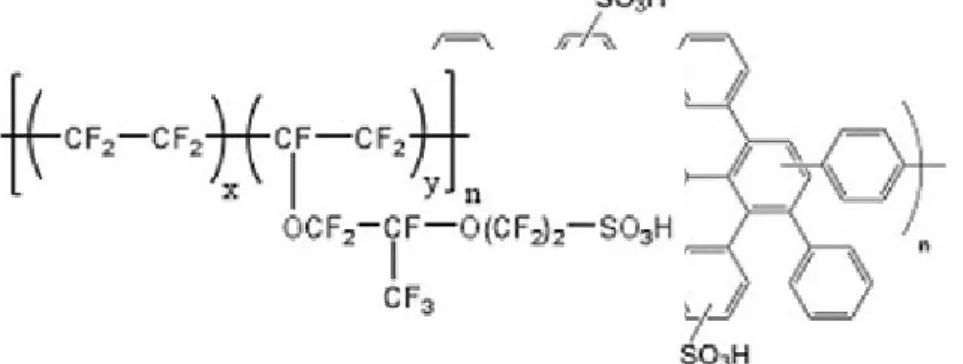
A few such proton exchange membranes with outstanding chemical resistance & high conductivity that have shown promising features as fuel cell electrolytes are; Poly(Perfluorosulfonic acid) (PFSA)-based membranes - among them Nafion, Aquivion, 3M ionomer etc.
Fig: Nafion Proton exchange polymer structure Fig: Sulfonated poly(phenylene) Proton exchange
polymer structure
Also the membrane performance for above applications have been observed in aromatic polymers such as; poly(imide) poly(phenylene), poly(ketone) and poly(sulfone ) backbones.
Application of Block copolymers
One such strategy for creating highly conductive proton exchange membranes is to control the connectivity and size of hydrophilic phases throughout the material. Further To promote the formation of ordered, highly conductive ionic domains, block copolymers have gained considerable attention. Many of the latest examples of high performing proton exchange membranes have relied on block copolymer designing to adjust the size of the ionic domain and to optimize the mechanical reinforcement provided by the hydrophobic blocks. There are a few outstanding examples of block copolymers with robust poly(arylene) backbones
Conclusion
Faster water motion in polymer membranes, as quantified by water self diffusion measurements and other techniques, leads to higher ionic conductivity. Therefore the water motion in hydrated polymers and the morphology of ionic domains are key features of these materials that allow their transport properties to be understood at a molecular level.
2. Michael A. Hickner "Ion-Containing Polymers: New Energy & Clean Water" Materials Today May 2010, Volume 13, Number 5
First, conducting polymers uniquely combine chemical, electrical and mechanical properties. This offers convenience in manipulating electrical properties by chemical doping. Ionically functionalized polyacetylenes have been used to develop an approach to stable interfaces between dissimilarly doped regions. Such interfaces provide a means of realizing regions of charge depletion analogous to that at traditional inorganic semiconductor interfaces Another favorable property of ionically functionalized polyacetylenes is that they are a single component system, in contrast to the polymer blends often used in studies of MIECs and where phase separation is a potential problem.
To understand the electrical characteristics of MIECs consisting of an ionically functionalized polyacetylene sandwiched between two metal electrodes, it is necessary to introduce charge transport processes in semiconductors. charge transport can be roughly divided into two processes in series: (i) charge transport across the metal-semiconductor interfaces (injection) and (ii) charge transport within the semiconductor.
Determination of molecular weight of polymer by intrinsic method using ostwalds viscometer
When a known quantity of of polymer is dissolved in a pure solvent (water, organic solvent)of low viscosity , an increase in the viscosity of the solvent is observed whose magnititude depends on conc, size, shape and mol wt.
The ratio of viscosity coefficient of solution(ηs) and and pure solvent(ηp) is known as relative
viscosity.
By plotting the graph of (ηred)versus
concentration gives a sytraight lineas per equation( 6)
Where m is the slope and the
r =
s
p
s
pt
s
t
p
= 1
s
p are densities of solution and pure solventt
pand
t
s and are time of flow of specific solution and solvent for a given polymer
s
=
p equation 1 becomes( )
s
viscosity coefficient of solutionviscosity coefficient of pure solvent
p
rt
st
p 2=
( ))sp
specific viscosity
sp
s
p
p
p
s
1
=
=
( )3
sp
r1
=
t
st
p1
=
(4)
red
=
sp
C(5)
red
Reduced viscosity
red
=
sp
C
number .The value of intrinsic viscosity is independent of conc and is obtained by extrapolating the line on to ordinate as shown below.
Thus the viscosity value which is independent of concentration is called limiting value of viscosity is also known as intrinsic viscosity
In case of linear polymers, the value of
intrinsic viscosity and the molecular weight observed to obey Mark-Khun-Houwink equation which is given by
Where both ‘K’ and ‘a’ are
the conatants for a given polymer solvent and temperature generally the value of ‘a’ lies in the range of 0.6-0.8, and K*104 lies in between 0.5-5.
Procedure
(A)Preparation of polymer solution of different concentration
Weigh the know n amount of polymer powder transfer into the 100 ml standard flask add water to dissolve the salt and make it up to the mark with the distilled water.
Prepare a series of polymer solution of lower concentration (0.1%, 0.2%, 0.3%, 0,4% etc) with proper dilution of the above prepared polymer stock solution.
(B) Time of flow measurement using Ostwald’s viscometer
Take a clean and dry Ostwald’s viscometer pipette out 10 ml of pure solvent into the wider limb of the viscomater anf fix to the stand in such a way the bulb is immresed in water bath , allow the viscometer to stand in the bath for 5 minutes to attain the lab temperature . To the smaller limb fix the rubber tube and suck the liquid to the upper mark X switch on the stop clock allow the liquid to flow in downward direction when the liquid level reaches mark Y stop the clock , record the time of flow of liquid.
Dicard the pure solvent and dry the viscometer using acetone. Now measure the time of flow of solution in the order (0.1%, 0.2%, 0.3%, 0,4% ) and finally 0.5%
Observation and calculations Temperature of water bath = Solvent used
constant values of polymer at a given temperature K*104 =
a =
Polymer
solution conc (g/
Flow time (s) Relative viscosity
Specific viscosity
Reduced viscosity []
sp /C
intrinsic viscosity
conc(g/mol)
sp
C
= mC (7)
cm3 )
Pure solvent tp
0.1 t1
0.2 t2
0.3 t3
0.4 t4
0.5 t5
(d) Determination of Intrinsic viscosity
Plot graph of reduced viscosity values versus concentration, extrapolate the line to y-axis i,e., to zero concentration and record the value intercept which is Intrinsic viscosity [η]
(e) Determination of molecular weight We know the equation ;
The above equation can be written as ;
Result :
Molecular weight of the given polymer has been calculated and the value found to be
= KMa
log =
=
log K a logM
logM log log K a