College completion predicts lower depression but
higher metabolic syndrome among disadvantaged
minorities in young adulthood
Lauren Gaydosha, Kristen M. Schorppb, Edith Chenc,d, Gregory E. Millerc,d, and Kathleen Mullan Harrisa,e,1
aCarolina Population Center, University of North Carolina at Chapel Hill, Chapel Hill, NC 27516;bDepartment of Sociology, Roanoke College, Salem, VA
24153;cInstitute for Policy Research, Northwestern University, Evanston, IL 60208;dDepartment of Psychology, Northwestern University, Evanston, IL 60208;
andeDepartment of Sociology, University of North Carolina at Chapel Hill, Chapel Hill, NC 27599
Contributed by Kathleen Mullan Harris, October 31, 2017 (sent for review August 23, 2017; reviewed by Peter S. Bearman and Douglas S. Massey)
Individuals with higher educational attainment live healthier and longer lives. However, not everyone benefits equally from higher education. In particular, the black–white gap in life expectancy is greater at higher levels of educational attainment. Furthermore, recent research suggests that disadvantaged African Americans in the rural Southeast who attend college have worse physical health than their similarly disadvantaged peers who do not attend college. The extent to which this pattern generalizes to a nationally repre-sentative, mixed-race sample is unknown. Using data from the Na-tional Longitudinal Study of Adolescent to Adult Health, we test whether the health benefits associated with college completion vary by level of childhood disadvantage for depression and meta-bolic syndrome in young adulthood, across race/ethnicity. We find uniform lower depression associated with college completion re-gardless of childhood disadvantage, and across non-Hispanic white, non-Hispanic black, and Hispanic young adults. College completion is associated with lower metabolic syndrome for whites across all levels of childhood disadvantage. In contrast, college completion is associated with higher metabolic syndrome among black and His-panic young adults from disadvantaged childhood environments. Our findings suggest that, for minorities from disadvantaged back-grounds, finishing college pays substantial dividends for mental health but simultaneously exacts costs with regard to physical health. This pattern contrasts starkly with whites and minorities from more privileged backgrounds, for whom college completion is associated with benefits to both mental and physical health. These results suggest that racial disparities in health may persist in part because the health of upwardly mobile minorities is compro-mised in young adulthood.
social mobility
|
health disparities|
race and ethnic disparities|
young adulthoodI
ncome and wealth inequality in the United States is high and has been growing since the 1970s, with an increasing concentration of fortunes in the top of the distribution (1–4). Upward inter-generational income mobility has become less likely over this period (5). While access to education has expanded, increasing population levels of college attainment have been met with a si-multaneous intensification of differentiation within categories of educational attainment according to the quality of the educational degree (6). Alongside the rise in income inequality, increases in income segregation mean that the affluent are increasingly isolated in affluent communities, concentrating high-quality public goods, including schools, in restricted geographic locations (7). Income segregation combined with racial segregation results in black and Hispanic individuals living in more disadvantaged neighborhoods and attending lower-quality schools than whites with the same level of income and assets (8–10). Furthermore, there is evidence that the returns to housing and educational investments are lower for blacks and Hispanics than they are for whites (11, 12).This context of inequality has been reflected in socioeconomic gradients in health. The socioeconomic gradient in health and
mortality in the United States is large, persistent, and increasing over time (13–16). While greater levels of socioeconomic re-sources broadly defined are associated with better health, educa-tion demonstrates the most consistently robust associaeduca-tion (17). More-educated individuals live healthier and longer lives; indi-viduals with a college degree can expect to outlive their less-educated counterparts by about a decade (18).
However, higher socioeconomic status (SES) is not equally beneficial for all individuals; within SES categories, non-Hispanic whites enjoy better health outcomes than non-Hispanic blacks, and this gap is wider at higher levels of SES (19, 20). Weathering is a conceptual framework that has been proposed to explain this pattern (21). Minorities face greater exposure to stressors, in-cluding discrimination and institutionalized racism, that requires sustained coping (22–25). Another conceptual framework relevant to these patterns is John Henryism, which suggests that individual characteristics such as self-control, grit, and perseverance promote psychosocial well-being and achievement but can be physiologi-cally taxing because they result in sustained activation of the stress-response system (26–28). This results in biological wear and tear, accelerated aging, and accumulated risk, also referred to as allo-static load (29, 30). Such stress-related deterioration is manifested in physiological risk across biological systems (29). Alongside this increasing emphasis on the importance of accumulated stressors
Significance
College graduates enjoy healthier, longer lives compared with individuals who do not graduate from college. However, the health benefit of educational attainment is not as great for blacks as it is for whites. Moreover, college completion may not erase the detrimental effects of early-life disadvantage for blacks and Hispanics. We use nationally representative data on young adults to test whether American minorities experience differential returns to educational attainment. We find that college completion predicts lower rates of depression for all racial groups. It also predicts lower metabolic syndrome among whites. However, college completion predicts higher metabolic syndrome among black and Hispanic adults from disadvan-taged backgrounds, suggesting upward mobility may come at a health cost to young minorities in America.
Author contributions: L.G., E.C., G.E.M., and K.M.H. designed research; L.G., K.M.S., and K.M.H. performed research; L.G., K.M.S., and K.M.H. analyzed data; and L.G., K.M.S., E.C., G.E.M., and K.M.H. wrote the paper.
Reviewers: P.S.B., Columbia University; and D.S.M., Princeton University.
The authors declare no conflict of interest.
This open access article is distributed underCreative Commons Attribution-NonCommercial-NoDerivatives License 4.0 (CC BY-NC-ND).
1To whom correspondence should be addressed. Email: [email protected].
This article contains supporting information online atwww.pnas.org/lookup/suppl/doi:10. 1073/pnas.1714616114/-/DCSupplemental.
SO
CIAL
has been the recognition of the role of early-life environments in shaping adult health outcomes (31–33).
In a recent set of papers, Brody, Chen, Miller, and colleagues investigate the health consequences of the intersection of high-effort coping and early-life disadvantage among young adult Af-rican AmeAf-ricans living in the rural Southeast. They document a pattern of“skin-deep resilience”among African Americans from severely disadvantaged backgrounds wherein those who evince high levels of self-control prospectively demonstrate better school outcomes and mental health than those with lower levels of self-control, suggesting that they are psychologically resilient to dis-advantage. However, these psychologically resilient individuals simultaneously display signs of compromised physical health, in-cluding higher allostatic load, greater cardiometabolic risk, more epigenetic aging of leukocytes, and greater susceptibility to re-spiratory infection (34–37).
These findings suggest that for African Americans from severely disadvantaged backgrounds, upward mobility may have divergent consequences for mental and physical health. However, the gener-alizability of this phenomenon is unclear; most of the findings come from small cohorts of African Americans in the rural Southeast, and whether the same pattern unfolds with upward mobility in other ethnic and racial groups across the United States is unknown. The majority of existing research has concentrated on black–white dif-ferences in health (20, 38, 39). However, the stress induced by upward mobility is likely greater among any minority group for whom systems of inequality constitute additional and compounding barriers to achieving upward mobility. Indeed, the experience of young adulthood and the process of becoming socially mobile vary by race/ethnicity. Both African Americans and Hispanics are more likely to be incarcerated, live in poverty, be unemployed, and have lower incomes for a given level of education compared with whites (40–42). Differences in the life course markers and transitions among minority young adults not only affect their prospects for becoming upwardly mobile but also affect the amount of distress and sustained effort required to achieve upward mobility. These differences have important implications for the experience and potential health consequences of mobility for minorities.
We consider that possibility here, using a large, nationally rep-resentative study with longitudinal data spanning 14 y that include young adults from all race, ethnic, socioeconomic, and geographic contexts in America. Drawing from the literatures on weathering, John Henryism, and skin-deep resilience, we predicted there would be racial and ethnic disparities in the mental and physical health benefits associated with a college degree. We used self-reported depressive symptoms as a measure of mental health, as it is a mental health problem that increases during adolescence and re-mains prevalent for young adults (43–46). Morbidity and mortality are unusual in 24- to 32-y-olds, so we measured physical health in terms of metabolic syndrome, a cluster of signs that is common in midlife and forecasts risk for later diabetes, heart attack, stroke, and premature mortality (47, 48). Among whites from all socio-economic backgrounds, we hypothesized that finishing college would be associated with uniformly positive returns in adulthood,
as reflected in fewer depressive symptoms and better car-diometabolic health at ages 24–32 y. However, among ethnic and racial minorities, we hypothesized there would be mixed returns to finishing college, particularly for those from the most severely disadvantaged backgrounds, who are likely to face racism, dis-crimination, and isolation as they progress through education. Specifically, we predicted these individuals will go on to have better mental health, as reflected in fewer depressive symptoms at ages 24–32 y, but simultaneously worse cardiometabolic health.
Results
The data were drawn from the nationally representative National Longitudinal Study of Adolescent to Adult Health (Add Health), an ongoing study of the social, behavioral, and biological linkages in health and developmental trajectories. Our analysis examined non-Hispanic white, non-Hispanic black, and Hispanic young adults interviewed in adolescence (wave I, age 12–18 y) and early adulthood (wave IV, age 24–32 y). From these data we generated a composite indicator of exposure to disadvantage in adolescence by summing the number of top quintile values across household, neighborhood, and school contexts (see details in Materials and Methods). Table 1 shows that black and Hispanic individuals ex-perienced significantly higher levels of disadvantage in adoles-cence compared with white peers. By early adulthood, both race/ ethnic minorities were also significantly less likely to complete a college degree than whites.
We measured adult depressive symptoms at wave IV using a subset of nine items from the Center for Epidemiologic Studies Depression scale (CES-D) (see details inMaterials and Methods). Whites reported the fewest depressive symptoms on average (4.55), followed by Hispanics (5.65) and blacks (6.07). The mea-surements were collected in home visits during wave IV. We constructed an indicator of metabolic syndrome, modifying slightly the National Cholesterol Education Program guidelines to ac-commodate the available Add Health biomarkers. We used measures of blood pressure, glycosylated hemoglobin, HDL cho-lesterol, triglycerides, and waist circumference (see details in
Materials and Methods). Similar to the pattern observed for de-pression, and consistent with the broader epidemiologic literature, whites were the least likely to have metabolic syndrome (26%) compared with Hispanics (32%) and blacks (35%).
We tested for psychosocial resilience using Poisson regression for the count of the number of depressive symptoms reported with models stratified by race/ethnicity (Table S2). In all models, sex and age were modeled as covariates. Individuals from disadvan-taged childhood backgrounds reported more depressive symptoms in adulthood, and those who completed a college degree reported fewer depressive symptoms. To test whether the association be-tween college education and depression varies by level of ado-lescent disadvantage we included an interaction term. There was no evidence that the depression-buffering association of college completion varies by exposure to disadvantage in adolescence for whites (P=0.32) or Hispanics (P=0.24). Furthermore, among black young adults, a college degree was associated with even
Table 1. Descriptive statistics by race/ethnicity, mean (SD) or percent
Variable White Black Hispanic Black–white difference* Hispanic–white difference*
Female 51.43 54.50 51.54 P=0.414 P=0.400
Age (wave IV) 28.24 (1.66) 28.51 (2.23) 28.39 (2.22) P=0.243 P=0.523
Adolescent disadvantage index 3.65 (3.18) 10.13 (5.23) 7.15 (5.35) P<0.001 P<0.001
College degree 32.58 20.77 19.27 P<0.001 P<0.001
Depressive symptoms 4.55 (3.71) 6.07 (5.24) 5.65 (4.85) P<0.001 P=0.004
Metabolic syndrome 25.81 34.70 32.08 P<0.001 P<0.001
N 6,901 2,482 1,403
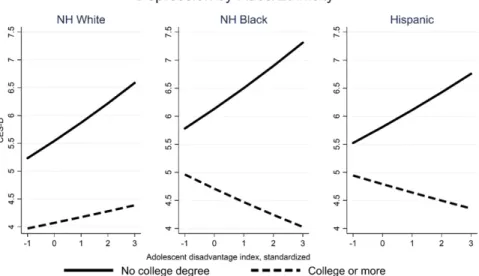
fewer depressive symptoms for individuals from increasingly dis-advantaged childhood backgrounds (P < 0.05). Controlling for baseline depressive symptoms in adolescence does not sub-stantively alter the conclusion. As Fig. 1 illustrates, the results were consistent with the hypothesis that greater educational at-tainment is associated with psychosocial benefits for individuals from all socioeconomic backgrounds and of varying race/ethnicity. We tested the differential benefits of college completion for physical health using logistic regression to predict the odds of having metabolic syndrome with models stratified by race/ethnicity
(Table S3). In all models, sex and age were modeled as covariates.
Among white young adults, each SD increase in adolescent dis-advantage was associated with a 10% increase in the odds of metabolic syndrome (P< 0.05). College completion was associ-ated with a 37% decrease in the odds of metabolic syndrome (P<
0.001). There was no evidence that this health-protective associ-ation of college completion varied by level of adolescent disad-vantage (P = 0.33). Results are substantively similar when controlling for measures of physical health in adolescence.
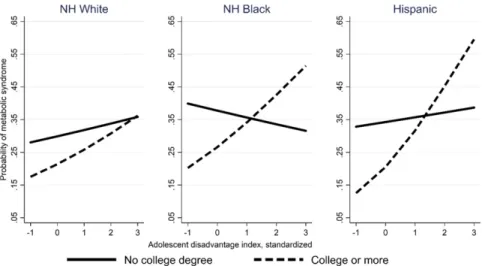
As demonstrated in Fig. 2, the results were different for black and Hispanic adults compared with whites. At low levels of ex-posure to adolescent disadvantage college completion predicted a lower probability of metabolic syndrome compared with those without a college degree. However, as exposure to adolescent disadvantage increased, the health benefit associated with college completion declined. In fact, at high levels of disadvantage (>1 SD above mean), black and Hispanic adults with a college degree were predicted to be more likely to have metabolic syndrome compared with their similarly disadvantaged peers who did not complete college. For example, a black adult exposed to an ado-lescent environment of disadvantage two SDs above the mean who completed college had a predicted probability of metabolic syn-drome 9% points higher than a peer who did not complete college (0.43 compared with 0.34).
Follow-up analyses verified that the physical health benefit associated with college completion was significantly different for Hispanic and black adults compared with whites (Table S4). Specifically, we tested for race/ethnic differences in a single lo-gistic regression model pooling the three groups and including additional indicators for black/Hispanic identity interacted with adolescent disadvantage and college degree (i.e., a three-way interaction). The main effect of college degree indicated that
college completion is associated with lower odds of metabolic syndrome [odds ratio (OR)=0.59,P<0.001]. The interaction between adolescent disadvantage and college completion— rele-vant for the reference group of whites—was not statistically sig-nificant (P= 0.54). However, the three-way interaction between adolescent disadvantage, college completion, and black/Hispanic identity was positive (OR=1.44) and marginally significant (P<
0.10). These findings indicate that for black and Hispanic adults the metabolic“benefit”associated with college completion diminishes— and indeed appears to become a liability—with increasing levels of exposure to adolescent disadvantage.
Discussion
Upward social mobility is a tenet of the American dream. Scholars and policymakers interested in health and inequality would hope that greater social and economic advantage attained in adulthood would improve health outcomes compared with remaining disad-vantaged. Indeed, many social policies are premised on the belief that by promoting socioeconomic success among the disadvan-taged we can improve their well-being and physical health, cre-ating a healthier and more productive population. Consistent with these aspirations, we found that young adults from disadvantaged backgrounds who achieve upward mobility by attaining a college degree report fewer depressive symptoms compared with their similarly disadvantaged peers who do not complete college. This relationship holds for non-Hispanic whites, blacks, and Hispanics. In contrast, for metabolic syndrome we found that individuals do not uniformly benefit from a college degree; black and Hispanic adults from the most disadvantaged backgrounds face higher levels of metabolic syndrome with a college degree than those without a college degree. While whites from across the socioeco-nomic spectrum enjoy a physical health benefit associated with college completion, blacks and Hispanics from disadvantaged backgrounds see no benefit and at higher levels of disadvantage may actually experience a cost. If this relationship persists through adulthood and older age it has the potential to undermine the individual and social benefits of upward mobility.
This is the first evidence documenting the psychological benefit and physiological deficit of college completion in both disadvan-taged African American and Hispanic American young adults in a nationally representative sample. Our findings are consistent with a pattern of skin-deep resilience among upwardly mobile
Fig. 1. Predicted number of depressive symptoms from race-stratified Poisson regression models allowing for an interaction between adolescent disad-vantage and college completion. The association between college completion and depression does not vary according to level of exposure to disaddisad-vantage in adolescence for whites (P=0.32) and Hispanics (P=0.24) and increases with disadvantage for blacks (P<0.05).
SO
CIAL
minorities from severely disadvantaged backgrounds (35, 37). What might underlie these patterns? We speculate that these upwardly mobile minority youth are psychologically hardy. However, when young adults from disadvantaged backgrounds achieve upward mobility the higher-status environment in which they find themselves may differ greatly from their social envi-ronment of origin (49, 50); such incongruence can lead to iso-lation and a lack of social support (20, 51–53). Furthermore, conditions in the environment of arrival may be inhospitable or hostile, particularly given discriminatory social structures. Up-wardly mobile minorities may also feel that their achieved posi-tion is tenuous (54, 55). To cope with these stressors, individuals may deploy strategies that are effective in alleviating mental strife but are harmful for physical health (51, 56). Despite such chal-lenges, these young adults complete their degrees and maintain good mental health. As they do so, however, a wear and tear on bodily systems from hard-driving effort may accrue.
In supplementary analyses of metabolic syndrome (Table S5) we tested the mediating role of four potential mechanisms: indi-vidual psychosocial characteristics of striving in adolescence and perseverance in adulthood, social isolation in adolescence and adulthood, experience of stressful life events in adolescence and adulthood and perceived social stress in adulthood, and adoles-cent body mass index. Accounting for differences in individual levels of striving and exposure to social stressors does not explain the elevated health risk observed among disadvantaged minority college graduates. Future research must consider both more nu-anced measures of the social context in which upward mobility occurs as well as more complicated intersections of stress exposure and response.
The absence of a physical health benefit to college completion for young adult minorities suggests important implications for the labor force, health care, and the future of inequality. If they do not experience the expected health benefits of educational attainment, upwardly mobile minorities may spend less time in the labor force, limiting their resource accumulation and the intergenerational transfer of wealth, consequently stunting potential for reducing inequality within and across generations. Furthermore, accelera-ted physiological deterioration may mean that they will need more health care at earlier adult ages. Greater health-care costs could divert investment from future human capital development in themselves and their children. Finally, given the persistence of
inequality and the difficulty of mobility in the United States, it is troubling if the individuals who manage to achieve upward mo-bility experience health costs. Perhaps more troubling still is that this pattern is limited to black and Hispanic individuals, poten-tially making it more challenging to close existing racial disparities in health.
However, it would be erroneous to conclude from our findings that upward mobility is bad for your health and should therefore be avoided. Rather, policies are needed that promote upward mobility, making it more common and less stressful, and sup-porting the upwardly mobile individual’s ability to translate his or her additional education into health-promoting resources. This should include increased attention to educational quality in ad-dition to access. Recent publicity of the challenges faced by first-generation college students provides an opportunity to examine how supportive interventions affect not only completion, but mental and physical health. Online communities, such asI’m First!, provide student testimonials and information to support first-generation students in accessing and completing college. Many colleges and universities are beginning to offer programs tailored to the needs of first-generation students, such as the Harvard College First Generation Student Union. Such programs may in-crease feelings of belonging and reduce stress; for example, a social-belonging intervention not only reduced the achievement gap but also demonstrated physical health improvements among minority students (57). Design and evaluation of other interven-tions, with specific attention to the potential physical health risks of college completion among disadvantaged minorities, is a fruitful area for future research.
Future research can also address a limitation of this study by following individuals across the life course to better understand how elevated health risk at this age shapes health and aging tra-jectories among the upwardly mobile. We examined a composite measure of metabolic syndrome in early adulthood, when re-spondents were aged 24–32 y. The use of biomarker measure-ments allows us to investigate risk before disease onset when many conditions are asymptomatic or undetected via traditional clinical screening. Nevertheless, it remains unknown whether such risk will ultimately manifest in morbidities, or if upwardly mobile individ-uals will be able to translate their accumulating advantage into better health as they age. Documenting the health consequences associated with social mobility in early adulthood provides a
foundation from which to understand different aging trajectories for those from disadvantaged backgrounds that begin during the transition to adulthood. In addition, the elevated health risk asso-ciated with upward mobility for disadvantaged minority young adults may partially explain the persistent racial disparity in health across place and time among older adults at the same level of SES (58).
Materials and Methods
Sample and Design.Add Health is an ongoing national longitudinal study representative of American adolescents in grades 7–12 in 1994–1995. The initial sample included 20,745 adolescents aged 12–20 y; since the start of the study, participants have been interviewed in home at four data collec-tion waves. At wave IV in 2008–2009, respondents were aged 24–32 y (n=
15,701, 80.3% response rate) and asked to participate in biological specimen collection (over 95% provided specimens, almost 15,000).
We limited our analytic sample to respondents who participated in both waves I and IV home interviews, were from schools that participated in the in-school and in-school administrator surveys, and had valid sampling weights (n=
14,167). From this sample, we conducted listwise deletion to exclude those without complete data for all predictors and demographic covariates used in the analysis, leaving us with a final sample size ofn=13,009 for the depressive symptoms analysis. An additional 20% of respondents had missing data for at least one biological indicator of metabolic syndrome, yielding a sample size of n=10,786 for the metabolic syndrome analysis. All data were analyzed with institutional review board approval from the University of North Carolina at Chapel Hill. Information on how to obtain the Add Health data files is available on the Add Health website (www.cpc.unc.edu/addhealth).
Race/Ethnicity.At wave I, individuals were asked,“What is your race?”and instructed to indicate as many categories as applied. They were also asked a separate question,“Are you of Hispanic or Spanish origin?”We classified any individual who indicated yes as Hispanic. We classified individuals as non-Hispanic white if they did not identify as Hispanic and reported their race as white only. We classified individuals as non-Hispanic black if they did not identify as Hispanic and reported their race as black only; 135 individuals identified as both white and black, and were excluded from analysis, and 370 foreign-born individuals were also excluded from analysis.
Adolescent Disadvantage.To measure childhood disadvantage, we constructed a count of 22 binary indicators that capture cumulative exposure to household, school, and neighborhood disadvantage over childhood and/or during ado-lescence (wave I;Table S1). Household disadvantage indicators include a binary indicator of single-parent family structure at birth, experience of any family structure change across childhood and adolescence, parent education less than high school, and a retrospective measure of household welfare receipt during childhood or adolescence. Neighborhood disadvantage indicators were taken from the 1990 US Census to best approximate neighborhood conditions during wave I of the Add Health study. Neighborhood disadvantage measures include the tract-level proportion of households receiving welfare, proportion of un-employed adults, proportion of households below poverty line, proportion of adults with less than a high school education, proportion female-headed households, proportion black residents, proportion vacant homes, and the county-level infant mortality rate and violent crime rate. Each item was reco-ded so those residing in neighborhoods at the top quartile of the distribution were coded as disadvantaged. Finally, indicators of school disadvantage at wave I included school-level aggregated measures of the proportion of households receiving welfare, the proportion of unemployed parents, the proportion of parents with less than a high school education, and the pro-portion of single-parent households. All items were recoded as binary indica-tors, with the top quartile coded as disadvantaged. School disadvantage was also captured using wave I school administrator reports of grade retention, the school dropout rate, class sizes, the proportion of teachers with a master’s degree, and daily school attendance. Consistent with other items in the index, school administrator items were recoded as binary indicators, with the top
quartile of grade retention, dropout rate, and class size coded as disad-vantaged and the bottom quartile of teachers with a master’s degree and daily school attendance coded as disadvantaged. We summed all of the in-dicators to create a score ranging from 0 to 22. We standardized the score, so that the coefficients associated with the disadvantage index can be interpreted as the change in health risk associated with a one-SD increase in disadvantage.
Depression.At wave IV, respondents were asked how often they“were both-ered by things that usually don’t bother you,” “could not shake off the blues,” “felt you were as good as other people,” “had trouble keeping your mind on what you were doing,” “felt depressed,” “felt that you were too tired to do things,” “enjoyed life,” “felt sad,”and“felt that people disliked you”over the past 7 d. Response categories ranged from 0 to 3 and included“never or rarely,” “sometimes,” “a lot of the time,”and“most of the time or all of the time.”
Items were summed to produce a continuous scale with a possible range of 0–27.
Metabolic Syndrome.For each biomarker measured at wave IV we defined the high-risk threshold according to the guidelines established by the National Cholesterol Education Program (NCEP) Expert Panel when possible. High-risk blood pressure was defined as measured blood pressure greater than 130/ 85 mmHg, or self-report of doctor-diagnosed hypertension or antihyper-tensive medication. A measured waist circumference of 88 cm or greater for women and 102 cm or greater for men was defined as high risk.
NCEP guidelines specify cut points of HDL and triglycerides for risk thresh-olds; however, Add Health only releases lipid measurements in deciles due to detrending and interconversion procedures (59). As an alternative classifica-tion, we relied on previous estimates from the same time period on the prevalence of hypertriglyceridemia and low HDL in similarly aged males and females (60). This approach has been used previously to create a modified measure of metabolic syndrome in Add Health (61). The top three deciles of triglycerides were defined as high-risk for males, and the top two for females. The bottom two deciles of HDL were defined as high-risk for males, and the bottom three for females. Finally, the NCEP guidelines use fasting blood glu-cose; due to differences in fasting time, we used glycated hemoglobin (HbA1c) as a measure of glycemic homeostasis. HbA1c levels at 5.7% or greater were defined as high-risk (62). Metabolic syndrome is an indicator, defined as hav-ing high risk levels on three or more of the component risk factors. Detailed Add Health data collection procedures and biomarker validation are available elsewhere (63–65).
Mediators.We tested the mediating role of four sets of potential mechanisms. Striving was measured in adolescence (wave I) using a four-item scale drawing from educational expectations, educational aspirations, hopefulness about the future, and belief in hard work. We measured perseverance in adulthood (wave IV) using nine personality items such as optimism, planning for the future, and sense of control over one’s life. We tested the role of social isolation using scales of social isolation in adolescence (lack of social connections with family, friends, and schoolmates and in the community) and adulthood (lack of social connections with family, friends, community, and other social institutions). Social stress was measured using a count of the number of stressful life events reported in adolescence and adulthood, and the Cohen perceived stress scale measured at wave IV. Finally, we investigated the role of obesity using a measure of adolescent body mass index derived from adolescent report of height and weight at wave I.
ACKNOWLEDGMENTS. This research was supported by Eunice Kennedy ShriverNational Institute of Child Health and Human Development (NICHD) Grants F32-HD084117, P01-HD31921, and P2C-HD050924. This research uses data from Add Health, a program project directed by K.M.H. and designed by J. Richard Udry, Peter S. Bearman, and K.M.H. at the University of North Carolina at Chapel Hill and funded by NICHD Grant P01-HD31921 with coop-erative funding from 23 other federal agencies and foundations. We also acknowledge the support of the Russell Sage Foundation Working Group in Biology and Social Science.
1. Piketty T, Saez E (2003) Income inequality in the United States, 1913–1998.Q J Econ
118:1–41.
2. Piketty T, Saez E (2014) Inequality in the long run.Science344:838–843.
3. Saez E (2017) Income and wealth inequality: Evidence and policy implications.
Contemp Econ Policy35:7–25.
4. Saez E, Zucman G (2016) Wealth inequality in the United States since 1913: Evidence from capitalized income tax data.Q J Econ131:519–578.
5. Chetty R, et al. (2017) The fading American dream: Trends in absolute income mobility since 1940.Science356:398–406.
6. Torche F (2011) Is a college degree still the great equalizer? Intergenerational mobility across levels of schooling in the United States. Am J Sociol 117: 763–807.
7. Reardon SF, Bischoff K (2011) Income inequality and income segregation.AJS116: 1092–1153.
8. Logan JR, Minca E, Adar S (2012) The geography of inequality: Why separate means unequal in American public schools.Sociol Educ85:287–301.
9. Orfield G, Yun JT (1999) Resegregation in American schools (The Civil Rights Project, Harvard Univ, Cambridge, MA).
SO
CIAL
10. Massey DS (2007)Categorically Unequal: The American Stratification System(Russel Sage Foundation, New York).
11. Brand JE, Xie Y (2010) Who benefits most from college? Evidence for negative selection in heterogeneous economic returns to higher education.Am Sociol Rev75:273–302. 12. Flippen C (2004) Unequal returns to housing investments? A study of real housing
appreciation among black, white, and hispanic households.Soc Forces82:1523–1551. 13. Elo IT, Preston SH (1996) Educational differentials in mortality: United States, 1979-85.
Soc Sci Med42:47–57.
14. Williams D (1990) Socioeconomic differentials in health: A review and redirection.Soc Psychol Q53:81–99.
15. Kitagawa EME, Hauser PMP (1973)Differential Mortality in the United States: A Study in Socioeconomic Epidemiology(Harvard Univ Press, Cambridge, MA).
16. Chetty R, et al. (2016) The association between income and life expectancy in the United States, 2001-2014.JAMA315:1750–1766.
17. Elo IT (2009) Social class differentials in health and mortality: Patterns and explana-tions in comparative perspective.Annu Rev Sociol35:553–572.
18. Hummer RA, Hernandez EM (2013) The effect of educational attainment on adult mortality in the United States.Popul Bull68:1–16.
19. Williams DR, Collins C (1995) US socioeconomic and racial differences in health: Pat-terns and explanations.Annu Rev Sociol21:349–386.
20. Geronimus AT, Hicken M, Keene D, Bound J (2006)“Weathering”and age patterns of allostatic load scores among blacks and whites in the United States.Am J Public Health96:826–833.
21. Geronimus AT (1992) The weathering hypothesis and the health of African-American women and infants: Evidence and speculations.Ethn Dis2:207–221.
22. Williams DR, Mohammed SA (2009) Discrimination and racial disparities in health: Evidence and needed research.J Behav Med32:20–47.
23. Williams DR, Yan Yu, Jackson JS, Anderson NB (1997) Racial differences in physical and mental health: Socio-economic status, stress and discrimination.J Health Psychol
2:335–351.
24. James SA, Hartnett SA, Kalsbeek WD (1983) John Henryism and blood pressure dif-ferences among black men.J Behav Med6:259–278.
25. Phelan JC, Link BG (2015) Is racism a fundamental cause of inequalities in health?
Annu Rev Sociol41:311–330.
26. James SA, Keenan NL, Strogatz DS, Browning SR, Garrett JM (1992) Socioeconomic status, John Henryism, and blood pressure in black adults. The Pitt county study.Am J Epidemiol135:59–67.
27. James SA (1994) John Henryism and the health of African-Americans.Cult Med Psychiatry18:163–182.
28. James SA, Strogatz DS, Wing SB, Ramsey DL (1987) Socioeconomic status, John Henryism, and hypertension in blacks and whites.Am J Epidemiol126:664–673. 29. McEwen BS, Seeman T (1999) Protective and damaging effects of mediators of stress.
Elaborating and testing the concepts of allostasis and allostatic load.Ann N Y Acad Sci
896:30–47.
30. Seeman TE, Singer BH, Rowe JW, Horwitz RI, McEwen BS (1997) Price of adaptation– Allostatic load and its health consequences. MacArthur studies of successful aging.
Arch Intern Med157:2259–2268.
31. Barker DJ (1995) Fetal origins of coronary heart disease.BMJ311:171–174. 32. Elo IT, Preston SH (1992) Effects of early-life conditions on adult mortality: A review.
Popul Index58:186–212.
33. Hayward MD, Gorman BK (2004) The long arm of childhood: The influence of early-life social conditions on men’s mortality.Demography41:87–107.
34. Miller GE, Yu T, Chen E, Brody GH (2015) Self-control forecasts better psychosocial outcomes but faster epigenetic aging in low-SES youth.Proc Natl Acad Sci USA112: 10325–10330.
35. Brody GH, et al. (2013) Is resilience only skin deep?: Rural African Americans’ socio-economic status-related risk and competence in preadolescence and psychological adjustment and allostatic load at age 19.Psychol Sci24:1285–1293.
36. Miller GE, Cohen S, Janicki-Deverts D, Brody GH, Chen E (2016) Viral challenge reveals further evidence of skin-deep resilience in African Americans from disadvantaged backgrounds.Health Psychol35:1225–1234.
37. Chen E, Miller GE, Brody GH, Lei M (2015) Neighborhood poverty, college attendance, and diverging profiles of substance use and allostatic load in rural African American youth.Clin Psychol Sci3:675–685.
38. Brody GH, Yu T, Miller GE, Chen E (2016) Resilience in adolescence, health, and psy-chosocial outcomes.Pediatrics138:e20161042.
39. Colen CG, Geronimus AT, Bound J, James SA (2006) Maternal upward socioeconomic mobility and black-white disparities in infant birthweight.Am J Public Health96: 2032–2039.
40. Alexander M (2012) The New Jim Crow: Mass Incarceration in the Age of Colorblindness(New, New York).
41. US Census Bureau (2015) Current Population Survey, Annual Social and Economic Supplement, 1996 through 2015 (US Census Bureau, Suitland, MD).
42. Kena G, Musu-Gillette L, Robinson J, Wang X (2015) The condition of education 2015 (National Center for Education Statistics, US Department of Education, Washington, DC).
43. Wickrama KAS, O’Neal CW, Lee TK (2016) Cumulative socioeconomic adversity, de-velopmental pathways, and mental health risks during the early life course.Emerg Adulthood4:378–390.
44. Boardman JD, Alexander KB (2011) Stress trajectories, health behaviors, and the mental health of black and white young adults.Soc Sci Med72:1659–1666. 45. Wight RG, Sepúlveda JE, Aneshensel CS (2004) Depressive symptoms: How do
ado-lescents compare with adults?J Adolesc Health34:314–323.
46. Rushton JL, Forcier M, Schectman RM (2002) Epidemiology of depressive symptoms in the National Longitudinal Study of Adolescent Health.J Am Acad Child Adolesc Psychiatry41:199–205.
47. Mottillo S, et al. (2010) The metabolic syndrome and cardiovascular risk a systematic review and meta-analysis.J Am Coll Cardiol56:1113–1132.
48. Alberti KG, et al.; International Diabetes Federation Task Force on Epidemiology and Prevention; Hational Heart, Lung, and Blood Institute; American Heart Association; World Heart Federation; International Atherosclerosis Society; International Associ-ation for the Study of Obesity (2009) Harmonizing the metabolic syndrome.
Circulation120:1640–1645.
49. Reay D, Crozier G, Clayton J (2009)“Strangers in paradise”? Working-class students in elite universities.Sociology43:1103–1121.
50. Jetten J, Iyer A, Tsivrikos D, Young BM (2008) When is individual mobility costly? The role of economic and social identity factors.Eur J Soc Psychol38:866–879. 51. Hudson DL, Neighbors HW, Geronimus AT, Jackson JS (2016) Racial discrimination,
John Henryism, and depression among African Americans.J Black Psychol42:221–243. 52. Cole ER, Omari SR (2003) Race, class and the dilemmas of upward mobility for African
Americans.J Soc Issues59:785–802.
53. McClure HH, et al. (2010) Discrimination-related stress, blood pressure and Epstein-Barr virus antibodies among Latin American immigrants in Oregon, us.J Biosoc Sci42: 433–461.
54. McBrier D, Wilson G (2004) Going down? Race and downward occupational mobility for white-collar workers in the 1990s.Work Occup31:283–322.
55. Pattillo M (2013)Black Picket Fences: Privilege and Peril Among the Black Middle Class
(Univ of Chicago Press, Chicago).
56. Jackson JS, Knight KM, Rafferty JA (2010) Race and unhealthy behaviors: Chronic stress, the HPA axis, and physical and mental health disparities over the life course.
Am J Public Health100:933–939.
57. Walton GM, Cohen GL (2011) A brief social-belonging intervention improves aca-demic and health of minority students.Science331:1447–1451.
58. Farmer MM, Ferraro KF (2005) Are racial disparities in health conditional on socio-economic status?Soc Sci Med60:191–204.
59. Whitsel EA, et al. (2013) Add health wave IV documentation: Lipids (Carolina Pop-ulation Center, Chapel Hill, NC).
60. Ervin RB (2009) Prevalence of metabolic syndrome among adults 20 years of age and over, by sex, age, race and ethnicity, and body mass index: United States, 2003-2006.
Natl Health Stat Rep13:1–7.
61. Bohr AD, Laurson K, McQueen MB (2016) A novel cutoff for the waist-to-height ratio predicting metabolic syndrome in young American adults.BMC Public Health16:295. 62. Ong KL, et al. (2010) Using glycosylated hemoglobin to define the metabolic
syn-drome in United States adults.Diabetes Care33:1856–1858.
63. Hussey JM, et al. (2015) The reliability of in-home measures of height and weight in large cohort studies: Evidence from add health.Demogr Res32:1081–1098. 64. Nguyen QC, et al. (2011) Discordance in national estimates of hypertension among
young adults.Epidemiology22:532–541.