Imaging of Electrical and
Optogenetic Deep Brain
Stimulation at the Rat Nucleus
Accumbens
Daniel L. Albaugh
1,2,3, Andrew Salzwedel
2,4,5, Nathalie Van Den Berge
1,2,6, Wei Gao
2,4,5,
Garret D. Stuber
3,7& Yen-Yu Ian Shih
1,2,3,8Deep brain stimulation of the nucleus accumbens (NAc-DBS) is an emerging therapy for diverse, refractory neuropsychiatric diseases. Although DBS therapy is broadly hypothesized to work through large-scale neural modulation, little is known regarding the neural circuits and networks affected by NAc-DBS. Using a healthy, sedated rat model of NAc-DBS, we employed both evoked- and functional connectivity (fc) MRI to examine the functional circuit and network changes achieved by electrical NAc stimulation. Optogenetic-fMRI experiments were also undertaken to evaluate the circuit modulation profile achieved by selective stimulation of NAc neurons. NAc-DBS directly modulated neural activity within prefrontal cortex and a large number of subcortical limbic areas (e.g., amygdala, lateral hypothalamus), and influenced functional connectivity among sensorimotor, executive, and limbic networks. The pattern and extent of circuit modulation measured by evoked-fMRI was relatively insensitive to DBS frequency. Optogenetic stimulation of NAc cell bodies induced a positive fMRI signal in the NAc, but no other detectable downstream responses, indicating that therapeutic NAc-DBS might exert its effect through antidromic stimulation. Our study provides a comprehensive mapping of circuit and network-level neuromodulation by NAc-DBS, which should facilitate our developing understanding of its therapeutic mechanisms of action.
Therapeutic deep brain stimulation (DBS) therapy has become an increasingly important clinical tool in neu-ropsychiatry1,2. Among several targets under active clinical consideration for neuropsychiatric DBS, the nucleus accumbens (NAc, ventral striatum) is perhaps the most common. Functionally interfaced with both limbic and executive circuitry3, the NAc has emerged as a promising target for several neuropsychiatric conditions, including obsessive-compulsive disorder (OCD)4 and treatment-resistant depression5.
A longstanding issue with DBS therapy is the unpredictability of the cellular, circuit- and network-level responses to site-specific electrical stimulation, particularly at the high stimulation frequencies that are com-monly employed (>100 Hz)6. Indeed, despite active clinical use, the therapeutic mechanisms of NAc-DBS are poorly understood, impeding the development and refinement of this promising therapy. Functional brain map-ping tools, including positron emission tomography (PET) and functional magnetic resonance imaging (fMRI), are promising avenues for the study of circuit and network modulation by DBS therapy7,8. The key strengths
1Department of Neurology, University of North Carolina, Chapel Hill, NC, 27599, USA. 2Biomedical Research Imaging
Center, University of North Carolina, Chapel Hill, NC, 27599, USA. 3Curriculum in Neurobiology, University of North
Carolina, Chapel Hill, NC, 27599, USA. 4Department of Radiology, University of North Carolina, Chapel Hill, NC,
27599, USA. 5Biomedical Imaging Research Institute, Department of Biomedical Sciences and Imaging, Cedars-Sinai
Medical Center, Los Angeles, CA, 90048, USA. 6Medical Image and Signal Processing Group, Ghent University, Ghent,
9000, Belgium. 7Department of Psychiatry, University of North Carolina, Chapel Hill, NC, 27599, USA. 8Department
of Biomedical Engineering, University of North Carolina, Chapel Hill, NC, 27599, USA. Correspondence and requests for materials should be addressed to W.G. (email: [email protected]) or G.D.S. (email: [email protected]) or Y.-Y.I. S. (email: [email protected])
to fMRI-based studies of DBS include the ability to detect dynamic changes in stimulus-evoked activity and connectivity, in vivo, across the whole brain with reasonably high spatiotemporal resolution. Unfortunately, the implementation of fMRI tools to study NAc-DBS in clinical populations is strongly limited by both obstructive electrode imaging artifacts and appropriate safety considerations (largely pertaining to dangers associated with the introduction of DBS equipment to the MR environment)9.
In contrast to clinical populations, animal models of DBS can be readily studied with fMRI under far more flexible experimental conditions10–13. For example, long-duration scan sessions can be conducted to map the acute neural responses to DBS at varying stimulation frequencies. This is particularly important as DBS therapy for both movement and neuropsychiatric disorders is commonly employed only at high stimulation frequencies, suggesting frequency-dependent mechanism(s) of action6. In the case of NAc-DBS, the effects of stimulation frequency on neural circuit modulation have not been extensively explored using neuroimaging tools. DBS-fMRI in animal models also offers flexibility in electrode choice, in particular those built using more MR-compatible materials, reducing obstructive imaging artifacts14.
In the present study, we employed simultaneous DBS and multimodal fMRI to study the circuit and network-level effects of NAc stimulation in a healthy rat model. This model was chosen based on its widespread use in preclinical studies of NAc-DBS15–20. Electrical stimulation of the NAc strongly modulated prefrontal cor-tex and a diverse complement of subcortical limbic regions, including many areas not previously detected by DBS-fMRI. We also provide the first global functional connectivity mapping of NAc-DBS at therapeutic stim-ulation parameters. Broadly, these DBS-fMRI measurements provide critical information regarding both the pathways modulated by NAc-DBS, as well as the strength of modulation by DBS at therapeutic parameters. Interestingly, the detected pattern and size of CBV modulation by NAc DBS was largely insensitive to stimulation frequency. Supplementing our electrical DBS findings, we describe exploratory optogenetic-fMRI experiments with selective stimulation of NAc neurons.
Materials and Methods
Subjects.
A total of 15 male Sprague-Dawley rats (300–500 g, Charles River Laboratories, Wilmington MA) were included in this study. Rats were individually housed in cages with food and water available ad libitum and 12:12 day–night cycles with control of humidity and temperature. All procedures were performed in accordance with the National Institutes of Health Guidelines for Animal Research (Guide for the Care and Use of Laboratory Animals) and approved by the University of North Carolina Institutional Animal Care and Use Committee.Experimental Overview.
This study broadly consisted of four different experiments: 1) Evoked-fMRI of electri-cal NAc-DBS at 130 Hz (300 μA stimulation); 2) Evoked-fMRI of electrical NAc-DBS to examine frequency-dependency of fMRI responses (10, 40, 70, 130, 200 Hz; 500 μA stimulation); 3) Functional connectivity (fc) MRI measurements of network-level responses to NAc-DBS at 130 Hz (300 μA stimulation); and 4) Evoked-fMRI responses to selective opto-genetic stimulation of NAc neurons. Evoked- and fcMRI experiments were conducted in the same group of subjects (and scanning session), whereas optogenetic experiments were conducted in a separate group of subjects.Stereotactic Surgery.
For all surgical procedures, rats were endotracheally intubated and mechanically ven-tilated using a small animal ventilator (CWE Inc., SAR-830/PA, Ardmore, PA). Anesthesia was maintained under a constant flow of 2% isoflurane mixed with medical air, and physiological parameters were continuously monitored and maintained within normal ranges using capnometry (Surgivet, Smith Medical, Waukesha, WI) and pulse oxi-metry (MouseOx Plus, STARR Life Science Corp., Oakmont, PA). Animals were head-fixed to a stereotactic frame (Kopf Instruments, Model 962, Tujunga, CA), and burr holes were prepared according to experimental coordinates. For electrical DBS experiments, homemade MRI-compatible two-channel tungsten microelectrodes were fabricated as previously described14, and targeted to the mediodorsal boundary of the NAc core/shell (2.28 mm anterior to bregma, 1.2 mm right of midline, and 6.6 mm ventral to cortical surface). Two electrode leads (50 μm each in diam-eter, approximately 1 cm in length), were adhered with a saturated sucrose solution for minimal interspace distance. These electrodes were fully insulated with polyimide except at the tips, with an in vitro impedance of 18–22 kΩ at 1 kHz14. For optogenetic DBS experiments, viral microinjections were targeted to the same stereotactic coordinates used for electrode implantations. Injections were administered as either 1 or 2 μl volumes at a flow rate of 0.1 and 0.2 μl/min, respectively (total infusion time = 10 min). An additional 10 min was given for virus diffusion prior to slow retraction of the microsyringe needle. Chronically-implantable optical fibers (200 μM; NA: 0.37)21 were placed 0.5 mm above virus injection sites.For all experiments, MR-compatible miniature brass screws (Item #94070A031, McMaster Carr, Atlanta, GA) were anchored to the skull, and dental cement was used to seal implanted components. Surgical sutures were employed to further protect the surgical site. For electrical DBS experiments, a recovery period of at least 24 h was given prior to fMRI, while at least three weeks were given for optogenetics experiments to allow for sufficient viral expression.
Smith Medical, Waukesha, WI) and pulse oximetry (MouseOx Plus, STARR Life Science Corp., Oakmont, PA). EtCO2 values from the capnometry system were previously calibrated against invasive sampling of arterial blood gas, reflecting a pCO2 level of 30–40 mm Hg22,23.
Functional MRI.
MR images were acquired on a 9.4-Tesla Bruker BioSpec system with a BGA-9S gradient insert (Bruker Corp., Billerica, MA). A homemade single-loop surface coil with an internal diameter of 1.6 cm, placed directly over the head, was used as a transceiver. Toothpaste was applied within the open coil loop to min-imize MR susceptibility artifacts. The set-up of the coil and DBS electrode is shown in Fig. 1A.Magnetic field homogeneity was optimized first by global shim and followed by local first- and second-order shims using the FASTMAP protocol24. For anatomical referencing, a T
2-weighted RARE pilot image was taken in the mid-sagittal plane to localize the anterior commissure; this structure is located at approximately 0.36 mm posterior to the bregma and served as a reference for anteroposterior slice positioning in subsequent anatomical and functional scans. T2-weighted anatomical images were obtained using a RARE sequence (scan parameters: TR = 2500 ms, TEeff= 33 ms, RARE factor = 8, slice thickness = 1 mm, matrix size = 256 × 256, FOV = 2.56 × 2.56 cm2). Twelve coronal slices were acquired, with the 5th slice from the anterior direction aligned with the anterior commissure (as revealed in the previous T2-weighted pilot scan). The reduced electrode distortion artifact (Supplemental Figure S1), together with standardized slice positioning, rendered these images sufficient to localize the electrode tip placement, as previously described12,14. As visualized slices were 1 mm thick, all correctly targeted electrodes fell within this coronal section we deemed this resolution adequate given the rel-atively large anteroposterior size of the NAc. For optogenetic-fMRI experiments, optical fiber placements above the NAc virus injection site were similarly visualized using the anatomical images. Electrode and optical fiber placements within the NAc were confirmed for each rat (Fig. 1B and Supplemental Figure S1); animals with place-ments outside of the target regions or defective electrodes were discarded for subsequent experiplace-ments (n = 3).
Following setup processes and immediately prior to cerebral blood volume (CBV) fMRI scan acquisition, rats were administered Feraheme (30 mg Fe/kg, i.v.). Subsequently, anesthesia was switched from 1.5–2% isoflurane to sedation using dexmedetomidine (dexdomitor; 0.05 mg/kg/hr, i.v.) cocktailed with the paralytic agent pancu-ronium bromide (0.5 mg/kg/hr, i.v.) (to facilitate mechanical ventilation). This cocktail was administered for the remaining scan duration, continuously supplemented by 0.5% isoflurane25. A delay of at least 10 min was given before beginning fMRI experiments, to allow animals to adjust to sedation. Total experimental duration was lim-ited to a maximum of three hours (following dexmedetomidine administration for all subjects.
CBV fMRI was chosen against the more traditional blood-oxygen-level-dependent (BOLD) fMRI due to its superior contrast-to-noise ratio26. CBV fMRI scans were acquired using a multi-slice single-shot gradient echo echo-planar imaging sequence (GE-EPI) (scan parameters: TR = 1000 ms, TE = 8.1 ms, bandwidth = 250 kHz, slice thickness = 1 mm, matrix size = 80 × 80 (zero-padding to 128 × 128), and FOV = 2.56 × 2.56 cm2. Image slice geometry was imported from the previously acquired T2-weighted anatomical image (12 slices).
Deep Brain Stimulation (DBS).
Simultaneous electrical DBS with CBV fMRI was acquired in the same manner for all subjects showing accurate electrode placement (n = 9), using bipolar and uniformly-distributed unilateral stimulation of the right NAc. Subjects with inaccurate electrode placement were excluded for subse-quent experiments. Each stimulation period consisted of a series of TTL-triggered biphasic, charge-balanced square-wave pulses delivered at 130 Hz, with a stimulation intensity of 300 μA and pulse duration of 90 μs (Experiment 1). A 70 s block design paradigm was implemented (adopted from one of our previous DBS-fMRI studies)12, consisting of 20 s of rest (stimulation OFF) followed by 10 s of stimulation ON, and an additional 40 s of rest (stimulation OFF). In a second set of experiments designed to test frequency-dependency of DBS-evoked CBV modulation (Experiment 2), higher current amplitude was employed (500 μA). These exper-iments, conducted prior to the observation of detectable CBV responses at 300 μA, nevertheless fall within nor-mal amplitude ranges (or lower) for rodent DBS-fMRI experiments12,27. Stimulation frequencies were varied Figure 1. (A) Schematic of experimental imaging setup with a custom single loop surface coil and ain a pseudo-randomized order (i.e., 130, 40, 70, 200, 10 Hz), consistent across subjects yet designed to elimi-nate potential stimulation frequency order effects. The application of a fixed pulse duration in this experiment (i.e., 90 μs), while varying total charge delivered by stimulation frequency, was chosen to mimic the short pulse durations used clinically, which may be biased for targeting axons over somata28. Each DBS frequency scan was repeated 5-times per rat for within-subject/session averaging (note that all descriptions of n refer to total rat number). An additional rest period of at least two min was given between all evoked-fMRI DBS scans (electrical and optogenetic [see below]) to allow for neurovascular recovery.
For Experiment 3, fcMRI scans were acquired using EPI scan parameters identical to those for evoked-fMRI data (see above), however with a 5 min (300 frame) scan duration (n = 7). First, a pre-stimulation (“resting”) baseline scan was acquired, wherein no NAc-DBS was applied. Immediately afterwards, a second fcMRI scan was acquired with simultaneous, continuous 130 Hz NAc-DBS (300 μA). This was again followed by a resting, post-stimulation scan in which no DBS was applied.
In Experiment 4, a pilot experiment examining the evoked-fMRI responses to optogenetic stimulation at NAc (n = 4 for ChR2; n = 2 for EYFP control), a 473 nm wavelength diode-pumped solid-state (DPSS) laser (model BL473T8-200, Shanghai Laser & Optics Century, Shanghai, China) was connected via coupler to a homemade patch cable terminating above the chronically-implanted optical fibers. Wavelength-specific light output at the terminating end of the patch cable was pre-calibrated to 20 mW using a wattage meter. Optogenetic stimulation periods consisted of a series of TTL-triggered light pulses with a stimulation frequency of 40 Hz and pulse dura-tion of 5 or 10 ms. A 100 s block design paradigm was implemented, consisting of 20 s rest (stimuladura-tion OFF) followed by two 10 s stimulation periods (stimulation ON), with intervening and final rest periods of 30 s.
Stimulus-Evoked Data Processing and Statistical Analyses.
Preprocessing and image analysis was performed using SPM codes and a custom-written program in Matlab (MathWorks Inc., Natick, MA) similar to our previous DBS-fMRI studies10,12,14. CBV fMRI data were automatically realigned to the first volume of a well-positioned subject. These datasets were semi-automatically skull-stripped using a thresholding method and coregistered to an anatomical MRI rat atlas29.Functional DBS response maps were generated using the general linear model (GLM), statistical significance was set at p ≤ 0.05. To control for multiple comparisons, the Benjamini and Hochberg/Yekutieli procedure for controlling false discovery rate was utilized30. All images were smoothed by applying a mean filter with a 3 × 3 kernel, and overlaid on an anatomical MRI rat atlas29. Responses are expressed in T-score units ranging from 2 to 10.
For temporal analysis of electrical DBS-evoked CBV changes, 3-dimensional regions of interest (ROIs) were defined a priori according to anatomical structural boundaries29,31, and applied onto the coregistered data. The ROIs chosen for time-course analysis included only those regions showing statistically significant modulation during 130 Hz DBS with 300 μA current (see Fig. 2).
The effect of DBS stimulation frequency on ΔCBV change was calculated by averaging CBV values from the 10 second stimulation epochs. The baseline ΔR2* value was calculated as follows: Baseline ΔR2*=−1/TE ln(Sprestim/S0), where Sprestim and S0 represents MR signal intensity after and before Feraheme injection. Stimulus evoked ΔR2* values were calculated as follows: Stimulus evoked ΔR2*=−1/TE ln(Sstim/Sprestim), where Sstim and Sprestim are the MR signal intensities during and before stimulation, respectively. Cerebral blood volume changes were calculated by dividing stimulus-evoked ΔR2* by baseline ΔR2* values; because Sprestim is used to calculate baseline ΔR2* for each stimulation session, this corrects for any potential baseline drift. Statistical comparisons of DBS frequency effects on ΔCBV for each ROI were conducted using Graphpad Prism software (San Diego, CA). Two-tailed, one-way repeated measures ANOVA tests were conducted with Tukey post-hoc analyses. Statistical significance was set at p ≤ 0.05.
Individual connections, or pair-wise correlations (i.e. NAc ↔ OFC, etc), were further evaluated in the context of the stimulation paradigm and relative direction of effect (Connectivity versus Condition). Direction of effect was deter-mined by fitting each significant (rANOVA, p ≤ 0.05 uncorrected) set of pair-wise connections with a 2nd -order pol-ynomial. The resulting sign of the quadratic term was used to categorize connections as either enhanced (increased correlation) or suppressed (increased anti-correlation). Pair-wise connections with weak modulation (|ΔZ-corr.| < 0.10) were ignored. Finally, connections were grouped based on network classifications (sensorimotor, executive, limbic, and between network connections) and then visualized on coronal and volumetric representations of the rat template brain.
Optogenetic Constructs.
For optogenetic experiments, neuronal opsin expression was achieved using adeno-associated viral vectors (AAV, serotype 5), encoding either a humanized variant of ChannelRhodopsin-2 (hChR2; H134R) fused to an enhanced yellow fluorescent protein (EYFP), or EYFP alone. Both constructs were placed under the calcium-calmodulin kinase IIα (CaMKIIα) promoter to target striatal neurons. Viral titers were approximately 5.0 × 10¹² viral genome/ml. All viruses were obtained from the Vector Core at the University of North Carolina at Chapel Hill.Histology.
Following scan procedures, rats were deeply anesthetized with a 1–2 ml cocktail of pentobarbital sodium and phenytoin sodium (Euthasol) and transcardially perfused with saline followed by 10% formalin. Extracted brains were stored overnight in 10% formalin and transferred to a 30% sucrose solution (in DI water) for 2–3 days, until brains sunk to bottom of storage bottles. Brains were cut to 40 μm thick sections on a freezing microtome and mounted on glass slides for fluorescent imaging. Vectashield mounting medium with DAPI stain (Vector laboratories, Item # H-1200) was used to provide a cell body counterstain. Slides were imaged using a Zeiss 780 confocal microscope.Results
Electrode targeting accuracy within the NAc was verified using T2-weighted anatomical scans (Fig. 1B). Given the possibility of current spread to the shell region during DBS, we did not differentiate between these anatomical subdivisions in this study.
stimulation period, and not present in DBS-fMRI studies conducted with the same electrode at different targets (e.g., thalamus)14, strongly suggesting a neural origin. Minor CBV decreases were also detected in a small subre-gion of the dorsolateral striatum. Interestingly, although each of these resubre-gions has known anatomical connectivity with the NAc (in many cases as nonreciprocal glutamatergic inputs to the NAc)32, anatomical connectivity alone was insufficient to predict responsive brain regions. For example, the ventral tegmental area, which is densely and reciprocally connected to the NAc33,34, did not show detectable CBV modulation by 130 Hz NAc-DBS (see Fig. 2 and Supplemental Figure S3).
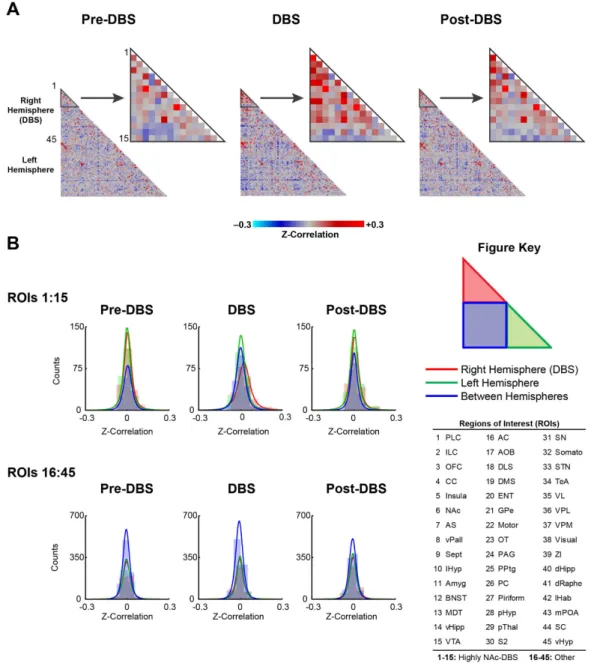
Next, we undertook fcMRI experiments to study the effects of NAc-DBS over longer time periods (minutes). Previous electrophysiological and neuroimaging studies have provided evidence of network synchrony modula-tion by high frequency NAc-DBS15,35. Exploiting the capability of fcMRI to measure functional connectivity on a whole-brain scale, we mapped global network changes induced by NAc-DBS at 130 Hz (300 μA). Mean correlation matrices were generated for each stimulus condition (Pre-DBS, DBS, Post-DBS) across 90 anatomically-defined ROIs (45 ROI’s per brain hemisphere) (Fig. 3A). These ROIs were grouped into two pre-defined networks, based on our evoked fMRI findings (see Methods; NAc-DBS [#s 1–15] and Other [#’s 16–45]). A complete listing of ROIs and network groupings is provided in the Fig. 3 key and associated figure caption. For the Pre-DBS con-dition, bilateral connectivity was evident between homologous ROIs, and for certain structures appeared more robust (i.e. PLC, ILC, OFC, CC, Insula, Motor, etc). The presence of bilateral functional connectivity, as displayed in our datasets, represents a key feature of fcMRI36. Except for a small number of ROIs (i.e. NAc ↔ OFC), within hemisphere connectivity was overall low in the Pre-DBS condition, possibly due to the short sampling period (5 mins per trial). However, during NAc-DBS of the RH NAc, within RH connectivity (i.e. ipsilateral to the DBS site) increased between many of the “NAc-DBS related network” ROIs, whereas there was little apparent modu-lation in the “Other network”. Between NAc-DBS network connectivity also appeared slightly modulated in the DBS condition but for a smaller number of ROIs (i.e. PLC, ILC). Post-DBS connectivity for the DBS-NAc network was similar, or perhaps intermittent to the pre-DBS / DBS conditions.
Next, histograms were generated (Fig. 3B) and fit as t-distributions for each stimulus condition, network, and connectivity grouping (within and between hemispheres) using average measures from the connectivity matrices. Consistent with the previous observations, NAc-DBS network connectivity within the RH was the only distribu-tion to show enhanced positive correladistribu-tions during DBS stimuladistribu-tion of the RH NAc. Repeated measures analyses of variance (rANOVA) were used to statistically validate these results across animals. For the NAc-DBS network, the stimulus condition (Pre-DBS, DBS, Post-DBS) and interaction between condition and connectivity (RH, LH, RH ↔ LH) were significant (plb≤ 0.05); Condition F(2,41) = 7.45, plb= 0.014 and Condition*Connectivity F(4,41) = 4.15, plb= 0.033.
Visualization of significantly (rANOVA, p < 0.05 uncorrected, ΔZ-Corr> 0.10) enhanced (increased cor-relation) or suppressed (decreased correlation or increased anti-corcor-relation) individual pair-wise connec-tions grouped by functionally-defined networks (Sensorimotor, Executive, Limbic, and Between Network Connections) paralleled the above observations and revealed additional information that was not readily appar-ent in the original classification of the data (Fig. 4; blue-suppressed, red-enhanced). Enhancemappar-ent was primar-ily restricted to connections between RH limbic structures, however consistent suppression was also evident, mainly within the sensorimotor network and between limbic and motor regions. The sensorimotor network showed no significant enhancement, and moreover, the executive network was devoid of suppressed connec-tions. Enhancement was relatively robust (Fig. 4, ΔZ-Corr> 0.20 thick red lines) for the following connections; R-NAc ↔ R-Sept, R-PLC and R-ILC ↔ R-PLC. Additional analyses of fcMRI data are provided in Supplemental Figures S5 and 6.
of NAc-DBS on CBV amplitude were noted. That is, increasing the frequency of NAc-DBS from 40 to 200 Hz, a five-fold difference, did not further modulate the functional circuit responses in the structures that we investi-gated. Critically, evoked responses were generally consistent across multiple stimulation trials, arguing against the possibility of stimulation-induced neural damage.
In addition to electrical stimulation, optogenetic tools are being increasingly exploited for mapping func-tional connectivity among neural circuits. Several studies have also employed optogenetic stimulation to elucidate potential mechanisms of therapeutic DBS action, including at the nucleus accumbens target39. In experiments reported here, we explored the possibility of using optogenetic NAc stimulation to induce detect-able downstream fMRI signals. This pilot experiment was performed in rats that received viral injections of an adeno-associated virus encoding ChR2 under the neuron-specific CaMKIIα promoter. A representative example of virally-mediated ChR2 expression in NAc neurons is provided in Fig. 6A. Optogenetic stimulation at 40 Hz evoked a local positive CBV signal in the NAc, with no significant CBV modulation observed outside the tar-get region (Fig. 6B,C). Ongoing studies in our laboratory using a completely identical experimental setup and analysis pipeline have revealed robust optogenetic-induced responses in downstream areas far from the stimu-lation site. Thus, we are confident that our findings do not reflect a technical failure to manipulate NAc neurons optogenetically.
A recent study has demonstrated hemodynamic changes following blue light laser stimulation (50% duty cycle) in naïve rat brain, possibly due to a laser heating artifact40. To evaluate the possibility of such an artifact as the source of the observed optogenetic response at the NAc, we repeated our optogenetic-fMRI experiments in control rats expressing an inert EYFP fluorophore in the NAc. In these animals, no significant CBV modulation by NAc-DBS was observed (Fig. 6B,C). It is worth noting that our laser pulse duration was substantially shorter than that previously reported to induce laser artifacts, likely explaining the absence of such a response caused by laser heating. Local heating artifacts in optogenetic-fMRI experiments have since been examined in greater detail, including suggested control experiments to rule out such artifacts as causal in fMRI signal generation41.
Discussion
In this study, we performed multimodal fMRI procedures to identify neural circuitry modulated by NAc-DBS in a healthy rat model. Evoked fMRI with electrical DBS uncovered a broad range of cortical and subcortical regions displaying stimulation-induced CBV increases, including prefrontal cortex, lateral hypothalamus, amygdala, septum, and ventral hippocampus. fcMRI provided corroborative evidence of robust network modulation by NAc-DBS, including suppression of sensorimotor and enhancement of executive and limbic network connectiv-ity. Lastly, we performed opto-fMRI with selective and direct stimulation of NAc neurons, showing time-locked CBV increases exclusively localized in the NAc during 40 Hz optical stimulation.
local metabolic demand in the absence of somatic spiking44. In this context, it is also interesting to note several reports of local increases in c-fos expression following DBS of the NAc, STN, or pedunculopontine tegmental nucleus in rats45–47. Future studies may determine the nature and extent of this possible uncoupling, which has strong implications for the interpretations of neuronal activity based on indirect experimental measures such as fMRI or immediate early gene expression.
Complementing our evoked-fMRI findings of direct limbic circuit modulation by NAc-DBS, fcMRI meas-urements revealed robust enhancements in functional connectivity between many of these same regions. More generally, limbic and executive network connections were primarily enhanced but those in the sensorimotor network were largely suppressed. These findings suggest that NAc-DBS modulates multiple functional network domains, spanning the entire brain. Although these functional connectivity maps alone do not allow for causal inferences relating to the therapeutic mechanism of NAc-DBS, they should provide an invaluable resource for the generation of future, hypothesis-driven DBS studies.
A central tenet of DBS therapy is its dependence upon high stimulation frequencies. One widely held hypothesis of DBS action posits that high frequency stimulation masks pathological endogenous circuit activity, thus creat-ing an “informational lesion” at the DBS target (although other mechanisms have also been posited)48–50. We were thus surprised to find that the functional activation profile obtained by NAc-DBS in rats was remarkably insensi-tive to a wide range of stimulation frequencies; indeed, 40 Hz stimulation modulated CBV across all tested areas in a manner quantitatively similar to all higher frequencies tested, including 200 Hz. Although we used a healthy rodent model, precluding behavioral tests of DBS efficacy, our evoked-fMRI results highlight strong parallels in circuit modulation by either moderate or high frequency stimulation of the NAc. Further, a recent preclinical study of NAc-DBS for cocaine addiction reported similar attenuation of reinstated drug-seeking behavior at 20 or 160 Hz, suggesting that some behavioral effects of NAc-DBS may also be frequency-insensitive17. The frequency sensitivity of symptom amelioration by NAc-DBS would be interesting to study in the clinical setting, particularly in light of the possibility of prolonging the battery life of DBS pulse generators using lower frequency stimulation protocols.
patterns between optogenetic and electrical NAc stimulation is unclear, although several possibilities exist. First, stimulus intensity differed between optogenetic and electrical DBS in this study, which may contribute to the differing activation patterns. Second, although we have assumed that both electrical and optogenetic stim-ulation delivered at 40 Hz would activate (rather than suppress) neural circuits, this was not formally tested. Another possibility concerns more fundamental differences between these stimulation approaches, such as the confinement of optogenetic stimulation to the opsin-expressing neurons and their efferent fibers. However, we also cannot entirely rule out the possibility that ChR2 was expressed in a small population of non-neuronal cells. The most likely explanation for our findings, in our opinion, is that most of the circuits recruited by NAc-DBS were resulted from antidromic activation of axons or fibers of passage. Our future studies will focus on evaluating this hypothesis.
although they may provide a biased perspective on DBS-evoked changes in functional connectivity. A recent report by Ewing and Grace highlights the importance of studying DBS network effects under chronic stimulation conditions15. In that study, local field potentials (LFPs) were recorded in multiple brain regions of rats receiving continuous NAc-DBS for a period of 5 days. Some of the observed DBS-induced network changes were transient, including enhanced delta power in the mediodorsal thalamus and orbitofrontal cortex, whereas other network effects emerged over time (e.g., decreased alpha power in the mediodorsal thalamus). This work highlights the importance of studying DBS effects over more translationally-relevant timespans (days or weeks, if experimen-tally feasible). fcMRI, which does not require within-session baseline (“OFF”) periods, provides an ideal experi-mental measure for future longitudinal examinations of DBS effects across time and brain regions.
In the present study, we identified a robustly recruited network of cortical and subcortical circuits modulated by NAc-DBS, many of which are likely to be antidromically-stimulated. Remarkably, the extent of this circuit modulation was relatively frequency-insensitive, as demonstrated by our evoked-fMRI findings. Collectively, our findings should facilitate the understanding of DBS mechanisms and mapping of therapeutic circuits at this important clinical target. Future NAc-DBS fMRI studies should examine the circuit- and network-level responses to therapeutic stimulation in neuropsychiatric disease models, wherein pathology-specific circuit disruptions (and putative amelioration by DBS) may be explored.
References
1. Wichmann, T. & Delong, M. R. Deep brain stimulation for neurologic and neuropsychiatric disorders. Neuron 52, 197–204 (2006). 2. Goodman, W. K. & Alterman, R. L. Deep brain stimulation for intractable psychiatric disorders. Annu Rev Med 63, 511–524 (2012). 3. Floresco, S. B. The nucleus accumbens: an interface between cognition, emotion, and action. Annu Rev Psychol 66, 25–52 (2015). 4. de Koning, P. P., Figee, M., van den Munckhof, P., Schuurman, P. R. & Denys, D. Current status of deep brain stimulation for
obsessive-compulsive disorder: a clinical review of different targets. Curr Psychiatry Rep 13, 274–282 (2011).
5. Bewernick, B. H., Kayser, S., Sturm, V. & Schlaepfer, T. E. Long-term effects of nucleus accumbens deep brain stimulation in treatment-resistant depression: evidence for sustained efficacy. Neuropsychopharmacology 37, 1975–1985 (2012).
6. Garcia, L., D’Alessandro, G., Bioulac, B. & Hammond, C. High-frequency stimulation in Parkinson’s disease: more or less? Trends Neurosci 28, 209–216 (2005).
7. Albaugh, D. L. & Shih, Y. Y. Neural circuit modulation during deep brain stimulation at the subthalamic nucleus for Parkinson’s disease: what have we learned from neuroimaging studies? Brain Connect 4, 1–14 (2014).
8. Jech, R. Functional imaging of deep brain stimulation: fMRI, SPECT, and PET. In Deep Brain Stimulation in Neurological and Psychiatric Disorders 179–201 (Springer, 2008).
9. Tagliati, M. et al. Safety of MRI in patients with implanted deep brain stimulation devices. Neuroimage 47 Suppl 2, T53–57 (2009). 10. Younce, J. R., Albaugh, D. L. & Shih, Y. Y. Deep Brain Stimulation with Simultaneous fMRI in Rodents. J Vis Exp, e51271–e51271
(2014).
11. Knight, E. J. et al. Nucleus accumbens deep brain stimulation results in insula and prefrontal activation: a large animal FMRI study. PloS One 8, e56640 (2013).
12. Lai, H. Y., Younce, J. R., Albaugh, D. L., Kao, Y. C. & Shih, Y. Y. Functional MRI reveals frequency-dependent responses during deep brain stimulation at the subthalamic nucleus or internal globus pallidus. Neuroimage 84, 11–18 (2014).
13. Min, H. K. et al. Deep brain stimulation induces BOLD activation in motor and non-motor networks: an fMRI comparison study of STN and EN/GPi DBS in large animals. Neuroimage 63, 1408–1420 (2012).
14. Lai, H. Y., Albaugh, D. L., Kao, Y. C., Younce, J. R. & Shih, Y. Y. Robust deep brain stimulation functional MRI procedures in rats and mice using an MR‐compatible tungsten microwire electrode. Magn Reson Med 73, 1246–1251 (2015).
15. Ewing, S. G. & Grace, A. A. Long-term high frequency deep brain stimulation of the nucleus accumbens drives time-dependent changes in functional connectivity in the rodent limbic system. Brain Stimul 6, 274–285 (2013).
16. Hamani, C. et al. Deep brain stimulation in rats: different targets induce similar antidepressant-like effects but influence different circuits. Neurobiol Dis 71, 205–214 (2014).
17. Hamilton, J., Lee, J. & Canales, J. J. Chronic Unilateral Stimulation of the Nucleus Accumbens at High or Low Frequencies Attenuates Relapse to Cocaine Seeking in an Animal Model. Brain Stimul 8, 57–63 (2015).
18. McCracken, C. B. & Grace, A. A. High-frequency deep brain stimulation of the nucleus accumbens region suppresses neuronal activity and selectively modulates afferent drive in rat orbitofrontal cortex in vivo. J Neurosci 27, 12601–12610 (2007).
19. Vassoler, F. M. et al. Deep brain stimulation of the nucleus accumbens shell attenuates cocaine priming-induced reinstatement of drug seeking in rats. J Neurosci 28, 8735–8739 (2008).
20. Xie, Y. et al. High-frequency electrical stimulation suppresses cholinergic accumbens interneurons in acute rat brain slices through GABA receptors. Eur J Neurosci 40, 3653–3662 (2014).
21. Sparta, D. R. et al. Construction of implantable optical fibers for long-term optogenetic manipulation of neural circuits. Nat Protoc 7, 12–23 (2012).
22. Shih, Y. Y. et al. Pharmacological MRI of the choroid and retina: blood flow and BOLD responses during nitroprusside infusion. Magn Reson Med 68, 1273–1278 (2012).
24. Gruetter, R. Automatic, localized in Vivo adjustment of all first‐and second‐order shim coils. Magnetic resonance in medicine 29, 804–811 (1993).
25. Fukuda, M., Vazquez, A. L., Zong, X. & Kim, S. G. Effects of the alpha(2)-adrenergic receptor agonist dexmedetomidine on neural, vascular and BOLD fMRI responses in the somatosensory cortex. Eur J Neurosci 37, 80–95 (2013).
26. Kim, S. G. et al. Cerebral blood volume MRI with intravascular superparamagnetic iron oxide nanoparticles. NMR Biomed 26, 949–962 (2013).
27. Canals, S., Beyerlein, M., Murayama, Y. & Logothetis, N. K. Electric stimulation fMRI of the perforant pathway to the rat hippocampus. Magn Reson Imaging 26, 978–986 (2008).
28. Kringelbach, M. L., Jenkinson, N., Owen, S. L. & Aziz, T. Z. Translational principles of deep brain stimulation. Nat Rev Neurosci 8, 623–635 (2007).
29. Valdes-Hernandez, P. A. et al. An in vivo MRI Template Set for Morphometry, Tissue Segmentation, and fMRI Localization in Rats. Front Neuroinform 5, 26 (2011).
30. Benjamini, Y., Drai, D., Elmer, G., Kafkafi, N. & Golani, I. Controlling the false discovery rate in behavior genetics research. Behav Brain Res 125, 279–284 (2001).
31. Paxinos, G. & Watson, C. The rat brain in stereotaxic coordinates (Academic Press, New York, NY, 2004).
32. Britt, J. P. et al. Synaptic and behavioral profile of multiple glutamatergic inputs to the nucleus accumbens. Neuron 76, 790–803 (2012).
33. Russo, S. J. & Nestler, E. J. The brain reward circuitry in mood disorders. Nat Rev Neurosci 14, 609–625 (2013).
34. Xia, Y. et al. Nucleus accumbens medium spiny neurons target non-dopaminergic neurons in the ventral tegmental area. J Neurosci 31, 7811–7816 (2011).
35. Figee, M. et al. Deep brain stimulation restores frontostriatal network activity in obsessive-compulsive disorder. Nat Neurosci 16, 386–387 (2013).
36. Nasrallah, F. A., Tay, H. C. & Chuang, K. H. Detection of functional connectivity in the resting mouse brain. Neuroimage 86, 417–424 (2014).
37. Shih, Y. Y., Yash, T. V., Rogers, B. & Duong, T. Q. fMRI of deep brain stimulation at the rat ventral posteromedial thalamus. Brain Stimulation 7, 190–193 (2014).
38. Scherf, T. & Angenstein, F. Postsynaptic and spiking activity of pyramidal cells, the principal neurons in the rat hippocampal CA1 region, does not control the resultant BOLD response: a combined electrophysiologic and fMRI approach. J Cereb Blood Flow Metab 35, 565–575 (2015).
39. Creed, M., Pascoli, V. J. & Lüscher, C. Refining deep brain stimulation to emulate optogenetic treatment of synaptic pathology. Science 347, 659–664 (2015).
40. Christie, I. N. et al. fMRI response to blue light delivery in the naive brain: Implications for combined optogenetic fMRI studies. Neuroimage 66C, 634–641 (2012).
41. Schmid, F. et al. True and apparent optogenetic BOLD fMRI signals. Magn Reson Med doi: 10.1002/mrm.26095 (2016).
42. Tai, C. H. et al. Electrophysiological and metabolic evidence that high-frequency stimulation of the subthalamic nucleus bridles neuronal activity in the subthalamic nucleus and the substantia nigra reticulata. FASEB J 17, 1820–1830 (2003).
43. Filali, M., Hutchison, W. D., Palter, V. N., Lozano, A. M. & Dostrovsky, J. O. Stimulation-induced inhibition of neuronal firing in human subthalamic nucleus. Exp Brain Res 156, 274–281 (2004).
44. Logothetis, N. K. The ins and outs of fMRI signals. Nat Neurosci 10, 1230–1232 (2007).
45. Shehab, S., D’Souza, C., Ljubisavljevic, M. & Redgrave, P. High-frequency electrical stimulation of the subthalamic nucleus excites target structures in a model using c-fos immunohistochemistry. Neuroscience 270, 212–225 (2014).
46. Vassoler, F. M. et al. Deep brain stimulation of the nucleus accumbens shell attenuates cocaine reinstatement through local and antidromic activation. J Neurosci 33, 14446–14454 (2013).
47. Saryyeva, A., Nakamura, M., Krauss, J. K. & Schwabe, K. c-Fos expression after deep brain stimulation of the pedunculopontine tegmental nucleus in the rat 6-hydroxydopamine Parkinson model. J Chem Neuroanat 42, 210–217 (2011).
48. Bourne, S. K., Eckhardt, C. A., Sheth, S. A. & Eskandar, E. N. Mechanisms of deep brain stimulation for obsessive compulsive disorder: effects upon cells and circuits. Front Integr Neurosci 6, 29 (2012).
49. Nuttin, B., Cosyns, P., Demeulemeester, H., Gybels, J. & Meyerson, B. Electrical stimulation in anterior limbs of internal capsules in patients with obsessive-compulsive disorder. The Lancet 354, 1526 (1999).
50. Grill, W. M., Snyder, A. N. & Miocinovic, S. Deep brain stimulation creates an informational lesion of the stimulated nucleus. Neuroreport 15, 1137–1140 (2004).
51. Figee, M. et al. Deep brain stimulation induces striatal dopamine release in obsessive-compulsive disorder. Biol Psychiatry 75, 647–652 (2014).
52. Greenberg, B. D. et al. Deep brain stimulation of the ventral internal capsule/ventral striatum for obsessive-compulsive disorder: worldwide experience. Mol Psychiatry 15, 64–79 (2010).
53. Pierce, R. C. & Vassoler, F. M. Deep brain stimulation for the treatment of addiction: basic and clinical studies and potential mechanisms of action. Psychopharmacology (Berl) 229, 487–491 (2013).
54. Mundt, A. et al. High-frequency stimulation of the nucleus accumbens core and shell reduces quinpirole-induced compulsive checking in rats. Eur J Neurosci 29, 2401–2412 (2009).
55. van Dijk, A. et al. Deep brain stimulation affects conditioned and unconditioned anxiety in different brain areas. Transl Psychiatry 3, e289 (2013).
56. Min, H. K. et al. Subthalamic Nucleus Deep Brain Stimulation Induces Motor Network BOLD Activation: Use of a High Precision MRI Guided Stereotactic System for Nonhuman Primates. Brain Stimul 7, 603–607 (2014).
Acknowledgements
(2016).
This work is licensed under a Creative Commons Attribution 4.0 International License. The images or other third party material in this article are included in the article’s Creative Commons license, unless indicated otherwise in the credit line; if the material is not included under the Creative Commons license, users will need to obtain permission from the license holder to reproduce the material. To view a copy of this license, visit http://creativecommons.org/licenses/by/4.0/