PEDIATRIC FEEDING PROBLEMS: CONCEPT ANALYSIS AND FAMILY MANAGEMENT
Hayley Henrikson Estrem
A dissertation submitted to the faculty of the University of North Carolina at Chapel Hill in partial fulfillment of the requirements for the degree of Doctor of Philosophy in the School of
Nursing.
Chapel Hill 2015
Approved by:
Suzanne M. Thoyre
Kathleen A. Knafl
Marcia Van Riper
Cara McComish
©2015
ABSTRACT
Hayley Henrikson Estrem: Pediatric Feeding Problems: Concept Analysis and Family Management
(Under the direction of Suzanne M. Thoyre)
Background: Pediatric feeding problems occur in 25% of the general pediatric population and up to 80% of those who have developmental delays. When feeding
problems place the child at nutritional risk, families are typically encouraged to increase their child’s intake. As pressures to eat increase, children’s aversive behaviors can worsen, extending the time of under nutrition, and limiting developmental potential. Family mealtime may become a battle with entrenched inappropriate mealtime behaviors. To add to the challenge this presents to healthcare and families, there is no interdisciplinary consensus on terms to describe feeding problems. Lack of common language is a barrier to effective interdisciplinary, family-centered care.
Purpose: This dissertation is comprised of three studies. Chapter 2 presents an evolutionary concept analysis of pediatric feeding problems. Chapter 3 describes family conceptualization of feeding problems. Chapter 4 is a descriptive study of family
management of child feeding difficulty.
Methods: In Chapter 2 an evolutionary concept analysis was conducted with 100
their efforts to manage their child’s feeding problems. A within-and-across family-case analysis was conducted.
Results: Chapter 2 illustrates divergent conceptualizations within and between disciplines. Emphasis is given to areas of consensus. Chapter 3 highlights shared and discrepant ways of writing and speaking about the problem from interviewed parents and references Chapter 2 for comparison to literature on provider perspectives. Chapter 4 describes family management of feeding problems and parental perceptions of the child, using within and across family thematic analysis.
ACKNOWLEDGEMENTS
There is a long list of people that made my dissertation work possible, and to all of them I would like to express my sincere gratitude. To start, I could not have embarked upon this project, maintained the course, and completed this dissertation without the support of my husband, Michael. We found ourselves in uncharted territory with our first child, and I will always appreciate that when I decided I needed a doctoral degree to make some positive change, Michael was on board. Thank you to Alex showing us we are more
resilient than we ever thought we could be (as are you), and then Ben and Zach for bringing some joyful chaos. Thank you to my Mother and Father-in-law for all of your help with the boys. Also, thank goodness for my Mom for her visits, often coordinated around my important work times. Thanks to my Dad for his words of encouragement. Another
essential support had been Suzanne, my son’s CNA. Her dedication and care for Alex has been critical for me to attend to my work these last years, I couldn’t have done this without her.
a difference for children with feeding problems and their families. Thank you to Dr. Eric Hodges for your contributions to the Feeding Flock.
Dr. Kathy Knafl inspires me to develop as a family researcher and has taught me a great deal through working on her team’s study, in the classroom, and through her
mentoring my dissertation work. Dr. Marcia Van Riper has helped me develop as an educator, a researcher, and has shown me how a well-timed and thoughtful conversation can be so helpful. Thank you to Dr. Ruth Humphry for her role on my dissertation
committee.
Faculty and staff within the School of Nursing have been wonderful. Helen Hall has played an important role in design of materials for dissemination of my findings, and of those of our research team, the Feeding Flock. I am grateful for the thoughtful support Kathy Moore always gives to students this program.
Funding and support for my predoctoral training included National Institute of Nursing Research of the National Institutes of Health T32 (PI: Mishel) from 2009-2011. This early funding supported me as I began planning and grant writing for the family management study. All three of my studies were funded by Sigma Theta Tau, Alpha Alpha Chapter Small Grants (PI: Estrem, 2011, 2012, 2014, 2015). Both the evolutionary concept analysis and family management of feeding when a child has feeding difficulty studies were each funded by a Linda Waring Matthews Research Fund Scholarship (PI: Estrem, 2013-2014, 2015). And I am grateful to have received the The University of North Carolina at Chapel Hill - Graduate School, Dissertation Completion Fellowship Award (PI: Estrem, 2014-2015).
TABLE OF CONTENTS
LIST OF TABLES ... x
LIST OF FIGURES ... xi
LIST OF ABBREVIATIONS ... xii
CHAPTER 1: INTRODUCTION ...13
Background and Significance ...13
Conceptual Problem ...14
Family Management of Feeding ...15
Aims ...19
Prepared Manuscripts ...20
REFERENCES ...23
CHAPTER 2: FEEDING PROBLEMS IN INFANCY AND EARLY CHILDHOOD: EVOLUTIONARY CONCEPT ANALYSIS ...26
Introduction ...26
Methods ...28
Sample ...28
Evolutionary Concept Analysis ...30
Results ...31
Historical Conceptualization of Feeding Problems ...31
Present Conceptualization of Feeding Problems ...36
Proposed Interdisciplinary Model for Further Development ...42
Autism spectrum disorder (ASD): A similar evolutionary path ...43
Consensus Attributes and Further Development of Concept ...44
Conclusion ...46
REFERENCES ...55
Overview ...61
Introduction ...62
Study Design and Methods ...64
Results ...65
Related concepts ...65
Antecedents ...65
Attributes of the feeding problem ...66
Consequences ...69
Clinical Nursing Implications ...72
Toward spectrum conceptualization of pediatric feeding problems ...74
REFERENCES ...76
CHAPTER 4: FAMILY MANAGEMENT OF FEEDING WHEN A CHILD HAS FEEDING DIFFICULTY ...78
Overview ...78
Background and Significance ...79
Family Management Style Framework ...84
Methods ...85
Design ...85
Setting and Sample ...85
Measures ...87
Procedures ...87
Analysis...88
Results ...89
Child’s daily life and identity as an eater ...90
Feeding Management Ability ...93
Feeding Management Effort ...95
Family Life Difficulty ...97
Feeding Management Impact ...99
Parent Mutuality ... 101
Discussion ... 106
REFERENCES ... 111
CHAPTER 5: DISCUSSION ... 116
Future Directions for Research ... 118
REFERENCES ... 120
APPENDIX A: FAMILY INFORMATION FORM ... 121
LIST OF TABLES
Table 1 – FMSF Applied to Pediatric Feeding Problems……….10
Table 2.1 – Sampled Literature By Discipline……….………..………37
Table 2.2 – Top Three Surrogate Terms Per Discipline………...……….…...37
Table 2.3 – Available Classifications For Pediatric Feeding Problem Conditions………...38
Table 2.4 – Attributes of a Feeding Problem and Percentages of Disciplinary Samples………...………....39-40 Table 2.5 – Top Diagnoses Related to Feeding Problems Per Discipline……...……....….41
LIST OF FIGURES
LIST OF ABBREVIATIONS ASD Autism spectrum disorder
APA American Psychiatric Association DD Developmental delay or disability
DS Down syndrome
CP Cerebral palsy
CF Cystic fibrosis
DNP Doctor of Nursing Practice
DSM-V Diagnostic and Statistical Manual of the Mental Disorders: 5th Edition
EE Eosioniphilic Esophagitis
EI Early intervention
FaMM Family Management Measure
FMSF Family Management Style Framework
FTT Failure to thrive
GI Gastrointestinal
GERD Gastro esophageal reflux disease
G-tube Gastric tube
CHAPTER 1: INTRODUCTION Background and Significance
When a child will not or cannot consume adequate nutrition orally, a feeding problem is diagnosed (Williams, Riegel, & Kerwin, 2009). Feeding problems are reported to occur in 25% of typical children and up to 80% of those with developmental delays or disabilities (Manikam & Perman, 2000). For 3-10% of children, feeding problems will be severe and persistent (Kerwin, 1999). When feeding problems result in faltering growth, the need for a surgical feeding tube may be evaluated during a trial of increased feeding efforts at home (Batchelor, 2008). Ensuring proper nutrition for a child is a basic part of the parenting role (Silverman, 2010), and in families where parents are challenged to meet this basic nutrition need, there is potential for significant distress (Greer, Gulotta, Masler, & Laud, 2008). The time between identification of a significant feeding problem and tube placement or resolution of the feeding problem, is a great challenge to family management of feeding and can have negative consequences for both child and family.
Multiple comorbidities often exist in children with feeding problems making this a heterogeneous group (Sharp, Jaquess, Morton, & Herzinger, 2010). Because this is a group with multiple comorbidities (Sharp et al., 2010) including most often the general diagnosis of developmental delay or disability, it is critically important that their nutritional status support optimal neurodevelopment. A latent class analysis shows that while patterns of comorbidities exist in children with feeding problems, the co-morbidities do nothing to indicate the severity of the feeding problem and relate only a non-specific risk (Berlin,
or Down syndrome can present with the same functional feeding problem and children with any one condition do not necessarily present with the similar feeding problems. Families, however, are thought to share common responses to management of feeding a child with feeding problems regardless of particular background conditions. The heterogeneous nature of this problem leaves both the families experiencing having a child with feeding problems and the pediatric providers who need to identify and treat this in a state of conceptual tension.
Conceptual Problem
Reviews of the literature on pediatric feeding problems and disorders repeatedly reference the lack of a shared conceptualization of feeding problems (Bryant-Waugh, 2013; Davis, Bruce, Cocjin, Mousa, & Hyman, 2010; Lukens & Silverman, 2014; Sharp et al., 2010). This makes the significance of pediatric feeding problems difficult to establish for those clinically unfamiliar with the problem. Also, among the disciplines that are involved with this phenomenon, there are divergent ideas of etiology, assessment, diagnosis, and treatment. Herein lies a significant problem for the population of infants and children experiencing feeding difficulty, because “When the attributes (definitions) that comprise the concept are not clear, the ability to communicate and categorize phenomena is severely limited.” (Rodgers & Knafl, 2000, p. 80). This makes for a conceptual problem that leaves all involved in a vulnerable and poorly recognized situation. Clinically speaking, infants and young children with significant feeding issues may go undetected or waste valuable
developmental time in inappropriate or under-dosed treatment. Lack of common language is a barrier to effective communication between clinicians, researchers, and caregivers, and inhibits collaboration.
analysis of pediatric feeding problems will advance the science and art of interdisciplinary treatment forward. These are not meant to be endpoints on the development of the concept, but rather steps towards developing a common language that is practical and understood by all who come into contact with children with feeding problems. This will be presented in Chapters 2 and 3.
Family Management of Feeding
Parents of children with feeding problems have reported a lack of guidance beyond being told to take their child home and get the child to eat (Thoyre & VanRiper, 2010). In six focus groups of parents with a child with Down syndrome (DS), parents reported having to make their own path for teaching their child to eat, after they learned that the standard approaches for getting children to eat did not work for their families (Thoyre & VanRiper, 2010). Batchelor (2008) noted that mothers of children who eventually enrolled in a feeding program reported being “desperate” for help. The mothers felt like failures as parents, and they said this feeling of failure was reinforced by family, friends, and some professionals, who did not understand how it was possible that their child refused to eat. For most of the parents, “Successful feeding of their child was intimately bound with their sense of
themselves as competent and caring” (Batchelor, 2008, p. 385). This linkage of successful feeding to being a competent parent was also reported by Sleigh (2005) in interviews with parents of children with cerebral palsy.
learn to be averse to eating (Field, Garland, & Williams, 2003; Kerwin, 2003). While infants and young children are developing as eaters, they learn and adapt to experiences with food. If feeding has been painful or unsafe, if they associate food in their mouth with fear and discomfort, then they will be left with behavioral feeding problems even after the medical issues have been treated and safer eating modes established. Learned behaviors that once served them well in meeting their goals of pain avoidance, will become entrenched
maladaptations (Burklow, McGrath, & Kaul, 2002; Patel, 2013).
When children learn that eating is undesirable, parents are in uncharted territory that requires non-intuitive management of their child’s nutrition. When parents boost calories in food forms the child accepts more easily (preferred foods), the development of feeding skills and the range of foods the child receives may be restricted. Management strategies can result in loss of child autonomy, development of more intense avoidance behaviors incompatible with intake, and strengthening of negative mealtime associations (Batchelor, 2008). Hours spent in “battleground” or difficult mealtimes impact the functioning of the whole family, yet parents of children with significant feeding problems have not yet been asked what would help or hinder their attempts at making feeding their child a more easily manageable, and therefore sustainable, family activity (Spalding & McKeever, 1998; Weisner, 2002).
therefore try hard to avoid it, parents will often change or intensify their style of feeding management during this time. Using a limited skill set, and with no clear roadmap of how to successfully feed a child with feeding problems (Thoyre & VanRiper, 2010), the literature reports that parents spend excessive time in “mealtime” trying to achieve adequate intake (Spalding & McKeever, 1998), and may adopt methodical or mechanical feeding styles that disregard cues from the child (Levy et al., 2009). Parents must take on the responsibility of feeding this child using the guidelines their child’s physician provides and incorporate these into family life.
Parental caregivers often have perceived enteral feeding tubes as unnatural or wrong (Pedersen, Parsons, & Dewey, 2004; Sleigh, 2005; Spalding & McKeever, 1998; Thorne, Radford, & McCormick, 1997). They reported holding out on tube placement, or trying to “get by without [the tube]” (Sleigh). Parents reported spending hours just trying to get their child to eat, or trying to avoid feeding tube acceptance (Spalding & McKeever, 1998). Children with developmental delays or other medical conditions already require some type of intervention or non-intuitive family care. The expectation that families will
aggressively apply normal societal feeding practices to these children and be successful is perhaps unrealistic and unfair (Craig & Scambler, 2006; Mahant, Jovcevska, & Cohen, 2011).
Because feeding tube placement is most commonly meant to serve as a temporary means to deliver necessary nutrition with a long term goal to return to oral eating, the
neglect of the family’s management of feeding risks worsening of the child’s feeding problem and setting a more difficult path to future oral eating. Recent literature supports this
strategies and goals. Feeding studies to date have neglected to encompass the family embedded nature of feeding by limiting scientific inquiry to only the child or parent (Berlin et al., 2009), and rarely examining shared or discrepant views of feeding management
between both parents.
Healthcare providers could partner with families at this delicate time, a time when children are being monitored closely for the consequences of feeding problems. This information would set the stage for informed prevention of the maladaptive mealtime behaviors clinicians commonly see demonstrated by both children and their parents (Sharp et al., 2010; Williams, Field, & Seiverling, 2010).
Family Management Style Framework. The study presented in Chapter 4 was guided by the Family Management Style Framework (FMSF; Knafl & Deatrick, 2003; Knafl, Deatrick, & Havill, 2012). The FMSF was developed to explore family management of childhood chronic conditions, and it originated with conceptual work on family normalization of childhood chronic illness (Deatrick, Knafl, & Murphy-Moore, 1999; Knafl & Deatrick, 2006) and research to identify patterns of family management (Knafl, Breitmayer, Gallo, & Zoeller, 1996). According to the FMSF, individuals in the family contribute to developing a family management style or pattern that can influence both individual and family outcomes. The major components of the framework (contextual influences, definition of the situation, management approach, and perceived consequences) were subsequently validated and refined (Knafl & Deatrick, 2003; Knafl et al., 2012) using integrative literature reviews.
feeding in the context of family life: what strategies are used to feed their child day-to-day, how do they make goals for their child’s eating? What elements have to be balanced or weighed against other elements in the context of family life? Do they have resources to accomplish those goals? What has been helpful, what has been detrimental? Is the feeding problem in the foreground or background on daily family life? Knowledge of parent
perspectives on the future is helpful when planning intervention: what are their goals for their child’s feeding, when do they anticipate their child self-feeding, if ever? What do parents think needs to happen to accomplish those goals? What is the impact of feeding the child on the rest of the family? Also important to know is the degree to which partnered parents share views on feeding management and contextual influences. The information gleaned from use of the FMSF as a lens on family feeding management will assist us in learning areas for intervention or supplementing existing intervention with family-centered care. Table 1 outlines how the FMSF components align with aspects of family management of feeding when a child had feeding difficulty.
Aims
This dissertation conducted three studies: two primary studies and a combined secondary analysis of data from the primary studies. Together, these explore and describe the issues of conceptualization and family management of pediatric feeding problems. The aims for Chapters 2 through 4 are listed below.
Chapter 2:
1. Trace the evolution of the concept of pediatric feeding problems from professional perspectives using historical exemplar manuscripts.
3. Highlight conceptual discrepancies and areas of consensus within and across disciplines.
Chapter 3:
1. Present themes of conceptual elements (attributes, surrogate terms, related concepts, antecedents, and consequences of feeding problems) from parent perspectives
2. Highlight conceptual discrepancies and surrogate terms that characterize parents’ perspectives.
Chapter 4:
1. Describe parent perspectives of their child’s eating and of managing the feeding problem.
2. Identify factors parents perceive as facilitating or impeding their ability to manage the feeding problem.
3. Examine themes of management across families.
Full description of family feeding management and perceptions of the child diagnosed with feeding problems will provide a foundation for developing and testing family-centered partnerships with early intervention to preserve child interest in eating at a time when treatment would still be proactive and foster sustainable feeding practices at home.
Prepared Manuscripts
Chapter 2, titled “Feeding problems in infancy and early childhood: Evolutionary concept analysis,” examines the concept of pediatric feeding problems over time and then compares the current conceptualization in the literature within and across the disciplines that treat children with feeding.
Chapter 3 is titled “Parent perspective on pediatric feeding problems” and presents a secondary analysis of parent interviews to describe how parents conceptualized their child’s feeding problem.
Table 1
FMSF Applied to Pediatric Feeding Problems
FMSF Component Topic of Interest
Definition of the Situation
Management Approach
Perceived Consequences
Parents’ perceptions and interpretations of the child’s feeding problems and of the child’s health and feeding capabilities; Strategies used by parents to feed their child, goals they have for their child’s feeding, routines and priorities for feeding;
Parents’ views of their abilities to balance their child’s feeding and other responsibilities;
Expectations of the future for the child and family when considering the child’s feeding difficulty
Contextual Influences Parents’ perceptions of factors contributing to the ease or difficulty of feeding the child
Contextual Influences Definition of the Situation Management Approach Perceived Consequences
REFERENCES
Axelrod, D., Kazmerski, K., & Iyer, K. (2006). Pediatric Enteral Nutrition. JPEN J Parenter
Enteral Nutr, 30(1_suppl), S21-26. doi: 10.1177/01486071060300s1s21
Batchelor, J. (2008). 'Failure to thrive' revisited. Child Abuse Review, 17(3), 147-159. Berlin, K. S., Davies, W. H., Lobato, D. J., & Silverman, A. H. (2009). A biopsychosocial
model of normative and problematic pediatric feeding. Children's Health Care, 38(4), 263-282. doi: 10.1080/02739610903235984
Berlin, K. S., Lobato, D. J., Pinkos, B., Cerezo, C. S., & LeLeiko, N. S. (2011). Patterns of medical and developmental comorbidities among children presenting with feeding problems: A latent class analysis. Journal of Developmental and Behavioral
Pediatrics, 32(1), 41-47. doi: 10.1097/DBP.0b013e318203e06d
Bryant-Waugh, R. (2013). Feeding and eating disorders in children. Current Opinion in
Psychiatry, 26(6), 537-542. doi: 10.1097/YCO.0b013e328365a34b
Burklow, K. A., McGrath, A. M., & Kaul, A. (2002). Management and prevention of feeding problems in young children with prematurity and very low birth weight. Infants &
Young Children: An Interdisciplinary Journal of Special Care Practices, 14(4), 19-30.
Cook, S., Hooper, V., Nasser, R., & Larsen, D. (2005). Effect of gastrostomy on growth in children with neurodevelopmental disabilities. Canadian Journal of Dietetic Practice & Research, 66(1), 19-24.
Craig, G. M., & Scambler, G. (2006). Negotiating mothering against the odds: Gastrostomy tube feeding, stigma, governmentality and disabled children. Social Science &
Medicine, 62(5), 1115-1125. doi: 10.1016/j.socscimed.2005.07.007
Davis, A., Bruce, A., Cocjin, J., Mousa, H., & Hyman, P. (2010). Empirically Supported Treatments for Feeding Difficulties in Young Children. Curr Gastroenterol Rep, 12(3), 189-194. doi: 10.1007/s11894-010-0100-9
Deatrick, J. A., Knafl, K. A., & Murphy-Moore, C. (1999). Clarifying the concept of normalization. Image: Journal of Nursing Scholarship, 31(3), 209-214. Field, D., Garland, M., & Williams, K. (2003). Correlates of specific childhood feeding
problems. Journal of Paediatrics & Child Health, 39(4), 299-304. doi: 10.1046/j.1440-1754.2003.00151.
Greer, A. J., Gulotta, C. S., Masler, E. A., & Laud, R. B. (2008). Caregiver stress and outcomes of children with pediatric feeding disorders treated in an intensive interdisciplinary program. J Pediatr Psychol, 33(6), 612-620. doi:
10.1093/jpepsy/jsm116
Kerwin, M. E. (1999). Empirically supported treatments in pediatric psychology: severe feeding problems. J Pediatr Psychol, 24(3), 193-214. doi: 10.1093/jpepsy/24.3.193 Knafl, K., Breitmayer, B., Gallo, A., & Zoeller, L. (1996). Family response to childhood
chronic illness: Description of management styles. Journal of pediatric nursing, 11(5), 315-326. doi: Doi: 10.1016/s0882-5963(05)80065-x
Knafl, K., & Deatrick, J. (2003). Further refinement of the family management style framework. Journal of Family Nursing, 9(3), 232-256.
Knafl, K., & Deatrick, J. A. (2006). Family Management Style and the challenge of moving from conceptualization to measurement. Journal of Pediatric Oncology Nursing, 23(1), 12-18.
Knafl, K., Deatrick, J. A., & Havill, N. L. (2012). Continued Development of the Family Management Style Framework. Journal of Family Nursing, 18(1), 11-34. doi: 10.1177/1074840711427294
Levy, Y., Levy, A., Zangen, T., Kornfeld, L., Dalal, I., Samuel, E., . . . Levine, A. (2009). Diagnostic Clues for Identification of Nonorganic vs Organic Causes of Food Refusal and Poor Feeding. Journal of Pediatric Gastroenterology & Nutrition, 48(3), 8. doi: 10.1097/MPG.0b013e31818b1936
Lukens, C. T., & Silverman, A. H. (2014). Systematic review of psychological interventions for pediatric feeding problems. J Pediatr Psychol, jsu040.
Mahant, S., Jovcevska, V., & Cohen, E. (2011). Decision-Making Around Gastrostomy-Feeding in Children With Neurologic Disabilities. Pediatrics, 127(6), e1471-e1481. doi: 10.1542/peds.2010-3007
Manikam, R., & Perman, J. A. (2000). Pediatric feeding disorders. Journal of Clinical
Gastroenterology, 30(1), 13.
Mason, S. J., Harris, G., & Blissett, J. (2005). Tube feeding in infancy: implications for the development of normal eating and drinking skills. Dysphagia (0179051X), 20(1), 46-61.
Patel, M. R. (2013). Assessment of Pediatric Feeding Disorders Handbook of Crisis
Intervention and Developmental Disabilities (pp. 169-182): Springer.
Pedersen, S. D., Parsons, H. G., & Dewey, D. (2004). Stress levels experienced by the parents of enterally fed children. Child: Care, Health & Development, 30(5), 507-513. Rodgers, B. L., & Knafl, K. A. (2000). Concept development in nursing: Foundations,
techniques, and applications: Saunders Philadelphia, PA.
Silverman, A. H. (2010). Interdisciplinary care for feeding problems in children. Nutrition in
Clinical Practice, 25(2), 160-165. doi: 10.1177/0884533610361609
Sleigh, G. (2005). Mothers' voice: a qualitative study on feeding children with cerebral palsy.
Child: Care, Health & Development, 31(4), 373-383.
Spalding, K., & McKeever, P. (1998). Mothers' experiences caring for children with
disabilities who require a gastrostomy tube. Journal of pediatric nursing, 13(4), 234-243.
Thorne, S. E., Radford, M. J., & McCormick, J. (1997). The multiple meanings of long-term gastrostomy in children with severe disability. Journal of pediatric nursing, 12(2), 89-99.
Thoyre, S., & VanRiper, M. (2010). Figuring it out: Parents’ reports of how they help their
toddlers with Down syndrome learn how to eat. Paper presented at the SNRS,
Austin, Texas.
Weisner, T. S. (2002). Ecocultural understanding of children's developmental pathways.
Human Development, 45(4), 275-281. doi: 10.1159/000064989
Williams, K., Field, D., & Seiverling, L. (2010). Food refusal in children: A review of the literature. Res Dev Disabil, 31(3), 625-633. doi: 10.1016/j.ridd.2010.01.001
CHAPTER 2: FEEDING PROBLEMS IN INFANCY AND EARLY CHILDHOOD: EVOLUTIONARY CONCEPT ANALYSIS
Introduction
It is generally agreed upon that feeding problems occur when an infant or young child is physically unable to eat, or will not eat enough, despite the availability of adequate nutrition (Kedesdy & Budd, 1998). Also, inherent in the meaning of feeding problem is the implied relationship, of at the very least, a dyad of caregiver and child, for feeding to occur (Tarbell & Allaire, 2002). Feeding problems in early childhood are common, affecting approximately 25% of typically developing children and up to 80% of children with
developmental disabilities (Manikam & Perman, 2000, p. 217). For about 3-10% of children, feeding problems will become clinically significant (Kerwin, 1999). Discussions of feeding problems in the literature vary in severity from phases of pickiness to complete food refusal. There is no interdisciplinary consensus on terms or conceptualization to describe the
Lukens & Silverman, 2014; Sharp, Jaquess, Morton, & Herzinger, 2010). The healthcare system cannot be faulted for this directly, as the concept of pediatric feeding problems has historically been fodder for disciplinary turf wars (Linscheid, 2006), and often was conflated with symptoms of abuse (Batchelor, 2008; Bray, 1989). This lack of a shared
conceptualization makes the significance of pediatric feeding problems difficult to establish for those clinically unfamiliar with the problem. It is difficult to track etiology, prevalence, and incidence of a phenomena when available definitions and diagnoses lack practical utility. In a time when personalized care is realized more and more as an essential precursor to quality care, it is necessary to revisit this conceptual chaos around pediatric feeding
problems, and find attributes, which could comprise an interdisciplinary conceptual model. Since the 1990s, the variety of terms used to describe and diagnose feeding
problems has grown, and the number of children and families impacted by this problem has also increased. One possible reason for the increase is that infants and children with the co-occurring conditions that contribute to risk for development of feeding problems are living longer. As medical technology has advanced, greater numbers of infants are surviving extreme prematurity and previously lethal cardiac anomalies (Field, Garland, & Williams, 2003; Rommel et al., 2003; Stephens & Vohr, 2009), and many of these children face chronic illnesses (Lefton-Greif & Arvedson, 2008). Another possible reason for increased numbers of children with feeding problems is that similar to what has occurred with autism spectrum disorders (Millon, Krueger, & Simonsen, 2011): with an increase in diagnostic plurality/range comes an increased awareness and referral for treatment (Bryant-Waugh, 2013).
fact that it can take years before families have their child’s feeding problems acknowledged and then find appropriate, personalized care (Rommel et al., 2003).
Among the disciplines that are involved with this phenomenon, there are divergent ideas of etiology, assessment, diagnosis, and treatment. Herein lies a significant problem for the population of infants and children experiencing feeding difficulty, because “when the attributes (definitions) that compromise the concept are not clear, the ability to communicate and categorize phenomena is severely limited.” (Rodgers & Knafl, 2000, p. 80). This makes for a conceptual problem that leaves all involved in a vulnerable and poorly recognized situation. Infants and young children with significant feeding issues may go undetected or waste valuable developmental time in inappropriate or under-dosed treatment. Lack of common language is a barrier to effective communication between clinicians, researchers, and caregivers, and inhibits collaboration (Bryant-Waugh, 2013).
The purpose of this study is to (1) examine the historical conceptualization of feeding problems (2) explore and clarify the current conceptualization of feeding problems within and across disciplines and highlight areas of consensus amenable to creation of an
interdisciplinary conceptualization. In discussion, given the contextual history of the concept and its current applications in the literature, a clarification of current consensus will be presented, along with a proposed interdisciplinary model for further development.
Methods
Sample
abstract. The disciplines represented by the searched literature were determined by authorship of the retained sample. Indexed literature from these disciplines represent the providers who interact with infants and young children with feeding problems in primary care, allied health, early Intervention, and specialty services.
The literature search was inductive and emergent, and conducted in October 2014. References and citations of exemplar manuscripts were also searched. Across the search engines and reference searches, over 2000 abstracts were reviewed. The reviewed abstracts were narrowed for inclusion by Estrem by scanning them and eliminating those that did not have a feeding problem focus. When abstracts did not provide enough information, the full article was reviewed.
There were 266 articles that met inclusion criteria after redundancies were eliminated. These documents were placed into Atlas.ti for sorting into disciplines of authorship, including Psychology, Medicine, Nursing, Nutrition, Occupational Therapy, Speech Language
Pathology or Other. Categorization of the articles into disciplines was completed by the author and a research assistant, and was based on the following guidelines:
If > 50% of authors were of a discipline including first author, then it was classified as that discipline.
When there was no majority of authorship, the article was categorized as “multidisciplinary”.
When the authorship was unclear from information in the manuscript and after researching authors by name, the manuscript was declared “unclear”.
The “Other” category was created for disciplines with low representation.
A paradigm shift was evident early in the literature search with an expansion of terms to describe and diagnose feeding problems that occurred in the late 1990s, thus a decision was made to consider the 42 publications prior to the year 2000 as historical references on evolution of the concept. The remaining current articles, or post-2000 sample (n=224), were then further narrowed to a sample of 100 articles using the following steps. First,
redundancies of viewpoints were eliminated. Manuscripts by the same first author were reduced to the one manuscript that was deemed most saturated in content on feeding problems. The final step in reaching the post-2000 sample size of 100 was guided by proportions of articles authored by disciplines (Table 2.1). For example, the 72 post-2000 articles on feeding problems in psychology comprised 32% of the total post-2000 sample of articles. Therefore 32% of the final sample of 100 articles (n=32) was selected to be from psychology. Of note, Speech-language pathology and Occupational Sciences did not “just” arrive in the literature, but, based on publications dates, were newer to research relative to other disciplines.
Evolutionary Concept Analysis
Roger’s Evolutionary concept analysis (2000) was used to evaluate the roots of the concept of pediatric feeding problem along with influencing factors that have shaped the attributes over time. The historical analysis was completed on the pre-2000 sample, selecting those exemplary items that were most often cited in subsequent works. The post-2000, current sample was systematically analyzed for conceptual attributes that collectively clarify a concept. The 100 manuscripts of the current sample were coded for the following conceptual elements outlined by Rodgers:
Surrogate terms - exact words or phrases used for feeding problems Related terms - phenomena that have some but not all features of feeding
Attributes - qualities of the problem
Antecedent - events or qualities that preceded the feeding problem Consequences - outcomes attributable to pediatric feeding problems. A start set of codes for each element was based on an initial working definition. A team of four coders coded the manuscripts. Another team member also coded the first five
manuscripts coded by each team member. Any discrepancies in coding were discussed and consensus was reached. Attributes and antecedents were the largest categories by frequency of codes. Data analysis was facilitated by use of Atlas.ti (Berlin, Germany), a software program that supports the coding and analysis of qualitative data.
Results
Historical Conceptualization of Feeding Problems
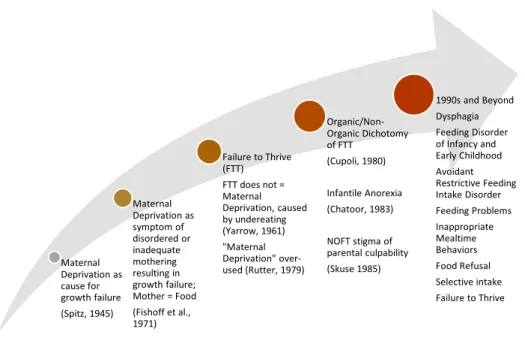
In this section, an overview of the concept over the last century will be described, drawing from the pre-2000 sample of manuscripts. Failure to thrive was the first term introduced to describe children with feeding problems. Failure to thrive was first used by von Pfaundler of Munich in the early 20th century to describe institutionalized foundling, or orphaned, children with poor growth (Wolke, 1996). These children were government wards and received poor care giving in environments that often lacked hygiene. Dr. Rene Spitz published a report in 1945 that introduced “maternal deprivation” as the cause for failure to thrive in institutionalized infants. Unfortunately, mortality rates for infants in institutions (foundling homes, orphanages) were abysmal. Children could sometimes be saved by discharge to a foster home. Spitz studied the infants of a foundling institution and compared them to infants born into a penal institution for “delinquent” girls (Spitz, 1945). Spitz
institution infants failed to grow and thrive (develop) because they had no maternal interaction. In truth, from Spitz’s own descriptions of the institutional environment for orphaned children, their situation could be interpreted as a dismal state of isolation from nearly all human interaction and/or stimulation (not just an absence of mothers, but extremely limited contact and stimulation of any kind).
Later when infants and young children failed to thrive in the home or community setting, the idea of maternal deprivation carried over (Whitten, Pettit, & Fischhoff, 1969). When it could not be proven that these children were deprived of mother interaction, the deficiency assumption became one of disordered or distorted mothering (Fischhoff, Whitten, & Pettit, 1971). Whitten and Pettit (1969) conducted a study to determine if the cause of maternal deprivation syndrome (essentially growth failure) was from psychologically borne absorption or metabolic issues, or if it was from low food intake. They found that failure to thrive/maternal deprivation syndrome was due primarily to under-eating: either from not being offered enough food or from the child not accepting food. They were also one of the first to note that low birth weight was also associated with later growth failure. However, Whitten et al. still named the phenomena maternal deprivation, stating “maternally deprived infants are underweight because of under-eating which is secondary to not being offered adequate food or not accepting it” (Whitten et al., 1969, p. 1675)
were provided and mothers were observed feeding their children. When the children gained weight, Fischoff and colleagues attributed this to adequate mothering.
In the late 1970s, Rutter published a review on maternal deprivation, early child-caregiver relationships, and development of psychopathy, making multiple assertions in an effort to steer the science towards examination of what made some children resilient to difficult environments and loss early in life (Rutter, 1979). He showed that attachment did not have to be with a mother for growth and development to occur, and anti-social disorders later in life were not necessarily linked to lack of a mother. According to Rutter, “maternal deprivation” was a term used to describe a “most heterogeneous range of experiences and outcomes due to quite disparate mechanisms” (Rutter, 1979, p. 283). At this time the literature begins to move away from attributing pediatric growth failure automatically to maternal deprivation. However, there are still themes of mother blame or caregiver abuse in the dichotomous conceptualization of failure to thrive that was developed in the 1970s (Bray, 1989). Specifically, failure to thrive was divided into two different types according to
assumed causes for the growth failure (Cupoli, Hallock, & Barness, 1980). Organic failure to thrive (OFT) had a clear pathologic cause (such as a disorder of metabolism); while non-organic failure to thrive (NOFT) was attributed to an abnormal parent-child relationship “due to neglect, emotional disturbances, or parental ignorance” (Cupoli et al., 1980).
In 1985, Altemeier’s (Altemeier, O'Connor, Sherrod, & Vietze, 1985) team of
pediatricians and psychologists studied the antecedents to NOFT in children of low-income mothers. Of 274 births, fifteen children developed NOFT and six OFT. The mothers of children with NOFT more often had some spousal conflict and history of “aberrant nurture in the mother’s childhood” (Altemeier et al., 1985, p. 360). Pregnancy complications, short gestation, and minor medical problems existing at discharge from the hospital nursery were correlated with NOFT. Altemeier and colleagues interpreted these complications and medical conditions as interference with the mother-child relationship, and thus the dysfunctional mother-child relationship caused growth failure. This line of thought, with ignoring the medical history as possible organic causes of interruption in intake, was problematic because it contributed to mother blame and failed to advance understanding. Additionally, the selection of a study population of only low-income mothers was
The 1990s saw an increase in the description of the presenting behaviors of the child as the problem. Terms that entered the literature in the 1990s included: food refusal,
feeding disorder, feeding problems, feeding difficulty, and mealtime behavior. These terms are indicative of a change in thinking toward more focus on what the problem looks like and less dichotomizing, less focus on maternal blame and why a child would not grow. Sanders and colleagues (Sanders, Patel, le Grice, & Shepherd, 1993) compared feeding practices of parents and behavior of young children with and without feeding problems at mealtime. Greater food refusal and disruptive mealtime behaviors were observed from the children with feeding problems. Also parents of children with feeding problems were more negative and coercive in their mealtime parent-child interactions. Sanders linked these refusal behaviors and responses of caregivers in a negative mealtime cycle of parent-child
interaction. During that same decade Paul Hyman (1994) presented a subversive medical cause for infant food refusal behaviors. He theorized that food refusal was an adaptation to avoid pain caused by esophageal reflux after eating. According to Dr. Hyman, infants could have pain from acidic reflux without evidence of esophagitis or erosion. This was a unique contribution to the conceptualization of antecedents for pediatric feeding problems, that food refusal behavior could be an adaptation to underlying physiology of the infant, an observable manifestation of a symptom.
Present Conceptualization of Feeding Problems
Each of the disciplines working to define and understand the phenomena of pediatric feeding problems has done so in ways that are reflective of their scope of practice and philosophies therein. While there has been considerable effort to describe this phenomenon as a disorder or diagnosis, emphasis has been on description of discrepant
conceptualizations rather than on areas of consensus. In this section, current
conceptualizations will be presented within and across disciplines with focus on areas of consensus.
Surrogate terms. Alternative, surrogate terms for feeding problems were numerous. Across the 100 manuscripts, there were 283 different surrogate terms used. Often, authors used multiple terms in the same manuscript. Table 2.2 illustrates the three most often used surrogate terms per discipline of authorship. “Feeding problem” was the term used most frequently over all. “Dysphagia” appeared in the top three only for Speech-Language Pathology and this fits with their scope of practice. “Food refusal” represents a clustering of more specific behaviors such as head turning, clamping the mouth shut, hitting the spoon, throwing the bottle, and spitting food out once it is in the mouth. “Failure to thrive” comes in third for Speech and the “Other” category. As a surrogate term, failure to thrive was used as a description of an outcome of feeding problems, often it is when a child begins to lose weight or growth falters that a feeding problem is suspected. The diagnostic classifications available to pediatric providers, although mentioned (Atzaba‐Poria et al., 2010; Chatoor & Ganiban, 2003; Greer, Gulotta, Masler, & Laud, 2008; Uher & Rutter, 2012) were not the most commonly used terms within the literature (Table 2.3). In fact, most often these diagnoses were critiqued for their limited practical use given both the range of
presentation of feeding problems encountered clinically, and practical application of
In the DSM-V the APA (2013a & 2013b) has removed the previous version’s “Feeding Disorders of Infancy and Early Childhood” and replaced it with a non-age restricted “Avoidant/Restrictive Food Intake Disorder”, citing a lack of information on clinical characteristics and therefore an inability propose valid diagnostic criteria.
In sum, existing classification systems are inadequate with respect to the spectrum that includes many children with feeding disorders. These systems do not provide criteria that reflect the heterogeneity of potential feeding problems, do not account for the complex etiology of feeding problems, and they lack sufficient specificity in terms of operationally defining the criteria for the diagnosis. Most important, the extant classification systems are not prescriptive for treatment development. That is, these systems provide clinicians with a limited categorization of feeding disorders and offer no support for developing interventions based on the presenting problem. (Piazza et al., 2009, p. 477)
Related concepts. Related concepts to feeding problems frequently also fit into the categories of surrogate terms, antecedents, and/or consequences (depending on how the author contextualized the phrase). An example of a related concept with attribute overlap would be “tube feeding.” Tube feeding itself does not share all attributes with feeding problems, but there exist some shared features. Eating behavior with enteral tube feeding will be altered significantly from what would typically be expected (Sharp, Jaquess, Bogard, & Morton, 2010). Tube feeding could be seen as an antecedent to a feeding problem, when the problem was conceptualized as feeding tube dependency (Tarbell & Allaire, 2002; Trabi, Dunitz-Scheer, Kratky, Beckenbach, & Scheer, 2010). And lastly, tube feeding could be a consequence of food refusal behaviors (Sharp et al., 2010; Williams, Field, & Seiverling, 2010).
Caregivers will usually be noted to have made feeding adaptations, to be affected by the feeding problem, and the feeding relationship they share with the child may have atypical or dysfunctional features. Family function can be impacted, and overall mealtime can become a negative cycle of maladaptation and poor eating. Together, this paints a picture of a complex phenotype condition that presents along a range of severity depending on functional impact.
The overall most frequently appearing attribute across all disciplines, and ranked within the top three attributes for all, was problematic feeding behaviors displayed by the child. For Multidisciplinary and Occupational Science categories, these behavioral features, such as food refusal or selectivity, were described as key attributes of the problem in 100% of the sample. Within Psychology, problematic feeding behaviors were the most often occurring attribute and were coded within 94% of the articles. Selective or restrictive oral intakes by type, texture, or presentation, and oral hypersensitivity or aversion, were included in this category as well. Growth faltering (including failure to thrive and weight loss) was a top attribute for disciplines of Medicine, Nursing, Speech-Language Pathology, Other, Occupational Science, and Psychology, and occurred in greater than 50% of the
Multidisciplinary articles. Dyadic interaction issues, or dysfunction of the caregiver-child relationship was a common attribute across all discipline categories, although it was most often appearing in the Occupational Sciences sample (83%). The most commonly noted attribute of the atypical child physiologic function impacting eating were oral-motor problems and dysphagia. This was one of the most often occurring attributes within Speech,
delay/disabilities, complex medical conditions or genetic syndromes, and enteral tube feeding.
Some noteworthy differences among the disciplines will now be highlighted. The theme of “range of presentation” applied when a manuscript explained a variety of
presentations for pediatric feeding problems. For example, Sharp and colleagues (2010) conducted a review of treatment outcomes for feeding problem interventions. The
heterogeneity of presentation was noted with feeding problems varying from selectivity by texture, type, or presentation, to disruptive mealtime behaviors, to tube feeding dependency. This theme of range of presentation was common across the majority of Occupational
Science, Speech Language Pathology, and Psychology manuscripts; however, range was not common in Medicine, Multidisciplinary, or Nursing.
Attributes of caregiver coping and adaptation (includes personal impact of child’s feeding problem on parent and changes in parent behavior) related to a child’s feeding problems were supported by the entire Occupational Science sample, while the proportion was lower for all other disciplines. Eighty-three percent of the Occupational Science articles noted an attribute of caregiver feeding role adaptations during feeding. This was followed by Nursing and Speech, and Other disciplines where the attribute was noted in less than 50% of the sample. From Nursing, the mother’s “working model of feeding” is an explicit example of this attribute of feeding problems.
A working model is an internal or mental model of experience that operates in relation to events to regulate goal-directed thought and action. An example of a goal of an internal working model of parenting is giving safe and nurturing care to the very young, VLBW baby…A mother's motivations, feelings, thoughts, and feeding behaviors are functions of her internal working model. A working model is constructed and reconstructed through experience, including relationships with and the guidance of others, and response to changing need. The working model operates actively during a feeding and is likely to be in a mother’s conscious awareness whenever a challenge to feeding goals is confronted. (Pridham, Saxe, & Limbo, 2004, p. 162).
perceived as anxious, controlling, inflexible, or depressed when her child has a feeding problem. Maternal mental health issues were an attribute found in 100% of the
Occupational Science sample, 50% of Medicine, and 43% of Psychology. Themes of maternal or feeder insensitivity existed in a minority of the Psychology (22%) and Nursing (21%) articles. All disciplines had feeder mealtime rules, roles, or structure as an attribute of the problem; this was highest in Occupational Science (83%) and Nursing (64%), followed by Speech Language Pathology (56%). Atypical family function or impact on family function was noted most often within the Other, Occupational Science, Psychology and Speech Language Pathology samples, although it was present across all disciplinary groups to some degree.
A negative mealtime cycle as an attribute of pediatric feeding problems was found across disciplines, but most often in Psychology. This negative cycle was between the feeder and the child (Greer, 2008) and sometimes proposed within the family context. The cycle was more than just behaviors of the child or the feeder, this included the transactional development of maladaptation and food aversions with motivations for each individuals actions within the system (Figure 2.2).
Antecedents. Antecedents to feeding problems in the literature were often difficult,
if not impossible, to separate from overall attributes as the two categories have much overlap. When a child is born with a condition and develops a feeding problem, this other condition often becomes a clue to the feeding problem and vice versa. Numerous
conditions often co-occur with feeding problems, as seen in Table 2.5. Children with failure to thrive and inappropriate mealtime behaviors may be pre-diagnostic for an heretofore undiagnosed condition, such as Autism spectrum disorder (Keen, 2008).
Remaining antecedents to feeding problems for infants and young children can be conceptualized as being internal and external to the child. Main themes of internal
related to eating, abnormal functioning or disease of structures related to eating (Arvedson, 2008; Rommel et al., 2003), abnormal sensory processes (Zangen et al., 2003), physiologic cognitive/behavioral (Schwarz, Corredor, Fisher-Medina, Cohen, & Rabinowitz, 2001), experiential, and specific past invasive procedures (Bernard-Bonnin, 2006; Jadcherla, Vijayapal, & Leuthner, 2009).
Main themes of antecedents discussed in the sample that were external to the child were parenting experience, thoughts, and beliefs (Davies et al., 2006; Motion, Northstone, & Emond, 2001), parental psychosocial health (Fishbein, Benton, & Struthers, 2014; Motion et al., 2001), mother-child interaction (Williams et al., 2009), feeding strategies (Levy et al., 2009; Lewinsohn et al., 2005), and family and environmental factors (Arvedson, 2008; Meyer et al., 2014). Also delayed access to care was mentioned as contributing to the feeding problem in a few manuscripts, although this was a low occurring antecedent mostly from studies that used family input (Kessler, 2008; Sleigh, 2005; Thomlinson, 2002).
Consequences. Consequences of pediatric feeding problems are some of the most clearly agreed upon conceptual elements across disciplines. Malnutrition, undernutrition, and growth failure were common consequences (Ammaniti, Lucarelli, Cimino, D'Olimpio, & Chatoor, 2010; Burklow, McGrath, & Kaul, 2002; Pridham et al., 2004). Also delayed development of feeding skills (delayed feeding skill acquisition), and impaired global development (Arvedson, 2008; Bachmeyer et al., 2009; Bahr & Johanson, 2013). For the infant or child, health can be impacted by aspiration, increased risk for infection,
malnutrition, or the feeding problem may even result in death (Berlin, Davies, Lobato, & Silverman, 2009; Brotherton & Abbott, 2012; Liou, 2013; Locklin, 2005).
cycle as shown in Figure 2.2) were common consequences that can also be conceptualized as antecedents (thus the cycle) (Bachmeyer et al., 2009; Kessler, 2008; Patel, 2013;
Rommel et al., 2003).
Maternal impact and stress were present throughout disciplines as consequences of feeding problems, as were family impact and family stress. “Families heard their children labeled as failures and were told they were the cause of the problem” (Thomlinson, 2002, p. 541).
Parents may be presented with an option of feeding tube placement, or risk for death of their child (Brotherton & Abbott, 2012). With feeding tube placement comes its own host of issues with extensive impact on the child and family. For the child this includes limited or hindered mealtime social opportunities, lack of association between intake of food and satiety, and invasive surgical procedures (Byars et al., 2003; Sleigh, 2005). For families and parents, impact of tube feeding includes economic impact (supply costs, work time lost by parents), perceived social stigma, loss of caregiver sleep, caregiver stress, and limited qualified caregivers for respite (Brotherton & Abbott, 2012; Craig & Scambler, 2006; Davis, Bruce, Cocjin, Mousa, & Hyman, 2010).
Some consequences were mostly limited to a particular discipline. Prolonged hospitalization, or neonatal intensive care unit time, was a factor cited within the Nursing sample (White-Traut & Norr, 2009). Within Speech and Psychology, lingering feeding problems, or inappropriate mealtime behaviors, were noted to persist and require intensive treatments after the medical antecedents for the feeding problem have been resolved (Silverman, 2010; Tarbell & Allaire, 2002)
Proposed Interdisciplinary Model for Further Development
proposed interdisciplinary model for further development. There is consensus that pediatric feeding problems are complex and present in heterogeneous ways. Each discipline tends to focus on certain aspects of the problem. This evolutionary concept analysis has illustrated the landscape of all of those perspectives together to look at the problem in a
comprehensive way. Disagreements with the concepts related to feeding problems are likely related to the heterogeneous nature of the problem and complexity of the causes and the foci of the discipline itself. For example, Nursing literature on this subject most often considers a younger population of neonates and young infants. Unlike a toddler with the volition to refuse food, feeding behavior of the neonate is not interpreted as inappropriate. Instead, behaviors indicating distress or feeding avoidance indicate appropriate physiologic and or neurological response to the challenge of participating in feeding at that time; feeding behaviors are thereby considered functional adaptations that require interpretation as such.
When the average age of children presenting to specialty feeding clinics is greater than 2 years and they have complex medical histories with significant feeding disorders (Berlin, Lobato, Pinkos, Cerezo, & LeLeiko, 2011; Rommel et al., 2003), this problem is developing along with the child - seemingly under-the-radar of health care and early intervention. Only when it is obvious (sometimes painfully so for child and family) do they arrive at treatment (Field et al., 2003; Thomlinson, 2002). Interdisciplinary healthcare and early intervention providers can do much better for children and their families if they possess a valid, shared conceptualization of pediatric feeding problems and tools for assessment.
Autism spectrum disorder (ASD): A similar evolutionary path
with the described “autistic disturbances of affective contact” (Kanner, 1943, p. 217), it was his anecdotal remarks about the frigid, highly intelligent, and career driven parents who were lacking warmth that were used by Bruno Bettelheim (Bettelheim, 1967) to endorse cold, affectionless mothers as the cause for Autism. Now Autism is classified as a complex spectrum disorder with multiple known and unknown antecedents (Millon et al., 2011). A strained mother-child relationship can be a part of the presentation because these children may be less inclined to seek typical social interaction and may have delayed development of communication. Mother blame in the refrigerator mother conceptualization of Autism (a condition of complex etiology and heterogeneous presentation) was similar to the strong connotations of mother blame with maternal deprivation (Spitz, 1945) and non-organic failure to thrive (Cupoli et al., 1980). Also as with ASD (Newschaffer et al., 2007), today it is known that the etiology for pediatric feeding problems is largely unknown, but is likely to stem from a complex interaction of biological and environmental influences (Berlin et al., 2009; Berlin et al., 2011).
Autism has been reclassified as a spectrum disorder within the latest version of the DSM; this encompasses a range from classic autism as described by Kanner (Kanner, 1943, 1971), to the higher functioning individuals with Asperger’s (APA, 2013a; Millon et al., 2011). All under the umbrella of autism spectrum disorder (ASD) have two key traits common to ASDs, 1) social impairments of some degree, and 2) restricted interests. A similar classification approach could be beneficial to the conceptualization of pediatric feeding problems.
Consensus Attributes and Further Development of Concept
pediatric feeding problems. From this analysis of 100 manuscripts, main traits of pediatric feeding problems that were common across disciplinary conceptualizations were
problematic feeding behaviors and restrictive intake. With these two main traits underlying
all presentations of feeding problems agreed upon, other features such as developmental delay, growth faltering, and tube feeding would be possible features along the spectrum that impact feeding function. Valid measurement of these constructs along the spectrum would allow for personalized assessment and intervention.
This analysis guides what is needed for a comprehensive assessment of a child with feeding problems. Valid and reliable instruments are needed to assess some of the key attributes of feeding problems across its spectrum of presentation and then tailor
intervention to the strengths and difficulties of each child and their family. These include: 1. Infant/Child feeding behaviors
2. Feeding skills/abilities
3. Development (gross, fine, oral motor) 4. Child growth
5. Diet & nutrition
6. Family function and management of feeding problem 7. Impact that the feeding problem has on the family 8. Feeding environment/strategies being used
most often noted within Occupational Science, Nursing, and Speech, although they had presence within the other disciplines. Now, the science ought to move beyond to practical studies of function, behavioral assessment, and into personalized intervention effectiveness. The varying classifications and descriptions of what “is” a pediatric feeding problem, are likely a result of the complexity of the problem itself. The conceptual plurality of pediatric feeding problems could be ameliorated with a schema to be engaged with across
disciplines.
Tube dependency is a conceptual attribute warranting further study. In this sample of 100 manuscripts, enteral tube feeding was sometimes a surrogate term for feeding problem, sometimes a cause of a feeding problem, and sometimes a result of a feeding problem. Research is needed to describe the transition point in which enteral feeding tube placement changes from the consequence of a feeding problem, and becomes tube
dependency, an antecedent for one of the most difficult to overcome feeding problems.
Conclusion
Because pediatric feeding problems are complex and often require multi or
interventions, rather than approaches based on proprietary feeding treatments or
interventions that categorize children into predetermined problem types. Parents of children with feeding problems are important to engage in assessment and treatment for the child, not because they were the cause of the problem, but because they are the proximal agents for change in the child’s natural environment.
Longitudinal description of the comprehensive assessment attributes may reveal the path to one of the more difficult to treat types of feeding problems, and areas for
intervention. “Behavioral” approaches that are used for older children with tube dependency are based on operant conditioning and are meant to correct problems that have already developed and taken root (Silverman et al., 2013). Somewhere, sometime along and infant’s developmental path the feeding difficulty begins, they have learned that feeding is difficult or undesirable.
Pragmatic research is research conducted in real world settings, driven by the patients and providers, and seeking outcomes which are meaningful for all involved (Glasgow, 2013). Pragmatic research is needed of the feeding problem phenotype. Divergent efforts at defining multiple types of this disorder based off clinical convenience samples have prevented valid diagnostic classification (APA, 2013b). Comprehensive assessment of the child who presents with feeding difficulty and their family will allow for better identification of children who are struggling to eat and assessment of the
Table 2.1
Sampled Literature by Discipline
Discipline Initial Sample
Historical (Pre-2000) Sample
Full Current (Post-2000)
Sample
Final Reduced Sample for
Current Analysis
n % n % n % n
Medicine 36 14% 10 24% 26 12% 12
Multidisciplinary 60 23% 11 26% 49 22% 22
Nursing 37 14% 6 14% 31 14% 14
Nutrition 5 2% 2 5% 3 1% Moved to Other*
Occupational 14 5% 0 0% 14 6% 6
Other 10 4% 2 5% 8 4% 5*
Psychology 83 31% 11 26% 72 32% 32
Speech Language
Pathology 21 6% 0 0% 21 9% 9
Total 266 42 224 100% 100
Table 2.2
Top Three Surrogate Terms Per Discipline
Rank Medicine Multi-disciplinary Nursing Other Occupational Science Psychology Speech Language Pathology
1 Feeding Problem Feeding Problem Feeding Difficulty Feeding Difficulty Feeding Problem Feeding Problem Feeding Disorder
2 Food Refusal Feeding Difficulty Feeding Problem Feeding Disorder Feeding Difficulty Food Refusal Dysphagia
3 Feeding Disorder Feeding Disorder Feeding Issues Failure to Thrive Problematic Feeding Behaviors
Feeding Difficulty
Table 2.3
Available Classifications for Pediatric Feeding Problem Conditions
Diagnostic Classification of Mental Health and Developmental Disorders of Infancy and Early Childhood (DC-0-3R; Zero to Three, 2005, pg. 35-38)
Diagnostic and Statistical Manual of Mental Disorders, 5th Edition (DSM-5; American Psychiatric Association, 2013, pg. 334-338)
Feeding Behavior Disorder
Considered when an infant or young child has difficulty establishing regular feeding patterns – that is, when the child does not regulate his feeding in accordance with physiological feelings of hunger or fullness. If these difficulties occur in the absence of hunger and/or interpersonal precipitants such as separation, negativism, or trauma, the clinician should consider a primary feeding disorder
Feeding Disorder of State Regulation (3)*
Feeding Disorder of Caregiver–Infant Reciprocity (3)*
Infantile Anorexia (6)*
Sensory Food Aversions (4)*
Feeding Disorder Associated with Concurrent Medical Condition (4)*
Feeding Disorder Associated with Insults to the Gastrointestinal Tract (4)*
*Each of the above subcategories of feeding behavior disorder have criteria that must be met for that particular diagnosis.
Avoidant/Restrictive Food Intake Disorder An eating or feeding disturbance as manifested by persistent failure to meet nutritional and/or energy needs associated with one or more of the following:
Significant weight loss or faltering growth
Significant nutritional deficiency
Dependence on enteral feeding or oral nutritional supplements
Marked interference with psychosocial functioning
50
Table 2.4.
Attributes of a Feeding Problem and Percentages of Disciplinary Sample
Attributes Medicine disciplinary Multi- Nursing Other Occupational Science Psychology Language Speech Pathology
Range of presentation 8 9 7 0 67 56 78
Negative mealtime
cycle 33 36 36 20 17 59 44
Caregiver behaviors 30 36 64 20 83 44 56
Caregiver mental
health 50 18 0 20 100 43 33
Changes by caregiver 58 23 36 20 100 45 67
Family life, day-to-day 33 9 21 0 50 22 44
Dysfunctional feeding
relationship 42 52 43 60 83 59 56
Temperament or
organization 33 27 43 40 33 47 22
Child mental/
Psychosocial 33 32 21 40 50 62 67