Indonesian Students
'
Association (PPI) in
Netherlands from 1952 to 2015: a Continuing
Dynamic
Dirgantara Reksa Ginanjar s1729101
A thesis submitted to the Faculty of HUMANITIES
for the
MASTER’S DEGREE in
ASIAN STUDIES
LEIDEN UNIVERSITY Rapenburg 70 2311 EZ Leiden The Netherlands
Supervisor: Prof. Dr. David E.F. Henley
TABLE OF CONTENTS
CHAPTER I – INTRODUCTION
CHAPTER II – RESEARCH SETTING AND METHODOLOGY
CHAPTER III – HISTORY OF ESTABLISHMENT
III.I. Colonial Era: Years of Awakening
III.II. Indonesian Students' Association in the Netherlands during Orde Lama
III.III. Indonesian Students' Association in the Netherlands during Orde Baru
CHAPTER IV – POST-REFORMASI SITUATION
IV.I. City Branches of PPI di Belanda
IV.II. Events
IV. III. PPI Involvement in Domestic Politics
IV.IV. Relation with the State’s Representatives: Embassy of the Republic of Indonesia (KBRI) and Atdikbud.
IV.V. Overseas Indonesian Student Association Alliance (OISAA).
CHAPTER V – OTHER STUDENTS' ASSOCIATIONS IN THE NETHERLANDS
CHAPTER VI – CONCLUSION
CHAPTER I - INTRODUCTION
Since the beginning of the 20th century, when Indonesia was not yet independent, Indonesian students' associations have played a major role in the nation building. The founding fathers Mohammad Hatta (the later vice-president), Dr. Soetomo, Sutan Sjahrir, and Achmad Soebardjo who studied in the Netherlands actively discussed Indonesian identity and the independence in an organisation called Perhimpoenan Indonesia (PI, Indonesian Association), which was reintroduced in 1925 after being originally established in 1908 under the name Indische Vereeniging. Firstly formed as a social club, the PI was later active politically. It frequently criticized the Dutch government for what they did in the Netherlands Indies through its newspapers Hinda Poetra and Indonesia Merdeka. The PI demanded freedom for Indonesia and had the spirit of anti-colonialism and non-cooperation with the Dutch. Later it became anti-fascist, which made the PI a tool for the independence struggle. However, once the purpose of the political movement –the Japanese replacement of the Dutch, and independence– became known, the PI was slowly dissolved, though the exact dissolution date is unknown.1
In 1952, an association that bonded and united Indonesian students with the spirit of nationalism reappeared with the new name of Persatuan Peladjar Indonesia (PPI). This is the benchmark year of this study as it was the first year of term PPI. From there on, the dynamic of the PPI has never stopped. Although it altered its name to Persatuan/Perhimpunan Pelajar Indonesia, the spirit still remains for Indonesian students overseas.
The aftermath of the PI can be seen afterwards. Indonesian students overseas took a similar form of action. There are other student diaspora stories from the late 1960s, this time in the United States. When the Indonesian Orde Baru just started its administration, a handful of economic students from the University of
1 See Sunario. (1970) “Perhimpunan Indoensia dan Peranannja Dalam Perdjuangan Kemredeaan Kita” in
California, Berkeley, were chosen to bring back the Indonesian economy from deprivation. In the United States, they formed a group that people called the ‘Berkeley Mafia’ that consisted of several prominent figures such as Widjojo Nitisastro, Mohammad Sadli, Emil Salim, Subroto, and Ali Wardhana2. These students, who were linked together in Berkeley, returned as a group lead by Nitisastro to work under the administration of Soeharto. One of the professors in the Department of Political Science, T.C. Blaisdell commented: “These (would be) prominent Indonesian leaders are gathering,” as the group were having study meeting in Barrows Hall, Berkeley (Anwar et al, 2007). The group supported the
Orde Baru until its collapse in 1998. In the 1960s I believe the number of Indonesian students was not as many as there are now. And in 1961, following the establishment in the Netherlands, the Persatoean Mahasiswa Indonesia di Amerika Serikat (Indonesian Students' Union in the United States) was born.3
Today, the number of Indonesian students overseas have increased, as there are 51 PPI in the world. Indonesian students tend to be organized as they belong to the PPI. This is not only in the Netherlands and the United States, but in Singapore, Malaysia, the Philippines, Australia, Turkey, Russia, Saudi Arabia, and Morocco, among others. These students association are familiar among Indonesian under the name of Perhimpunan Pelajar Indonesia (PPI). Although the associations are geographically separated, they seem to have similar form of organization, source of funding, and activities. I did not observe this pattern of association in other international students' association, thus it is worth comparing with other students' associations.
For this research on the Indonesian Students' Association, I want to look specifically at the existing Indonesian students association in the Netherlands (PPI di Belanda), which is divided into two: The Indonesian Students' Association Netherlands (PPI Belanda), and city offices of the Indonesian Students' Association Netherlands (PPI Kota di Belanda).
2 See more on Berkeley mafia on http://www.atimes.com/atimes/Southeast_Asia/JA28Ae02.html (Access on
17 May 2016).
Indonesian students have a long history in the Netherlands, which can be traced to a century back. However the association itself has changed its name many times from Indische Vereeniging (Indies' Association) to Indonesische Vereeniging (Indonesian Association) to Perhimpoenan Indonesia (PI, Indonesia Association), Persatuan Peladjar Indonesia (PPI, Indonesian Students' Union) until its current manifestation Perhimpunan Pelajar Indonesia.
I believe it is possible to see the phenomena of the PPI around the world from the case of the PPI in the Netherlands. There are several arguments that support this opinion. First, PPI in the Netherlands has a deep root to the earliest Indonesian students' association, and the term PPI was born in the Netherlands. Second, the members of the PPI Belanda have had a significant impact on the development of the nation, which I explain in later chapters. Third, organizationally the establishment of the PPI Belanda occurred in the national and the city level with 17 city branches. Fourth, it has been related with the country’s representative The Kedutaan Besar Republik Indonesia (KBRI)4 since 1963.
In this study I address how the PPI Belanda developed during the different regimes in Indonesia from Orde Lama to Post-reformasi and how the PPI Belanda reacted to each regime. Next I question how the previous and current PPI organize itself in terms of constitution, purpose, membership policy, and medium of information, activities and source of funding. I also became interested in the PPI Belanda’s political connection with Indonesian domestic politics, as it is acknowledged that the PPI often deliver the Pernyataan Sikap (Position Statement) on current issues in Indonesia. Thereafter I discuss the longstanding relationships between the PPI and the government’s representatives, particularly the Atase Pendidikan dan Kebudayaan Republik Indonesia (Atdikbud)5 that is in
the KBRI in The Hague. By examining these topics I hope the dynamic of the PPI Belanda will be more acknowledged in the future.
4 Embassy of the Republic of Indonesia.
In the current situation, Indonesian students in Netherlands consist of three groups: bachelor's, master's, and doctorate students. Most bachelor's students are self-funded, so are being funded by their family or relatives. Conversely, master's and doctorate students are commonly supported by scholarships, such as from Indonesian Government, Indonesian state-owned companies6, and the
Dutch government, although some of them are privately funded. From the research conducted by PPI Belanda7 in 2015 on student funding, the 10 most
common sponsors for Indonesian students are: Nuffic Neso8, Indonesia Endowment Fund for Education (LPDP)9, Ministry of Education of Indonesia, sponsorship from the university where they are enrolled, SPIRIT10, Islamic Development Bank, Ministry of Transportation of Indonesia, PT. Telekomunikasi Indonesia, Ministry of Communication and Information of Indonesia, and Erasmus Mundus.
There is no exact data on the total number of Indonesian students in the Netherlands. The Educational Attaché of the Republic of Indonesia in Den Haag stated that in 2015, approximately 1600 Indonesian students were pursuing their education in the Netherlands11. This was the same number estimated by the Dutch government in 2014.12 However, based on the Lapor Diri13 report the
6 In Indonesia these are known as Badan Usaha Milik Negara (BUMN).
7 http://public.tableau.com/shared/RX4MPN4K7?:display_count=yes (Accessed on 7 May 2016).
8 Nuffic is the international organization that focuses on higher education in the Netherlands. The
organization is non-profit and based in The Hague. Nuffic offers four scholarship programs for Indonesians: StuNed, Orange Tulip Scholarship, Netherlands Fellowship Program, and Holland Scholarship. Quoted from http://www.nesoindonesia.or.id/beasiswa (accessed on 25 May 2016).
9 Indonesian Education Scholarship (BPI) for Master and Doctoral Programs is a scholarship program
funded by the Indonesian government through the use of National Trust for Education Development (DPPN) and is managed by LPDP to finance higher education in master's or doctoral program in higher education in Indonesian or overseas institutions. Quoted from http://www.lpdp.kemenkeu.go.id/en/scholarship/master-and-doctoral-scholarships/ (accessed on 1 June 2016).
10 SPIRIT stands for the Scholarship Program for Strengthening the Reforming Institutions, which was
initiated by the Indonesian Ministry of The National Development Planning (Bappenas), Indonesian Ministry of Finance and World Bank to strengthen the bureaucracy reform in central government offices. Taken from http://pusbindiklatren.bappenas.go.id/spirit/index.php/profile (Accessed on 19 June 2016).
11 Author’s Interview with Educational Attaché of the Republic of Indonesia, Bambang Hari Wibisono, at
Schiphol, 10th April 2016.
12See https://www.government.nl/topics/international-relations/contents/indonesia (accessed on 27 June
2016).
13Lapor Diri, which translates into English as “self-report”, is a system created by the Embassy of Indonesia
number of students that are registered are around just 600. The gap results from the lack of briefing from the embassy to the students. In the Netherlands, Indonesian students are in many cities such as Amsterdam, Den Haag, Groningen, Enschede, Tilburg, Maastricht, Leiden, Leeuwarden, Deventer, Delft, Rotterdam, Wageningen, Nijmegen, and Utrecht.
CHAPTER II – RESEARCH SETTING AND METHODOLOGY
Previously, there has been no academic research about the current Indonesian Students' Association in Netherlands. Existing studies are mainly about the Indonesian Students' Association in the pre-independence time. Luckily, there are enough resources to support the study of the contemporary although the archiving system of the associations is disorganized: some archives are available, but most of them are not. To address this issue, I undertook participant observation wherever and whenever possible among the Indonesian students associations. I participated as fully as possible in the community life by attending many events held by Indonesian students' associations, such as discussions, sports events, regular meetings, and cultural events.
I also conducted an interview with the current and ex-general secretaries of PPI Belanda and ex-chief of PPI Kota: Ali Abdillah (PPI Belanda 2015-2016), Reynaldo Rante Allo (PPI Belanda 2010-2011 & PPI Den Haag 2009-2010), Niken Edgina (PPI Amsterdam 2014-2015), Hellena Yoranita Soussa (PPI Leiden 2004-2005), and Ghamal Satya Mohammad (PPI Leiden 2015-2016). At the time of the research, Ali Abdillah was on a master's program in the Law Faculty of Leiden University. Reynaldo had graduated from NHTV Breda University of Applied Sciences and had been living in the Netherlands since 2009. Hellena did an MA in International Relations and Diplomacy at Leiden University from 2003-2005. Niken did MA in Law and International Politcs at Vrije
Universiteit Amsterdam from 2014-2015. And Ghamal was on a research master’s program in the History Department of Leiden University. Additionally, I interviewed the project officer of Indonesian students events, and members of PPIs: Alqiz Lukman from PPI Leiden 2015-2016, Dyah Kathy Kartika from PPI Kota Den Haag 2015-2016, Santy Kouwagam from PPI Leiden 2015-2016, and Tamara Soukotta from PPI Kota Den Haag 2012-2013.
Lastly, I interviewed the current educational attaché of The Republic of Indonesia (Atdikbud)14, Mr Hari Bambang Wibisono, who is the main actor in the relationships between the PPI and the Indonesian Embassy. He has been working as Atdikbud since 2013 and has established the relationship with the PPI, succeeding the previous Atdikbud. The interview with him was conducted in his office in the Embassy of the Republic of Indonesia in Tobias Asserlaan, The Hague. Also I interviewed Farina Lomboan, a local staff in the Indonesian embassy who has been working for almost twenty years and had witnessed the interactions between students and embassy since then. And as for the other students' association in Netherlands, I interviewed Sungbin Lee, the current president of KSAN (Korean Students' Association in the Netherlands) to know how her association going on.
Furthermore I collected articles, online articles, archives, bulletins and magazines that discuss the Indonesian Students Association in previous years such as:
Madjallah Perhimpoenan Peladjar Indonesia di Belanda, Suluh, Ganeca, Chattulistiwa / De Evenaar, Bulletin PPI Delft, Bulletin PPI Uni-Soviet. I also researched the book Konperensi Pelajar Indonesia Se-Eropah 1955 Hannef and
Seminar Pembangunan II dan Konferensi V Peladjar, Pikiran Gagasan: Pedoman Penjelenggaraan Konperensi Ilmiah, Sanggar Perantau, and the journal Api Pemuda Indonesia.
I also obtained documents from the archive of the current PPI Belanda and PPI city branches such as the constitutions of PPI Belanda which I could access from
the website of PPI Belanda and city branches, Laporan Ketua 1987/1988 Perhimpunan Pelajar Indonesia Rotterdam, Laporan Pertanggungjawaban Presidium PPI Di Negeri Belanda 1991/1993, Laporan Pertanggungjawaban Historun PPI Leiden 2016, Undangan Simposium Perspektif Ekonomi Indonesia, Amandemen AD/ART PPI Belanda 19 Juli 1986, and Decree of the Minister of Education and Culture Number 064/MPK/LN/2013 dated 5th April 2013. I got these rare documents from interviewees .
CHAPTER III – HISTORY OF ESTABLISHMENT
III.I. Colonial Era: Years of Awakening
In 1925, Indonesian students in the Netherlands renamed their organization
Perhimpoenan Indonesia. This was the Indonesian equivalent of the Dutch name
de Indonische Vereniging, which had been adopted in 1922. As is clear from the emphasis on the word Indonesia and use of the Indonesian language, the organization was known in the 1920s for wanting independence from Dutch colonial rule. In an article of Perhimpoenan Indonesia dan Peranannya dalam Perdjuangan Kemerdekaan Kita (The Role of Perhimpoenan Indonesia in Our Independence) by Sunario –an ex member of PPI from March 1924 to June 1926 –five phases of PPI taken from the article by A. Maramis Terugblik in Gedenboek 1923 are outlined, namely15:
1. 1908-1913: Period of striving for goals and means, despite already noticeable patriotism.
2. 1913-1919: Political orientation toward Indonesian independence under the influence of three leaders of the Indies Party (prominent political party in Indonesia) deported to the Netherlands: Dr. Douwes Dekker, Dr. Tjipto Mangunkusumo, and R.M. Suwardi Surjaningrat.
15 See Sunario. (1970) “Perhimpunan Indoensia dan Peranannja Dalam Perdjuangan Kemredeaan Kita” in
3. 1919-1923: Rise of nationalist spirit, leading to a change in name. In 1922, the name of Indische Vereeniging changed to the Indonesische Vereeniging.
4. 1923-1930: Change from a student organization to a political organization. Published the magazine Indonesia Merdeka in 1924 and altered the name of Indonesiche Vereeniging to Perhimpoenan Indonesia (PI) in the same year. Perhimpoenan Indonesia had a spirit of democratic nationalism and non-cooperation with the Dutch government. The PI also developed an international anti-colonial network among occupied nations like India, Egypt, and the Philippines.
5. 1930 and after" the decline of the PI due to the return of Mohammad Hatta and Achmad Soebardjo to Indonesia in 1932. Afterwards there was change from anticolonial to antifascist policy due to German occupation of the Netherlands in 10 May 1940. The PI was engaged in the movement of Communist International in Europe. Sometime later the PI was disbanded, although there are no details available about exactly when.16
Figure 1 The Reunion of Perhimpoenan Indonesia in Leiden, around 1924 - 192). In the pictures there is Winarjo Projodikaro, Soenario, Achmad Soebardjo (First
Indonesian Foreign Minister), Mr. Singgih, Ali Sastroamidjojo (First Indonesian Representative to the United Nations), and Mohammad Hatta (Indonesian First Vice-President), Boedhiarto) (Source, KITLV: 2016).
III.II. Students' Association during Soekarno’s regime (1949-1966)
After the military aggression in 1945-1949, and the recognition of Indonesian sovereignty by the United Nations, the relationship between the newly formed Indonesian Republic and the Netherlands deteriorated. Consequently, the number of Indonesian students departing to study in Netherlands declined for the next few years. Many students began to study in other countries such as Romania, Albania, Germany, and the Soviet Union. In these countries they also formed Indonesian students' association.
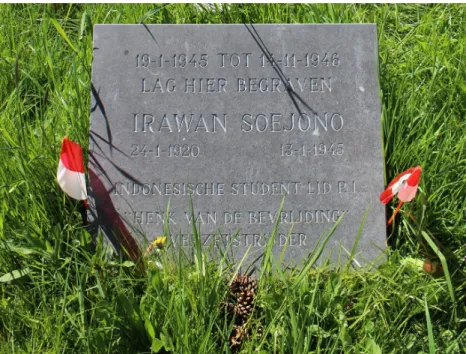
The story of Perhimpoenan Indonesia ended after World War II, Japanese occupation in Indonesia and the Indonesian revolutionary war of 1945-1949. Correspondingly it was also mentioned by Sunario that the PI was disbanded sometime in the 1940s.17 The only known story on the activity and movement of the PI in the 1940s was the tale of Irawan Soejono who died during the German occupation of the Netherlands in 1942. He together with other Indonesian students joined forces with the Dutch to resist the occupation. Later in the war his name was remembered in one of the resistance troops called Barisan Soejono
(Soejono’s Front).18
17 Idem.
18 See http://www.thejakartapost.com/news/2015/06/30/irawan-soejono-a-dutch-indonesian-hero.html
Figure 2 Indonesian resistance fighters called their resistance "Barisan Irawan (B.I.)". Here they parade on the
Breestraat during the liberation celebration of Leiden on May 7, 1945. (Source: Leids Universitair Weekblad 21
April 2016, 39ste jaargang, nr. 27)
Seven years after independence, the Persatuan Peladjar Indonesia (PPI, Indonesian Students Union) was established on 19th April 1952 in Delft, as can be seen in the magazine of Chattulistiwa/De Evenaar, 5e Jaargang, No, 7, Mei/Juni 1952: 3, along with four branches of PPI: Amsterdam, Leiden, Utrecht, and Delft. Also in 1952, another branch (cabang) of Persatuan Peladjar Indonesia was formed, namely PPI Cabang Rotterdam.19 I consider this was also
the first time the abbreviation of PPI for Persatuan Peladjar Indonesia was established.
The first chair of the PPI was Soemantri Brodjonegoro, a prominent academic who was later appointed as minister and Rector Magnificus of Universitas Indonesia from the mid-1960s to the early 1970s.20 This finding shows the great involvement of PPI after independence. The main achievement by the Persatuan Peladjar Indonesia was the consolidation of the Chung Hwa Hui (The Indonesian Chinese descendants students organization) with the PPI on 2 October 1952. This was a big step of ethnicity integration within Indonesian students in the Netherlands, which was not seen in the previous pre-independence association:
Perhimpoean Indonesia.21 In later years, one of the prominent Indo-Chinese members is Kwik Kian Gie22. However, I believe that in the newly established association, the objectives and focus was less political than PI and more focused on the life of its association members.
19 Taken from the magazine Chattulistiwa/De Evenaar: Maandelijks Contact met Oosterse Studenten di
Eropa, 6e Jaargang, No.3, December 1952: 4-5.
20 His name is commemorated as the name of a multi-function sports stadium in South Jakarta, Stadion
Soemanrtri Brodjonegoro.
21 See Bord of PPI Delft, PPI Delft by Yearbook ’87 of the Society of Aerospace Students Leonardo da Vinci
in Laporan Ketua 1987/88 Perhimpunan Pelajar Indonesia Rotterdam.
22 Kwik Kian Gie was the Indonesian Coordinating Minister of Economics and Finance from 1999–2000, and
Figure 4 The announcement of the establishment of Persatuan Peladjar Indonesia
(Indonesian Students Union) in the Netherlands (Source, Chattulistiwa/De Evenaar, 5e Jaargang, No. 7, Mei/Juni 1952 in http://www.kompasiana.com/suryadileiden/ppi-belanda-di-zaman-orde-lama_577f6d975eafbd9c06fdfc36 ).
Some years after 1952, due to the conflict between Indonesia and the Netherlands on West Papua, some of the students got deported and moved to Germany and Belgium, so the Persatuan Peladjar Indonesia had to be halted.23
Nevertheless in 1956 the Persatuan Peladjar Indonesia Amsterdam branch still existed and had just recently chosen its board.24In addition, Chattulistiwa/De
Evenaar informed about student activities such as thesis defences, weddings, and births, as well as the activities of various other Indonesian groups/organizations in the Netherlands. This magazine, which was prominent until the 1970s, also published poems and reviews of Indonesian art, and one Dutch student A. Teeuw often wrote Indonesian literary criticism. He became a renowned professor of Indonesian studies at the University of Leiden.
23 The Information was taken from Laporan Tahunan Ketua PPI Rotterdam Tahun 1987/1988 by: Heryanto,
1988: page 4
Afterwards the source of information for the activity of the Indonesian Students' Association is the Madjallah Perhimpunan Peladjar Indonesia di Negeri Belanda
(Magazine of Indonesian Students in the Netherlands) that was first published in October 1963.25 In that magazine, it stated that Persatoean Peladjar Indonesia
(PPI, Indonesian Students Union) changed its name to Perhimpoenan Peladjar Indonesia di Negeri Belanda (maintaining the same abbreviation PPI) on 11th May 1963 in Delft, and a new constitution followed.26 In this constitution it was
stated that the PPI was formed to preserve the 1945 revolution, thus achieving justice, prosperity, and glory for Indonesia. Concretely, Indonesian students overseas should unite and the PPI should be a tool for bonding. This must be done not just by Indonesian students in Netherlands but also in other European countries.27
Figure 5 The announcement of the establishment of the Perhimpunan Peladjar Indonesia di Negeri Belanda on 11 May 1963 (Source, Madjallah Perhimpunan Peladjar Indonesia
25Madjallah Perhimpunan Pelajar Indonesia di Negeri Belanda was first published in 1963. Its publishing
address was Zwaerdecroonstraat 53a, Rotterdam.
di Negeri Belanda, October 1963:2).
In the early 1960s, PPI Belanda was divided into 5 Regional Commissariats: the Amsterdam Commissariat and its surroundings such as Utrecht; the Den Haag/ Leiden Commissariat; the Rotterdam/Delft Commissariat; the Nijmegen/Wageningen/Tilburg/Eindhoven/Maastricht Commissariat; and lastly the Commissariat for the Indonesian School in Wassenaar.28 However, on 25 May 1967, PPI Belanda changed the terminology of “Commisariat” into “Branch” due to the socio-political situation at that time. Hence, there were 6 PPI Branches: PPI Delft, PPI Amsterdam, PPI Nijmegen, PPI Eindhoven, and PPI Utrecht.29
Madjallah Perhimpunan Peladjar Indonesia/Suluh also showcased PPI’s activities during the early 1960s, such as data collection and sorting.30 This process was conducted by PPI to account for the number of Indonesian students in the Netherlands. According to information from the Ministerie van Onderwijs, Kunsten en Wetenschappen, there were 282 Indonesian students registered in Dutch universities and academies (Hogeschool) during the academic year of 1961/1962, which were divided into the following universities: 30 in Leiden, 26 in Utrecht, 6 in Groningen, 85 in Amsterdam U.G., 28 in Amsterdam V.U., 5 in Nijmegen, 78 in Delft, 4 in Eindhoven, 5 in Wageningen, 14 in Rotterdam, and 1 in Tilburg.31 However, out of this total number of students, only 50 enrolled in the
association. For unknown reasons, the magazine’s preface also stated that
Perhimpunan Peladjar Indonesia in the Netherlands was established on 11 May 1963 rather than tracing back to their roots of Persatuan Peladjar Indonesia,
which was founded in 1952. As quoted from the address of the Ambassador of the Republic of Indonesia in Den Haag, Mr. Sharif:
“Since May 11th, the Indonesian Students Association in the Netherlands
28 See Madjallah Perhimpunan Peladjar Indonesia di Negeri Belanda/ Suluh, year 5 number 1, August 1966:
19.
29 The Information is taken from Laporan Tahunan Ketua PPI Rotterdam Tahun 1987/1988 by: Heryanto.
1988: 4.
was also founded as an independent Indonesian students organization. To all Indonesian students who have not yet received this information, it is expected of you to assemble yourselves within this association, so that we can collectively keep track of and study the developments of our own country, which due to its distance cannot be kept track of and studied thoroughly.”32
Apart from this, Madjallah Perhimpunan Peladjar Indonesia di Negeri Belanda
also contained information that Indonesian students in the Netherlands needed to know about their students' association, such as the constitution, agenda, budget, seminar and conference reports conducted by Indonesian students throughout Europe, as well as the association’s current board. The magazine’s preface stressed that the magazine would not be published regularly, but would instead be published in accordance with PPI’s needs.33 I believe that this is what diminished the magazine’s continuity in times to come. Concerning Ambassador Sharif’s date of the reestablishment of the Indonesian students association, it is unknown what happened before 11th May 1963, and why PPI Belanda had just been re-established.
The 1960s Gathering of PPI Networks in Europe
The earliest record of the Indonesian students gathering in Europe after the Independence was in 1955. It was entitled Konperensi Peladjar Indonesia Se-Eropah (The Conference of Indonesian Students in Europe) and was held from 4th to 15th July in Haneff, Germany.34 It is also stated in the foreword of the book that this 1955 assembly was the first for Indonesian students in Europe and designed to bring Indonesians together so that they could discuss current domestic issues.35 However, the committee together with the participants didn’t
represent the PPI; they ran independently although the Persatuan Peladjar
32 Idem. 33 Idem.
Indonesia was established in 1952. From 143 Indonesian students that participated in this conference, 64 of them were from Netherlands coming from universities in Leiden, The Hague, Rotterdam, Amsterdam, Tilburg, Wageningen, Delft, Nijmegen, and Enschede.36
Figure 6 The Participants and Committee of Konferensi Pelajar Se-Eropah 4-15 July 1955 in Haneff, Germany (Source, Buku Konferensi Pelajar Se-Eropah, 1955: 12).
From then onwards, the first recorded Indonesian students' conference in Europe, which bore the name PPI, was Seminar Pembangunan II dan Konperensi ke V Peladjar Indonesia Se-Eropah (Second Development Seminar and Fifth Conference of Indonesian Students throughout Europe), which was held from 2-16 August 1963 in Moscow. The First Development Seminar (Seminar Pembangunan I) was also held in 1963, in Prague, but there is no documentation for this.37
36 Idem, page 104-112.
Figure 7 The Book of Seminar Pembangunan II dan Konferensi ke V Pelajar Indonesia Se-Eropa (Second Development Seminar and Fifth Conference of Indonesian Students throughout Europe), 2-16 August 1963, Moscow, USSR.
The Seminar Pembangunan II dan Konferensi ke V Pelajar Indonesia Se-Eropa was attended by delegations from PPI branches in Belgium, Bulgaria, West Germany, East Germany, Hungaria, Italy, the UK, France, Poland, Romania, Scandinavia, the Soviet Union, Switzerland, Czechoslovakia, Yugoslavia, and Denmark. 38 The aim of this seminar was to involve Indonesian students in Europe in realizing the Pola Pembangunan Semesta Berencana (Planned Overall Development Design).39 The topics covered during this seminar encompassed: electro-engineering, chemistry, culture, social studies and education, ship engineering, metallurgy, mining and geology, exact and natural sciences, construction, agriculture, public health, economics, aeronautics, machine engineering, and politics, PPI Belanda sent nine delegates to participate in Moscow, including two renowned figures, Ferry Sonneville40 and Kwik Kian Gie.41
38 Idem.
39 Eight years of National developmental design from 1961-1969 created by Soekarno. See
http://www.hukumonline.com/pusatdata/downloadfile/lt50598084c7c50/parent/lt5059801bcced1
40 Ferry Sonneville was an Indonesian badminton player noted for his touch, consistency, tactical
In addition, the seminar that was held by Badan Pekerdja Badan Koordinasi PPI Se-Eropa (Coordination and Running Body of Indonesian Students throughout Europe) produced resolutions and position statements on relevant issues of that time. PPI Se-Eropa sent a letter to the leader of the Soviet Union, the president of the United States of America, and the prime minister of the UK, that fully supported the signing of a treaty to stop all land-based atomic and thermonuclear weapons' tests.42 They also sent a letter of condolence to the president of
Yugoslavia regarding an earthquake that hit the city of Skopje on 26th July, 1963. Lastly, PPI Se-Eropa fully supported the politics of confrontation that was being spearheaded by Soekarno towards Malaysia and the then-upcoming Games of the New Emerging Forces (Ganefo). PPI Se-Eropa’s support of Soekarno was also broadcast on the national news, Antara.43
PPI Belanda as well as other PPIs in Europe supported the Orde Lama
development plans, showing that PPI was in sync with the ruling status quo. The choice of the conference’s location in Moscow also showed that there was a strong communist influence attached to Indonesian students' associations in Europe, reflecting what was occurring in domestic politics.44 In each and every word that PPI Belanda used to address Soekarno, Soekarno was the Great Leader of the Revolution (Pemimpin Besar Revolusi). This title glorified Soekarno as a revered figure. I believe that the voice of Indonesian students in Europe who held the conference in Moscow and their support of Soekarno intensified the political climate between Indonesian students in Europe and the Indonesian government.
Federation) and president of the Badminton Association of Indonesia (PBSI). He also studied in the Rotterdam. See https://en.wikipedia.org/wiki/Ferry_Sonneville (Accessed on 29 June 2016).
41 See Madjallah Perhimpunan Peladjar Indonesia di Negeri Belanda, Oktober 1963: 7. 42 Idem, page 9.
43 Idem.
44 In the mid-1960s, Indonesia was in the midst of social and political turmoil. Dutch colonial rule had ended
just 20 years ago, and tensions were high amongst those of differing political ideologies, especially the right-wing military and the left-right-wing communist party. Indonesia’s president at the time, President Sukarno—the nation’s first president and a key player in ousting Dutch rule in 1945—shunned Western powers and supported communism. With an estimated three million members, the Indonesian Communist Party (PKI)
was the largest such party outside of a communist nation. Quoted from
Throughout the Orde Lama, PPI Belanda was constantly up-to-date with the latest political news from the motherland through the Madjalah Perhimpunan Peladjar Indonesia di Negeri Belanda. Three years after the first publication of the Madjalah Perhimpunan Peladjar Indonesia di Negeri Belanda, the magazine was still up and running. In 1966, the magazine altered its name to Suluh,45 and
in the February 1966 edition —six months after the 30th September movement
(GESTAPU, Gerakan September Tiga Puluh) incident—PPI Belanda sent a
Surat Pernyataan (Position Statement) to President Soekarno that stated46:
1. PPI Belanda will be forever loyal and trustworthy in supporting the President/Great Leader of the Revolution/Commander-in-Chief of the Armed Forces/Mandatary of the Temporary People’s Consultative Assembly (Mandataris MPRS)/Bung Karno in finding a political solution to the GESTAPU incident;
2. Obeying the teachings of the President/Great Leader of the Revolution/Commander-in-Chief of the Armed Forces/Mandatary of the Temporary People’s Consultative Assembly (Mandataris MPRS)/Bung Karno that are based on the Pantja Azimat Revolusi (the Five Charms of the Revolution), to continue to be upheld as the only legitimate teaching of the Indonesian Revolution;
3. Fully supporting the entire struggle to make the Dwi Komando Rakyat
(Dwikora)47 successful. Ultimately all neocolonialist-imperialist factions
and sides will meet their demise across the globe.
After the 1965 anti-communist massacre, in which over 500,000 Indonesians were murdered, the new Suharto government accused those studying abroad of
45 Differing from 1963, the Indonesian Students Association magazine, Suluh, was published by the
Consulate-General of the Republic of Indonesia in Amsterdam and had its publishing address at Kiefskamp 99, Buitenveldert, Amsterdam (Suluh, February 1966: 1).
46 This position statement was made by PPI Belanda and signed by the Head of the Presidium, Erwin Akib,
and the General Secretary, Istidjab, on 20th January 1966 in Den Haag. This letter was also sent to the Coordinating Body of PPI throughout Europe as well as the Indonesian Ambassador in the Netherlands. From Suluh, (February 1966: 6-7).
47Dwikora was a campaign created by Soekarno in the Malaysia-Indonesia confrontation in the 1960s. See
supporting Sukarno and revoked their passports and citizenships. Left stateless, such students were forced to seek asylum overseas and up to this day have largely remained persona non grata in Indonesia.
Non-political activity
Besides PPI Belanda’s political movement, it also conducted non-political activities. For example, on 28th January, 1966, during the birthday of the Institute
of Social Studies Den Haag’s Rector, Prof. Dr. de Vries, PPI Belanda contributed to the party through by showcasing tari payung (the umbrella dance) and music, which was led by Ireng Maulana. 48 In addition, on 25th February 1966, PPI Belanda participated in an event held by the Leiden International Students' Foundation, in which PPI Belanda showcased Indonesian traditional dances such as the Pendet, Payung (Umbrella), Kupu-kupu (Butterfly), Minahasa, and Klasik Minakdjingga.49 This was undertaken by PPI as a form of introducing Indonesian culture to foreign citizens in order to deepen mutual understanding among the younger generation. As a form of bond-deepening between Indonesian students and citizens in the Netherlands, the February and August editions of Suluh also provided a page for leaving greetings and messages. For example, in the February edition, PPI Belanda gave birthday wishes to the Indonesian Ambassador to the Netherlands, Soedjarwo Tjondronegoro, whose birthday was on 2nd March 1966.50 In addition, there was also news on engagements,
weddings, as well as deaths. It can be imagined that at a time when communication was still difficult, the publication of a magazine such as this was a vital bridging-media among the people.
48 See Madjallah Perhimpunan Peladjar Indonesia/Suluh, February 1966: 8. 49 Idem.
Figure 8 Indonesian students in Netherlands, 1951. (Source: De Evenaar, 5e Jaargang, No. 2, November 1951: 20. From http://www.kompasiana.com/suryadileiden/ppi-belanda-di-zaman-orde-lama_577f6d975eafbd9c06fdfc36)
Similar to the Netherlands, the Indonesian Students' Association in Germany and the former Soviet Union still exist. The students' association in the former Soviet Union changed its name to “Indonesian students' association in Russia” some time after the collapse of Soviet Union. PPI Russia, known in Russian as Ассоциация Индонезийских Студентов В России was re-established on 1st
September 1998 and has its office in Mikluho-Maklaya Ulitsa, Building 13, Block 5, Room 515, Moscow, Russian Federation.51 Germany’s Indonesian Students Association (PPI Jerman e.V) was founded on 4th May 1956 in Bad Godesberg.52 PPI Jerman is also known as the Indonesian Student Association in Germany/Vereinigung Indonessischer Studenten in Deutschland. PPI Jerman was registered as a legal entity in Bonn on 22nd October 1963, with the legal number of 2912. PPI Jerman then continuously experienced transformation, and is currently based on the Pancasila and the 1945 Constitution. This PPI holds the
traits of being non-partyist, scientific, social, and independent.53 A PPI Cabang
(branch) in the city of Delft, Netherlands, was established on 21st November 1967.54
III.III. Students' Association in Soeharto’s Regime (1967-1998)
The transition of power in the post-30th September movement in Indonesia had ramifications for the lives of Indonesian students in Europe. It could be said that in general, PPI in Europe supported Soekarno’s regime, so that when Soeharto seized power, many PPIs disagreed with this political process. Several PPIs in Europe had strong affiliations with the Indonesian Communist Party, such as the PPI Uni-Soviet and PPI Albania.
In 1964, with the political jargon of Amanat Penderitaan Rakyat (Ampera), Soekarno envisioned Indonesia becoming economically independent. Thus Soekarno’s government sent Indonesian students mostly to Russia and Communist-block countries, which aligned with Soekarno’s anti-imperialism foreign policy, to study various disciplines like engineering, medical, agriculture, and arts. It is believed by Hill (2014)55 that Sukarno’s 1956 visit to the Soviet Union gave the first opportunities for Indonesian students to go there and Premier Nikita Khrushchev’s return visit to Indonesia in February-March 1960 really opened up study opportunities for Indonesians in Russia. According to Hill (2014, 624): “Khrushchev offered hundreds of scholarships to Indonesians wanting to study at the newly established Patrice Lumumba People’s Friendship University in the Soviet Union”. Students in the communist block countries also formed PPIs. Two PPIs for which the documentation still exist are PPI Uni-Soviet (now PPI Russia) and PPI Albania. PPI in Albania printed the journal Api Pemuda Indonesia (Flame of Indonesian Youth).
Api Pemuda Indonesia was one of the main organs of the pro-communist wing of
53 Idem.
54 See Bulletin PPI Delft No. 3, December 1992: 3 & 19.
Indonesian students in Europe and strongly opposed Soeharto’s regime.56 One
of the PPI Albania members, Chalik Hamid, still lives today and is residing in Amsterdam, Netherlands. His passport was taken away some time after 1965 by the Indonesian embassy under the Soeharto government due to his connection with the PKI, so he became stateless and he lived in Albania for another 25 years. In the 1990s he moved to the Netherlands because of economic and political instability in Albania.57
Figure 9 The Journal of PPI Albania; Api Pemuda Indonesia (Flame of Youth) Vol. 2 No. 2, 1969.
A bulletin published by PPI Uni-Soviet58 in 1967 strongly denounced the new
56 See Tang Tsou; Ping-ti Ho (1968). China in Crisis, Volume 2: China's Policies in Asia and America's
Alternatives. University of Chicago Press. p. 390.
57 See http://www.bbc.com/indonesia/berita_indonesia/2015/09/150928_indonesia_lapsus_eksil_bui
(accessed on 8 July 2016).
58 In 1967, PPI Soviet’s secretariat was located at Pavlovskaja Dom 8, korp. 5 -201 Moscow. PPI
government led by Soeharto. They considered Soeharto’s regime to be a fascist one, which therefore had to be fought against and overthrown. They wrote:
“In fully accepting the laws of the progress of society, we students, fully conscious of the duties of the revolution of August 1945, with full responsibility and courage take part in the Indonesian people’s struggle to overthrow the fascist dictator headed by the rightist generals, Soeharto-Nasution ... In realizing the duties that we must still undertake together, we ask you our brothers to tighten the ranks, strengthen the revolutionary unity among progressive Indonesian students, and to intensify the revolutionary student offensive in the Soviet Union ...”59
In the documentation available, PPI Belanda does not demonstrate the resistance and political dynamic shown by PPI Uni-Soviet and PPI Albania when Soeharto took power. The transition from the Old Order to the New Order had significant consequences for the lives of Indonesian scholars abroad. Soeharto recalled all ambassadors that had affiliation with Soekarno and the Communist Party of Indonesia (PKI) and replaced them with new officials. Students who had a proven connection with PKI would be detained. As stated by Bambang Alfred Sipayong in his article Exiled Memories: The Collective Memory of Indonesian 1965 Exiles,:
“1965 brought about a sudden change for them. The friendly embassies started to become hostile, and military attachés played an influential role in screening every Indonesian for their individual and familial ideological background. The screening process started in 1966, and every Indonesian was asked to sign a loyalty statement to the New Order regime. Those who refused to do so had their passports revoked and finally lost their citizenship. Among the students, the 1965 event divided them into the
New Order and the pro- Sukarno groups.”60
Afterwards, there was no further information about PPI Uni-Soviet and PPI Albania.
PPI in the 1970s
Figure 10 the bulletin of Sanggar Perantau / Bulletin Pemuda- Pelajar Indonesia di Amsterdam (16/09/1973) No. 6 Yr. 1. Published by Perhimpunan Pelajar Indonesia (Cabang Amsterdam).
Entering the 1970s and the Orde Baru, the political movement of PPI in Europe and resistance against the Soeharto regime was not much heard as much as in the late 1960s. In 1973, Amsterdam's PPI Belanda branch published the bulletin of Sanggar Perantau61
for the first time. Therefore from 1973 onwards, PPI had two media: the Sanggar Perantau bulletin and Madjallah Perhimpoenan Indonesia di Negeri Belanda.
Similar to the previous media like Madjallah Perhimpunan Peladjar Indonesia, Suluh, and Chattulstiwa/ De Evenaar the Sanggar Perantau bulletin wrote about the social life of Indonesian students, such as participation in sport competitions, Independence day celebrations, and social drinks in the Indonesian embassy. One of their sources of funding was from advertising space, which they sold to
60 See Sipayung, Bambang Alfred. (2011, December 15). Exiled Memories: The Collective Memory of
Indonesian 1965 Exiles: 16. Conflict, Reconstruction and Human Security (CRS). Retrieved from http://hdl.handle.net/2105/10793 (Access on 29 June 2016).
61Sanggar Perantau is a newspaper organized by the PPI branch of Amsterdam and had its office in
companies like travel agencies, restaurants, and banks62. This was not seen in
previous media. In 1976, the Majalah Perhimpunan Pelajar Indonesia di Negeri Belanda came into existence. This published information on social activities like movie screenings, 1976-77 New Year’s celebration plan, wedding congratulations, and get-well messages. The new distinguishing factor of the PPI media in Soeharto’s regime in the 1970s was that they had a section for the Indonesian Ambassador in The Hague or General Consulate of Indonesia in Amsterdam to inform the readers about general affairs.63
Figure 11 Mr. Ambassador Alamsyah Ratu Prawiranegara (middle) with PPI members in 1973 (Source: Sanggar Perantau / Bulletin Pemuda- Pelajar Indonesia di Amsterdam (16/09/1973) No. 6 Yr. 1, 1973: 5).
Another activity that sprang up during Orde Baru was the Konferensi Imilah
(Scientific Conference) pioneered by students of PPI in Belgium, West Germany,
62 See Sanggar Perantau / Bulletin Pemuda- Pelajar Indonesia di Amsterdam (16/09/1973) No. 6 Yr. 1,
1973:1.
63 See Sanggar Perantau / Bulletin Pemuda- Pelajar Indonesia di Amsterdam (16/09/1973) and edition of
the Netherlands, and Switzerland.64 This conference was first held on 12-18 April
1966 in Zurich, Switzerland, and was followed by a second Konferensi Ilmiah
held in Vogelenszang, Netherlands, on 5-9 August 1969, a third in Haasrode (Belgium) on 28 March-1 April 1970, a fourth in Frankfurt (West Germany) on 8-11 April 1971, a fifth was unknown and the sixth was in Konigswinter (Germany) on 18-25 April 1973.65 The conference was a joint project between four PPIs that
was hoped to encourage Indonesian students to be better in articulating problems that could be traced back to problems in the motherland. In this activity, several keynote speakers talked about social and political issues happening in Indonesia and around the globe. One speaker in the 3rd Scientific Conference was Daoed Joesoef. Hadi Soesastro was one of the conference’s initiators.66
PPI in the 1980-90s
Page 9 of Laporan Ketua Perhimpunan Pelajar Indonesia Rotterdam 1987/1988
stated that PPI Belanda was immobilized for 6 years from 1979 to 1985. I believe this was due to the implementation of NKK/ BKK67 (Normalization of Campus Life/Body for the Coordination of Student Affairs), which affected not only student activism in Indonesia but also Indonesian students overseas.
In 1985, there were attempts by Indonesian students to resuscitate PPIs in Netherlands.68 Five that were revived in the mid-1980s were Delft69 (19 April
64 See Pikiran dan Gagasan: Pedoman Penyelenggaraan Konperensi Ilmiah, 1971. Published by PPI in
Belgium, West Germany, the Netherlands, and Switzerland.
65 Idem, 1.
66 Hadi Soesastro was an Indonesian economist, academic and public intellectual. He was one of the
founders of the Centre for Strategic and International Studies (CSIS), a think tank founded in 1971, where he served as an executive director and economist. See https://en.wikipedia.org/wiki/Hadi_Soesastro (Accessed on 3 July 2016).
67Normalisasi Kehidupan Kampus / Badan Koordinasi Kemahasiswaan is a policy in which campus
bureaucracies were given greatly extended rights to intervene in student activities. This resulted in the immobilization of student councils, and a permanent ban was placed on political activities on campus. Quoted from Aspinall: “The effect of NKK/BKK was further to marginalize student activism from the mainstream of Indonesian political life. During the 1980s it was virtually impossible for students critical of the government to organize openly on campus.” More in: Edward Aspinall. (1995). Students and the Military: Regime Friction and Civilian Dissent in the Late Suharto Period. Indonesia, (59), 21-44. Retrieved from
http://www.jstor.org/stable/3351126 (Access on 8 July 2016).
1985), Rotterdam (19 October 1985)70, Wageningen (1987)71 The Hague
(1988-89)72, and the PPI Belanda itself (19 July 1986), which was restored in Delft with a new constitution.73
Figure 12 The documentation of Laporan Ketua Perhimpunan Pelajar Indonesia Rotterdam 1987/88 Oleh: Heryanto (Source, Dirgantara Reksa Ginanjar, 2016).
70 Idem, 7.
Figure 13 The anonymous board of PPI Rotterdam 1987/1988 (Source, Laporan ketua Perhimpunan Pelajar Indonesia Rotterdam 1987/1988: 3)
Four years after its reestablishment, PPI Rotterdam held the Simposium Perspektif Ekonomi Indonesia (Indonesia Economic Perspective Symposium) in Erasmus University on 10 June 198974, for which they invited notable alumni of Erasmus University and PPI branch Rotterdam such as Radius Prawiro75, Arifin Siregar76, and Kwik Kian Gie. These three names could be compared to the
Berkeley Mafia 77, which Soeharto appointed for successive Finance Minister position in his 1970-1980s administration.
74 See Undangan Simposium Perspektif Ekonomi Indonesia, 10 Juni 1989.
75 Radius Prawiro was the Coordinating Minister of Economics, Finance, and Industry of the Republic of
Indonesia from 1988 to 1993, and was the Governor of Bank Indonesia from 1966-1973. During the 1950s, he studied at the Nederlands Economische Hogeschool now known as Erasmus University, Rotterdam.
76 Arifin Siregar was the Minister of Trade of the Republic of Indonesia from 1988-1993 and was the
Governor of Bank Indonesia from 1983-1988. From 1953-1956 he studied in Nederlands Economische Hogeschool now Erasmus University, Rotterdam.
77 The Berkeley Mafia is a name for a group of mostly US-trained Indonesian economists, as several had
Figure 14 President and ex-president of PPI Delft in early 1990s, from left to right: Leo, Irlan, Judi and Adjie (source: Buletin PPI Delft 1992: 20)
As one of several PPI branches that stood during the Orde Baru, PPI Delft still continued to display its existence in the 1990s by publishing a magazine named
Buletin PPI Delft. From what I have discerned, this bulletin managed to be autonomous—like its predecessor Sanggar Perantau—by including many advertisements in their issues, such as an advertisement for a travel agency for Indonesians in the Netherlands who wanted to buy plane tickets to Jakarta/Singapore,78 an Indonesian restaurant in Delft, and a photocopying office that could be accessed by students. 200 copies of the magazine were printed. In addition, the bulletin also contained transparent financial reports of PPI Delft, complete with activities that they had undertaken throughout 1992. It is known that PPI Delft had around 220 members at this time, and that their income came from membership dues and sponsorships from corporations, universities, and the Indonesian Embassy. I perceive that PPI Delft’s relationship with the Indonesian Embassy was quite close. In 1992, the Embassy gave a donation to PPI Delft of 3000 Dutch Guilders.79Furthermore, PPI Delft invited the Indonesian ambassador
to the Netherlands at that time, Prof. Bintoro Tjokroamidjojo, to a lecture held in Delft on 29th November, 1992.80
Not much information on PPI Belanda or PPI Cabang in subsequent years could be found in the documents available. The last existing document from the 1990s was the Laporan Pertanggungjawaban Presidium PPI di Negeri Belanda 1991/1993 which I acquired from the archive of PPI Belanda and which had been stored in Rotterdam. In that document it is stated that in 1993 there were only 6 PPI branches: Delft, Den Haag, Eindhoven, Enschede, Rotterdam, and Wageningen. Afterwards for unknown reasons PPI went into a temporary period of inactivity, though many of them then began to reestablish themselves around 2003–2004.
CHAPTER IV – POST
REFORMASI
SITUATION
After Indonesian Reformasi81, many city branches in PPI were established or
reestablished. From 1998-2004 five PPI were revived and thrived: PPI Leiden (somewhere around 1998), PPI Groningen (10 June 1998)82, PPI Enschede (12 December 1998)83, PPI Amsterdam (4 December 2004)84, and PPI Maastricht85.
To understand the early years of establishment I managed to interview the
80 Idem, 15.
81Reformasi is the time when Soeharto left office in May 1998 due to the monetary crisis and turmoil in
Indonesia. Shortly thereafter, the parliament decided to decentralise state administration and fiscal and economic relations with the regions. See more in Franz von Beckmann and Keebet von Benda-Beckmann. (2013). Political and Legal Transformations of an Indonesian Polity [Online]. Cambridge Studies in Law and Society. Cambridge: Cambridge University Press. Available from: Cambridge Books Online <http://dx.doi.org/10.1017/CBO9781139839082 (Accessed on 10 July 2016).
82 See http://ppigroningen.nl/profil-2/sejarah/ (Accessed on 9 July 2016).
83 See https://www.utwente.edu/indonesia/perkumpulan/ (Accessed on 7July 2016). 84 See http://ppiamsterdam.org/page/organisasi (Accessed on 7 July 2016).
85 Information on the establishment of PPI Maastricht was obtained from the interview with Fitri Octaviani; a
president of PPI Leiden 2004-2005, Hellena Yoranita Soussa. 86 She explained
that during that time PPI Leiden was occupied with discussions and social activities for the members. Following the 26 December 2004 tsunami catastrophe in Aceh, Indonesia, PPI Leiden had cooperate with Leiden University to donate “two containers of book” to Syiah Kuala University.87 As it established after the
Reformasi event, Hellena also said that the PPI Leiden was actively vocal on the Indonesian government. Such as in 2005, they published pictures of the people’s representative council members when they did shopping in Netherlands during their studi banding (comparison study) to the website of PPI Belanda.
PPI Belanda itself was reestablished in 2003 by several members, and was supported by the Cultural and Educational Attaché of the Republic of Indonesia (Atdikbud) Dr Andi Lolo, who evidently also supported the establishment of PPI Groningen in 199888. Based on the information from the website of PPI Belanda89, Andi Lolo was very active in facilitating students by inviting the PPI
Kota to a conference in Den Haag. This conference gave birth to the idea of the re-establishment of PPI Belanda, followed by the formation of the steering committee that helped reestablish PPI Belanda in Rotterdam. The next Atdikbud
Muhajir also supported the PPI Belanda to resurface among Indonesian students. On 24 January 2004, there was a seminar in Arnhem in which the
Atdikbud Muhajir stressed the significance of the PPI to the students, so that they would give more commitment to the PPI. Furthermore, Atdikbud Muhajir explained that the role of educational attaché was as a liaison between Embassy of Republic of Indonesia (KBRI) and PPI.90 The relationship between two subjects will be discussed further in the following sub-chapters. Following the seminar by Atdikbud Muhajir, on 18 June 2005 the PPI Belanda was restored
86 Hellena was the president of PPI Leiden 2004-2005. She did an MA in International Relations and
Diplomacy in Leiden University from 2004-2006. At the moment she’s a PhD candidate in the Asia Institute of Melbourne University, Australia. The interview was conducted in The Hague, 5 July 2016.
87 Syiah Kuala University is the oldest state university in Banda Aceh, Indonesia, founded on 2 September
1960.
88 See http://ppigroningen.nl/2007/07/sejarah-ppi-groningen/ (Accessed on 9 July 2016). 89 See http://ppibelanda.org/tentang-kami/ (Access on 5 May 2016).
with a new constitution amending the constitution of 19 July 1986, and declared 8 PPI city branches: PPI Amsterdam, PPI Arnhem-Nijmegen, PPI Enschede, PPI Groningen, PPI Maastricht, PPI Rotterdam, and PPI Groningen. This declaration was called the Deklarasi Arnhem (Arnhem Declaration) and the secretary general chosen was Albert Simorangkir from Amsterdam.91 This declaration marked the
first use of term general secretary replacing the word ketua (chief) in the PPI Belanda organization. On 20 and 27 March 2010 the constitution of the PPI Belanda was renewed again and signed by 17 PPI Branches in Tilburg.92 The 2010 constitution is still being used today.
To make an assessment of the current state of PPIs in the Netherlands, I have made a table where I list the existing PPI along with its date of establishment, existence and reestablishment. For some PPIs only the year of establishment was known, while for others the exact date is known. Certain PPIs have never been reestablished whereas others have been reestablished due to immobilization for some periods of time. The details missing here are due to the incapability of PPIs to store their archives.
No. Name of PPI
Date of Establishment or
Existence
Date of Reestablishment
Current Status
1 PPI Belanda
(Netherlands) 19 April 1952
11 May 1963
19 July 1986
18 July 2005
Active
2 PPI Amsterdam 19 April 1952 4 December 2004 Active
3 PPI Arnhem 2003-10 No Inactive
reestablishment
4 PPI Delft 19 April 1952
11 May 1963
19 April 1985
Active
5 PPI Den Haag 1988-89 2006 Active
6 PPI Kota Den Haag 1988-89 Unknown Active
7 PPI Deventer 2003 2008 Active
8 PPI Eindhoven 1967 31 August 2008 Active
9 PPI Emmen 2010 No
reestablishment Inactive
10 PPI Enschede 1993 12 December
1998 Active
11 PPI Groningen 10 June 1998 No
reestablishment Active
12 PPI Leiden 19 April 1952 Unknown Active
13 PPI Maastricht 1 April 2004 No
reestablishment Active
14 PPI Nijmegen 1967 2009 Active
15 PPI Rotterdam 1967 19 October 1985 Active
16 PPI Tilburg 2008 No
reestablishment Active