WHEN BLACK MOVEMENTS MATTER: EFFECTS OF THE BLACK LIVES MATTER MOVEMENT ON LOCAL NEWSPAPER ATTENTION TO BLACK VICTIMS OF LETHAL
POLICING
Todd Jiajin Lu
A thesis submitted to the faculty at the University of North Carolina at Chapel Hill in partial fulfillment of the requirements for the degree of Master of Arts in the Department of Sociology
in the College of Arts and Sciences.
Chapel Hill 2020
Approved by: Neal Caren
Kenneth (Andy) Andrews Mosi Ifatunji
iii ABSTRACT
Todd Lu: When Black Movements Matter: Effects of the Black Lives Matter Movement on Local Newspaper Attention to Black Victims of Lethal Policing
(Under the direction of Neal Caren)
Scholars of mass media and racism highlight racial stereotypes and legitimation of racist discourse in coverage of minority communities. However, the Black Lives Matter movement drew widespread media attention to high profile cases of police brutality against Black civilians and racist policing practices in the United States. Using a unique dataset of media coverage of 501 Black victims killed by US law enforcement between 2014 and 2016 in over two hundred local newspapers, this paper tests four main movement pathways—resource mobilization, frame resonance, political process theory, and social media activism—that explain why some Black victims killed by police received more local newspaper attention than others. This paper finds support for resource mobilization and frame resonance theories while no support for political process theory and social media activism. Black victims of lethal policing were more likely to receive local newspaper coverage when they were unarmed, where a local racial justice organization was present, and where local Black Lives Matter protests were present.
iv
ACKNOWLEDGEMENTS
I would like to thank my co-advisors, Neal Caren and Andy Andrews, for their insightful feedback and continued support throughout my thesis writing process. I would also like to thank Mosi Ifatunji for his guidance in centering scholarship of race and ethnicity into my research program and Deen Freelon for his methodological expertise in social media and computational analyses. I would also like to thank members of the Culture and Politics Workshop and the Race Workshop at the University of North Carolina at Chapel Hill for their comments on earlier drafts of this paper. Furthermore, this paper would also have not seen the light of day without the personal support and mentorship from my early mentors at the University of California in Los Angeles: Edward Walker, Zsuzsa Berend, and Ashley Gromis.
v
TABLE OF CONTENTS
LIST OF TABLES AND FIGURES... vi
INTRODUCTION ... 1
THEORETICAL BACKGROUND ... 6
Mass Media and Racism ... 6
Black-Led Movements in the Making of Media Attention ... 7
The Case of Black Lives Matter ... 9
Movement Pathways to Media Attention ... 12
Resource Mobilization, Injustice Frames, and the Efficacy of Protest ... 12
Alternative Explanations ... 16
METHODS AND DATA ... 19
Dependent Variable ... 21
Independent Variables ... 22
Resource Mobilization ... 22
Frame Resonance and Victim-Level Characteristics ... 23
Political Process Theory ... 24
Social Media Activism ... 25
Controls ... 27
RESULTS ... 29
DISCUSSION AND CONCLUSION ... 33
TABLES AND FIGURES ... 40
APPENDIX A: Granger Causality Test ... 48
APPENDIX B: List of Top Ten Nielsen’s Designated Media Area by N Newspapers ... 49
APPENDIX C: List of Top Ten Newspapers ... 50
APPENDIX D: Negative Binomial Regression ... 51
vi
LIST OF TABLES AND FIGURES
Table 1: Local Newspaper Coverage of Black Victims (Two Weeks after Death):
One Year Before and After Ferguson….………..………… 40
Table 2: Descriptive Statistics of Victim-Day Variables……….. 41
Table 3: Descriptive Statistics of Black Victims……….…. 42
Table 4: Correlation Matrix……….. 43
Table 5: Logistic Regression: Effects on Local Newspaper Coverage of Black Victims……… 44
1
INTRODUCTION
Policing of Black communities in the US has in recent years received widespread national scrutiny from protests around high profile cases of police killings of Black Americans. While Black Americans represent only around 12% of the US population according to the 2010 Census (Humes et al. 2011), they represent around 27% of Americans killed by police between 2013 and 2016 (Mapping Police Violence 2016). Recent protests by the Black Lives Matter movement has drawn national attention to racial disparities in policing, but police brutality in Black communities is nothing new in the United States. In response to the 1960s urban riots, President Lyndon B. Johnson appointed the National Advisory Commission on Civil Disorders, more commonly known as the “Kerner Commission.” The commission presented its report in 1968 and underlined the role of police brutality in generating urban uprisings:
“The police are not merely a “spark” factor. To some Negroes, police have come to symbolize white power, white racism and white repression. And the fact is that many police do reflect and express these white attitudes. The atmosphere of hostility and cynicism is reinforced by a widespread belief among Negroes in the existence of police brutality and in a “double standard” of justice and protection--one for Negroes and protection--one for whites” (Kerner Commission 1968)
2
Whereas the #BlackLivesMatter hashtag emerged initially with public outrage over the 2012 death of Black teenager Trayvon Martin, the movement garnered national news attention following the 2014 Ferguson uprising against the death of Black teenager Michael Brown by white police officer Darren Wilson. In subsequent mobilizations, the movement challenged the color-blind context of the US under the first Black President as it directly brought forward to the national public images and videos of police violence against Black Americans.
This emergence of a Black-led social movement against police brutality challenges previous scholarship of mass media and race/ethnicity, which largely point to how mass media function as hubs of information to construct, transmit, and legitimate racial, and oftentimes racist, discourse (Van Dijk 1991; Entman 1992; Kibria et al. 2018). Empirical studies highlight how mass media selectively associate stories of crime and poverty with racial and ethnic minorities (Hall 1990; Gilens 1996; Sonnet et al. 2015). Such associations are meaningful for many Americans because media shape their social realities of events (Gamson et al. 1992) and perform an agenda setting role in determining which social issues enter into political discussion (McCombs & Shaw 1972). While this scholarship provides important contributions to how mass media communicate racial ideologies and color-blind justifications for disparities along racial lines (Bonilla-Silva 2012), they overlook the ways that Black activists can successfully insert themselves into the news making process and affect media depictions of Black communities.
Scholars of social movements and media have provided an extensive research program on how movements draw media attention. Media coverage represents an important cultural
3
build political power and draw attention to racial disparities (Desmond & Emirbayer 2012). Much of the current scholarship on movements and media find that organizational capacity and disruptive power of protests matters greatly to draw media attention to events or issues
(McCarthy et al. 1996; Oliver & Meyer 1999; Amenta et al. 2009; Andrews & Caren 2010). However, current scholarship on media and movements overlook the constraining role that the “worthiness” of Black victims plays in shaping when protests matter. Snow and
Benford’s (1988, 2000) classic work on frame resonance demonstrates that social movements are successful when the frames they purport resonate with their target audiences. In this way,
journalists who are confronted with protests may ignore activists when their activities do not match the story that journalists have already decided to tell (Sobieraj 2011). In the case of the Black Lives Matter movement, Black activists who try to organize protests around all Black victims of lethal policing find that their efficacy is constrained by the extent that victims’ characteristics align with an injustice frame rather than a criminality frame. Amidst anti-police brutality protests, Black victims who were unarmed may garner much more sympathy than Black victims who were armed with dangerous weapons. When social movements enter into the public sphere, the frames they purport must compete with pre-existing media stereotypes of legitimating police action and criminalizing civilians killed by police (Hirschfield & Simon 2010). In line with this approach, the paper asks to what extent has the Black Lives Matter movement shifted local newspaper attention to Black victims of lethal policing? And through what pathways?
To answer these questions, this paper compiled a unique dataset to test four main movement theories by which movements can generate media attention: resource mobilization, frame resonance, political process theory, and social media activism. The following paper
4
social movements can insert themselves into the news making process of a largely white mainstream media and highlight police brutality cases in Black communities. Instead of conceptualizing mass media as merely an institution that perpetuates racism, contributions of social movement scholarship demonstrate that media coverage is a contestable outcome and is often necessary for social movements to bring attention to social issues. Furthermore, scholarship on mass media and racism demonstrate that Black led social movements’ attempts to highlight cases of police brutality must compete with existing media stereotypes of the criminal behavior of Black individuals stopped by police officers.
Studying the local media coverage of the immediate aftermath of police killings among 501 Black victims between 2013 and 2016, I find that Black victims of lethal policing received the most media attention when they were unarmed and when there was presence of local protests and local racial justice organizations. However, local protests helped to garner media attention for unarmed Black victims and not armed Black victims, suggesting that the disruptive capacity of Black Lives Matter protests mattered only when the victim’s characteristics aligned with an injustice frame. Consistent with previous scholarship on the organizational capacity of
movements, I find strong support for resource mobilization theories to explain why some Black victims received local news attention while others did not. However, I also find that this
organizational capacity was only effective when Black victims’ characteristics aligned closely with the injustice frame rather than a criminality frame.
5
6
THEORETICAL BACKGROUND Mass Media and Racism
Mass media represent one of modern society’s most important originators and diffusers of information and ideology. In the distribution of ideas, mass media increasingly dominate political, cultural, and social life. They set the public agendas for political elites (McCombs et al. 1972), identify important social problems (Hilgartner & Bosk 1988; Best 2013), and shape what images, claims, and meanings are put forward to the public (Gamson et al. 1992). Not all events receive media coverage equally, and so what events become news and how they become
interpreted are largely ideologically filtered (Herman & Chomsky 1988) and constrained by the routines of professional news environments (Gans 1979; Reese & Shoemaker 2016).
Within a racialized society like in the US (Omi & Winant 1986; Bonilla-Silva 1997), mass media function as hubs of information to construct, transmit, and legitimate racial discourse (Van Dijk 2012). Many scholars have thus identified ways in which mass media disparage racial and ethnic minorities. Hall (1990) reports how media employ overt and covert stereotypes when discussing peoples and communities from different racial backgrounds. Race becomes the major subject of some topics, like immigration, crime and violence, and poverty than in others (Hall 1990; Van Dijk 1991). For instance, Gilens (1996) finds that television news and weekly
7
considered “white” by most journalists and media consumers. Reporters can also underplay explanations of systemic racism in observed racial disparities. In high profile shootings of Black teenagers, Carlson (2016) finds that news outlets limited discussions on systemic racism when attributing individual cases to social problems. In addition, reporters can de-emphasize the agency of underrepresented minority communities. Jacobs (1996, 2000) in his comparison of mainstream and Black press narratives on the 1965 Watts and 1992 Rodney King riots in Los Angeles, finds that in comparison to Black newspapers, mainstream newspapers gave less voice to Black communities and were less likely to engage in narratives around racism. Instead, mainstream newspapers more frequently engage in narratives around civic tragedy, urban decline, the urban underclass, the decline of the Black family, and breakdowns in law and order (Jacobs 2000). Thus, media play an important role in circulating and legitimating racialized language and criminality stereotypes in coverage of Black communities.
Black-Led Movements in the Making of Media Attention
8
disparities and systemic oppressions in Black communities, Black-led and anti-racist movements can compel media and political institutions to respond to ongoing grievances in Black
communities (Bloom 2015). Black movements therefore directly engage with mainstream media institutions in a contest over attention to and framing of social problems in Black communities.
Social movements scholarship also notes, however, that media attention may not always be favorable for social movements. This is particularly prevalent for minority-led social
movements, whose activists confront added challenges to mobilization. Empirical studies of media coverage of Black communities often find that coverage is ridden with stereotypes around lawlessness, crime, and poverty (Gilens 1996; Dixon & Linz 2000; Sonnet et al. 2015).
9
movement participants, goals, and actions (Ashley and Olson 1998; McLeod and Detenber 1999; Boyle et al. 2012; Weaver and Scacco 2013). Media function as crucial, albeit unreliable,
intermediators between movements and publics in transmitting movement issues into the mainstream public.
The Case of Black Lives Matter
The #BlackLivesMatter hashtag originated from Patrisse Cullors, Opal Tometi, and Alicia Garza, three black women, as a call to action against the 2012 shooting death of
seventeen-year old Black teenager Trayvon Martin and the 2013 acquittal of his killer George Zimmerman. The original co-founders envisioned the hashtag as “an ideological and political intervention in a world where Black lives are systematically and intentionally targeted for demise” and the “affirmation of Black folks’ contributions to this society, our humanity, and our resilience in the face of deadly oppression” (Garza 2014). While activists seldom used
“#BlackLivesMatter” in the Trayvon Martin mobilizations, the hashtag began trending during the August 2014 Ferguson protests against the death of eighteen-year old Black teenager Michael Brown by white police officer Darren Wilson (Freelon et al. 2016; Taylor 2016).
#BlackLivesMatter persisted in national news headlines as activists and social media users have consistently employed the hashtag to mobilize protests and garner media attention to Black victims of police violence. Later hashtags, such as #SayHerName, emerged to call attention to Black women and transgender women victims of police violence (Crenshaw et al. 2015).
10
of the 1960s, initially organized as a self-defense force against local police violence in Oakland, California (Bloom & Martin 2013). In the post-Civil Rights and Black Power era, protests and riots erupted in Miami (1980), Los Angeles (1992) and Oakland (2009), among others following cases of police brutality against young Black men.
The Black Lives Matter movement and its mobilization against police brutality represents a prime case to study the effect of Black-led movements on media attention to grievances present in Black communities. Scholars now have access to a near exhaustive documentation of people killed by police (Hirschfield 2015), enabling scholars to test why some victims received
newspaper coverage and others did not. This provides scholars with an exhaustible set of grievances in contrast to many other social movement grievances or issues that pertain to broad social problems. The Black Lives Matter movement’s decentralized structure enables
11
should itself be a case worthy of study, with its cultural and political impacts have yet to be fully understood in the era of the Trump administration.
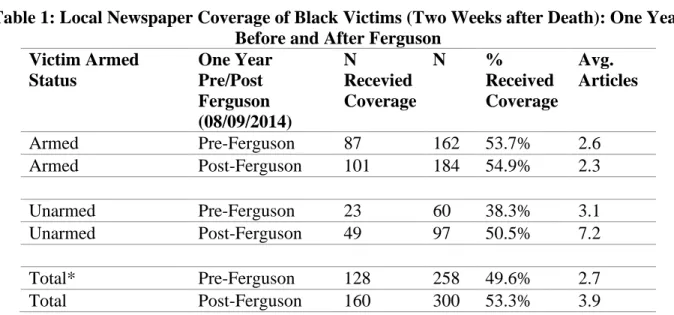
Using data collected in this study, I present a cursory comparison, located in table 1, of local newspaper attention to Black victims in one year before and after the Ferguson uprisings, starting August 9th 2014 following Michael Brown’s death.
[Table 1: Local Newspaper Coverage of Black Victims (Two Weeks after Death): One Year Before and After Ferguson]
Local newspapers were more likely to cover and publish more stories about unarmed Black victims of lethal policing in the year after the Ferguson uprisings than in the year before the Ferguson uprising. In the year before, only 38.3% of unarmed Black victims killed by police received media attention. In the year after, 50.5% of unarmed Black victims killed by police were mentioned in local newspapers. In addition, journalists wrote more stories about these victims after the Ferguson uprisings. Before the Ferguson uprisings, unarmed Black victims received an average of 3.13 articles per victim while after the Ferguson uprisings, unarmed Black victims received an average of 7.24 articles per victim.
These results likely underestimate the actual impact of the Black Lives Matter movement on local newspaper coverage of Black victims of lethal policing. My analyses do not include Black victims who were killed in Nielsen’s designated media areas with no local newspapers. Furthermore, the BLM movement also drew attention to more accurate data collection efforts on victims of police violence, particularly on the race of the victim. The current data provided by
12 Movement Pathways to Media Attention
Resource Mobilization, Injustice Frames, and the Efficacy of Protest
Social movements scholars have identified and tested key pathways that enable movements to receive media attention. Scholars have predominantly drawn from resource mobilization theory to purport the role of social movement organizations and disruptive capacity of protest in driving media attention to movement issues. In contrast, frame resonance theory purports that successful mobilization often depends on when injustice frames align neatly, or resonate with, respective audiences (Benford & Snow 2000). Crucially, social movements must stake a convincing claim to victimhood in order for news media and third parties to take their claims seriously (Cole 2006; Rentschler 2011). Movements led by racial and ethnic minorities such as the Black Lives Matter movement must organize within ideological constraints of existing stereotypes of criminality to Black civilians stopped by police (Oliver 2017) and public perceptions of legitimacy and respect for law enforcement (Weitzer 2002). Scholarship around media coverage of minorities provide further empirical evidence that stereotypes of criminality pervade coverage of Black individuals and the communities they come from. Using the Black Lives Matter movement as a case study, I test the effects of protest mobilization and presence of local social movement organizations on local newspaper coverage of Black people killed by police and the moderating impact of unarmed status of Black victims on the efficacy of protest.
Resource Mobilization Theory
Resource mobilization theory highlights the importance of social movement
13
SMOs can mobilize marginalized groups to enter into political contention (Lipsky 1968; Morris 2000) and provide crucial spaces within which activists can strategize and mobilize (Ganz 2000; Rohlinger 2015). SMOs also serve as reputation markers that media outlets continue to follow and associate with certain causes (Rohlinger 2015; Evans 2016). Hence, SMOs enable
movements to sustain themselves in periods of abeyance and inactivity (Staggenborg 1988; Taylor 1989).
Additionally, Piven and Cloward’s (1977) classic study puts forward the disruptive power of protest as a crucial measure for movement outcomes. Movements from marginalized
communities can build power and obtain media attention through protests. Although Piven and Cloward (1977) conceptualize movement organizations as demobilizing rather than disruptive forces, scholarship on movements and media have identified the importance of SMOs in
garnering media attention (Oliver & Meyer 1999; Amenta et al. 2009; Andrews & Caren 2010). Scholars have also found that particularly large, conflict-filled protest events are more likely to receive media coverage (McCarthy et al. 1996; Oliver & Meyer 1999). Thus, local racial justice organizations that formed the Movement for Black Lives coalition and the protests they organize may help explain in part why some Black victims killed by police received more media coverage than others.
H1: Black victims in communities with Movement for Black Lives organizations will be more likely to see local newspaper coverage.
H2a: Black victims in communities with local Black Lives Matter protests will be more likely to see local newspaper coverage.
14
Frame Resonance
While theories rooted in resource mobilization contribute greatly to explaining how movements can obtain media attention, they overlook the impact of frame resonance in enabling the extent organizational capacities matter in media attention. Movement actors seek to build collective action frames around grievances that resonate and mobilize decision makers, movement supporters, and other third-party actors (Snow et al. 1986; Snow & Benford 2000). These frames, however, rely on tapping into pre-existing beliefs and cultural schemas to be successful (Snow & Benford 1988). In line with this approach, more recent scholarship highlights that the meaning-laden negotiation of grievances shapes protest mobilization and movement outcomes (Shultziner 2013; Simmons 2014). Activists who employ, organize around, and proliferate certain injustice frames must directly compete in resonance with pre-existing inimical frames.
15
When movements engage in protests, they enter into a public sphere where their claims are filtered through media, and the effect of protest become conditional on resonating with audiences. Reporters who are presented with competing injustice and criminality frames must then negotiate whether such cases are considered newsworthy enough for extensive media coverage (Lee 2009). For the Black Lives Matter movement, whether or not victims killed by police were armed or unarmed may serve as crucial information for the extent each person will receive extensive media coverage. Victims killed while unarmed or without any dangerous possessions, which matches an injustice frame, could be more likely to receive local newspaper attention. Victims who are killed while armed with a dangerous weapon, on the other hand, can be seen as less worthy of news attention and sympathy and instead can be interpreted through the lens of a Black criminality frame.
The presentation of “worthy” and “unworthy” victims matters greatly for favorable media coverage and public opinion (Cole 2006; Simmons 2017). Freelon et al. (2016), for instance, notes how conservatives on Twitter were more likely to tweet in support of protests around Eric Garner’s death than in those of Michael Brown’s because of clear video footage that
16
match an injustice frame around unarmed Black victims rather than a criminality frame of armed victims killed by police. In this way, news organizations selectively put more weight in some cases than others based on their “worthiness,” despite efforts by social movements to draw attention to all victims.
H3: Black unarmed victims killed by police will be more likely to receive local newspaper coverage than Black armed victims.
H4: The effects of local Black Lives Matter protests on local newspaper attention are mediated through the unarmed status of Black victims of police.
Alternative Explanations
Political Process Theory
Political process theory (PPT) conceptualizes movements in relation to political
structures and contentious politics (Tarrow 1994). In this framework, social movement outcomes depend largely on favorable political opportunities (McAdam 1982; Meyer & Minkoff 2004; Amenta et al. 2010). Supportive political leaders can provide resources, connections, and legitimacy to movement causes, enabling them to become more newsworthy. Recent research also suggests political regimes’ public statements and policy changes on specific issues generates a short-term issue attention cycle that increases media attention to movement issues (McCarthy et al. 1996; Amenta et al. 2009; Amenta et al. 2012).
Since the 1960s Civil Rights movement, US society has witnessed the emergence of Black political officeholders not seen before since the Reconstruction era (LaVeist 1992; Hunter 2013; Broockman 2013; Griffin 2014). The increased presence of Black political leaders
suggests greater representation of political interests in Black communities through linked fate, as Black politicians are more likely than white political leaders to respond to Black issues
17
political leaders in the US during recent decades, this paper tests the role of Black political leaders in responding to and providing institutional support for the Black Lives Matter movement.
H5a: Black victims in communities with greater representation of Democratic Congressional Representatives will be more likely to see local newspaper coverage.
H5b: Black victims in communities with greater representation of Black Congressional Representatives will be more likely to see local newspaper coverage.
H6: Black victims killed amidst the context of recent policy announcements from the White House on criminal justice reform and police-community relations will be more likely to see local newspaper coverage.
18
opportunities for Black journalists to draw attention to social issues in Black communities (Dalton 2015; Carlett 2016)
H7: Black victims in communities with the presence of Black workers in local newspapers will be more likely to see local newspaper coverage.
H8: Black victims in communities with the presence of National Association of Black Journalist chapters will be more likely to see local newspaper coverage.
Social Media Activism
With the emergence and proliferation of online communicative platforms, political activists have quickly come to engage with and employ these new technologies. These new forms of communication enable organizers to connect with one another, share information, and mobilize online or offline on the platform regardless of physical distance (Tufekci 2017). Previously including emails, web sites, online blogs, and forums (Maratea 2008), these have since expanded to include social media platforms like Facebook, Twitter, YouTube, and Instagram, search engines like Google, and instant messaging software. These new platforms affect traditional media outlets by loosening the restrictions of participation in public discourse, thereby challenging the gatekeeping role of mainstream news (Antony & Ryan 2010; Boynton & Richardson 2016). Scholars studying the impacts between social media on mainstream news do find that hashtag driven activism can predict mainstream news attention on Twitter (Freelon et al. 2018). Furthermore, journalists commonly employ Twitter as part of their professional identity (Revers 2014), thereby suggesting journalists are more likely to pay attention to hashtag activism on this platform.
19
METHODS AND DATA
My main research question asks in what pathways did the Black Lives Matter movement generate local newspaper attention to Black victims of police violence. My unit of analysis will be daily newspaper attention for each person killed between two non-contiguous time periods: July 6th 2014 and May 10th 2015 and March 1st 2016 to December 31st 2016. I have chosen these time periods for availability of social media.1 Cases were also dropped when Black victims were killed in locations where no local newspapers were present, as they could not have received any local newspaper coverage. Since I intend to focus on the coverage of each person in the immediate aftermath of their death from US law enforcement, I restrict my daily media coverage to within the first fourteen days of their death.2 For example, my analysis of media attention to “Michael Brown” looks at only the first fourteen days after his death. This means that I do not include coverage and protest that may emerge months afterwards because these outcomes may be driven by non-movement events like legal proceedings or publicly released video footage. In total, my data contains 501 Black victims of lethal policing across 7210 days of potential
coverage in 437 local newspapers, of which around two hundred newspapers covered any Black victims killed by police.
1 Regressions including victims in the whole time period were run excluding social media data with no major
differences in statistical significance among key independent variables.
2 Alternative day restrictions of seven and twenty-eight were used, with no major differences in tests of statistical
20
Furthermore, instead of using geographical areas such as US counties or states, I employ a more innovative measurement of local newspaper coverage through Designated Market Areas (DMA) calculated by Nielsen Media Research.3 Such media markets refer to regions where similar television, radio, broadcast media, and newspapers are sold to consumers and are commonly used as in media studies to sample for local outlets including television, radio, and newspapers (Long et al. 2005).
I employ a logistic regression on a binary dependent variable of whether each victim received any media attention in each of the fourteen days after their death. Breush-Pagan tests indicated violations of homoscedasticity in the regression models. Failure to employ robust standard errors leads to mis-specification of standard errors, thereby leading to an
under-rejection of tests of statistical significance. Calculation of intra-class correlation, which measures the extent that observed variation is explained by clustered data, indicate over forty percent of the variation in daily media attention is explained by differences among victims and DMAs. In order to account for such high between-cluster variation, I employ cluster-robust standard errors around victims and DMAs in my analyses (for extended review, see Camerone & Miller 2015). This paper draws from a unique dataset that links together a wide variety of data sources about the Black Lives Matter movement. These include Black Lives Matter related tweets, street protests organized by the movement, characteristics of the victims who are killed by police, the presence of local Movement for Black Lives organizations, news coverage of lethal policing victims, and county-level demographics data from the 2010 census. I combined these datasets by acquiring publicly available data sources, web scraping news databases, and accessing Twitter Application Programming Interface (API). Datasets for each variable are described below.
3Using crosswalk files, I have linked county location of newspapers and victim’s place of death to their designated
21
[Table 2: Descriptive Statistics of Victim-Day Variables] Dependent Variable
My main dependent variable is daily media attention to Black lethal policing victims. I measure this as a binary variable of any coverage per day for the first fourteen days of each person’s death. My data comes from the US News Stream Database maintained by ProQuest. The database features over one thousand national and regional newspapers, radio, cable news transcripts, among others since 1980. For the purposes of this analysis, I only include
newspapers. Unlike many movement and media studies that look at a few national news sources or a few local newspapers in one location, this project takes into account a large number of local newspapers from all across the United States. Local newspaper coverage is particularly
important as an impact for the Black Lives Matter movement given the local organization of police departments in the United States. Although these local newspapers are by no means exhaustive of all media coverage, the data feature many important newspapers in the United States from which many local elected officials and Americans consume local news. These are important for racial justice organizations that organize around local grievances and aim to reach as many people as possible.
22 Independent Variables
Resource Mobilization
Research mobilization highlights the beneficial role of social movement organizations and the disruptive capacity of political protest in driving newspaper attention to some Black victims over others. My variables for resource mobilization include the presence of local
Movement for Black Lives (M4BL) organizations, the number of local BLM protests in the past week, and the number of BLM protests around the country in the past week. Local presence refers to within the DMA where each person was killed by police. Presence of local racial justice organization is measured through the presence of a M4BL organization active in the same DMA where each victim was killed by police.
Data on M4BL organizations were collected by the author of this paper. The Movement for Black Lives is a coalition of racial justice groups that formed amidst the Black Lives Matter movement when thousands of activists from Black advocacy organizations coalesced in a conference at Cleveland State University to put forward a broad political platform for Black liberation (Blackwell 2015). Data for their location and founding date was collected from organizations’ social media pages and websites.
23
I have chosen a broad measurement of protest to best capture the wide array of activism against police brutality around the country, including street demonstrations, marches, rallies at court-houses and law enforcement buildings, protests at college campuses, and actions taken by NFL football players in different games. I leave other future research to expand on the characteristics of different types of protest, such as the size and the tactics employed, on local newspaper coverage. The use of newspapers as a source of protest data has been widely discussed (Earl et al. 2004) with errors in selection and description bias. While some scholars argue that these limitations make newspapers an insufficient data source for protests (Ortiz et al. 2005),
newspapers are generally reliable in getting the “hard facts” correct and often represent the best source of data available (Earl et al. 2004; Soule 2013).
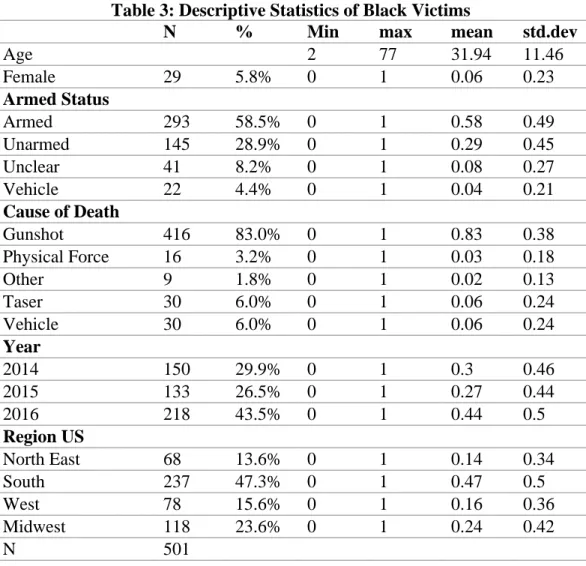
[Table 3: Descriptive Statistics of Black Victims] Frame Resonance and Victim-Level Characteristics
24
undercount the total number of victims killed by police (Fyfe 2002). As a result, crowdsourced datasets by independent researchers and journalists often represent the best sources of data on lethal policing. These crowdsourced data sets come very close to the total number of lethal policing victims estimated by the federal government (Banks et al. 2015; Hirschfield 2015) and when compared to one another these separate data sets provide similar estimates of the total number of people killed by police (Campbell et al. 2017). In recent years, criminologists and sociologists have turned to these data sets to study police use of force on US citizens (Ross 2015; Legewie & Fagan 2016). I have chosen Mapping Police Violence in particular because it
aggregates from multiple crowdsourced datasets, verifies the accuracy of these data, and attempts to fill in missing details using publicly available records (Mapping Police Violence 2016). As a result, Mapping Police Violence estimates a larger number of people killed by police and provides more information about lethal policing victims (Campbell et al. 2017).
Political Process Theory
25
using a ratio of Congressional House Representatives in each DMA who self-define as African American or Black as designated in the official Biographical Directory of the US Congress. I define political regime support as institutional support of issues related to the BLM movement through policy proposals and public statements. I measure these through a brief time window of one week after White House statements made by the Obama administration related to policing and criminal justice. Data on political party and minority political leadership support have been collected from the Biographical Directory of the United States Congress. Data on White House statements have been collected from the archived Obama White House website and the author manually selected relevant White House statements on issues responding to policing and criminal justice.
Furthermore, I employ two measurements to capture the effect of Black journalists and news workers on media attention to Black victims. First, I use the ratio of newspapers in each DMA that report at least one Black worker in their newsroom as reported in the American Society of News Editors’ (ASNE) Newsroom Employment Diversity Surveys between 2009 and 2013. The ASNE surveys news editors from newsrooms and newspapers across the United States. I have chosen the years 2009 and 2013 because methodological changes in 2016 make it hard to compare survey results with one another after 2015 (ASNE Methodology 2016). Second, I use a measurement of the presence of National Association of Black Journalists chapter within each DMA. The presence of organized Black journalists may provide more opportunities for local newspapers to provide coverage of the movement and victims of lethal policing. Social Media Activism
26
outlets. My variable for social media mobilization is the sum of Black Lives Matter related tweets in the three days before each measure of daily local media attention for each person killed by US law enforcement.4 These data were collected from two datasets: The first comprises of three day counts of 40,815,975 tweets associated with the Black Lives Matter movement between June 1st 2014 and May 31st 2015, which Freelon et al. (2016) purchased directly from Twitter, and have made the tweet ids available to the public. Freelon et al. (2016) collected these data using a number of predefined hashtags and keywords: including #ferguson, michaelbrown / mike brown / #michaelbrown / #makebrown, and #blacklivesmatter (see Freelon et al. 2016: 21 for a complete list). The second features three day counts of 17,292,130 tweets containing #BlackLivesMatter and #BLM tweets (case insensitive) between January 29th 2016 and March 18th 2017 (Summers 2017). Summers (2017) collected these data through the Twitter streaming API and also made tweet ids publicly available.5 Although time restrictions mean I am missing nearly eight months between June 2015 and January 2016, these two time periods of two years cover much of BLM online activism on Twitter.
I have chosen to use the entirety of Freelon et al.’s (2016) tweets rather than restricting tweets to only those containing #BlackLivesMatter or #BLM because online activism in the immediate months after the Ferguson uprisings did not extensively use these hashtags. Instead, #BlackLivesMatter emerged prominently on November 24th 2014, when the St. Louis
prosecutor announced that the grand jury in Missouri decided not to indict police officer Darren Wilson for his killing of Michael Brown. Since then, #BlackLivesMatter became widely used in subsequent police killings.
4 A period of three days was chosen to reflect the fast-paced nature of social media as opposed to street protests.
5 I thank both Deen Freelon and Edward Summers for helping me provide daily counts of Twitter data. In particular,
27
I will note two major limitations to my data. First, the data that Summers (2017) provides may not be entirely exhaustive because these tweets were collected using the streaming API, which does not capture all BLM discourse during high activity periods due to rate limits on the Twitter API. Furthermore, while I do count tweets containing #BlackLivesMatter and #BLM starting January 2016, I am not able to count tweets containing names of certain victims like those in the early periods. Nonetheless, given the intricacies and difficulty of accessing Twitter data (Freelon 2018), I believe what I have calculated are the best measurements available of online activism of the Black Lives Matter movement.
Second, I acknowledge that not all tweets containing such hashtags or keywords may be favorable to the movement. This is because the use of certain hashtags and meanings can change depending on the user and as the movement progresses (Tufekci 2017). Sometimes, hashtags can even be co-opted among groups of people who seek to use the hashtag to undermine the
movement. Freelon et al. (2016) in particularly documents that conservative opponents to Black Lives Matter have actively engaged in online Twitter discourse using similar hashtags to
discredit Black Lives Matter. While I acknowledge the multiple uses of social media hashtags, I justify its use as a measure for online movement activism for BLM because the majority of the upsurge is driven by supporters of the movement while conservatives represented a significantly smaller part of the discourse across different time periods (Freelon et al. 2016).
Controls
28
each DMA using the number of local newspapers in each DMA, as these may explain why some Black victims and not others received daily media attention. I also control for a measurement of political ideology using the ratio of voters in each DMA who voted for President Obama in the 2012 Presidential election. To account for regional differences in newspaper coverage, I have controlled for the census region of the US where each Black victim was killed.
29 RESULTS
My results test which social movement theory pathways best explain local newspapers attention to Black victims of lethal policing. Table 5 displays four logit regression models that estimate the effect of victim characteristics, movement factors, political process theory, and the total model on local newspaper coverage. Models one to three are differentiated by different theories while model four represents the total model. Model one tests the theory of frame resonance around victim characteristics. Model two tests both resource mobilization theory and social media activism. Model three tests for political process theory. All four models include control variables. Coefficients are displayed in odds ratios and standard errors are in log odds. Standard errors and tests of statistical significance are also robust around clusters of victims and DMAs. My results suggest that frame resonance and resource mobilization theories best
demonstrate why some Black victims and not others received media attention while political process theory and social media activism fail to account for daily local newspaper attention.
30
victims, controlling for all other variables. This effect persists across both models at the p<0.001 level. Furthermore, Black victims of lethal policing were far more likely to receive daily
newspaper attention when they were killed by gunshot. In both models, the effect is four times the rate as being killed by taser and is statistically significant at the p<0.001 level. Finally, I find some evidence of regional bias in local newspaper coverage. Black victims killed in the Western United States received on average 59.3% less coverage than Black victims killed in the Northeast United States, controlling for all other variables. This effect size is statistically significant at the p<0.01 level.
[Table 5: Logistic Regression: Effects on Local Newspaper Coverage of Black Victims] Resource mobilization theory, tested in model two, argues that social movement
31
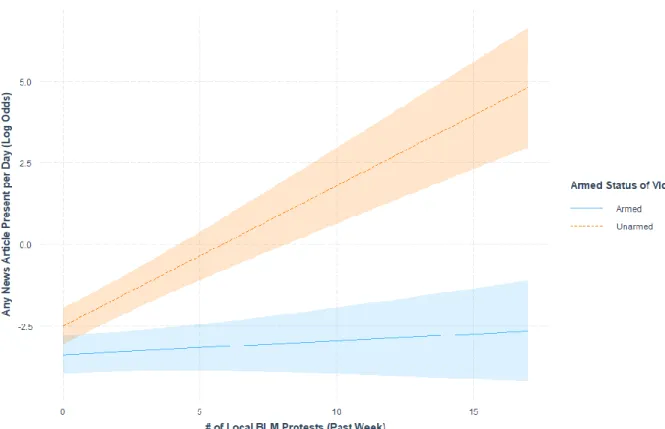
protest is no longer statistically significant. Among unarmed Black victims, the effect of protest increases to 44.6% for each additional local protest in the past week and is statistically
significant at the p<0.001 level. I thus find strong support for hypothesis four, which purports that local BLM protests matter when they align with the injustice frame around the unarmed status of Black victims. Across models two and four, I find no support for hypotheses 2b and nine, which purport that the number of BLM protests in the country in the past week (hypothesis 2b) and social media activism in Black Lives Matter related tweets (hypothesis nine) matter for local newspaper attention for Black victims. While the Black Lives Matter movement’s national protests and social media activism may have mattered a great deal on the national stage, they do not seem to explain local contexts of news attention to Black victims.
Political process theory purports that favorable political circumstances help explain why movements are more successful in some cases than others. In the case of the Black Lives Matter movement, I test the extent that favorable political contexts in Democratic party and Black political officials, short-term effects of White House policy reports on criminal and racial justice, and presence of Black journalists in local news outlets help explain why some Black victims of lethal policing received local newspaper attention while others did not. Across models three and four, I find no support for hypotheses five to eight. What mattered most for local newspaper coverage was neither favorable political contexts nor social media activism but rather the local organizational capacity of local Black Lives Matter activism and the extent that victim
characteristics aligned with an injustice frame.
[Figure 1: Interaction of Victim Armed Status on Effect of Protest on News Coverage of Victims]
32
33
DISCUSSION AND CONCLUSION
Scholarship on media and race/ethnicity has highlighted the role of mass media as a purveyor and legitimator of racial ideologies by employing negative stereotypes in coverage of underrepresented minority communities. This is particularly pressing because of the historic agenda-setting role of mass media in highlighting some social problems and not others (McCombs & Shaw 1972; Hilgartner & Bosk 1988). Political leaders and the public receive much of their knowledge of social events through the social reality constructed by mass media (Gamson et al. 1992). Scholarship on social movements, however, has conceptualized the necessary role that mass media plays in legitimating grievances, proliferating information, and bringing public attention to social problems. This relationship, however, is not a fair one, as media outlets can seek to cover other newsworthy events and social movements often cannot control how media eventually portray such movements (Gamson & Wolfsfeld 1993). Movements led by racial and ethnic communities in particular face greater difficulty in mobilization than movements led by ethnically dominant groups due to less access to material and cultural
34
My results revealed that what mattered most in drawing local newspaper attention was the fact that the Black Lives Matter movement made newspapers more aware of the injustice frame around unarmed Black victims whose lives were cut short by police violence. In the period covered by my analysis, unarmed Black victims were more than twice as likely to receive local newspaper attention than armed Black victims, controlling for all other variables. Moreover, consistent with resource mobilization theory, my findings provide evidence that the local
presence of Movement for Black Lives organizations and the mobilization of local BLM protests do explain why some victims and not others received more daily newspaper attention. However, the effect of local protests was entirely mediated through the unarmed status of Black victims. Local activists may organize protests around all Black victims, but these protests only seemed to be effective when the Black victim was unarmed.
35
assessing how the negotiation of “worthy” and “unworthy” victims shape movement outcomes. Scholarship on victimhood discourse suggests that successful presentation of “worthy” victims helps movements gain favorable media coverage and public opinion (Cole 2006). In Patler and Gonzales’s (2015) case study on media coverage of anti-deportation cases, undocumented students were more likely to receive media coverage than undocumented non-students, which they attributed to some immigrants’ being perceived as more accultured to mainstream US society than others.
Furthermore, my results found no significant support for political process theory nor for social media activism in drawing local newspaper attention to Black victims of police violence. Some of these findings may be due to the fact that favorable partisanship contexts may serve as a poor measure for political opportunities around newspaper coverage (Amenta et al. 2009). My lack of findings around the presence of Black news workers, Black Congressional
36
The lack of effect on the volume of #BlackLivesMatter social media activism on local newspaper attention is also surprising, given the widespread scholarship on social media
activism of the Black Lives Matter movement (Bonilla and Rosa 2015; Freelon et al. 2016; Ray et al. 2017). This may suggest relative isolation between local newspapers and social media in the hybrid public sphere. Whereas in social media can often play an agenda setting role for social issues (Boynton & Richardson 2016), there is some evidence that such an agenda setting role do not extend to local newspapers outlets (Skogerbø and Krumsvik 2015).
My study also contributes to the growing literature and interest of the Black Lives Matter movement, one of the most significant Black social movements in the United States since the 1960-70s Civil Rights and Black Power movements. Most of this literature has focused on how social media users have generated counter-narrative discourse and information around racial justice to challenge mainstream media frames on police brutality (Bonilla & Rosa 2015; Ince et al. 2017; Brown et al 2017; Cox 2017), while others have studied if social media activism predicts the prevalence of Black Lives Matter protests (De Choudhury et al. 2016). Furthermore, scholars have demonstrated that political elites do respond to online Black Lives Matter
mobilization (Stout et al. 2017; Freelon et al. 2018). I demonstrate empirical findings that local protests, injustice frames around victims, and the presence of organizations matter in drawing media attention to Black victims of police violence. Given the far-reaching and continuing salience of race in American politics, further research should pay closer attention to the anti-racist collective organizing on the ground that draws attention to and challenges ongoing systemic oppression in Black communities.
37
movements. Local newspaper attention is particularly important for cases of police brutality because of the highly decentralized structure of law enforcement in the US. Local newspapers matter, as they better structurally positioned to hold accountable local governments and law enforcement. In addition, whereas a few high-profile cases of police brutality may draw national media attention, most Black victims killed by police only received attention from local news outlets. The decline of local newspapers in the US is thus a further concerning sign for public accountability to US law enforcement treatment of Black civilians.
Finally, this paper speaks to the nascent scholarship on ethnoracial mobilization, which attempt to bring together the different scholarships in social movements and race and ethnicity. While the field of social movements has emerged from studies on the 1960s Civil Rights movement, very little attempt has been made to incorporate race scholarship into explaining the emergence and outcomes of movements led by racial and ethnic minorities (Bell 2016; Bracey 2016; Morris 2019). Theorizing ethnoracial mobilization, Oliver (2017) argues that compared to dominant majorities, subordinated ethnoracial minorities confront added challenges to
mobilization, including stronger ideological constraints, limited access to political and material resources, and greater state repression. Moreover, movement scholars of conservative
38
Nonetheless, there are a number of limitations to my research. First, I cannot fully rule out the possibility of reverse causality in protest and media attention. Media attention may plausibly generate more protest as activists learn more about recent police shootings from local newspapers. To partially account for reverse causality, I lag my measurement of protest to the week before each daily news attention. As part of a robustness check, I also employ a test of granger causality on the prevalence of protest and newspaper coverage (Freeman 1983; Neuman et al. 2014), finding that protests were more likely to predict newspaper coverage than the other way around (see appendix A). Second, my measurement of media coverage only takes into account local newspapers and no other media sources. This means I do not take into account other media such as radio, broadcast cable news, and other online news sources. In an increasingly online media environment, fewer people from the public read local newspapers. Nonetheless, local newspapers remain an important institution in holding local public institutions like US police departments accountable.
While traditional news coverage of Black communities drew upon stereotypes and associations with crime, poverty, and urban decline, the Black Lives Matter movement
39
40
TABLES AND FIGURES
Table 1: Local Newspaper Coverage of Black Victims (Two Weeks after Death): One Year Before and After Ferguson
Victim Armed Status
One Year Pre/Post Ferguson (08/09/2014)
N
Recevied Coverage
N %
Received Coverage
Avg. Articles
Armed Pre-Ferguson 87 162 53.7% 2.6
Armed Post-Ferguson 101 184 54.9% 2.3
Unarmed Pre-Ferguson 23 60 38.3% 3.1
Unarmed Post-Ferguson 49 97 50.5% 7.2
Total* Pre-Ferguson 128 258 49.6% 2.7
Total Post-Ferguson 160 300 53.3% 3.9
41
Table 2: Descriptive Statistics of Victim-Day Variables
N min max mean std.dev
DV: (1/0) Coverage 796 0 1 0.11 0.32
# Protests in DMA (Past Wk) 0 17 0.41 1.19
# Protests in US (Past Wk) 0 192 17.43 29.16
M4BL Org Present 3945 0 1 0.55 0.5
BLM Tweets Past 3 days, Logged 0 15.71 11.6 1.42
Ratio Newspapers w/ Blk Worker 0 1 0.5 0.23
NABJ Chapter Present 4042 0 1 0.57 0.5
Ratio Dem Congress Reps 0 1 0.4 0.27
Ratio Blk Congress Reps 0 0.5 0.13 0.1
WH Press Release (Past Wk) 1480 0 1 0.21 0.41
# Congress Reps 1 35 11.02 8.29
# Blk Deaths in US (Past Wk) 0 14 6.67 2.79
# Blk Deaths in DMA (Past Wk) 0 3 0.65 0.68
Ratio Obama Votes, 2012 Pres. Election
0.25 0.73 0.53 0.1
Total Pop, Logged 12.1 16.85 15.11 0.94
Ratio Black Pop 0.01 0.48 0.17 0.09
# of Newspapers 1 21 5.13 5.54
42
Table 3: Descriptive Statistics of Black Victims
N % Min max mean std.dev
Age 2 77 31.94 11.46
Female 29 5.8% 0 1 0.06 0.23
Armed Status
Armed 293 58.5% 0 1 0.58 0.49
Unarmed 145 28.9% 0 1 0.29 0.45
Unclear 41 8.2% 0 1 0.08 0.27
Vehicle 22 4.4% 0 1 0.04 0.21
Cause of Death
Gunshot 416 83.0% 0 1 0.83 0.38
Physical Force 16 3.2% 0 1 0.03 0.18
Other 9 1.8% 0 1 0.02 0.13
Taser 30 6.0% 0 1 0.06 0.24
Vehicle 30 6.0% 0 1 0.06 0.24
Year
2014 150 29.9% 0 1 0.3 0.46
2015 133 26.5% 0 1 0.27 0.44
2016 218 43.5% 0 1 0.44 0.5
Region US
North East 68 13.6% 0 1 0.14 0.34
South 237 47.3% 0 1 0.47 0.5
West 78 15.6% 0 1 0.16 0.36
Midwest 118 23.6% 0 1 0.24 0.42
4
3
Table 4: Correlation Matrix
1 2 3 4 5 6 7 8 9 10 11 12 13 14 15 16 17 18 19 20 21 22
1 DV: (1/0) Coverage 1.00
2 Age -0.05 1.00
3 Female 0.02 0.06 1.00
4 Unarmed 0.09 -0.01 0.10 1.00
5 Gunshot 0.05 -0.12 -0.10 -0.51 1.00
6 # Protests in DMA (Past Wk)
0.14 -0.05 -0.01 0.04 0.01 1.00
7 # Protests in US (Past Wk)
0.04 -0.01 0.00 -0.03 0.04 0.45 1.00
8 M4BL Org Present 0.11 -0.06 0.05 -0.04 0.01 0.26 -0.01 1.00
9 BLM Tweets Past 3 days, Logged
0.06 0.04 0.03 0.07 -0.05 0.33 0.64 0.00 1.00
10 Ratio Newspapers w/ Blk Worker
0.04 -0.01 0.09 0.04 -0.03 0.07 0.01 0.20 0.03 1.00
11 NABJ Chapter Present
0.12 -0.06 0.02 -0.03 0.08 0.25 0.03 0.41 0.06 -0.10 1.00
12 Ratio Blk Congress Reps
0.08 -0.02 0.04 0.06 -0.02 0.17 0.00 0.48 0.04 0.12 0.45 1.00
13 Ratio Dem Congress Reps
-0.02 -0.17 -0.02 -0.04 0.05 0.03 -0.09 0.11 -0.05 0.24 -0.01 0.26 1.00
14 WH Press Release (Past Wk)
0.00 0.01 -0.03 -0.06 0.06 0.07 0.05 0.00 0.08 0.02 0.01 -0.04 -0.01 1.00
15 # Congress Reps 0.14 -0.06 0.03 0.02 0.00 0.31 0.01 0.65 0.05 0.23 0.59 0.56 0.04 -0.04 1.00
16 # Blk Deaths in US (Past Wk)
0.05 0.02 0.01 0.07 -0.09 0.03 0.02 0.02 0.14 0.05 0.01 0.02 0.03 0.07 0.04 1.00
17 # Blk Deaths in DMA (Past Wk)
0.15 -0.03 -0.01 0.03 -0.04 0.05 0.02 0.09 0.02 0.03 0.07 0.09 0.03 -0.01 0.14 0.25 1.00
18 Ratio Obama Votes, 2012
0.10 -0.06 0.01 0.04 0.03 0.24 -0.02 0.58 0.00 0.25 0.58 0.78 0.21 0.00 0.71 0.01 0.10 1.00
19 Total Pop, Logged 0.13 -0.05 0.03 0.01 0.00 0.30 0.03 0.66 0.04 0.23 0.59 0.65 0.07 -0.04 0.95 0.03 0.14 0.74 1.00
20 Ratio Black Pop -0.05 -0.08 0.04 -0.02 -0.04 -0.03 -0.05 0.12 0.01 0.47 -0.24 -0.09 0.63 0.03 -0.11 0.07 0.00 0.00 -0.16 1.00
21 # of Newspapers 0.14 -0.02 0.03 0.02 -0.01 0.17 0.01 0.46 0.00 0.19 0.59 0.59 -0.01 -0.04 0.73 0.02 0.10 0.70 0.74 -0.20 1.00
44
Table 5: Logistic Regressions: Effect on Daily Media Attention of Black Victims by Police
Dependent variable:
Any Coverage (1/0) Per Victim-Day Victim Characteristics Movement Factors Pol. Process Theory Total
(1) (2) (3) (4)
Age 0.996 0.997
(0.014) (0.013)
Female 1.872 1.840
(0.338) (0.356)
Reference Group: Armed with Dangerous Item
Armed Status (AS): Unarmed/NonLethal Item
3.038*** 2.345***
(0.174) (0.176)
AS: Unclear 2.020 1.550
(0.377) (0.376)
AS: Vehicle 0.454* 0.484*
(0.348) (0.362)
Reference Group: Killed by Taser
Cause of Death (CoD): Gunshot 4.283*** 4.023***
(0.379) (0.317)
CoD: Other 1.269 1.460
(0.584) (0.661)
CoD: Physical Force 1.801 1.517
(0.441) (0.515)
CoD: Vehicle 0.632 0.530
(0.459) (0.441)
N BLM Protests in DMA (Past Wk)
1.303*** 1.058
(0.060) (0.041)
AS: Unarmed X DMA Protests 1.446***
(0.057)
AS: Unclear X DMA Protests 1.181
(0.124)
AS: Vehicle X DMA Protests 0.371
(0.964)
N BLM Protests in US (Past Wk) 0.997 0.997
(0.003) (0.003)
Movement For Black Lives Org Present
1.969* 1.990*
45 N BLM-Related Tweets (Logged,
Past 3 Days)
1.093 1.099
(0.046) (0.050)
Ratio Dems Congress in DMA 2.133 3.053
(0.738) (0.751)
Ratio Black Congress in DMA 0.105 0.108
(1.584) (1.670) Criminal/Racial Justice Obama
WH Press Release (Past Wk)
1.140 1.045 (0.160) (0.149) Ratio Newspapers in DMA w/ > 0
Blk Worker (2009-13)
1.600 1.847 (0.753) (0.591) Nat. Assoc. Black Journalist
Chapter Present
1.166 1.105 (0.439) (0.403)
Black Deaths in US (Past Wk) 1.023 1.008 1.014 1.003
(0.030) (0.028) (0.031) (0.027) Black Deaths in DMA (Past Wk) 1.444*** 1.424*** 1.366*** 1.524*** (0.090) (0.096) (0.091) (0.088)
Obama % Votes in DMA (2012) 0.105 0.078 0.046 0.004*
(1.843) (2.019) (3.228) (2.784) Population in DMA (Logged,
2010)
1.545 1.155 1.426 1.273
(0.353) (0.354) (0.364) (0.317)
Ratio Black Pop in DMA (2010) 1.702 0.422 6.002 1.155
(2.053) (1.995) (2.726) (2.670)
N Newspapers in DMA 1.159* 1.170** 1.128* 1.184***
(0.061) (0.050) (0.056) (0.049)
Days after Death 0.903*** 0.899*** 0.904*** 0.894***
(0.013) (0.012) (0.014) (0.014)
N Congress DMA 0.918 0.914* 0.933 0.902**
(0.052) (0.043) (0.045) (0.038)
Reference Group: Year 2014
Year 2015 0.825 0.769 0.817 0.883
(0.291) (0.280) (0.275) (0.288)
Year 2016 0.684 0.658* 0.717 0.686
(0.227) (0.198) (0.229) (0.195)
Reference Group: Northeast
Midwest 1.215 1.119 1.360 1.343
(0.398) (0.336) (0.376) (0.380)
South 0.553 0.649 0.574 0.611
(0.403) (0.371) (0.332) (0.390)
West 0.505* 0.636 0.607 0.407**
46
Constant 0.0002 0.034 0.003 0.005
(4.565) (4.560) (4.460) (4.332)
Observations 7,120 7,120 7,120 7,120
Log Likelihood -2,175.963 -2,211.884 -2,273.984
-2,084.793 Akaike Inf. Crit. 4,397.926 4,459.768 4,585.967 4,239.586
Note: SEs are clustered around Victims and DMAs and displayed as Log-Odds
47
48
APPENDIX A: Granger Causality Test
Granger Causality Test for Protest and Local Newspaper Attention
F Statistic
P-value Protest -> Coverage (lagged 7 days) 13.759
2.20E-16*** Coverage -> Protest (lagged 7 days) 0.8371 0.56
49
APPENDIX B: List of Top Ten Nielsen’s Designated Media Area by N Newspapers
Nielsen’s Designated Media Area (DMA) N Counties N Local
Newspapers
N Black Victims (2014-2016)
New York, NY - CT - NJ - PA DMA 32 76 66
Denver, CO - NE - NV - WY DMA 60 19 8
Los Angeles, CA DMA 5 15 55
Boston, MA - NH DMA 16 14 12
Philadelphia, PA - DE - NJ DMA 19 13 38
San Francisco - Oakland - San Jose, CA DMA 11 11 34
Albuquerque - Santa Fe, NM - AZ - CO DMA 33 9 3
Harrisburg - Lancaster - Lebanon - York, PA DMA 9 8 6
Minneapolis - St. Paul, MN - WI DMA 57 8 11
50
APPENDIX C: List of Top Ten Newspapers
Newspaper Title State Nielsen’s Designated Media Area N
Articles
The Washington Post DC Washington, DC - MD - PA - VA -
WV DMA
953
New York Daily News NY New York, NY - CT - NJ - PA DMA 633
Wall Street Journal (Online) NY New York, NY - CT - NJ - PA DMA 554
St. Louis Post - Dispatch MO St. Louis, MO - IL DMA 530
New York Times, Late Edition (East Coast)
NY New York, NY - CT - NJ - PA DMA 503
Chicago Tribune IL Chicago, IL - IN DMA 439
Targeted News Service DC Washington, DC - MD - PA - VA -
WV DMA
435
The Baltimore Sun MD Baltimore, MD DMA 363
Los Angeles Times CA Los Angeles, CA DMA 360
51
APPENDIX D: Negative Binomial Regression
Negative Binomial Regression: Effect on Daily Media Attention of Black Victims by Police
Dependent variable:
N Articles per Victim-Day Victim Characteristics Movement Factors Pol. Process Theory Total
(1) (2) (3) (4)
Age -0.007 -0.004
(0.014) (0.013)
Female 0.876* 0.797*
(0.372) (0.361)
Reference Group: Armed with Dangerous Weapon
Armed Status (AS): Unarmed/NonLethal Item
1.498*** 0.996***
(0.228) (0.207)
AS: Unclear 1.148** 0.643
(0.372) (0.385)
AS: Vehicle -0.849* -0.837*
(0.339) (0.351)
Reference Group: Killed by Taser
Cause of Death (CoD): Gunshot
1.464** 1.327**
(0.517) (0.448)
CoD: Other -0.231 0.041
(0.613) (0.664)
CoD: Physical Force 0.772 0.905
(0.609) (0.572)
CoD: Vehicle -0.917 -0.808
(0.585) (0.534)
N BLM Protests in DMA (Past Wk)
0.357*** 0.016
(0.042) (0.044)
AS: Unarmed X DMA Protests 0.396***
(0.069)
AS: Unclear X DMA Protests 0.215
(0.121)
AS: Vehicle X DMA Protests -1.082
52 N BLM Protests in US (Past
Wk)
-0.001 -0.001
(0.003) (0.003)
Movement For Black Lives Org Present
0.606 0.630
(0.387) (0.337)
N BLM Related Tweets (Logged, Past 3 Days)
0.149* 0.105
(0.068) (0.066)
Ratio Dems Congress in DMA 0.895 0.769
(0.940) (0.712)
Ratio Black Congress in DMA -1.046 -0.970
(3.734) (1.472) Criminal/Racial Justice Obama
WH Press Release (Past Wk)
0.423 0.137 (0.261) (0.177) Ratio Newspapers in DMA w/
> 0 Blk Worker (2009-13)
0.748 0.505 (2.266) (0.585) Nat. Assoc. Black Journalist
Chapter Present
-0.063 -0.132 (2.319) (0.440)
Black Deaths in US (Past Wk) 0.025 -0.022 0.029 -0.023
(0.038) (0.031) (0.039) (0.028) Black Deaths in DMA (Past
Wk)
0.458*** 0.418*** 0.452*** 0.461*** (0.111) (0.107) (0.104) (0.098) Obama % Votes in DMA
(2012)
-0.559 -1.486 -3.153 -3.229
(2.245) (2.833) (15.759) (3.102) Population in DMA (Logged,
2010)
0.043 -0.179 0.117 0.026
(0.384) (0.482) (1.491) (0.335) Ratio Black Pop in DMA
(2010)
-0.219 -1.428 0.490 -0.810
(2.226) (2.502) (2.892) (2.264)
N Newspapers in DMA 0.156** 0.181*** 0.102 0.197***
(0.054) (0.046) (0.116) (0.047)
Days after Death -0.083*** -0.084*** -0.065* -0.098***
(0.017) (0.016) (0.032) (0.015)
N Congress DMA -0.047 -0.060 -0.034 -0.088**
(0.048) (0.039) (0.090) (0.032)
Reference Group: Year 2014
Year 2015 -0.518 -0.529 -0.787 -0.325
53
Year 2016 -0.666** -0.682*** -0.780* -0.528**
(0.220) (0.196) (0.336) (0.179)
Reference Group: Northeast
Midwest 0.381 0.290 0.393 0.359
(0.348) (0.327) (2.062) (0.404)
South -0.818* -0.526 -1.192 -0.687
(0.383) (0.368) (0.781) (0.396)
West -0.933*** -0.569* -0.663 -0.978***
(0.281) (0.275) (0.443) (0.254)
Constant -3.280 0.390 -1.756 -2.947
(4.753) (6.061) (15.316) (4.435)
Observations 7,120 7,120 7,120 7,120
Log Likelihood -3,260.340 -3,304.248 -3,419.640 -3,170.245
theta 0.202*** (0.013) 0.191***
(0.012)
0.145*** (0.009)
0.267*** (0.018) Akaike Inf. Crit. 6,566.681 6,644.496 6,877.280 6,410.489
Note:Standard Errors are clustered around Victims and DMAs