i
SEXUAL ATTRACTIVENESS, SEXUAL SATISFACTION AND PSYCHOLOGICAL DISTRESS IN LIUZHOU, CHINA
Qianlai Luo
A dissertation submitted to the faculty at the University of North Carolina at Chapel Hill in partial fulfillment of the requirements for the degree of Doctor of Philosophy in the
Department of Epidemiology in the Gillings School of Global Public Health.
Chapel Hill 2014
Approved by:
Victor J. Schoenbach
Yingying Huang
Clara N. Lee
William C. Miller
© 2014 Qianlai Luo
ABSTRACT
Qianlai Luo: Sexual attractiveness, sexual satisfaction and psychological distress in Liuzhou, China
(Under the direction of Victor J. Schoenbach)
We hypothesized that sexual satisfaction and psychological distress are both related to
self-rated sexual attractiveness, but in different ways: on the one hand, greater sexual satisfaction
is associated with greater sexual attractiveness; on the other hand, higher psychological distress
is associated with basing one’s sexual attractiveness primarily on body image-oriented features
(“face” and “body type”). We analyzed cross-sectional household survey data from Liuzhou city
in southern China with a series of regression analyses. We found: 1. Self-rated sexual
attractiveness was associated more strongly with women’s emotional sexual satisfaction (ESS)
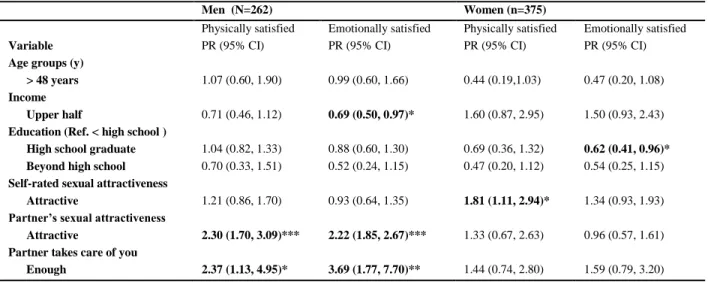
(prevalence ratio [PR] 1.34, 95% confidence interval [CI]: 0.93-1.93) and especially physical
sexual satisfaction (PSS) (PR 1.81, 95% CI: 1.11-2.94) than with men’s ESS (PR 0.93 95% CI:
0.64-1.35) and PSS (PR 1.21, 95% CI: 0.86-1.70). For men, the associations of partner’s
attractiveness with ESS (PR 2.22, 95% CI: 1.85-2.67) and with PSS (PR 2.30, 95% CI: 1.70-3.09)
were both stronger than the corresponding associations for women (PR 0.96, 95% CI: 0.57-1.61
for ESS and 1.33, 95% CI: 0.67-2.63 for PSS). Similarly, the associations of the feeling that
one’s partner takes enough care of one with ESS (PR 3.69, 95% CI: 1.77-7.70) and with PSS (PR
2.37, 95% CI: 1.13-4.95) were stronger for men than the corresponding associations for women
(PR 1.59, 95% CI: 0.79-3.20 for ESS, and PR 1.44, 95% CI: 0.74-2.80 for PSS). 2.Compared to
non-body-image oriented feature: (1) women who self-rated attractive but ranked “face” or “body type” as
their most attractive feature had a 0.91(95% CI: 0.00-1.82) point higher psychological distress
score (PDS); (2) women who self-rated unattractive but ranked a body-image aspect as their
most attractive feature had a 0.79 (95% CI: 0.21-1.37) point higher PDS; and (3) women who
considered themselves “not attractive in any aspect” had a 0.88 (95% CI: 0.10-1.66) point higher
PDS. Our study results highlighted the health impact of self-rated sexual attractiveness.
Awareness of how perceptions of one’s sexual attractiveness relate to sexual wellbeing and
ACKNOWLEDGEMENTS
The Liuzhou survey was funded by ‘‘Partnership for Social Science Research on
HIV/AIDS in China’’ (NIH Grant # R24 HD056670, PI: Gail E. Henderson). I was supported by
this grant from 2009 to 2011 and am grateful for the generous support. I wish to thank the survey
team members in Renmin University for their hard work in data collection and the Research
Funds of Renmin University of China #10XNJ059 which made that possible.
Dr. Victor Schoenbach, my advisor and the chair of my dissertation committee, is the
most dedicated teacher. He provided thoughtful input and was very generous with his time,
always careful as an intellectual, and gave his unwavering support during my difficult times in
the researching and writing of this project. I thank him. Dr. Huang Yingying, Dr. William Miller,
Dr. Clara Lee, and Dr. Brian Pence—my dissertation committee members—have also been
incredibly helpful and supportive. They are a “dream team” dissertation committee for me.
Additionally, I want to thank Dr. William Miller, from whom I took two classes which were very
helpful (and which I still need time to fully digest). Through him I was able to construct my full
committee, and through him I met Dr. Clara Lee, an inspiration for a Ph.D. student. I am also
indebted to Dr. Huang Yingying for her knowledge, input, and her support before and during my
entire dissertation process. Dr. Brian Pence, too, was incredibly supportive, helpful, and willing
to accommodate my schedule.
I am thankful to Dr. Steve Wing at the UNC Department of Epidemiology, for being a
possible dissertation topics. I also wish to thank Professor Richard Levins at Harvard University
and Professor Jing Jun at Tsinghua University for their teaching. It was they who kindled my
interest in looking at health from a broader perspective, and I will not forget the example they set
for me as scholarly role models.
I also want to thank my friends, Xuesong Han, Xuemei Han, Tina He. I’ve known them
almost all of my adult life. Their friendship has nurtured me in many ways.
Lastly and most importantly, I want to thank my family: my parents, who had the vision
of a fulfilling life in a global village for their children, who emphasized education more than
anything; my aunt, who was illiterate but knew every important thing in life, who was always
prepared and full of love for us; my brother and my sister in China, for with their support and
caring for my parents, I could focus on my studies; and my sister in Canada, who made herself
TABLE OF CONTENTS
LIST OF TABLES ... xi
LIST OF FIGURES ... xii
LIST OF ABBREVIATIONS ... xiii
CHAPTER 1 INTRODUCTION ... 1
REFERENCES ... 3
CHAPTER 2 LITERATURE REVIEW ... 4
2.1 Sexual Health, sexual satisfaction and public health ... 4
2.2 Sexual attractiveness ... 6
2.3 Psychological distress ... 7
2.4 The double role of sexual attractiveness in sexual well-being and in mental health ... 8
2.5 Sexual attractiveness and its relationship to sexual satisfaction ... 9
2.6 Self-rated sexual attractiveness and its relationship to psychological distress ... 9
2.7 Society, sexuality and sexual health in China ... 10
2.8 Self-rated sexual attractiveness, sexual satisfaction and psychological distress in China .. 12
REFERENCES ... 13
CHAPTER 3 SPECIFIC AIMS, HYPOTHESES, AND SIGNIFICANCE ... 20
3.1 Specific Aims ... 20
3.3 Significance ... 21
REFERENCES ... 23
CHAPTER 4 STUDY DESIGN & METHOD ... 24
4.1 Study Setting ... 24
4.2 Study Population ... 24
4.3 Measures ... 25
4.4 Statistical Analysis ... 27
REFERENCES ... 31
CHAPTER 5 AIM 1... 33
INTRODUCTION ... 33
METHOD ... 35
RESULTS ... 38
DISCUSSION ... 40
CONCLUSIONS ... 43
REFERENCES ... 48
CHAPTER 6 AIM 2... 52
INTRODUCTION ... 52
METHOD ... 54
RESULTS ... 58
DISCUSSION ... 60
REFERENCES ... 67
CHAPTER 7 DISCUSSION ... 71
Aim 2 Attractive Aspect and Psychological Distress ... 72
Limitations ... 72
Implications ... 73
Future Directions for Research... 75
LIST OF TABLES
Table 5.1 Descriptive Statistics for Urban Chinese Men and Women Study Participants Aged 18-61 Years Who were Married or Had a Steady Sexual Partner in the Past 6 Months, in Liuzhou City, Guangxi
Province, China, 2008...44
Table 5.2 Bivariate Analyses of Sexual Satisfaction for Urban Chinese Men and Women Study Participants Aged 18-61 Years Who Were Married or Had a Steady Sexual Partner in the Past 6 Months in Liuzhou City,
Guangxi Province, China, 2008...45
Table 5.3 Multivariable Analyses of Sexual Satisfaction for Urban Chinese Men and Women Study Participants Aged 18-61 Years Who Were Married or Had a Steady Sexual Partner in the Past 6 Months in
Liuzhou City, Guangxi Province, China, 2008 ...46
Table 5.4 Results of Associations between Sexual Attractiveness, Partner’s Care and Sexual Satisfaction in Multivariable Analyses for Urban Chinese Men and Women Study Participants Aged 18-61 Years Who Were Married or Had a Steady Sexual Partner in the Past 6 Months in
Liuzhou City, Guangxi province, China, 2008 ...47
Table 6.1 Descriptive Statistics for Urban Chinese Men and Women Study
Participants Aged 18-61 Years in Liuzhou City, Guangxi Province, China, 2008...65
Table 6.2 Distribution of Psychological Distress Score by Attractiveness and Attractive Aspects for Urban Chinese Men and Women Study Participants
Aged 18-61 Years in Liuzhou City, Guangxi province, China, 2008 ...66
Table 6.3 Multivariable Analyses of Psychological Distress for Urban Chinese Men and Women Study Participants Aged 18-61 Years in
LIST OF FIGURES
Figure 6.1 Distribution of self-rated 4-item Zung scale scores among women by Self-reported Attractive Features and Attractive
LIST OF ABBREVIATIONS
ACASI Audio Computer-Assisted Self Interview
BMI Body Mass Index
CHFLS Chinese Health and Family Life Survey
CI Confidence Interval
ESS Emotional Sexual Satisfaction
PSS Physical Sexual Satisfaction
PR Prevalence Ratio
CHAPTER 1 INTRODUCTION
A movement toward “sexual health” has taken place in the field of public health in recent
decades. The movement is characterized by a sustained effort toward more positive approaches
to sexuality and sexual relationships, and toward the rights and ability to express one’s sexuality
free from risk of disease, unwanted pregnancy, coercion, and violence1, 2. This movement is
evidenced by proliferation of discourses on sexual rights, including rights to sexual pleasure,
and by pleasure-centered sexual health promotion in public health campaign3, 4. Despite this
trend, strikingly little public health research has focused on sexual well-being outcomes5.
Sexuality is deeply woven into human existence. The correlates and sequelae of sexual
attractiveness have been of interest to sociologists, psychologists, evolutionary biologists, and
cultural anthropologists, and have been a central focus of marketing campaigns in our modern
society. Sexual attractiveness is often conceptualized in two primary ways. In the first, sexual
attractiveness is a set of physical characteristics that influences how people are evaluated by
others. These characteristics influence how people who possess them are treated by others. A
considerable body of research concerns the assessment of sexual attractiveness characteristics of
men and women from different cultural and social contexts, and how those characteristics affect
men’s and women’s social experiences6
. In the second conceptualization, sexual attractiveness is
part of an individual’s self-concept, as illustrated in the literature on body-image disturbances
As the body of research grows, many questions – such as what set of qualities are labeled
as sexually “attractive”, the relative importance men and women place on them, and in what way
rating of sexual attractiveness could affect sexual well-being and mental health – remain largely
unexplored in the literature10, 11. This dissertation uses data from a survey conducted in an urban
population in southern China to explore ways that sexual attractiveness, a woman’s
conceptualization of her attractiveness, and the perception of one’s sexual partner may be related
to both sexual satisfaction and psychological distress, as well as how these relationships may
differ between men and women. By tapping into the construct of sexual attractiveness, this study
raises awareness of how assessments of one’s sexual attractiveness relate to sexual wellbeing and
REFERENCES
1. World Health Organization. Defining sexual health: reports of technical consultation on sexual health, January 28-31, 2002. In. Geneva, Switzerland: World Health Organization; 2006.
2. Corrêa S. From reproductive health to sexual rights achievements and future challenges.
Reproductive Health Matters 1997;5(10):107-116.
3. Petchesky R. Sexual rights: Inventing a concept, mapping an international practice.
Framing the sexual subject: The politics of gender, sexuality, and power 2000:81-103.
4. Miller AM. Sexual but not reproductive: exploring the junction and disjunction of sexual and reproductive rights. Health and Human Rights 2000:68-109.
5. Higgins JA, Mullinax M, Trussell J, Davidson JK, Sr., Moore NB. Sexual satisfaction and
sexual health among university students in the United States. Am J Public Health 2011;101(9):1643-54.
6. Eagly AH, Ashmore RD, Makhijani MG, Longo LC. What is beautiful is good, but…: A
meta-analytic review of research on the physical attractiveness stereotype. Psychological
Bulletin 1991;110(1):109.
7. Davison TE, McCabe MP. Relationships between men’s and women’s body image and
their psychological, social, and sexual functioning. Sex Roles 2005;52(7-8):463-475.
8. Heinberg LJ, Thompson JK. Body Image and Televised Images of Thinness and
Attractiveness: A Controlled Laboratory Investigation. Journal of Social and Clinical
Psychology 1995;14(4):325-338.
9. Jackson LA. Physical appearance and gender : sociobiological and sociocultural
perspectives. Albany: State University of New York Press; 1992.
10. Feingold A. Good-looking People are Not What We Think. Psychological Bulletin
1992;111(2):304-341.
CHAPTER 2 LITERATURE REVIEW
2.1 Sexual Health, sexual satisfaction and public health
2.1.1 Sexual health
For most of the 20th century, studies on human sexuality were relegated to the realm of
biomedical sciences, when reproductive health and population control were the focus of
research1. When sexual health first appeared in a World Health Organization (WHO) document,
in 1975, its treatment introduced a new concept of sexuality based on acknowledging the positive
nature of non-reproductive sexual activity2. In that document, sexual health was defined as: “the
integration of somatic, emotional, intellectual, and social aspects of sexual being, in ways that
are positively enriching and that enhance personality, communication and love. …” The
definition and understanding of sexual health has evolved since then and now encompasses
mental health, communication, responsibility, and a positive and respectful approach to sexual
relationships1, 3, 4. In addition to changing over time, the meaning of sexual health also varies
depending on the national, political, and cultural context5.
2.1.2 Sexual satisfaction and its public health importance
In view of the increasing recognition that sexuality in contemporary society serves major
recreation and communication functions, and of the need for a life course approach which also
includes the sexual health needs of people outside the reproductive age range, public health
incorporate non-reproductive aspects of sexuality, such as sexual violence, pleasure, and
satisfaction6.
Sexual satisfaction has been defined as the affective response arising from one’s
evaluation of his or her sexual relationships7. Research on sexual satisfaction has grown very
quickly in the sociology, economics, and more recently, public health literatures. Sexual
satisfaction is important to public health for several reasons. First, sexual satisfaction as, by
definition, a key component of sexual health, is important as a health outcome in its own right8.
Second, goals relating to sexual satisfaction shape both taking and adoption of
risk-reduction practices, such as use of condoms and effective contraceptives9, 10. Third, a deficit in
sexual satisfaction is a strong motivation for initiating extra-marital relationships and other
concurrent sexual partnerships, thereby increasing population dissemination of sexually
transmitted infections11. Fourth, satisfaction with one’s sexual life indicates the absence of
coercion and sexual violence. Last, sexual satisfaction is important to personal and relationship
happiness, which promotes physical and mental health12, 13.
Women tend to report a level of sexual satisfaction equal to or slightly higher than that
reported by men14-16. In China, however, women tend to report lower sexual satisfaction17.
Recent critical work has argued, though, that women may hold lower expectations for sexual
satisfaction and therefore report may have a greater deficit in sexual satisfaction than they
report14. Similarly, there may also be cultural influences that affect women’s reporting of sexual
2.2 Sexual attractiveness
Attractiveness is the power to evoke interest. Repeatedly, researchers have found high
agreement of inter-rater assessment of sexual attractiveness18, 19. However, questions such as
what set of properties are labeled as sexually “attractive”, the ranking of sexual attractiveness,
and the social production of sexual attractiveness20 are largely unexplored in the literature.
Previously, most sociological theorists relied on market metaphors to explain the logic of
sexual actions, such as in the marriage “market,” where men and women negotiate their sexual
relationship with various resources to be bargained21. However, the market perspective has not
proved useful for generating research ideas and facilitating discussions, because in the market
perspective all desires are “unfathomable, idiosyncratic, exogenous yet totally convertible”20
.
Recent developments in social theories of sexual desirability center on the question of the social
organization of sexual desiring. These developments may be able to remedy major theoretical
inadequacies of market theories used previously, facilitating investigation of empirical and
historical questions that were previously difficult to study. (For a fuller treatment of the topic of
sexual field and sexual stratification theories, see the article by John Martin et al. 20).
2.2.1 Sexual attractiveness as sexual capital
The recent developments in social theories on sexual desirability and sexual actions rely
on the concept of the sexual field, with an associated concept of sexual capital (based on Pierre
Bourdieu’s idea of fields and concept of capital)20, 22-24. A “sexual field” is a social setting in
which individuals seek intimate partners and compete for sexual status. “Sexual capital” refers to
a value attached to sexual desirability and sexual attractiveness. One can attempt to determine
particular persons find attractive indicates that distribution of sexual capital has qualitative
variations25. For example, Bourdieu pointed out there can be two states of capital, as objectified
in institutions (the field) and as incorporated in the body. The full externalization of sexual
capital is akin to social capital26; the full internalization of sexual capital is entirely a matter of
the body, its “bearings” and “active conditions”20
.
2.2.2 Difference between men’s and women’s assessment of sexual attractiveness
Men and women differ in their assessment of and criteria for sexual attractiveness19, 27-29.
Evolutionary psychology maintains that while men’s assessment of women’s sexual
attractiveness is determined more by observable, physical attributes, women’s assessment of
male sexual attractiveness is mostly influenced by (1) perceived ability of the potential partner,
such as his social status, ambition and potential; (2) the partner’s potential interest in them28, 30.
Socio-cultural studies consider these differences as deriving from the interaction between the
physical specialization of the sexes, and the economic and social structural aspects of societies29.
The socio-cultural approach has been criticized, however, by feminist and gender studies31. In
light of these theoretical frameworks on gender differences, it is important to conduct separate
and comparative analyses on how sexual attractiveness is related to sexual and mental health of
men and women.
2.3 Psychological distress
Mental disorders are leading causes of disability worldwide32. Psychological distress is
defined as a state of emotional suffering characterized by symptoms of depression and anxiety
sometimes accompanied by somatic symptoms33. Psychological distress is widely used as an
Prevalence of psychological distress ranges between 5% and 30% in the general population34-36
and can be higher in subpopulations such as immigrants and refugees37, 38. There are widespread
gender differences and variation over the lifespan in prevalence of psychological distress33, 39.
Epidemiological explanations for psychological distress stem from essentially two
models: the stress-distress model and the role-identity model33. The stress-distress model posits
that stressful events and life conditions compromise physical and mental health, and the inability
to cope effectively will result in negative health impacts. The role-identity model states that lack
of valued social roles deprives individuals of social identity, putting people at greater risk for
psychological distress20, 33, 40-42.
2.4 The double role of sexual attractiveness in sexual well-being and in mental health
Theories on sexual capital suggest that more sexual capital may be associated with more
social and economic benefit23. Sexological theory holds that a man’s experience is dominated by
seeking sexual pleasure, while a woman’s is dominated by a sense of being desired and a sense
of emotional intimacy, both of which are made possible by her sense of being in control43. These
theories lead to our hypothesis that: (1) more sexual capital is associated with greater sexual
satisfaction; (2) the strength and nature of the association differ between men and women.
Specifically, women’s sexual attractiveness may play a more important role in both men’s and
women’s sexual satisfaction.
Although the literature often equates sexual attractiveness with physical attractiveness17,
44, 45
, sexual attractiveness is a broader concept46. In addition to physical attractiveness, socially
evaluation of sexual attractiveness 47-49. Sexual attractiveness plays an important role in women’s
decision-making. For example, it has been cited as one of the major reasons why women desire
to conform to “the thin ideal” 50
.
Objectification theory posits that girls and women are typically acculturated to internalize
an observer’s perspective as a primary view of their physical selves, which leads to constant
body monitoring, and makes them more vulnerable to an array of mental health problems51.
2.5 Sexual attractiveness and its relationship to sexual satisfaction
Several studies have noted an association between rating oneself as more attractive and
greater sexual satisfaction52-55. These studies tend to use women in clinical populations56-58. For
example, studies examining women's body image and sexual satisfaction following breast
augmentation indicated a significant increase in perceived levels of body image and sexual
satisfaction53. A qualitative study found breast cancer patients who have undergone surgical
procedures that resulted in changes in self-perceived sexual attractiveness perceived an increase
in the quality of life after TRAM flap breast reconstruction52. A general population study among
midlife Canadian women found that the more they perceived themselves as attractive, the more
likely they were to experience an increase in sexual activities and sexual enjoyment55. Additional
general populations studies of this association have been recommended52.
2.6 Self-rated sexual attractiveness and its relationship to psychological distress
The attention to and evaluation of an individual’s own physical attractiveness and overall
physical appearance is referred to as “body image” in the public health literature59,60
. There is a
pronounced for women than for men60. Poor body image has been found to be associated with
depression and/or psychological distress in non-clinical populations (especially females and
adolescent populations)61-63 as well as in clinical populations such as women who underwent
mastectomy, and obese populations 52, 64, 65.
Previous research has hypothesized that the association between physical attractiveness
and psychological distress may reflect differences in individual understanding of what
constitutes sexual attractiveness66, and suggested that physical attractiveness should be studied
along with other socially valued characteristics rather than in isolation46. In the proposed study,
we hypothesize that women who cite body-image oriented features as the primary bases of their
sexual attractiveness are more likely to have psychological distress than women who regard their
sexual attractiveness as deriving from their other features. There appear to be no published
studies that test this hypothesis. We also looked at this association among men for comparison.
2.7 Society, sexuality and sexual health in China
Sexuality vary greatly across historical and cultural contexts67, 68. China holds one fifth of
the world population, with significant cultural and historical variations. Traditionally, issues
concerning marriage and sexual conduct in China were governed by a patrilineal system of
inheritance and power69. In the late nineteenth and early twentieth centuries social reforms in
China identified free-choice monogamous marriage as an indispensible step to reach sexual
equality. During the Maoist era, the Chinese Communist Party (CCP), following its egalitarian
political paradigm, set sexual equity as a fundamental political goal. After the founding of
People’s Republic of China in 1949, CCP instituted policies to promote sexual equity in political
prostitution, abolish foot-binding, and concubinage; and enabled women to play a greater role in
the growing labor force. From the 1950s until the late 1970s, gender differences were officially
downplayed, and sexual relationships were highly politicized.
In 1978, China initiated market reforms, opened itself more to the rest of the world, and
moved toward a market-based economy. During this period, China underwent major social and
structural changes, such as the collapse of the work units system, the gradual and selective
privatization of state-owned enterprises, and the growth of a rural-based migrant labor force.
Three decades later, China has achieved significant economic growth but also faces a myriad of
problems, such as widening income gaps between rich and poor, urban and rural, coastal and
inland regions; environmental pollution; and natural resource depletion. In this context, changes
have been observed in social mores, including in people’s attitudes toward love, sexuality,
marriage, family, and relationships. Pre-marital sex (national prevalence: 32.9% in 2000 to 43.5%
in 2006), divorce, extra-marital relationships (national prevalence: 13.2% in 2000 to 19.1% in
2006), mistress-keeping, prostitution and sexually transmitted infections have all risen70-72.
The collapse of the former regimen of social control exercised via work units and
neighborhood policing hastened the changes in sexuality in China, changes termed a “sexual
revolution” by some sociologists70
. These sociologists concluded that the success of the
revolution can be seen in a separation between public and private spheres. Specifically, the
sexual revolution is characterized by a more public display of sexually-explicit content in the
media and greater privacy of sexual life for individuals. The most meaningful and important
component of the sexual revolution in China is seen among couples, who now enjoy more
However, economic reform has been accompanied by a cost in mental health. In both
urban and rural China, psychological distress has been linked to socio-economic status36, 74, 75. A
study in rural China found 33% of the population had mild psychological distress. This
prevalence is similar to estimates found in other studies of rural populations around the world76-78.
In the past three decades, China has joined the worldwide diffusion of “the thin ideal”,
with a negative health impact on women 79. In the meantime, overweight and obesity in all age
groups in China have been steadily increasing 80-85. If to be attractive is to be thin, but
overweight and obesity are increasing, then the increasing pressure and difficulty to be regarded
as attractive may exert a negative impact on psychological health.
2.8 Self-rated sexual attractiveness, sexual satisfaction and psychological distress in China
There have been a number of studies concerning sexual satisfaction in China86-90,
although none had sexual attractiveness or sexual capital as a primary focus. One study of a
nationally representative Chinese urban sample of 930 women and 893 men aged 20-45 who
were married or had a steady sexual partner found that women who perceive themselves as
unattractive and who want to lose weight report more psychological distress79. However, no
study we are aware of has explored how different aspects of the construct of sexual attractiveness
REFERENCES
1. Parker R, di Mauro D, Filiano B, Garcia J, Munoz-Laboy M, Sember R. Global
transformations and intimate relations in the 21st century: social science research on sexuality and the emergence of sexual health and sexual rights frameworks. Annu Rev Sex Res 2004;15:362-98.
2. WHO. Education and Treatment in Human Sexuality: the Training of Health Professionals.
In. Geneva: World Health Organization; 1975.
3. Edwards WM, Coleman E. Defining sexual health: a descriptive overview. Arch Sex
Behav 2004;33(3):189-95.
4. Sandfort TG, Ehrhardt AA. Sexual health: a useful public health paradigm or a moral
imperative? Arch Sex Behav 2004;33(3):181-7.
5. Giami A. Sexual health: the emergence, development, and diversity of a concept. Annual
Review of Sex Research 2002;13:1.
6. Wellings K, Johnson AM. Framing sexual health research: adopting a broader perspective.
The Lancet 2013;382(9907):1759-1762.
7. Offman A, Matheson K. Sexual compatibility and sexual functioning in intimate
relationships. Canadian journal of human sexuality 2005;14(1-2):31-39.
8. WHO. Measuring sexual health: Conceptual and practical considerations and related
indicators. Available at:
http://www.who.int/reproductivehealth/topics/sexual_health/issues/en/. Accessed 12/29 2013.
9. Higgins JA, Hirsch JS. Pleasure, power, and inequality: incorporating sexuality into research on contraceptive use. Am J Public Health 2008;98(10):1803-13.
10. Khan SI, Hudson-Rodd N, Saggers S, Bhuiyan MI, Bhuiya A. Safer sex or pleasurable sex? Rethinking condom use in the AIDS era. Sexual Health 2004;1(4):217-25.
11. Mah TL, Shelton JD. Concurrency revisited: increasing and compelling epidemiological
evidence. J Int AIDS Soc 2011;14:33.
12. Costa RMB, S. Sexual satisfaction, relationship satisfaction, and health are associated with greater frequency of penile-vaginal intercourse. Archives of Sexual Behavior
13. Mulhall J, King R, Glina S, Hvidsten K. Importance of and satisfaction with sex among men and women worldwide: results of the global better sex survey. The Journal of Sexual Medicine 2008;5(4):788-795.
14. McClelland SI. Intimate justice: Sexual satisfaction in young adults: ProQuest, UMI Dissertations Publishing; 2009.
15. Colson MH, Lemaire A, Pinton P, Hamidi K, Klein P. Couple's sexual dysfunction: sexual
behaviors and mental perception, satisfaction and expectations of sex life in men and women in France. The Journal of Sexual Medicine 2006;3(1):121-131.
16. McClelland S. Who is the “Self” in Self Reports of Sexual Satisfaction? Research and Policy Implications. Sexuality Research and Social Policy 2011;8(4):304-320.
17. Parish WL, Luo Y, Stolzenberg R, Laumann EO, Farrer G, Pan S. Sexual practices and
sexual satisfaction: a population based study of Chinese urban adults. Arch Sex Behav 2007;36(1):5-20.
18. Feingold A. Matching for attractiveness in romantic partners and same-sex friends: a meta-analysis and theoretical critique. Psychological Bulletin 1988;104(2):226-235.
19. Feingold A. Gender differences in effects of physical attractiveness on romantic attraction: a comparison across five research paradigms. Journal of Personality and Social
Psychology 1990;59(5):981-993.
20. Martin JL, George M. Theories of sexual stratification: toward an analytics of the sexual field and a theory of sexual capital. Sociological Theory 2006;24(2):107-132.
21. Collins R. A conflict theory of sexual stratification. Social Problems 1971:3-21.
22. Green AI. Playing the (sexual) field: the interactional basis of systems of sexual stratification. Social Psychology Quarterly 2011;74(3):244-266.
23. Hakim C. Erotic capital. European Sociological Review 2010;26(5):499-518.
24. Martin JL. What is field theory? American Journal of Sociology 2003;109(1):1-49.
25. Whittier DK, Simon W. The fuzzy matrix of `my type' in intrapsychic sexual scripting. Sexualities 2001;4(2):139-165.
26. Hauberer J. The Founding Concepts of Social Capital - Bourdieu’s Theory of Capital and
Coleman's Rational-Choice Approach to Social Capital. In. Wiesbaden: VS Verlag für Sozialwissenschaften; 2011:35-51.
27. Townsend JM, Wasserman T. The perception of sexual attractiveness: sex differences in
28. Townsend JM, Wasserman T. Sexual attractiveness: sex differences in assessment and criteria. Evolution and Human Behavior 1998;19(3):171-191.
29. Wood W, Eagly AH. A cross-cultural analysis of the behavior of women and men:
implications for the origins of sex differences. Psychological Bulletin 2002;128(5):699.
30. Townsend J, Wasserman T. The Perception of Sexual Attractiveness: Sex Differences in
Variability. Archives of Sexual Behavior 1997;26(3):243-268.
31. Gowaty P. Evolutionary biology and feminism. Human Nature 1992;3(3):217-249.
32. Lopez AD, Murray CC. The global burden of disease, 1990-2020. Nat Med
1998;4(11):1241-3.
33. Hattori T, Miyata S, Ito A, Katayama T, Tohyama M. Mental Illnesses - Understanding,
Prediction and Control. In: L'Abate L, ed.: InTech; 2012.
34. Cunningham J, Paradies YC. Socio-demographic factors and psychological distress in
Indigenous and non-Indigenous Australian adults aged 18-64 years: analysis of national survey data. BMC Public Health 2012;12:95.
35. Gispert R, Rajmil L, Schiaffino A, Herdman M. Sociodemographic and health-related
correlates of psychiatric distress in a general population. Soc Psychiatry Psychiatr Epidemiol 2003;38(12):677-83.
36. Feng D, Ji L, Xu L. The influence of social support, lifestyle and functional disability on psychological distress in rural China: structural equation modelling. Aust J Rural Health 2013;21(1):13-9.
37. Birman D, Taylor-Ritzler T. Acculturation and psychological distress among adolescent
immigrants from the former Soviet Union: exploring the mediating effect of family relationships. Cultur Divers Ethnic Minor Psychol 2007;13(4):337-46.
38. Bronstein I, Montgomery P. Psychological distress in refugee children: a systematic review. Clin Child Fam Psychol Rev 2011;14(1):44-56.
39. Chittleborough CR, Winefield H, Gill TK, Koster C, Taylor AW. Age differences in
associations between psychological distress and chronic conditions. Int J Public Health 2011;56(1):71-80.
40. Jacobson D. Context and the sociological study of stress. An invited response to Pearlin (Vol. 30, No. 3). J Health Soc Behav 1989;30(3):257-60.
42. Thoits PA. On merging identity theory and stress research. Social Psychology Quarterly 1991;54(2):101-112.
43. Bancroft J, Graham CA. The varied nature of women's sexuality: Unresolved issues and a
theoretical approach. Hormones and Behavior 2011;59(5):717-729.
44. Weeden J, Sabini J. Physical attractiveness and health in western societies: a review. Psychological Bulletin 2005;131(5):635-653.
45. Bar-Tal D, Saxe L. Physical attractiveness and its relationship to sex-role stereotyping. Sex Roles 1976;2(2):123-123.
46. Feingold A. Good-looking People are Not What We Think. Psychological Bulletin
1992;111(2):304-341.
47. Cook MW, Glenn D. Love and attraction : an international conference. In: Cook MW,
Glenn D., ed. Oxford;New York: Pergamon Press; 1979.
48. Centers R. Sexual attraction and love; an instrumental theory: Springfield, Ill., Thomas [1975]; 1975.
49. Aron A. Love and the expansion of self : understanding attraction and satisfaction. Washington: Hemisphere Pub. Corp.; 1986.
50. Charles N, Kerr M. Food for feminist thought. Sociological Review 1986;34(3):537-572.
51. Fredrickson BL, Roberts T-A. Objectification theory: toward understanding women's
lived experiences and mental health risks. Psychology of Women Quarterly 1997;21(2):173-206.
52. Lee RF. Sexual satisfaction and self-image after post-mastectomy TRAM flap breast
reconstruction: ProQuest, UMI Dissertations Publishing; 2000.
53. Worrell A. An examination of women's body image and sexual satisfaction following
breast augmentation: ProQuest, UMI Dissertations Publishing; 2008.
54. Woertman L, van den Brink F. Body Image and Female Sexual Functioning and Behavior:
A Review. Journal of Sex Research 2012;49(2-3):184-211.
55. Koch PB, Mansfield PK, Thurau D, Carey M. "Feeling Frumpy": The Relationships between Body Image and Sexual Response Changes in Midlife Women. The Journal of Sex Research 2005;42(3):215-223.
56. McLaughlin SA, M.; Diehl, N.; Alexander, P. Correlation between sexual satisfaction and
57. Tran SNR, C.; Wirth, G.; Bianchi-Demicheli, F.; Iselin, C. E. Sexual satisfaction within 6 months after radical prostatectomy: Does the quality of erections represent the quality of the relationship? European Urology Supplements 2012;11(1):E1062-U217.
58. Aloulou JH, N.; Charfeddine, F.; Mseddi, N.; Charfi, N.; Abid, M.; Amami, O. Marital
sexual satisfaction in women with polycystic ovary syndrome. European Psychiatry 2012;27.
59. American Handbook of Psychiatry: New York, Basic Books, 1959-66.; 1959.
60. Grogan S. Body image: Understanding body dissatisfaction in men, women, and children:
Taylor & Francis; 2008.
61. Noles SW, Cash TF, Winstead BA. Body image, physical attractiveness, and depression.
Journal of Consulting and Clinical Psychology 1985;53(1):88-94.
62. Olivardia R, Pope HG, Borowiecki JJ, Cohane GH. Biceps and body image: The
relationship between muscularity and self-esteem, depression, and eating disorder symptoms. Psychology of men and masculinity 2004;5:112-120.
63. Stice E, Hayward C, Cameron RP, Killen JD, Taylor CB. Body-image and eating
disturbances predict onset of depression among female adolescents: a longitudinal study. Journal of abnormal psychology 2000;109(3):438-444.
64. Archangelo SCV, Sabino-Neto M, Veiga DF, Garcia EB, Cunha TM, Ferreira LM.
Sexuality, body image and depression after breast reconstruction. Journal of Women's Health 2012;21(4):12-12.
65. Xie B, Unger JB, Gallaher P, Johnson CA, Wu Q, Chou C-P. Overweight, body image,
and depression in Asian and Hispanic adolescents. American Journal of Health Behavior 2010;34(4):476-488.
66. Noles SW, Cash TF, Winstead BA. Body-image, physical attractiveness, and depression.
Journal of Consulting and Clinical Psychology 1985;53(1):88-94.
67. Levon E. Sexuality in context: Variation and the sociolinguistic perception of identity. Language in Society 2007;36(04):533-554.
68. Gregersen E. Sexual practices: The story of human sexuality. 1983.
69. Evans H. Women and sexuality in China: female sexuality and gender since 1949. New
York: Continuum; 1997.
70. Pan S. 中国性革命纵论 (Sex revolution in China : its origin, expressions and evolution).
71. Chen XS, Yin YP, Tucker JD, et al. Detection of acute and established HIV infections in sexually transmitted disease clinics in Guangxi, China: Implications for screening and prevention of HIV infection. Journal of Infectious Diseases 2007;196(11):1654-1661.
72. Cohen MS, Ping G, Fox K, Henderson GE. Sexually transmitted diseases in the People's
Republic of China in Y2K. Sexually Transmitted Diseases 2000;27(3):143-145.
73. Pan S. 中国性革命成功的实证 : 全国成年人口随机抽样调查结果简报2000年与2006
年的对照研究(The accomplishment of sexuality revolution in China : preliminary reports
on a compared study between 2000 and 2006). First Edition ed. 高雄市 Kao-Siung: 万有
出版社 Wanyou Publishing House; 2008.
74. Yu W-h. The psychological cost of market transition: mental health disparities in reform-era China. Social Problems 2008;55(3):347-369.
75. Lai G, Lee RPL. Market reforms and psychological distress in urban Beijing. International Sociology 2006;21(4):551-579.
76. Bhattacharyya M, Marston L, Walters K, D'Costa G, King M, Nazareth I. Psychological
distress, gender and dietary factors in South Asians: a cross-sectional survey. Public Health Nutr 2013:1-9.
77. Brumby S, Kennedy A, Chandrasekara A. Alcohol consumption, obesity, and
psychological distress in farming communities-an Australian study. J Rural Health 2013;29(3):311-9.
78. Clarke K, Saville N, Shrestha B, et al. Predictors of psychological distress among postnatal mothers in rural Nepal: A cross-sectional community-based study. J Affect Disord 2013.
79. Luo Y, Parish WL, Laumann EO. A population-based study of body image concerns
among urban Chinese adults. Body Image 2005;2(4):333-45.
80. Wang Y, Mi J, Shan XY, Wang QJ, Ge KY. Is China facing an obesity epidemic and the
consequences? The trends in obesity and chronic disease in China. International Journal of Obesity 2007;31(1):177-188.
81. He K, Du SF, Xun PC, et al. A lack of epidemiologic evidence to link consumption of
monosodium L-glutamate and obesity in China Reply. American Journal of Clinical Nutrition 2011;94(3):960-961.
82. Dearth-Wesley T, Popkin B. Do dietary changes explain the differences in adult and child obesity dynamics in China? Faseb Journal 2007;21(5):A310-A310.
83. Du SF, Zhai FY, Popkin BM. Changes in physical activity, TV viewing, and diet affect
84. Wang YF, Monteiro C, Popkin BM. Trends of obesity and underweight in older children and adolescents in the United States, Brazil, China, and Russia. American Journal of Clinical Nutrition 2002;75(6):971-977.
85. Popkin BM, Paeratakul S, Zhai FY, Ge KY. Dietary and environmental correlates of
obesity in a population study in China. Obesity Research 1995;3:S135-S143.
86. Ji J, Norling AM. Sexual satisfaction of married urban Chinese. Journal of Developing Societies 2004;20(1-2):21-38.
87. Chen C-P, Huang K-G, Wan G-H, Tu L-Y, Lee J-T. Sexual satisfaction and related factors
in women previously treated for gynecological cancer. 护理杂志 Journal of Nursing 2013;60(2):61.
88. Guo B, Huang J. Marital and sexual satisfaction in Chinese families: exploring the moderating effects. Journal of sex & marital therapy 2005;31(1):21-29.
89. Lau JTF, Yang X, Wang Q, et al. Gender power and marital relationship as predictors of
sexual dysfunction and sexual satisfaction among young married couples in rural China: a population-based study. Urology 2006;67(3):579.
90. Parish WL, Luo Y, Stolzenberg R, Laumann EO, Farrer G, Pan S. Sexual practices and
CHAPTER 3 SPECIFIC AIMS, HYPOTHESES, AND SIGNIFICANCE
3.1 Specific Aims
Sexual satisfaction is an important aspect of sexual health and thus of overall health.
Several studies have noted an association between rating oneself or one’s partner as more
attractive and greater sexual satisfaction1-3. Most of these studies involve women in clinical
populations4-6. Literature on this topic is lacking in China, a country that holds one-fifth of the
world’s population and which has undergone a sexual revolution in recent decades7
.
Many socially desirable characteristics can contribute to sexual attractiveness, such as
physical attractiveness, pleasant personality, and athletic ability. Previous studies found an
association between sexual attractiveness and psychological health, but such studies almost
exclusively focused on physical appearance when measuring sexual attractiveness. The existing
literature's relative neglect of aspects of sexual attractiveness other than physical attractiveness
reflects both a lack of theoretical development and possibly a limitation of available data.
In this dissertation, I propose to use data from a cross-sectional survey conducted in an
urban community in southern China to fill in the two gaps described above. Specifically, I aim to
investigate:
1. Evaluate the association between self-rated attractiveness, partner’s attractiveness and
2. Assess whether ranking a body-image oriented aspect as one’s most attractive feature
is associated with higher psychological distress in women.
3.2 Hypotheses
We hypothesize that: (1) Rating oneself or one’s partner as more attractive is associated
with greater sexual satisfaction; the association between self-rated attractiveness and sexual
satisfaction is stronger in women compared to the association in men. (2) Women who rank
body-image-oriented features as their most attractive aspect have higher psychological distress.
3.3 Significance
By tapping into the construct of sexual attractiveness, this study raises awareness of how
assessments of one’s sexual attractiveness relate to sexual wellbeing and mental health, and in
doing so, sheds light on strategies to improve quality of life for men and women.
Many qualities identified as contributing to sexual attractiveness begin to be shaped long
before the initiation of sexual intercourse. Being able to invest in these qualities early in life may
add to one’s sexual attractiveness and be beneficial for subsequent sexual well-being.
Although more sexual attractiveness may increase sexual satisfaction for women, if the
body-image oriented features are the primary basis for her sexual attractiveness, the
objectification of the female body may negatively impact mental health.
Life events can shape or change people’s self and body image. Being a victim of sexual
violence often leads to a devalued self image8. Clinical populations such as cancer patients,
diabetes patients, and HIV/AIDS patients often experience a deteriorating self-image due to
associated with mental and sexual health, the study results will support intervention programs
that encourage practitioners, such as social workers, nurses, psychotherapists, to learn about the
relevant variables and create tools that allow them to effectively address self-rated attractiveness
and its physical and mental impacts. For example, (1) social support programs targeting these
populations should help people assess their status in favorable and positive ways10; (2) access to
psychosocial support that maintains a healthy body image will be beneficial to the patients’
recovery from or living with clinical conditions.
More broadly, the findings could provide evidence to inform education programs and
media campaigns that aimed at promoting positive sexuality and mental health, particularly
REFERENCES
1. Woertman L, van den Brink F. Body image and female sexual functioning and behavior: a
review. The Journal of Sex Research 2012;49(2-3):184-211.
2. Lee RF. Sexual satisfaction and self-image after post-mastectomy TRAM flap breast
reconstruction: ProQuest, UMI Dissertations Publishing; 2000.
3. Worrell A. An examination of women's body image and sexual satisfaction following
breast augmentation: ProQuest, UMI Dissertations Publishing; 2008.
4. McLaughlin SA, M.; Diehl, N.; Alexander, P. Correlation between sexual satisfaction and
feelings of closeness among women and men prior to surgical intervention for newly diagnosed cancer. Journal of Sexual Medicine 2012;9:25-25.
5. Tran SNR, C.; Wirth, G.; Bianchi-Demicheli, F.; Iselin, C. E. Sexual satisfaction within 6 months after radical prostatectomy: Does the quality of erections represent the quality of the relationship? European Urology Supplements 2012;11(1):E1062-U217.
6. Aloulou JH, N.; Charfeddine, F.; Mseddi, N.; Charfi, N.; Abid, M.; Amami, O. Marital
sexual satisfaction in women with polycystic ovary syndrome. European Psychiatry 2012;27.
7. Pan S. 中国性革命成功的实证 : 全国成年人口随机抽样调查结果简报2000年与2006
年的对照研究(The accomplishment of sexuality revolution in China : preliminary reports
on a compared study between 2000 and 2006). First Edition ed. 高雄市 Kao-Siung: 万有
出版社 Wanyou Publishing House; 2008.
8. Andrews B. Bodily shame as a mediator between abusive experiences and depression.
Journal of Abnormal Psychology 1995;104(2):277.
9. Archangelo SCV, Sabino-Neto M, Veiga DF, Garcia EB, Cunha TM, Ferreira LM.
Sexuality, body image and depression after breast reconstruction. Journal of Women's Health 2012;21(4):12-12.
10. Rosen JC, Saltzberg E, Srebnik D. Cognitive behavior therapy for negative body image.
CHAPTER 4 STUDY DESIGN & METHOD
4.1 Study Setting
Liuzhou is a major industrial city in China, a transportation hub for southern China, and a
major tourist center. The city has several industrial and “high-tech” development zones, and also
includes six surrounding rural counties. The survey was conducted in Liuzhou’s four urban
districts, which have a total population of approximately 1.4 million, about 300,000 of whom are
migrants. Liuzhou, which has been hard-hit by the HIV epidemic, was selected as a
demonstration site for a collaborative NIH R24 research and training grant to the University of
North Carolina at Chapel Hill, Renmin University in Beijing, and the National Center for STD
Control in Nanjing, China.
4.2 Study Population
We conducted a secondary data analysis using survey data collected in urban Liuzhou in
June and July 2008. The sampling design and survey were adapted from the 2006 Chinese Health
and Family Life Survey (CHFLS), a nationally representative survey of Chinese adults that
focused on sexual partnerships, behaviors, and attitudes. Eight urban neighborhoods (jiedao) in
Liuzhou were randomly selected as the primary sampling units; three residence committees
(juweihui) in each of the eight neighborhoods were randomly selected as the secondary sampling
units, for a total of 24 residence committees. The primary and secondary sampling units were
household registration lists in each residence committee. Then, individual respondents (n = 1209)
who appeared on the residence committee list as permanent residents or as migrants registered as
temporary residents, and who were between 18 and 61 years old, were invited to participate. An
audio computer assisted self interview (ACASI) survey was completed by 852 respondents (70.5 %
response rate). The survey was administered at a private venue to preserve the confidentiality of
the respondents. The Renmin University of China Institutional Review Board approved the
Liuzhou study. The present analyses were approved by the UNC Chapel Hill Institutional
Review Board.
4.3 Measures
4.3.1 AIM 1
Primary outcomes
The primary outcomes were self-reported physical and emotional sexual satisfaction. In
the survey, participants were asked about sexual satisfaction in their current partnership of at
least 6 months duration. The questions were: “Does having sex with your current partner make
you feel physically satisfied?” and “Does having sex with your current partner make you feel
emotionally satisfied?”
Primary exposure
The primary exposure measure was self-rated sexual attractiveness. The question was:
“Compared with people of the same age, how attractive are you in the eyes of the opposite sex?”
Participants’ self-rated attractiveness was coded as a dichotomous variable: 1 (“very much” or
“somewhat”) or 0 (“not much” or “not at all”). Few respondents answered “very much” or “not
Other exposure variables
Respondents were also asked about their partner’s sexual attractiveness and about
whether they received enough care from their partner in daily life. The question was:
“Compared with people of the same age, how attractive is your partner in the eyes of the
opposite sex?” Partner’s attractiveness was coded as a dichotomous variable: 1 (“very much” or
“somewhat”) or 0 (“not much” or “not at all”). Few respondents answered “very much” or “not
at all”. Participants were also asked to rate how well they feel cared for by their current spouse /
sexual partner. The question was: “Does your partner take good and sufficient care of you in
daily life?” The response is coded as 1 “enough” and 0 “Not enough / very insufficient / none.”
Sixty-six percent of male and 54% of female respondents reported “enough” care from his/her
spouse/partner.
4.3.2 AIM 2
Primary outcome
The primary outcome was psychological distress. A four-item short form of Zung’s
Self-rating Depression Scale (SDS) was used to measure psychological distress. The full SDS has
been validated in China1. Each item asks about a condition over the last 3 months. The four items
used for the present study were: (a) “In the past 3 month, did you sleep well or poorly at night?”
(b) “…did you often feel depressed or bored?” (c) “…did you feel fatigued for reasons unknown
to you?” (d) “…have you felt more irritable than usual?” The three-point response scale to the
first item ranged from “usually slept well” to “always slept poorly”. The remaining three items
had response choices of “often”, “sometimes” or “never”. Although this four-item subscale has
Cronbach’s alpha for the four item scale was 0.66. As in the 2006 CHFLS, we constructed a
psychological distress variable by summing the four items, with the last three items
reverse-coded, to obtain a score with higher values denoting higher levels of psychological distress.
Primary exposure
Participants were asked “In your opinion, which aspect of yourself is most attractive in
the eyes of similarly aged members of the opposite sex? (Only one selection allowed)”. The
choices were: “face”, “body type”, “deportment”, “personality”, “none of the above – my
attractiveness is in other aspects”, “none of the above – I am not attractive”. Body-image
oriented features were “face” and “body type”.
4.3.3 Covariates for both aims
Personal attributes such as age and health; relationship factors such as relationship status,
length of relationships; and cultural influences, such as cultural belief about age and
masculinity/femininity, value of sexual self-expression3, 4 have been known to affect sexual
satisfaction5, 6. The overall effect of age on sexual satisfaction is not clear7. Among women, there
seems to be a pronounced decline in sexual satisfaction starting in late midlife (roughly ages
50-65)8. Socio-economic factors seem to not make a difference, based on a review of western
literature6. However, Chinese national survey results found significant differences in sexual
satisfaction in relation to education, income, and urban/rural status9.
A similar set of variables was also included in the model for psychological distress.
4.4 Statistical Analysis
Sexuality10. These differences warrant looking at associations among men and women
separately. All analyses were controlled for clustering and weighted to be representative of the
age and gender distribution of Liuzhou. To ensure proper coding of variables, in addition to
previous literature, we evaluated the distributions of outcomes, exposures, and covariates, tested
linearity assumptions of bivariate associations between exposure and outcome, between
covariates and outcomes, and adjust our coding and analyses accordingly. The analyses were
performed using STATAIC 12 (STATA Inc.).
4.4.1 AIM 1
First, we calculated descriptive statistics of the sample by sex. In the survey, questions
regarding physical as well as emotional sexual satisfaction were asked only of respondents who
were married or had a steady sexual partner for the past 6 months. These 655 (270 male, 385
female) respondents constitute the study population for analyses for aim 1. We considered two
approaches to the analysis of the outcomes of physical and emotional sexual satisfaction. Since
physical and emotional sexual satisfaction are arguably highly-related aspects of the same
construct and were highly correlated with one another (ρ=0.73 in our data, ρ=0.85 in the U.S.
National Health and Social Life Survey (NHSLS))8, 11, a logical approach is analyze the sum of
the two items as a scale, as other researchers have done11. However, at least one study has found
different correlates for physical and emotional sexual satisfaction12. Also, interpretation of the
individual items is more straightforward than of their sum. We therefore decided to analyze these
two dimensions of sexual satisfaction as dependent variables in separate models.
Then, drawing on theories, relevant literature, and our hypotheses, we conducted a series
education, income, and partner’s care.
We assessed effect measure modification and confounding. Partner’s care in daily life
was found to modify the association between self-rated sexual attractiveness and sexual
satisfaction. We also checked whether partner’s care in daily life modified the association
between partner’s attractiveness and sexual satisfaction and found that it did not. We used
Poisson regression or log-binomial models to obtain prevalence ratios for common outcomes13, 14.
Backwards elimination was used to reduce the models. An a priori alpha level of 0.05 was used
for selection of variables for the final model. Model fit was assessed.
4.4.2 AIM 2
The study population for analyses for aim 2 had 852 respondents initially, and 850 (497
women) after exclusion of respondents with missing values for most attractive aspect. We
calculated descriptive statistics, by sex. We then used linear regression analysis to identify the
explanatory model, controlling for key variables such as age, income, BMI, self-rated health, and
urban vs. rural household registration status.
We assessed effect measure modification and confounding. In order to assess whether the
relation of psychological distress to regarding one’s body-image oriented features as one’s most
attractive aspect may differ according to one’s self-rated sexual attractiveness, we combined the
responses to the questions on sexual attractiveness and attractive aspects to create a 5-level
nominal variable: (1) attractive, personality / deportment / other aspect is my most attractive
feature(91 male, 132 female), (2) attractive, face/body type is my most attractive feature(29 male,
attractive feature(148 male, 197 female), (4) I am not attractive, but face/body type is my most
attractive feature(30 male, 49 female), (5) not attractive in any aspect(55 male, 84 female). Level
1 was the reference group. We used linear regression with backwards elimination. We also
REFERENCES
1. Leung KK, Lue BH, Lee MB, Tang LY. Screening of depression in patients with chronic
medical diseases in a primary care setting. Family Practice 1998;15(1):67-75.
2. Luo Y, Parish WL, Laumann EO. A population-based study of body image concerns
among urban Chinese adults. Body Image 2005;2(4):333-45.
3. Gibson H. Emotional and sexual adjustment in later life. Ageing, independence, and the
life course 1993:104-118.
4. Broude GJ, Greene SJ. Cross-cultural codes on twenty sexual attitudes and practices.
Ethnology 1976:409-429.
5. Sprecher S, Cate RM, Harvey J, Wenzel A. Sexual satisfaction and sexual expression as
predictors of relationship satisfaction and stability. The handbook of sexuality in close relationships 2004:235-256.
6. Carpenter L, Nathanson C, Kim Y. Physical Women, Emotional Men: Gender and Sexual
Satisfaction in Midlife. Archives of Sexual Behavior 2009;38(1):87-107.
7. Schwartz P, Young L. Sexual satisfaction in committed relationships. Sexuality Research
& Social Policy 2009;6(1):1-17.
8. Laumann EO. The social organization of sexuality: sexual practices in the United States: University of Chicago Press; 1994.
9. Pan S. 中国性革命成功的实证 : 全国成年人口随机抽样调查结果简报2000年与2006
年的对照研究(The accomplishment of sexuality revolution in China : preliminary reports
on a compared study between 2000 and 2006). First Edition ed. 高雄市 Kao-Siung: 万有
出版社 Wanyou Publishing House; 2008.
10. Oliver MB, Hyde JS. Gender differences in sexuality: a meta-analysis. Psychological
Bulletin 1993;114(1):29.
11. Liu C. Does Quality of Marital Sex Decline with Duration? Archives of Sexual Behavior
2003;32(1):55-60.
12. Waite LJ, Joyner K. Emotional and physical satisfaction with sex in married, cohabiting, and dating sexual unions: Do men and women differ. Sex, love, and health in America: Private choices and public policies 2001:239-269.
13. Blizzard L, Hosmer DW. Parameter estimation and goodness-of-fit in log binomial
CHAPTER 5 AIM 1
Sexual Attractiveness and Sexual Satisfaction:
- Evidence from a Chinese Urban Community Household Survey
INTRODUCTION
Sexual satisfaction has been defined as the affective response arising from one’s
evaluation of his or her sexual relationships1. Sexual satisfaction is important to public health for
several reasons2. First, sexual satisfaction is by definition an important aspect of sexual health
and is important as a health outcome in its own right3. Second, goals relating to sexual
satisfaction shape both risk-taking and adoption of risk-reduction practices, such as use of
condoms and effective contraceptives4, 5. Third, a deficit in sexual satisfaction is a strong
motivation for initiating extra-marital relationships and other concurrent sexual relationships,
which increases population dissemination of sexually transmitted infections6. Fourth, satisfaction
with one’s sexual life indicates the absence of coercion and sexual violence. Lastly, sexual
satisfaction is important to personal and relationship happiness, which promotes physical and
mental health7, 8.
Attractiveness is the power to evoke interest. Sexual attractiveness is associated with
high agreement of inter-rater assessment9, 10, but men and women differ in their assessment of
and criteria for sexual attractiveness11, 12. Higher levels of attractiveness may be associated with
People with a high sense of self-attractiveness or higher partner attractiveness often
report greater sexual satisfaction14-16, although this relationship has been studied primarily in
women in clinical populations17-19. For example, women who underwent breast augmentation
reported improved body image and sexual satisfaction16. In a qualitative study, breast cancer
patients who had undergone surgical procedures that resulted in changes in self-perceived sexual
attractiveness perceived an increase in the quality of life after TRAM flap breast reconstruction15.
Among midlife Canadian women, self-perceived attractiveness was associated with sexual
activities and sexual enjoyment20. In the US, wives' perceptions of their sexual attractiveness
was associated with husbands and wives’ marital satisfaction, aside from BMI and other
variables21.
China holds nearly one-fifth of the world population, with significant cultural and
historical variation. Traditionally, issues concerning marriage and sexual conduct in China were
governed by a patri-lineal system of inheritance and power22. Since 1978, China initiated market
reform and underwent major social and structural changes, such as the collapse of the work units
system, the gradual and selective privatization of state-owned enterprises, and the growth of a
rural-based migrant labor force.
The collapse of the former regimen of social control exercised via work units and
neighborhood policing hastened the changes in sexuality in China, changes termed as a “sexual
revolution” by some sociologists23. The success of the revolution can be seen in a separation
between public and private spheres, characterized by a more public display of sexual content and
greater privacy of sexual life for individuals. The most meaningful and important component of
the sexual revolution, they contend, is seen among couples, who now enjoy more frequent and
There have been a number of studies concerning sexual life satisfaction in China25-30,
although none had sexual attractiveness as a primary focus. We examined the relationship
between sexual attractiveness and sexual satisfaction by analyzing data from a 2008 household
survey in Liuzhou city in southern China. The survey used the Chinese Health and Family Life
Survey (CHFLS) questionnaire and was conducted by researchers from Renmin University in
Beijing, the National Center for STD Control in Nanjing, China, and the University of North
Carolina at Chapel Hill. We investigated (1) whether regarding oneself and/or one’s partner as
more sexually attractive is associated with greater sexual satisfaction, and (2) whether this
association is modified by gender and by feeling that one’s partner takes good care of one in
daily life.
METHOD
Study Setting
Liuzhou is a major industrial city in China and has several manufacturing bases and
high-tech development zones. Liuzhou also serves as a transportation hub for southern China and
is a major tourist center. Liuzhou city has four urban districts and six surrounding rural counties,
many of whose residents have migrated to the urban districts. The survey was conducted in
Liuzhou’s four urban districts. The total population in the four urban districts is approximately
1.4 million, about 300,000 of whom are migrants. Compared to the national statistics, Liuzhou
city has higher prevalences of STI and HIV31.
Study Population
The Liuzhou survey was conducted in urban Liuzhou in June and July 2008. Eight urban
neighborhoods (jiedao) in Liuzhou were randomly selected as the primary sampling units, with