
ROBO-AO
KEPLER
PLANETARY CANDIDATE SURVEY. II. ADAPTIVE OPTICS IMAGING
OF 969
KEPLER
EXOPLANET CANDIDATE HOST STARS
Christoph Baranec1, Carl Ziegler2, Nicholas M. Law2, Tim Morton3, Reed Riddle4, Dani Atkinson1,
Jessica Schonhut1,5, and Justin Crepp6 1
Institute for Astronomy, University of Hawai‘i at Mānoa, Hilo, HI 96720-2700, USA;[email protected] 2
Department of Physics and Astronomy, University of North Carolina at Chapel Hill, Chapel Hill, NC 27599-3255, USA 3
Department of Astrophysical Sciences, Princeton University, Princeton, NJ 08544, USA 4
Division of Physics, Mathematics, and Astronomy, California Institute of Technology, Pasadena, CA 91125, USA 5
University of Hertfordshire, Hatfield, Hertfordshire AL10 9AB, UK 6
Department of Physics, University of Notre Dame, Notre Dame, IN 46556, USA
Received 2016 March 6; accepted 2016 April 21; published 2016 June 23
ABSTRACT
We initiated the Robo-AOKeplerPlanetary Candidate Survey in 2012 to observe eachKeplerexoplanet candidate
host star with high angular resolution, visible light, laser adaptive optics(AOs)imaging. Our goal is tofind nearby stars lying inKeplerʼs photometric apertures that are responsible for the relatively high probability of false-positive exoplanet detections and that cause underestimates of the size of transit radii. Our comprehensive survey will also shed light on the effects of stellar multiplicity on exoplanet properties and will identify rare exoplanetary architectures. In this second part of our ongoing survey, we observed an additional 969Kepler planet candidate hosts and we report blended stellar companions up toD »m 6that contribute toKeplerʼs measured light curves.
We found 203 companions within∼4″of 181 of theKeplerstars, of which 141 are new discoveries. We measure
the nearby star probability for this sample of Keplerplanet candidate host stars to be 10.6% ±1.1% at angular separations up to 2 5, significantly higher than the 7.4%±1.0% probability discovered in our initial sample of 715 stars; wefind the probability increases to 17.6% ±1.5% out to a separation of 4 0. The median position of Kepler Objects of Interest(KOIs)observed in this survey are 1°. 1 closer to the galactic plane, which may account for some of the nearby star probability enhancement. We additionally detail 50 Keck AO images of Robo-AO observed KOIs in order to confirm 37 companions detected at a<5σ significance level and to obtain additional infrared photometry on higher significance detected companions.
Key words:binaries: close–instrumentation: adaptive optics–instrumentation: high angular resolution–planetary systems–planets and satellites: detection– planets and satellites: fundamental parameters
Supporting material:machine-readable table
1. INTRODUCTION
The primary Kepler mission photometrically observed
approximately 200,000 stars for 4 years in the search for transiting exoplanets. As of the Q1-Q17 DR24 data set release
(Coughlin et al. 2015), there are 3,324 Kepler Objects of
Interest (KOI) stars in the Kepler input catalog that are
designated as either “CONFIRMED” or “CANDIDATE” in
the NASA Exoplanet Archive(Akeson et al.2013), with 4302
repeating transit signals indicative of transiting exoplanets.
While Kepler is one of the best facilities to measure the
periodic dips in stellar brightness caused by transiting exoplanets, it has a coarse pixel size,~ 4 , and a mean 95% encircled energy diameter of 4.3 pixels(Haas et al.2010)that make it unsuitable for reliably detecting multiple sources
within the Kepler photometric apertures. Follow-up high
angular resolution imaging of KOIs is used to determine the sources contributing to theKeplerlight curves in order to rule
out astrophysical false-positives (e.g., Morton &
John-son 2011; Dressing & Charbonneau 2013; Fressin
et al. 2013; Santerne et al. 2013), to accurately measure the radii of the detected planets with respect to their host star
(e.g., Campante et al.2015; Ciardi et al.2015), to measure the
effect of stellar multiplicity on exoplanet formation (e.g.,
Wang et al.2014a,2014b,2015a,2015b), and to study other
astrophysical phenomena (e.g., Muirhead et al.2013; Montet
et al.2015).
In 2012, we initiated the Robo-AO Kepler Planetary
Candidate Survey in an effort to systematically observe each Kepler planet candidate host star in a consistent way with
adaptive optics (AO). No AO survey of this magnitude had
previously been attempted and this type of survey has only recently been made possible with the commissioning of the Robo-AO robotic laser AO system that can observe more than 200 objects in a single night(Baranec et al.2014a). We expect that the results of this survey will be used in validating candidate exoplanets, correcting the estimates of transit radii, identifying rare and interesting exoplanetary system architec-tures, and exploring the properties and trends of exoplanets in multiple star systems.
During our first observing season in 2012, we observed
715 KOIs with Robo-AO (Law et al. 2014, henceforth
Paper I). Of the 715 KOIs observed, we found 53 to have a
fainter stellar companion within a 2 5 radius, leading to a
nearby star probability of 7.4% ± 1.0%. We now report
results from the second part of our ongoing survey, comprising a further 969 observations of KOIs with Robo-AO. We additionally report Keck AO images of 50 of the
Robo-AO observed KOIs to confirm companion detections
made at low significance, <5σ, and to obtain additional infrared photometry that will later be used to better constrain photometric parallaxes to determine if the companions are
physically associated (D. Atkinson et al. 2016, in
preparation). Of the 969 KOIs observed, we have found 203
companions,7of which 141 are new discoveries.
This paper is organized as follows. In Section2we describe the KOI survey target selection and the observations made with
Robo-AO and NIRC2. Sections3and4describe the Robo-AO
and NIRC2 data reduction and companion detection pipelines, respectively. In Section5we describe the results of the survey, including the companions discovered, and compare these with
other surveys and observations. In Section 6 we discuss
implications of the survey and how others can use these observations. Finally, we conclude with plans for current and future work in Section7.
2. SURVEY, TARGETS, AND OBSERVATIONS
2.1. Target Selection
We selected targets that we had not previously observed
from the KOI Catalog based on the Q1-Q12Keplerdata(Rowe
et al. 2015). These targets were added to the Robo-AO
intelligent observing queue (Riddle et al. 2014)and observed
during the summer of 2013. While we imposed no artificial
magnitude limit on the targets, there were only four targets
fainter than the 16th magnitude that we effectively observed. In
Figure 1 we compare the Robo-AO imaged KOIs to the
distribution of all current KOIs(Coughlin et al.2015). The four graphs show the comparisons in the characteristics of KOI stellar magnitude and effective temperature, and planetary orbital period and radius. The list we have observed correlates
closely with the Kepler Q1-Q17 DR24 list in all of these
categories, with the exception of the longest period planets, which are fewer in number in the Q1-Q12 list due to the shorter time baseline. It is only by coincidence that we did not observe
the small number of KOIs with 15–20RÅcompanions or with
stellar temperatures higher than 8000 K.
2.2. Observations
2.2.1. Robo-AO
We obtained high angular resolution images of 956Kepler
planet candidate host stars over the course of 19 nights between
2013 July 21 and 2013 October 25, detailed in Table5 in the
Appendix. We also include 13 images from 2012 that required
additional confirmation of the KOI position in the Robo-AO
field of view. All the observations were performed in a queue-scheduled mode in combination with other science programs
using the Robo-AO autonomous laser AO system (Baranec
et al.2013,2014a)mounted on the robotic 1.5 m telescope at
Figure 1.Comparison of the distribution of the Robo-AO sample in this paper, from Q1-Q12(Rowe et al.2015), to the set of KOIs from Q1-Q17 DR24(Coughlin et al.2015).
7
For brevity, we denote stars which we have found within our detection radius of KOIs as“companions,”in the sense that they are asterisms associated on the sky.
Palomar Observatory(Cenko et al.2006). Table1summarizes the system and survey specifications.
Each observation comprises a sequence of full frame transfer detector readouts of an electron multiplying CCD camera at the maximum rate of 8.6 Hz. Individual frames are later registered to correct for the dynamic image displacement of the KOI
(Section3)that cannot be measured with the laser guide star. A total exposure integration time of 90 s was chosen so that close
sources up to roughly 6 magnitudes fainter than the Kepler
object would be detected. For the majority of these observa-tions, a long-passfilter with a cut on wavelength of 600 nm was
used (LP600 hereafter). The LP600 filter approximately
matches theKepler passband at the redder wavelengths while
simultaneously suppressing the blue wavelengths. The blue wavelengths will degrade the performance of AOs in the majority of seeing conditions. Compared to near-infrared AO
observations, the LP600 filter more closely approximates the
direct measurement of the effects of any unresolved compa-nions for the relevant Kepler light curves. An i′-band filter
(York et al. 2000) was used during eight of the 2012
observations in an attempt to obtain slightly sharper images of brighter targets. A comparison of the twofilters can be found in PaperI.
There are two main factors that affect the quality of images acquired by Robo-AO: atmospheric seeing and the brightness of the target. For bright targets (mV<13), in a median seeing of 1 1(Cenko et al.2006), Robo-AO can obtain images with a
Strehl ratio of 9% and FWHM of 0 12 in the i′band. As the
seeing approaches 1 6, the Strehl ratio drops to 5%. For fainter targets, i.e., mV>14, there needs to be a sufficient number of photons in the diffraction-limited core captured during each frame transfer exposure for post-facto image registration techniques to maintain full acuity. Robo-AO is able to capture scientifically useful images on these fainter targets during times when the atmospheric seeing is favorable, so observations are often repeated until data of sufficient quality is obtained. We
adopted the same automated routines used by Paper I to
measure the actual imaging performance and to classify the targets into the imaging performance classes given in the full observations list; this classification was used with the contrast curve for each class to estimate the companion detection performance for each target (Section 3.5).
2.2.2. Keck AOs
We obtained images of 50 KOIs with the NIRC2 instrument behind the Keck II AO system that were previously observed with Robo-AO and had evidence of a companion. For KOIs brighter thanmV∼13, we typically used the KOI as the guide star in natural guide star mode, and for fainter KOIs we used
the laser guide star, using the KOI as the tip-tilt focus guide star
(Wizinowich et al.2006; van Dam et al.2006). Observations were conducted on 2013 June 25, 2013 August 24 and 25,
2014 August 17, and 2015 July 25 in the K, Ks, or Kpfilters,
and in the narrow mode of NIRC2(9.952 mas pixel−1; Yelda
et al.2010). An initial 30 s exposure was taken for each target, and we waited for the low-bandwidth wavefront sensor to settle if the laser was used. The integration time and number of co-adds per detector readout were adjusted to keep the peak of the stellar point-spread function(PSF)counts less than 8,000 ADU
per single integration(roughly half the dynamic range where
sensitivity of the detector is linear), while maintaining a total exposure time of 30 s. Dithered images were then acquired with the primary centered in the 3 lowest noise quadrants using the
“bxy3 2.5”command, for a total exposure time of 90 s.
3. ROBO-AO DATA REDUCTION
We adopted the same automated data reduction and analysis pipeline used in Paper I and we briefly review it here, along
with minor improvements. Wefirst manuallyfind the location
of the KOI in thefield using a preliminary reduction of the data
(Section 3.1). The pipeline first takes the short-exposure data cubes recorded by the electron multiplying CCD camera and produces dark,flat-field, and tip-tilt-corrected co-added output images(Section3.2). We then subtract a locally optimized PSF
estimate from the image of the Kepler target in each field
(Section 3.3), and either detect companions around the target stars or place limits on their existence(Section3.4). Finally, we
measure the properties of the detected companions
(Section3.6).
3.1. Target Confirmation
We manually checked the location of the KOI in Digital Sky Survey(DSS)images and selected the KOI itself as the guide star to correct image displacement in each observation. In this
survey, for fields where the DSS image was insufficient for
KOI identification, or if the proper motion of stars made the target ambiguous, we would use the publicly available recent
UKIRT J-band images of theKepler field. For a minority of
targets, there was only a single star in the field of view. For these targets, wefirst confirmed with UKIRT images that there
were no other sources within our field; then we confirmed
whether the telescope pointing offsets were stable for that particular observation by noting if prior and subsequent KOI targets landed in the same area of the detector. We note that
Paper I did not include all of the observed targets in 2012
because of our inability to unambiguously identify every KOI. Using this new method of target confirmation, we were able to positively identify 13 KOIs observed in 2012 and now include them in this paper.
3.2. Imaging Pipeline
The Robo-AO imaging pipeline (Law et al. 2012; Terziev
et al. 2013) is based on the lucky imaging reduction system
described in Law et al. (2006a, 2006b, 2009). The recorded camera frames are dark-subtracted andflatfielded, and are then corrected for image displacement using the KOI as the reference guide star. This produced more consistent and predictable imaging performance for groups of similar KOIs, even if a brighter guide star was nearby and offered potentially increased performance.
Table 1
Specifications of the Robo-AO KOI survey
KOI targets 969
Exposure time 90 s
Observation wavelengths 600–950 nm
FWHM resolution 0 12–0 15
Field of view 44″×44″
Pixel scale 43.1 mas/pix
Detector format 10242pixels
Observation dates 2012 July 16–September 13 2013 July 21–October 25
3.3. PSF Subtraction
The large number of KOI target stars observed each night are all in similar parts of the sky, have similar brightness, and were observed at similar airmasses. We take advantage of this fact and use each night’s KOI observations as PSF references due to the fact that it is unlikely that a companion would be in the same position for multiple targets. We use a custom locally optimized PSF subtraction routine based on the Locally
Optimized Combination of Images algorithm (Lafrenière
et al. 2007), wherein the regions around at least 20 targets are combined to create a PSF which is an optimal local combination of the reference PSFs and is then subtracted from
the target star’s PSF. The PSF subtraction typically leaves
residuals that are consistent with photon noise only(for these
relatively short exposures). For more information and an
example of the target star subtraction, see PaperI.
3.4. Automated Companion Detection
To more easily and robustly find companions in this large
data set, we developed a new automated companion detection
algorithm for Robo-AO data, described in PaperI. During the
analysis of images for this survey, we extended the automated search radius from 2 5 to 4 0 to capture a larger population of stars that contribute to the Kepler light curves, as well as to facilitate better comparison with other high angular resolution imaging surveys.
We also manually checked each image for companions after the automated companion detection to assess the performance of the automated system and to search for faint but real companions that could have been removed by spurious speckles in the PSF references. Only those that had a measured significance of >2.0σ are reported here despite the fact that
others may have confirmed their existence (e.g., the ∼0 5
companions detected near KOI-3284 and KOI-3309). While
not comprehensive, we also flagged several low-significance
companions out to∼4 5 that were just outside of the automatic search radius during the manual check.
3.5. Imaging Performance Metrics
In PaperI, we evaluated the contrast versus radius detection performance of the PSF subtraction and automated companion detection code by performing Monte Carlo simulations of artificial companion injection and recovery. We found that if
wefit two Moffat functions to each PSF, one tuned to the PSF
core and the other to the uncorrected halo, that the width of the PSF core size alone was an excellent predictor of contrast performance. On this basis, we used the PSF core size to assign targets to contrast performance groups:“low,”<0 1,N=355;
“medium,”[0 1, 0 14), N = 308; and “high,”0. 14 , N =
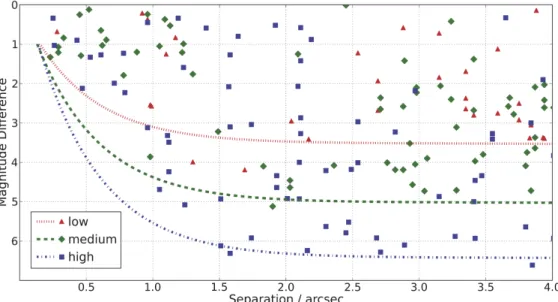
306. Figure 2 shows smoothed contrast curves resulting from
the Monte Carlo companion detection simulations for the three ranges of contrast performance groups.
3.6. Companion Contrast Ratios, Separations, and Position Angles
We determined the contrast ratio between the companions and primaries in two ways: for the widest separations, we performed aperture photometry on the original images; for the closer systems, we used the estimated PSF to remove the blended contributions of each of the stars before performing aperture photometry. In all cases, the aperture sizes were optimized for the system separation and the available signal. We calculated the contrast ratio uncertainty on the basis of the difference between the injected and measured contrasts of the
artificial companions during the contrast curve calculations
(Section 3.4). We found that the detection significance of the companion was the best predictor of the contrast ratio accuracy, and so we use that relation to estimate the contrast ratio uncertainty for each companion. We note that the uncertainties
(5%–30%) are much higher than would be naively expected
from the signal-to-noise ratio of the companion detection, as they include an estimate of the systematic errors resulting from the AO imaging, PSF subtraction, and contrast measurement processes.
To obtain the separation and position angle of the binaries, we measured the centroid of the PSF-subtracted images of the companion and primary, as above. We converted the raw pixel
Figure 2.Points on this plot show the angular separations and magnitude differences of the detected companions described in Tables2and3, with the color and shape of each point denoting the associated typical low-, medium-, and high-performance 5σcontrast curve during the observation(as described in Section3.5).
positions to on-sky separations and position angles using a distortion solution produced from Robo-AO measurements of globular clusters, detailed in Riddle et al.(2015). We calculated the uncertainties of the companion separation and position angles using estimated systematic errors in the position measurements due to blending between components, depend-ing on the separation of the companion (typically 1–2 pixels uncertainty in the position of each star). We also included an estimate of the maximal changes in the Robo-AO orientation throughout the observation period(±1°. 5), as verified using the globular cluster measurements above. Finally, we verified the measured positions and contrast ratios in direct measurement from non-PSF-subtracted images.
4. NIRC2 DATA REDUCTION
We created a pipeline to automatically reduce and analyze our NIRC2 data. After sky subtraction andflat-field calibration, the frames were co-added into a single image based on the automatic detection of the location of the primary star in each dither frame. Because the distortion across each detector
quadrant is sufficiently small compared to the Robo-AO
position errors, 20 mas (Yelda et al. 2010), we did not
correct for field distortion. The pipeline then automatically
identifies companion stars via pixel binning, vetting the
brightest bins by measuring radius in the eight cardinal and diagonal directions against a minimum cutoff and radial consistency. Cutoff values are optimized to search for both wide and narrow separation companions. For targets with observations in multiple filters (reported in D. Atkinson et al. 2016, in preparation), the results are cross-referenced and stars found in only onefilter are dropped as multi-color observations are effective in discriminating PSF speckles from astrophysical objects. Targets for which the pipeline registered multiple
companions areflagged for manual validation.
The higher angular resolution images clearly separate the vast majority of companions and simple aperture photometry is used to measure the brightness of each star. For close companions, a matching aperture opposite the partner star from the object being investigated is subtracted from the star’s own photometry. This corrects for any overlapping PSF halo
(and assumes a radially constant PSF, which is more accurate at
larger separations). Magnitude differences between
compa-nions and their primary star are shown in Table 4.
The uncertainty in the magnitude difference is estimated by varying the aperture radius from 0.5 to 5 of the width of the stellar PSF and measuring the standard deviation of the difference. Injected companions are used to measure the overall
efficacy of the technique and determine the weighting of
magnitude difference versus aperture radius. Recovering injections with this technique demonstrated an uncertainty of ∼5%, consistent with our reported uncertainties.
5. DISCOVERIES
We resolved 181Keplerplanet candidate hosts into multiple stars; the contrast ratios and the separations are shown in
Figure 2 and the discovery images are summarized in
Figures 3–5. The measured companion properties for the
targets with secure detections, >5σ, are detailed in Table 2.
Table3 describes probable companions which fell just below
our formal 5σdetection criteria. We consider these very likely to be real, but we cannot exclude the possibility that a small
fraction of these detections are spurious speckles without additional information. Where possible, we observed these targets with NIRC2 to confirm their existence, as discussed in Section5.3.
5.1. Comparison to Other Imaging Surveys
In the search for blended Kepler companions, many other
high angular resolution surveys of KOIs have been performed using a range of observational techniques, e.g., infrared AOs, sparse aperture interferometry, speckle interferometry, lucky
imaging, and direct imaging with theHubble Space Telescope
(HST; Howell et al. 2011; Adams et al. 2012, 2013; Horch
et al.2012; Lillo-Box et al.2012,2014; Dressing et al.2014; Marcy et al. 2014; Everett et al. 2015; Gilliland et al. 2015; Teske et al.2015; Torres et al.2015; Wang et al.2015a,2015b;
Gaidos et al. 2016; Kraus et al. 2016). Each technique and
instrument setup has a unique sensitivity, inner working angle, and spectral bandpass, presenting a challenge for a complete analysis of the multiplicity of KOI stars, and is part of our motivation for observing all KOIs with a single instrument setup. We have indicated in Tables2and3where these surveys have previously detected the same companion at approximately the same location. These other surveys have detected 38 of the 98 companions we detected at a significance greater than 5σ, and 24 of the 105 companions we detected at a lower significance.
Interestingly, Robo-AO was able to detect a close
compa-nion to KOI-2971 at a significance of 3.9σ that was not
detected by Dressing et al.(2014)using ARIES with the MMT
AO system; and conversely Robo-AO did not detect the 3 5
companion found by Dressing et al. (2014). We fortuitously
observed KOI-2971 with NIRC2(see Section5.3)and we were
able to clearly see both of these companions.
We also note that the Robo-AO automated companion detection software found companions to 2849 and KOI-3246 at nearly the same separation, 0 36, position angle, 215◦, magnitude difference,∼1, and at a significance level of 4.0σ and 5σ,respectively. Observations of both targets occurred on 2013 August 16 and showed evidence of static non-common path error in the stellar PSF leading to a speckle in the position
of the purported companions. Kraus et al. (2016) observed
KOI-3246 with NIRC2, and confirmed that there was no
companion of similar brightness near the location of the Robo-AO automated detection. Because of our insensitivity at that position during that night, we did not report these detections in our list of companions.
5.2. Comparison to a Spectroscopic Survey
Kolbl et al.(2015) searched for close companions to KOIs by detecting secondary light sources in spectra used for determining radial velocities. They demonstrated sensitivity to
companions as faint as ∼1% of the primary star, and to
companions captured within the 0 87 × 3 0 Keck-HIRES
entrance slit. We observed 19 of the 58 KOIs for which Kolbl et al.(2015)found evidence for a companion. Of those 19, we detected companions to KOI-151, KOI-652, KOI-1784, and
KOI-4871. We had sufficient image contrast performance for
Figure 3.Color-inverted, normalized log scale cutouts of 61 multiple KOI systems[KOI-4 to KOI-2056]with separations<4″resolved with Robo-AO. The angular scale and orientation is similar for each cutout. The smaller circles are centered on the detected nearby star.
Figure 5.Color-inverted, normalized log-scale cutouts of 59 multiple KOI systems[KOI-3284 to KOI-4871]with separations<4″resolved with Robo-AO. The angular scale and orientation is similar for each cutout. The smaller circles are centered on the detected nearby star.
Table 2
Detections of Objects Within∼4 0 ofKeplerPlanet Candidates at 5σSignificance
KOI mi ObsID Filter Signf. Separation P.A. Mag. Diff. Previous NIRC2
(mag) σ (arcsec) (deg.) (mag) Detection? Detection?
KOI-4 11.3 2012 Jul 16 i′ 12 3.42±0.06 75±2 4.46±0.05 L L
KOI-42 9.2 2013 Jul 28 LP600 35 1.74±0.06 35±2 3.04±0.17 A12, H11, K16 L
KOI-227 13.7 2013 Jul 27 LP600 5 0.33±0.06 72±6 0.84±0.09 H11, K16 L
KOI-258 9.8 2012 Jul 18 i′ 14 1.05±0.06 77±2 2.76±0.17 A12, H11 L
KOI-284 11.7 2013 Jul 27 LP600 19 0.96±0.06 98±2 0.45±0.04 A12, H11, E15, K16 L
KOI-298 12.4 2013 Aug 15 LP600 477 2.11±0.06 270±2 0.58±0.04 LB12, K16 L
KOI-379 13.2 2013 Jul 27 LP600 56 2.11±0.06 83±2 1.42±0.11 LB12 L
KOI-521 14.5 2013 Aug 14 LP600 18 3.24±0.06 152±2 0.42±0.03 L L
KOI-558 14.6 2013 Aug 22 LP600 6 3.16±0.06 271±2 2.06±0.04 L L
KOI-641 13.1 2013 Jul 24 LP600 18 2.09±0.06 278±2 2.07±0.05 LB12 L
46 3.65±0.06 205±2 0.33±0.06 LB12 L
KOI-645 13.5 2013 Jul 25 LP600 6 2.98±0.06 48±2 2.23±0.04 LB12 L
KOI-652 13.3 2013 Jul 28 LP600 21 1.23±0.06 272±2 1.59±0.14 K15, K16, Te15 L
KOI-697 13.5 2013 Aug 15 LP600 9 0.71±0.06 54±3 0.06±0.03 W15 L
KOI-801 14.8 2013 Oct 25 LP600 6 3.67±0.06 195±2 2.58±0.11 L L
KOI-976 2012 Aug 03 i′ 22 0.25±0.06 129±7 0.34±0.09 K16 L
KOI-1061 14.3 2013 Aug 20 LP600 14 1.22±0.06 38±2 1.21±0.07 L L
KOI-1300 13.9 2013 Aug 16 LP600 8 0.78±0.06 357±3 1.79±0.18 K16 L
KOI-1357 15.3 2013 Aug 18 LP600 30 3.83±0.06 167±2 3.38±0.03 L L
KOI-1531 12.9 2013 Aug 16 LP600 7 0.43±0.06 99±4 0.90±0.16 L L
KOI-1546 14.2 2013 Aug 19 LP600 6 0.62±0.06 86±3 1.03±0.12 LB14 yes
KOI-1717 14.3 2013 Oct 25 LP600 9 0.87±0.06 305±3 1.46±0.13 L L
KOI-1853 13.3 2013 Aug 14 LP600 11 0.96±0.06 304±2 0.24±0.05 L L
KOI-1861 13.8 2013 Jul 28 LP600 5 2.10±0.06 84±2 4.93±0.16 L L
KOI-1899 14.4 2013 Jul 27 LP600 16 1.84±0.06 342±2 0.94±0.05 L L
KOI-1972 13.6 2013 Aug 15 LP600 21 1.05±0.06 246±2 1.05±0.12 L L
KOI-2032 12.0 2013 Jul 28 LP600 17 1.19±0.06 317±2 0.34±0.05 K16 L
KOI-2067 12.3 2013 Jul 24 LP600 17 1.64±0.06 315±2 0.80±0.04 K16 L
KOI-2096 14.9 2013 Aug 19 LP600 29 3.50±0.06 17±2 4.13±0.11 L L
KOI-2098 13.7 2013 Jul 27 LP600 8 2.88±0.06 156±2 2.58±0.04 L L
10 3.24±0.06 132±2 2.40±0.06 L L
KOI-2100 14.4 2013 Jul 28 LP600 8 2.98±0.06 318±2 2.10±0.05 L L
KOI-2174 15.2 2012 Aug 07 LP600 10 0.92±0.06 226±2 0.21±0.06 L L
25 3.88±0.06 314±2 0.14±0.03 L L
KOI-2295 11.4 2013 Jul 29 LP600 21 2.19±0.06 78±2 0.88±0.06 K16 L
KOI-2298 13.5 2013 Aug 16 LP600 29 1.57±0.06 194±2 2.08±0.14 D14 L
KOI-2377 14.5 2013 Jul 24 LP600 14 2.09±0.06 335±2 1.25±0.03 L yes
KOI-2421 14.0 2013 Jul 25 LP600 8 1.23±0.06 290±2 0.99±0.09 D14 L
KOI-2474 13.9 2013 Aug 13 LP600 8 0.61±0.06 279±3 0.65±0.07 H12 L
KOI-2598 14.0 2013 Aug 13 LP600 9 1.09±0.06 75±2 0.37±0.04 L L
KOI-2601 13.8 2013 Aug 13 LP600 17 1.66±0.06 14±2 1.43±0.06 L L
KOI-2679 13.3 2013 Jul 25 LP600 19 2.11±0.06 324±2 2.87±0.06 L L
KOI-2705 14.3 2013 Jul 25 LP600 15 1.84±0.06 304±2 3.19±0.14 G16, K16 yes
KOI-2711 13.5 2013 Jul 29 LP600 8 0.52±0.06 147±4 0.12±0.08 L yes
KOI-2729 13.7 2013 Aug 18 LP600 6 3.94±0.06 278±2 2.03±0.12 L L
KOI-2754 2013 Aug 14 LP600 21 0.79±0.06 260±3 2.23±0.20 D14, K16 L
KOI-2771 2013 Aug 16 LP600 13 3.85±0.06 312±2 6.61±0.14 D14 L
KOI-2803 12.1 2013 Aug 13 LP600 25 3.84±0.06 61±2 3.00±0.05 D14, K16 L
KOI-2807 13.7 2013 Jul 28 LP600 13 3.93±0.06 77±2 1.90±0.04 L L
KOI-2812 14.2 2013 Jul 27 LP600 22 2.09±0.06 335±2 3.23±0.05 L L
KOI-2836 14.9 2013 Oct 22 LP600 217 3.94±0.06 70±2 3.39±0.04 L L
KOI-2837 13.1 2013 Aug 15 LP600 6 0.35±0.06 136±5 0.23±0.04 L yes
KOI-2848 12.3 2013 Aug 14 LP600 6 2.30±0.06 28±2 5.63±0.23 L L
KOI-2904 12.5 2013 Jul 24 LP600 10 0.71±0.06 226±3 1.99±0.24 D14 yes
KOI-2910 15.0 2013 Aug 19 LP600 7 3.15±0.06 88±2 0.72±0.05 L L
KOI-2962 14.0 2013 Jul 25 LP600 9 1.13±0.06 68±2 0.53±0.05 L L
KOI-3069 14.7 2013 Aug 19 LP600 5 1.93±0.06 109±2 2.20±0.07 L yes
KOI-3073 14.2 2013 Aug 14 LP600 10 1.30±0.06 10±2 1.76±0.15 L L
KOI-3158 2013 Jul 21 LP600 613 2.10±0.06 254±2 4.00±0.15 LB14, K16, C15 L
KOI-3190 11.1 2013 Jul 27 LP600 6 2.68±0.06 190±2 5.92±0.17 L L
KOI-3245 12.3 2013 Jul 25 LP600 12 1.58±0.06 184±2 3.10±0.07 L L
KOI-3324 15.7 2013 Oct 23 LP600 11 3.84±0.06 323±2 3.05±0.06 L L
evidence to the spectroscopic companions existing at closer angular separations.
We detected a companion to KOI-151 at an angular
separation of 4 2 and at a radiant flux ratio of 0.0046 ±
0.0008 with respect to the primary star. This companion is fainter than the 1σ lower limit on the radiant flux of 0.012±
0.006 determined by Kolbl et al. (2015) and was likely not
captured by the HIRES entrance slit. Therefore, we conclude that our detection is new and that KOI-151 is an asterism of at least three stars.
We detected a companion to KOI-652 at an angular separation of 1 23. This companion was also detected by Teske et al. (2015)and Kraus et al.(2016)with Keck-NIRC2 as a∼0 08 binary. This lends further evidence to Kolbl et al.ʼs claim that this system is at least a triple star system.
Both we and Wang et al.(2015b)detected a companion to
KOI-1784 at an angular separation of ∼0 3, which would
easily be captured within the HIRES entrance slit. We calculate
a radiant flux ratio of 0.59 ±0.07, which is well above the
lower limit of 0.192±0.058 determined by Kolbl et al.(2015).
Wang et al. (2015b) estimated a physical separation of
160.7 AU between the primary and the companion, and this
may not be compatible with theΔRV of−13 km s−1measured
by Kolbl et al.(2015). It is not conclusive that the imaged close companion is also responsible for the spectroscopic signal, so it is possible this is also an asterism of at least three stars.
We observed a companion to KOI-4871 at an angular
separation of 0 96 and a radiant flux ratio of 0.057 ±0.010
with respect to the primary star. This detection is compatible with the lower limit on the radiantflux ratio of 0.012±0.003 determined by Kolbl et al. (2015). If this is indeed the same star, Kolbl et al.ʼs reportedΔRV of−23 km s−1suggests it is not physically associated with the primary.
While we have not conclusively imaged stellar companions
that were detected by Kolbl et al.ʼs survey, we have found
additional nearby stars not detected by spectroscopic methods. As previously suggested by Teske et al.(2015), spectroscopic and AO methods can probe complementary, and sometimes overlapping, regions of parameter space when searching for stellar companions. While spectroscopic companions can be
Table 2
(Continued)
KOI mi ObsID Filter Signf. Separation P.A. Mag. Diff. Previous NIRC2
(mag) σ (arcsec) (deg.) (mag) Detection? Detection?
KOI-3468 14.1 2013 Jul 24 LP600 6 1.49±0.06 117±2 3.22±0.15 L L
KOI-3497 13.0 2013 Oct 24 LP600 15 0.78±0.06 174±3 1.23±0.12 M14, K16 L
KOI-3891 13.4 2013 Jul 27 LP600 5 1.05±0.06 240±2 4.69±0.41 K16 L
9 2.01±0.06 136±2 4.92±0.13 K16 L
KOI-3907 12.5 2013 Jul 27 LP600 7 1.58±0.06 162±2 6.31±0.25 W15 L
20 2.82±0.06 72±2 3.23±0.04 W15 L
KOI-4004 12.5 2013 Jul 27 LP600 13 1.93±0.06 217±2 4.34±0.27 K16 yes
KOI-4021 12.5 2013 Aug 16 LP600 11 1.92±0.06 113±2 0.52±0.07 L L
KOI-4145 14.1 2013 Jul 27 LP600 9 2.71±0.06 237±2 2.36±0.03 L L
KOI-4149 14.1 2013 Oct 22 LP600 11 1.76±0.06 63±2 0.17±0.03 L L
KOI-4205 14.2 2013 Jul 28 LP600 7 2.71±0.06 66±2 2.65±0.03 L L
KOI-4209 15.7 2013 Aug 19 LP600 11 0.96±0.06 203±2 0.37±0.08 L yes
KOI-4287 11.1 2013 Aug 17 LP600 10 0.61±0.06 76±3 1.27±0.14 K16 L
KOI-4329 11.9 2013 Aug 18 LP600 10 1.93±0.06 117±2 4.64±0.21 L L
KOI-4331 13.0 2013 Jul 29 LP600 6 0.45±0.06 103±4 0.25±0.04 L yes
KOI-4389 14.8 2013 Aug 21 LP600 7 2.88±0.06 332±2 0.58±0.06 L L
KOI-4399 11.8 2013 Jul 24 LP600 6 2.16±0.06 17±2 6.24±0.21 K16 L
KOI-4407 11.0 2013 Jul 24 LP600 19 2.54±0.06 298±2 2.97±0.05 E15, K16 yes
KOI-4463 14.6 2013 Jul 27 LP600 29 2.45±0.06 143±2 0.01±0.03 L yes
KOI-4495 15.2 2013 Aug 22 LP600 6 3.06±0.06 89±2 3.90±0.06 L L
9 3.41±0.06 344±2 2.68±0.05 L L
KOI-4567 13.6 2013 Jul 24 LP600 12 1.31±0.06 142±2 2.48±0.13 L L
KOI-4575 13.0 2013 Aug 16 LP600 18 2.97±0.06 61±2 2.18±0.03 L L
KOI-4580 12.8 2013 Aug 13 LP600 19 1.58±0.06 60±2 1.27±0.05 L L
KOI-4582 11.6 2013 Jul 27 LP600 68 2.71±0.06 308±2 6.28±0.18 K16 L
39 3.55±0.06 286±2 3.27±0.12 K16 L
KOI-4634 13.5 2013 Jul 24 LP600 5 0.35±0.06 275±5 1.55±0.18 L yes
KOI-4651 13.6 2013 Jul 25 LP600 9 1.22±0.06 105±2 2.88±0.37 L L
KOI-4656 13.7 2013 Jul 29 LP600 8 2.89±0.06 23±2 1.42±0.03 L L
KOI-4657 13.0 2013 Jul 29 LP600 22 2.11±0.06 234±2 3.27±0.10 K16 L
KOI-4792 14.0 2013 Aug 15 LP600 9 3.68±0.06 318±2 2.36±0.04 L L
KOI-4797 15.3 2013 Aug 22 LP600 6 3.59±0.06 127±2 1.12±0.06 L L
KOI-4813 13.3 2013 Jul 28 LP600 5 2.54±0.06 208±2 1.22±0.05 L L
KOI-4823 12.5 2013 Aug 17 LP600 16 1.40±0.06 153±2 0.59±0.04 L L
KOI-4871 12.9 2013 Oct 25 LP600 11 0.96±0.06 333±2 3.12±0.19 a yes
Notes.References for previous detections are denoted with the following codes: Adams et al.2012(A12), Campante et al.2015(C15), Dressing et al.2014(D14), Everett et al.2015(E15), Gaidos et al.2016(G16), Howell et al.2011(H11), Horch et al.2012(H12), Kraus et al.2016(K16), Lillo-Box et al.2012(LB12), Lillo-Box et al.2014(LB14), Muirhead et al.2014(M14), Teske et al.2015(Te15), Wang et al.2015b(W15).
a
Companion identity is ambiguous. See Section5.2.
Table 3
Detections of Objects Within∼4 0 ofKeplerPlanet Candidates at<5σSignificance
KOI mi ObsID Filter Signf. Separation P.A. Mag. Diff. Previous NIRC2
(mag) σ (arcsec) (deg.) (mag) Detection? Detection?
KOI-151 13.8 2013 Jul 27 LP600 4.2 4.17±0.06 58±2 5.84±0.18 L L
KOI-155 13.3 2013 Aug 13 LP600 4.0 4.01±0.06 251±2 3.83±0.17 L L
KOI-190 13.9 2013 Jul 27 LP600 3.6 0.23±0.06 105±2 1.33±0.18 L yes
KOI-251 14.1 2013 Aug 21 LP600 2.1 3.48±0.06 123±2 3.80±0.12 A12, G16, K16 L
KOI-285 2013 Aug 13 LP600 4.6 1.51±0.06 136±2 6.12±0.21 A12, K16 L
KOI-387 13.2 2013 Jul 29 LP600 2.3 0.98±0.06 352±2 3.86±0.18 LB12, K16 L
KOI-425 14.5 2013 Aug 22 LP600 2.8 0.53±0.06 346±4 0.86±0.10 L yes
KOI-438 13.8 2013 Aug 18 LP600 3.9 3.28±0.06 181±2 3.11±0.04 K16 L
KOI-507 14.6 2013 Aug 22 LP600 2.3 2.03±0.06 358±2 4.46±0.11 L L
KOI-584 13.9 2012 Aug 05 LP600 2.5 1.83±0.06 137±2 4.10±0.12 L L
KOI-592 14.1 2013 Aug 14 LP600 2.6 2.30±0.06 150±2 4.21±0.11 LB12 L
KOI-614 14.3 2013 Jul 29 LP600 2.2 2.76±0.06 214±2 4.01±0.03 L L
KOI-730 15.1 2013 Aug 21 LP600 3.8 2.04±0.06 237±2 2.95±0.09 L L
KOI-813 15.5 2013 Aug 22 LP600 4.3 3.87±0.06 137±2 2.09±0.08 L L
KOI-931 15.0 2013 Oct 23 LP600 4.0 1.38±0.06 177±2 3.40±0.14 L yes
KOI-999 15.0 2013 Aug 18 LP600 2.6 3.41±0.06 125±2 2.80±0.05 L L
KOI-1066 15.4 2013 Aug 21 LP600 2.2 1.69±0.06 205±2 4.19±0.18 L yes
KOI-1067 14.5 2013 Oct 23 LP600 3.5 2.97±0.06 143±2 4.05±0.15 L yes
KOI-1112 14.4 2013 Jul 27 LP600 2.5 2.95±0.06 172±2 4.57±0.05 L yes
KOI-1214 14.4 2013 Jul 24 LP600 3.9 0.33±0.06 132±2 1.21±0.18 L yes
KOI-1397 14.8 2013 Aug 21 LP600 3.1 2.30±0.06 229±2 4.41±0.17 K16 L
KOI-1495 15.2 2013 Aug 22 LP600 2.5 3.75±0.06 188±2 2.92±0.11 L L
KOI-1546 14.2 2013 Aug 19 LP600 4.2 4.15±0.06 165±2 3.34±0.07 LB14 yes
3.5 2.93±0.06 5±2 3.52±0.08 LB14 yes
KOI-1573 14.2 2013 Jul 25 LP600 3.7 3.84±0.06 299±2 4.72±0.15 L L
KOI-1599 14.6 2013 Aug 18 LP600 3.4 2.98±0.06 207±2 2.22±0.06 L L
2.6 3.42±0.06 316±2 2.89±0.05 L L
KOI-1700 14.1 2013 Jul 27 LP600 3.6 0.29±0.06 289±2 1.07±0.26 L yes
KOI-1784 13.4 2013 Jul 28 LP600 4.7 0.33±0.06 286±6 0.58±0.13 K15, W15 yes
KOI-1798 14.2 2013 Aug 13 LP600 2.4 3.81±0.06 186±2 3.75±0.21 L L
KOI-1830 14.2 2013 Jul 27 LP600 3.9 0.46±0.06 319±4 1.29±0.17 L L
KOI-1950 15.7 2013 Aug 22 LP600 3.6 3.35±0.06 326±2 1.69±0.05 L L
KOI-1985 13.4 2013 Jul 24 LP600 2.2 2.82±0.06 156±2 4.19±0.09 K16 L
KOI-1989 13.1 2013 Aug 14 LP600 2.9 1.12±0.06 41±2 3.49±0.16 L yes
KOI-2014 15.4 2013 Oct 23 LP600 3.1 3.75±0.06 267±2 2.50±0.04 L L
KOI-2019 15.4 2013 Aug 22 LP600 3.3 4.01±0.06 105±2 2.61±0.21 L L
KOI-2055 14.3 2013 Jul 25 LP600 2.2 3.80±0.06 57±2 4.09±0.05 L L
KOI-2056 14.3 2013 Aug 16 LP600 4.9 3.87±0.06 131±2 3.37±0.11 L L
KOI-2069 13.6 2013 Aug 14 LP600 2.7 1.12±0.06 108±2 4.24±0.51 L L
KOI-2083 13.4 2013 Jul 28 LP600 2.5 0.26±0.06 176±2 1.03±0.18 L yes
KOI-2115 15.8 2013 Jul 21 LP600 2.4 3.59±0.06 243±2 2.75±0.12 L L
KOI-2156 15.3 2013 Aug 18 LP600 2.0 3.35±0.06 303±2 2.64±0.05 G16, K16 L
KOI-2247 14.0 2013 Jul 27 LP600 2.3 1.90±0.06 355±2 5.12±0.21 L L
KOI-2314 14.4 2013 Jul 27 LP600 4.6 4.14±0.06 201±2 3.45±0.22 L L
KOI-2317 14.1 2013 Jul 27 LP600 4.6 1.51±0.06 110±2 4.93±0.19 L yes
KOI-2377 14.5 2013 Jul 24 LP600 4.3 4.11±0.06 326±2 4.04±0.12 L yes
KOI-2380 14.0 2013 Jul 24 LP600 4.0 4.01±0.06 250±2 2.46±0.08 L L
KOI-2421 14.0 2013 Jul 25 LP600 4.1 4.07±0.06 132±2 3.87±0.18 D14 L
KOI-2469 14.7 2013 Aug 18 LP600 3.8 4.18±0.06 114±2 2.44±0.17 L L
KOI-2493 15.0 2013 Aug 22 LP600 2.4 2.69±0.06 300±2 2.68±0.04 L L
KOI-2516 13.1 2013 Jul 27 LP600 4.0 3.42±0.06 84±2 5.93±0.04 D14 L
KOI-2542 14.8 2013 Aug 21 LP600 3.4 0.88±0.06 22±3 1.20±0.19 G16, K16 yes
KOI-2551 15.5 2013 Oct 23 LP600 3.5 2.69±0.06 197±2 1.93±0.03 L L
KOI-2601 13.8 2013 Aug 13 LP600 3.8 1.44±0.06 297±2 3.61±0.14 L L
KOI-2664 15.3 2013 Aug 18 LP600 4.4 1.17±0.06 90±2 0.83±0.09 L yes
KOI-2681 15.7 2013 Oct 23 LP600 4.2 1.10±0.06 161±2 1.25±0.11 L yes
KOI-2707 14.2 2013 Jul 24 LP600 2.2 3.28±0.06 217±2 4.71±0.16 L L
2.9 3.87±0.06 182±2 3.64±0.11 L L
KOI-2722 13.1 2013 Aug 14 LP600 3.7 3.27±0.06 282±2 5.88±0.14 D14 yes
KOI-2743 13.5 2013 Aug 14 LP600 3.1 2.36±0.06 182±2 3.79±0.08 L L
KOI-2779 14.8 2013 Oct 22 LP600 2.9 0.98±0.06 61±2 2.54±0.38 L L
KOI-2838 13.2 2013 Aug 13 LP600 2.4 1.74±0.06 197±2 5.92±0.35 D14 L
detected at much closer angular separations, AO observations probe larger angular separations, and at a much greater dynamic range that can be used to more precisely calibrate transit radii measurements. Physical association of companions can be established either from the difference in measured radial velocities from spectroscopy or from probabilistic or additional spectrophotometric parallax analysis when using AO. From a practical perspective, AO imaging requires much less on-sky observing time, and can target a much greater range of exoplanetary host stars.
5.3. Keck-NIRC2 Imaging of Robo-AO Observed KOIs
Details of the 50 observations and 63 companions detected
with NIRC2 appear in Table 4. We observed 14 KOIs with
companions detected at >5σ so we could later calculate
spectrophotometric parallax distances to determine the prob-ability of physical association. We observed 13 companions detected by Paper Iat a significance level of <5σ. Including those previously imaged with NIRC2 and by Lillo-Box et al.
(2012)and Adams et al.(2012), all 17 of these detections have been confirmed.
The remainder of KOIs we observed with NIRC2 were at various levels of analysis: some Robo-AO images had been
fully processed with measured significance levels on the
candidate companion, while others were manually identified
before PSF subtraction. We confirmed 24 of the companions
detected at a significance level of <5σ in this survey (2 of which were in systems with a>5σ detected companion), and
Table 3
(Continued)
KOI mi ObsID Filter Signf. Separation P.A. Mag. Diff. Previous NIRC2
(mag) σ (arcsec) (deg.) (mag) Detection? Detection?
KOI-2914 12.1 2013 Jul 24 LP600 2.4 3.80±0.06 231±2 5.64±0.06 D14 L
KOI-2949 13.1 2013 Jul 29 LP600 2.2 2.36±0.06 311±2 4.08±0.32 L L
KOI-2971 12.6 2013 Jul 24 LP600 3.9 0.53±0.06 209±4 1.33±0.18 L yes
KOI-2984 12.9 2013 Jul 24 LP600 4.1 3.47±0.06 33±2 4.34±0.05 D14 L
KOI-3029 14.7 2013 Aug 18 LP600 3.1 0.28±0.06 272±2 0.68±0.22 L yes
KOI-3041 14.0 2013 Jul 25 LP600 3.2 2.03±0.06 128±2 4.64±0.17 L L
KOI-3255 13.9 2013 Jul 27 LP600 2.2 3.15±0.06 44±2 4.87±0.05 E15, K16 L
KOI-3277 12.9 2013 Jul 24 LP600 2.1 2.45±0.06 355±2 5.79±0.23 L L
3.8 3.41±0.06 353±2 5.00±0.12 L L
KOI-3284 13.8 2013 Aug 22 LP600 4.2 3.94±0.06 4±2 2.42±0.08 To15, E15, G16, K16 L
KOI-3288 14.0 2013 Jul 24 LP600 2.4 3.17±0.06 75±2 4.32±0.12 L L
2.1 3.50±0.06 80±2 4.62±0.16 L L
KOI-3309 14.4 2013 Aug 17 LP600 3.2 3.71±0.06 42±2 2.78±0.04 K16 L
KOI-3377 14.9 2013 Aug 22 LP600 2.7 1.45±0.06 58±2 4.26±0.19 L yes
KOI-3401 14.2 2013 Jul 28 LP600 4.3 0.65±0.06 94±3 0.89±0.20 L L
KOI-3439 14.0 2013 Jul 24 LP600 2.8 3.42±0.06 228±2 3.97±0.05 L L
KOI-3444 13.0 2013 Jul 25 LP600 2.6 1.11±0.06 8±2 3.32±0.17 LB14, W15, G16, K16 L 3.2 3.55±0.06 262±2 3.41±0.23 LB14, W15, G16, K16 L
KOI-3459 15.0 2013 Aug 21 LP600 3.3 3.35±0.06 124±2 2.37±0.04 L L
KOI-3460 14.3 2013 Jul 27 LP600 2.5 1.24±0.06 153±2 5.08±0.13 L L
2.8 2.47±0.06 231±2 5.52±0.11 L L
KOI-3486 14.1 2013 Jul 24 LP600 2.7 4.16±0.06 260±2 4.06±0.12 L L
KOI-3500 13.0 2013 Jul 25 LP600 4.1 2.54±0.06 137±2 4.01±0.05 L L
KOI-3946 13.1 2013 Aug 13 LP600 3.9 4.27±0.06 61±2 5.26±0.13 L L
KOI-4053 12.6 2013 Jul 25 LP600 3.2 4.11±0.06 302±2 5.51±0.12 L L
KOI-4098 13.5 2013 Aug 15 LP600 4.5 0.78±0.06 174±3 1.10±0.22 L L
KOI-4166 15.0 2013 Aug 18 LP600 2.0 3.54±0.06 157±2 3.29±0.04 L L
KOI-4194 15.0 2013 Aug 21 LP600 2.3 2.17±0.06 290±2 3.41±0.07 L L
KOI-4208 15.3 2013 Aug 17 LP600 3.3 0.99±0.06 234±2 2.57±0.29 L L
KOI-4226 12.6 2013 Jul 24 LP600 4.7 2.49±0.06 267±2 4.18±0.03 K16 L
KOI-4274 15.1 2013 Aug 22 LP600 3.1 3.26±0.06 207±2 3.71±0.11 L L
2.4 4.54±0.06 327±2 4.11±0.13 L L
KOI-4313 14.1 2013 Aug 13 LP600 2.6 2.88±0.06 81±2 4.19±0.05 L L
KOI-4409 12.3 2013 Jul 24 LP600 2.3 2.89±0.06 139±2 6.10±0.10 L L
KOI-4443 13.7 2013 Aug 13 LP600 2.2 3.41±0.06 26±2 5.00±0.13 L L
KOI-4495 15.2 2013 Aug 22 LP600 3.9 3.04±0.06 58±2 4.73±0.09 L L
KOI-4523 14.6 2013 Aug 21 LP600 2.4 3.94±0.06 100±2 2.61±0.33 L L
KOI-4699 12.8 2013 Aug 13 LP600 2.8 4.01±0.06 285±2 5.93±0.21 L L
KOI-4768 15.4 2013 Oct 23 LP600 2.3 1.30±0.06 159±2 3.99±0.26 L yes
KOI-4797 15.3 2013 Aug 22 LP600 3.5 3.93±0.06 77±2 3.37±0.11 L L
KOI-4812 15.5 2013 Oct 23 LP600 3.6 3.15±0.06 100±2 1.84±0.03 L L
KOI-4813 13.3 2013 Jul 28 LP600 4.6 4.03±0.06 146±2 3.34±0.09 L L
Note. References for previous detections are denoted with the following codes: Adams et al.2012(A12), Dressing et al.2014(D14), Everett et al.2015(E15), Gaidos et al.2016(G16), Kolbl et al.2015(K15), Kraus et al.2016(K16), Lillo-Box et al.2012(LB12), Lillo-Box et al.2014(LB14), Torres et al.2015(To15), Wang et al.2015b(W15).
Table 4
Full Keck-NIRC2 Observation List and Detected Companions
KOI ObsID Filter Separation P.A. Mag. Diff. Notes
(arcsec) (deg.) (mag)
KOI-190 2015 Jul 25 Kp 0.180±0.010 109±3 0.64±0.14 Table3
KOI-425 2015 Jul 25 Kp 0.490±0.010 343±1 0.83±0.06 Table3
KOI-628 2013 Aug 25 Kp 1.828±0.005 311±1 3.87±0.06 c
2.752±0.005 239±1 3.00±0.06 a
KOI-931 2015 Jul 25 Kp 1.261±0.005 177±1 3.23±0.06 Table3
KOI-987 2013 Aug 25 Kp 1.977±0.005 226±1 2.24±0.06 c
KOI-1066 2014 Aug 17 Kp 1.687±0.005 231±1 2.95±0.07 Table3
KOI-1067 2014 Aug 17 Kp 2.923±0.005 142±1 3.79±0.11 Table3
KOI-1112 2013 Aug 24 Kp 3.063±0.005 172±1 2.76±0.07 Table3
KOI-1151 2014 Aug 17 Kp 0.756±0.010 307±1 2.41±0.06 c
KOI-1214 2014 Aug 17 Kp 0.347±0.010 136±2 2.46±0.06 Table3
KOI-1359 2013 Jun 25 Ks 1.387±0.005 332±1 2.17±0.06 c
KOI-1375 2014 Aug 17 Kp 0.785±0.010 27±1 3.39±0.07 c
KOI-1442 2013 Aug 25 Kp 2.113±0.005 71±1 3.63±0.06 c
KOI-1546 2013 Aug 24 Kp 0.600±0.010 90±1 0.73±0.05 Table2
2.918±0.005 4±1 2.95±0.08 Table3
4.108±0.005 165±1 3.48±0.06 Table3
KOI-1700 2014 Aug 17 Kp 0.274±0.010 288±2 0.55±0.06 Table3
KOI-1784 2015 Jul 25 Kp 0.279±0.010 291±2 0.78±0.06 Table3
KOI-1845 2013 Jun 25 Ks 1.996±0.005 79±1 2.89±0.06 c
2.963±0.005 348±1 4.40±0.09 a
KOI-1884 2013 Aug 24 K 0.934±0.010 95±1 2.31±0.06 c
1.838±0.005 82±1 2.73±0.06 b
2.567±0.005 327±1 3.20±0.14 b
KOI-1891 2013 Aug 24 Kp 2.069±0.005 211±1 4.60±0.07 c
KOI-1989 2015 Jul 25 Kp 0.817±0.010 40±1 2.92±0.06 Table3
KOI-2009 2013 Aug 25 Kp 1.511±0.005 178±1 2.75±0.06 c
KOI-2083 2014 Aug 17 Kp 0.252±0.010 166±1 1.60±0.05 Table3
KOI-2159 2014 Aug 17 Kp 2.018±0.005 324±1 2.48±0.06 c
KOI-2317 2015 Jul 25 Kp 1.512±0.005 112±1 3.92±0.06 Table3
KOI-2363 2014 Aug 17 Kp 1.952±0.005 357±1 5.04±0.09 b
KOI-2377 2013 Aug 24 Kp 2.186±0.005 335±1 0.63±0.07 Table2
2.544±0.005 42±1 3.75±0.12 b
3.911±0.005 316±1 3.55±0.17 Table3
KOI-2413 2013 Aug 25 Kp 0.308±0.010 250±2 0.17±0.06 c
KOI-2443 2013 Jun 25 Ks 1.383±0.005 164±1 3.63±0.06 c
KOI-2542 2015 Jul 25 Kp 0.765±0.010 29±1 0.60±0.05 Table3
KOI-2664 2015 Jul 25 Kp 1.180±0.005 90±1 1.10±0.06 Table3
KOI-2681 2014 Aug 17 Kp 1.132±0.005 148±1 0.43±0.06 Table3
KOI-2705 2013 Aug 24 Kp 1.900±0.005 304±1 2.58±0.07 Table2
KOI-2711 2014 Aug 17 Kp 0.466±0.010 149±1 0.12±0.06 Table2
KOI-2722 2014 Aug 17 Kp 3.226±0.005 283±1 3.77±0.06 Table3
KOI-2837 2013 Aug 24 Kp 0.347±0.010 138±2 0.20±0.06 Table2
KOI-2859 2014 Aug 17 Kp 0.454±0.010 291±1 2.89±0.06 Table3
KOI-2904 2013 Aug 24 Kp 0.700±0.010 226±1 2.45±0.06 Table2
KOI-2971 2015 Jul 25 Kp 0.301±0.010 274±2 3.57±0.06 Table3
3.564±0.005 38±1 5.93±0.17 b
KOI-3029 2014 Aug 17 Kp 0.251±0.010 264±2 0.06±0.06 Table3
1.734±0.005 356±1 4.49±0.07 b
2.552±0.005 4±1 3.44±0.07 b
KOI-3069 2013 Aug 24 Kp 1.785±0.005 108±1 1.26±0.06 Table2
KOI-3377 2015 Jul 25 Kp 0.264±0.010 335±2 0.49±0.06 b
1.405±0.005 50±1 3.74±0.06 Table3
KOI-4004 2015 Jul 25 Kp 1.958±0.005 218±1 2.37±0.08 Table2
KOI-4209 2013 Aug 24 Kp 0.975±0.010 205±1 0.57±0.06 Table2
KOI-4292 2013 Aug 25 Kp 1.951±0.005 30±1 4.54±0.08 b
KOI-4331 2014 Aug 17 Kp 0.347±0.010 102±2 0.13±0.05 Table2
KOI-4407 2013 Aug 25 Kp 2.455±0.005 300±1 1.89±0.06 Table2
2.662±0.005 311±1 4.65±0.34 b
KOI-4463 2013 Aug 24 Kp 2.462±0.005 144±1 -0.26±0.07 Table2
KOI-4634 2015 Jul 25 Kp 0.282±0.010 276±2 0.65±0.06 Table2
KOI-4768 2014 Aug 17 Kp 1.326±0.005 160±1 2.61±0.07 Table3
KOI-4871 2014 Aug 17 Kp 0.921±0.010 334±1 3.04±0.06 Table2
Notes.
a
Additional detection not reported in PaperI.(Angular separation exceeds 2 5.) b
Companion not detected in the Robo-AO image. cConfirmation of<
other surveys confirmed 18 more of these companions. Due to the enhanced contrast with NIRC2, we found additional
companions to 6 KOIs (1884, 2377, 2971, 3029, 3377, and
4407)that were not detected in the original Robo-AO data. We also found individual companions near 2363 and KOI-4292 in the NIRC2 data that did not correspond to the
preliminary manually identified candidate companions in the
Robo-AO data and we note them in Tables4and5. Despite the
somewhat haphazard selection of targets, the vast majority of Robo-AO detections that have follow-up observations with NIRC2 have been shown to be real; so far, 60 of the 120 companions detected at a significance of <5σ with Robo-AO
from Paper Iand this work have been confirmed.
6. DISCUSSION
We observed 969 Kepler planetary system candidates with
the Robo-AO robotic laser AOs system. Presuming all
confirmed and probable 203 Robo-AO detected companions
within∼4″of 181 KOIs are real, we calculate the nearby star probability as a function of angular distance; see Figure 7. In
our previous study, we found a probability of 7.4%±1.0% at
angular separations up to 2 5 around 715 KOIs. For direct comparison, we calculated the probability in our sample to the
same separation of 2 5 and found it to be 10.6% ±1.1%, a
difference of 2.2σ. Additional fainter companions are
dis-covered here, e.g., 9 companions with a magnitude difference greater than 5 within 2 5 compared to 3 previously.
We explored the possibility of a bias change in the KOI selection process between major data releases, Q1-Q6(Batalha et al. 2013) and Q1-Q12 (Rowe et al.2015). Our first study comprised 715 targets solely from Q1-Q6, while this work includes targets originally identified in both catalogs, 505 that
appear in Q1-Q6 (51 of which have <2 5 companions)and
464 that only appear in Q1-Q12 (52 companions). After
combining the results of both and comparing the nearby star probability within 2 5 for the KOIs that only appear in Q1-Q12 catalog versus those originally found in the Q1-Q6 catalog, we
find probabilities of 11.2% ± 1.6% and 8.5% ± 0.9%,
respectively, a difference of 1.5σ.
We also examined the on-sky spatial distribution of observed
KOIs and those with <2 5 companions for both studies
(Figure6). In our cumulative survey there is a bias of targets located closer to the galactic plane compared to the center of theKeplerfield. Additionally, compared to ourfirst study, the median position of KOIs observed in this work is closer to the galactic plane by 1°. 1, and the median position of KOIs with
<2 5 companions is closer to the galactic plane by 1°. 4. We
find in general that higher galactic latitude KOIs have fewer
wide companions which is consistent with lower stellar
crowding away from the galactic plane in the Kepler field
(Gilliland et al.2011), and therefore the difference in nearby
star probability between this work and PaperImay simply be
due to the specific KOI samples.
Previous studies have shown that the majority of stellar
companions to KOIs at a separation of <1″ are physically
associated, with the probability of association decreasing with increasing angular separation(Horch et al.2014). We calculate the cumulative nearby star probability as a function of angular separation of our data and present it in Figure7. Our data show that the probability increases nearly linearly with increasing
separation, up to 17.9%±1.4% out to a separation of 4 0. If
the distribution had consisted solely of chance alignments of non-physically associated companions, we would expect this probability to instead increase quadratically. This suggests again that a large fraction of the companions with smaller angular separations are indeed physically associated with the primary star.
This work and PaperItogether comprise a survey of roughly half of the KOIs in the Q1-Q17 DR24 data set release. In light of the apparent discrepancy in companion discovery rates between the two using the same instrument, we caution against extrapolating companion rates from any individual survey that samples a small fraction of the overall population. Even when
combined, the existing patchwork of other KOI surveys (see
Section 5.1) is not as comprehensive, and requires detailed
calibration to match the varying sensitivities, inner working angles, and wavelength ranges. Future high angular resolution follow-up observations of large numbers of candidate
exopla-net hosts would benefit from an initial comprehensive survey
from Robo-AO that can very efficiently find lower contrast
blended stars; preserving precious and limited resources like Keck AO orHSTfor those targets that pass the initial round of vetting.
We expect that our data will be used by other researchers usingKepler data to study and validate exoplanets, their host stars, and stellar environments, and other astrophysical phenomena. To aid in this effort, Robo-AO images of KOIs and the position and photometry of any detected companions
will be available at the Kepler Community Follow-up
Observing Program.8
7. FUTURE WORK
In the third installment of this paper series we will present the remaining Robo-AO observations of KOIs and explore an analysis of the complete data set. We will detail the effects of
the detected nearby stars on the interpretation of Kepler
planetary candidates and note particular systems of interest. We will investigate further the spatial distribution of all KOIs with companions as a function of separation.
In parallel, we are currently using the multi-color visible and infrared observations obtained for this survey to estimate relative spectrophotometric distances between KOIs and their detected companions to determine if the stars are physically bound. We have also inspected all of our Robo-AO images of
KOIs for images of other Kepler input catalog (KIC) targets
that do not have repeating transit signals. We have identified
Table 5
Full Robo-AO Observation List
KOI mi/mag ObsID Obs. Qual.a Companion?
K00004.01 11.3 2012 Jul 16 high(i′-band) yes
K00042.01 9.2 2013 Jul 28 high yes
K00116.01 12.7 2013 Jul 24 high L
K00123.01 12.2 2013 Jul 25 high L
K00127.01 13.7 2013 Aug 15 high L
Notes.
a
All observations taken in the LP600 filter unless otherwise noted by
‘(i′-band)’ b
Companion originally discovered in NIRC2 image; see Table4. (This table is available in its entirety in machine-readable form.)
8
Seehttps://exofop.ipac.caltech.edu/cfop.php.
nearly 700 of these serendipitously observed KICs in our existing data; we will use these observations as a control sample to determine if there is a fundamental difference in the nearby star probability between the KOIs and non-KOI KICs, including if there are similar effects due to galactic latitude, and
whether this has an effect on planetary systems (Nofi
et al.2015).
We have reconfigured and redeployed the Robo-AO system
as the only instrument on the 2.1 m telescope at Kitt Peak as of
2015 November (Riddle et al. 2016). We intend to continue
observations of our detected companions to search for common proper motion pairs to better understand the probability of physical association. We will additionally integrate a science grade detector version of a low-noise infrared camera to
Robo-AO (previously demonstrated by Baranec et al. 2015). This
camera will enable both infrared imaging and tip-tilt sensing and correction that will allow us to better observe redder KOIs.
We are also in the process of building an upgraded Robo-AO
system for the University of Hawai‘i 2.2 m telescope on
Maunakea(Baranec et al.2014b). Between the two Robo-AO
systems, we will be able to observe up to ∼500 objects per
night, covering nearly three-quarters of the sky over the course
of a year. Forthcoming transit missions such as NASAʼs
Transiting Exoplanet Survey Satellite (Ricker et al. 2015),
scheduled to launch in 2017, and ESAʼs PLAnetary Transits
and Oscillations of stars 2.0 (Rauer et al. 2014) will release their data on timescales of months and shorter, and are expected to discover a greater number of exoplanet systems
compared to Kepler. Only the extremely efficient and rapid
follow-up capability of Robo-AO will be able to keep up with the sustained demand for high-acuity imaging of thousands of
exoplanet candidate host stars identified by these and other
projects.
This research is supported by the NASA Exoplanets
Research Program, grant #NNX 15AC91G. C.B.
acknowl-edges support from the Alfred P. Sloan Foundation. T.M. is
supported by NASA grant#NNX 14AE11G under theKepler
Participating Scientist Program. D.A. is supported by a NASA
Space Technology Research Fellowship, grant #NNX
13AL75H.
The Robo-AO system was developed by collaborating partner institutions, the California Institute of Technology and the Inter-University Centre for Astronomy and Astrophysics, and with the support of the National Science Foundation under grant Nos. AST-0906060, AST-0960343, and AST-1207891, the Mt. Cuba Astronomical Foundation, and by a gift from Samuel Oschin. We are grateful to the Palomar Observatory staff for their support of Robo-AO on the 1.5 m telescope, particularly S. Kunsman, M. Doyle, J. Henning, R. Walters, G. Van Idsinga, B. Baker, K. Dunscombe, and D. Roderick. We thank Adam Kraus et al. for sharing a preprint of their paper. This work used the
astronomy and astrophysics package for Matlab (Ofek 2014).
Some of the data presented herein were obtained at the W.M.
Figure 6.Location in galactic coordinates for the KOIs(a), and those with companions detected at angular separations of less than 2 5(b), observed by PaperI(PI) and in this work(PII). In both panels the“×”represents the median galactic coordinate for each set of objects. Projections of theKeplerdetectors on sky for the spring season is provided for reference.
Keck Observatory, which is operated as a scientific partnership among the California Institute of Technology, the University of California, and the National Aeronautics and Space Adminis-tration. The Observatory was made possible by the generous
financial support of the W.M. Keck Foundation. The authors
wish to recognize and acknowledge the very significant cultural role and reverence that the summit of Maunakea has always had within the indigenous Hawaiian community. We are most fortunate to have the opportunity to conduct observations from this mountain.
Facilities: PO:1.5m(Robo-AO), Keck:II(NIRC2-LGS).
APPENDIX
In Table5, we list our Robo-AO observed KOIs, including
the date the target was observed, the observation quality as
described in Section 3.5, and the presence of detected
companions.
REFERENCES
Adams, E. R., Ciardi, D. R., Dupree, A. K., et al. 2012,AJ,144, 42 Adams, E. R., Dupree, A. K., Kulesa, C., & McCarthy, D. 2013,AJ,146, 9 Akeson, R. L., Chen, X., Ciardi, D., et al. 2013,PASP,125, 989
Baranec, C., Atkinson, D., Riddle, R., et al. 2015,ApJ,809, 70 Baranec, C., Riddle, R., Law, N. M., et al. 2013, JVE,72, e50021 Baranec, C., Riddle, R., Law, N. M., et al. 2014a,ApJL,790, L8
Baranec, C., Riddle, R., Law, N. M., et al. 2014b, Proc. SPIE, 9148, 914812 Batalha, N. M., Rowe, J. F., Bryson, S. T., et al. 2013,ApJS,204, 24 Campante, T. L., Barclay, T., Swift, J. J., et al. 2015,ApJ,799, 170 Cenko, S. B., Fox, D. B., moon, D.-S., et al. 2006,PASP,118, 1396 Ciardi, D. R., Beichman, C. A., Horch, E. P., & Howell, S. B. 2015, ApJ,
805, 16
Coughlin, J. L., Mullally, F., Thompson, S. E., et al. 2015, arXiv:1512.06149 Dressing, C. D., Adams, E. R., Dupree, A. K., Kulesa, C., & McCarthy, D.
2014,AJ,148, 78
Dressing, C. D., & Charbonneau, D. 2013,ApJ,767, 95 Everett, M. E., Barclay, T., Ciardi, D. R., et al. 2015,AJ,149, 55 Fressin, F., Torres, G., Charbonneau, D., et al. 2013,ApJ,766, 81
Gaidos, E., Mann, A. W., Kraus, A. L., & Ireland, M. 2016, MNRAS, 457, 2877
Gilliland, R. L., Cartier, K. M. S., Adams, E. R., et al. 2015,AJ,149, 24
Gilliland, R. L., Chaplin, W. J., Dunham, E. W., et al. 2011,ApJS,197, 6 Haas, M. R., Batalha, N. M., Bryson, S. T., et al. 2010,ApJL,713, L115 Horch, E. P., Howell, S. B., Everett, M. E., & Ciardi, D. R. 2012,AJ,144, 165 Horch, E. P., Howell, S. B., Everett, M. E., & Ciardi, D. R. 2014,ApJ,795, 60 Howell, S. B., Everett, M. E., Sherry, W., Horch, E., & Ciardi, D. R. 2011,AJ,
142, 19
Kolbl, R., Marcy, G. W., Isaacson, H., & Howard, A. W. 2015,AJ,149, 18 Kraus, A. L., Ireland, M. J., Huber, D., Mann, A. W., & Dupuy, T. J. 2016, AJ,
in press(arXiv:1604.05744)
Lafrenière, D., Marois, C., Doyon, R., Nadeau, D., & Artigau, É 2007,ApJ, 660, 770
Law, N. M., Hodgkin, S. T., & Mackay, C. D. 2006a,MNRAS,368, 1917 Law, N. M., Kraus, A. L., Street, R., et al. 2012,ApJ,757, 133
Law, N. M., Mackay, C. D., & Baldwin, J. E. 2006b,A&A,446, 739 Law, N. M., Mackay, C. D., Dekany, R. G., et al. 2009,ApJ,692, 924 Law, N. M., Morton, T., Baranec, C., et al. 2014,ApJ,791, 35 Lillo-Box, J., Barrado, D., & Bouy, H. 2012,A&A,546, A10 Lillo-Box, J., Barrado, D., & Bouy, H. 2014,A&A,566, A103 Marcy, G. W., Isaacson, H., Howard, A. W., et al. 2014,ApJS,210, 20 Montet, B. T., Johnson, J. A., Muirhead, P. S., et al. 2015,ApJ,800, 134 Morton, T. D., & Johnson, J. A. 2011,ApJ,738, 170
Muirhead, P. S., Becker, J., Feiden, G. A., et al. 2014,ApJS,213, 5 Muirhead, P. S., Vanderburg, A., Shporer, A., et al. 2013,ApJ,767, 111 Nofi, L., Baranec, C., Howard, A., et al. 2015, BAAS,3, 117.13
Ofek, E. O. 2014, MATLAB Package for Astronomy and Astrophysics, Astrophysics Source Code Library, ascl:1407.005
Rauer, H., Catala, C., Aerts, C., et al. 2014,ExA,38, 249
Ricker, G. R., Winn, J. N., Vanderspek, R., et al. 2015,JATIS,1, 014003 Riddle, R. L., Baranec, C., Law, N. M., et al. 2016, BAAS,227, 427.03 Riddle, R. L., Hogstrom, K., Papadopoulos, A., Baranec, C., & Law, N. M.
2014,Proc. SPIE,9152, 91521E
Riddle, R. L., Tokovinin, A., Mason, B. D., et al. 2015,ApJ,799, 4 Rowe, J. F., Coughlin, J. L., Antoci, V., et al. 2015,ApJS,217, 16 Santerne, A., Fressin, F., Díaz, R. F., et al. 2013,A&A,557, A139 Terziev, E., Law, N. M., Arcavi, I., et al. 2013,ApJS,206, 18 Teske, J. K., Everett, M. E., Hirsch, L., et al. 2015,AJ,150, 144 Torres, G., Kipping, D. M., Fressin, F., et al. 2015,ApJ,800, 99
van Dam, M. A., Bouchez, A. H., Le Mignant, D., et al. 2006, PASP, 118, 310
Wang, J., Fischer, D. A., Horch, E. P., & Xie, J.-W. 2015a,ApJ,806, 248 Wang, J., Fischer, D. A., Xie, J.-W., & Ciardi, D. R. 2014a,ApJ,791, 111 Wang, J., Fischer, D. A., Xie, J.-W., & Ciardi, D. R. 2015b,ApJ,813, 130 Wang, J., Xie, J.-W., Barclay, T., & Fischer, D. A. 2014b,ApJ,783, 4 Wizinowich, P. L., Le Mignant, D., Bouchez, A. H., et al. 2006, PASP,
118, 297
Yelda, S., Lu, J. R., Ghez, A. M., et al. 2010,ApJ,725, 331
York, D. G., Adelman, J., Anderson, J. E., Jr., et al. 2000,AJ,120, 1579

![Figure 3. Color-inverted, normalized log scale cutouts of 61 multiple KOI systems [KOI-4 to KOI-2056] with separations <4″ resolved with Robo-AO](https://thumb-us.123doks.com/thumbv2/123dok_us/8254063.2186902/6.918.82.839.66.1041/figure-inverted-normalized-cutouts-multiple-systems-separations-resolved.webp)
![Figure 4. Color-inverted, normalized log-scale cutouts of 61 multiple KOI systems [KOI-2067 to KOI-3277] with separations <4″ resolved with Robo-AO](https://thumb-us.123doks.com/thumbv2/123dok_us/8254063.2186902/7.918.82.839.66.1043/figure-inverted-normalized-cutouts-multiple-systems-separations-resolved.webp)
![Figure 5. Color-inverted, normalized log-scale cutouts of 59 multiple KOI systems [KOI-3284 to KOI-4871] with separations <4″ resolved with Robo-AO](https://thumb-us.123doks.com/thumbv2/123dok_us/8254063.2186902/8.918.81.840.72.1054/figure-inverted-normalized-cutouts-multiple-systems-separations-resolved.webp)

