THE FEASIBILITY OF AN 8-WEEK, HOME-BASED ISOMETRIC STRENGTH TRAINING PROGRAM FOR IMPROVING DRESSAGE TEST PERFORMANCE IN EQUESTRIAN
ATHLETES
Jordan Talmadge Lee
A thesis submitted to the faculty of the University of North Carolina at Chapel Hill in fulfillment of the requirements for the degree of Masters of Arts in the Department of Exercise and Sport
Science (Exercise Physiology).
Chapel Hill 2015
Approved By:
Claudio L. Battaglini
Anthony C. Hackney
Edgar W. Shields
ABSTRACT
Jordan Lee: The Feasibility of an 8-week, Home-based Isometric Strength Training Program for Improving Dressage Test Performance in Equestrian Athletes
(Under the direction of Dr. Claudio L. Battaglini)
PURPOSE: To determine the feasibility of an 8-week, home-based isometric strength-training program in equestrians. Secondary purposes examined changes in muscular strength, endurance, and riding performance. METHODS: 18 riders (≥1yr dressage experience, riding ≥1hr/week, otherwise untrained) completed pre/post muscular tests and a US Equestrian Federation (USEF) Training Level Rider Test. A progressive, 3 day/wk riding-specific intervention using
To my mother, the strongest woman I know, for putting her whole heart into supporting my every dream and endeavor.
TABLE OF CONTENTS
LIST OF TABLES ... xiii
CHAPTER ONE: INTRODUCTION ... 1
Background ... 1
Statement of Purpose ... 3
Research Question ... 3
Hypothesis ... 4
Definition of Terms ... 5
Assumptions ... 6
Limitations ... 7
Delimitations ... 7
Significance ... 8
CHAPTER TWO: REVIEW OF LITERATURE ... 9
Overview ... 9
Sport of Horseback Riding ... 9
Horse and Rider Communication and Rider Positioning ... 10
Physical Fitness of the Equestrian Athlete ... 11
Demands and Movement Patterns of Equestrians ... 14
Summary ... 17
CHAPTER THREE: METHODS ... 18
Recruitment ... 19
Instrumentation ... 19
Research Design Overview ... 20
General Procedures ... 21
Assessments ... 22
Riding Test ... 24
Exercise Training Intervention ... 25
Statistical Analysis and Design ... 28
CHAPTER FOUR: RESULTS ... 31
Overview ... 31
Subjects ... 31
Hypotheses ... 33
Exploratory Analyses ... 35
CHAPTER FIVE: DISCUSSION ... 38
Overview ... 38
Feasibility ... 39
Muscular Fitness ... 40
Riding Test ... 43
Exploratory Analyses ... 46
Conclusion ... 48
Future Research ... 49
APPENDIX 3.1: STUDY BROCHURE ... 50
APPENDIX 3.3: PHYSICAL ACTIVITY READINESS QUESTIONNAIRE (PARQ) ... 52
APPENDIX 3.4: MEDICAL HISTORY QUESTIONNAIRE ... 53
APPENDIX 3.5:INTERNATIONAL PHYSICAL ACTIVITY QUESTIONAIRRE (IPAQ) ... 56
APPENDIX 3.6: USEF TRAINING LEVEL RIDER TEST ... 60
APPENDIX 3.7: PRE-ASSESMENT QUESTIONAIRRE ... 62
APPENDIX 3.8: STANDARD/SMALL DRESSAGE ARENA ... 63
APPENDIX 3.9: FOLLY FARM LIABILITY WAIVER ... 64
APPENDIX 3.10: PARTICIPANT EXERCISE INSTRUCTION MANUAL ... 65
APPENDIX 3.11: PARTICIPANT EXERCISE LOG ... 71
APPENDIX 3.12: STRETCHING GUIDE ... 73
APPENDIX 3.13: INTERVENTION ENJOYMENT QUESTIONAIRRE ... 74
LIST OF TABLES
Table 1 - Timeline of Study Events ... 21
Table 2 - Progression of Strength Training Over the 8-week Intervention ... 27
Table 3 - Rider Physical Characteristics ... 32
CHAPTER 1: INTRODUCTION
Background
The horse industry, with about 4.6 million people involved, produces a total economic impact of $101.5 billion on the United States’ Gross Domestic Product (GDP). Of that, approximately $10-$12 billion are from riding activities alone. The horse business is highly diverse with rural to urban activities, breeding and training to high dollar races and shows. The sport is unique in that it involves a partnership between a human and a relatively “wild” animal of drastically different sizes. The sport is also distinct in that men and women compete side by side, although the field is dominated by female participants (~85%). American equestrians tend to be older, with an average age of 39 years old (“National economic impact”, 2005). Some equestrians participate for pleasure and others train for competitions.
Dressage is the performance of a horse and rider completing a series of predetermined movements of varying difficulty. Dressage is commonly referred to as “horse ballet” because the horse and rider appear to dance together. The performance spectrum ranges from simple patterns with minimal gait and directional changes to complex patterns where the rider instructs the horse to pivot, extend, move laterally and move backwards with precision, ease and power.
Movements are graded from 0-10 by a certified judge using the Federation Equestre Internationale (FEI) guidelines (FEI, 2013). Like gymnastics, judging is subjective and
controversy about scores is prevalent. Means to objectively measure horse and rider ‘harmony’ have been determined, yet the methods are far too impractical to implement in a real-world show setting. These methods are purposeful for education and training of judges and instructors
(Peham 2001). Judges usually evaluate the horse’s performance in a dressage test. However, in 2012 the United States Equestrian Federation (USEF) created Rider Tests to assess the rider’s performance.
Although research in this field is limited, a few published studies have concluded that riding alone only minimally improves equestrian fitness and that cross-training is necessary to reach optimal physiological fitness (Devienne, 2000; Meyers, 2000; Meyers, 2006).
Traditionally, cross-training is not a habit of most equestrians. However, improved fitness gained through cross-training may lead to improved riding performance by allowing the rider to
maintain a more stable and balanced position while performing the required equitation movements. Due to the additional time required to care for horses outside of just riding
better in competition. Therefore, examining the feasibility of providing riders with an exercise intervention where they could participate during a convenient time and location (for example at home) aimed to improve physical fitness for horseback riding is warranted. The lack of research in this field and the ability to provide riders with a scalable home-based training program could be a first step towards answering the question whether fitness interventions can improve riding performance.
Statement of Purpose
The purpose of this study will be to determine if an 8-week, home-based, isometric strength-training program designed specifically to target riding muscles is a feasible cross-training intervention for equestrian athletes. A secondary purpose will examine if the 8-week home based intervention affects muscular fitness (strength and endurance) and improve riding test performance. A tertiary purpose will be to explore the relationship between changes in muscular fitness and changes in the riding test performance from baseline to the completion of the 8-week home based, isometric strength training program. Exploratory analysis will also be conducted to investigate the relationship between changes in cardiorespiratory function, body composition and changes in riding performance.
Research Questions
RQ1: Will an 8-week, home-based isometric strength-training program be a feasible cross-training exercise intervention for equestrians?
RQ2: Will an 8-week, home-based isometric strength-training program improve muscular strength and muscular endurance of the specific muscles associated with postural
RQ3: Will an 8-week, home-based isometric strength-training program improve scores on a USEF Training Level Rider Test in equestrians?
RQ4: Will changes in muscular fitness be associated with changes in riding performance after 8-weeks of an isometric strength-training program?
Hypothesis
H1: An 8-week, home-based isometric strength-training program will be a feasible cross training exercise intervention for equestrians.
H2: An 8-week, home-based isometric strength-training program will improve muscular fitness of the specific muscles associated with postural maintenance during riding (muscular strength: handgrip, adductor magnus; muscular endurance: rectus abdominis, erector spinae) in equestrians.
H3: An 8-week, home-based isometric strength-training program will improve riding test (USEF Training Level Rider Test) performance in equestrians.
Definition of Terms and Abbreviations
Feasibility: The degree to which the intervention prescription is correctly followed, adhered to and completed over the course of the exercise intervention, lasting a total of 8 weeks. The
intervention will be considered “feasible” if more than 50% of participants complete at least 75% of all exercise sessions (adherence) and perform at least 2 sets of each exercise (compliance) during the 8-week intervention. Adherence and compliance measures will be obtained from the participants’ exercise logs at the conclusion of the intervention. Criteria for feasibility was set based on >50% of participants representing a statistical majority and completion of 75% of sessions represented approximately 2-3 sessions per week, which aligns with ACSM standard recommendation guidelines for resistance/strength training.
Dressage: A French term meaning “training” that describes a discipline of horseback riding aimed at developing and maximizing the horse’s athletic ability and willingness to work while remaining calm, supple and attentive to the rider (“About Dressage”, 2014).
United States Equestrian Federation (USEF) Training Level Rider Test (TLRT): This
the halt. The rider is judged and graded on their position, use of aids, horse’s response and performance, accuracy of the exercises and harmony between horse and rider. These 5
components are graded on a scale of 0(not performed)-10(excellent) with decimals allowed, then multiplied by a coefficient of 2 so that the total final score is a portion of 100. The test is
designed to emphasize the rider’s control, assess their strengths and weaknesses and in turn, provide feedback to teach riders where they can improve their abilities. Generally, scoring a 60-65% or higher on a test suggests enough competency to move up to the next level (“Tests”, 2014).
Isometric strength training: Strength exercises designed to cause muscular contraction and force production without drastically shortening the muscle fiber and causing changes in a joint angle.
Muscular strength: Force production in the muscle measured in foot-pounds or Newton’s using a dynamometer following standard testing guidelines. The muscles that will be analyzed for this study include the shoulder and back muscles activated in an isometric row, the hand muscles used to squeeze/grip, and the hip adductors.
Muscular endurance: The muscle’s ability to resist fatigue from multiple, consecutive contractions. The muscles tested for endurance capacity in this study will be the abdominals (partial curl-ups) and the back extensors (isometric chest raise).
Assumptions
2. All of the participants will be honest in answering questions related to medical history and physical activity (including riding activity).
3. Every participant will report their participation in the exercise intervention honestly using the exercise logs.
4. All participants will maintain current/normal lifestyles throughout the 8 week study period with the exception of the exercise intervention prescribed by researchers. 5. All participants will maintain their normal/regular equestrian training programs
throughout the 8-week study period.
Limitations
1. Despite all participants completing the dressage testing on the same day, time of day may impact horses and riders. However, this is a standard design for a typical dressage test. 2. Some participants will travel to the test site so rider and horse fatigue may be a limiting
factor on test performance. However, travel time will be relatively short and is a frequent habit of most active riders and horses.
3. Subject’s horses ridden during the test may experience different riding dispositions between the pre-test and the post-test.
Delimitations
1. A relatively small sample size
2. Due to the average age of an equestrian in the United States being 39 (“National
3. Subjects come from a variety of horse training backgrounds and practices. However, every rider will be required to have a minimum experience of 1 year of dressage riding.
Significance of the Study
Equestrian literature is scant in analyzing the physiological effects and characteristics of the athletes who participate in this complex and unique sport. It has been suggested that
CHAPTER TWO: LITERATURE REVIEW
Overview
For the purpose of organization, this review of literature is divided into four main sections. The first section describes the sport of horseback riding. The second section will discuss the horse and rider communication, its relationship to dressage riding, and factors influencing rider positioning. The third section addresses the current understanding of physical fitness characteristics of equestrians in relation to muscular fitness and the last section focuses on presenting the current understanding of the physical demands and movement patterns of a rider on horseback.
The Sport of Horseback Riding
International, an international governing body for equestrian sports, is both an art and a magic of the highest manifestation of horse training where horses are ridden at all three gaits (walk, trot and canter) to complete memorized tests of patterns and movements (“About Dressage”, 2014). Dressage quality is commonly described as harmony between horse and rider, encompassing both the athleticism of the horse and the effortless-appearance of the rider as they work to achieve perfect understanding (Peham et al., 2001). Dressage, as well as other disciplines of riding, requires specific, accurate and effective communication between horse and rider through various physical points of contact such as the legs, seat and hands, collectively referred to as “aids”. The correct use of these aids by the rider in requesting particular action of the horse is vital to good performance in both training and competition.
Horse and Rider Communication and Rider Positioning
Different combinations of speed and direction aids are used to communicate and request particular movement from the horse. These points of communication are reciprocal in that the horse and rider both send and receive feedback that is constantly monitored and adjusted to produce the proper movement (Lagarde et al., 2005). In an inexperienced rider, the use of these aids is likely more visually obvious than in a more experienced rider, such as kicking a horse to go forward rather than applying squeezing pressure with the legs. In dressage riding, the goal of the judged ride is for the horse and rider pair to flawlessly complete the series of movements (specific to the level of test chosen) while appearing completely “effortless”, as the
communication between the pair is visually absent (Lagarde et al., 2005).
example, losing balance) or rider inexperience, can prevent or hinder the proper communication between horse and rider. An equestrian’s muscular fitness (muscular strength and endurance) is important for not only controlling their own position but also for controlling the horse; resisting a pulling horse, moving a lethargic horse forward or requesting lateral movement. Muscular fitness is also important for the rider to withstand long periods of tonic or quasi-isometric muscle
contraction as their position is maintained (Terada 2004; Meyers 2006). The human muscles specific to posture maintenance during riding are the adductor magnus, erector spinae and the rectus abdominis (Terada 2000). Lack of strength in postural muscles can promote rider-position asymmetry. Such unevenness can result in conflict between horse and rider communication, loss of balance and potential injury (Symes, 2009). Ways to improve postural strength in riders has not yet been studied but it is known that riding alone fails to significantly improve muscular strength. However, riders were found to have above average upper body and abdominal strength when compared to non-rider norms (Meyers, 2006). This suggests that strength in these regions of the body could be beneficial to the sport of riding but specific physical fitness characteristics that are successful to riding performance have yet to be determined (Alfredson et al., 1998; Meyers et al., 2000; Meyers 2006; Terada et al., 2004; Westerling 1983). Cross-training targeting the postural muscles specific to riding may be an effective stimulus to strengthening these muscles, improve riding posture and produce better riding performance.
Physical Fitness of the Equestrian Athlete
Performance indicators of athletes (in other sports) like oxygen consumption, anaerobic fitness, muscular strength and muscular endurance have been minimally studied in the equestrian athlete. Due to the nature of the proposed study, this section will emphasize primarily the
Westerling (1983) completed one of the first studies that included examination of muscular strength in the equestrian athlete. Static muscular strength during knee extension, hip adduction, elbow flexion and handgrip were measured through maximal voluntary isometric contractions in both riders and non-riders. Researchers concluded that neither muscular strength nor endurance was significantly different between riders and non-riders and postulated that rider’s static muscular contraction only makes a slight contribution when riding (Westerling, 1983). However, more recent studies contradicted Westerling (1983), suggesting that muscular endurance was extremely important for the rider to be able to sustain tonic contractions during riding, which was theorized to help maintain posture (Terada et al., 2004).
Alfredson et al. (1998) theorized that dressage riding and horse jumping subjected the rider to significant weight bearing stress and impact through the thigh. Alfredson and colleague’s study examined muscle strength and bone mass of the thigh in female equestrians using a Biodex isokinetic dynamometer and dual energy X-ray absorptiometer (DXA), respectively. Results suggested an association of high muscular thigh strength, concentrically and eccentrically in the hamstrings and eccentrically in the quadriceps, but non-significant differences in bone mass. It was concluded that horseback riding provided little impact on bone mass in female equestrians but may provide a stimulus for muscular strength (Alfredson et al., 1998).
In both equestrian studies completed by Meyers et al. in 2000 and Meyers in 2006, the Robertson Modified Curl-Up Test (CUT), reverse sit-ups/back extensions and push-ups were used to assess abdominal, back and arm muscular strength and endurance in collegiate female equestrians. Handgrip strength was also examined in both studies using a handgrip
to female normatives, equestrian athletes had average and above average mean upper body and abdominal strength. The results of Meyers and colleague’s study suggest that equestrianism may improve muscular strength above that of non-athletes but not as much as some other sports of the same competitive level (Meyers et al., 2000).
As a follow-up, Meyers completed a second study in 2006 examining the effects of a 14-week equestrian training program. Interestingly, but not surprisingly, the results of the study showed that the riders attained no significant improvement in muscular strength from riding alone. The authors concluded that riders need to supplement in-saddle work with traditional aerobic and strength training regimens in order to optimize physiological performance (Meyers 2006).
One of the most significant challenges in analyzing previous equestrian research is the lack of consistency in testing rider’s muscular fitness. Westerling (1983) employed the use of a rig and belted chair, likely conceptually similar to the modern day Biodex isokinetic
dynamometer, which was used by Alfredson in 1998 (Westerling 1983; Alfredson et al., 1998). Meyers employed functionality tests (that required no additional equipment) analyzing the number of repetitions over time such as curl up tests, back extensions and push ups to asses muscular endurance. A handgrip dynamometer has been used for analysis of strength (Meyers et al., 2000; Meyers, 2006). With various methods used to determine muscular fitness and few studies conducted to date it is currently impossible to evaluate, objectively, the results of
design training regiments for these muscles and examine if, by training these muscles, riding can be improved (Meyers 2006).
Demands and Movement Patterns of the Equestrian
To date, the only studies that investigated biomechanical demands of the equestrian athlete all used dressage horses and riders. The rider’s position in the walk, trot and canter, were evaluated using high-speed video kinematics, electromyography and/or movement patterns (Bystrom et al., 2009; Terada 2000; Terada et al., 2004).
Positional differences of the hip, knee, thigh, lower leg, upper arm and trunk have been compared in novice, intermediate and advanced riders completing the walk, rising trot and sitting trot. The more advanced riders had positions parallel to most riding theory descriptions while less experienced riders did not. The upper bodies of advanced riders were more upright and better match the vertical axis than novice counterparts. These less experienced riders deviated from the vertical by leaning forward in their riding position (Schils et al., 1993). This forward tilt was confirmed in a subsequent study that analyzed trunk and leg angles in the walk, trot and canter (Lovett et al., 2005). When moving through the gaits, the tilt of the upper body also tended to increase. As the rider’s trunk angle deviated more from the vertical, greater muscle activity may have been required to maintain position, suggesting a possible increased metabolic cost as the gait advanced (Lovett et al., 2005).
spinae and adductor magnus muscles. Accelerometers fitted to the helmets of the riders produced information about the movement of the head in a proximal-distal and cranial-caudal direction. In the advanced rider, the rectus abdominis and the erector spinae muscles elicited more
synchronized activity of similar frequency unlike the novice rider where frequencies were mixed. Additionally, the novice rider appeared to use the adductor magnus to compensate for the
unbalanced upper body. The results of this compensation in the body was seen also as changes in acceleration in the head. The researcher concluded that the changes in the horse’s gait presents varying coordination challenges for the rider, particularly in the maintenance of position. The results indicated that the adductor magnus muscle was not only important for leg aids to the horse but also postural maintenance of the rider. Overall, more experienced riders appeared to be able to maintain their posture and better gauge their movements to stay in “sync” with the horse (Terada 2000) when compared to the novice riders. Isometric contractions of these postural muscles are likely used in attempt to maintain posture, as there is very little change in joint angle.
Dis-synchronous or disorganized muscle activation in the rider could produce asymmetrical movements that threaten rider stability or position (Symes et al., 2009). Rider asymmetrical movements can also cause asymmetric loading of the horse (Licka et al., 2004), potentially disrupting harmony between horse and rider. Patterns of displacement in the shoulders and positioning of the thoracic girdle throughout various gaits were examined by Symes and colleagues (2009). During this study, it was observed that during both canter leads, riders rotate their thoracic girdle to the left. However, right and left canter leads produced very different movement patterns in the rider’s shoulders. When tracking left, riders had a generally synchronous shoulder movement pattern, very unlike the chaotic pattern observed when tracking right. This distinct axial rotation asymmetry could potentially injure the rider or produce mixed messages towards the horse. Even Grand Prix level riders show forms of asymmetry when riding (Byström et al., 2009). Researchers suggested core stability and flexibility interventions out of the saddle could be beneficial in reducing the movement asymmetry in the saddle (Symes et al., 2009).
Overall, posture appears to improve with experience, yet experience does not guarantee perfect posture or positioning. A variety of muscles have been identified as responsible for maintaining the balance and upper body positioning in the equestrian (Terada 2000; Terada et al., 2004). Quasi-isometric muscular contractions are likely responsible in maintaining riding posture by aligning the body’s position over it’s center of gravity (Meyers 2006). However, improper engagement of these muscles either in timing or synchronization can create
capacity of the rider to maintain best possible technique, can only be improved to a certain extent with riding alone (Meyers 2006). A cross-training exercise program focused on improving muscular fitness may help improve postural deficiencies in the equestrian athlete. Once again, more research is needed to confirm or refute this possibility.
Summary
CHAPTER THREE: METHODOLOGY
Subjects
Due to a large number of older individuals (ages 40 and above) that participate in riding on a regular basis, and the current lack of specific exercise programs that could potentially assist these older riders with their riding performance, 20 equestrians aged 40 to 70 years old will be recruited from the central N.C. piedmont area to participate in this study. Although to our knowledge, no studies exist examining a cross-training intervention in equestrians, a study by Zion et al. (2003) used a home-based resistance-training intervention with elastic bands for elderly patients (>60 years old) and achieved statistical significance with only 8 subjects. Power for the proposed study was calculated based on the Zion et al. (2003) study due to a similarly aged population and similar exercise intervention mode. With a predicted 10% performance improvement in upper body strength, mirroring the results of the aforementioned study, the proposed study would achieve a power of .80 with 19 subjects. Therefore, we plan to recruit 20 subjects to ensure power and account for a possible dropout.
present with any orthopedic condition that precludes participation in any of the proposed study activities (fitness tests, riding tests and exercise intervention).
All subjects will be required to complete a comprehensive medical questionnaire. After evaluating the medical questionnaire and if a physician’s approval is deemed necessary to insure that the subject can safely participate in this study, the subject will be asked to bring the
physician’s clearance documentation prior to starting the study. Recruitment
Riders and instructors from local horseback riding interest groups and training facilities will be approached by the primary investigator during training sessions, competitions and group meetings to make them aware of the opportunity to participate in this study. In addition,
brochures (see Appendix 3.1) will be distributed and posted at local riding facilities explaining the purpose and methodology of the study and the primary investigator’s contact information. After a subject demonstrates interest in participating in this study, the subjects will receive information about pre-assessment guidelines (see Appendix 3.2) and a meeting will be scheduled to take place during week 0 at the Applied Physiology Lab (APL) in the Department of Exercise and Sport Science at the University of North Carolina at Chapel Hill (Chapel Hill, NC). At this meeting, subjects will review and sign informed consent forms, complete comprehensive medical history questionnaires, the primary investigator will determine the ability of the subject to participate in the study, and if cleared, the subject will complete baseline fitness pre-testing.
Instrumentation
Physical Activity Questionnaire (IPAQ; see Appendix 3.5) will be used to determine current physical activity participation.
A portable stadiometer (Perspective Enterprises, Portage, MI) will be used to measure height to the nearest 0.5 cm. An electronic scale (Healthometer, Bridgewater, IL) will be used to measure body mass to the nearest 0.1 kg. An air-displacement plethysmograher (BodPod, Life Measurement, Inc., Concord, CA) will be used to assess body density. A Polar telemetry system (Polar Electro Inc., Lake Success, NY) will be used to monitor heart rate. A 12” exercise bench will be used to assess cardiorespiratory function using a YMCA 3-minute Step Test. A portable dynamometer (Lafayette Inst. Co., Lafayette, IN) will be used to assess muscular strength. A United States Equestrian Federation (USEF) Training Level Rider Test (TLRT; see Appendix 3.6) judged by the same USEF Registered (R) level judge will be used to assess rider
performance. TheraBand elastic tubing (light intensity: yellow; moderate intensity: red; high intensity: green) (“Exercise Instructions”, 2014) and a tennis ball will be used for the exercise training intervention.
Research Design Overview
In this non-randomized, feasibility study, all subjects will complete two laboratory visits for physical fitness tests, one prior to beginning the study intervention (pre-test) and one after the completion of the 8-week exercise intervention (post-test). Subjects will also complete two farm visits for the assessment of riding performance, one prior to beginning the study intervention (pre-test) and one after the completion of the 8-week exercise intervention (post-test). Both laboratory visits will be conducted in the Applied Physiology Laboratory (APL) in the department of Exercise and Sport Science at UNC-Chapel Hill. Both farm visits will be
will be conducted during week 0 of the study (fitness tests will be administered during the weekdays and the riding test will be conducted on one of the weekend days of week 0). For the fitness tests, subjects may be pre-tested at different times during the week but all subjects will complete the riding test on the same weekend day by the same judge. Following pre-testing, subjects will complete 8-weeks of a strength training intervention. After 8-weeks of exercise intervention, subjects will undergo post-testing. The post-test will occur during week 9 of the study, following the same format administered during week 0 (fitness testing during the weekdays and the riding test on one day of the weekend). Table1.0 below is a graphic representation of the timeline of study events.
Table 1.0: Timeline of Study Events
Weekdays of Week 0 Weekend of Week 0 Week
1 Week 2 Week 3 Week 4 Week 5 Week 6 Week 7 Week 8
Weekdays of Week 9 Weekend of Week 9 Fitness
Pre-Test Pre-Test Riding EXI EXI EXI EXI EXI EXI EXI EXI Post-Test Fitness Post-Test Riding
EXI = Exercise Intervention
General Procedures
investigator, subjects will complete the short version of the IPAQ to determine current physical activity participation. The primary investigator will collect demographic information of each subject including age, race, gender, height and weight. Following demographic data collection, each subject will complete in the following order: one BodPod assessment, a YMCA 3-minute step test, muscular strength and lastly, muscular endurance tests. Descriptions of each
assessment are described as follows. Assessments
Height and Weight
Subject’s height will be measured without shoes, standing with their back against the stadiometer and looking straight ahead. Weight will be measured without shoes and in minimal clothing using an electronic scale.
Whole body air-displacement plethysmography (BodPod)
Subjects will have a two-compartment assessment of body density using the BodPod. Subjects will be required to remove all jewelry/accessories from their bodies, dress in tightly fitting clothing such as a swimsuit or spandex and sit inside the egg shaped device. Subjects will be asked to remain still and breathe normally while in the BodPod during the scan, with each scan lasting 3-6 minutes. The device will be calibrated and operated by the same technician for each participant. The Brozek formula (BF% = ((4.57/ρ) − 4.142)) will be used to calculate percent body fat from body density values and an estimated residual volume value from the software will
YMCA Three-minute Step Test
Subjects will step up and down, one foot after the other (up-up-down-down), on a 12” bench for 3 minutes at a metronome pace of 96 beats per minute. Immediately following the 3 minutes of stepping, subjects will remain standing. After 5 seconds of rest, recovery heart rate will be recorded for one minute.
Isometric Muscular Strength Testing
Hip Adduction: Subjects will be positioned on their side on a padded table with the top leg strapped into the lever arm with padding placed proximal to the medial condyle of the femur and the hip adducted 30-degrees. Axis of rotation of the dynamometer will be placed in line with the head of the femur. The other leg will be immobilized on the table by securing with straps in accordance with Humac Norm testing protocol. When instructed, subjects will adduct the testing leg against the lever arm as hard as possible for 3-4 seconds. Each leg will be tested 3 times with maximal torque used for analysis. Subject will have left and right hip adductors tested.
Isometric Row: Subjects will be seated upright, secured to a chair with arms bent (90-degree angle) at their sides and hands in a neural (0-degree) grip position holding straps with handles connected to a horizontal lever arm. When instructed, subjects will pull back as hard as possible for 3-4 seconds. Subjects will complete 3 trials and maximal torque generated will be used for analysis.
dynamometer as hard as possible for approximately 5 seconds without moving any other part of their body. Subjects will complete 3 trials and maximum values will be used for analysis.
Muscular Endurance Testing
Partial Curl-Up Test: Subjects will lie supine on a mat with the knees bent at a 90-degree angle. Hands will be by the side, palms down and fingertips touching a tape mark. Subjects will curl up enough to slide the hands forward and touch a second piece of tape 10cm beyond the first tape, and return to starting position. Subjects will complete as many curl-ups as possible in 1 minute, or until form failure.
Isometric Chest Raise: Subjects will lie prone on a padded surface, keeping the hands at the temples, and will raise the upper body so that the head, arms and chest are not in contact with the surface. The subject will hold this position for as many seconds as possible up until 300 seconds or failure to keep the sternum elevated.
Following the fitness testing, subjects will be randomly assigned a riding test time to be completed at Folly Farm (on the same day as all other subjects) during the weekend of week 0. Riding Test
A covered, standard, 8-letter dressage arena (measuring 20m x 40m) at Folly Farm (Chapel Hill, NC) will be used for testing (see Appendix 3.8). A USEF Licensed Technical Delegate will individually judge riders on a United States Equestrian Federation (USEF)
surrounding the testing arena. Riders will report to the testing arena a few minutes before their scheduled test time. Once reported, the judge will use a bell or whistle to signify the rider has a 45 second limit to enter the arena and begin their test. Riders will complete the riding test movements in proper sequence and gait. The judge will score the rider’s performance at the conclusion of each test. Each test will be videotaped and be used for reference by a second judge in the event that the primary judge is unable to complete post-testing. Researchers will be given each subject’s test in a sealed envelope and will remain blinded to the test results until the conclusion of the study. Subjects will also remain blinded to the results until after the study to prevent the potential influence of score of dressage test on motivation to complete the exercise intervention. Videos will be captured with a digital camera and the footage will be uploaded via SD stick to the PI’s personal computer (secured with a password) and labeled with the
appropriate subject’s 4-digit identification codes.
In the event of an injury during riding testing, immediate first aid care will be provided to the rider/horse and if necessary, emergency responders (paramedic or veterinarian, as
appropriate) will be notified immediately in accordance with the facility’s standard of practice. Exercise Training Intervention
Subjects will be instructed how to complete the specific exercises used for the 8-week strength training intervention as a group, after the completion of the initial Riding Test. All subjects will be provided a detailed, printed handout of exercise descriptions/illustrations for reference and an exercise log to complete each session (see Appendix 3.10, 3.11 respectively). In this log, there will be space for each subject to report the number of reps and sets actually
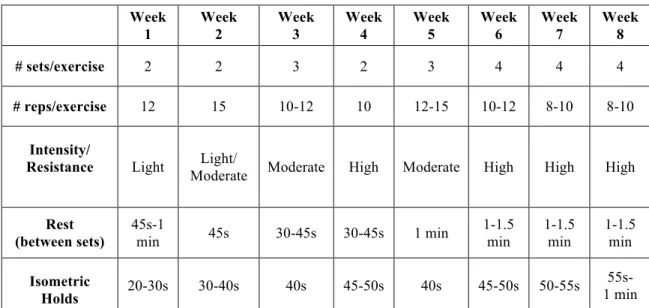
number of hours that they rode their horse as part of their regular riding schedule during the 8-week intervention. The exercise illustrations in the manual will be obtained from the TheraBand Resistance Band and Tubing Instruction Manual (“Exercise Instructions”, 2014). The exercise logs will be collected following the 8-week intervention. Exercises will include an isometric row, trunk curl-ups, trunk twists, back extensions and thigh adduction (all with a resistance band of appropriate intensity) and isometric wall squats with a tennis ball between the knees. The research team will provide the subject with the elastic bands and the tennis ball needed for the exercises. Subjects will have email and phone access to the research team should they have questions or concerns about the exercises during the 8-week intervention. Also, the research team will contact subjects one time per week during the 8-week training via phone and/or email to check if the subjects are having any trouble with the exercise program, to encourage continued effort, and to answer any questions about the training regimen. Subjects will be instructed to complete the exercises 3 times a week for the duration of the study intervention. To allow for proper adaptation to the exercise-training program and to stimulate a training response, the progression of training including volume and intensity following the ACSM guidelines is described in Table 2.0 below.
Table 2.0: Progression of Strength Training Over the 8-week Intervention. Week 1 Week 2 Week 3 Week 4 Week 5 Week 6 Week 7 Week 8
# sets/exercise 2 2 3 2 3 4 4 4
# reps/exercise 12 15 10-12 10 12-15 10-12 8-10 8-10
Intensity/
Resistance Light Moderate Light/ Moderate High Moderate High High High
Rest (between sets)
45s-1
min 45s 30-45s 30-45s 1 min
1-1.5 min 1-1.5 min 1-1.5 min Isometric
Holds 20-30s 30-40s 40s 45-50s 40s 45-50s 50-55s
55s- 1 min
Intensity represents the color of the theraband. Each color represents a different level of resistance; Yellow=Light resistance, Red=Moderate resistance; Green=High resistance.
Before beginning each exercise training session, subjects will be asked to walk, bike or use an elliptical machine if available for approximately 6 minutes as part of an initial warm-up. After the 6 minutes, they will perform overall body stretching (see Appendix 3.13) then begin the exercise intervention training session. Subjects will be advised and encouraged to breathe well through the exercises to prevent a Valsalva maneuver. The specific intervention exercises should be completed as follows:
Trunk Curl-Ups: Subject should attach elastic to a non-moveable object near the floor behind their head, lie on their back with bent knees, grasp the elastic with straight arms and both hands overhead, slowly curl trunk upward bringing the shoulder blades off the floor then return to starting position and repeat.
Back Extensions: Subject should attach elastic to a non-moveable object at shoulder height, be seated and grasp the elastic with both hands at their chest, pull backwards straightening the truck then slowly return to starting position and repeat.
Isometric Seated Row: Subject should attach elastic to non-moveable object, hold elastic in their hands, sit upright keeping bent elbows near their sides and squeeze shoulder blades together while pulling the resistance band and hold the position.
Hip Adduction: Subjects should attach the elastic to a non-moveable object at ankle level at their side, place the foot that is on the same side of elastic in the elastic loop, keep their knee straight, pull the leg inward and hold the position.
Wall Squats: Participants should put their back on a wall, squat down with knees bent at a 90-degree angle, place a tennis ball between the knees and maintain weight in the heels. Elbows or hands should not come in contact with the thighs and squatted position should be maintained.
Following the 8-weeks of strength training intervention and all post-testing, subjects will be asked via questionnaire (see Appendix 3.14) whether or not they enjoyed the prescribed intervention and if they plan to continue the intervention or a similar cross-training strategy in the future as a way to improve their riding performance.
Statistical Analysis and Design
will hopefully serve as reference for calculations of power to in the development of future interventions using similar protocols.
H1: An 8-week, home-based isometric strength-training program will be a feasible cross training exercise intervention for equestrians. Feasibility will be determined by calculating average adherence and compliance of the subjects to the exercise intervention by using data from the participant’s exercise logs. The intervention will be considered feasible if more than 50% of the participants complete at least 75% of the 24 sessions performing at least 2 sets of each exercise and at least half of the prescribed number of repetitions at the prescribed intensity.
H2: An 8-week, home-based isometric strength-training program will improve muscular fitness (strength and endurance) from pre-test to post-test at the end of the 8-week training program. Hypothesis 2 will be analyzed using 2 dependent samples tests. The first dependent sample t-test will compare the results of muscular strength from pre-t-test to post-t-test. A composite score consisting of the addition of the results of the handgrip, hip adduction and isometric row strength tests will be used for the analyses. The second dependent samples t-test will compare the results of the pre-test to post-test muscular endurance tests. A composite score consisting of the addition of the results from the partial curl-up and back extension tests will be used for the analyses.
H4: Changes in muscular fitness (strength and endurance) due to an 8-week, home-based isometric strength-training program will be positively correlated to changes in riding test performance (USEF Training Level Rider Test) in equestrians. Hypothesis 4 will be analyzed using two simple regression models; the first simple regression will be used to evaluate the correlation between muscular strength (Independent variable) and total riding performance score (Dependent variable). Changes (Delta scores = post-test – pre-test of the composite variable created for muscular strength consisting of the addition of the results of the handgrip, hip adduction and isometric row strength tests) and the changes in the results of the scores of the riding test (delta scores = post riding test – pre riding test score, dependent variable) will be used for the correlation analysis. The second simple regression will evaluate the correlation between muscular endurance (Independent variable) and riding performance score (Dependent variable). Changes (delta scores = post-test – pre-test of the composite variable created for muscular endurance consisting of the addition of the results of the partial curl-up and back extension tests) and the changes in the results of the scores of the riding test (delta scores = post riding test – pre riding test score, dependent variable) will be used for the correlation analysis.
CHAPTER FOUR: RESULTS
Overview
The primary purpose of this study was to determine the feasibility of an 8-week, home-based, isometric strength-training program designed specifically to target riding muscles as a cross-training intervention for equestrian athletes. A secondary purpose was to examine if the 8-week home based intervention affected muscular fitness (strength and endurance) and improved riding test performance. A tertiary purpose was to explore the relationship between changes in muscular fitness and changes in the riding test performance from baseline to the completion of the 8-week home based, isometric strength training program. Exploratory analyses were also conducted to investigate the relationship between changes in cardiorespiratory function, body composition, riding test component scores and overall riding performance test scores. All data were entered into an electronic database and analyzed using the statistical software SPSS,
version 19 for Mac. Alpha level was set a priori at 0.05 for all analyses.Descriptive statistics are presented in the form of means and standard deviations.When performing multiple paired samples t-tests, a Bonferroni adjustment was implemented to minimize the likelihood of a Type I error.
Subjects
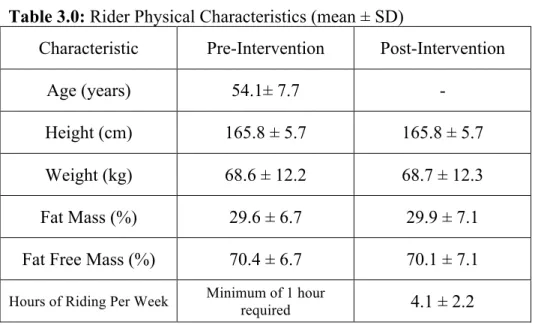
subjects were included in the analyses. Physical characteristics of the subjects and amount of hours of riding per week are presented in Table 3.
Table 3.0: Rider Physical Characteristics (mean ± SD)
Characteristic Pre-Intervention Post-Intervention
Age (years) 54.1± 7.7 -
Height (cm) 165.8 ± 5.7 165.8 ± 5.7
Weight (kg) 68.6 ± 12.2 68.7 ± 12.3
Fat Mass (%) 29.6 ± 6.7 29.9 ± 7.1
Fat Free Mass (%) 70.4 ± 6.7 70.1 ± 7.1
Hours of Riding Per Week Minimum of 1 hour required 4.1 ± 2.2
Table 4.0: Physical Fitness and Riding Test Performance Scores (mean ± SD)
Test Pre-Intervention
(N=18) Post-Intervention (N=18)
Step Test Recovery
Heart Rate (bpm) 97.7 ±18.9 93.4 ± 17.3
*
Isometric Row (ftlb.) 19.2 ± 4.4 27.6 ± 5.1*
Right Hip Adduction
(ftlb.) 35.8 ±10.9 57.6 ± 19.1*
Left Hip Adduction (ftlb.) 36.1 ± 9.1 52.7 ± 16.5*
Hip Adduction Total 71.9 ± 19.1 110.3 ± 33.0*
Right Handgrip (lb.) 31.4 ± 4.9 32.7 ± 4.8*
Left Handgrip (lb.) 30.4 ± 6.0 30.5 ± 5.5
Handgrip Total (lb.) 61.8 ± 10.5 63.2 ± 10.1*
Composite Muscular
Strength∞ 152.8 ±29.5 201.1 ± 43.5
*
Partial Curl Up (reps) 38.1 ± 13.9 45.9 ± 12.5*
Isometric Chest Raise
(sec) 111.7 ± 73.4 163.3 ± 105.5*
Composite Muscular
Endurance∧ 149.8 ± 82.2 209.2 ± 112.3
*
USEF Training Level Rider Test Total Score
(#/100) 57.9 ± 7.4 60.9 ± 5.1
*
Rider Position Component
Score (#/20) 11.2 ± 1.9 11.9 ± 1.4
Effective Use of Aids
Component Score (#/20) 11.4 ± 1.7 11.9 ±1.0
*<.05=significant different from pre-intervention
∞ Composite Muscular Strength: sum of isometric row, total hip adduction and handgrip total scores
∧ Composite Muscular Endurance: sum of partial curl up and isometric chest raise scores
Component Scores are 5 categories each worth 20 points, which collectively contribute to the total riding test score. Rider Position component evaluates the rider’s symmetry and alignment in the saddle. Effective Use of Aids component evaluates performance as a result of proper communication between horse and rider.
Hypotheses
subject’s average adherence and compliance with the exercise intervention by using data from the participant’s exercise logs. The intervention was considered feasible as more than half of the participants (11 out of 18 of the subjects) completed 75% of the 24 sessions performing at least 2 sets of each exercise and at least half of the prescribed number of repetitions at the prescribed intensity.
Hypothesis 2, an 8-week, home-based isometric strength-training program will improve muscular fitness (strength and endurance) from pre-test to post-test at the end of the 8-week training program was analyzed using dependent samples t-tests. Composite scores consisting of the addition of the results of the handgrip, hip adduction and isometric row strength tests
assessed pre and post the exercise intervention were used for the analyses of muscular strength. Significant improvements in muscular strength from pre to post intervention (p<.005) were observed. Composite scores consisting of the addition of the results from the partial curl-up and back extension tests assessed pre and post the exercise intervention were used for the analyses. Significant improvements in muscular endurance from pre to post intervention were observed (p=.001).
Hypothesis 3, an 8-week, home-based isometric strength-training program will improve total riding test (USEF Training Level Rider Test) performance in equestrians, was analyzed using a dependent samples t-test using pre and post total scores from the USEF Training Level Rider Test. Significant improvements were observed from pre to post intervention in the Rider Test total scores (p = .037).
simple regression models. The first simple regression evaluated the correlation between muscular strength (independent variable) and total riding test performance score (dependent variable). Changes in muscular strength (delta scores= post-test – pre-test of the composite variable created for muscular strength consisting of the addition of the handgrip, hip adduction and isometric row strength test values) and the changes in the results of the total scores of the riding test (delta scores = post total riding test performance score – pre total riding test performance score, dependent variable) were used for the correlation analysis. No significant correlations were found between changes in muscular strength and changes in total riding test performance score (r2=.104,p=.096). The second simple regression evaluated the correlation between muscular endurance (independent variable) and total riding test performance score (dependent variable). Changes (delta scores = post-test – pre-test of the composite variable created for muscular
endurance consisting of the addition of the partial curl-up and back extension test values) and the changes in the results of the total riding test performance scores (delta scores = post total riding test performance score – pre total riding test performance score) were used for the correlation analysis. A significant correlation was found between changes in muscular endurance and changes in total riding test score (r2=.285, p=.011),with muscular endurance accounting for almost 30% of changes in total riding test performance scores.
Exploratory Analyses
changes in the Rider’s Effective Use of Aids score (r2=.244, p=.019) with muscular endurance accounting for 24% of the changes in the Rider’s Effective Use of Aids score. Conversely, there was no correlation found between changes in muscular endurance and changes in Rider’s
Position score (r2=.071, p=.285). The influence of changes in muscular strength composite score on changes in the USEF Training Level Rider Test component scores was also evaluated. No significant correlations were found between changes in muscular strength and changes in the Rider’s Effective Use of Aids score (r2=.054, p=.351). The relationship between changes in muscular strength and changes in Rider’s Position score, however, did approach significance (r2=.171, p=.08) with changes in muscular strength likely accounting for %17 of changes in Rider’s Position score.
The relationship between changes in riding test component scores (which collectively produce the total USEF Training Level Rider Test score) and changes in total riding test scores from pre to post intervention were evaluated to determine the potential influence of each component on the overall test score. The components analyzed were Rider Position score and Rider’s Effective Use of Aids score. A significant correlation was observed between changes in Rider Position score and changes in total riding test scores (r2=.772, p<.005) with changes in Rider Position score accounting for 77% of changes in the total riding test performance score. Additionally, a significant correlation was observed between changes in Rider’s Effective Use of Aids score and changes in total riding test performance score (r2=.636, p<.005), with Effective Use of Aids score accounting for 63% of changes in the overall riding test score.
of riding per week and changes in total riding test performance scores, was performed using each subject’s average hours of riding per week (dependent variable) as reported in their exercise logs and delta scores calculated from the results of the USEF Training Level Rider Test total score (independent variable). No significant correlation was found between average hours of riding per week and changes in total riding test performance scores (r2=.003; p=.418).
CHAPTER FIVE: DISCUSSION AND CONCLUSION
Overview
The purpose of this study was to determine if an 8-week, home-based, isometric strength-training program designed specifically to target riding muscles would be a feasible cross-strength-training intervention for amateur equestrian athletes. Further investigations examined the effect of the intervention on muscular fitness (strength and endurance) and riding test performance as well as the relationship between changes in different components of fitness (i.e. cardiorespiratory function, muscular fitness, and body composition) and changes in the riding test performance from baseline to the completion of the intervention. Deeming that the exercise intervention used in this current study was feasible and promoted positive changes in different component of fitness of the riders, another goal of current study was to provide insight to the specific physical fitness characteristics of riders that may influence riding performance, which other studies had yet to determine (Alfredson et al., 1998; Meyers et al., 2000; Meyers 2006; Terada et al., 2004; Westerling 1983).
specifically created to improve in-the-saddle performances been designed and implemented, until the current study.
It is important to note that the current study was only powered for feasibility and muscular fitness changes. The study was not powered for correlation calculations and all correlation implications should be considered strictly exploratory. A future study of increased sample size and with a control group is necessary to confirm or refute the results of the analyses implemented in the current study.
Feasibility
Due to the conclusions from the few studies existing that examined some aspects of rider fitness (Alfredson et al., 1998; Meyers et al., 2000; Meyers 2006; Terada et al., 2004; Westerling 1983) but had not examined the effects of exercise training on riders performance, it was
imperative to first determine the feasibility of an exercise program. Determining whether or not a group of equestrians would complete a cross training intervention at all is important for the design of future programs. It is well understood that the sport of riding is a time consuming endeavor, thus a home-based program using only resistance bands and body weight was designed to maximize the opportunity for ease and versatility.
themselves as the intervention progressed. Two subjects independently reported, on behalf of their trainers, that the trainers stated to have observed significant in-saddle improvements while the rider was participating in the study. Subjects seemed to most appreciate the versatility of the bands as it allowed them to complete the exercises almost anywhere and the time commitment per session was reasonable for their schedules. One participant traveled overseas and was still able to complete the exercises because the bands packed well into luggage. Conversely, many of the riders agreed they least liked the wall squat exercise, as it was the most challenging. Some riders felt there was a discrepancy in the difficulty between the different exercises but supported that each exercise was specific to riding. Subjective responses are of utmost importance when analyzing an intervention due to the practical understanding that a program that is generally enjoyed likely improves the chances of subject adherence.
Muscular Fitness
The strength training intervention using resistance bands in this study produced significant changes in the rider’s muscular strength and muscular endurance. These
improvements in muscular fitness align with the results found in a previous study examining the effect of strength training using Therabands in 20 women aged 50 years and older completing an intervention of very similar design (Delshad et al., 2013). In the current study, the fitness testing and strength training intervention was specifically designed to target the muscles previously determined to be pertinent to posture maintenance for riding: the adductor magnus, erector spinae and the rectus abdominis (Terada 2000). Previous research has used inconsistent
regarding a population, and the demands to study equestrians are no exception. The current study therefore used a variety of tests previously implemented by researchers to evaluate the subjects in the current study, specifically the partial curl up, handgrip and back extension tests (Meyers et al., 2000; Meyers, 2006). Likely similar to the apparatus described in previous studies, the current study also implemented the use of an isokinetic dynamometer to assess hip adduction and upper body strength (Westerling 1983; Alfredson et al., 1998). Every muscular fitness test used to assess changes from pre to post intervention targeted riding specific muscles.
The strength training intervention exercises were explicitly designed to progressively train the riding specific muscles in order to maximize adaptation in congruence with standard principles of training. The training intervention was isometric in nature to reflect the isometric demands of muscles experienced while riding. Equestrians rely on isometric muscular
fatigue-inducing bi-products such as hydrogen ions and a concurrent decrease in pH in the active muscle will eventually lead to failure to maintain contraction. With proper training, the muscles become more reliant upon oxidative energy sources (Kiens et al., 1992). Thus, training allows a shift to oxidative substrate usage, a delay in the onset of metabolite accumulation associated with fatigue, and an overall increased efficiency, which improves muscular endurance.
The use of the resistance bands provided a simple yet appropriate and effective
intervention strategy for the particular population, especially with respect to time as the home-based design did not require travel to/from a gym facility. The bands also did not require significant space, were easy to move, store, and were quiet to use. Although only 3 intensities were used for this intervention, a variety of progressing intensity bands are available so riders have the ability to advance. Weeks 1-3 of the training protocol gradually increased in volume and intensity, followed by a slight decrease during week 4 to allow for recovery, and finished with further increases in volume and intensity from weeks 5-8.
Riding Test
Unlike the findings of a previous study on the effects of in-saddle only training on
muscular strength, the current study found improved muscular strength performances from pre to post intervention (Meyers 2006). However, exploratory analyses revealed there was no
significant correlation between changes in muscular strength and changes in total riding test performance score or Rider’s Effective Use of Aids score. Correlations between changes in muscular strength and changes in Rider Position scores approached significance. Although it is obvious that some amount of strength is required to ride and work with horses, the ability to generate a high force contraction to be used as an aid while riding would likely be short-lived and not particularly beneficial. Communication with the horse while riding relies on continuous, maintained aids (popularly referred to as a “connection”) from substantial but not overly
position is established and sufficient to perform at the level required by the Training Level Rider Test. Therefore, positional changes may not be drastically impacted by changes in muscular endurance. Previous studies support this notion that as experience level increases, instability in-saddle appears to decrease and approximation of the ideal riding position becomes more obvious (Terada 2000; Peham et al. 2001; Schils et al. 1993). Additionally, it has been found that
differences in the kinematic variables governing position are smaller when the rider is more experienced (Schils et al 1993).
Aids however, unlike position, are used to request the horse’s movement and are
generally only as effective as long as the aid can be given correctly and maintained. As dressage riding level progresses, the level of difficulty of movements required increase as well. At higher performance levels, movements are executed for longer periods of time with more step,
direction, and gait changes. More effective aids, therefore, should result in better production of the intended movement and thus, ideally, an improvement in overall performance. Thus, there is a rational connection between improvements in muscular endurance, and effectiveness of aids in relation to overall performance. Especially in a well-trained mount, a horse should respond to an aid as long as the aid is given. If the strength of the aid cannot be maintained and the aid
diminishes, the horse’s reaction is likely to diminish as well, negatively impacting performance. Based on the results of the current study, when considering the riders as moderately trained, it appears that improvements in muscular endurance may impact the riders use of their bodies more than the position of the body itself with regards to overall performance. Interestingly, the
overall performance, and Rider’s Use of Aids score accounting for approximately 63% of changes in overall performance, the notion that position and aids are related is likely. As before, this potential association is sensible to a seasoned rider as the proper position of the body is important for requesting the proper aid. As an elementary example, a young child learning to ride may cause a horse to unexpectedly speed up instead of halt because they are leaning forward rather than pulling on the reins and staying upright. Again, the current study was not powered to complete correlations and the notions presented here are purely speculative.
Muscular endurance sensibly relates to a rider’s ability to engage with the horse, but it may also have implications for safety. Muscular fatigue has been directly linked with the
increased likelihood of sustaining injury (Rohmert 1973). The potential for injury due to fatigue, when considering a rider atop a horse, is particularly concerning. Therefore, improvements in muscular endurance may be warranted not only to potentially improve attentive riding
performance but to also prevent potential fatigue-induced injuries.
One of the greatest challenges when studying the horse/rider pair is controlling the horse as a variable. In the current study, in order to help identify potentially detrimental horse
temperament during testing, the riders and judge scored the horses on a 1-3 temperament scale after each ride for both pre and post testing. On average for both test sessions, the riders and judge agreed the horses performed “normally”. The performance improvements in the riding tests were appropriate based on the characteristics of the intervention, and reasonable for the time of in-saddle training that could take place from beginning to end of the study. Based on the average score for the first dressage test ( = 57.9) and the ability to complete all of the
complete the riding test, which included movements at a walk, trot and canter, directional changes and geometrical patterns. The score for the post-test improved by 3 points ( =60.9). Without a control group, it is difficult to conclude whether or not the improvements were purely due to the training intervention. However, subjects were asked to maintain all other in and out-of-saddle training habits during the eight weeks so the only significant difference in training from pre to post testing should be the strength training intervention. With a post-score of 60.9, riders crossed the threshold score of 60, which has been loosely regarded as a score that
represents when the horse/rider pair are ready to advance to the next level (http://www.equine-‐
world.co.uk/horse_sports/dressage_scoring.asp). In relation to the current study, a simple
8-week strength training intervention may provide the stimulus necessary to transition riders to the next competitive level.
Exploratory Analyses
with tennis ball between the knees, may have elicited enough training stimulus to produce significant improvements in quadriceps strength. The wall squat, although a great exercise for quad strength, included squeezing a tennis ball between the knees and was thus originally
implemented to target the adductors, core and back muscles. Additionally, the core strengthening exercises may have contributed to better upper body control and therefore balance. The study population was essentially untrained outside of riding conditioning and therefore the wall squat may have been a strong enough stimulus to improve not only muscular strength and endurance but cardiorespiratory fitness as well. With improved quad strength and balance from pre to post testing, the step test may not have been as challenging of a task, potentially allowing the riders to more efficiently perform the test. This may have resulted in the decreased recovery heart rate values seen in post testing. Interestingly, most subjects reported to dislike the wall squat exercise, frequently referring to it as the most challenging of the 6 exercises. Regardless, safe improvements in cardiorespiratory fitness, especially in a population of this age should be welcomed and encouraged. Further research is needed to confirm what stimulus may have produced the improvement in cardiorespiratory fitness in the current study.
physical conditioning in relation to other groups of athletes. This should be an important factor to consider and target for improvement when training future populations of equestrians. Previous research has concluded that in-saddle only training also failed to improve body composition, therefore, greater physical activity and diet alterations are likely necessary to produce significant body composition changes in this population (Meyers 2006).
Conclusion
Future Research
As this study is the first of it’s kind, there are many opportunities for future research. Primarily, a larger sample size with a control group would be the next step to confirm the findings of the current study. A longitudinal study of performances of riders who do and don’t cross train would help provide a long-term perspective of equestrian training habits and their impact on performance. Additionally, a cross-training intervention with the intention of
improving body composition through modified dietary choices and improved physical activity is warranted. This study, in conjunction with prior studies, has demonstrated that equestrians exhibit relatively high, and potentially dangerous, proportions of body fat. Improving body composition of equestrians could not only benefit riding performance but overall health as well.
Although a very complex task, multiple disciplines other than dressage should be studied to better characterize and address the demands of a particular riding style. Riders represent a large age range and encompass multiple skill levels and experience. Thus, riders should also be studied in groups in relation to years of riding experience and biological age. Evaluating highly accomplished riders and beginners would help develop the spectrum of the sport and allow for characterization of intermediate riders in a more logical and progressive manner.