FUNQUAL: USER-DEFINED, STATICALLY-CHECKED CALL GRAPH CONSTRAINTS IN C++
A Thesis presented to
the Faculty of California Polytechnic State University, San Luis Obispo
In Partial Fulfillment
of the Requirements for the Degree Master of Science in Computer Science
by Andrew Nelson
c
COMMITTEE MEMBERSHIP
TITLE: Funqual: User-Defined, Statically-Checked Call Graph Constraints in C++
AUTHOR: Andrew Nelson
DATE SUBMITTED: June 2018
COMMITTEE CHAIR: Aaron Keen, Ph.D.
Professor of Computer Science
COMMITTEE MEMBER: John Clements, Ph.D.
Professor of Computer Science
COMMITTEE MEMBER: Phillip Nico, Ph.D.
ABSTRACT
Funqual: User-Defined, Statically-Checked Call Graph Constraints in C++ Andrew Nelson
ACKNOWLEDGMENTS
Thanks to:
TABLE OF CONTENTS
Page
LIST OF TABLES . . . viii
LIST OF FIGURES . . . ix
LIST OF LISTINGS . . . x
CHAPTER 1 Introduction . . . 1
2 Background . . . 5
2.1 Classic Type Qualifiers . . . 5
2.2 Turning Program Source into a Call Graph . . . 6
3 Related work . . . 10
3.1 On the Effectiveness of Static Analysis . . . 10
3.2 Aftermarket Type Systems — Supplementing an Existing Language . 11 3.3 libClang and the Explosion of C++ Tooling . . . 13
4 Type Rules . . . 15
4.1 Overview . . . 15
4.2 Function Pointers and Indirect Type . . . 19
4.2.1 Rules of Assignment . . . 24
4.3 Call Graph Rules . . . 25
4.3.1 Restrict Direct Call . . . 26
4.3.2 Restrict Indirect Call . . . 27
4.3.3 Require Direct Call . . . 29
4.3.4 Indirect Type Inference . . . 30
4.4 Special Considerations when Creating a Call Graph . . . 33
4.4.1 Dealing with Inheritance . . . 33
4.4.2 Overriding Methods with Annotations . . . 35
4.4.3 Operator Overloading . . . 37
4.4.4 Bridging the Divide between Translation Units . . . 37
5 Implementation . . . 38
5.1.1 Function Qualifier Annotations with QTAG and QTAG IND . 38
5.1.2 Constrain the World! Writing a Rules File . . . 40
5.1.3 Running Funqual . . . 41
5.1.4 Example Output . . . 42
5.2 Practical Limitations . . . 42
6 Application . . . 45
6.1 Glibc Nonreentrant Functions . . . 45
6.2 Restricting API available during kernel initialization . . . 48
6.3 Detecting slow function calls in high frequency contexts . . . 54
7 Future Work . . . 60
8 Conclusion . . . 62
LIST OF TABLES
Table Page
LIST OF FIGURES
Figure Page
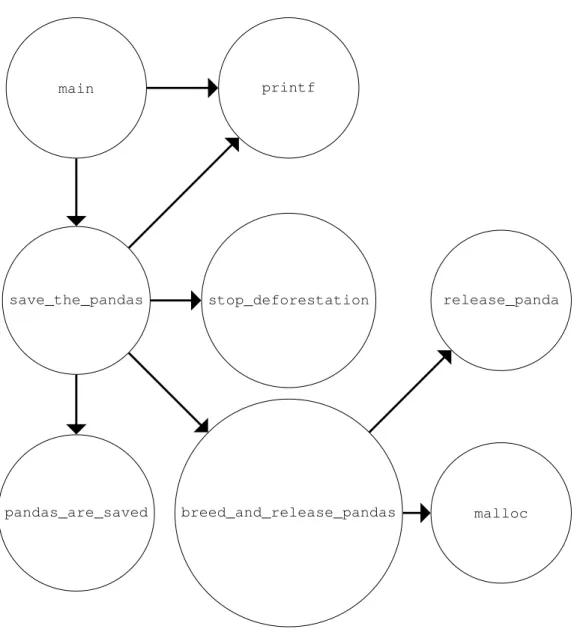
2.1 Example Call Graph. The source code associated with this call graph is shown in Listing 2.1 . . . 8 4.1 Color-coded Call Graph for Listing 2.1. Functions tagged
static_memory are highlighted green and functions tagged dynamic_memoryare highlighted red. . . 18 4.2 Color-coded Call Graph for Listing 4.3. Functions tagged
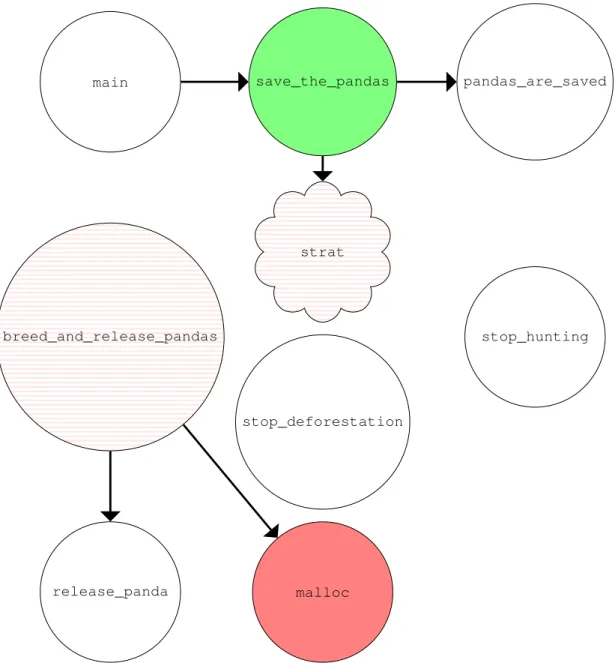
static_memory are highlighted green and functions tagged dynamic_memoryare highlighted red. Indirect types are represented as horizontal line patterns on a node. Clouds represent function pointers. . . 23 4.3 Call graph for Listing 4.8. BecausePanda::Feedis a virtual function,
LIST OF LISTINGS
Listing Page
1.1 Example piece of C code containing an error . . . 2 2.1 Example C program. The call graph for this program is shown in
Figure 2.1 . . . 7 4.1 Example C program. Running this code in a production environment
may not actually save the pandas . . . 16 4.2 In this example C program, it is impossible to know statically what the
value ofstratis. Because of this, funqual requires the programmer to annotate function pointers with additional type information. . . 20 4.3 Same example program as Listing 4.2 but with function pointer type
annotations inserted . . . 22 4.4 Pseudocode for an algorithm that can check arestrict direct call
con-straint. This algorithm returns true if the call graph respects the constraint andfalse if the call graph violates it. . . 26 4.5 Pseudocode for an algorithm that can check a restrict indirect call
constraint. This algorithm returns true if the call graph respects the constraint andfalse if the call graph violates it. . . 28 4.6 Pseudocode for an algorithm that can check arequire direct call
4.8 Example C++ program demonstrating inheritance. In feedPanda, it is impossible to know statically which instance of the Feed function will be called. Figure 4.3 shows the call graph for this program. . . . 34 4.9 Example C++ containing an error. Panda::Feedand RedPanda::Feed
have different types and so the override is invalid. . . 36 4.10 Example C++ containing a funqual type error. Panda::Feed and
RedPanda::Feedhave different types and so the override is invalid. . . 36 5.1 Examples of function pointer assignment expressions that are not checked
correctly by funqual . . . 43 6.1 Rules file for preventing preemptive functions from calling non reentrant
functions. Since this rules file contains no references to project-specific functions, the file could conceivably be re-used by several projects. . . 47 6.2 Lines inserted into C file to mark signal handlers as preemptive. . . . 47 6.3 Output from funqual when run on a project that had manually-inserted
call graph violations . . . 48 6.4 Rules file for a simple kernel written for CSC454. The rules written
here are intended to prevent code which runs before a subsystem is initialized from calling any function that depend on the subsystem. . 50 6.5 Lines inserted into C source for a simple kernel in order to prevent
subsystems from depending on interfaces not yet initialized. . . 51 6.6 Output from funqual when run on simple OS kernel . . . 53 6.7 Rules file for preventing high frequency functions from calling slow
6.8 Lines inserted into C++ source file to mark certain functions ashi_freq. 57 6.9 Output of running funqual on robotics library. This is not the entire
Chapter 1 INTRODUCTION
Writing bug-free software is challenging if not impossible. In the past 30 years, millions of dollars have been invested in tools that help developers write code that is robust, readable, and correct [18]. In general these tools fall into two categories: dynamic analysis tools such as gdb, valgrind, and IDA which analyze programs as they are running; and static analysis tools such as lint, cppcheck, and gcc -Wall which analyze programs before they are run. All these tools have different use cases and can be used together to minimize the presence of errors in code.
While these tools are extremely helpful in finding bugs in code, they are by no means complete. Every tool uses a finite set of techniques to detect a specific class of issues. Some tools examine the types of values and expressions to enforce type safety[18], some tools examine ownership of objects to enforce memory safety[11], some tools examine the flow of values through a program to ensure security[8], and many other tools do other things entirely.
1 #include <stdio.h> 2 #include <signal.h> 3 #include <unistd.h> 4
5 void sig_handler(int signo) {
6 printf("Received signal %d\n", signo);
7 }
8
9 int main(void) {
10 if (signal(SIGINT, sig_handler) == SIG_ERR) { 11 printf("Could not register signal handler\n");
12 return 1;
13 }
14
15 printf("Signal handler registered...\n");
16 while (1) {
17 printf("Waiting for signals...\n");
18 sleep(1);
19 }
20 }
Listing 1.1: Example piece of C code containing an error
Most well-seasoned C and C++ programmers would be at a loss to find the error — and the error certainly is obscure. A quotation from the glibc library reference may be helpful here:
If a function uses a static variable or a global variable, or a dynamically-allocated object that it finds for itself, then it is non-reentrant and any two calls to the function can interfere [10].
executing and transfers execution to sig_handler. Sig_handler proceeds to call printf which may or may not already be executing in the main context. This is problematic because printf grabs a global lock around stdout and in the case of concurrent calls results in deadlock. Not good.
The glibc library reference goes on to explicitly mention several common functions as being nonreentrant. A few of them are malloc, free, fprintf, printf, and any function that modifies the global errno, although any function which uses static, global, or dynamically-allocated state will fall into this category.
A stop-gap measure that could be implemented to solve this issue is to make a rule: No interrupt handlers are allowed to call nonreentrant functions, and to ask your peers to inspect all code by hand to enforce this requirement. This is tedious, error-prone, and can be extremely difficult for code at scale. Let’s say, for instance, that sig_handler calledfoo, and foocalled bar, and bar called printf. Is it reasonable to expect a human to detect this error in judgment that occurred through 4 layers of indirection? Probably not.
Chapter 2 BACKGROUND
This Chapter aims to provide context for funqual as well as to provide an intuition for why funqual works the way that it does. Section 2.1 presents a brief review of type systems that should be familiar to most programmers; special care is taken to define systems of type qualifiers. Section 2.2 develops the concept of a call graph and sets the stage for the two concepts to be combined later in the paper.
2.1. Classic Type Qualifiers
Some compilers also have their own compiler-specific type qualifiers. In Microsoft Visual C++, function parameters that are modified by the caller and referenced by the callee can be annotated with the [Runtime::InteropServices::Out] qualifier to tell the programmer and the compiler that this is an out parameter. Having a programming environment rich in these type qualifiers can help make the intent of source code easier for the programmer to infer and make it possible for those intents to be statically checked by the compiler.
In the majority of these systems, defining additional type qualifiers is either rel-egated to the language designers or to the compiler maintainers. There is not much tooling or support for the average programmer to create their own type qualifiers and there does not seem to be any sort of emphasis on creating project-specific qualifiers to help maintain program semantics.
2.2. Turning Program Source into a Call Graph
The focus of this paper is on creating and analyzing type qualifiers for functions that constrain where those functions can and cannot be called. The central notion behind this sort of type checking is that every program has a call graph and that there are certain patterns in the call graph which must be prevented.
1 int breed_and_release_pandas() {
2 Panda *baby_panda = malloc(sizeof(Panda)); 3 release_panda(baby_panda);
4 }
5
6 int save_the_pandas() { 7 stop_deforestation());
8 if (pandas_are_saved()) {
9 printf("Stopping deforestation saved the pandas!\n");
10 return 1; 11 }
12
13 breed_and_release_pandas();
14 if (pandas_are_saved()) {
15 printf("Breeding pandas in captivation and releasing them has
saved the pandas!\n");
16 return 1; 17 }
18 return 0; 19 }
20
21 int main(void) {
22 if (save_the_pandas()) {
23 printf("The pandas have been saved!\n");
24 }
25 }
Listing 2.1: Example C program. The call graph for this program is shown in Figure 2.1
main
save_the_pandas stop_deforestation
breed_and_release_pandas printf
pandas_are_saved
release_panda
malloc
Chapter 3 RELATED WORK
Static program analysis is a hot topic in Computer Science research. The Association for Computing Machinery (ACM) publishes several journals, such as Proceedings of the ACM on Programming Languages (PACMPL), Transactions on Programming Languages and Systems (TOPLAS), and Transactions On Software Engineering and Methodology (TOSEM), which are focused (at least in part) on static verification and type systems. It should come as no surprise that there is a large body of research that is related to this thesis. This Chapter references a tiny fraction of this body of work. Section 3.1 calls upon past research to assert unquestionably the positive impact that static analysis has on the software development process. Section 3.2 explores a line of research dedicated to inserting supplemental specifications into existing programming languages in order to improve the static checkability of those languages. Lastly, Section 3.3 pays respect to the LLVM project which has enabled so much of the research for this thesis.
3.1. On the Effectiveness of Static Analysis
Studies have long shown that static analysis is an essential tool for developing high-quality software. The high speed and low cost of this type of verification make it an economical method for finding faults in program code [18, 12].
specifically crafted for Mozilla’s mostly C++ codebase. Using these tools, every Pull Request into Mozilla Firefox is parsed and checked against a set of hand-written rules to detect and report common issues [6, 1]. Much of this tooling was dedicated to detecting memory issues. Of course, without modifying the grammar of C++, there are limitations in what can be easily checked statically by these tools. Only a small subset of the problem could be effectively detected.
More recently, Mozilla developed and began using a language called Rust which was designed with certain static analysis characteristics in mind. The Rust language implements an innovative type system meant to formally track the ownership of ob-jects in memory. “Rust’s type system and runtime guarantee the absence of data races, buffer overflows, stack overflows, and access to uninitialized or deallocated memory” [11]. A common sentiment in the Rust-language community is that even though the “Borrow Checker” (the part of the type system that enforces memory safety) seems complicated at first, seasoned Rust users learn to depend on it to help them reason through complicated programs [17]. Rust demonstrates that making a type system more expressive and more restrictive can improve both the static check-ability of a programming language and also the help the users of those languages.
3.2. Aftermarket Type Systems — Supplementing an Existing Language
A useful attribute of these supplemental static analysis tools is that they scale incrementally — the programmer can use these tools to whatever extent they find helpful and can increase or reduce the amount of information they pass on to these tools as they see fit. Since these specifications are opt-in, adding new forms of spec-ification to a tool like LCLint is a straightforward way to expand the scope of the tool without breaking backwards compatibility. As an example, in 1996, Evans et al. added a few variable type annotations to LCLint such as not-null, possibly-null, and null. When used by the programmer, these annotations allow LCLint to check for certain kinds of errors relating to nullness and memory allocation [3]. Such modi-fications require zero action by the users that choose not to use them; if a variable is not annotated then LCLint will not try to check that variable. However, as the user adds more annotations, LCLint is able to check more variables. The amount of feed-back LCLint is able to provide scales up and down with the amount of annotations in the code.
In general, variable annotations likenot-nullandpossibly-nullare very similar in use to the existing system of type qualifiers in the C family of languages. A canonical example of a type qualifier would be the C const qualifier; a variable marked const may be set once at declaration but never updated again (ignoring unsafe casts). Type qualifiers and annotations like const and not-null have two benefits: First, they declare the intent behind the code so that other programmers reading the code have a better idea of how it works. Second, they dictate what the programmer can and cannot do with an identifier so that the compiler or other static checking tool can detect accidental misuse. However, their use is entirely optional — the programmer can choose to treat an identifier as const or not-null without actually adding the annotation [5].
One of the most relevant observations to the work in this paper is that every type qualifier introduces a form of subtyping. For all types T and any qualifier q, either
T ≤ qT or qT ≤ T depending on q1. Here we notate T qualified byq as qT and we notateX is a subtype ofY asX ≤Y. X ≤Y should be interpreted to mean thatX
can be safely used whenever Y is expected. For example int ≤ const int because in any statement containing a const int, one could safely substitute anint however the reverse is not true. In the same vein, not-null char* ≤ char* because any statement referencing achar*could safely be given anot-null char*instead [5]. In this paper we will apply this concept to the type qualifiers introduced by funqual in order to argue for the correctness of funqual.
3.3. libClang and the Explosion of C++ Tooling
C++ is difficult to parse [9, 15, 13, 14]. Years of language additions, the need for backwards compatibility, and the existence of a text-based preprocessor2 means that the language grammar is large and complicated. As a result, even the simplest static analysis tools require a huge amount of complexity to do basic parsing of source code. Up until relatively recently, many C++ language tools settled on doing a partial parse of the language using approximations and heuristics [15]. This method can lead to artificial constraints on the language or to incorrect interpretations of the source.
As a result of the LLVM Compiler Infrastructure Project, we now have an excel-lent set of tools for working with code. The Clang compiler is a fully featured compiler from the LLVM project that supports a wealth of C-family language standards includ-ing C++17. The LLVM project also provides libClang which exposes a convenient
1This notation is equivalent to the subset notation (i.e., T ⊆ qT or qT ⊆ T). We choose to
use the less than operator because it matches the notation used by Foster in “A Theory of Type Qualifiers”.
2In theory, preprocessing could be delegated to another tool like gcc. In practice this generally
Chapter 4 TYPE RULES
Funqual checks a program against a type system. It is a tool that takes in source code as well some user-defined call graph rules, does some computation, and prints one of two things: “This program is well-typed”, or “This program is not well typed” (in practice the later case also comes with an explanation as to why the program is not well-typed). If a program is well-typed, then it is free from call graph rule violations. If a program is not well-typed, then it may contain one or more errors.
This chapter contains an overview of the rules implemented by funqual as well as a brief exploration of what needs to happen behind the scenes in order to correctly check these rules. Section 4.1 demonstrates the big picture of what these rules are trying to accomplish. Section 4.2 explains how type qualifiers are applied to function pointers and how funqual checks them. Section 4.3 is a detailed explanation of each of the call graph constraints supported by funqual. Finally, Section 4.4 explains a few special cases and explains how funqual handles them to create a complete call graph. Note that this chapter focuses only on the conceptual design of funqual and its type system. For details on how it is implemented or how to use it, refer to Chapter 5.
4.1. Overview
1 int breed_and_release_pandas() {
2 Panda *baby_panda = malloc(sizeof(Panda)); 3 release_panda(baby_panda);
4 }
5
6 int save_the_pandas() { 7 stop_deforestation());
8 if (pandas_are_saved()) {
9 printf("Stopping deforestation saved the pandas!\n");
10 return 1; 11 }
12
13 breed_and_release_pandas();
14 if (pandas_are_saved()) {
15 printf("Breeding pandas in captivation and releasing them has saved
the pandas!\n");
16 return 1; 17 }
18 return 0; 19 }
20
21 int main(void) {
22 if (save_the_pandas()) {
23 printf("The pandas have been saved!\n");
24 }
25 }
Listing 4.1: Example C program. Running this code in a production
environment may not actually save the pandas
self-regulation like this often ends poorly. As a result we would like a tool like funqual to enforce this constraint automatically.
Funqual allows us as programmers to create our own type qualifiers and to apply whatever meaning we want to those qualifiers. In this particu-lar case we create two type qualifiers: static_memory and dynamic_memory. We also create one rule: restrict indirect call(static memory, dynamic memory). When the programmer qualifies a function with static_memory, that de-clares the intent that this function will never allocate memory on the heap. When the programmer qualifies a function with dynamic_memory, that de-clares the intent that this function always allocates memory on the heap1. The rule restrict indirect call(static memory, dynamic memory) tells funqual that static_memory functions are not allowed to call dynamic_memory functions either directly or indirectly. If it is possible for a static_memory function to reach a dynamic_memory function, then the rule has been violated and funqual should in-form the user.
In the example about saving the pandas, we would qualify save_the_pandas as static_memory and we would qualify malloc as dynamic_memory. Figure 4.1 shows the call graph for Listing 4.1 with static_memory functions marked green and with dynamic_memoryfunctions marked red.
By turning the program into a directed graph and by assigning types to the vertices, we have transformed the problem of type qualifier rule satisfaction into a graph problem. A question like are there any static memory functions that inadver-tently call dynamic memory functions essentially boils down to are there any paths from green vertices to red vertices. In this example, the answer to that question is yes. In the code, save_the_pandas calls breed_and_release_pandas which calls
1The meanings of these type qualifiers are as determined by the programmer; without a rule to
main
save the pandas stop def orestation
breed and release pandas printf
pandas are saved
release panda
malloc
Figure 4.1: Color-coded Call Graph for Listing 2.1. Functions tagged
static_memory are highlighted green and functions tagged dynamic_memory
malloc constituting an illicit call. Equivalently, save_the_pandas has an edge to breed_and_release_pandaswhich has an edge tomallocconstituting an illicit path. A well-typed program has no paths from green vertices to red vertices. A poorly-typed program will have at least one path.
4.2. Function Pointers and Indirect Type
Traversing a program for function calls and adding them to the call graph is relatively straightforward. Knowing exactly what function is being called at the time of parsing makes this process trivial. This does not account for all function calls, however. There are multiple cases in modern C++ where a function call is either happening behind the scenes or where the exact callee is not knowable. This section examines function pointers and explains how they are represented in the call graph.
1 int breed_and_release_pandas() {
2 Panda *baby_panda = malloc(sizeof(Panda)); 3 return release_panda(baby_panda);
4 }
5
6 int (*)() get_random_strategy() { 7 switch (rand() % 3) {
8 case 0:
9 return breed_and_release_pandas;
10 break;
11 case 1:
12 return stop_deforestation;
13 break;
14 case 2:
15 return stop_hunting;
16 break;
17 }
18 }
19
20 int save_the_pandas() {
21 while (!pandas_are_saved()) {
22 int (*strat)() = get_random_strategy()
23 strat();
24 }
25 return 0; 26 }
27
28 int main(void) {
29 return save_the_pandas(); 30 }
Listing 4.2: In this example C program, it is impossible to know
statically what the value of strat is. Because of this, funqual requires
If we still intend to use funqual to enforce this restrict indirect call(
static memory, dynamic memory) rule then we are going to need some additional tools. Since keeping track of all the possible values of strat is impractical, we will instead keep track of the type of strat with respect to this call graph. Re-call that the type ofsave_the_pandas isstatic_memoryand that the type ofmalloc is dynamic_memory. If we had a function pointer pointing to malloc, then the type of that function pointer would have to also be dynamic_memory. In this example we have a function pointer pointing to breed_and_release_pandas. We will say that breed_and_release_pandas has indirect type dynamic_memory because it calls mal-loc and so any function pointer that points tobreed_and_release_pandasmust have indirect type dynamic_memory.
For this reason, when we use function pointers we will have two kinds of type qualifiers: direct type qualifiers and indirect type qualifiers. Direct type refers to the funqual type qualifiers we have explicitly assigned to the pointee. Indirect type refers to the funqual type qualifiers of all the functions reachable from the pointee. Direct type for both functions and function pointers must be explicitly annotated in the code. Indirect types for function pointers must be annotated explicitly but indirect types for functions can be inferred.
1 int breed_and_release_pandas() {
2 Panda *baby_panda = malloc(sizeof(Panda)); 3 return release_panda(baby_panda);
4 }
5
6 int indirect_dynamic_memory (*)() get_random_strategy() { 7 switch (rand() % 3) {
8 case 0:
9 return breed_and_release_pandas;
10 break;
11 case 1:
12 return stop_deforestation;
13 break;
14 case 2:
15 return stop_hunting;
16 break;
17 }
18 }
19
20 int save_the_pandas() static_memory { 21 while (!pandas_are_saved()) {
22 int indirect_dynamic_memory (*strat)() = 23 get_random_strategy()
24 strat();
25 }
26 return 0; 27 }
28
29 int main(void) {
30 return save_the_pandas(); 31 }
main save_the_pandas pandas_are_saved
strat
stop_deforestation
stop_hunting breed_and_release_pandas
release_panda malloc
Figure 4.2: Color-coded Call Graph for Listing 4.3. Functions tagged
static_memory are highlighted green and functions tagged dynamic_memory
Thanks to the graph based representation of this program, it is clear to see where the error is. save_the_pandascallsstratand it is possible that a call tostratcould result in a call to malloc. The indirect type of strat (notated in Figure 4.2 as red horizontal lines) is how we keep track of this possibility.
4.2.1. Rules of Assignment
To properly enforce call graph constraints, funqual checks function pointers in two places: first when the function pointer is assigned, and second when the function pointer is called. The rules described in this section are crafted specifically to maintain call graph correctness. For the purpose of this discussion, we will letLstand for some function pointer and we will let R stand for some function value (the namesLandR
are a reference to the lvalue and rvalue in a typical assignment statement).
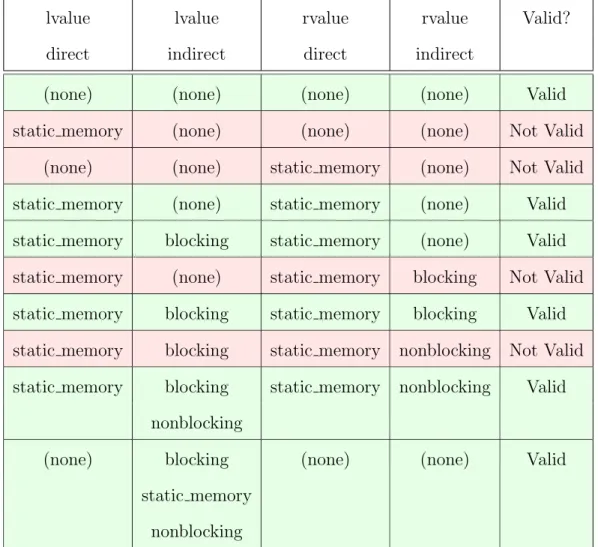
When assigning a function pointerLto point to a function R, there are two rules that funqual checks: the direct type of L must match exactly the direct type of R, and the indirect type ofL must be a superset of the indirect type of R. For function pointers, both the direct and indirect types must be explicitly annotated in code. For functions, only the direct type must be explicitly annotated as the indirect type can be inferred.
These rules are necessary to maintain the soundness of the system. In order to correctly enforce require direct call(X, Y), the direct type of L must be contained in R — otherwise a call to L might be considered valid even if R does not have Y
in its type. In order to correctly enforce restrict direct call(X, Y), the direct type of R must be contained in L — otherwise a call to L might be considered valid even if R does not have Y in its type. Combining both of these requirements means that the direct types of L and R must match exactly. Lastly, in order to properly enforce
Table 4.1: Examples of valid and invalid assignments in funqual. The left two columns show the direct and indirect type of the lvalue respectively. The next two columns show the direct and indirect type of the rvalue respectively. The rightmost column shows whether or not that assignment is valid.
lvalue lvalue rvalue rvalue Valid?
direct indirect direct indirect
(none) (none) (none) (none) Valid
static memory (none) (none) (none) Not Valid
(none) (none) static memory (none) Not Valid
static memory (none) static memory (none) Valid static memory blocking static memory (none) Valid static memory (none) static memory blocking Not Valid static memory blocking static memory blocking Valid static memory blocking static memory nonblocking Not Valid static memory blocking static memory nonblocking Valid
nonblocking
(none) blocking (none) (none) Valid
static memory nonblocking
reachable by calling L.
Table 4.1 shows a few examples of valid and invalid assignments.
4.3. Call Graph Rules
type system. The algorithms presented here only return true or false depending on whether the graph in question is valid. The algorithms actually implemented in funqual are slightly more complicated because they print helpful diagnostic messages to the user. Both sets of algorithms enforce the same rules, though.
4.3.1. Restrict Direct Call
restrict direct call(X, Y)
A restrict direct call rule creates a constraint that disallows functions with di-rect type X from calling functions with direct type Y. This constraint is relatively permissive because it still allows indirect calls from functions with direct type X to functions with direct type Y but is nonetheless checkable by this type system.
Listing 4.4 shows pseudocode for an algorithm that can check a call graph for violations of this rule. Assume thatedgesis a list of objects representing all the calls in the call graph.
1 function enforce_restrict_direct_call(X, Y, edges):
2 for edge in edges:
3 callee = edge.to
4 caller = edge.from
5
6 if X in caller.direct_type and Y in callee.direct_type:
7 return false
8 return true
Listing 4.4: Pseudocode for an algorithm that can check arestrict direct call
constraint. This algorithm returns true if the call graph respects the
constraint and false if the call graph violates it.
will categorize each function call in this graph as one of two possibilities: a call to a standard function, or a call to a function pointer.
In the case of a standard function call, the correctness is trivial. The user must have annotated the direct type of both the caller and the callee2. If a function with direct type X calls a function with direct type Y, then edges will contain such an edge and in checking each edge we will detect it.
In the case of the function pointer call, we need to also examine all possible assignments of that function pointer. It is of course possible that the function pointer is null at runtime, but we will consider this type of error to be out of the scope of funqual. For the sake of this argument, let P stand for any function pointer and F
stand for any function. For an assignment of F into P to be valid, F and P must have the same direct type. If they do not have the same direct type, then funqual will inform the user of an assignment type violation. If they do have the same direct type, then edges will contain an edge intoP wherever P is called and that edge will be checked in the same way as a standard function call.
4.3.2. Restrict Indirect Call
restrict indirect call(X, Y)
A restrict indirect call rule creates a constraint that functions with direct typeX
cannot call functions with direct or indirect typeY. This has the effect of restricting functions with direct typeX from calling functions with direct typeY, whether that call is direct or indirect. The need to enforce indirect calls in the presence of function pointers requires us to examine the indirect type of the callee for each edge.
2Funqual will check whatever was declared by the programmer — whether the programmer
1 function enforce_restrict_indirect_call(X, Y, edges):
2 for edge in edges:
3 callee = edge.to
4 caller = edge.from
5
6 if X in caller.direct_type and Y in callee.indirect_type:
7 return false
8 return true
Listing 4.5: Pseudocode for an algorithm that can check a
restrict indirect callconstraint. This algorithm returnstrueif the call graph
respects the constraint and false if the call graph violates it.
Listing 4.5 shows pseudocode for an algorithm that can check a call graph for violations of this rule. Assume thatedgesis a list of objects representing all the calls in the call graph.
In order to simplify this algorithm, we will assume for the time being that indirect function types are inferred correctly. For an explanation of the indirect type inference algorithm and for an argument for its correctness, refer to Subsection 4.3.4. To assert the correctness of enforce_restrict_indirect_call, we will again consider each function call in the graph as a member of one of two categories: a call to a standard function, or an invocation of a function pointer.
In the case of a standard function call, the correctness is trivial. Assume function
A with direct typeX calls functionB with indirect typeY. SinceA directly callsB, we know that there will be an edge fromAtoB in theedgesand when the algorithm visits it, the algorithm will terminate with the claim that there is a violation.
Subsection 4.3.4). As a result, when visiting the edge from A to B (where A is the function invoking function pointer B), the algorithm will detect that B has indirect type Y and will terminate with the claim that there is a violation.
4.3.3. Require Direct Call
require direct call(X, Y)
A require direct call rule creates a constraint that functions with direct type X
can only call functions with direct type Y. Much like the restrict direct call rule, this rule is relatively easy to check and can be checked in time linear with respect to the number of edges in the call graph.
Listing 4.6 shows pseudocode for an algorithm that can check a call graph for violations of this rule. Assume thatedgesis a list of objects representing all the calls in the call graph.
1 function enforce_require_direct_call(X, Y, edges):
2 for edge in edges:
3 callee = edge.to
4 caller = edge.from
5
6 if X in caller.direct_type and Y not in callee.direct_type:
7 return false
8 return true
Listing 4.6: Pseudocode for an algorithm that can check arequire direct call
constraint. This algorithm returns true if the call graph respects the
constraint and false if the call graph violates it.
must have annotated the direct type of both the caller and the callee and we take these annotations to be correct. If a function with direct type X calls any function, then edges will contain an edge from the caller to the callee. Checking the direct types of caller and callee exhaustively for every edge in the graph will eventually find any violations.
In the case of a function pointer call, we need to also examine all the possible assignments to that function pointer. Thankfully the assignment checker already checked the type safety of every function pointer assignment so we will assume that those are correct. In this case specifically, we can assume that, if the function which is actually called does not have direct type Y, then the function pointer which is called in code will also not have direct type Y. This call creates an edge which will certainly be visited byenforce_restrict_direct_calland so we can be certain that any function pointer invocation will be correctly checked in this regard.
4.3.4. Indirect Type Inference
While the user does not invoke indirect type inference in the same way that the user invokes the other rules, indirect type inference is still an important part of the type safety of funqual. This subsection explains indirect type inference and argues for the correctness of the algorithm.
1 function infer_indirect_type(function, edges):
2 indirect_types = empty set
3 visited = empty set
4 to_visit = empty set
5 to_visit.add(function)
6
7 while to_visit is not empty:
8 curr = to_visit.pop()
9 visited.add(curr)
10
11 indirect_types.add_all(curr.direct_type)
12 indirect_types.add_all(curr.indirect_type)
13
14 for edge in edges:
15 callee = edge.to
16 caller = edge.from
17 if caller == curr and callee not in visited:
18 to_visit.add(callee)
19 return indirect_types
Listing 4.7: Pseudocode for an algorithm to infer the indirect type of a function.
To assert the correctness of this algorithm imagine a function, F, from which evaluation eventually (either directly or indirectly) reaches a function, C, with type
Y. We propose that because of the rules of this type system, it is necessary that Y is in the type of F. To demonstrate this we will break down the type pipeline into its multiple cases.
the algorithm does visit C, it will grab the direct type of C (which contains Y) and add it to the indirect type of F. When the algorithm terminates, it will necessarily contain Y. In other words, if there is a path fromF toC, the indirect type ofF will contain the direct and indirect types of C.
The second case is that F invokes a function pointer P from which evaluation eventually results in a call to C. In this case, there may or may not be a path in edges from F to C. However, there will be a path in edges from F to P and an assignment of C into P. Recall that for an assignment ofC intoP to typecheck, the direct types of C and P must match and the indirect type of P must contain the indirect type ofC. If Y is in the direct type ofC, then Y must be in the direct type of P. Also if Y is in the indirect type of C, then Y must be in the indirect type of P. Since either the direct type or the indirect type of P must contain Y, we can reference case one and claim that because there is a path from F to P, and because the type of P contains Y, then Y will be in the indirect type of F.
The third case is an inductive step. Assume thatF calls Cbut indirectly through some arbitrary number of function pointer invocations between. LetP0 be a function pointer through which a call is made toC, let P1 be a function pointer through which a call is made to P0, let Pn be a function pointer through which a call is made to
Pn−1, and let F call Pn. According to the logic in case two, if Y is in the direct type of C, then it must be in the direct type of P0 or else the assignment will have failed. In the same way, ifY is in the direct or indirect type of Pn−1, then it must be in the direct or indirect type ofPn. Inductively, Y must be in the direct or indirect type of
This algorithm terminates even in the presence of cycles because it tracks previ-ously visited vertices in visited and does not visit them again. Even though these cyclic edges are not followed, the output is still correct because every vertex is visited once. Assume that F calls C and thatC calls F. The algorithm first visits F, then visits C, but does not visit F again because F was added to visited when it was first examined. When F was added to visited, its direct and indirect type were added to the return value and the edges out of F were added to to_visit. All the necessary information was extracted from F on the first visit so visiting it again is not necessary.
4.4. Special Considerations when Creating a Call Graph
4.4.1. Dealing with Inheritance
When calling a virtual method in C++, it is impossible to know at compile time exactly which function is going to be run at run-time. This is very similar to the problem of function pointers (and in fact dynamic dispatch is usually implemented as a table of function pointers [16]) except that in the case of virtual functions we actually know statically the set of possible functions that could be called3. To account for this, we need to add extra edges to our call graph to represent all the possible places that a virtual method call could go.
LetC be some function that calls T.M where T is some class and M is a virtual method of T. When creating the call graph, we must surely add an edge from C to
T.M. In addition to that, though, for any class S that is a subclass of T, we must also add an edge from C toS.M. This accounts for any possible overloads of M that might be called at run-time.
Listing 4.8 demonstrates this concept. It is a piece of C++ source code that calls a virtual function. Figure 4.3 shows the call graph for this code sample.
1 class Panda { 2 protected:
3 int m_hunger; 4 public:
5 virtual int Feed() { 6 m_hunger--;
7 }
8 };
9
10 class RedPanda : public Panda{ 11 public:
12 int Feed() override {
13 Stomach *stomach = malloc(sizeof(Stomach)); 14 memset(stomach, 0xFF, sizeof(Stomach));
15 }
16 };
17
18 void feedPanda(Panda *panda) static_memory { 19 panda->Feed();
20 }
21
22 int main(void) {
23 feedPanda(new RedPanda());
24 }
Listing 4.8: Example C++ program demonstrating inheritance. In
feedPanda, it is impossible to know statically which instance of the Feed
function will be called. Figure 4.3 shows the call graph for this program.
main feedPanda
Panda::Feed RedPanda::Feed
memset
malloc
Figure 4.3: Call graph for Listing 4.8. Because Panda::Feed is a virtual
function, we must draw an edge from feedPanda to every instance of Feed.
can see that we call Panda::Feed. This is somewhat misleading: Panda::Feed is a virtual function and it is overridden by a child class called RedPanda. This means that any timefeedPandais called, it is impossible to know whether it isPanda::Feed being called or whether it is actually RedPanda::Feed being called. The only safe way to handle this scenario is to assume that feedPanda calls both of them. This is reflected in Figure 4.3 which is a call graph showing feedPanda pointing to both versions of the Feedfunction.
4.4.2. Overriding Methods with Annotations
As such, the two functions have different types and the compiler will generate an error.
1 class Panda { 2 public:
3 virtual void Feed() const; 4 };
5
6 class RedPanda: public Panda { 7 virtual void Feed() override; 8 };
Listing 4.9: Example C++ containing an error. Panda::Feed and
RedPanda::Feed have different types and so the override is invalid.
Funqual treats funqual direct type in the same way. ForT.M to be overridden by
S.M, the two functions must have the same direct type. If they do not, funqual will display an error. The Listing 4.10 shows a similar example of an invalid override but where the direct type is the type in conflict.
1 class Panda { 2 public:
3 virtual void Feed() QTAG(static_memory); 4 };
5
6 class RedPanda: public Panda { 7 virtual void Feed() override; 8 };
Listing 4.10: Example C++ containing a funqual type error. Panda::Feed
4.4.3. Operator Overloading
C++ allows for operator overloading. As a result, an expression such asa = b + c; could result in a function call depending on the types of a and b.
Compensating for this is relatively straightforward. When funqual comes across a binary or unary operator that can be overloaded, it checks the type of the operand(s) and checks for an operator overload. If there is an operator overload, then the call graph will contain an edge from the calling context to the overload function. If the overload is virtual, funqual checks for operator overloads in child classes as described in Section 4.4.1.
4.4.4. Bridging the Divide between Translation Units
The compilation of C++ code is driven by translation units. Translation units are the files which are provided to the C compiler to be translated into object files. In general, translation units are singular .cor .cpp files including any source files that may be #include-ed. During this process, many symbols are said to have external linkage meaning that their type is specified in this translation unit but that their value is not (this is the case with extern variables, function prototypes, and class forward declarations). In these cases, examining the call graph of a single translation unit is not sufficient to enforcing global call graph constraints because we would not be able to see the calls made in other translation units which may be of interest for enforcing indirect call restrictions.
Chapter 5 IMPLEMENTATION
This section contains information about the funqual tool including a discussion of how to use it, how it works, and what its limitations are.
5.1. Operation
Funqual is a tool that takes in C++ source code and a set of call graph rules and outputs a list of rule violations, if any exist. Section 5.1.1 demonstrates how to anno-tate C++ source code with funqual type qualifiers. Section 5.1.2 explains the syntax for writing down rules in the rules file. Section 5.1.3 shows the syntax for running funqual from the command line. Finally, Section 5.1.4 contains a few examples of programs, rules files, and the output from funqual.
5.1.1. Function Qualifier Annotations with QTAG and QTAG IND
One of the goals of funqual was that it be entirely compatible with the C++17 stan-dard. As such, funqual does not add any syntax to the language that would prevent annotated programs from being used by other tools (such as gcc or cppchecker). Additionally, any C++17 code that exists “in the wild” should be compatible with funqual with no modification. To this end, we use the existing C++17 annotation syntax to insert funqual type qualifiers.
1 #ifndef FUNQUAL 2 #define FUNQUAL 3 // For direct type:
4 #define QTAG(TAG) \
5 __attribute__((annotate("funqual::" #TAG)))
6 // For indirect type:
7 #define QTAG_IND(TAG) \
8 __attribute__((annotate("funqual_indirect::" #TAG)))
9 #endif
Note that the attribute ((annotate(foobar))) syntax is generally used for compiler-specific directives (like packed, align(8), noreturn, etc) and that attributes unknown by the compiler are simply ignored. This allows us to insert information into the AST that is available after parsing but which will not affect compilation.
Below is an example of the syntax for adding type qualifiers to a function. The function below has two qualified types: static_memoryand no_io.
1 int main() QTAG(static_memory) QTAG(no_io) { 2 return 0;
3 }
Below is an example of the syntax for adding type qualifiers to a method prototype within a class. The function below has qualified typestatic_memory.
1 class Panda {
2 Panda() QTAG(static_memory);
3 };
1 int QTAG(static_memory) (*func)(int, int);
Functions in the standard library can be annotated by simply repeating their prototype and adding a type qualifier annotation. During the first phase of type checking, funqual will scrape the entire codebase and determine the union of all type annotations for each function symbol. In the example below, malloc has two type qualifiers: dynamic_memory and blocking. Lines 1 and 3 could appear in the same file or in different files. There is no limit to the number of type qualifiers that can be applied to a function.
1 void *malloc(size_t size) QTAG(dynamic_memory); 2
3 void *malloc(size_t size) QTAG(blocking);
Function pointers must also be annotated with their indirect type. For a primer on the rules regarding indirect type and function pointer assignment, refer to Section 4.2. Below is an example of a function pointer with the indirect type blocking.
1 int QTAG_IND(blocking) (*func)(int, int);
5.1.2. Constrain the World! Writing a Rules File
Call graph rules are inserted into special files called rules files. By convention, rules files have the file extension.qtagbut this convention is optional. Below is an example of a rules file that shows a few examples of each rule type:
1 rule restrict_indirect_call static_memory dynamic_memory
2 rule restrict_direct_call nonblocking blocking
3 rule require_direct_call nonblocking nonblocking
dynamic memory), restrict direct call(nonblocking, blocking), and
require direct call(nonblocking, nonblocking). As shown in this file, there is no process of declaring a type qualifier. They are brought into existence simply by referencing them.
In addition to specifying rules in a rules file, funqual also allows the user to specify additional function qualifiers in this file. In order to do this, the user must deter-mine the clang Unified Symbol Resolution for the given symbol. This is a string that uniquely identifies the symbol across all translation units - it contains more information than the fully qualified name of the symbol because it needs to differen-tiate between static symbols in different translation units and it needs to differendifferen-tiate between overloaded identifiers within the same translation unit. The Listing below demonstrates the syntax for adding thedynamic_memoryqualifier to the stdlibmalloc:
1 tag c:@F@malloc dynamic_memory
5.1.3. Running Funqual
Funqual can be run from the command line. There are two kinds of arguments: translation units and rules files. Arguments preceded by -t or --tags-file will be interpreted as a rules file. All other arguments will be interpreted as translation units. Funqual needs to be passed every translation unit in a project in order for it to create a representative call graph for the codebase. Below is an example command for running funqual. This command will pass in every .cpp file in the current directory and any subdirectories and will also pass in a rules file called rules.qtag in the current directory.
5.1.4. Example Output
Below is the output of running funqual on Listing 4.8. Not only does funqual detect the presence of a rule violation, it also shows the exact sequence of calls that represent the violation. This information helps the user know that their code contains a type error and also helps the user to correct the error.
1 Rule violation: ‘dynamic_memory‘ function indirectly called from
‘static_memory‘ context
2 Path: main.cpp::main() (38,5)
3 -calls: main.cpp::RedPanda::Feed(int) (31,18)
4 -calls: main.cpp::(#include)::malloc(size_t) (466,14)
Funqual will, by default, output every illegal path in a program. This has the potential to generate a lot of output for larger programs with many violations.
5.2. Practical Limitations
1 void *(**array)(size_t size) QTAG(dynamic_memory); 2
3 //assignment not checkable because the array dereference in lvalue
4 array[0] = malloc;
5
6 struct {
7 void *(*field)(size_t size); 8 } structure;
9
10 struct structure s; 11
12 //assignment not checkable because of field dereference in lvalue
13 s.field = malloc;
14
15 void *(**arr)(size_t); 16
17 //assignment not checkable because of array dereference in rvalue
18 arr = array[0];
Listing 5.1: Examples of function pointer assignment expressions that are not checked correctly by funqual
Chapter 6 APPLICATION
This chapter demonstrates three real use-cases for funqual. In each section below, we outline the application of funqual to a project, the constraint that funqual was used to enforce, and the outcome of using funqual to check that constraint. Section 6.1 de-scribes using funqual to prevent reentrancy errors in a class assignment for Operating Systems at Cal Poly (CSC453). Section 6.2 describes using funqual to prevent use of malloc and printf during boot-up of a custom kernel written in a class assignment for Operating Systems 2 at Cal Poly (CSC454). Lastly, Section 6.3 describes using funqual to prevent the use of potentially blocking calls in high frequency loops in a robotics application.
All of these projects were developed before funqual existed, so funqual was not used during the development cycle. The goal of this chapter is to demonstrate that funqual can scale beyond small test cases and to demonstrate how funqual can be used to address a variety of real-world issues.
6.1. Glibc Nonreentrant Functions
a thread-safe function may not necessarily be reentrant. As an example,printfcould be considered thread safe because it locks the stream while writing to it. However, if a call to printf is interrupted while it holds the lock and the interrupt handler makes its own call to printf, then the interrupt handler will wait for the lock. Since the code holding the lock cannot run until the interrupt handler finishes, the system is in deadlock. This is bad — we would like to prevent this error as well as errors like it.
Funqual can find and report this type of error. To demonstrate this, we take a class assignment written for an Operating Systems class (CSC453) that uses signal handlers, insert function type qualifiers, and create a rules file. The assignment was to simulate a set of snakes crawling around the screen. Each time the user presses control-C (creating a SIGINT signal), one of the snakes disappears. When the user tries to kill the process (creating a SIGQUIT signal), the program makes each snake disappear and then terminates. If a signal is sent during a call to a nonreentrant function, that function is preempted by the signal handler; if the signal handler calls that same nonreentrant function, this can result in undefined behavior.
To make funqual detect this issue, we use two type qualifiers: preemptive which applies to signal handlers, and non_reentrant which applies to nonreentrant func-tions. We also create one rule: restrict indirect call(preemptive, non reentrant). Since many of the nonreentrant functions we are concerned about are in the C stan-dard library, these functions are annotated asnon_reentrantin the rules file. Listing 6.1 shows the rules file used. The list of functions tagged as nonreentrant is incom-plete but represents the ones used in this program. In addition to tagging nonreen-trant library functions in the rules file, the signal handlers in the code are tagged as preemptive. Listing 6.2 shows the two lines that were added to the program source
1 rule restrict_indirect_call preemptive non_reentrant
2
3 tag c:@F@malloc non_reentrant
4 tag c:@F@free non_reentrant
5 tag c:@F@printf non_reentrant
6 tag c:@F@fprintf non_reentrant
7 tag c:@F@sprintf non_reentrant
8 tag c:@F@rand non_reentrant
Listing 6.1: Rules file for preventing preemptive functions from calling
non reentrant functions. Since this rules file contains no references to
project-specific functions, the file could conceivably be re-used by several projects.
1 void kill_snake() QTAG(preemptive); 2 void lwp_stop() QTAG(preemptive);
Listing 6.2: Lines inserted into C file to mark signal handlers as
preemptive.
The size of this project was 458 lines of code1contained in five.cfiles with 40 edges in the call graph. Funqual analyzed the source in about 0.9 seconds2 — 0.1 seconds were spent in libClang parsing the source, 0.8 seconds were spent traversing the AST to generate the call graph, 0.001 seconds were spent performing type inference, 0.000,01 seconds were spent checking the call graph, and 0.000,01 seconds were spent checking assignments.
On the first run, funqual did not detect any call graph violations. In order to test that the tool does actually detect errors, several illicit calls to printf were inserted. After doing so, funqual correctly detected and reported these errors. Listing 6.3 shows the output from funqual when run on this modified codebase.
1Line count achieved using theclocutility not including comments or blank lines.
1 Rule violation: ‘non_reentrant‘ function indirectly called from
‘preemptive‘ context
2 Path: snakemain.c::lwp_stop(int) (68,14)
3 -calls: libLWP.c::get_init_context() (193,6)
4 -calls: libLWP.c::printf(const char *, ...) (362,12)
Listing 6.3: Output from funqual when run on a project that had manually-inserted call graph violations
As seen in Listing 6.3, funqual successfully found a call graph violation that was manually inserted into the program source. Additionally, funqual listed the loca-tions in code where each call occurred between the preemptive and non_reentrant functions.
6.2. Restricting API available during kernel initialization
Kernel development is complicated for a variety of reasons. One reason that makes it particularly complicated is that not all of the standard libraries are available from certain contexts in the kernel. Just like in Section 6.1, it would be a serious issue if we were to call malloc or printf from within an interrupt handler. In addition to that, we also need to ensure that these functions are not called before their associated interfaces are initialized. As an example, the use ofmallocdepends on the page table having been initialized, and so there are contexts within kernel initialization where a call to mallocwould be inappropriate. We would like to prevent this error as well as errors like it.
to poll the keyboard and mouse for input, a subsystem to schedule interrupts and register interrupt handlers, an interface to send and receive text over the system’s serial interface, a memory manager to allocate physical pages and add them to the page table, a scheduler to run multiple processes, and lastly a set of processes which each draw a snake crawling around the screen like in Section 6.1. These subsystems all depend on things in the previous subsystems. The keyboard subsystem depends on the VGA subsystem to display the keys the user pressed, the physical memory manager depends on the interrupt subsystem to listen for page faults,mallocdepends on the memory manager, and so on. It is very easy in the early stages of boot-up to accidentally call a function in a subsystem that has not been initialized. Sometimes these calls are hidden by a few edges in the call graph, making it hard for a human to detect them.
To solve this problem, we use several type qualifiers: pre_vga,vga,pre_pc2,pc2, pre_irq,irq, pre_ser, ser,pre_mmu,mmu, pre_proc, andproc. We also create rules
for each subsystem that prevent functions tagged pre_XXX from calling functions in any of the subsystems that involveXXX. Listing 6.4 shows the rules file used to support this.
1 rule restrict_indirect_call pre_vga vga
2 rule restrict_indirect_call pre_vga pc2
3 rule restrict_indirect_call pre_vga irq
4 rule restrict_indirect_call pre_vga ser
5 rule restrict_indirect_call pre_vga mmu
6 rule restrict_indirect_call pre_vga proc
7
8 rule restrict_indirect_call pre_pc2 pc2
9 rule restrict_indirect_call pre_pc2 irq
10 rule restrict_indirect_call pre_pc2 ser
11 rule restrict_indirect_call pre_pc2 mmu
12 rule restrict_indirect_call pre_pc2 proc
13
14 rule restrict_indirect_call pre_irq irq
15 rule restrict_indirect_call pre_irq ser
16 rule restrict_indirect_call pre_irq mmu
17 rule restrict_indirect_call pre_irq proc
18
19 rule restrict_indirect_call pre_ser ser
20 rule restrict_indirect_call pre_ser mmu
21 rule restrict_indirect_call pre_ser proc
22
23 rule restrict_indirect_call pre_mmu mmu
24 rule restrict_indirect_call pre_mmu proc
25
26 rule restrict_indirect_call pre_proc proc
1 // for VGA subsystem
2 bool VGA_init() QTAG(pre_pc2);
3 void set_char_at(int row, int col, char character, char attributes) 4 QTAG(vga) QTAG(pre_pc2);
5
6 // for PC2 subsystem
7 void PC2_init() QTAG(pre_irq);
8 bool get_char(char *ret) QTAG(pc2) QTAG(pre_irq); 9
10 // for interrupt request subsystem
11 void IRQ_init() QTAG(pre_ser);
12 void IRQ_set_handler(int irq, irq_handler_t handler, void *args) 13 QTAG(irq) QTAG(pre_ser);
14
15 // for serial subsystem
16 void SER_init() QTAG(pre_mmu);
17 int SER_write(const char *buff, int len) QTAG(ser) QTAG(pre_mmu); 18
19 // for memory management unit subsystem
20 void MMU_pt_init() QTAG(pre_proc);
21 void *MMU_alloc_page() QTAG(mmu) QTAG(pre_proc);
22 void MMU_free_page(void *page) QTAG(mmu) QTAG(pre_proc); 23
24 // for multiprocessing subsystem
25 void PROC_init();
26 Process_t *PROC_create_kthread(kproc_t entry_point, void *arg) 27 QTAG(proc);
28 void PROC_run() QTAG(proc);
This project contained 6034 lines of C code spread over 36 files with 291 edges in the call graph3. Funqual analyzed this source in about 2.2 seconds — 0.3 seconds were spend in libClang parsing source files, 1.9 seconds were spent building the call graph, 0.005 seconds were spent performing type inference, less than 0.000,05 seconds were spent checking the call graph, and less than 0.000,05 seconds were spent checking function pointer assignments.
Funqual did detect errors in this source. Listing 6.6 shows the output from running funqual. According to this output, funqual detected several cases where a pre_ser function called a serfunction. Specifically,IRQ_init calledprintkwhich eventually callsSER_write. printkin this project operates just likeprintf. The only difference is that printk outputs to both VGA and to serial. This rule violation represents an actual error that existed in the project which was not detected until funqual found it. Ideally, SER_writejust fills a buffer; this buffer is emptied when the serial port sends an interrupt requesting data. However, if the serial interface isn’t operating, that buffer might fill up causing the caller to block until space becomes available in the buffer. If we had filled the entire 1024 character buffer before initializing the serial interface, the kernel would have blocked permanently.
3Line count achieved using the cloc utility not including comments or blank lines. Many of
1 Rule violation: ‘ser‘ function indirectly called from ‘pre_ser‘ context
2 Path: src/IRQ.c::IRQ_init() (12,6)
3 -calls: src/io.c::printk(const char *, ...) (7,5)
4 -calls: src/io.c::print_char(char) (9,6)
5 -calls: src/main.c::SER_write(const char *, int) (7,5)
6
7 Rule violation: ‘ser‘ function indirectly called from ‘pre_ser‘ context
8 Path: src/IRQ.c::IRQ_init() (12,6)
9 -calls: src/io.c::printk(const char *, ...) (7,5)
10 -calls: src/io.c::print_str(const char *) (10,6)
11 -calls: src/main.c::SER_write(const char *, int) (7,5)
12
13 Rule violation: ‘ser‘ function indirectly called from ‘pre_ser‘ context
14 Path: src/IRQ.c::IRQ_init() (12,6)
15 -calls: src/io.c::printk(const char *, ...) (7,5)
16 -calls: src/io.c::print_long_hex(uint64_t, bool) (13,6)
17 -calls: src/io.c::print_str(const char *) (10,6)
18 -calls: src/main.c::SER_write(const char *, int) (7,5)
19
20 Rule violation: ‘ser‘ function indirectly called from ‘pre_ser‘ context
21 Path: src/IRQ.c::IRQ_init() (12,6)
22 -calls: src/io.c::printk(const char *, ...) (7,5)
23 -calls: src/io.c::print_decimal(int64_t) (14,6)
24 -calls: src/io.c::print_str(const char *) (10,6)
25 -calls: src/main.c::SER_write(const char *, int) (7,5)
Listing 6.6: Output from funqual when run on simple OS kernel
At this point, a simple modification was made to print_str without considering all the ways that printkwas used.
This sort of mistake is probably very familiar to many programmers and it might exist for quite a while before presenting as an error. Imagine what the symptoms would have been: the programmer would have added an extra printk to IRQ_init and the programmer would have observed that the program hanged. Why did it hang, though? In kernel development, there are a lot of things that could cause a hang, but a simple call to printk might not be the first thing one would check. It would take quite a lot of digging to go from printk to print_char toSER_write to then see that the issue was there.
This situation really demonstrates the strength of funqual. The programmer can-not possibly be cognizant of every location from which a function is called. What’s more, the programmer is usually unaware of paths between functions, especially when there are several levels of indirection in-between them. Letting the programmer ex-press their intuition as hard-coded rules and using a tool to check those rules auto-matically enables the programmer to be confident that errors like this don’t occur in practice.
6.3. Detecting slow function calls in high frequency contexts
In robotic motion control, proper timing is paramount to good performance. In industrial automation, control loops4 often run on special hardware with real-time guarantees at several thousand cycles per second. Specialized hardware like this is out of reach for robotics hobbyists, so we use general purpose hardware and GNU/Linux
4A control loop is an algorithm that measures some aspect of a system, calculates an output
to achieve similar results.
Without the real-time guarantees of a specialized environment, it is very difficult to maintain consistent control loops even at 100Hz. Part of the problem is that the GNU/Linux “real-time” scheduler is subject to some minor jitter [2], but a lot of the problem stems from the fact that some standard library functions are just too slow to run in these high frequency contexts. Over years of troubleshooting slow control loops, the software team at the Atascadero Education Foundation has created a list of functions which are sometimes slow and should never be called in these high frequency contexts. We would like a tool to statically check that these high frequency contexts never call into functions in this list of slow functions.
We use funqual to find and report these issues. To do this, we use two type quali-fiers: hi_freqto represent these high-frequency control loops, and slow to represent those functions which should not be called from within a control loop. We also cre-ate one rule: restrict indirect call(hi f req, slow) which tells funqual that hi_freq functions should never callslow functions whether directly or indirectly.
An alternative approach which we abandoned because of increased burden on the programmer is to use just one function qualifier,fast, and one rule,require direct call(
f ast, f ast), to require that each function marked fast only call other functions marked fast. The issue with this approach is that functions would be guilty until proven innocent — there are hundreds of library functions that we do use in control loops without issue and each of these would need to be marked asfastbefore funqual would accept them. This increases the adoption cost for this approach and requires a lot of annotation. If we were more serious about guaranteeing close to real-time performance, this approach would have been more appealing.
restricting hi_freq functions from calling slow functions. This is not an exhaustive list of slow functions, but it is a representative subset of them.
1 rule restrict_indirect_call hi_freq slow
2
3 tag c:@F@malloc slow
4 tag c:@F@printf slow
5 tag c:@F@fprintf slow
6 tag c:@F@sprintf slow
7 tag c:@N@frc@S@CameraServer@F@GetInstance#S slow
8 tag c:@N@frc@S@DriverStation@F@GetInstance#S slow
9 tag c:@N@frc@S@Scheduler@F@GetInstance#S slow
10 tag c:@N@nt@S@NetworkTableEntry@F@GetInstance#1 slow
11 tag c:@N@nt@S@NetworkTable@F@GetInstance#1 slow
Listing 6.7: Rules file for preventing high frequency functions from calling slow functions. Several functions from standard libraries are marked in the rules file as slow.
1 void CoopMTRobot::DisabledPeriodic() QTAG(hi_freq) override; 2 void CoopMTRobot::AutonomousPeriodic() QTAG(hi_freq) override; 3 void CoopMTRobot::TeleopPeriodic() QTAG(hi_freq) override; 4 void CoopMTRobot::TestPeriodic() QTAG(hi_freq) override; 5
6 static void *SPIGyro::Run() QTAG(hi_freq); 7
8 bool SmartPixy::getStart() QTAG(hi_freq);
Listing 6.8: Lines inserted into C++ source file to mark certain functions as hi_freq.
Funqual found many errors in this codebase. Because the funqual output is so large, the entire listing is not included here, but a representative portion of the output is shown in Listing 6.9. Most of these errors relate to stray debug printfs inserted into the code.