IDENTIFYING ‘HYBRID WARFARE’
Manon van Tienhoven
Student ID: s1745816
Email: [email protected]
Supervisor: Ms. Dr. A. van Leeuwen
Master Thesis
Public Administration
Crisis and Security Management
This thesis attempts to examine how ‘hybrid warfare’ can be identified in practice. Hybrid
warfare is a current buzz-word to explain modern warfare, which has blurred the line between
conventional warfare and irregular warfare. However, hybrid warfare is a contested concept,
with no universally agreed upon definition, and little empirical evidence. This thesis attempts
to take the first step in filling the knowledge gap surrounding hybrid warfare, which will build
a bridge between the different perspectives on hybrid warfare and how hybrid warfare is labeled
in practice. In order to this an exploratory research approach is used to identify hybrid warfare
through a comparative case study approach in the actions of Russia in Crimea from November
2013 until March 2014, and the actions of Daesh in Iraq and Syria from June 2014 until
December 2014. A framework is established of different modes of warfare and dimensions of
hybrid warfare through building on the works of three hybrid warfare scholars: Frank Hoffman,
Russell Glenn, and John McCuen.
List of Figures
1. Introduction ... 1
2. Literature review and theoretical framework ... 3
2.1 Evolution in warfare – From Clausewitz to the 21st century ... 3
2.2. Hybrid warfare ... 7
2.2.1 Upswing of the hybrid warfare concept: Hezbollah 2006 ... 7
2.2.2 Defining hybrid warfare ... 8
2.2.3 Criticizing hybrid warfare ... 10
3. Research design ... 15
3.1 Operationalizing the concept of hybrid warfare ... 15
3.1.1 Dimensions of hybrid warfare ... 16
3.1.2 Modes of warfare and indicators of hybrid warfare ... 17
3.2 Choice of methodology ... 22
3.2.1 Case selection ... 22
3.3 Data collection ... 24
4. Empirical analysis ... 25
4.1 Identifying hybrid warfare in the actions of Russia ... 25
4.1.1 Modes of warfare ... 25
4.1.2 Dimensions of hybrid warfare in the case of Russia ... 33
4.2 Identifying hybrid warfare in the actions of Daesh ... 36
4.2.1 Modes of warfare ... 36
4.2.2 Dimensions of hybrid warfare in the case of Daesh ... 43
5. Conclusion and discussion ... 46
5.1 Conclusion ... 46
5.2 Discussion ... 50
5.2.1 Limitations and strengths ... 50
5.2.2 The added value of hybrid warfare is brought in question ... 52
5.2.3 Future research ... 53
Figure 1 – Conventional and irregular warfare characteristics comparison………….…………5
Figure 2 – Hybrid warfare contrasted with other ‘new’ concepts………...13
Figure 3 – Operationalizing hybrid warfare………...16
Figure 4 – Modes of warfare with corresponding indicators……….……….18
Figure 5 – Modes of warfare and dimensions of hybrid warfare framework………21
Figure 6 – Modes of warfare identified in the actions of Russia in Crimea………..……...32
Figure 7 - Modes of warfare identified in the actions of Daesh in Iraq and Syria…..………….42
Figure 8 – Comparing modes of warfare of Russia and Daesh………...………47
1. INTRODUCTION
“Hybrid warfare is an amalgam of overt and covert military power; a combination of bullying
and subversion along with just a dash of deniability – all intended to make a full-scale response
that much harder” (Marcus, 2014).
“The concept of hybrid threats is at the nexus between internal security and defense, between civilians and military capabilities” (Barnes, 2016).
“Hybrid warfare deliberately integrates the use of various instruments of national power so as
to achieve foreign policy objectives in the light of the believed goals and capabilities of the adversary” (Lanoszka, 2016, p. 178).
“In the two years that have passed since Russia annexed Crimea, the expression ‘Russian hybrid warfare’ has become a fixture in the Western political, media and academic lexicon. It’s
a catch-all for Russian hostility” (Bershidsky, 2016).
“ISIL is a terror network with territorial ambitions and some of the strategy and tactics of an army” (Obama in Garamone, 2014).
‘Hybrid warfare’1 is the current buzz-word in the media, academic literature, and in the
policy-making circles. Looking at the first three definitions above, it is an understatement that there is
little agreement on what the concept entails. Nevertheless, the high utilization of the concept in
the various platforms suggests that a new form of warfare has come to light. Some academics
accredit this transformation in warfare to the increasingly blurred character of modern wars
(Wilkie, 2009; Glenn, 2009). Others have attributed the usage of the concept to the fact that the
West is not prepared to provide security against adversaries that attempt to target the
weaknesses of the West without using traditional military strength (Hoffman, 2007; McCuen,
2008).
Whichever of these reasons might be the cause; the concept hybrid warfare is currently
used to explain certain threats and warfare acts. For example, both NATO and the EU recognize
Russia’s aggression in Crimea and the advances of Daesh in Iraq and Syria as hybrid warfare
threats (Council of the European Union, 2015; Miranda Calha, 2015). Both of these
1 The thesis will focus on the concept of hybrid warfare. However, this term is used interchangeably in the literature
organizations are also working on counter measures as they fear for the safety of Europe,
because of these two threats labeled as hybrid warfare. However, it seems problematic to label
certain warfare acts as hybrid warfare, and developing countermeasures, whilst there is little
agreement on what the concept means. Therefore, due to the terminological and conceptual
imprecision of the concept, multiple academics have stated that the concept only serves to gain
a better understanding of the current difficulties in warfare; not necessarily as a theoretical or a
planning concept (Gunneriusson, 2012; Hoffman, 2009b).
Nonetheless, the hybrid warfare concept is used to label the actions of two adversaries,
as demonstrated by the two latter citations: Russia and Daesh. Therefore, it can be assumed that
there are similarities between these two cases that constitute it as hybrid warfare. However,
besides the terminological and conceptual gap, there is limited empirical evidence of other cases
of hybrid warfare, the single case of empirical evidence being Hezbollah against Israel in 2006.
There are currently no acknowledged factors on how to identify and label hybrid warfare.
This thesis attempts to take the first step in filling the knowledge gap surrounding hybrid
warfare, by examining how hybrid warfare is identified in the actions of Russia in Crimea and
in the actions of Daesh in Iraq and Syria. This will build a bridge between the different
perspectives on hybrid warfare and how hybrid warfare is labeled in practice. The main research
question of this thesis is: How can ‘hybrid warfare’ be identified in the actions of Russia in
Crimea and in the actions of Daesh in Iraq and Syria? In order to answer this question, the
thesis will construct a framework from the hybrid warfare perspectives of three prominent
academics: Hoffman, Glenn, and McCuen. Using these indicators and data collection from open
sources, the cases of Russia and Daesh will be analyzed to examine how hybrid warfare is
identified. This thesis could serve as a beginning to inventory common indicators of hybrid
warfare, making it possible to identify acts of war as hybrid warfare and to defend adequately
against such acts.
This thesis is structured in the following manner. In the literature review and theoretical
framework, the origins of hybrid warfare and the concept itself will be scrutinized and common
elements for a framework will be highlighted. In the research design, the methodology and the
two cases will be explained and the framework of hybrid warfare will be further explained. In
the empirical analysis, first the different modes of warfare in each case will be identified,
followed by which dimensions of hybrid warfare are evident in the cases. In the conclusion the
2. LITERATURE REVIEW AND THEORETICAL FRAMEWORK
Since there is no agreed upon definition of hybrid warfare, and due to the fact that it is a rather
vague concept; this section of the thesis will examine how the concept of hybrid warfare has
evolved in the academic literature. First of all, a brief study will be made of the evolution of
warfare, based on two main theoreticians in the field, Clausewitz and Van Creveld. Secondly,
the concept of hybrid warfare will be scrutinized: its origins, its definitions, and its criticisms.
After, the concept will be operationalized and modes of warfare and dimensions of hybrid
warfare will be presented and defined.
2.1 EVOLUTION IN WARFARE – FROM CLAUSEWITZ TO T HE 21S T CENTURY
In order to understand warfare, and how it has evolved, it is essential to understand what the
term ‘warfare’ entails. The Merriam-Webster dictionary (n.d.) defines warfare as “military
operations between enemies; an activity undertaken by a political unit (as a nation) to weaken
or destroy another”. However, in military theory, the definition of warfare is often the one that
Prussian strategist Carl von Clausewitz (1984, p. 87) gives to it: “war is a mere continuation of
politics by other means”. Therefore, due to the important position he holds in traditional
warfare, this thesis will start with examining briefly the contributions he made in understanding
warfare, afterwards the criticism on his work will be explained that led to the development of
hybrid warfare.
In his work On War (1832), Clausewitz offers the answer on what warfare entails based
on the experiences of the Napoleonic Wars. He identified three criteria that an act of aggression
must meet for it to be considered warfare. These can be summed up as: violence, instrumental,
and political (Rid, 2012). First of all, “war is an act of force to compel the enemy to our will”,
implying that all warfare is violent in its nature. Secondly, that war always has an instrumental
character: “the political object is the goal, war is the means of reaching it, and means can never
be considered in isolation of their purpose”. The third criterion is that warfare needs to have a
political goal, hence the main definition of warfare by Clausewitz. This also implies that the
acts of war need to be attributed to one side of the conflict (Clausewitz, 1984; Rid, 2012). Using
basic criteria, Clausewitz (1984) attempted to articulate a theory to understand war, whilst
taking into account its complexities, and its ‘chameleon character’, which changes throughout
nation-states (Andersen, 2012), and therefore his work is linked to the notion of ‘conventional
warfare’ (Wilkie, 2009).
The concept of conventional warfare is not easily defined, but it adheres to the society’s
way of fighting that includes doctrinal thinking, the structure of the organizations, the rules of
engagement, and also the appropriate goals of violence (Payne, 2012). Elements that are
instinctively thought of as ‘conventional’ are described by Russell Weigley (1973), as firepower
intensive, industrialized, state centric, focused on armies as the enemy center of gravity,
regularized, and regulated. Therefore conventional warfare capabilities are often associated
with the military capabilities of a state, for example: large units of armies, fleets, aircraft, and
the joint combined arms maneuver warfare (Reyeg & Marsh, 2011).
Nowadays, not everyone agrees that Clausewitz is still the most relevant military
theorist in the 21st century in explaining warfare. Clausewitz has been critiqued for his manner
of describing war as only being waged by states. For instance, Van Creveld (1991, p. 36) argues
that “organized violence should only be called ‘war’ if it were waged by the state, for the state,
and against the state”. Due to this criticism, Van Creveld, among others2, has developed his
own theory that does explain warfare in the 21st century (Schuurman, 2010). It was Van Creveld
(1991) who predicted in the 1980s, that the main conventional military conflict between regular
armed forces of nation-states would decrease in frequency, whilst low intensity conflicts
conducted by non-state groups as: militias, warlords, criminal gangs, and paramilitary forces
would proliferate severely. He ascribed his forecast to the following causes: the proliferation of
nuclear weapons makes conventional war between states less likely3; increasing international
dependence due to globalization; and the growing identification of territory and nationality to
international law (Van Creveld, 2002). These make conventional conquests unacceptable.
Moreover, this prediction of Van Creveld on the ‘transformation’ in conventional
warfare seems to have been affirmed in the last decade (Wilkie, 2009). According to military
theorists, the contemporary wars between opponents with unequal capabilities combine
2 For more background information on the criticism on Clausewitz’s work, look at ‘Clausewitz in Wonderland’ by
Tony Corn, and ‘Busting the icon: restoring balance to the influence of Clausewitz’ by Philip S. Meillinger. For a more detailed explanation on the diminishing lack of importance of Clausewitz in the 21st century, ‘Clausewitz
and the ‘New Wars’ Scholars’ by Bart Schuurman is advisable to read.
3 This statement corresponds with the rational deterrence theory of Kenneth Waltz, which states that the
elements of regular conventional warfare with elements of ‘irregular warfare’ (Lanoszka,
2016), which are displayed in the low intensity conflicts Van Creveld predicted. Examples of
such contemporary wars in the 1990s are Somalia, Rwanda, and the Balkans (Schuurman,
2010).
Similar to conventional warfare, irregular warfare is also not easily defined. Arquilla
(2011) uses three elements to define irregular warfare: the engagement of small units of military
forces; the prevalence of guerrilla tactics; and resort to terrorism. A situation of irregular
warfare can arise when one of the combatants is at the disadvantage in comparison to its
opponent, implying that the combatant does not possess the resources to challenge its opponent
directly (Weigley, 1973). Moreover, due to the limited amount of resources, human creativity
and innovation become essential to develop new tactics and strategies, which leads to higher
risks taken due to the inability of direct conventional confrontation (Reyeg & Marsh, 2011).
Since both conventional and irregular warfare are difficult concepts to grasp, this overview in
Figure 1, which contrasts the two should provide more clarity.
Conventional warfare
Irregular warfare
Units Large
(Divisions, Fleets, Wings)
↔
Small
(Cellular, Light, Fast)
Supported Well Resourced
↔
Comparatively UnderResourced
Doctrine Joint Combined Arms
Maneuver Warfare
↔
Guerrilla Tactics, Insurgency, Terrorism, Special Operations
Effect Quick and Decisive
↔
Protracted and Slow BurningObjective Annihilation
↔
AttritionTechnology New Weapons Development
↔
Leverage what is AvailableNevertheless, there are those who are not content with the increasing usage of the term
irregular warfare by policy makers and academics. Some academics even call the usage of the
tactical asymmetry (Vacca & Davidson, 2011). Another criticism for concern is that irregular
warfare is used as a ‘catch-all term’ to represent anything other than conventional warfare, such
as unconventional warfare, asymmetric warfare, guerrilla warfare, civil war, and the global war
on terror (United States Forces Command, 2006). It is also argued that irregular warfare in its
broadest meaning is not new, that it was also used in wars before, such as the French Revolution
and the Franco-Prussian war; which makes it not new or a challenge since conventional armies
have had to engage in this for centuries (Vacca & Davidson, 2011). Nonetheless, although that
the concept of irregular warfare might be a ‘fallacy’ (Salmoni, 2007); this does not indicate that
the actual activities of irregular warfare are as well. Considering these activities in military
discourse can be highly beneficial.
Whilst irregular warfare is under some criticism, it has brought about a new kind of
logic of practice for military forces, in the way that it describes war against adversaries who
drift from the conventional warfare military thinking (Gunneriusson, 2012). Moreover, while
irregular warfare is a contested concept in itself, the complexity has increased since the line
between irregular and conventional warfare has started to blur; adversaries are able to adopt
both warfare tactics (Arquilla, 2011). This revelation has caused a new wave of warfare
concepts to elucidate the blurring of the line between conventional and irregular warfare.
2.2. HYBRID WARFARE
Hybrid warfare has made its appearance in the military discourse at the beginning of the 21st
century (Nemeth, 2002). However, it were the actions of Hezbollah in the Lebanon war of 2006,
that caused the popularity of the term to grow among academics and politicians. Therefore,
before a definition of hybrid warfare is examined, a brief overview to the actions of Hezbollah
in 2006 will be given as an explanation of how the hybrid warfare concept has evolved.
2.2.1 UPSWING OF THE HYB RID W ARFAR E CONCEPT: HEZB OLLAH 2 006
One of the most important contributions to the hybrid warfare debate is from Frank Hoffman,
whom conducted extensive research on the phenomenon in the aftermath of the success of
Hezbollah against the Israeli Defense Forces (IDF) in 2006. According to Hoffman (2007), this
case validates the ability of non-state actors to deconstruct the vulnerabilities of Western style
military states. The case received worldwide attention in the summer of 2006 when the
non-state actor’s successfully held off the Israel Defense Forces, who were known for their military
excellence (Glenn, 2009). The tactic of Hezbollah in the summer of 2006 was that it mixed a
political movement with decentralized cells employing adaptive tactics in ungoverned zones,
which revealed that Hezbollah was able both to inflict as take punishment (Hoffman, 2007).
The disciplined and well-trained cells contested ground against the modern conventional
military force of Israel, whilst using a mixture of guerrilla tactics and technology in often
densely packed city centers. Hezbollah exploited their territory to create traps and evade
detection, in order to build a strong defense in close proximity of civilians (Exum, 2006).
Moreover, it would be unconvinced to claim that Hezbollah ‘won’ in military terms.
Nevertheless, the credibility of the IDF had been diminished, and in an ideological sense
Hezbollah came out stronger (Hoffman, 2007). The strength of Hezbollah was not just in its
military, it was the combination of its political, social, diplomatic, and informational
components that provided the basics for a strong military organization (Glenn, 2009). The
Hezbollah case provided for Hoffman, and also for others the opportunity to research the
changing nature in military warfare. Furthermore, this case is, in the academic literature, the
2.2.2 DEFINING HYB RI D W ARFARE
Hybrid can be defined as ‘something heterogeneous in origin or composition’
(Merriam-Webster, n.d.). Therefore, hybrid warfare indicates a combination of two or multiple forms of
warfare. As has been demonstrated in the introduction and in the literature review above, it
becomes evident that hybrid warfare refers to the simultaneous adoption of multiple modes of
warfare. The Hezbollah case demonstrated that states can be attacked by opponents who do not
necessary have to be state actors or even command a Western ‘standard’ armed force
(Gunneriusson, 2012). Moreover, this case led into further research of hybrid warfare. Multiple
definitions have evolved over the past decade, this thesis will name three that are similar; yet,
also have fundamental differences: Hoffman, Glenn, and McCuen.4
A. FRANK G. HOFFMAN
First of all, Hoffman has developed his definition on the ideas of the following concepts5: ‘New
Wars’, ‘War amongst the people’, ‘Fourth Generation Warfare’, and ‘Unrestricted warfare’
(Williamson, 2009). Hoffman (2009b, p. 2) defines hybrid warfare as: “any adversary that
simultaneously and adaptively employs a fused mix of conventional weapons, irregular tactics,
terrorism and criminal activities in the battle space to obtain their political objectives.” It
becomes evident from this definition, that Hoffman identifies four critical characteristics:
conventional weapons, irregular tactics, terrorism, and criminal behavior. Hoffman does not
give his own definitions to these elements, therefore this thesis will. The first two have been
explained in the section above, but the latter two need still to be clarified. Terrorism is a
contested concept, but can be defined as “the illegitimate use of force to achieve a political
objective by targeting innocent people” (Laqueur, 1977, p. 7). Criminal activities, on the other
hand, are mentioned by Hoffman (2009c) as smuggling, narcoterrorism, illicit transfers of
advanced weapons, and the exploitation of gang networks.
However, according to Hoffman (2007), the most important characteristic of hybrid
warfare is its convergence: the ability to apply and combine different means. For example, the
converging of the psychological and physical; of the civilian and the combatant; of
nation-building and violence; and, of the informational and kinetic approach (Williamson, 2009).
4 Other important contributions in the debate on a definition of hybrid warfare are ‘Future war and Chechyna: a
case for hybrid warfare’ by W.J. Nemeth; and, ‘Hybrid warfare: fighting complex opponents from the ancient world to the present’ by W. Murray and P. Mansoor.
However, it is essential to underline that Hoffman states that hybrid warfare does not mean the
diminishment of conventional warfare or obsolescence of these tools. Hybrid warfare causes
additional sorts of dangers of which a modern state needs to be resilient to (Rácz, 2015).
Nonetheless, Hoffman anticipates that future adversaries will apply multiple modes of war,
simultaneously, to exploit a state’s weaknesses by using an optimal blend of tactics that favor
their own strategic culture, geography, and priorities (Williamson, 2009). Hoffman has laid the
foundation for the debate on the concept of hybrid warfare. As will be discussed next, most
authors have based their work on his definition of the term.
B. RUSSELL W. GLENN
Secondly, Glenn (2009, p. 2) adopts the following definition to hybrid warfare: “when an
adversary that simultaneously and adaptively employs some combination of (1) political,
military, economic, social, and information means, and (2) conventional, irregular,
catastrophic, terrorism, and disruptive/criminal warfare methods. It may include a combination
of state and non-state actors.” Although at first glance it is quite similar to Hoffman, there are
two main changes: the catastrophic element, and the inclusion of non-military means. First of
all, the catastrophic element. Glenn gives credit to Mr. Robert Everson for having this addition
in his definition. Glenn (2009, p. 2) defines ‘catastrophic’ as “any natural or man-made
incident, including terrorism, which results in extraordinary levels of mass casualties, damage,
or disruption severely affecting the population, infrastructure, environment, economy, national
morale, and/or government functions”. Therefore, Glenn takes into account the impact on the
society that is targeted by hybrid warfare. Secondly, the inclusion of non-military means.
Surprisingly, whilst Hoffman (2007; 2009a) speaks in his work of non-military methods or
tactics, he does not include these specifically in his definition. Glenn (2009) has identified the
strength of Hezbollah in 2006, in that it was more than just a military power. Hezbollah had
social, diplomatic, political, and informational capabilities that provided the foundation for its
military power. Therefore, the inclusion of the non-military means in his definition of hybrid
warfare and the catastrophic element is novel in the debate on hybrid warfare (Rácz, 2015).
C. JOHN J. MCCUEN
Lastly, another accredited academic in the field of hybrid warfare is John J. McCuen. Unlike
are fought on “both physical and conceptual dimensions: the former a struggle against an
armed enemy and the latter, a wide struggle for control and support of the combat zone’s
indigenous population, the support of the home fronts of the intervening nations, and the
support of the international community”. According to Hoffman (2009b), the definition of
McCuen emphasized the battle of the narratives, and this also justified the emphasis of Nemeth
that he put on the modern information tools and mobilization of the masses. Nemeth (2002, p.
29) looked at the Chechen-Russian conflict where he described the action of the Chechens’ as
a “contemporary form of guerrilla warfare” who “employ both modern technology and modern
mobilization methods”. So therefore, McCuen (2008) builds upon Nemeth’s considerations and
states that hybrid warfare is effective, if the strategic objectives are achieved in physical and
conceptual dimensions. Interestingly, McCuen adds the societal element as key to success in
hybrid warfare compared to Glenn and Hoffman. Rebuilding and restoring security among the
indigenous population, and restore essential services, infrastructure, local government, and the
economy, are the key to winning or losing a hybrid war (McCuen, 2008). Thus, using the
populations as battleground is another important element in hybrid warfare for adversaries who
do not have the conventional military strength to wage war directly.
All in all, these definitions of hybrid warfare include some similarities, yet are also
different, which could lead to grand differences in approaching the identification of hybrid
warfare in actions of adversaries. Therefore, this thesis will use the dimensions and modes of
warfare from the above definitions to operationalize hybrid warfare in the empirical analysis.
2.2.3 CRITICIZING HY B RID W ARFARE
Although hybrid warfare is utilized by various platforms, the concept is still a topic of intense
debate. Certain topics of criticism are: the extent of the military means, its novelty, its
vagueness, and its utility compared with other new concepts.
A. EXTENT OF THE MILITARY MEANS
First of all, one of the criticisms is to what extent the hybrid warfare definition should include
non-military means. When looking at the definitions above, it becomes clear that hybrid warfare
involves more than just military means. Not everyone agrees with this. For example Murray
and Mansoor (2012) have neglected the non-military means in their definition to explain hybrid
the opposite compared with McCuen (2008), who focuses on the social aspect of hybrid
warfare; how adversaries use societies and the international community to achieve their
objectives. Additionally, as is demonstrated in the definitions of Hoffman and Glenn, it is not
clear whether non-military means should also be taken into account with hybrid warfare. In
Hoffman’s articles (2007; 2009a), he does state that the hybrid adversaries will target the West’s
weaknesses, but does not make statements on whether this is done through military and
non-military means.
B. NOVELTY
Secondly, the debate continues on whether or not the phenomenon that is described by hybrid
warfare is new, or that it has been around through all ages (Wilkie, 2009). Murray and Mansoor6
(2012) have argued that the use of conventional and irregular means have been war tactics since
ancient times. They provide case studies as Rome’s efforts to control Germania in 9 AD, and
the American revolution, as proof of their statement. For instance, how Rome’s adversaries
adapted their mode of fighting to offset Rome’s disciplined military (Lacey in Murray &
Mansoor, 2012). Additionally, Murray (2012) argues that the American revolution was founded
in hybrid warfare; from the conventional line battles in the North to the partisan irregular
warfare in the South. Others have admitted that when you look at the history, there is nothing
new in the current phenomenon that is called hybrid warfare (Glenn, 2009b). Nevertheless,
Glenn (2009a) does state that the ‘new’ concept can inspire a debate for a better understanding
of modern warfare today. Therefore, the debate on whether hybrid warfare is a new
phenomenon or whether it has been around for centuries is a moot point, because mostly this
discussion is due to the fact that there is no universally agreed upon definition or characteristics
of hybrid warfare.
C. VAGUENESS
Thirdly, as Hoffman (2009b) admittedly states, the excessive amount of definitions in the
academic literature adds to the image of hybrid warfare as a vague concept. Again, this problem
can be traced back to the lack of a universally agreed upon definition and characteristics of
6 This thesis argues that there is a lack of empirical evidence regarding hybrid warfare. Murray and Mansoor argue
hybrid warfare. Therefore the concept is criticized to be unsuitable, because it is too abstract,
and no more than a combination of irregular warfare with conventional warfare or as a subset
of irregular warfare (Fleming, 2009). There is also the belief that hybrid warfare should only
be used as a way to gain a better understanding of the phenomenon and that it is not intended
as a concept for policy-making. For instance, Hoffman (2009c, p. 6) states “at the end of the day we drop the ‘hybrid’ term and simply gain a better understanding of the large gray space
between our idealized bins and pristine Western categorizations, we will have made progress”.
This is in line with Gunneriusson (2012), who believes that he concept of hybrid warfare is
wanted and needed, but not primarily as a theoretical or planning concept, until the acceptance
of the term will eventually lead to consequences in the theory, planning, and doctrine.
D. UTILITY COMPARED WITH OTHER CONCEPTS
Lastly, the line between conventional and irregular warfare has become blurred, which has
caused the origin of a new wave of warfare concepts to explain this. Hybrid warfare is an
example of one of these concepts, but there are many more. For instance, in the section on
Hoffman (2007) it was stated that he based his definition of hybrid warfare on ‘new wars’, ‘war
amongst the people’, ‘fourth generation warfare’, and ‘unrestricted warfare’, which are four
similar types of concepts as hybrid warfare. The criticism on the concept is what makes hybrid
warfare unique compared to these other concepts. An overview is presented in Figure 2, which
contrasts the characteristics of these concepts with hybrid warfare.
First of all, Mary Kaldor (2007) introduced the concept ‘new wars’, which take place in
the post-Cold War period and have the following characteristics: they are fought by a
combination of state and non-state actors; they use identity politics to fight in a name of a label
instead of an ideology; the motivation is to achieve political control of a society through the use
of control and fear; and, they are not per se financed through the state but through other means.
Secondly, Rupert Smith (2005) developed the concept of ‘war amongst the people’, grasping
the concept that conflicts will become more timeless, more political of nature, and that the
conflicts are fought more often amongst the population than between conventional armies on
the battlefield. Thirdly, Lind (2007) and a group of Marine Corps officers introduce ‘fourth
generation warfare’ (referred to in short by 4GW), which describes the diminishing power of
the state as governing mechanism leading to the rise of non-state actors who challenge the
4GW actor to de-legitimize the governing state, and motivate a social breakdown within the
society. Fourthly, two Chinese colonels proposed the term ‘unrestricted warfare’, where a
country at a military disadvantage should use catastrophic and disruptive threats to target
vulnerabilities of its opponent, using: economic warfare, financial warfare,
tele-communications and network warfare, resource warfare, information and media warfare, and
international law warfare (Barno & Benshael, 2015).
As is demonstrated in Figure 2, when comparing the various hybrid warfare definitions
with the other ‘new’ concepts, it becomes clear that all of the concepts have similar elements.
This also begs the question why hybrid warfare is momentarily used in policy-making circles
and the media, whilst there are other similar concepts.
Elements HW NW WatP 4GW UW
H G M
Conventional warfare X X X X X X X
Irregular warfare X X X X X X X
Terrorism X X X X
Criminal activities X X
Catastrophic X X
Non-military means X X X X X
Among the population X X X
This literature review and theoretical framework has given a broad overview of the origins, the
definitions, and the criticisms on the concept of hybrid warfare. It is clear that it is a contested
concept, yet it is currently used by different platforms to label certain warfare actions and Figure 2 – Hybrid warfare contrasted with other ‘new’ conceptsa
Note: some abbreviations are used in this figure. HW = hybrid warfare; H = Hoffman; G = Glenn; M = McCuen; NW = new wars; WatP = war amongst the people; 4GW = fourth generation warfare; UW = unrestricted warfare.
develop countermeasures. Therefore, it is interesting to examine how cases are identified as
3. RESEARCH DESIGN
This section will explain the methodological framework of the thesis. Starting with the
operationalizing the concept of hybrid warfare. Secondly, the choice of methodology, and a
short explanation of both case selections, will be discussed.. Next, the choice and the approach
of data collection will be explained. Furthermore, a framework of the concept of hybrid warfare
will be presented to analyze how hybrid warfare is identified.
3.1 OPERATIONALIZING THE CONCEPT OF HYBRID WARFARE
It has become evident that there is no common framework on how to identify hybrid warfare,
due to the fact that it is a contested concept. This thesis aims to make the first step in filling the
knowledge gap by supplementing the empirical evidence of hybrid warfare with empirical
evidence drawn from the uncontestably hybrid warfare cases of the action of Russia in Crimea
and Daesh in Iraq and Syria. Therefore, this thesis will construct a framework using the hybrid
warfare perspectives of three prominent academics: Hoffman, Glenn, and McCuen, to extract
their modes of warfare and dimensions. On an important note, the hybrid warfare scholars have
failed to explain the modes of warfare they mention in-depth. Therefore, this thesis had to select
its own indicators to explain the modes of warfare by using other non-hybrid warfare literature.
This step was necessary, because only clearly defined indicators can be used to identify hybrid
warfare in practice.
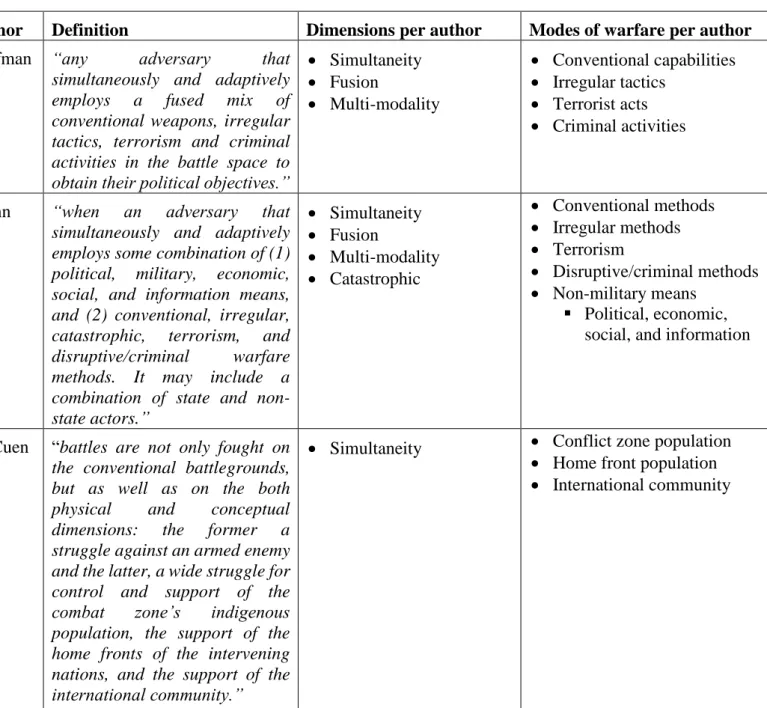
Hybrid warfare will be operationalized according to Figure 3. From the perspectives of
the three hybrid warfare scholars, certain modes of warfare and dimensions will be selected.
These are organized in the ‘dimensions per author’ and the ‘modes of warfare per author’. As
is evident, there is some overlap between the dimensions and the characteristics. In the Research
Design section, an overview will be provided on how the data will be analyzed. This section
3.1.1 DIMENSIONS OF HYB RID W ARFARE
There are four dimensions7 of hybrid warfare mentioned across the three authors, Hoffman,
Glenn, and McCuen: modality, simultaneity, fusion, and catastrophic. First of all,
multi-modality can be defined as the extent to which an adversary can mix and apply different modes
of warfare (Hoffman, 2009b).
Author Definition Dimensions per author Modes of warfareper author
Hoffman “any adversary that
simultaneously and adaptively employs a fused mix of conventional weapons, irregular tactics, terrorism and criminal activities in the battle space to obtain their political objectives.”
Simultaneity
Fusion
Multi-modality
Conventional capabilities
Irregular tactics
Terrorist acts
Criminal activities
Glenn “when an adversary that
simultaneously and adaptively employs some combination of (1) political, military, economic, social, and information means, and (2) conventional, irregular, catastrophic, terrorism, and disruptive/criminal warfare methods. It may include a combination of state and non-state actors.”
Simultaneity
Fusion
Multi-modality
Catastrophic
Conventional methods
Irregular methods
Terrorism
Disruptive/criminal methods
Non-military means Political, economic,
social, and information
McCuen “battles are not only fought on the conventional battlegrounds, but as well as on the both physical and conceptual dimensions: the former a struggle against an armed enemy and the latter, a wide struggle for control and support of the combat zone’s indigenous population, the support of the home fronts of the intervening nations, and the support of the international community.”
Simultaneity Conflict zone population
Home front population
International community
7 The definitions that are demonstrated in Figure 3, do not all state the dimensions literally. However, the literature
Secondly, simultaneity is the extent to which an adversary applies simultaneously different
modes of warfare (Hoffman, 2009b). Thirdly, fusion means the extent to which an adversary
fuses the different modes of warfare toward its own advantage (Hoffman, 2009b). Fourthly,
catastrophic can be perceived as the impact on the environment, as cited by Glenn (2009, p.2):
“any natural or man-made incident, including terrorism, which results in extraordinary levels
of mass casualties, damage, or disruption severely affecting the population, infrastructure, environment, economy, national morale, and/or government functions”.
3.1.2 MODES OF W ARFARE AND INDICATORS OF HY B RID W ARFARE
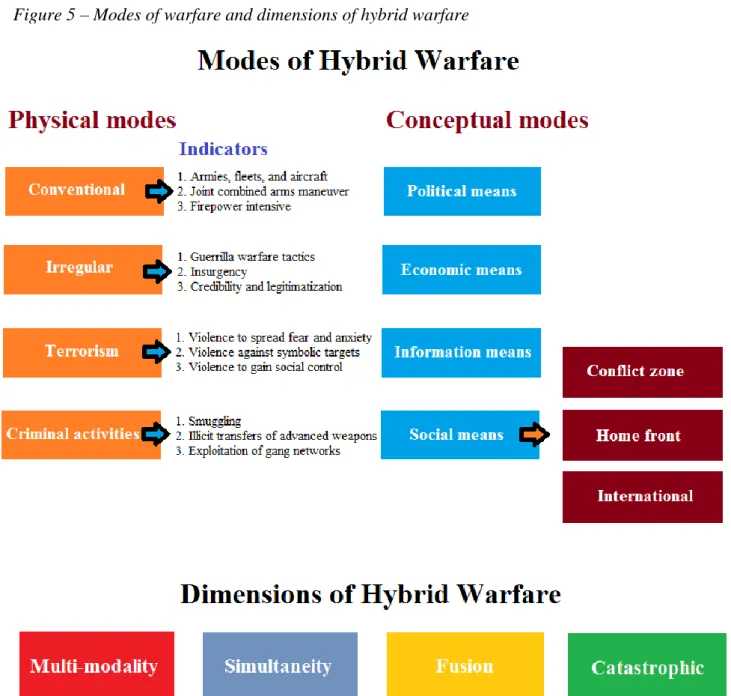
The three hybrid warfare scholars identify together eight different modes of warfare:
conventional capabilities, irregular tactics, terrorism, criminal activities, political, economic,
information, and social. These four can be divided into the physical modes of warfare, the first
four; and the conceptual modes of warfare, the latter four. This division is based on McCuen
(2009), who stated that hybrid warfare is fought on two battlegrounds: “physical and
conceptual”. The physical battleground therefore includes the physical modes of warfare, whilst
the conceptual dimension includes the non-military means of warfare and where is fought for
the control and support of the societies (McCuen, 2008). The modes of warfare have all been
described before in the sections of the authors. However, in the analysis these modes will be
examined using indicators. A flaw of the hybrid warfare scholars is that they have failed to
define contested concepts as: conventional capabilities, irregular tactics, and terrorism.
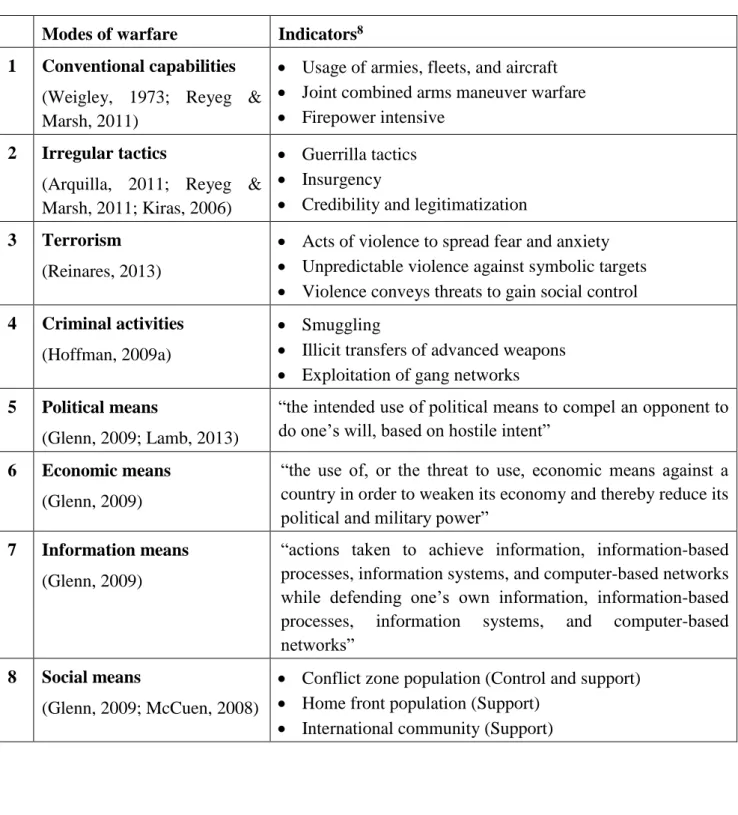
Therefore, indicators from other academics are used for the modes of warfare. In Figure 4, an
overview is provided with the characteristics and the corresponding indicators. These will be
Modes of warfare Indicators8 1 Conventional capabilities
(Weigley, 1973; Reyeg & Marsh, 2011)
Usage of armies, fleets, and aircraft
Joint combined arms maneuver warfare
Firepower intensive
2 Irregular tactics
(Arquilla, 2011; Reyeg & Marsh, 2011; Kiras, 2006)
Guerrilla tactics
Insurgency
Credibility and legitimatization
3 Terrorism
(Reinares, 2013)
Acts of violence to spread fear and anxiety
Unpredictable violence against symbolic targets
Violence conveys threats to gain social control
4 Criminal activities
(Hoffman, 2009a)
Smuggling
Illicit transfers of advanced weapons
Exploitation of gang networks
5 Political means
(Glenn, 2009; Lamb, 2013)
“the intended use of political means to compel an opponent to do one’s will, based on hostile intent”
6 Economic means
(Glenn, 2009)
“the use of, or the threat to use, economic means against a country in order to weaken its economy and thereby reduce its political and military power”
7 Information means
(Glenn, 2009)
“actions taken to achieve information, information-based processes, information systems, and computer-based networks while defending one’s own information, information-based processes, information systems, and computer-based networks”
8 Social means
(Glenn, 2009; McCuen, 2008)
Conflict zone population (Control and support)
Home front population (Support)
International community (Support)
8 Political, economic, and information means have no indicators, therefore the definitions are presented for these
conceptual modes of warfare.
1. CONVENTIONAL
Conventional warfare is one of the contested concepts used to describe hybrid warfare, since
conventional capabilities are associated with the military capabilities of the state, the thesis has
chosen for the following three indicators: 1) the usage of army, navy, and air force; 2) joint
combined arms maneuver warfare; 3) firepower intensive conflicts. These indicators are derived
from the works of Weigley and Reyeg & Marsh.
2. IRREGULAR
Irregular warfare is another contested concept, that is used to describe hybrid warfare. Again
using Reyeg & Marsh, and also Arquilla, three indicators have been derived to identify irregular
warfare: 1) guerrilla tactics; 2) insurgency; 3) credibility and legitimatization. Guerrilla tactics
and insurgency need further explanation. Guerrilla tactics can be characterized as “hit-and-run
raids and ambushes against local security forces” performed by “armed civilians” (Kiras, 2006,
p. 188). Insurgency can be defined as “a rebellion against an authority when those taking part
in the rebellion are not recognized as belligerents” (Merriam-Webster, n.d.).
3. TERRORISM
Terrorism is the third contested concept that is used to describe hybrid warfare. In the section
of Hoffman, a simple definition of terrorism was given by Laqueur (1977, p. 7):“the illegitimate
use of force to achieve a political objective by targeting innocent people”. Reinareshas a more
extensive definition of terrorism that is used for the indicators of the mode of warfare: “1) an
act of violence that produces widespread disproportionate emotional reactions such as fear and
anxiety; 2) violence is systematic usually directed against symbolic targets; 3) the violence
conveys messages and threats in order to communicate and gain social control” (Bjorgo, 2005,
p. 120).
4. CRIMINAL ACTIVITIES
Criminal activities are mentioned by Hoffman (2009c) as smuggling, narcoterrorism, illicit
transfers of advanced weapons, and the exploitation of gang networks. This thesis has selected
for its framework: 1) smuggling; 2) illicit transfers of advanced weapons; 3) exploitation of
5. POLITICAL MEANS
Glenn does not provide a definition, therefore this thesis will define the political means as a
mode of warfare as “the intended use of political means to compel an opponent to do one’s will,
based on hostile intent” (Lamb, 2013, p. 22).
6. ECONOMIC MEANS
Glenn does not provide a definition, therefore this thesis will define the economic means as a
mode of warfare as “the use of, or the threat to use, economic means against a country in order to weaken its economy and thereby reduce its political and military power” (Encyclopaedia
Britannica, n.d.).
7. INFORMATION MEANS
Neither does Glenn define information means as a mode of warfare. There this thesis will use
the definition of the U.S. Department of Defense (1996, p. 3) to define information means as a
mode of warfare: “actions taken to achieve information, information-based processes,
information systems, and computer-based networks while defending one’s own information,
information-based processes, information systems, and computer-based networks.”
8. SOCIAL MEANS
Social as a mode of warfare was mentioned by Glenn, and indirectly by McCuen, and will be
used in the thesis to determine the support and control of three groups that were identified by
McCuen. These three population groups are: 1) conflict zone population; 2) home front
population; 3) international community.
All in all, this is how the thesis operationalizes hybrid warfare. This framework will be used in
the empirical analysis to identify how hybrid warfare was identified in the actions of Russia in
Figure 5 demonstrates how the empirical analysis will be structured. First of all, data
will be collected to examine if there is evidence that each of the eight modes of warfare can be
distinguished in each case. Furthermore, using the data that is collected for the modes of
warfare, it will be analyzed whether the four dimensions are found in the case studies. This
framework is based on the works of Hoffman, Glenn, and McCuen; and is used in an
exploratory research. Therefore, it will not be stated that for a dimension to be ‘recognized’ in
a case, that it needs to have at least four or more modes of warfare. The purpose is to explore
whether these modes of warfare and dimensions can be used for further research in examining
whether certain actions can be labeled as hybrid warfare.
3.2 CHOICE OF METHODOLOGY
This thesis will follow a qualitative research methodology based on a comparative case study
design. A qualitative case study method allows to explore a phenomenon within its context
using diverse data sources (Baxter & Jack, 2008). Therefore, Robert Yin defines a case study
as “an empirical enquiry that investigates a contemporary phenomenon in depth and within its
real-life context, especially when the boundaries between phenomenon and context are not
clearly evident” (Yin, 2009, p. 46). A case study methodology was chosen, because hybrid
warfare is a complex and contested concept with lots of theoretical, but little empirical evidence.
Moreover, a comparative case study approach will allow for an in-depth analysis and provide
thorough insights. This approach provides high internal validity, at the cost of the external
validity and reliability (Bryman, 2012). These deficiencies are countered through triangulation
via diverse data sources. Additionally, the triangulation of data sources allows for a “thick
description of the phenomenon under scrutiny” (Shenton, 2004, p. 69).
3.2.1 CASE SELECTION
The cases that are selected for the comparative analysis are: Russia’s actions in Crimea
(November 2013 – March 2014) and the actions of Daesh9 in Iraq and Syria (June 2014 –
December 2014). These cases are selected, because multiple authors have labeled these as cases
of hybrid warfare (Lanoszka, 2016; Frank, 2015). Nevertheless, it is not specified what exactly
is identified as hybrid warfare in the actions of Russia and Daesh, which makes it interesting to
contrast these cases using similar modes of warfare and dimensions of hybrid warfare. Below
a brief summary of the two cases and the chosen time frames.
A. RUSSIA’S ACTIONS IN CRIMEA
First of all, the conflict between Russia and Ukraine is currently (June 2016) ongoing, yet, this
thesis will only look at the start of the conflict: the annexation of Crimea. Therefore, the chosen
time frame is from November 2013 until March 2014. This time period is chosen due to the
enormous amount of information that is available of the actions of Russia in Crimea. The
9 Daesh has many other names, such as ‘Islamic State’, ‘IS’ ‘Islamic State in Iraq and the Levant’, ‘ISIL’, ‘Islamic
annexation of Crimea was chosen as focus point of Russia’s actions in the conflict, because it
serves as focal point in the conflict.
Historically, Crimea has been on and off a part of Russia. In 1954, Crimea was
transferred back to Ukraine. Crimea is the only area in Ukraine, where its population has a
majority of ethnic Russia: approximately 60% of its 2.3 million habitants are ethnic Russian
(Paul, 2015).
The conflict originated when Ukrainian President Yanukovich rejected the Association
Agreement with the EU in December 2013, which caused protests throughout Ukraine because
Ukraine ‘turned its back’ on the EU for closer relations with Russia (Traynor & Grytsenko,
2013). After Yanukovich was ousted and fled Ukraine to Russia, and a the new interim
government was formed, violent protests began in eastern Ukraine, the Russian speaking
Donbass region. Furthermore in Crimea, ‘little green men’ appeared and buildings of local
authorities were occupied, along with the naval bases and airports in Crimea (Pifer, 2014). In
the presence of armed men, the Crimean parliament elected a new leadership on 27 February
2014. A referendum was held on 16 March on the status of Crimea, which led to a signing of a
treaty in Moscow to the annexation by Russia.
B. DAESH IN IRAQ AND SYRIA
The conflict of Daesh in Iraq and Syria is currently also ongoing. But similar to the first case,
the time frame chosen will be from June 2014 until December 2014. This time period is chosen
due to the enormous amount of information that is available, and June 2014 marks the date that
Daesh self-proclaimed the caliphate Islamic State.
Daesh is a militant movement that has occupied territory in western Iraq and eastern
Syria. The organization originates from the al-Qaeda Iraq faction, nonetheless, it has split from
the faction. In June 2014, after conquering territories in Iraq, as the cities Mosul and Tikrit;
Daesh proclaimed itself as the Islamic State as the caliphate, claiming political and theological
authority of Muslims all over the world (Laub, 2016). However its state-building has been
justified by Shari’a law, and its battlefield victories have attracted thousands of foreign fighters
(BBC, 2015a).
Both of these cases have been labeled as cases of hybrid warfare, and the purpose of this thesis
3.3 DATA COLLECTION
The data that will be collected for these case studies will be done through triangulation of
publicly available open sources. Most of the sources that will be used are international news
media, human rights reports, minutes of UN meetings, reports of governments, and reports of
Western think tanks. In order to gather the relevant sources, specific terms were inserted in the
search engine. For the Russian case, it were: ‘Russia’, ‘Crimea’, ‘2014’, and then the specific
modes and/or indicators that were examined. It proved to be more difficult for the Daesh case,
due to the many synonyms for the group. Therefore, multiple searches had to be performed to
find the relevant open sources. Terms in this case included: ‘Daesh’, ‘ISIS’, ‘ISIL’, ‘Islamic State’, ‘Syria’, ‘Iraq’, ‘2014’, and then again the specific modes and/or indicators that were
examined. For the triangulation method, each piece of information was cross-referenced among
multiple independent open sources. This approach does bring two limitations: 1) not all data
can be found in publicly available sources; and, 2) the data is Western biased, because no
Russian, Ukrainian or Arabic sources were included to the language barrier. However, the
publicly available data provides still the most information on these cases that is available to the
author of the thesis. Additionally, translated data and data collected from Russian, Ukrainian,
and Arabic sources were used in the empirical analysis, in order to diminish these two
4. EMPIRICAL ANALYSIS
In this section the above framework on hybrid warfare based on the works of Hoffman, Glenn,
and McCuen is used to identify which modes of warfare, and which dimensions can be
identified in the case of Russia’s actions in Crimea, and in the case of Daesh’s actions in Iraq
and Syria. Starting off, identifying hybrid warfare in the actions of Russia in the annexation of
Crimea.
4.1 IDENTIFYING HYBR ID WARFARE IN THE ACTIONS OF RUSSIA
4.1.1 MODES OF W AR FARE
1. CONVENTIONAL CAPABILITIES
On 1 March 2014, Russian President Putin receives authorization from the Russian Parliament
for the use of Russian troops in Ukraine (Beese & Kahn, 2014). A Kremlin statement said: “in
the case of further violence in eastern regions (of Ukraine) and Crimea, Russia maintains the
right to protect its citizens and the Russian-speaking population that lives there” (Sullivan &
Isachenkov, 2014). However, multiple sources state that weeks before the authorization of the
Russian Parliament, thousands of extra soldiers and ‘civilian volunteers’ were already
dispatched to the Russian rented bases in Crimea (Simpson, 2014; Sullivan & Isachenkov,
2014). On 3 March, President Putin ordered military exercises involving, the army, navy, and
air force in the districts bordering Ukraine (Walker, 2014). These acts together constituted “an act of aggression” according to Ukraine’s Permanent Representative of the UN (UN Security
Council, 2014). Due to the fact that Russian soldiers were already dispatched to Crimea before
the authorization of the Russian Parliament, and additionally the involvement of the “little green men”, which are discussed below; it is not evident the number of Russian military troops were
in Crimea.
Although Russia did not use its fleets and aircraft in a military manner directly against
Ukraine; but President Putin ordered surprise military exercises on the border of Ukraine and
at its base in Sevestopol10 (Yuhas, 2014). Moreover, on 5 March 2014, Russian sailors “scuttled
ships… blocking Ukrainian vessels at their base at Novoozerne”, which eventually at the end of March led to the surrender of the “majority of Ukraine’s Crimean naval bases and associated
vessels to Russian forces” (Naval Today, 2014). A week before that, the airports in Crimea
were “seized” (BBC, 2015c), “controlling access by pro-Russian separatists” (Salem, Walker, and Harding, 2014). Ukraine’s Interior Minister Arsen Avakov stated that: “the airports were controlled by Russian navy troops” and described it as “a military invasion and occupation”
(CBS News, 2014).
In Crimea, Russia did not display joint combined arms maneuver warfare, nor was the
conflict firepower intensive. The take-over in the end of February and beginning of March is
described as “fairly bloodless” (Hsu, 2014); as “a bloodless invasion” (Beckhusen, 2014); or as “a remarkable, quick, and mostly bloodless coup d’état” (Simpson, 2014). However abductions
and ill-treatment of captives in Crimea are frequent (Amnesty, 2015a); especially Crimean
Tatars, activists and others critical of Russia are targets (Human Rights Watch, 2014a).
2. IRREGULAR TACTICS
‘Little green men’ have been fanned out in Crimea since the beginning of 2014 (Pifer, 2014).
Russian President Putin calls them “members of self-defense groups organized by locals” (Lally
& Englund, 2014), and denies any involvement of Russian troops. However, many platforms
have “mounting evidence of the opposite” that Russia indeed sent troops to Crimea (Amnesty,
2015a, p. 32), who took part in occupying the Ukrainian navy bases, airports, and local
government buildings in Crimea (Herbst & Polyakova, 2016). Also Ukrainian media challenge
Putin’s claims: “Russian invaders and occupiers from Russia” (Ukrayinska Pravda in
Shevchenko, 2014); “the military presence in Crimea is an armed intervention” (Segodnya in
Shevchenko, 2014). Another popular blogger writes that the term “little green men” is invented by spin doctors from Russia who “are creating an image of a Russia liberator-soldier wearing a
nice new uniform and armed with beautiful weapons, who has come to defend peaceful towns
and villages (Varlamov in Shevchenko, 2014). Therefore, the actions of ‘little green men’ by Russia is described as a “military occupation that is staged as a non-occupation” (Yurchak, 2014). This usage of ‘little green men’ amongst the pro-Russian separatists and ‘volunteers’ in
Crimea to take over the major important locations in Crimea (Simpson, 2014); this can be seen
as an act of guerrilla warfare.
Insurgency can also be identified in this case. The Euromaidan protests led to the ousting
of President Yanukovich and the installation of a pro-European interim government; which was
d’etat” (International Republican Institute, 2014, p. 105-106). The aim of the pro-Russian groups was “to keep Ukraine in Moscow’s orbit and prevent its integration with Europe”
(Coalson, 2014). With Crimea being the only area in Ukraine, where the majority of its
population is ethnic Russian, and speaks Russian (BBC, 2015b); Russia with the assistance of
the pro-Russian groups as described above took control over Crimea, which led eventually into
the annexation by Russia.
Russia made numerous attempts to increase its credibility for its actions in Crimea and
to legitimize its actions. It legitimized its rights to intervene under the pretext of “to protect its
citizens and the Russian-speaking population that lives there” (Sullivan & Isachenkov, 2014).
The annexation was legitimized by the result of the referendum that was held on 16 March,
which according to the Russian Times over 95.7% voted in favor for the annexation with a voter
turnout of 81.37% (RT, 2014).
3. TERRORISM
As mentioned previously, the occupation and annexation of Crimea were almost bloodless, and
although the threat of violence was present to gain social control; unpredictable violence against
symbolic targets and to spread fear and anxiety cannot be identified in the case of the Russian
annexation. The Russian surprise military exercises on Ukraine’s doorstep involving the army,
navy, and air force, (Salem, et al., 2014), “to check combat readiness of armed forces in western
and central military districts as well as several branches of the armed forces” (Smith-Spark,
Black & Pleitgen, 2014) can be seen as acts of intimidation. Nonetheless, otherwise the
terrorism indicators are non-existent in this case.
4. CRIMINAL ACTIVITIES
Criminal activities were evidently a part of Russia’s actions in the annexation of Crimea.
Although smuggling cannot be found in its strategy, rather as a result of the Russian takeover,
since “Crimea has long been a center of criminal activity and interest… its supply convoys were
infamously misused for smuggling of every kind” (Galeoitti, 2014a). Moreover, the Ukraine
permanent representative of the UN accused Russia, that before the occupation in Crimea, that
“the Russian Federation provided numerous supplies of arms into Crimea… the continuous
(Kateryna Bila in UN Security Council, 2015a). Other resources report similar findings: “the
flow of weapons into Ukraine has fueled separatist tensions… pro-Russian forces have shot down Ukrainian helicopters and planes with similar heavy weapons” (Munteanu, 2014); “the provision of tanks, advanced air defence systems and other heavy weapons to the separatists”
(NATO, 2014).
The exploitation of the gang networks can also be found in the Russian takeover of
Crimea, “Kremlin uses criminal as instruments of state policy and also how the underworld and
upperworld have become inextricably entwined as a consequence” (Galeoitti, 2014b). For example, the Kremlin’s elected acting Prime Minister of Crimea after the Russian annexation
was Sergei Aksyonov, whom has repeatedly been connected with criminal networks (Flintoff,
2014; Shuster, 2014). Aksyonov used to go by the nickname ‘Goblin’, as a member of a
cigarette-smuggling gang called ‘Salem’ in the 1990s, however, the court records and police
reports of his activities have gone missing (Galeoitti, 2014b). Another source quotes an
anonymous Ukrainian prosecutor who claims that “Aksyonov and his Russian separatist
associates share sordid pasts that mix politics, graft, and extortion in equal measure and together
they helped steer Crimea into the Russian federation” (Dettmer, 2014). An American think tank stated in 2012, that “political corruption is ingrained in eastern Ukrainian political culture”
(Kuzio, 2012). This would imply that politics and corruption have always connected in Ukraine
and Crimea, and therefore these gang networks were easily exploited in 2014 by Russia.
5. POLITICAL MEANS
At the beginning of November 2013, President Putin met with President Yanukovich to struck
a deal, and this meeting led to the winning of “the tug-of-war” between Russia and the EU,
because shortly after President Yanokovich postponed the signing of the EU Association
Agreement indefinitely (Spiegel, 2013). The deal implied a Russian 15 billion dollar investment
in Ukraine and a reduction of a third of the price that Naftogaz, Ukraine’s national energy
company, has to pay for its gas imports from Russia (Piper, 2013). This decision led to the
Euromaidan protests in Ukraine, and the clash between the pro-Russian groups and the
anti-government groups (Kononczuk, 2014). However, also the political events on 1 March seem
“orchestrated”: Crimea’s new Prime Minister Aksyonov asks Russia for help; Russia’s lower
house of Parliament urges President Putin to stabilize Crimea; President Putin agrees; and he
political decisions were helpful for Russia in ‘legitimizing’ its occupation and annexation of
Crimea.
6. ECONOMIC MEANS
The political deal that was made between Russia and Ukraine, also includes the economic
denominator. In 2013, Ukraine had slid into recession, and therefore faced economic problems
(Spiegel, 2013). One of its causes, is that Ukraine is “energy inefficient” (Clark, 2014), and
highly dependent on Russian gas; “the cost of purchasing Russia gas, subsidized to a large
extent from the state budget, rose from US$ 8 billion in 2009 to US$ 12 billion in 2013” (Kardas
& Kononczuk, 2014). Therefore, the deal that President Putin offered to President Yanukovich,
would offer especially on the short-term solutions for Ukraine. Once again, this decision led
eventually to the Euromaidan protests, since moving towards closer relations with Russia,
meant moving away from the European Union (Grytsenko, 2013).
7. INFORMATION MEANS
Several sources have spoken of Russia’s “information war” in Crimea (Yuhas, 2014); NATO’s Supreme Commander even called it: “the most amazing information-warfare blitzkrieg we have ever seen in the history of information warfare” (Vandiver, 2014). “Russia has already mastered the use of an information war strategy to influence local populations, confuse the outside’s
world perception of ground events and shut down opposing sources of online information”
(Hsu, 2014). The main example are the “little green men” in Crimea that the Russian military
disguised and denied were Russian military (Ash, 2015). However, the actions of Russia go
beyond that. As mentioned previously, Crimea is a region that has an ethnic Russian majority;
moreover, the area belongs to the Russian media and cultural space: “Russian television
channels for two-third of the population; and, 555 Russian-language schools compared to six
Ukrainian-language schools” (Kononczuk, 2014). There is also a propaganda campaign
launched in Crimea: “local Crimean television is replaced with Russian broadcasts, which
deliver nonstop feed simultaneously discrediting the new government in Kiev and the West
while building up Moscow as a savior and protector” (Yaffa, 2014). All in all, “Russian officials
and state media grossly distorted, manipulated, and at times invented information about the