Contagious Capital: A Network Analysis of Interconnected
Intermediaries
Jesse Blocher
A dissertation submitted to the faculty of the University of North Carolina at Chapel Hill in partial fulfillment of the requirements for the degree of Doctor of Philosophy in Business Administration (Finance) in the Department of Finance of the Kenan-Flagler Business School.
Chapel Hill 2012
Approved by:
Adam V. Reed, Advisor
Greg W. Brown
Jennifer Conrad
Joseph Engelberg
Abstract
JESSE BLOCHER: Contagious Capital: A Network Analysis of Interconnected Intermediaries.
(Under the direction of Adam V. Reed.)
I measure the effects of capital flow contagion in financial markets by analyzing portfolio
managers linked through interconnected asset holdings. My novel, network-based specification
provides estimates of shocks to common predictor variables 50-75% higher than existing
esti-mates of manager’s capital flows which ignore network relationships. This additional impact
arises because my network specification includes the effect of spillover onto immediate
neigh-bors and beyond, leading to feedback loops. My findings seem to result from crowded trades
(popular, short-term investment strategies) since network connections do not show strong
per-sistence and relatively small changes in asset allocation toward more concentrated positions
Acknowledgments
Thanks to my advisers for their patient and numerous reading of the poorly written early
drafts of this paper. Thanks to my wonderful wife for supporting me and my kids for being
excited to see me every day when I come home.
I am also grateful to Rick Sias (Discussant at the Financial Research Association
confer-ence), Chris Lundblad, Ed Van Wesep and Matt Ringgenberg for useful comments. Thanks
to Matthew Bothner (ESMT Management/Sociology) and Peter Mucha (UNC Mathematics)
for valuable guidance on network measures and computational algorithms, respectively. Ethan
Cohen-Cole and Tim Conley provided help and references on identification and econometrics.
James Moody and seminar participants at the Duke Network Analysis Center (dnac.ssri.
duke.edu) provided useful feedback, as did seminar participants at the SAMSI (www.samsi.
Table of Contents
Abstract ii
List of Tables v
List of Figures vi
1 Introduction . . . 1
2 Hypotheses and Background . . . 4
3 Network Methodology . . . 7
3.1 Data . . . 8
3.2 Portfolio Similarity Measure – The Network . . . 9
3.3 Network Structure as Instrument . . . 10
3.4 Identification and Estimation of a Network Influence Process . . . 14
4 Results . . . 15
4.1 Regression Results . . . 16
4.2 Network Coefficient Interpretation . . . 17
5 Crowded Trades and Network Persistence . . . 19
6 Conclusion . . . 21
List of Tables
1 Fund Summary Statistics . . . 28
2 First Stage GMM Regression . . . 29
3 Effect of Peer Flows on Portfolio Returns . . . 31
4 Effect of Peer Flow on Fund Flows . . . 33
5 Contagion Effect of Peer Flows on Fund Flows - Long Run Steady State . . . . 34
6 Results removing sector funds – fund flows . . . 35
7 Results removing sector funds – portfolio returns . . . 37
8 Results removing the financial crisis – fund flows . . . 39
9 Results removing the financial crisis – portfolio returns . . . 41
List of Figures
1 Percentiles of portfolio distance measure through time. . . 24
2 The effect of a shock to cash holdings within a subset of portfolio managers. . . 25
3 The effect of a shock to portfolio returns within a subset of portfolio managers. 26
1. Introduction
Since the beginning of the recent financial crisis, the concept of
too-interconnected-to-fail has grown in importance, leading regulators to identify portfolio overlaps of financial
intermediaries as a potential source of systemic risk.1 Practitioners have also shown concern,
suggesting that “. . . there may be more crowded trades than most investors realize. If investors
exit at the same time, market movements could be chaotic.”2 Among academics, Stein (2009)
identifies “crowding”, or similar portfolios among sophisticated investors, as a risk in financial
markets and Brunnermeier and Sannikov (2011) identify portfolio overlaps as a destabilizing
mechanism in financial markets.
In this paper, I show that crowded trades may induce capital flow contagion among these
interconnected portfolio managers. Capital flow contagion occurs when the withdrawals and
forced sales experienced by one investment manager provoke capital outflows and asset sales
from other funds with similar portfolio holdings through the depressed prices of commonly
held assets (Brunnermeier and Pedersen (2009)).3 However, my approach accounts for broader
network propagation effects and feedback loops, not just pairwise connections. To do this, I
employ a novel instrumental variables specification to estimate contemporaneous capital flow
contagion effects in steady-state across the network.
Compared to the analysis of disconnected, independent portfolio managers common in
the literature, I find that coefficient estimates of common predictors of fund flows increase
1See speech by The Bank of England’s Executive Director for Financial Stability Andrew Haldane at
http: //www.bankofengland.co.uk/publications/speeches/2010/speech433.pdf
2Bank of America-Merrill Lynch report,
http://ftalphaville.ft.com/blog/2011/06/01/581676/ the-calm-before-the-volatility-storm/as quoted in the Financial Times, 1 June 2011.
3Brunnermeier and Pedersen (2009) model withdrawals and forced sales as a “market liquidity/funding
by 50-75% when network relationships are taken into account.4 This increase is due to two
contagion processes I am able to incorporate with the full network of interconnections. First,
“own” effects increase by up to 20% due to feedback loops in which a shock to a manager
propagates out and back via a sequence of connected peers. Second, spillover effects (assumed
to be zero in non-network specifications) are substantial and increase estimates by an additional
30-55%. Spillover effects are similar to a network externality in which a shock to a manager
spills over onto his neighbors, such that an unsuspecting manager may find his portfolio under
stress due to funding problems by others holding a similar set of positions. Coval and Stafford
(2007) and Lou (2010) have established that fund flows impact asset prices. My innovation is
to consider the effect that these fund flows may have on the fund flows of neighbors holding
those same assets, since the same flow-performance relationship holds (Chevalier and Ellison
(1997)) even if asset prices change due to a peer’s forced sale.
I measure these effects with a network-based specification which includes connections
be-tween portfolio managers along with their capital flows at time t. This contemporaneous
specification allows me to estimate cross-sectional steady-state peer influence processes so the
effect of each portfolio manager on each other manager is estimated simultaneously. To identify
this influence process, I specify the two-step neighbor’s capital flow as an instrument. This is
a valid instrument if enough two-step neighbors are not themselves connected to the manager
of interest.5
I also show that the flows of connected neighbors are positively and significantly
corre-lated with a manager’s portfolio return; including these networked flow measures significantly
reduces the influence of market returns and fund category average flows as predictors. This
is a remarkable result since a portfolio manager’s own lagged fund flows show no significance
4Existing literature predicting fund flows assumes each fund to be independent (e.g. Sirri and Tufano
(1998)). The common predictors of fund flows I consider are past returns, fund category average flows, and cash holdings.
5
in predicting returns (Frazzini and Lamont (2008)). It is also consistent with a contagion
process across managers connected by common holdings, since inflows would induce buying,
and outflows selling, of at least a portion of the commonly held portfolio.
To fully identify my network effect, I control for other possible explanations of correlated
flows. Specifically, since Sirri and Tufano (1998) show that the size of a mutual fund may
influence investor flows due to search costs, I control for both a manager’s own total net assets
and neighbor’s total net assets. In addition, since investor sector rotation strategies or other
strategic asset allocation decisions may induce flows to common categories, I include a category
average fund flow, similar to a Fama-French industry factor, as a control variable.
Given the result that capital flows seem to be contagious across similar portfolios, I next
address the nature of these portfolio connections. It may be that such connections are relatively
static, simply the result of natural linkages among varied strategies which are time invariant.
But it may also be that portfolio connections are transient and related to crowded trades, such
that interconnectedness may grow unobserved. To investigate these two hypotheses, I measure
the persistence of network connections through time. Static network connections should show
significant autoregressive properties, while transient crowded trades should show no long-term
temporal predictability among portfolio connections. I show that these connections among
portfolio managers are somewhat persistent short term, with network connections this quarter
correlating 0.4 with last quarter’s portfolio connections. However, the correlation across years
is approximately 0.13, with no correlation after two years. Since fund objectives are likely to
persist across several years, this suggests that shorter term connections are at least partially
driving my result.
To further investigate the nature of these portfolio connections, I demonstrate that the
similarity of two portfolios increases not only in terms of portfolio overlap, but also with
concentration in those commonly held assets. That is, two managers who overlap 20% of their
portfolio will be twice as connected if that overlap is in one holding than if it is equally held in
two holdings. The implication is that a mid-cap fund which holds hundreds of securities may
not connect other portfolios together as much as a fund with a few concentrated positions. It
connections to the extent that others hold similarly concentrated holdings. Small amounts of
overweighting compared to the manager’s benchmark may induce more interconnection than
a portfolio manager realizes.
First, I establish my hypotheses in the context of existing literature in Section 2. Next,
in Section 3, I describe my empirical approach to measuring capital flow contagion, detailing
network formation, measures, and methodology. In Section 4, I discuss my results, including
the interpretation of network coefficients and their economic significance. I then further analyze
the time-varying properties of my network and its relationship to crowded trades in Section 5,
after which I conclude with Section 6.
2. Hypotheses and Background
Quantifying the effects of capital flow contagion through interconnected asset holdings
implies hypotheses related to the prediction of mutual fund returns and mutual fund flows. I
first develop my hypothesis related to the prediction of portfolio returns which helps establish
portfolio overlaps as the mechanism for contagion. Second, I develop two hypotheses related
to the spillover effects of manager’s fund flows.
I propose that interconnected managers’ capital flows influence each other in the following
manner: inflows to neighboring portfolio managers induce purchases of their existing portfolio
and outflows induce sales, temporarily affecting the prices of those assets bought or sold.
But connected portfolio managers holding those same assets should see their portfolio returns
affected in a corresponding manner, such that the capital flows of connected portfolio managers
positively predict portfolio returns. Subsequently, since negative returns predict outflows and
positive returns predict inflows (Chevalier and Ellison (1997)), these affected managers may
experience their own inflows or outflows, perhaps beginning a market/funding liquidity spiral
(Brunnermeier and Pedersen (2009)). Thus, peer flows predict a portfolio manager’s returns
suggesting that interconnected portfolios are an important channel for capital flow contagion
in financial markets.
The fact that a portfolio manager’s fund flows affect the assets he holds is known. Coval
subsequent positive and negative returns, respectively. Lou (2010) addresses this question
across all fund flows, not just extreme positive and negative flows, and shows that this effect
is still significant but asymmetric – he estimates that one dollar of inflows correlates with
purchasing 0.6 dollars of the existing portfolio, while one dollar of outflows corresponds to
selling one dollar of the existing portfolio.
The “no arbitrage” condition in financial markets indicates that this mispricing should be
small or very short-term. But given that source of price pressure may be hidden (e.g., Kyle
(1985)), arbitrageurs may not identify a price movement as a deviation from fundamentals, and
thus not act to correct it. Arbitrageurs also face synchronization risk (Abreu and Brunnermeier
(2002, 2003)), since multiple arbitrageurs may be necessary to absorb the price pressure, as well
as other limits to arbitrage (e.g., Shleifer and Vishny (1997)). Indeed, rather than immediately
arbitraging an over- or under-pricing, these sophisticated investors may even exacerbate the
problem in a predatory manner to increase the mispricing and thus the profitability of a
subsequent convergence trade (Brunnermeier and Pedersen (2005)).
To identify common portfolio holdings as a channel of contagion, I hypothesize that the
fund flows of a manager’s connected neighbors predict portfolio returns through the buying
and selling of the commonly held assets. Formally,
Hypothesis 1: The fund flows of neighbors connected by common asset holdings positively
predict a manager’s portfolio return.
To test this hypothesis, I compute a measure of connected-neighbor fund flows weighted
by portfolio similarity, and then estimate its impact on portfolio returns. To determine my
baseline and control variables, I draw from the existing literature known predictor variables
of mutual fund returns. I include the market return which Carhart (1997) shows to be an
important predictor of mutual fund returns, as well as past flows to account for the
flow-performance relationship established in Chevalier and Ellison (1997). Since contemporaneous
fund flows and portfolio returns may suffer from endogeneity, I instrument peer flows in a
If connected-neighbor’s flows positively predict a manager’s portfolio returns, the next
log-ical step is to consider the effect on that manager’s fund flows, since returns affect future fund
flows. Chevalier and Ellison (1997) identify a performance-to-flow relationship such that
pos-itive past returns predict future inflows and poor past returns predict future outflows. While
Chevalier and Ellison measure these effects through lagged returns, these outflows could be
contemporaneous since a sophisticated manager, seeing his poor returns, may sell in
antici-pation of future outflows. Until now, investigating this relationship has been challenging due
to the endogeneity problem between contemporaneous flows and returns, a problem I solve
with my instrumental variables specification. This connection between the capital flows of
neighboring managers suggests two related hypotheses:
Hypothesis 2: The fund flows of neighbors connected by common asset holdings positively
predict a manager’s own fund flows.
Hypothesis 3: Spillover effects from each manager onto each other manager are nonzero.
While I could test Hypothesis 2 with lagged connected-neighbor fund flows in a simple
panel framework, that same specification would only provide indirect support for Hypothesis
3. To test both hypotheses, I employ a network specification which allows a
contemporane-ous equilibrium estimation of spillover effects across a network of connected agents. In this
network specification, I include other common predictors of capital flows such as past returns
(e.g.,Chevalier and Ellison (1997)), past flows (e.g., Coval and Stafford (2007)), total net
as-sets, and fund category average flows (e.g., Sirri and Tufano (1998)). I include my measure of
connected-neighbor fund flows as a predictor variable, instrumented by the two-step neighbor
fund flows. If the coefficient on this measure of peer’s capital flows is positive and significant,
this confirms Hypothesis 2: capital is contagious through interconnected portfolios.
While a positive and significant relationship establishes the existence of a contagion process,
obtaining evidence for Hypothesis 3 requires interpreting the resulting coefficient estimate.
Indeed, the richness of information available from this network specification constitutes a
an autoregression, but in the cross-section: fund flows at time t show up both as dependent
and independent variables, and as such the estimated coefficient on connected-neighbor flows
affects all other coefficient estimates in steady-state, similar to an temporal autoregression
framework.6 When the model is rearranged such that flows are only the dependent variable, the
coefficient on each independent variable becomes a matrix specifying the effect each portfolio
manager has on each other manager in equilibrium.7 This compares to the scalar coefficient
estimating the average effect in most other specifications. The average of the off-diagonals of
these matrix coefficients measures the spillover effects, while the average of the diagonal in
excess of the non-networked linear coefficient measures feedback effects. Nonzero off diagonals
in this matrix coefficient provides evidence of Hypothesis 3.
To test these hypotheses, I need to more fully specify the connection between portfolio
man-agers and how I measure the neighbor’s capital flows and estimate my network specification.
This is the topic of the next section.
3. Network Methodology
My network relationship derives from the connections among portfolio managers due to
common asset holdings but there are many concepts of interconnection in financial markets.
Allen, Babus, and Carletti (2010) and Zawadowski (2011) model connections among financial
intermediaries in the interbank market and Babus (2010) does the same for OTC markets.
Their analysis focuses on counterparty relationships in a game-theoretic framework in which
relationships are typically known and intentionally created by each market participant. My
measure of interconnection attempts to identify crowded trades in financial markets as a
sep-arate source of connectedness.
Others have studied the effect of common owners on financial assets. Kyle and Xiong
(2001) model convergence traders spanning disparate markets inducing comovement in the
assets they hold, and more recently Anton and Polk (2010) measure stock comovement as
6
Specifically, this model is a Spatial Auto-Regression (SAR), which is popular in spatial econometrics.
it relates to the number of common owners. Coval and Stafford (2007) and Jotikasthira,
Lundblad, and Ramadorai (2011) show that funding pressure on owners affects the assets they
hold, inducing price drops in those assets in U.S. and international settings, respectively. My
innovation is to consider what happens to other managers holding the same assets with no
funding pressure of their own, or spillover effects.
To describe my methodology in more detail, I describe my Data in Section 3.1. I then
de-velop my portfolio similarity measure in detail in Section 3.2 before proceeding to descriptions
of my GMM estimation approach, network instrument, and full specification in Section 3.3.
3.1. Data
My primary dataset is from Morningstar and contains the flows, returns, and full portfolio
holdings of U.S. Open Ended funds from 1998 to 2009.8 Flows of funds are a simple dollar value
per fund, per month or quarter. Note that my data includes reported values for both fund
flows and portfolio returns, whereas other studies typically compute fund flows from returns
and changes in total net assets. Because this data includes many bond funds and I want to
be as inclusive as possible, I keep any fund with nonzero equity position. I combine this data
with CRSP by CUSIP when necessary to obtain stock characteristics.
Importantly, this data contains the entire portfolio holdings of each open ended fund. This
means I have quarterly observations of each fund’s cash holdings as well rather than the less
frequent annual measures reported in the CRSP Mutual Fund database. In what follows,Flow
is always fund flow divided by total net assets as in Coval and Stafford (2007) andSize is the
log of total net assets. Cash is defined as currency, treasuries, and other cash-like holdings,
also divided by total net assets. I compute a fund-levelAmihud measure which is the portfolio
weighted sum of each equity holding’s individual Amihud measure over the previous quarter.
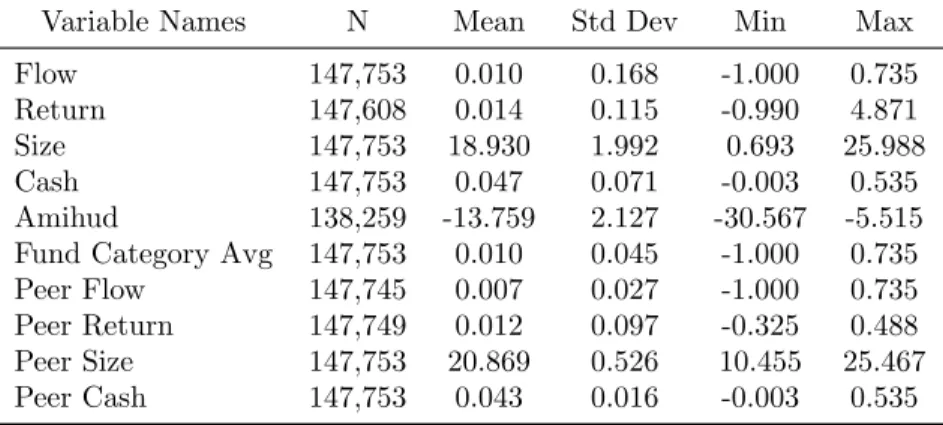
Summary statistics of these measures as well as peer measures are available in Table 1.
8
3.2. Portfolio Similarity Measure – The Network
My data represents a set of portfolio managers with detailed holdings data through time,
but for simplicity, I drop thetindex for this exposition and compute these measures for eacht.
I construct the similarity between two portfolios,sij as the dot product between the security
weight vectors of each portfolio manager i and j, divided by the product of the Euclidean
norm of each vector.9 Specifically,
sij =
si·sj
|si| |sj|
(1)
where for each manager i, the Euclidean norm is defined across M securities as
|si|=
v u u t
M
X
m=1
s2im (2)
Deriving this same measure in matrix form, let H be the holdings matrix, with portfolio
managers as each column, and each row consisting of the weight between 0 and 1 each manager
places on that security. My portfolio similarity measure is then
S = H
TH
|H| · |H| (3)
in which each sij already defined above is an element of symmetric similarity matrix S. The
norm of the matrixH is a Euclidean column norm, such that for each columnj, the norm of
Hj is defined as
|Hj|=
v u u t
M
X
m=1
h2jm (4)
Figure 1 plots percentiles of the distribution of this portfolio distance measure through time.
9
To construct Peer Flow for each manager i, I compute a weight vector which is each
similarity measuresij divided by the sum over all similarities, setting self-similaritysii to 0. I
then computePeer Flow as the dot product of the weight vector and the corresponding vector
of fund flows for each manager. Formally, peer weights are computed as
P eerW eightij =
sij
P
k
sik
, k6=i (5)
and Peer Flow is thus
P eerF lowi =
X
k
P eerW eightikF lowk (6)
For example, consider a portfolio manager with three neighbors at distances of 0.1, 0.2, and
0.1, such that the weights are.25,.50, and .25, respectively. If those neighbor’s flows (divided
by total net assets) are 0.01, 0.05, and 0.10, respectively, then Peer Flow is (.25∗.01) + (.5∗
.05) + (.25∗.10) = 0.0525.
In matrix form, if W is a row-stochastic transformation ofS, such that each row sums to
1, thenP eerF low =W ·F low in which bothPeerFlow and Flow areN×1 vectors andW is
anN×N matrix at timet. Note that I also compute other peer variables such as peer return,
peer size (total net assets), and peer cash (divided by total net assets) in the same way.10
3.3. Network Structure as Instrument
Since cross-sectional fund flows and returns of each portfolio manager at time t are
en-dogenous, I employ an instrument to identify influence rather than just correlation.11
With-out instrumentation, a correlation between two portfolio manager’s fund flows is not sufficient
evidence of one’s influence on the other.
Following Bramoull´e, Djebbari, and Fortin (2009), I employ a network-structure based
instrument to address this endogeneity based on “intransitive triads” which are often present
10This notion of portfolio distance is intuitively and mathematically similar to that of social distance as in
Conley and Topa (2002).
11Since the diagonal of weighting matrixW is set to zero,F lowiis never on both sides of the same
in a network. An intransitive triad is present if A connects to B and B to C, but A is not
connected to C. Thus, A can instrument for B’s influence on C since any influence A has on
C must be through the common relationship with B. In network terminology, A and C are
Two-Step neighbors, so my instrument isTwoStepPeerFlow.
For instance, a U.S. technology fund may be connected to a mid-cap fund through common
mid-cap technology holdings, and that mid-cap fund may also be connected to a Latin
Amer-ican fund through mid-cap Latin AmerAmer-ican holdings. Thus, the flows of the Latin AmerAmer-ican
fund can instrument for the mid-cap fund’s influence on the U.S. technology fund since they
are only connected through their common mid-cap neighbor.
However, not all two-step neighbors form intransitive triads. Additionally, while two
port-folio managers may not be directly connected, they both maintain some set relationship to
market-wide movements. Two-step neighbors can only serve as an instrument if they satisfy
the exclusion restriction – that the instrument is only correlated with the dependent variable
through the endogenous regressor. To address these concerns, Bramoull´e, Djebbari, and Fortin
(2009) specify a rank test which establishes that the instruments are not collinear with the
endogenous variable. To further test the validity of my instruments, I compute various tests
of weak instruments as well as Hansen’s J test of overidentification in all specifications. All
re-ported GMM specifications have results consistent with strong instruments and no correlation
of instruments with the second stage residual, thereby indicating a valid specification.
Mathematically, two-step neighbors are computed as B =S2, which is matrix
multiplica-tion (as opposed to element-by-element) where the diagonal of S has already been set to 0 to
avoid duplicating one-step and two-step neighbors.12 In summation notation, the equivalent
product is
bij = N
X
q=1
siqsqj, q 6=i, j (7)
with the diagonal of B also set to zero such that a manager cannot be his own two-step
12A nonzero diagonal indicates a ‘self-loop.’ So, ifS has a nonzero diagonal, a ‘two-step’ neighbor could be
neighbor.13 If Wf is the row-stochastic, N ×N, two-step weighting matrix derived from B,
thenT woStepP eerF low=fW ·F low or as a summation
e wji =
bji
P
k
bjk
(8)
T woStepP eerF lowj =
X
k
e
wjkF lowk (9)
To ensure overidentification, I include not justT woStepP eerF low but also
T woStepP eerF low2 as excluded instruments, which is standard in an IV specification.
To test my first hypothesis, I instrument for peer fund flows as described above, but place
portfolio returns as my dependent variable. Specifically, I estimate:
P eerF lowit =T woStepP eerF lowit+T woStepP eerF low2it (10)
Retit =P eerF low\ it+F lowt−p+Rett−p
+Sizeit+Cashit+Amihudit+P eerSizeit
+P eerCashit+CategoryAvgF lowjt+M arketReturnt
(11)
with the primary explanatory variable beingM arketReturnin a CAPM style framework.14 If
P eerF lowis a positive predictor of portfolio returns, then it seems highly likely that commonly
held assets are the channel of influence.
Next, to test my second hypothesis that capital flows are contagious, I incorporate my
network measure in addition to common predictor variables in a specification with fund flows
as the dependent variable. Coval and Stafford (2007) employ both lagged flows and lagged
returns as predictors, and Sirri and Tufano (1998) show that fund category averages and fund
size (measured as log of total net assets) are important determinants of flows given investors’
non-zero search costs. Since temporary asset price movements may be stronger for illiquid
13
The diagonal ofBmust now be set to 0 because for every one-step neighbor, a manager is his own two-step neighbor. For instance,iconnects toj, but thenjalso connects back toi, such that for every connection like thisiis his own two-step neighbor.
14
securities, I include a portfolio-wideAmihud measure which is simply the weighted average of
the Amihud liquidity measure computed for each individual equity holding (Amihud (2002)).15
Since fund size is an important predictor of flows, I also include PeerSize as a control
variable. This control is important in a network specification because if flows primarily go
to larger funds (Sirri and Tufano (1998)), then funds who are both large and connected may
simply experience correlated flows without any mutual influence.
A portfolio manager’s cash holdings provide a vital cushion against unexpected
redemp-tions, and as such they likely influence the prediction of inflows and outflows. Most studies
exclude cash holdings because the data is unavailable, not because cash holdings are
unimpor-tant. Because I do have this data, I include it for both the manager and connected neightbors
(PeerCash), since a manager connected to cash-poor neighbors may be more susceptible to
flow contagion.
In sum, I estimate the following set of equations in a GMM specification:
P eerF lowit =T woStepP eerF lowit+T woStepP eerF low2it (12)
F lowit =P eerF low\ it+F lowt−p+Rett−p
+Sizeit+Cashit+Amihudit+P eerSizeit
+P eerCashit+CategoryAvgF lowjt
(13)
in which F undi ∈ Categoryj, 4 time lags are included (p = 4) and P eerF low\ it is the fitted
values from equations (12).16
15I also computed a full portfolio Amihud measure including cash and non-equity, non-cash holdings at the
minimum and maximum Amihud measure, respectively, with similar results. Computed portfolio spreads and average daily volumes also gave similar results, available on request
16
Note that the exact specification of equation (12) includes all control variables in equation (13). To use strict GMM terminology,PeerFlow is the endogenous regressor, T woStepP eerF low andT woStepP eerF low2
3.4. Identification and Estimation of a Network Influence Process
In addition to the more standard identification problems already addressed, there are some
unique identification problems associated with network inference, which I now address following
the typology in Manski (1993). According to Manski (1993), identifying the endogenous social
influence process I have just described requires controlling for two other potential confounding
effects: “correlated effects” and “contextual effects.”17
“Correlated effects” simultaneously affect both connected managers due to common,
time-invariate characteristics. Correlated effects can be conceived as a cointegration relationship
where a relatively fixed relation among two neighbors induces a proportional response to
exogenous events. For example, two mutual funds, one half the size of the other, may find that
on average the smaller fund receives half the capital flows of the large one. Since there may
be a similar relationship due to cash holdings, I includePeerSize and PeerCash to control for
these potentially common fund characteristics which may drive correlated flows.
I control for Manski’s “contextual” effects by including CategoryAvgFlows, which
repre-sents the average flow for the Morningstar category to which each open ended fund belongs.
Contextual effects can be conceived as a network version of industry effects, in which
market-wide trends affect all members of the group equally, but may change across time. For instance,
a sector rotation strategy which suggests buying utilities and health care stocks in a declining
market represents a wider shift in investor behavior, operating above the level of individual
portfolio managers.
A further identification problem may arise due to network density, as noted by Kelejian,
Prucha, and Yuzefovich (2006). If I have a very dense or “complete” network such that everyone
is equally connected, each network member would have exactly the samePeerFlow measure.
For example, assume that each portfolio manager is connected to each other manager with a
weight of exactly 1. This would make PeerFlow equal to the average market-wide flow since
the weight on each flow variable would be N1 for every manager and therefore no longer display
17Bramoull´e, Djebbari, and Fortin (2009) also note that these controls are a necessary prerequisite for their
cross-sectional variation. Given that my weighted density is less than 5%, this is unlikely to
be a problem. As a further robustness check, I have run my results thresholding my network
at the 80th percentile, thus obtaining an unweighted density of 10% with no material change
in results.18
Finally, I estimate this set of equations by Generalized Method of Moments, whereas most
specifications of this type in the spatial econometrics literature estimate this model via
Max-imum Likelihood. Conley (1999) notes that ML specifications in which spatial dependence is
measured with error are misspecified. While this is unlikely to be a problem with geographical
measures of distance typical of the spatial econometrics literature, my measure of distance in
security space may be much less precise. Fortunately, Kelejian and Prucha (2002) show that
with panel data, such as I have here, both OLS and GMM estimators are consistent, and thus
represents the appropriate estimation approach. Elhorst (2010) includes a short discussion on
ML vs IV/GMM estimators, noting that while the use of IV/GMM is promising, it is still new
to the spatial econometrics literature and needs further research.
4. Results
The baseline fund flow specification is from Sirri and Tufano (1998) and Coval and Stafford
(2007). They regress fund flow on lagged flows, lagged returns, fund size, and fund category
average flows at timet, with fund flow defined as dollar flows normalized by total net assets,
the same normalization I apply throughout. When I run this specification in a pooled OLS
and Fama-MacBeth framework, I get results qualitatively similar to Coval and Stafford (2007)
and others who have investigated this relationship such as Lou (2010) and Ferreira, Keswani,
Miguel, and Ramos (2011). However, I find it necessary to include both time and firm fixed
effects and further cluster my standard errors in both time and portfolio manager dimensions.
When I run both the Breusch-Pagan test and an F test on RSS of regressions with and
without time and firm fixed effects, I find that it is necessary to include some type of fixed or
18
Weighted density is the sum of all network connections in the network divided by the sum of all possible network connections set to 1, N2. Unweighted density is the same, but sets any weighted network link to 1
random effects. A Hausman test verifies that fixed effects are necessary over random effects
(Kennedy (2008)). Clustering standard errors in both time and manager dimensions produces
large changes in standard errors indicating that this is a necessary step (Petersen (2009)).
I maintain this specification design throughout. Results from these tests as well as a table
comparing the varying differences in specification are available upon request.19 Including time
fixed effects also controls for market wide events affecting all funds, and fund fixed effects
control for fund or fund manager time-invariant attributes.
4.1. Regression Results
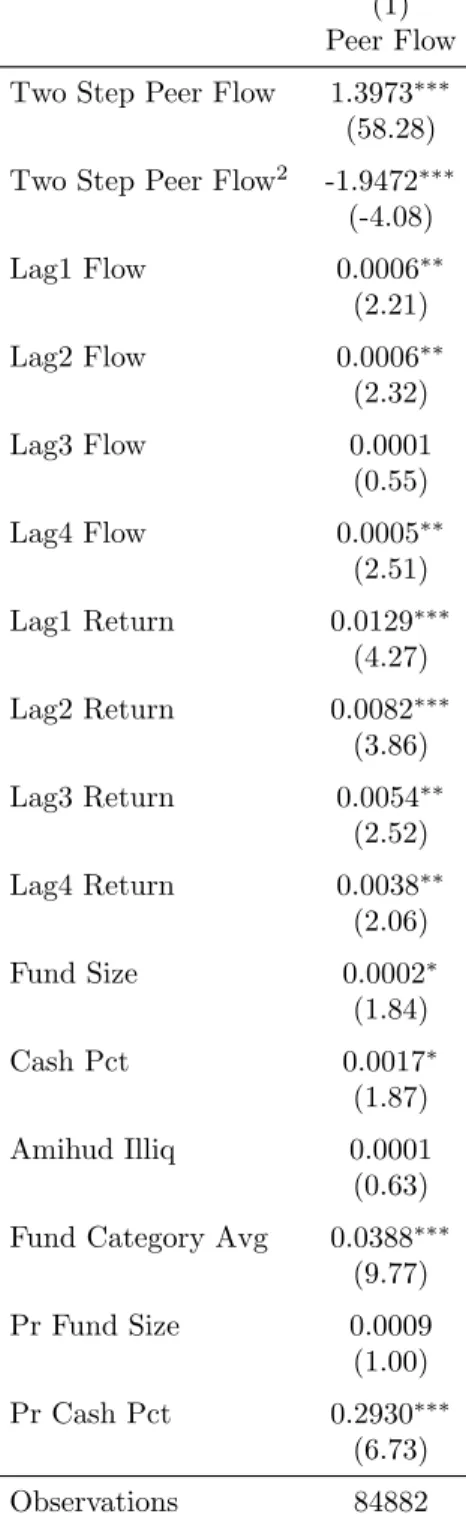
Our econometrics established, I turn to Table 2 which contains the results from the first
stage of the instrumental variables regression. The R2 of the Peer Flow regression is 0.83,
indicating the excellent fit necessary in a first stage regression.
Next, I begin by regressingReturnon my networked and instrumentedP eerF lowvariable
as evidence that portfolio overlaps are driving a contagion effect, rather than a correlated flow
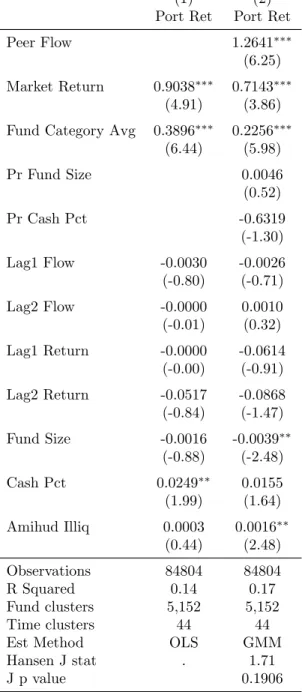
process. As shown in Table 3, there is a positive and significant coefficient onPeerFlow which
simultaneously increases the R2 from 0.14 to 0.17 and reduces the magnitude of both Market
Returnfrom 0.90 to 0.71 andCategory Avg Flowfrom 0.39 to 0.23, with all changes statistically
significant. That the fund flows from neighboring portfolio managers positively predict returns
is solid evidence that portfolio interconnections are the channel for this influence.
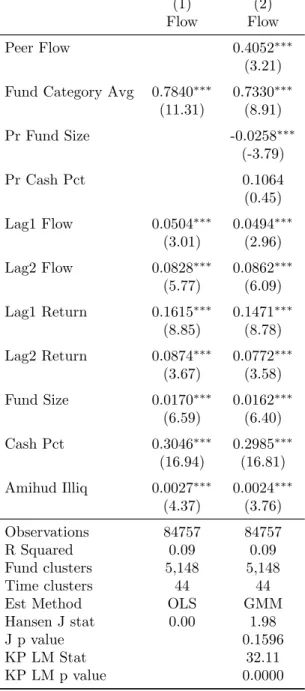
My main specification is in Table 4. Here,F lowis the dependent variable withP eerF low
as independent variable alongside other control variables. Again,P eerF lowenters in positively
and significantly with slight decreases in other predictor variables, indicating a flow contagion
process. However, sinceF lowenters into the specification both as dependent and independent
variable, I must transform the equation similar to an autoregression specification to fully
interpret this coefficient.
19
4.2. Network Coefficient Interpretation
To interpret the coefficient on Model 2 in Table 4, I begin by rewriting my specification in
Equation 13 in matrix form, without the instrumentation:20
Ft=ρsWtFt+ρtFt−1+Xtβ+ (14)
in which Ft is theN×1 vector of fund flows at timet. Wtis a row-stochastic transformation
ofN×N portfolio similarity matrixSat timet, such thatP eerF lowt=Wt·Ft. Xtrepresents
all other control and explanatory variables for simplicity.
Next, I group together all terms involving Ft, also setting Ft = Ft−1 to incorporate a
steady-state process.21 Since flows are not persistent, this is a trivial simplification. The
result is
((1−ρt)IN −ρsWt)Ft=Xtβ+ (15)
Ft=X1tβ˜1+X2tβ˜2+. . .+XP tβ˜P + (16)
for each p= 1. . . P explanatory variables. Each actual estimated coefficient is
˜
βp,N×N = ((1−ρt)IN−ρsWt)−1βp (17)
which is an N ×N matrix. Without my network specification, the comparable coefficient
would be the scalar coefficient estimate times anN ×N identity matrix.
In equation 17, βReturn is the sum of the return coefficients from Model 2 in Table 4 since
in steady-state,t=t−p∀p. Since P eerCash=W ·Cash,βCash is the sum of the coefficient
onCash times the identity matrix plus the coefficient onPeerCash timesW. Mathematically,
20
For this analysis, I simply use the endogenous PeerFlow rather than the predicted value from the first stage regression, which simplifies the exposition and likely is a good approximation since the R2 of the first
stage regression is 0.83. However, I still use the coefficient estimates from the instrumented specification.
21Note that in my specification, I have 4 Flow lags, soFt=Ft
if βC is the regression coefficient on Cash and βP C is the regression coefficient on PeerCash,
then the overall effect of cash, βCash is
βCash=βC ·I+βP C·W (18)
βCategoryAvgF low is simply the corresponding estimated coefficient from Model 2 in Table 4.
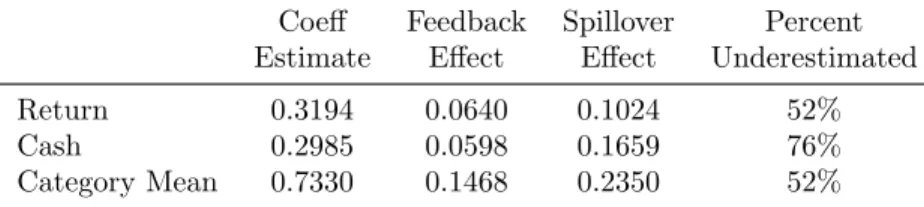
To interpret this network coefficient, I divide it into feedback effects, represented by the
diagonal, and spillover effects which reside on the off-diagonal. The results for important
explanatory variables are in Table 5. The first column is the scalar coefficient estimate, β,
without the network transformation. Next are the incremental feedback effects, computed as
the average of the diagonal less the scalar coefficient. Finally, spillover effects are computed
as the average of all off-diagonal entries in the network coefficient.
Table 5 shows how my network specification accounts for feedback and spillover effects,
increasing estimate by up to 76%. Specifically, returns and category average flows show effects
that are 52% greater than non-networked effects, and networked cash holdings effects are 76%
greater.
To illustrate spillover, I simulate a shock to approximately 40% of the fund managers in
the sample and measure the impact to the other 60%, which is assumed to be zero in a
non-networked specification. I shock Cash by one standard deviation, simulating an unexpected
redemption, and I shockReturns by one standard deviation, simulating an unexpected market
movement.22 The results are illustrated in Figure 2 and Figure 3. Note that these spillover
effects are as large as 0.01, which is the mean value of flow and approximately 10% of the
standard deviation, available in Table 1.
To more fully identify capital flow contagion as a unique phenomena, I perform several
ro-bustness checks. I re-run my main specification removing all sector funds from the dataset, and
22Since managers are connected by assets, for this to be an isolated shock, it could be to non-equity holdings
find the result strengthened – the coefficient is larger and estimated with more precision.23,24
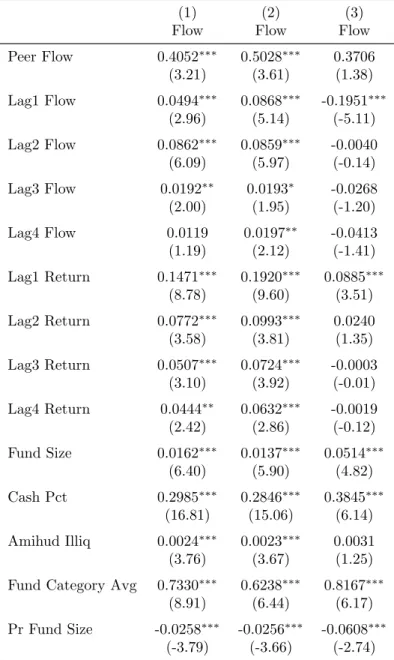
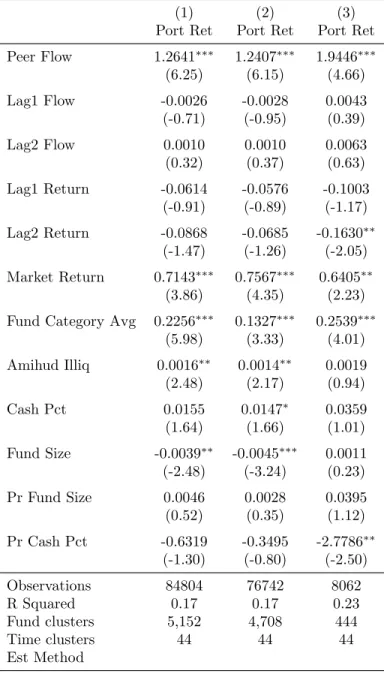
Results with and without sector funds are presented in Tables 6 and 7. In Table 6, the
contagion process in Model 2 without sector funds is almost 25% greater than the baseline
including them (0.50 compared to 0.41) whereas sector funds alone show no significance. Fund
Category Avg is also smaller without sector funds, at 0.62 vs 0.73 in the baseline result. Among
sector funds only, this same control is 0.82, indicating that Fund Category Avg is a primary
driver of sector fund flows. In Table 7, there is very little difference between the models with
and without sector funds, displayed in Models 1 and 2. Fund Category Avg drops from 0.23 to
0.13, indicating that whileP eerF lowand Fund Category Avgoverlap somewhat among sector
funds, they are much less related in the broader sample.
Since financial crises induce correlations across disparate asset groups, it is possible that my
result is simply arising from the recent financial crisis. Accrodingly, I re-run my specification
omitting the financial crisis, stopping my analysis in the second quarter of 2007 and 2008,
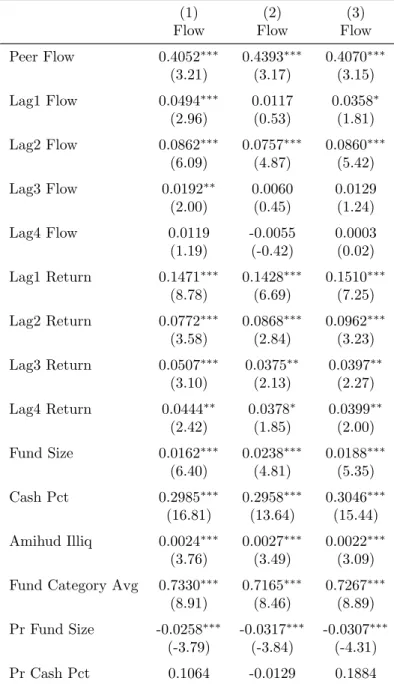
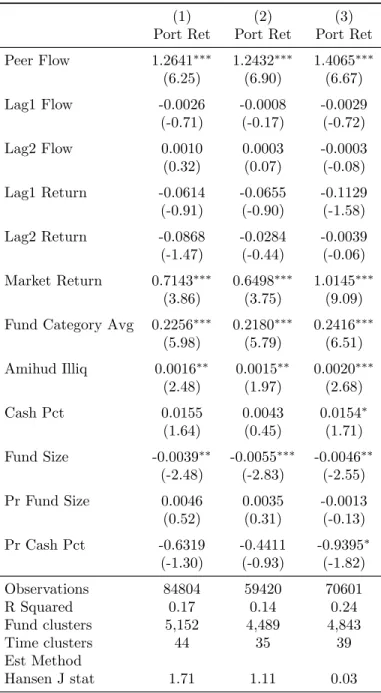
respectively, with results presented in Tables 8 and 9. Interestingly, the flow contagion effect
is stronger when omitting the financial crisis. This can be seen in Model 2 of Table 8, in which
the P eerF low coefficient rises moderately (though without statistical significance) from 0.41
to 0.44. Table 9 presents the results for returns, again showing no marked difference.
5. Crowded Trades and Network Persistence
Having provided evidence that portfolio interconnections may induce capital flow contagion,
I proceed to investigate the nature of these connections. If these portfolio connections are
relatively persistent, then this static set of connections may be more easily identified from
public holdings disclosures by both market participants and regulators alike. On the other
hand more transient portfolio interconnections may make capital flow contagion effects much
23
Sector funds are those labeled Technology, Utilities, Financials, etc. corresponding to equities held in a specific industry.
24Note that this is a simple division of my sample which only considers the portfolio managers who are
harder to detect ex ante.
Between the two, transient or hard-to-observe portfolio interconnections pose the greater
risk to portfolio managers and regulators alike since a hidden contagion process is more likely
to generate unexpected negative shocks. These transient portfolio interconnections may arise
due to so-called “crowded trades”, which occur when portfolio managers take concentrated or
overweighed positions in a small set of stocks.25 Due to lags in mandatory disclosures, crowded
trades may not be detectable to market participants until many months after the trades are
established. Thus, with no knowledge of network connections, negative flow shocks across
portfolio connections will be unanticipated and likely produce greater negative consequences
than shocks which are at least partially anticipated.
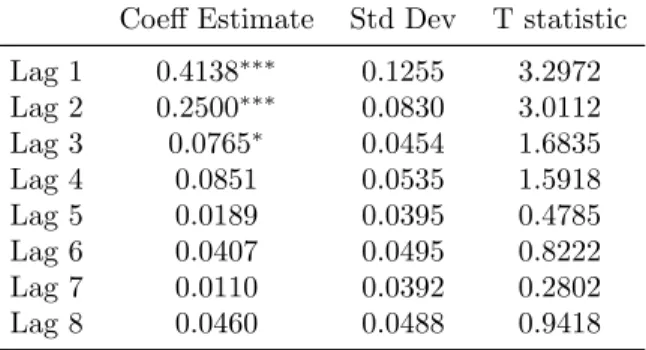
Table 10 presents the results of an autoregression on my network measure, similar to the
main specification in Anton and Polk (2010). This specification takes the N ×N network of
relationships between all of the portfolio managers at time tand puts them in aN×1 vector
as the dependent variable. Then the same network of relationships at t−1, t−2, enter as
independent variables, vectorized. I then run this regression for each time t and summarize
the coefficients across time in a Fama-MacBeth framework.
The marginal effects of the lags diminish to be statistically insignificant after 3 lags, but
still show some autoregressive properties. The network distance correlation lagged one quarter
is 0.41, which indicates some short-term persistence. To estimate the correlation two quarters
previous, I compute 0.412+ 0.25 = 0.42, showing that the persistence extends to the previous
six months. But the correlation between the network distance measure and that 3 quarters past
is 0.413+ 0.252+ 0.765 = 0.21, a significant drop off, and then one year past is 0.414+ 0.253+
0.082+ 0.0 = 0.05 if I treat the insignificant 4th lag as 0, or 0.13 if I retain it. After two years,
retaining the first four coefficients, the correlation is 0.418+ 0.257+ 0.086 + 0.085 = 0.0009,
which is very close to 0.26 Since portfolio objectives likely persist greater than two years,
25
Crowded trades are also related to the herding literature. Sias (2004) summarizes the broad classifications motivating herding. Rationally, managers herd on correlated private information (Froot, Scharfstein, and Stein (1992)). Other explanations include reputation-based herding (Scharfstein and Stein (1990)), and fads (Barberis and Shleifer (2003)).
26
this suggests that there is some transience to my measure of interconnectedness and thus that
crowded trades or herding among institutional managers plays a role in capital flow contagion.
Finally, to further investigate the nature of portfolio connectivity, I show that my
nor-malized dot product distance measure increases in two dimensions. First, it is increasing in
portfolio overlap, which is its primary purpose. As the percentage of portfolio overlap
in-creases, the distance between two managers in security space decreases (they are more similar
in security space). But, perhaps less intuitively, my portfolio distance measure is also
in-creasing in the concentration of those holdings. This is illustrated in Figure 4. Holding total
portfolio overlap constant, a single concentrated position gives twice as much similarity as two
overlapping holdings of equal proportion. This property of my portfolio distance measure
indi-cates that concentrated positions give rise to more interconnectedness. Accordingly, crowding
or overweighting in a specific set of securities may induce more connectedness among those
managers than they may realize.
6. Conclusion
In the wake of the recent financial crisis, the interconnection of market participants has
become an important new area of research. Employing a novel, network-based specification,
I show that interconnected intermediaries exhibit contagious capital flows, exposing them
to feedback effects and spillover effects which result in estimates 50-75% greater than
non-networked coefficients. To incorporate these network connections simultaneously, I
contem-poraneously estimate the influence of each portfolio manager’s capital flows on each other
manager by exploiting the network structure as an instrument.
I also have shown some evidence that that these contagious flows are the result of crowded
trades – short-term, popular market positions – since portfolio connection exhibits only a
small amount of short-term persistence. Furthermore, I have illustrated how distances between
portfolios in security space emphasize concentrated positions, such that active managers
over-weighting portions of their portfolio may unintentionally increase their dependence on similar
While my analysis focuses on the equity holdings of open ended funds, it also has
implica-tions for collateralized financing. Financial intermediaries who rely on collateralized
(whole-sale) financing to fund their investments are growing in market share (Adrian and Shin (2010)).
It may be that my results imply a broader “collateral contagion” effect which could have played
a role in recent runs on repo financing (Gorton and Metrick (2011)). Since even interbank
lending is becoming more collateralized, Allen and Gale (2000)’s canonical model of interbank
financial contagion may be further amplified by connected collateral.27
This work also provides motivation for the collection of more detailed holdings data from
market participants, since the results described herein can be characterized as a negative
network externality which may merit government regulation. Indeed, Brunnermeier, Hansen,
Kashyap, Krishnamurthy, and Lo (2011) recently responded to an AEA/NSF call for proposals
on “grand challenge questions” for research in the next ten years by advocating the collection
of additional data and developing network models in the pursuit of quantifying systemic
finan-cial risk. While immediate public disclosure may have unintended predatory trading effects
(Brunnermeier and Pedersen (2005)), confidential disclosure to regulatory bodies and/or
de-layed public disclosure are likely to be beneficial and could be the purview of the newly formed
Office of Financial Research established by the Dodd-Frank Act.
While network methods are becoming more popular in corporate finance (e.g., Hochberg,
Ljungqvist, and Lu (2007); Cohen, Frazzini, and Malloy (2008); Ahern and Harford (2010)) and
market microstructure (Cohen-Cole, Kirilenko, and Patacchini (2010)), little has been done
applying network methods to equity markets. My network approach allows a steady-state
analysis of this peer influence process in the cross-section, bringing structure to cross-sectional
analysis previously only available in the time series. While I have applied it to portfolio
interconnections, it may also have broad applicability to other areas such as interbank lending
(e.g. Cohen-Cole, Patacchini, and Zenou (2011)) or stock market volatility (Greenwood and
Thesmar (2011)). And in a time when bailouts are motivated not because of too-big-to-fail,
27
but because of too-interconnected-to-fail, understanding and quantifying the interconnections
Table 1: Fund Summary Statistics
Summary statistics for fund data as used in regression specifications. Flow is dollar flows divided by total net assets and Cash is cash holdings divided by total net assets. Size is log of total net assets. Amihud is a portfolio weighted measure of the Amihud values of equity holdings, logged. Fund Category Average is the average Flow across Morningstar categories. Peer variables are weighted by network connections. Data is quarterly from 1995 to 2009.
Variable Names N Mean Std Dev Min Max
Table 2: First Stage GMM Regression
First stage regressions with endogenous regressors as dependent variables. Peer Flow is the weighted average of peer connected flow, and Two Step Peer Flow is the same of their neighbor’s neighbors, used as instruments. Flow is dollar flows divided by total net assets and Cash is cash holdings divided by total net assets. Size is log of total net assets. Amihud is a portfolio weighted measure of the Amihud values of equity holdings, logged. Fund Category Average is the average Flow across Morningstar categories. Data is quarterly from 1995 to 2009. Time and Fund Fixed Effects included. T statistics are in parentheses and significance is denoted at the 1, 5, and 10% level.
(1) Peer Flow
Two Step Peer Flow 1.3973∗∗∗ (58.28)
Two Step Peer Flow2 -1.9472∗∗∗
(-4.08)
Lag1 Flow 0.0006∗∗ (2.21)
Lag2 Flow 0.0006∗∗ (2.32)
Lag3 Flow 0.0001 (0.55)
Lag4 Flow 0.0005∗∗ (2.51)
Lag1 Return 0.0129∗∗∗ (4.27)
Lag2 Return 0.0082∗∗∗ (3.86)
Lag3 Return 0.0054∗∗ (2.52)
Lag4 Return 0.0038∗∗ (2.06)
Fund Size 0.0002∗ (1.84)
Cash Pct 0.0017∗ (1.87)
Amihud Illiq 0.0001 (0.63)
Fund Category Avg 0.0388∗∗∗ (9.77)
Pr Fund Size 0.0009 (1.00)
Pr Cash Pct 0.2930∗∗∗
(6.73)
Observations 84882
(1) Peer Flow
Table 3: Effect of Peer Flows on Portfolio Returns
Portfolio return is the dependent variable, provided by Morningstar. Data is quarterly from 1998 to 2009, each panel variable is any open ended fund holding a nonzero equity position. Network relation is the normalized dot product, and peer effects are the weighted average of peer characteristics. Flow is the fund flow divided by total net assets. Fund size is the log of total net assets. Cash Pct is cash holdings divided by total net assets. Amihud is the portfolio weighted sum of equity holdings’ Amihud measures computed over the previous quarter. Market return is CRSP value weighted market return, and Category Avg Flow is the average of all reported fund flows by Morningstar category. Flow and return lags 3 and 4 included but not shown. Time and Fund Fixed Effects included. Hansen J stat is a test of overidentification for which the null hypothesis is that instruments are uncorrelated with stage 2 regression, KP LM stat tests the null of weak instruments. T statistics are in parentheses and significance is denoted at the 1, 5, and 10% level.
(1) (2) Port Ret Port Ret
Peer Flow 1.2641∗∗∗ (6.25)
Market Return 0.9038∗∗∗ 0.7143∗∗∗ (4.91) (3.86)
Fund Category Avg 0.3896∗∗∗ 0.2256∗∗∗ (6.44) (5.98)
Pr Fund Size 0.0046 (0.52)
Pr Cash Pct -0.6319 (-1.30)
Lag1 Flow -0.0030 -0.0026 (-0.80) (-0.71)
Lag2 Flow -0.0000 0.0010 (-0.01) (0.32)
Lag1 Return -0.0000 -0.0614 (-0.00) (-0.91)
Lag2 Return -0.0517 -0.0868 (-0.84) (-1.47)
Fund Size -0.0016 -0.0039∗∗ (-0.88) (-2.48)
Cash Pct 0.0249∗∗ 0.0155 (1.99) (1.64)
Amihud Illiq 0.0003 0.0016∗∗ (0.44) (2.48)
Observations 84804 84804 R Squared 0.14 0.17 Fund clusters 5,152 5,152 Time clusters 44 44 Est Method OLS GMM Hansen J stat . 1.71 J p value 0.1906
(1) (2) Port Ret Port Ret
Table 4: Effect of Peer Flow on Fund Flows
Flow ratio is the dependent variable and is the fund flow divided by total net assets. Data is quarterly from 1998 to 2009, each panel variable is any open ended fund holding a nonzero equity position. Network relation is the normalized dot product, and peer effects are the weighted average of peer characteristics. Fund size is the log of total net assets. Cash Pct is cash holdings divided by total net assets. Amihud is the portfolio weighted sum of equity holdings’ Amihud measures computed over the previous quarter. Category Avg Flow is the average of all reported fund flows by Morningstar category. Flow and return lags 3 and 4 included but not shown. Time and Fund Fixed Effects included. Hansen J stat is a test of overidentification for which the null hypothesis is that instruments are uncorrelated with stage 2 regression, KP LM stat tests the null of weak instruments. T statistics are in parentheses and significance is denoted at the 1, 5, and 10% level.
(1) (2) Flow Flow
Peer Flow 0.4052∗∗∗ (3.21)
Fund Category Avg 0.7840∗∗∗ 0.7330∗∗∗ (11.31) (8.91)
Pr Fund Size -0.0258∗∗∗ (-3.79)
Pr Cash Pct 0.1064 (0.45)
Lag1 Flow 0.0504∗∗∗ 0.0494∗∗∗ (3.01) (2.96)
Lag2 Flow 0.0828∗∗∗ 0.0862∗∗∗ (5.77) (6.09)
Lag1 Return 0.1615∗∗∗ 0.1471∗∗∗ (8.85) (8.78)
Lag2 Return 0.0874∗∗∗ 0.0772∗∗∗ (3.67) (3.58)
Fund Size 0.0170∗∗∗ 0.0162∗∗∗ (6.59) (6.40)
Cash Pct 0.3046∗∗∗ 0.2985∗∗∗ (16.94) (16.81)
Amihud Illiq 0.0027∗∗∗ 0.0024∗∗∗ (4.37) (3.76)
Table 5: Contagion Effect of Peer Flows on Fund Flows - Long Run Steady State
Contagion effect based on Model 2 in Table 4, assuming long run and cross-sectional equilibrium (through time and across funds). Coeff Estimate is non-networked estimate, Feedback Effect includes the incremental average spillover effects which circulate back to the same fund, Spillover effect is the average off-diagonal effects among portfolio managers. Data is quarterly from 1998 to 2009, each panel variable is any open ended fund holding a nonzero equity position. Network relation is the normalized dot product. Category Avg Flow is the average of all reported fund flows by Morningstar category.
Coeff Feedback Spillover Percent Estimate Effect Effect Underestimated
Table 6: Results removing sector funds – fund flows
Fund flow divided by total net assets is the dependent variable, provided by Morningstar. Model 1 is the baseline, taken from Model 2 of Table 4. Model 2 is the same, but with sector funds omitted from the analysis. Model 3 includes only sector funds. Sector funds are mutual funds with an industry-specific category, such as Technology or Health Care. Data is quarterly from 1998 to 2009, each panel variable is any open ended fund holding a nonzero equity position. Network relation is the normalized dot product, and peer effects are the weighted average of peer characteristics. Fund size is the log of total net assets. Cash Pct is cash holdings divided by total net assets. Amihud is the portfolio weighted sum of equity holdings’ Amihud measures computed over the previous quarter. Market return is CRSP value weighted market return, and Category Avg Flow is the average of all reported fund flows by Morningstar category. Time and Fund Fixed Effects included. Hansen J stat is a test of overidentification for which the null hypothesis is that instruments are uncorrelated with stage 2 regression, KP LM stat tests the null of weak instruments. T statistics are in parentheses and significance is denoted at the 1, 5, and 10% level.
(1) (2) (3) Flow Flow Flow
Peer Flow 0.4052∗∗∗ 0.5028∗∗∗ 0.3706 (3.21) (3.61) (1.38)
Lag1 Flow 0.0494∗∗∗ 0.0868∗∗∗ -0.1951∗∗∗
(2.96) (5.14) (-5.11)
Lag2 Flow 0.0862∗∗∗ 0.0859∗∗∗ -0.0040
(6.09) (5.97) (-0.14)
Lag3 Flow 0.0192∗∗ 0.0193∗ -0.0268 (2.00) (1.95) (-1.20)
Lag4 Flow 0.0119 0.0197∗∗ -0.0413 (1.19) (2.12) (-1.41)
Lag1 Return 0.1471∗∗∗ 0.1920∗∗∗ 0.0885∗∗∗ (8.78) (9.60) (3.51)
Lag2 Return 0.0772∗∗∗ 0.0993∗∗∗ 0.0240 (3.58) (3.81) (1.35)
Lag3 Return 0.0507∗∗∗ 0.0724∗∗∗ -0.0003 (3.10) (3.92) (-0.01)
Lag4 Return 0.0444∗∗ 0.0632∗∗∗ -0.0019 (2.42) (2.86) (-0.12)
Fund Size 0.0162∗∗∗ 0.0137∗∗∗ 0.0514∗∗∗ (6.40) (5.90) (4.82)
Cash Pct 0.2985∗∗∗ 0.2846∗∗∗ 0.3845∗∗∗ (16.81) (15.06) (6.14)
Amihud Illiq 0.0024∗∗∗ 0.0023∗∗∗ 0.0031 (3.76) (3.67) (1.25)
Fund Category Avg 0.7330∗∗∗ 0.6238∗∗∗ 0.8167∗∗∗ (8.91) (6.44) (6.17)
Pr Fund Size -0.0258∗∗∗ -0.0256∗∗∗ -0.0608∗∗∗ (-3.79) (-3.66) (-2.74)
(1) (2) (3) Flow Flow Flow
Pr Cash Pct 0.1064 0.0981 -0.1813 (0.45) (0.40) (-0.38)
Observations 84757 76698 8059 R Squared 0.09 0.09 0.18 Fund clusters 5,148 4,704 444 Time clusters 44 44 44 Est Method
Table 7: Results removing sector funds – portfolio returns
Portfolio return is the dependent variable, provided by Morningstar. Model 1 is the baseline, taken from Model 2 of Table 3. Model 2 is the same, but with sector funds omitted from the analysis. Model 3 includes only sector funds. Sector funds are mutual funds with an industry-specific category, such as Technology or Health Care. Data is quarterly from 1998 to 2009, each panel variable is any open ended fund holding a nonzero equity position. Network relation is the normalized dot product, and peer effects are the weighted average of peer characteristics. Fund size is the log of total net assets. Cash Pct is cash holdings divided by total net assets. Amihud is the portfolio weighted sum of equity holdings’ Amihud measures computed over the previous quarter. Market return is CRSP value weighted market return, and Category Avg Flow is the average of all reported fund flows by Morningstar category. Time and Fund Fixed Effects included. Hansen J stat is a test of overidentification for which the null hypothesis is that instruments are uncorrelated with stage 2 regression, KP LM stat tests the null of weak instruments. T statistics are in parentheses and significance is denoted at the 1, 5, and 10% level.
(1) (2) (3) Port Ret Port Ret Port Ret
Peer Flow 1.2641∗∗∗ 1.2407∗∗∗ 1.9446∗∗∗ (6.25) (6.15) (4.66)
Lag1 Flow -0.0026 -0.0028 0.0043 (-0.71) (-0.95) (0.39)
Lag2 Flow 0.0010 0.0010 0.0063 (0.32) (0.37) (0.63)
Lag1 Return -0.0614 -0.0576 -0.1003 (-0.91) (-0.89) (-1.17)
Lag2 Return -0.0868 -0.0685 -0.1630∗∗ (-1.47) (-1.26) (-2.05)
Market Return 0.7143∗∗∗ 0.7567∗∗∗ 0.6405∗∗ (3.86) (4.35) (2.23)
Fund Category Avg 0.2256∗∗∗ 0.1327∗∗∗ 0.2539∗∗∗ (5.98) (3.33) (4.01)
Amihud Illiq 0.0016∗∗ 0.0014∗∗ 0.0019 (2.48) (2.17) (0.94)
Cash Pct 0.0155 0.0147∗ 0.0359 (1.64) (1.66) (1.01)
Fund Size -0.0039∗∗ -0.0045∗∗∗ 0.0011 (-2.48) (-3.24) (0.23)
Pr Fund Size 0.0046 0.0028 0.0395 (0.52) (0.35) (1.12)
Pr Cash Pct -0.6319 -0.3495 -2.7786∗∗ (-1.30) (-0.80) (-2.50)
Observations 84804 76742 8062 R Squared 0.17 0.17 0.23 Fund clusters 5,152 4,708 444 Time clusters 44 44 44 Est Method
(1) (2) (3) Port Ret Port Ret Port Ret
Table 8: Results removing the financial crisis – fund flows
Fund flow divided by total net assets is the dependent variable, provided by Morningstar. Model 1 is the baseline, taken from Model 2 of Table 4, ranging from 1998 to 2009. Model 2 is the same, but only including quarters from 1998 through the second quarter of 2007. Model 3 extends through the second quarter of 2008. Each panel variable is any open ended fund holding a nonzero equity position. Network relation is the normalized dot product, and peer effects are the weighted average of peer characteristics. Fund size is the log of total net assets. Cash Pct is cash holdings divided by total net assets. Amihud is the portfolio weighted sum of equity holdings’ Amihud measures computed over the previous quarter. Market return is CRSP value weighted market return, and Category Avg Flow is the average of all reported fund flows by Morningstar category. Time and Fund Fixed Effects included. Hansen J stat is a test of overidentification for which the null hypothesis is that instruments are uncorrelated with stage 2 regression, KP LM stat tests the null of weak instruments. T statistics are in parentheses and significance is denoted at the 1, 5, and 10% level.
(1) (2) (3) Flow Flow Flow
Peer Flow 0.4052∗∗∗ 0.4393∗∗∗ 0.4070∗∗∗
(3.21) (3.17) (3.15)
Lag1 Flow 0.0494∗∗∗ 0.0117 0.0358∗
(2.96) (0.53) (1.81)
Lag2 Flow 0.0862∗∗∗ 0.0757∗∗∗ 0.0860∗∗∗ (6.09) (4.87) (5.42)
Lag3 Flow 0.0192∗∗ 0.0060 0.0129 (2.00) (0.45) (1.24)
Lag4 Flow 0.0119 -0.0055 0.0003 (1.19) (-0.42) (0.02)
Lag1 Return 0.1471∗∗∗ 0.1428∗∗∗ 0.1510∗∗∗ (8.78) (6.69) (7.25)
Lag2 Return 0.0772∗∗∗ 0.0868∗∗∗ 0.0962∗∗∗ (3.58) (2.84) (3.23)
Lag3 Return 0.0507∗∗∗ 0.0375∗∗ 0.0397∗∗ (3.10) (2.13) (2.27)
Lag4 Return 0.0444∗∗ 0.0378∗ 0.0399∗∗ (2.42) (1.85) (2.00)
Fund Size 0.0162∗∗∗ 0.0238∗∗∗ 0.0188∗∗∗ (6.40) (4.81) (5.35)
Cash Pct 0.2985∗∗∗ 0.2958∗∗∗ 0.3046∗∗∗ (16.81) (13.64) (15.44)
Amihud Illiq 0.0024∗∗∗ 0.0027∗∗∗ 0.0022∗∗∗ (3.76) (3.49) (3.09)
Fund Category Avg 0.7330∗∗∗ 0.7165∗∗∗ 0.7267∗∗∗ (8.91) (8.46) (8.89)
Pr Fund Size -0.0258∗∗∗ -0.0317∗∗∗ -0.0307∗∗∗ (-3.79) (-3.84) (-4.31)
Pr Cash Pct 0.1064 -0.0129 0.1884
(1) (2) (3) Flow Flow Flow
(0.45) (-0.06) (0.77)
Observations 84757 59376 70554 R Squared 0.09 0.09 0.09 Fund clusters 5,148 4,485 4,839 Time clusters 44 35 39 Est Method
Table 9: Results removing the financial crisis – portfolio returns
Portfolio return is the dependent variable, provided by Morningstar. Model 1 is the baseline, taken from Model 2 of Table 3, ranging from 1998 to 2009. Model 2 is the same, but only including quarters from 1998 through the second quarter of 2007. Model 3 extends through the second quarter of 2008. Each panel variable is any open ended fund holding a nonzero equity position. Network relation is the normalized dot product, and peer effects are the weighted average of peer characteristics. Fund size is the log of total net assets. Cash Pct is cash holdings divided by total net assets. Amihud is the portfolio weighted sum of equity holdings’ Amihud measures computed over the previous quarter. Market return is CRSP value weighted market return, and Category Avg Flow is the average of all reported fund flows by Morningstar category. Time and Fund Fixed Effects included. Hansen J stat is a test of overidentification for which the null hypothesis is that instruments are uncorrelated with stage 2 regression, KP LM stat tests the null of weak instruments. T statistics are in parentheses and significance is denoted at the 1, 5, and 10% level.
(1) (2) (3) Port Ret Port Ret Port Ret
Peer Flow 1.2641∗∗∗ 1.2432∗∗∗ 1.4065∗∗∗
(6.25) (6.90) (6.67)
Lag1 Flow -0.0026 -0.0008 -0.0029 (-0.71) (-0.17) (-0.72)
Lag2 Flow 0.0010 0.0003 -0.0003 (0.32) (0.07) (-0.08)
Lag1 Return -0.0614 -0.0655 -0.1129 (-0.91) (-0.90) (-1.58)
Lag2 Return -0.0868 -0.0284 -0.0039 (-1.47) (-0.44) (-0.06)
Market Return 0.7143∗∗∗ 0.6498∗∗∗ 1.0145∗∗∗ (3.86) (3.75) (9.09)
Fund Category Avg 0.2256∗∗∗ 0.2180∗∗∗ 0.2416∗∗∗ (5.98) (5.79) (6.51)
Amihud Illiq 0.0016∗∗ 0.0015∗∗ 0.0020∗∗∗ (2.48) (1.97) (2.68)
Cash Pct 0.0155 0.0043 0.0154∗ (1.64) (0.45) (1.71)
Fund Size -0.0039∗∗ -0.0055∗∗∗ -0.0046∗∗ (-2.48) (-2.83) (-2.55)
Pr Fund Size 0.0046 0.0035 -0.0013 (0.52) (0.31) (-0.13)
Pr Cash Pct -0.6319 -0.4411 -0.9395∗ (-1.30) (-0.93) (-1.82)
Observations 84804 59420 70601 R Squared 0.17 0.14 0.24 Fund clusters 5,152 4,489 4,843 Time clusters 44 35 39 Est Method
Hansen J stat 1.71 1.11 0.03
(1) (2) (3) Port Ret Port Ret Port Ret
Table 10: Persistence of Network Distance Relation
Network relation is the normalized dot product, and is the dependent variable. Results shown from Fama-MacBeth regression of eight lags of network connectivity. Data is quarterly from 1998 to 2009 Significance is denoted at the 1, 5, and 10% level.
Coeff Estimate Std Dev T statistic